
In the last five years, the business world has undergone more dramatic change than in the entire previous decade. Just as companies were adapting to ongoing changes in workplace dynamics, consumer behavior and the global economy – all triggered by the COVID-19 pandemic – generative AI emerged. This sent the economy into a shock comparable to the Internet revolution of the 1990s.
Companies that once led digital transformation are now facing an unexpected reality: their hard-won advantages are disappearing as competitors use AI to match the capabilities of much larger, better-funded teams.
The playing field hasn’t just leveled. It has been completely redrawn.
Through months of market research focused on customer needs, HubSpot has discovered how growth-driving teams are responding to this new environment. They abandon linear playbooks and rely on go-to-market strategies that work ad infinitum Ribbon – a constantly adapting cycle of learning, experimenting, optimizing and scaling.
A 2025 study of 1,800 brand experts (including marketers, advertisers, content strategists, brand specialists and GTM decision makers) have identified the key tactics brands are using to move forward in the face of dramatic technological change. These insights form what HubSpot calls The loop marketing landscape.
3 insights from HubSpot’s Loop Marketing Landscape Report
1. Brands must document clear brand positioning.
This may sound pretty obvious, but it is anything but self-evident. While every marketing textbook emphasizes the importance of documenting a unique value proposition (URP), HubSpot found that only half of them do so (51%) of global marketers actually have one.
The rest 49% resulted in the following:
- 39% Say, “We have a general idea, but it’s not officially documented.”
- 8% Say, “We have several competing value propositions, depending on who you ask.”
- 3% say their brand completely lacks brand positioning (documented or undocumented).
Why it matters
If you compare the overall goal achievement (in the past year) of all respondents, 52% of marketers on teams that exceed their goals had a clearly defined and documented RRP. Only 36% of teams that have just achieved their goals (without consistently exceeding them). And easy 24% of respondents who consistently missed their goals did so.
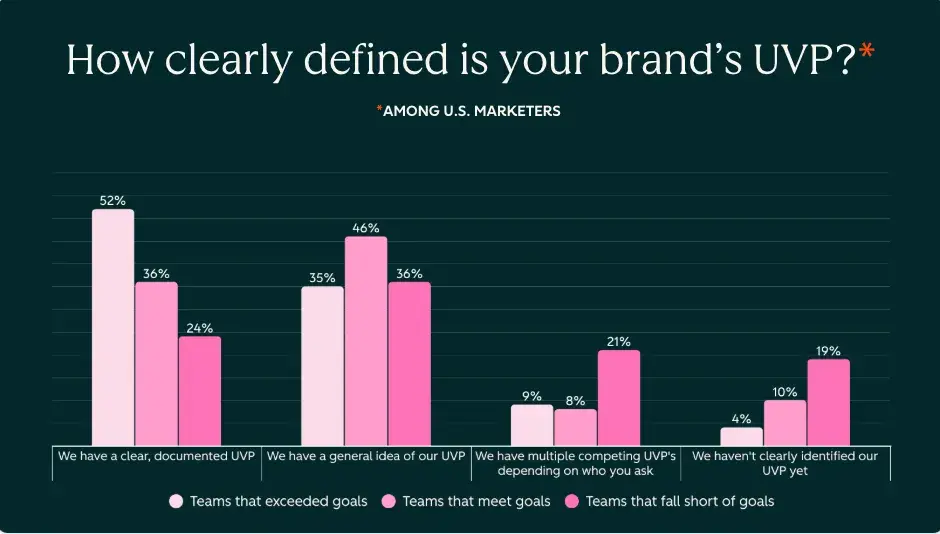
The connection is clear: If your own teams can’t articulate what makes you valuable, your customers won’t understand it either. Misalignment between marketing, sales, product and leadership can quickly lead to inconsistent messaging in the market.
How to build a brand identity that grows with you
Every brand identity should highlight the way your company offers unique solutions to the customer (and outshines the competition). Respondents with clearly documented brand positioning relied on the following best practices to develop and refine their own:
- Competitive research: If you have a limited customer base or don’t yet have access to the customer data you need, start with competitor research (e.g 25% of global marketers surveyed by HubSpot) to learn what they do and don’t want from high-performing and underperforming brands in your space.
- Customer data analysis: 48% of US respondents (and 97% of respondents outside the U.S.) use accessible customer data to create positioning statements or value propositions based on the needs and capabilities of audiences with the highest purchasing potential.
- Hard Analysis Monitoring: 31% Use web data such as social media analytics or website engagement to test, monitor and validate content that tests new messages, value propositions, brand mission statements, brand aesthetics or other parts of their brand identity.
- A/B or multivariate testing: A/B or multivariate testing allows teams to create two or more alternative brand identities for the same audience to see which one “wins.” While this depends heavily on the tools you work with, 11% from US marketers and 38% of non-US marketers still use it for refinement or validation steps.
- Regular audits and refinements: 64% of respondents whose teams consistently exceed their goals say they take the time to review and refine their brand identity at least every five years (with 34% say they do it at least every two years).
In the loop framework, brand positioning becomes the anchor that each iteration draws on.
2. Brands need to create personalized customer content.
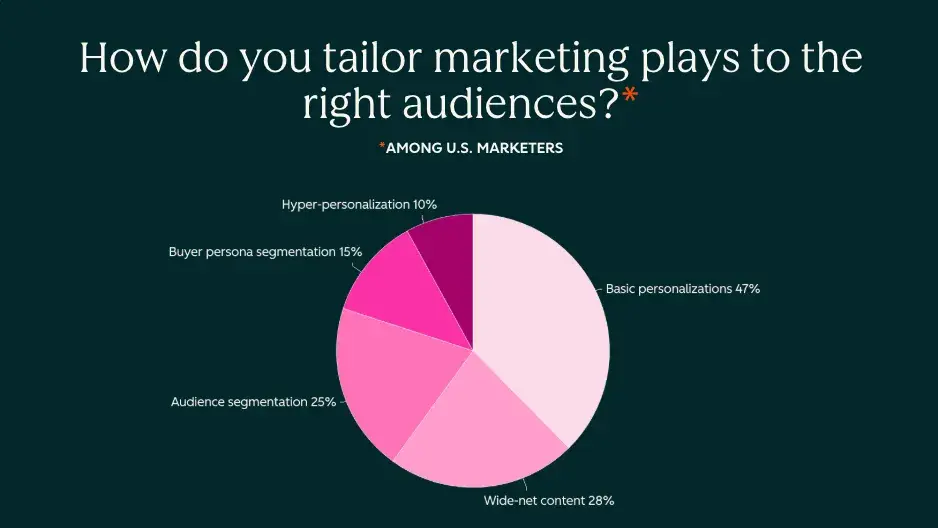
While most respondents worldwide use some form of personalization in their marketing or advertising content, 50% go no deeper than inserting a name, company or address token.
Only 25% said they segmented audiences based on easy-to-find demographics such as gender, country or industry. And only 15% segmented or personalized content tailored to the buyer personas (groups or audiences) most likely to purchase their products.
Why it matters
Let’s be honest. Contact markers are cute, but not captivating.
As marketing teams gain widespread access to generative AI, basic personalization is no longer a differentiator in the market – it’s the standard. What actually motivates customers to take action is content that directly addresses their needs, motivations and purchasing behavior.
The connection to performance is striking:
- 93% of respondents belong to teams that exceed their goals reported using some form of basic to advanced personalization techniques in their marketing, compared to 49% of respondents in teams that easily achieve their goals.
- Half of respondents in these teams that are exceeding their goals also say their brand uses at least one form of advanced personalization or segmentation.
- Further, 56% of respondents on teams that are exceeding their goals say that more than a quarter of their monthly content uses some form of personalization or segmentation 26% of respondents in teams that do not regularly exceed their goals.
This is how you get personal
You can’t create customized content without knowing it first WHO You talk to and Where they spend their time.
Of respondents with personalization tactics in motion, basic demographics (43%) and shopping habits (36%) were most valuable to them in determining:
- Who should you contact to find the best buying opportunity?
- Which channels should you target them on?
- What types of content will resonate most with them?
Once you’ve developed buyer personas for your target audiences, start identifying the channels they use and the type of affordable, personalized or segmented experiences you can offer them.
Two channels that respondents said their brands regularly use for personalized or segmented content are email (61%) and paid media such as website or social ads (47%).
In the loop model, personalization is how brands learn in real time, feed insights back into the system, and refine the next iteration of content.
3. Brands are diving into diversifying their channels.
The web landscape is constantly changing and evolving, especially with the expansion of generative AI. As new channels emerge and gain virality, other channels may begin to lose effectiveness or ROI within weeks or months.
HubSpot’s survey found the following:
- 73% of global respondents say they use three or more different marketing channels (e.g. email, ads, social, video, SEO, AEO, podcasts, influencers, etc.).
- This experiment is growing even more in the USA 56% of respondents say their brands have five marketing channels, compared to a third of global respondents.
Why it matters
It’s easy to see a channel doing well and then become complacent and think you can just rely on it forever. But that’s not how today’s world works.
In the last 12 months, for example, web brands that invested the majority of their resources in SEO experienced significant drops in ROI when Google’s AI overviews unexpectedly led to this 60% fewer search result clicks on other websites.
That’s probably one of many reasons why 48% of respondents now say their brand spends more than a fifth of its budget on channel experimentation and diversification.
Where to expand next
When looking at the data, these channel expansion opportunities stood out the most:
- 79% of respondents engage in some form of paid brand reinforcement across multiple channels (although each brand’s investment may vary).
- 74% of respondents worldwide use influencers or brand partnerships (particularly on channels their marketers are less familiar with).
- Most marketers on teams that meet or exceed their goals build or experiment with some sort of online community.
Diversification ensures that if one part of your loop stalls, the rest of your strategy stays moving.
Stay up to date
As brands adapt to a world where AI accelerates the pace of change, those companies that can continually learn, adapt and update their strategy will win.
That is the power of Loop marketing: It turns growth into a perpetual cycle rather than a one-time roadmap.
Teams that consistently exceed their goals don’t rely on static playbooks. They are:
- Bring your teams together based on clearly documented value propositions.
- Use the customer data you have available.
- This leaves important time for experiments and channel expansion.
- Using AI to optimize workplace efficiency while empowering the human-driven creativity that makes your brand identifiable and unique.
This is the next era of marketing.
To learn more about these insights and how to create a strong loop marketing playbook, Read the full report here.