
AI workflow automation tools connect applications, data and departments to execute tasks automatically – reducing manual work and improving efficiency across the organization. Unlike traditional rule-based automation, these tools use artificial intelligence to predict next steps, learn from results, and continuously optimize processes.
The change is already in full swing. Accordingly HubSpot’s State of Marketing Report 202592% of marketers say AI is already impacting their roles. Companies that adopt connected CRMs and unified AI systems see measurable gains in speed, accuracy, and customer experience.
AI workflow automation software closes gaps between marketing, sales, service and operations and scales processes without additional staff. This guide explains the key tools for each role and growth stage, evaluation criteria, and how HubSpot’s AI-powered suite works – including Marketing Hub, Distribution center, Service HubAnd Data hub – provides a unified foundation for smarter, more adaptable automation.
Table of contents
What are AI workflow automation tools and how do they work?
AI workflow automation tools automate complex business processes by using artificial intelligence to connect apps, analyze data, and perform multi-step tasks without manual intervention. Unlike traditional rule-based automation that follows static if-then logic, AI workflow automation software analyzes inputs, predicts next steps, and adjusts workflows based on performance data. For example, a traditional workflow builder might send an email when a form is submitted, while an AI workflow builder analyzes lead behavior, adjusts email timing, and triggers different sequences based on predicted interaction.
Accordingly HubSpot’s State of Marketing Report 2025This year, one in five marketers plan to use AI agents to automate end-to-end workflows – signaling a shift from manual setup to self-optimizing systems.
Pro tip: HubSpot Data Hub automates recurring data management tasks such as synchronization, deduplication and triggering cross-departmental workflows. Data Hub provides a scalable foundation for expanding automation across marketing, sales, service and operations.
Agents vs. Automated AI Workflows: What’s the Difference?
AI agents and automated workflows both streamline work, but AI agents differ from rule-based automated workflows in that they think and act autonomously. Workflows are based on predefined rules and triggers. For example, think about sending a follow-up email when a deal moves to a certain stage or forwarding a lead based on geographic location. They provide structure and consistency for repeatable processes.
AI agents, on the other hand, make decisions dynamically. Instead of following a fixed if-then path, they analyze real-time CRM data, historical patterns and context to choose the next best action without being explicitly programmed. This adaptability makes them useful for tasks where conditions change or where nuance matters.
Most organizations end up using both. Workflows handle predictable steps; Agents refine and optimize by adding additional information. For example, a workflow can assign leads to sales reps, but an agent can prioritize those leads based on engagement trends or conversion history, turning a static process into a self-improving process.
For example in Distribution centerthe AI prospecting agent breeze generates leads based on CRM signals and automatically triggers personalized outreach sequences. It builds on traditional workflows by making them smarter, faster and increasingly optimized over time.
|
Special feature |
AI agents |
Automated workflows |
|
logic |
Acts autonomously and learns from the context |
Follows predefined rules and triggers |
|
adaptability |
Adjusts actions based on results |
Runs static sequences |
|
Use case |
Personalized recommendations, decision making |
Recurring task automation |
|
integration |
Connects across systems and data |
Works within defined platforms |
Pro tip: AI agents improve workflows rather than replacing them. Combining both approaches provides flexibility to automate predictable processes while allowing AI to make smarter, context-driven decisions.
How to choose an AI workflow automation tool
Choosing an AI workflow automation tool requires evaluating company size, tech stack maturity, and business goals. The choice of platform depends on three main factors: the company’s growth stage, technical resources and integration requirements.
Some tools emphasize simplicity and quick setup, while others focus on deep customization, governance, and enterprise-level data control. The ideal platform integrates with existing CRM systems, supports cross-departmental data transparency, and adapts to changing organizational needs. In fact, according to Zapier, 78% of companies have difficulty integrating AI into their existing systems.
When evaluating tools, pay attention to flexibility, depth of integration, and scalability. The best tools combine performance and ease of use. Many companies start with low-code automation and then evolve to AI orchestration as their data infrastructure matures.
Evaluation criteria according to growth stage
Different growth phases require different automation options. The following criteria help balance platform capabilities with organizational maturity:
|
stage |
focus |
Evaluation criteria |
Example use case |
|
Startup |
Ease of use, affordability |
Low-code builder, easy CRM integration, minimal setup |
Automate lead capture and email follow-up |
|
middle class |
Scalability, cross-departmental visibility |
Multi-team workflows, analytics, workflow templates, cross-platform orchestration |
Connect marketing and sales data for better insights |
|
Pursue |
Governance, compliance, extensibility |
Audit trails, API orchestration, AI management |
Unite multiple systems under one orchestration layer |
Common implementation pitfalls
The most common pitfalls when adopting AI workflow automation include over-engineering processes, automating before data cleansing, or neglecting human oversight. Companies should start simple, regularly reviewing automation performance and documenting every workflow to prevent data silos as systems grow.
Pro tip: HubSpot Data Hub connects every system in a tech stack and ensures automations run on clean, consistent data. This data foundation allows companies to safely scale automation without sacrificing data quality or control.
Once the evaluation criteria are established, the next step is to identify which tools best suit each department. The following section introduces the top AI workflow automation tools for marketing, sales, service, and operations—and how HubSpot’s AI-powered hubs bring them all together.
Best AI workflow automation tools by department
AI workflow automation tools automate business processes in marketing, sales, service, and operations. Each department has different automation goals: marketing departments need faster campaign execution, sales organizations rely on intelligent lead management, service departments focus on faster solutions, and operations functions ensure data accuracy across systems.
The following section breaks down the most important AI automation tools for marketing, sales, service and operations – organized by company growth stage.
marketing
Accordingly HubSpot’s State of Marketing Report 202586% of marketers say automation has helped save time and increase personalization efforts. AI marketing workflow automation tools accelerate campaign execution by automating repetitive tasks like campaign setup, content distribution, and email personalization.
1. HubSpot Marketing Hub
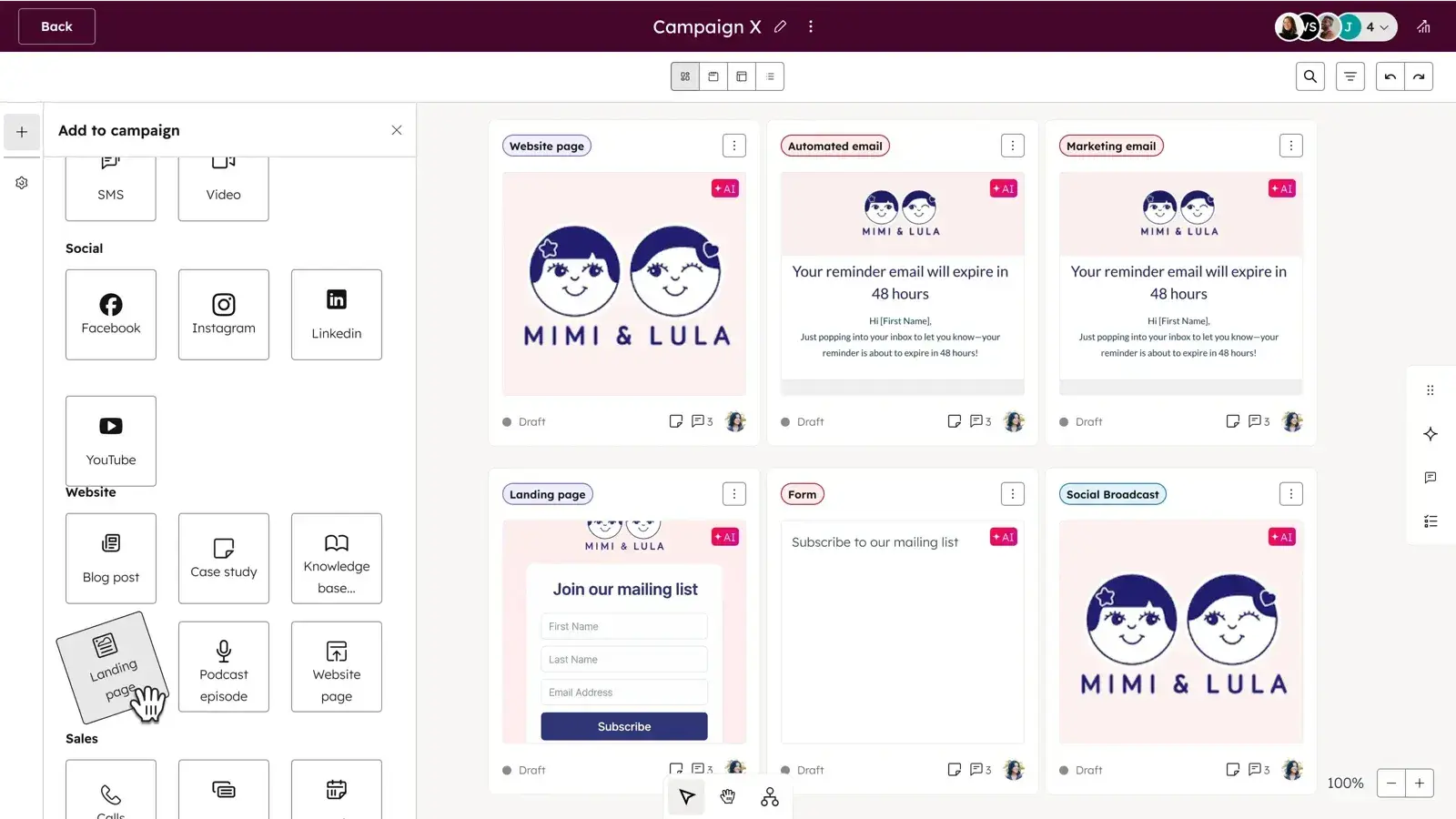
HubSpot’s marketing hub automates email campaigns, lead nurturing and content personalization through AI-powered workflows. Built-in AI tools segment audiences, generate copy, optimize send times and predict interactions to create targeted, data-driven campaigns.
The platform can be integrated natively sales center, service center, And Data hubplus thousands of tools through the HubSpot App Marketplace – from Google Ads and LinkedIn to Shopify and Zoom – to unify go-to-market data.
Best for: Growing SMBs to mid-sized companies ready to centralize campaigns and Automate end-to-end marketing workflows.
Pro tip: Use Breeze, HubSpot’s AI assistant to design campaign texts and A/B test variants directly in workflows. Marketing studio covers your campaigns from ideation to delivery to analysis.
2. Zapier
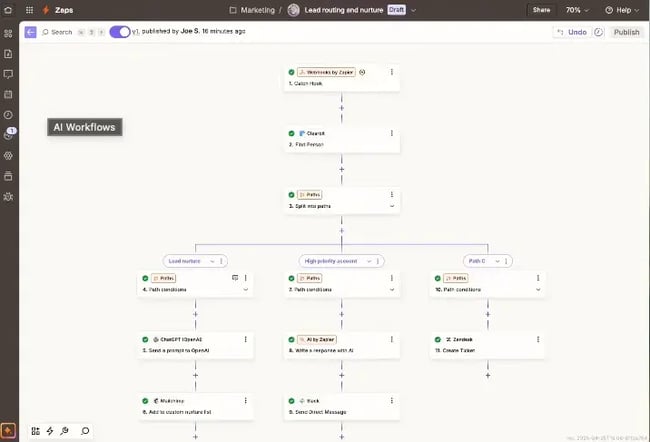
Zapier automates repetitive marketing tasks by connecting more than 7,000 apps—including HubSpot, Google Workspace, Slack, Meta Ads, and Airtable—to sync leads, trigger campaigns, and update data in real-time. Its AI Actions feature interprets natural language prompts to create workflows on the fly, allowing marketers to easily connect their entire tech stack without writing code.
Best for: Startups and SMBs who want quick, no-code automation between marketing apps.
Pro tip: Couple Zapier with HubSpot Forms to immediately route new leads to the right representative or Slack channel.
3. Jasper
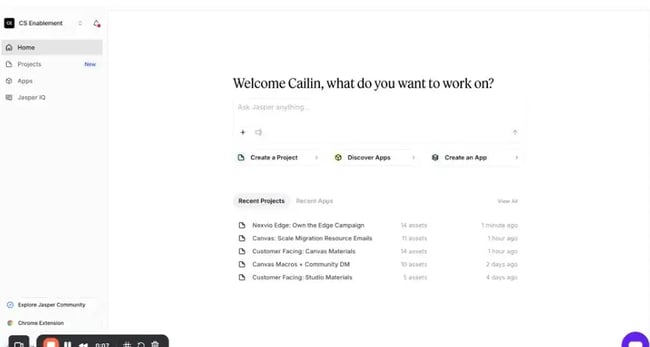
jasper is an AI-powered content creation platform that helps marketing teams create and reuse branded copy for blogs, ads, and social media – all at scale. Tools like Jasper streamline content workflows from brainstorming to publishing. It offers brand voice training, SEO optimization, and team collaboration tools that speed approvals and keep messaging consistent.
Jasper integrates himself HubSpot, Surfer SEO, Grammarly, And other popular marketing and CMS platformsThis allows teams to move content from ideation to publication in a seamless flow.
Best for: Mid-market and enterprise teams that need customizable, large-scale marketing automation with deeper data control.
Pro tip: Create a brand voice in Jasper and connect it to the HubSpot content library to ensure consistent campaigns across channels.
4. Do
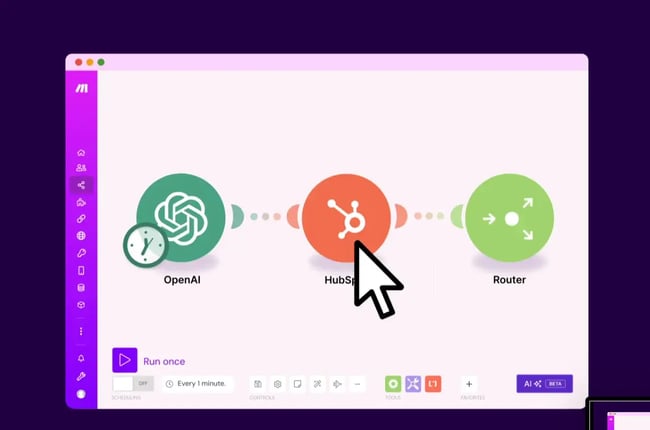
Make is a visual automation platform that offers marketers advanced control over multi-step workflows. It combines the simplicity of drag-and-drop with robust branching logic, API support, and now generative AI modules that can write, analyze, and tag content—or even make data-driven decisions within a workflow.
Make connections with Thousands of apps and services – including HubSpot, Notion, Airtable, And Shopify – This allows teams to orchestrate even complex, multi-stage workflows across platforms.
Best for: Marketing and operations teams from mid-sized to large companies managing complex, multi-app workflows at scale.
Pro tip: Use Make’s Iterator and Aggregator tools to dynamically personalize mass campaigns – perfect for segment-driven content.
Sales
According to Salesforce81% of sales teams using AI tools increased their productivity in the past year and 83% saw revenue growth in the past year. AI sales workflow automation streamlines lead management, forecasting, and deal follow-up. With the right tools, sales reps can automate busy tasks like updating CRMs or qualifying leads.
1. HubSpot Sales Hub
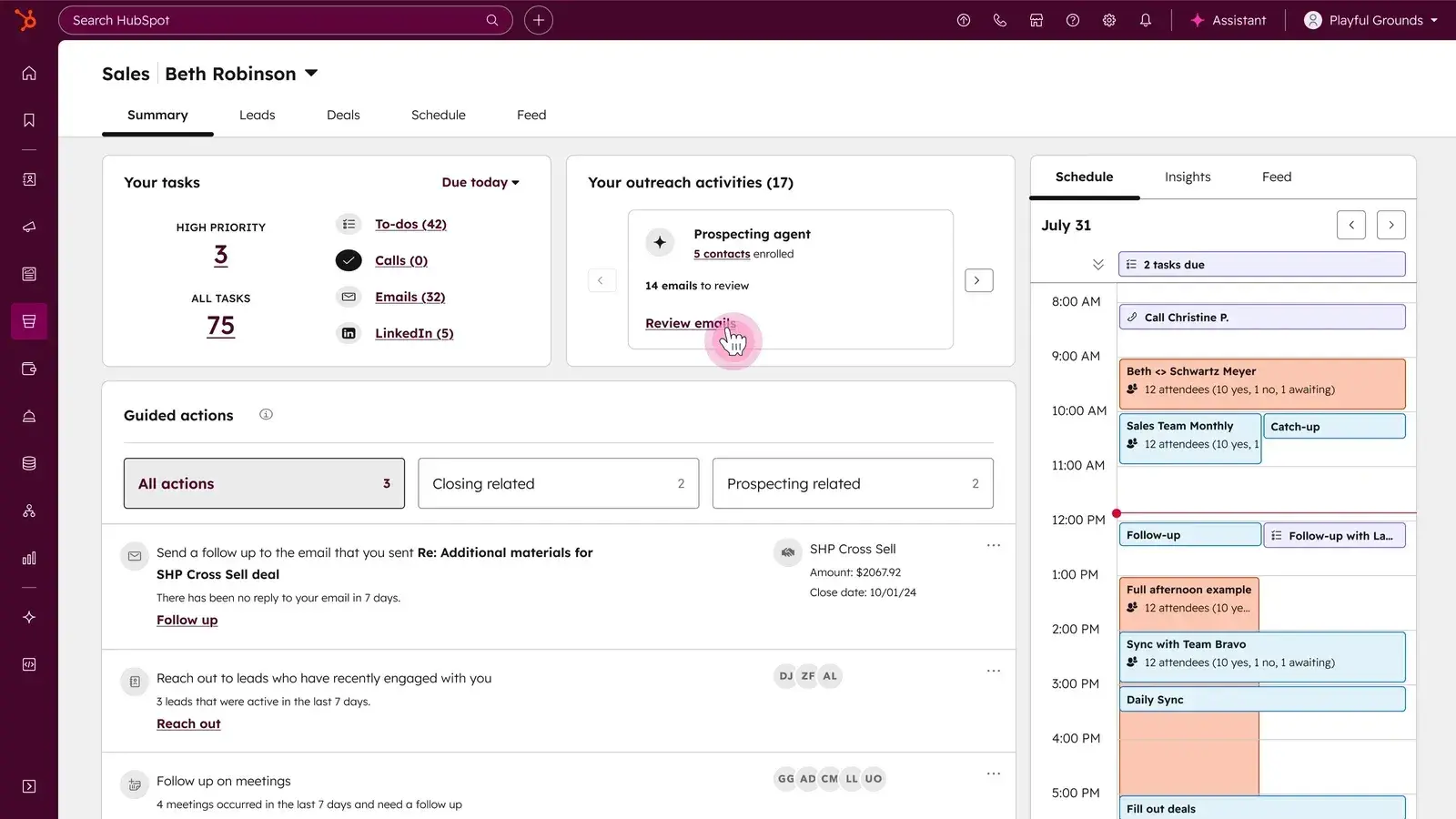
HubSpot Sales Hub Offers AI-powered ProspectingDeal scoring and automated Outreach sequences within a unified CRM. Its AI tools assist with prospecting, writing outreach emails, and summarizing calls while also being predictive Deal scoring and lead routing Keep your pipelines running efficiently. It integrates seamlessly HubSpot Marketing Hub, Service Hub, and thousands of apps – including Gmail, LinkedIn, And zoom – so that sales data remains consistent across teams. Sales Hub also improves business process management through automated deal tracking.
Best for: SMB and mid-sized sales teams who want a unified, AI-powered CRM for faster prospecting and deal-making.
Pro tip: Use the AI forecast Tool in Sales Hub to identify potential bottlenecks before they impact quarter-end numbers
2. Breeze
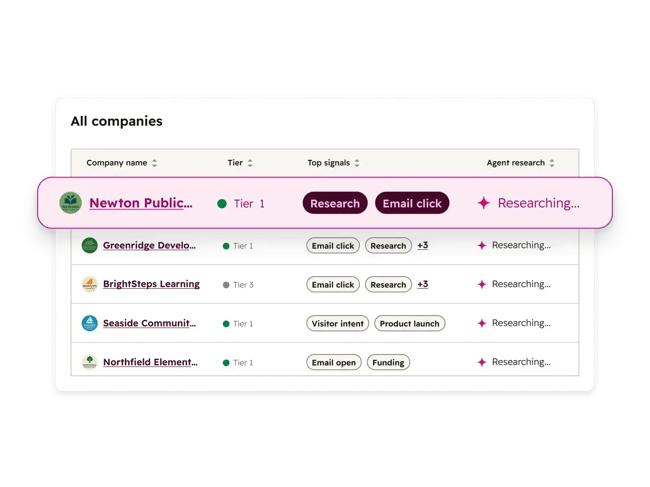
breezeHubSpot’s AI prospecting agent identifies high-potential leads, designs personalized outreach, and syncs data directly HubSpot CRM. It’s designed to help employees focus on high-value tasks by automating research, segmentation, and tracking. HubSpot Breeze AI Suite integrates with HubSpot Marketing, Sales, Service, And Data hubs. breeze functions natively in HubSpot’s Sales Hub, Connect with email, chat, and third-party platforms to create end-to-end AI-powered acquisition workflows.
Best for: SMB and mid-sized teams that rely heavily on outbound sales and require scalable, AI-driven lead automation.
Pro tip: Used together, Breeze and HubSpot’s AI email assistant can enable 24/7 acquisition workflows – all without adding additional tools to the stack.
3. Apollo.io
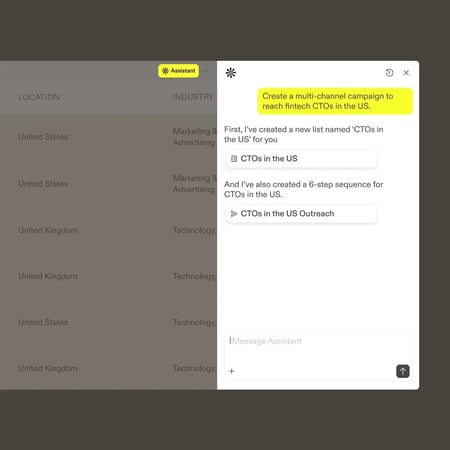
Apollo combines AI-supported lead recognition with automated multichannel targeting. Its AI engine scores leads, writes personalized messages, and triggers outreach sequences based on engagement data. Apollo can be integrated with HubSpot, Salesforce, LinkedIn, And Gmail to keep contact details and interactions in sync.
Best for: Startups and SMBs that need an affordable, all-in-one customer acquisition and outreach automation platform.
Pro tip: Connect Apollo with HubSpot CRM ensures that new contacts from the Apollo database are automatically evaluated, tagged and forwarded to the appropriate employees.
4. Range

reach uses generative AI to help employees personalize emails, summarize call notes, and forecast sales more accurately. Its AI-powered Smart Actions automatically update contract stages, recommend next steps, and prioritize opportunities based on historical results. Outreach can be integrated with HubSpot, Salesforce, And gong to unify communication data and improve pipeline visibility.
Best for: Mid-market and enterprise teams manage complex sales cycles with multiple sales reps and a high need for automation.
Pro tip: Use Outreach’s AI insights dashboard to determine which messages drive the most responses – and then sync the insights back into HubSpot workflows.
service
AI workflow automation transforms service delivery by automatically routing tickets and resolving issues. Service automation allows support agents to focus on higher-value interactions while improving response times and customer satisfaction.
1. HubSpot Service Hub
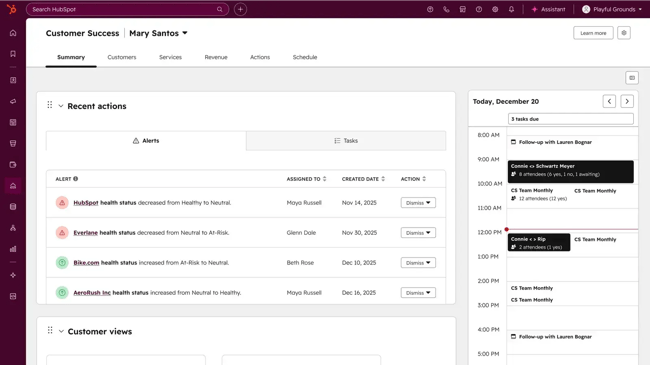
HubSpot’s service hub combines ticket automation, AI-powered chatbots and knowledge base management in one connected platform. It is AI powered Helpdesk and routing features categorize issues, suggest answers, and automatically display relevant knowledge base articles. Combined with HubSpot’s marketing and sales hubs, teams gain a unified view of every customer interaction, enabling personalized support at scale.
Best for: SME and medium-sized service teams who want this Automate service workflows directly in your CRM.
Pro tip: Use HubSpot’s AI help desk to automatically summarize customer conversations and suggest next steps, saving agents hours each week.
2. Moveworks
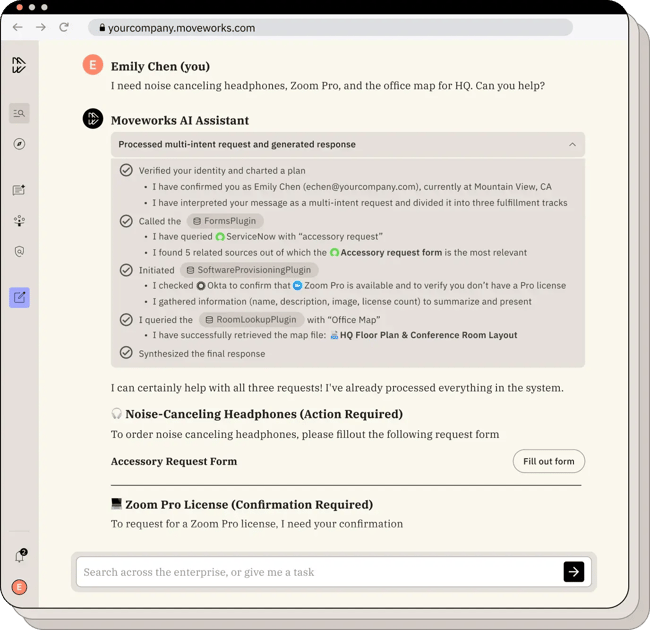
Moveworks uses generative AI to automate IT and HR support and resolve tickets in seconds. Its conversational AI engine interprets intent, retrieves responses from internal systems, and executes tasks across integrated platforms. Moveworks connects with HubSpot, Slack, Microsoft Teams, And ServiceNow to deliver seamless employee and customer support experiences.
Best for: Mid-sized and large service organizations automate internal and customer support workflows end-to-end.
Pro tip: Use Moveworks’ analytics dashboard to identify automation opportunities and measure time saved per request.
3. Intercom Fin 3
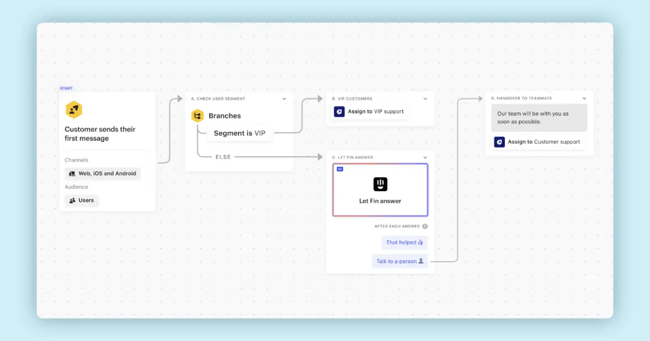
Fin 3Intercom’s newest AI agent combines multi-channel automation with advanced reasoning to manage even complex customer requests. It retrieves answers from the Help Center, CRM and connected apps and can take direct actions without human intervention – such as: B. Refunds or updating customer records. Fin 3 can be integrated with HubSpot, Salesforce, Slack, Notion, And Zendesk, Ensuring context travels across all channels with the customer.
Best for: Mid-market and enterprise service teams ready to scale human support across multiple channels.
Pro tip: By combining Fin 3 with HubSpot’s Service Hub, AI-resolved tickets remain visible in the CRM, maintaining full context and enabling accurate performance tracking.
4. Zendesk
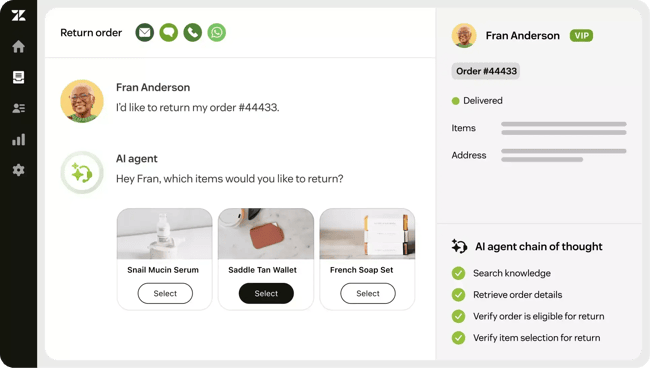
Zendesk uses AI to mitigate routine tickets and understand intent across email, chat and social networks. Its AI workflow builder handles routing, suggests macros, and triggers follow-up actions. Through integrations with HubSpot, Salesforce, Slack, And JiraService data remains connected across the entire stack.
Best for: Teams in small and medium-sized businesses manage large-scale customer interactions across multiple channels.
Pro tip: By connecting Zendesk with HubSpot CRM, sales and marketing teams gain visibility into all service conversations.
Operations
AI workflow automation tools for operations connect systems, clean data, and optimize repetitive processes across departments. Operations automation unifies technology stacks and ensures data accuracy so marketing, sales and service departments work with a single source of truth.
1. HubSpot Data Hub
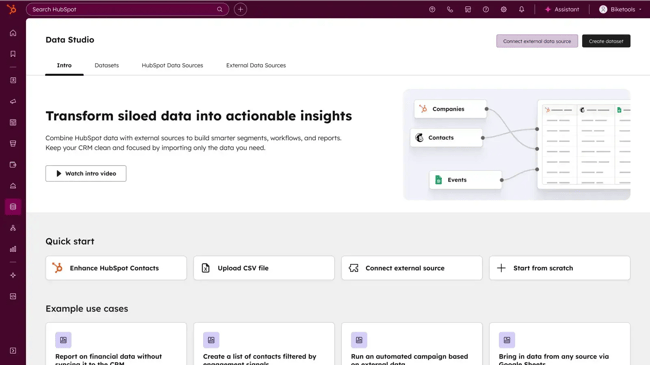
HubSpot’s data hub unifies and automates customer data across the tech stack, strengthening accuracy, governance and workflow performance. Its AI capabilities detect duplicates, standardize properties, and sync data bi-directionally across connected apps so every team has a single, trusted source of truth. This foundation supports scalable automation and consistent data management across the organization.
Data Hub integrates with HubSpot’s marketing, sales and service hubsas well as external platforms such as Snowflake, BigQuery, Databricks, And AWSgiving teams flexible options for governance and data sharing.
Best for: SMBs and mid-sized companies are ready to centralize data and automate cross-platform operations.
Pro tip: Use data hubs programmable automation to trigger downstream actions – like syncing updated customer data with external systems or notifying teams via Slack.
2. n8n
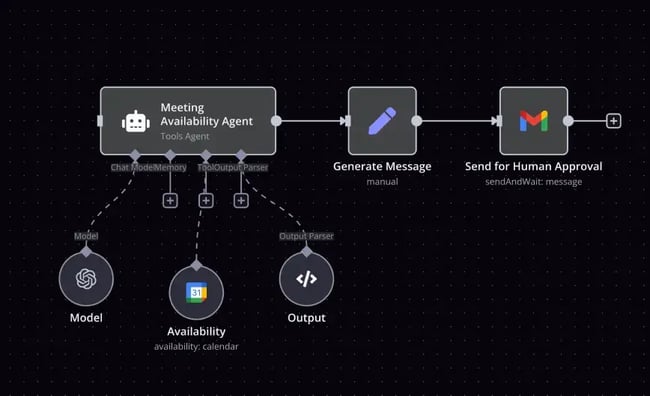
n8n is an open source AI workflow automation tool designed for technical teams that need complete control over how data is transferred between systems. Its visual editor supports complex, logic-driven automation, while AI nodes can summarize data, generate content, or trigger intelligent decisions within a flow. n8n can be integrated with HubSpot, Slack, Google Sheets, OpenAI, Notion, And Hundreds of other apps through native and community-built connectors, making it a flexible choice for both startups and technical operations teams.
Best for: Teams from mid-market to enterprises with in-house technical resources who want self-hosted or custom automation setups.
Pro tip: Use n8n’s AI nodes to automatically enrich CRM records or create ticket summaries before syncing with HubSpot
3. Workato
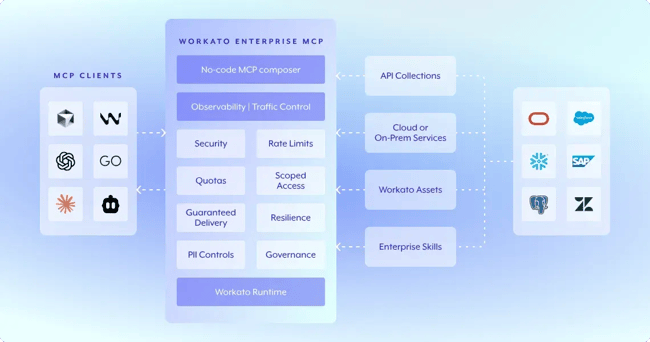
Workato brings enterprise-grade integration and automation into a single AI-powered platform. The RecipeIQ feature uses AI to suggest new automations, identify inefficiencies, and monitor data quality in real-time. The platform can be integrated with HubSpot, Salesforce, NetSuite, Snowflake, And AWSThis enables operations teams to connect business applications with robust governance and security controls.
Best for: Mid-market and enterprise operations teams managing complex integrations and data pipelines.
Pro tip: Workato’s AI insights can flag redundant automations and merge overlapping workflows, helping keep the tech stack lean.
4. Airtable Automations
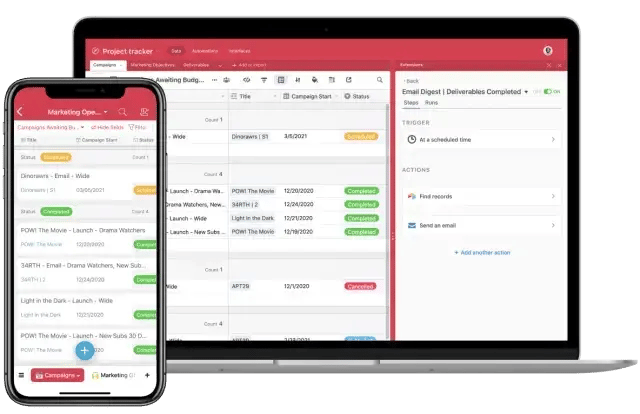
Airtables Automation and AI tools combine flexible databases with intuitive low-code workflow design. Teams can automatically trigger record updates, send alerts, or aggregate data with generative AI, all from their Airtable databases. With integrations too HubSpot, Slack, Google Drive, And JiraAirtable helps bridge the gap between creative and technical teams while organizing projects in one place.
Best for: SMB and mid-sized teams that want lean, easy-to-build automations to streamline project and data workflows.
Pro tip: Use Airtable Automations to push CRM data from HubSpot into campaign trackers or project dashboards for real-time visibility.
While newer players like it Lindy.ai, parchmentAnd Gumloop As companies experiment with no-code AI workflows, the tools above represent the most mature options for teams that need reliability, CRM integration, and scalability across marketing, sales, service, and operations.
Best AI workflow automation tools by growth stage
Growing companies should consider integration, security, scalability, and governance when selecting AI workflow automation tools. The company’s growth phase determines the automation approach: startups benefit from simplicity and speed, medium-sized companies need cross-departmental integration, and enterprises need governance and scalability. The best AI workflow automation tools depend on organizational maturity, technical resources, and complexity requirements.
|
growth phase |
Recommended tools |
Why they fit |
Remarkable integrations |
|
Startup |
Zapier, HubSpot Breeze, jasper |
Low-code workflows and integrated AI support enable automation without developer resources. Startup tools value speed and simplicity over extensive customization. |
HubSpot, Google Workspace, Slack |
|
middle class |
Make, n8n, reach, Intercom Fin 3 |
Offers greater flexibility and scalability, with both AI and human-in-the-loop options. Perfect for growing organizations that need advanced automation and multi-hub orchestration. |
HubSpot, Salesforce, Slack, Notion |
|
Pursue |
Moveworks, Zendesk, Workato, HubSpot Data Hub |
Designed for complex enterprise ecosystems with multi-layered governance, security, and data orchestration requirements. Supports end-to-end process automation and AI agents spanning multiple systems. |
HubSpot, ServiceNow, Microsoft 365, SAP |
Each phase presents different automation challenges, but the core approach remains the same:
Start with simple steps, ensure systems are connected, and evolve to scalable, AI-driven workflows.
Frequently asked questions about AI workflow automation tools
How can I start and scale AI workflow automation in my company?
Companies are starting to map repetitive workflows – like lead assignment or campaign planning – and test AI automation in a single department. After validating results, automation is extended across departments using a connected CRM like HubSpot to maintain consistent data and governance.
Which tool is best for small teams without developer resources?
Small teams without in-house developers should look for no-code platforms that automate workflows out of the box. AI workflow automation tools like Zapier, HubSpot Breezeand Jasper make it easy to connect apps, trigger actions, and embed AI without writing a line of code. These platforms are ideal for startups that need quick wins and rapid deployment.
What is an AI workflow builder and how is it different from an agent?
An AI workflow builder connects apps and triggers automated actions based on rules or conditions. An AI agent, on the other hand, argues and acts autonomously – it can decide what steps to take next without being explicitly told. Builders are ideal for predictable processes; Agents are better suited for dynamic, data-driven decisions that change in real time. Automated workflows can be triggered by AI agents or workflow builders.
Can AI automate end-to-end processes across multiple hubs?
Yes, modern AI workflow automation tools can automate multi-hub processes by connecting data and actions across marketing, sales, service, and operations. For example, HubSpot’s data hub can unify datasets, trigger AI-driven workflows, and sync insights across connected apps like Salesforce or Slack.
How do I assess data protection and security when using AI?
Assessing privacy and security begins with reviewing an AI workflow automation tool’s data handling policies, model training disclosures, and relevant compliance certifications (such as SOC 2, GDPR, or HIPAA, if applicable). Strong platforms ensure transparency about where data is stored and how it is used. Enterprise-class tools like Workato and Moveworks generally offer more advanced governance controls than simpler no-code options.
When should I choose iPaaS or self-hosting over a low-code tool?
iPaaS (Integration Platform as a Service) or self-hosting is a better choice when an organization requires deep system integrations, strict governance controls, or highly customized data flows. Low-code tools are generally better for smaller teams that value speed, ease of use, and rapid iteration. The right approach depends on the complexity of the tech stack and the level of control required. A detailed one iPaaS comparison can help clarify which approach meets an organization’s needs.
Implementing AI workflow automation
AI workflow automation tools are transforming the way companies work – enabling them to work smarter, connect data across systems, and scale processes without increasing headcount. Whether you start with simple automations in Zapier or build an AI-driven orchestration with Moveworks or Workato, success depends on choosing tools that match the growth stage and maturity of the tech stack.
HubSpot’s unified platform – including Marketing Hub, Sales Hub, Service Hub and Data Hub – combines automation, analytics and AI-powered workflows in a connected CRM. This integration reduces tool proliferation, maintains data quality, and enables cross-functional automation that scales with business growth.
The most successful automation strategies start small, prove valuable in one department, and then are systematically expanded. Companies that view automation as an iterative process rather than a one-time implementation see higher adoption rates and better long-term ROI.
From my 15 years of experience working with marketing organizations, I have found that the real transformation occurs when automation is integrated into daily operations rather than treated as a standalone project. The successful organizations continually experiment, rigorously measure results, and let data guide decision-making at every stage.