
Marketers use AEO and GEO interchangeably, but there is a difference that is defined and explained in this article. In short: AEO optimizes content for answer boxes and voice search results, while GEO targets AI chatbot quotes and generated summaries.
It might be difficult to get it all in there Agree on what’s what, but let’s try. AEO and GEO are not going away, and the sooner the industry can agree on the meaning of these acronyms, the better. From a strategic perspective it doesn’t matter so much Because all SEO specialists should already lay the foundation for AEO, GEO and of course SEO. But with a unified definition it will be much easier to talk about everything.
If you are not sure what work is required for AEO or GEO or how to measure their impact, stay tuned as we will take care of it after defining our terms.
Table of contents
AEO vs. GEO: What’s the difference?
AEO stands for Answer Engine Optimization. AEO focuses on direct answers in search results. It helps website content look that way direct answers in the search results.
Think:
- Selected excerpts.
- People ask too.
- Knowledge panels.
- And other SERP features.
GEO stands for Generative Engine Optimization. GEO optimizes brand quotes in AI-generated summaries. It helps brands be successful quoted in AI-generated summaries on platforms such as Google AI Overviews, Perplexity and ChatGPT.
In the simplest terms: AEO optimizes for answers while GEO optimizes for quotes.
Here is a comparison table:
|
strategy |
Primary goal |
How it is displayed |
What it is optimized for |
Best Use case |
|
AEO |
Provide direct answers when searching |
Featured Snippets, “People Also Ask,” and AI Short Answers |
Clarity, structure, question coverage |
Intentional, question-driven queries |
|
GEO |
Earn brand citations in AI summaries |
Google AI Overviews, ChatGPT, Perplexity |
Authority, entity clarity, quotable insights |
Research requests and information discovery |
|
SEO |
Earn rankings and organic traffic |
Traditional, organic blue links in search engines |
Relevance, backlinks, technical performance |
Long-term acquisition and traffic growth |
AEO vs. GEO vs. SEO
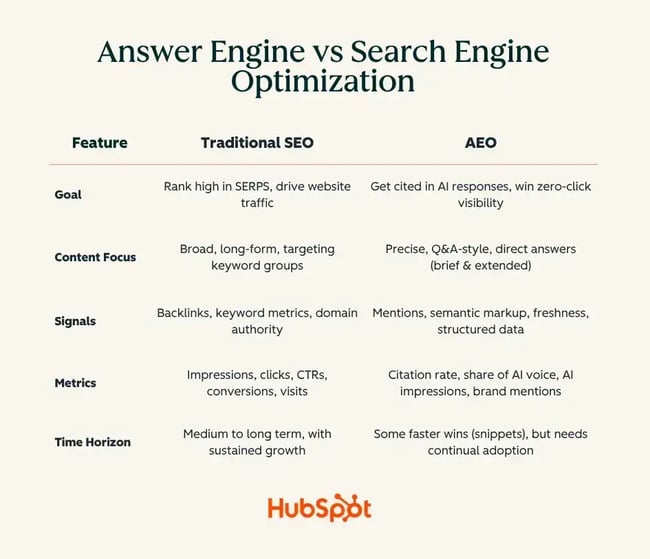
Traditional SEO focuses on three core pillars:
- Content strategy.
- Technical SEO.
- Backlinks.
SEO is a broad marketing tactic that encompasses many aspects, and many of the elements described under AEO and GEO also fall under their “umbrella.” However, these tactics are becoming increasingly important due to their impact on AEO and GEO in modern SEO.
AEO focuses on delivery Answer that search engines can extract cleanly.
GEO focuses on earning Quotes within AI-generated answers – often without the need for a click.
Combined, these three strategies ensure that brands:
- Can be found in search.
- Showcase the AI tools that today’s buyers rely on for research, vendor comparisons, and decision making.
- Appear in AI digests and other SERP features for maximum visibility.
AEO vs. GEO: Do you need both?
Both GEO and AEO are quickly becoming key marketing priorities as AI-powered search becomes a popular format for consumers to discover brands, compare solutions and make decisions. According to the HubSpot Consumer Trends Report72% of consumers surveyed said they intend to rely more on AI-powered search when shopping.
Experience shows that brands absolutely need both (and SEO, of course).
I’ve received leads through ChatGPT and other generative tools for my own agency and for clients, and these results were only achieved because my brand is visible in both response and generative engines.
AEO and GEO require structured content and clear units. AEO ensures that a website’s content is extractable, structured and suitable for direct answers in Google and other search engines. GEO ensures that when someone asks an AI model for recommendations, comparisons, or best-of lists, your brand is among the quotes the model includes in its summary.
In today’s search landscape, where buyers are increasingly starting to research in ChatGPT, Perplexity or Google AI Overviews, relying on SEO alone is no longer enough.
Pro tip: Read HubSpot’s AEO Instructions here.
Common tactics between AEO and GEO that produce results
AEO and GEO may appear differently on search and generative search platforms, but they are based on many of the same basic practices. The brands that perform best in AI search are those that create structured, answer-oriented content and ensure strong entity clarity on every page. Below are five core tactics that strengthen both AEO and GEO performance: answer-first content structuring, entity management and consistency, citable insights and data passages, schema and structured markup implementation, and reinforcement through repetition.
Answer-First content structuring
Content structuring is all about directly answering a user’s question before adding supporting details, examples, or context. Instead of burying the crucial point halfway down the page, writers need to get the most important point out immediately in a clean, high-flying format that response engines and generative machines can extract without ambiguity. Writers and AEO or GEO specialists must draft content to provide the answer and then flesh it out later.
For example, in a piece of content there is a heading, “What is Answer Engine Optimization?”
AEO immediately defines the answer that is designed for good performance in AI search as follows:
“Answer Engine Optimization (AEO) is the practice of structuring content so that search engines can extract direct, authoritative answers for featured snippets, AI summaries, and other answer-driven results.”
Pro tip: Journalists have been using a similar structure with the for decades inverted pyramid: Start with the headline and key facts, then add context, quotes, and background. Answer-first content is just the search-optimized version of the same newsroom principle – and has become one of the most important practices for the success of AEO and GEO.
Entity management and consistency
Entity management is the definition of your most important entities, be they people, products or concepts. A brand, for example, is a unit. Once established, marketers control the units and ensure they remain consistent wherever they appear.
By consistently maintaining accurate, consistent references throughout your website, blog, product pages, documentation, PR, and external mentions, generative citations are more likely to be accurate.
When your product names, features, claims and categories are described consistently across multiple surfaces, AI tools can reliably link these references to you. The more precise and consistent your entities are, the more confidence generative engines have in deciding which brand to cite in overviews or summaries.
Since AI models come from thousands of sources (your website, competitor sites, Reddit, forums, UGC, reviews), inconsistent entity signals become a real risk. If your materials list is described one way on your product page but another way in a press release or reseller listing, AI systems can conflate or misinterpret your data. Entity Management solves this problem by making your information stable, repeatable, and unique across the web – which is now essential to getting citations in AI-powered search.
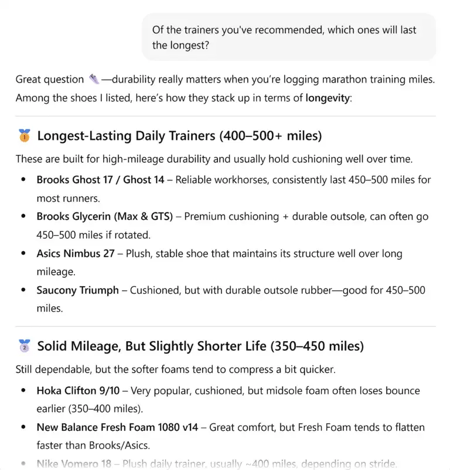
For example, if you sell running shoes, you probably cover the life of the shoes. Mentioning the lifespan of the sneakers on the product page may make sense since the units are interconnected, but the manufacturer’s warranty for the lifespan of the shoe may vary based on experience. Users on Reddit may say they have traveled 200 miles, others say 1,000. There is no universal truth, but if there is You Clearly state the accepted industry ranges (e.g. 300-500 miles) and explain why you are giving AI models the best possible chance of repeating the correct information and citing you as the source.
Entity clarity is becoming a form of quality control in AI search.
Unfortunately, citation cannot be guaranteed. Here is an example I found when I tested AI search engines for Backlinko: A search for the lifespan of running shoes returned figures of 450-500 miles. However, the actual range on the manufacturer’s website is 300-500 miles.
Quotable insights and data passages
Quotable insights are short, authoritative statements or data points that AI engines can convert directly into summaries. These can be statistics, expert explanations, definitions or clear recommendations.
Pro tip: Use quotable insights in a separate paragraph and don’t forget to respond directly to the headline first. This means that quotes or additional insights should come after the short paragraph that defines the main point.
Generative engines prefer clean, self-contained passages that can be quoted without restructuring. Give them a “ready-made” offer. This can increase the likelihood of appearing in AI overviews or ChatGPT replies. It also improves AEO as the same passages are often moved into answer boxes.
Clear definitions, strong statements, data and expert opinions have long been part of SEO and help demonstrate experience, expertise, authority and trust (EEAT). Still, AEO and GEO ask SEO specialists to remember and emphasize the importance of insights and data.
Schema and structured markup implementation
Schema markup is structured data that helps search engines understand the meaning of content – products, FAQs, authors, guides, reviews, and more. It turns plain text into clearly defined entities and relationships that machines can trust. Basically, schema markup is additional code that crawlers can read.
Schema is critical to AEO and GEO because it tells response engines exactly what the content represents, increasing a site’s eligibility for snippets and rich results. This is equally important for GEO because structured markup strengthens the consistency of entities that generative engines use to review information and decide which marks to cite.
As an SEO specialist, I have been adding schemas for years. For me it is non-negotiable.
My most commonly used schema types for B2B include:
- Person scheme helps understand who a subject matter expert is, including their qualifications, roles, specializations and publications. This is particularly effective for EEAT as it links authoritative content directly to a real expert.
- organization Scheme defines the company as an entity, including company name, brand name, industry category, contact information, social profiles and subsidiaries. It creates the “source of truth” about a company.
- FAQ schema Explicitly mark questions and answers and give search engines and AI models a clear, structured understanding of what each content section represents.
- Service scheme defines the specific services a company offers, including the type of service, who it is intended for, what problems it solves, and any related offerings.
- Product scheme Provides structured data about products including specifications, features, benefits, variations, materials, reviews and more.
Reinforcement through repetition
Reinforcement through repetition means that important facts, claims, and definitions are repeated consistently across multiple reputable sources so that AI systems begin to treat your version as the authoritative one. AI models don’t take websites at face value; they triangulate. They search the Internet for patterns, overlaps, and repeated claims.
If a brand’s website only says that a product reduces downtime by 30%, the AI will consider it unverified. When ten independent sources say the same thing, including press, partner sites, documentaries, industry publications and comparison sites, AI models accept this as truth and quotes become more representative of the message brands want to share.
Pro tip: I know how to worry about repetition, but marketers need to remember that only a small percentage of their audience sees the content they publish. There are many variables at play, including what the algorithm shows, when people log into their devices, and what they’re currently searching for. For example, a social media post can only Reach 8% of a large audience. There’s no harm in posting things twice or reposting things on a different platform.
How to measure the impact of AEO and GEO
Measuring AEO and GEO requires a move away from traditional SEO metrics like rankings and traffic. AI-driven search is changing the way users discover information, how they evaluate brands, and what signals influence their decisions.
Instead of just tracking clicks, marketers now need to measure visibility in AI-generated responses, citation accuracy, and downstream impact on conversion quality and pipeline.
Below are the five metrics that provide the clearest overview of AEO/GEO performance and where to optimize next. These include AI visibility and citation coverage, content quality and responsiveness, AEO/GEO-influenced conversions and revenue, lead quality through AI-influenced discovery, and page performance and user behavior.
AI visibility and citation coverage
AI visibility and citation coverage measure how often a brand appears in generative search experiences such as Google AI Overviews, ChatGPT, Perplexity and Gemini. Instead of just tracking clicks or rankings, this metric tells marketers whether AI systems are incorporating content into their answers, summaries, and recommendations.
Additionally, marketers can determine whether AI tools mention a brand positively or negatively.
The easiest way to track this is with HubSpot’s AI Search Grader. AI Search Grader measures brand visibility and citations in AI search. It is a free tool that analyzes any domain and shows how visible a brand is across all AI engines. It shows where the brand is cited, what is missing, and which pages need improvement to gain traction in generative search.
This is what the dashboard looks like: It also provides a full report.
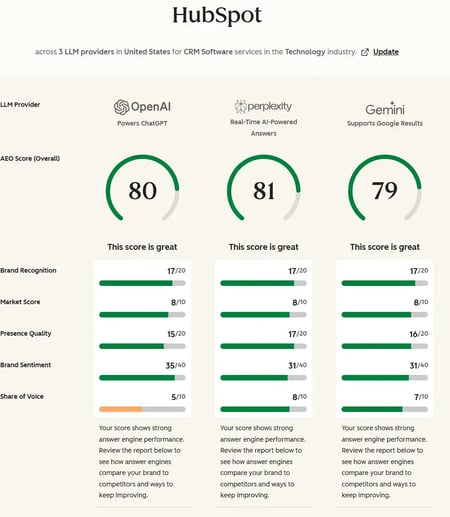
To manage this metric, regularly review top topics and pages.
Seek:
- Appearances in the AI overview.
- Mentions or quotes in ChatGPT or Perplexity.
- Whether generative engines use your definitions, statistics or product data.
- Which competitors are mentioned?
- Pages that appear without being clicked on.
- Gaps in content where your answers are not coming to light.
Content quality and responsiveness
Content quality and responsiveness measure how effectively content meets the structure, clarity, and formatting requirements on which AEO and GEO depend. The content must be cleanly extractable, well-researched, entity consistent and answer-oriented. This metric evaluates whether pages are written in a way that responders and generative machines can safely understand, reuse, and cite.
This is where Breeze Content Assistant, HubSpot Marketing Hub, and HubSpot Content Hub work together to improve and monitor responsiveness across your entire content library.
- Breeze Content Assistant helps marketers and writers create structured, response-oriented content that is optimized for AEO/GEO from the start. Breeze Intelligence supports entity monitoring and consistency. It understands HubSpot’s AEO best practices, allowing Breeze to generate definitions, FAQs, schema-ready structures, and entity-aware passages that AI engines are more likely to extract.
Best for: Quickly create AEO-ready passages, FAQs, definitions and structured updates.
- HubSpot Marketing Hub includes SEO tools that assess the SEO and AEO fundamentals underlying responsiveness, such as: E.g. page structure, metadata quality, internal linking, topic coverage and readability. Marketing Hub orchestrates campaigns and reporting for AEO and GEO.
- HubSpot Content Hub includes one AI content writer This ensures that content is built on a foundation that is SEO and AEO friendly. Content Hub enables answer-oriented, structured content creation. It provides in-editor SEO suggestions, internal linking recommendations, and on-page analytics to keep your content aligned with AI ranking and extraction criteria.
To measure content quality, check the content for the following:
- Clear, answer-oriented introductions.
- Definitive statements and quotable insights.
- Consistent use of entities and terminology.
- Strong internal linking to reinforce meaning.
- Well-structured FAQs, headers and schema.
- Smooth readability and minimal fluff.
Conversions and revenue are influenced by AEO/GEO
AEO/GEO Influenced Conversions and Revenue measures how often AI-powered search interfaces contribute to the pipeline, whether through:
- Direct clicks.
- Supported influence.
- Unclicked brand quotes that influence purchasing decisions.
- Conversions and sales made in sessions started with AI sources like ChatGPT.
Visibility is important, but conversions and revenue will always be the ultimate performance measures. AEO and GEO only fulfill their role if they help companies grow.
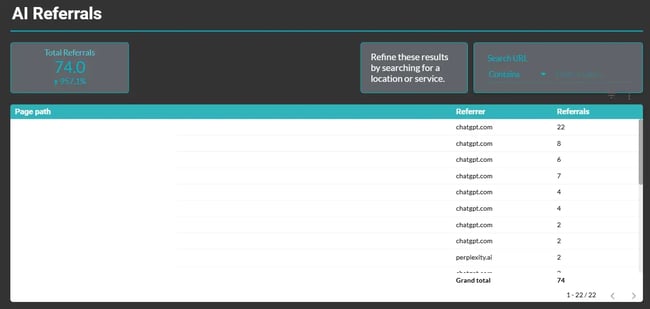
The best way to measure AEO/GEO-influenced conversions and revenue is to measure on-site behavior within sessions that began with a recommendation from an AI source such as ChatGPT or Perplexity.
I do this on Looker Studio. Here is a look at my report. I show how many recommendations came from AI sources:
And how many conversions took place:
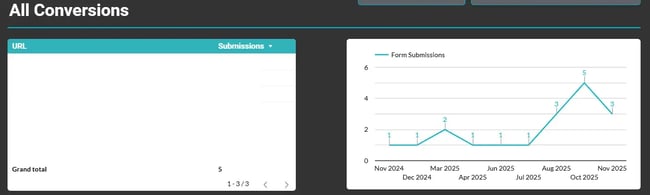
Reports give marketers the data they need to ask questions of sales. When marketing knows it has secured a top lead, it can see whether it has been converted or not.
Pro tip: Qualify marketing leads by adding qualifiers in contact forms. For example, I add “budget.” This way I know that ChatGPT resulted in a 10,000 lead for my client. This is the level of insight you need to quantify the impact of AEO/GEO.
But here’s the nuance: not all influence is trackable.
Many users see brands in an AI overview or a conversation reply, don’t click immediately, but return later through another channel. These unclicked quotes still influence decision making, which is why conversion analysis is one of the most important AEO metrics.
When reporting, pay attention to the following:
- Assisted conversions influenced by AI presence.
- Conversions on pages that appear in AI responses.
- Conversion rate changes after implementing AEO updates.
- Multi-touch attribution where AI interfaces are part of the journey.
Lead quality through AI-driven discovery
Lead quality through AI-driven discovery measures how well AEO/GEO-generated leads match ideal customer profiles (ICPs) and whether those leads move through the funnel faster than traditional organic traffic. AEO doesn’t just increase visibility; it improves the type the visibility that brands receive.
How?
Content appears in highly contextual AI responses, and the traffic that follows is often warmer, more targeted, and already problem-aware.
AI-generated recommendations act as intent filters. When someone finds a website through a generative engine answer or vendor comparison, it usually means they are actively searching for a problem you solve. For this reason, AI-powered leads often have better fit scores, higher qualification rates, and move faster into the pipeline.
What to measure:
- Fit Score of leads generated from pages appearing in AI responses.
- Sales qualified lead rate (SQL). from AI-based sessions.
- Guidance speed And Time until first action (e.g. demo booked, asset downloaded).
- Topics and pages that drive consistently high-quality conversions from generative engines.
High-quality leads are one of the clearest indicators that answer-oriented content, structured units and topic clarity are working. When AI repeatedly recommends your brand to the right audience, your pipeline improves even before attribution fully captures the source.
Pro tip: For a sophisticated setup use HubSpot lead scoring to compare leads influenced by AI interfaces with those from traditional organic search. With HubSpot’s lead scoring, sales and marketing teams can quickly see if the AEO/GEO strategy is attracting the right buyers that the sales team wants and can convert.
Page performance and user behavior
Page performance can give marketers an idea of which pages are performing well. The more sessions from AI sources there are on a page, the more frequently it is recommended.
Once marketing knows the top page citations, they can analyze user behavior to see how people are interacting with the page.
To track this, monitor sessions where the referrer is an AI tool.
Look at how visitors behave:
- Do they stay on the side or jump off quickly?
- Are you looking at multiple pages?
- Are they interacting with high-intent elements like CTAs, pricing pages, or demo forms?
- Do they trigger important events like downloads or form filling?
By combining AI-powered behavioral data with AEO/GEO visibility, you get a clear picture of which pages are doing the real heavy lifting and which deserve priority for schema improvements, answer-first rewrites, quotable insights, entity boosting, or deeper optimization.
What’s next for AEO and GEO?
AI search is evolving rapidly. I’ve been writing about AEO and GEO for a while now and it happens so quickly that I sometimes have to make significant changes to my articles between the first draft and publication (which takes about two weeks!) because things have already changed significantly.
Here are the three trends that I believe will define the next phase of AEO and GEO.
AI recognition will become the new top of funnel.
More and more buyers will start their research in ChatGPT, Perplexity, Gemini and other conversation tools. We already know, thanks HubSpot Consumer Trends Report72% of consumers surveyed said they intend to use AI-powered search more often to shop.
This means brands’ first impression may no longer be your website; It depends on what the AI model says about you. The success of AEO and GEO depends on question coverage, schema and distribution.
I think this is the biggest mindset shift marketers need to make. Your homepage is no longer the first point of contact; AI presence is and visibility is crucial.
Here’s an example of how visibility impacts consumers. When searching for the “best free CRM for small businesses,” HubSpot was recommended in AI overviews and then again in “Sources on the Internet.” The citation in AI Overviews is not HubSpot, but Zapier (third party credibility).
All of this visibility and trust comes from sources across the web (not just HubSpot).
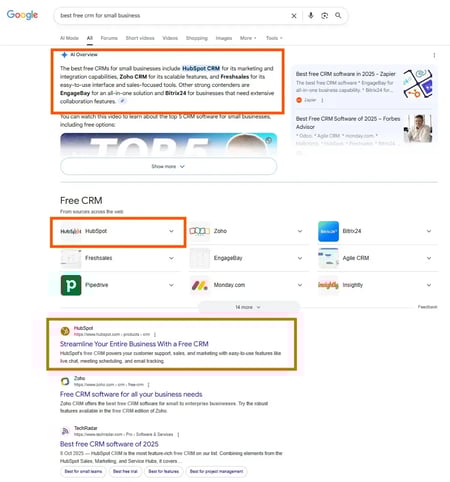
This demonstrates the power of consistent brand messaging and credibility with third parties and content delivery on a brand’s website.
The search industry will calm down.
I firmly believe that the search industry will agree on AEO, GEO and SEO and remind myself what matters: the consumer and reaching them no matter where they search or are online.
When I wrote The Future of SEO, I spoke to Mark Williams Cookwho had some SEO predictions. He believes we are “close to the peak where we will be with LLMs” in terms of novelty and hype.
In other words, the explosive growth, dizzying promises, confusion over everyone’s opinion of what’s what, and rapid experimentation in AI search are starting to plateau.
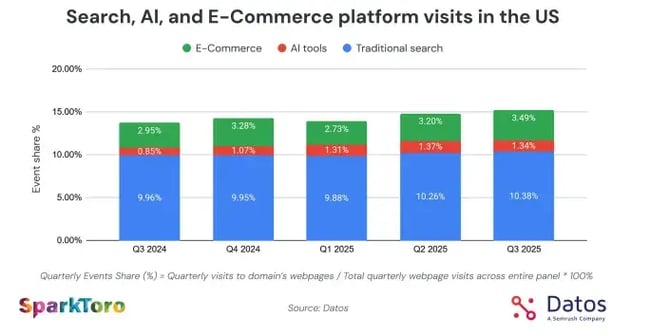
This view is supported by data showing that conversational AI tools like ChatGPT still only capture a tiny portion of all search activity. According to reports, the click share is around 1.3%. Here is a graphic of Datos’ state of search Q3 2025. In the third quarter, visits to AI tools reached about 1.3% and stabilized. Previously, it grew slowly from 0.85%.
SEO teams will report on AEO and GEO as well as SEO.
Although the AI hype is reaching a plateau (I think), that doesn’t mean it isn’t important. SEO specialists need to customize SEO reporting to include AEO and GEO. It’s becoming too important to ignore, and those who do risk falling behind.
AEO and GEO must now be a standard part of every SEO audit and reporting workflow. Just as we evaluate rankings, backlinks, core web vitals, and keyword visibility, we also need to measure AI visibility, citation counts, entity consistency, and AI-originated sessions. If your brand doesn’t appear in the generative results, it’s a performance deficiency, not a coincidence.
What this looks like in practice:
- Add AI sources (ChatGPT, Perplexity, Gemini, Claude) to your acquisition reports.
- Track which pages are recommended by AI engines – and whether they are your high-intent assets.
- Monitor AI-originated sessions as a standalone channel.
- Evaluate how often your definitions, statistics and product data appear in AI summaries.
Identify missed citation opportunities when competitors are chosen instead of you.
I integrated this into my clients’ Looker Studio dashboards months ago.
Once you embed AEO metrics into your reporting cadence, patterns quickly emerge – which pages earn citations, which topics attract high-quality traffic, and where you need to streamline units or restructure content.
Pro tip: Treat AI visibility the same way you treat keyword rankings. Add AEO metrics to your monthly reports and review them with the same rigor – staying ahead of competitors who still only track organic traffic.
If you want to understand how visible your brand is across all AI engines, start with this HubSpot AI Search Grader. It gives you an instant overview of your AEO/GEO performance and actionable steps to improve. And if you’re ready to create AEO-ready content at scale, HubSpot is for you Content Hub, Breeze Content AssistantAnd Marketing Hub Make it easy to create, manage and measure search visibility across all modern surfaces.
Frequently asked questions about AEO vs. GEO
How do I measure AEO vs GEO performance without relying on traffic?
Track citation frequency, AI overview appearance, entity consistency, AI-generated mentions, and fit score of leads influenced by AI-derived interfaces. Tools like that HubSpot AI Search Grader make that easier.
Which scheme helps with AEO and GEO?
The best schemes to assist with AEO and GEO include FAQ, Product, Service, Person, Organization, and SameAs. They improve entity clarity, answer extraction, and citation reliability. However, don’t rely only on these schemes. there are so many!
How can I get my brand mentioned in ChatGPT or Perplexity?
Use answer-first formatting, entity consistency, quotable passages, and schema. Then reinforce these facts on authoritative external surfaces so that AI models trust your version of the information.
How often should we update AEO-ready content?
At least quarterly for key sites or whenever product updates, regulations or competitive changes occur. AI engines reward freshness, accuracy and clarity.
AEO and GEO are now essential levels of search visibility.
AEO and GEO are not add-ons; They are the new foundation of brand visibility in an AI-first world. AEO wins the direct answers. GEO wins the awards. Together, they determine how buyers discover your brand, evaluate your solutions, and make a decision. It’s not about AEO vs. GEO, but rather both working together.
The marketers who adopt response-oriented content, structured units, and heavy distribution will dominate modern search. HubSpot’s AEO Grader can help marketers optimize their websites for the new era of search.
I’ve seen firsthand how AEO and GEO lead to warm, focused leads. When you focus on clarity, structure, and citation-worthiness, AI models do the distribution for you, and the results can be game-changing.