
At its core, an SEO audit is a step-by-step review of your website’s technical health, content quality, and visibility. An SEO audit identifies technical, on-page, content and link issues on a website. It helps SEO teams identify, prioritize, and fix the problems that are blocking traffic, rankings, and most importantly, conversions. Companies and SEO teams should conduct audits to identify opportunities that drive business goals and growth.
A modern audit goes beyond identifying issues that drive traditional blue check rankings in Google Search. As AI search changes the way users discover brands, marketers must now evaluate entity signals, brand visibility in AI responses, and how their content performs in generative search engines.
In this guide, you’ll learn how to conduct an SEO audit, which is helpful in today’s search landscape. I’ve included clear steps, examples, and an SEO audit checklist to help SEO professionals of all skill levels achieve measurable traffic growth.
Table of contents
What is an SEO audit and why is it important?
An SEO audit is a structured review of your website. SEO specialists conduct audits at regular intervals, such as quarterly or annually. Sometimes external consultants conduct on-site audits to look at the project from a new perspective.
The audit identifies the issues that are preventing your pages from ranking, being crawled, or converting. The SEO strategist then converts the audit results into a prioritized plan that directly supports traffic growth, lead generation and pipeline.
Typically an audit includes:
|
Examination area |
What it covers |
|
Technical health |
Crawlability, indexability, page speed, core web vitals, structured data and site architecture. |
|
On-page SEO |
Metadata, headings, internal linking, URL structure, etc Topic and keyword clusters. |
|
Content Quality + Depth |
EEAT signals, current authority, topicality, duplication, thin pages and content gaps. |
|
Best performing sites |
Pages that generate the most traffic or impressions, with opportunities to improve CTR and rankings. |
|
Revenue Generating Pages |
Product, service or conversion pages with the highest commercial impact and what is preventing them from ranking higher. |
|
Highest converting pages |
Pages that convert well and can be further scaled, replicated, or improved. |
|
CRO recommendations |
Layout friction, UX issues, unclear CTAs, clear messaging and engagement metrics. |
|
Backlink profile and gaps |
Authority, toxic links, and ways to earn links your competitors rely on. |
|
Brand and corporate signals |
How clearly your brand is understood and categorized by search engines and AI models. |
|
AI search visibility |
How your website appears in AI-generated responses using tools like AEO from HubSpot Graders. |
SEO audit checklist for quick success
Conducting an SEO audit can be overwhelming, even for experienced marketers. At a minimum, an SEO audit checklist includes crawlability, indexability, page speed, on-page SEO, content quality, technical SEO, and backlinks.
A good SEO audit uncovers hundreds of insights, and internal teams often dive into data without knowing where to start. Quick wins help cut through the noise. Identifying these factors early gives teams momentum and makes interpreting the rest of the audit much easier.
Here are high-impact, low-effort opportunities that SEO specialists should pay attention to as they work through the audit checklist (the step-by-step audit guide comes next):
- Content review. Identify thin or outdated pages. Almost every website has blogs that share trends or content that is currently completely irrelevant. For example, “Wedding trends in 2002” or content about services the company no longer offers. These pages almost always have next to no clicks and can almost always be removed. Check out HubSpot’s article Why we removed 3,000 pieces of stale content from the HubSpot blog. It’s truly brilliant and provides the thought process and reasoning behind her decision.
- Technical audit. Look for critical blockers like noindex tags, 404 pages, broken links, redirect chains, and slow loading pages. Use Screaming Frog or HubSpot to identify all of these (there’s a tools section later). In addition to serious technical issues, complete tasks that take less than 30 minutes to quickly resolve a range of issues. Sometimes momentum inspires further action.
- Image compression and lazy loading. Reducing image size is a quick way to improve page speed without developer assistance. Image compression and lazy loading are highly recommended to improve website performance.
- Broken UX or CTA elements. Address friction points that hinder conversions, such as: B. incorrect forms, unclear calls to action (CTAs) or problems with the mobile layout.
- Local SEO Test. Check that your Google business profile is up to date, ensure NAP consistency (name, address, phone number), and look for duplicate listings or missing local citations. Solve one of these problems. NAP consistency is especially important as AI tools aggregate data. Inconsistencies can reduce the likelihood of citation or lead to incorrect citations.
- Metadata improvements. Detect missing or weak title tags. These are quick solutions that often increase CTR immediately. I recently improved my client’s click-through rate by simply adding a site favicon and optimizing the title tags. The title tag changes caused other, more relevant pages to rank higher (instead of their home page) and therefore people clicked more often.
- Internal linking options. Add contextual links that point to your most important pages, especially those that drive conversions or support important topics. Identify orphan pages and work to reduce them to zero. Many can be deleted, consolidated or de-indexed. Orphan pages are often a treasure trove of audience and content insights. Marketers create them with the best of intentions (usually to close deals) and then forget about them. An internal link sweep helps these pages resurface, strengthening your site’s architecture and directing authority where it really counts. Or orphaned pages can inspire improved campaigns.
- duplicate or Cannibalization pages. Identify pages that compete for the same keyword and consolidate them for a clearer, stronger ranking signal.
- Schema check. Check important templates (articles, products, FAQs) for missing or incorrectly structured data. The right schema helps search engines understand your content and produce rich results.
- Low-hanging content is updated. Update pages with high impressions but low clicks – a few strategic improvements can lead to quick traffic gains.
- Backlink Gap Analysis. Compare your domain authority and backlink profile with the competition. Quick wins often include recovering unlinked brand mentions or updating link-worthy assets. This is important for both SEO and AEO/GEO. AI search engines rely on strong authority and brand mentions to select which websites to cite in generated answers. If competitors are getting better links from trusted, reputable sources, see if your company can earn the same.
Are you noticing a significant gap in your competitors’ backlinks compared to yours?
Watch this video and learn how to get more quality links:
How to conduct an SEO audit step by step
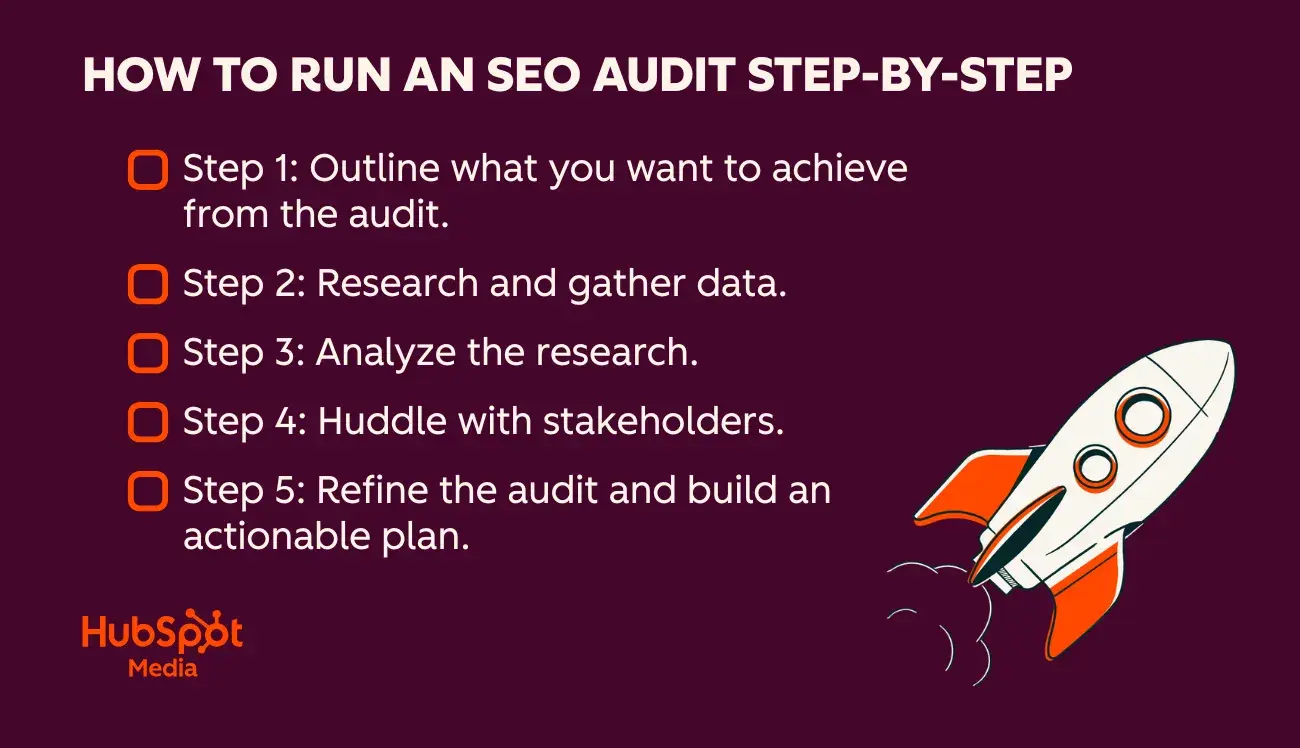
An effective SEO audit follows a straightforward process, from setting intent to translating data into strategic action.
Here is a simple five-step framework I use with clients to stay focused.
Important: Although I call this an “SEO audit,” it should always include AEO (Answer Engine Optimization) and GEO (Generative Engine Optimization) to reflect how people discover brands today.
Step 1: Describe what the company wants to achieve with the audit.
When defining the purpose of your audit, you need to be clear about it Why You do it and what problems you want to solve. Every audit should start with business goals, not just a list of technical checks, and every SEO audit improves website traffic and conversions. Still, SEO consultants or SEO team members creating the audit should ask what the underlying problem is and focus their efforts on the pages, templates, and metrics that matter most.
Here’s how:
- Talk to stakeholders and ask: What triggered the need for an audit?
- Identify whether the problem is a loss of traffic, declining conversions, falling rankings, poor AI visibility, or venturing into a new market/topic.
- Map the problem to specific pages, funnels, or content clusters.
- Document what success looks like (e.g. “recover 20% of lost traffic,” “improve visibility of AI responses for X topic,” “increase conversions on high-intent pages”).
- Set the boundaries of the audit so you don’t end up analyzing the entire site without guidance.
Note: An audit is good practice; Sometimes the purpose is to give SEO specialists a chance to step back and look at the site with fresh eyes. However, as a best practice, every planned audit should have a purpose or goal.
Before I pull data, I clarify what the company wants to solve. When a client tells me they’ve lost traffic, conversions are down, or a new product isn’t ranking, I design my review around that problem. This gives me a clear roadmap. I know which pages are most important and which elements or metrics deserve the most attention. That doesn’t mean I ignore everything else. My rule is simple: everything that comes to mind ends up in the inspection document. There is no need to record the results as the person conducting the audit will prioritize them later.
Step 2: Research and collect data.
Research and data collection is the phase where SEO specialists collect all the quantitative signals that show your website’s performance. It is the fundamental level of any SEO audit.
You could drag:
- Rankings
- Traffic trends
- Technical errors
- Backlink data
- Content performance
- AI visibility metrics
Pull all data together in one place, e.g. B. in a Google spreadsheet.
Pro tip: Keep this information safe as it will also serve as a benchmark for your next audit. If everything is in order, the next audit should demonstrate an increase in metrics such as rankings, traffic and AI visibility.
Here’s how:
- Pull data from core platforms like Google Search Console, Google Analytics, your CMS, crawl tools, backlink tools, etc AI visibility tools.
- Export everything to spreadsheets or Excel and use conditional formatting to help with analysis.
- Set up conditional formatting to highlight anomalies (e.g. pages with high impressions but low click-through rates, URLs with 404 errors, slow Core Web Vitals, orphaned pages, thin content, redirects).
- Collect data about competitors: ranking keywords, backlink gaps, content performance and AI search visibility.
- Organize your tabs by topic – tech, content, on-page, backlinks, local, AI – so patterns emerge.
At this point I collect everything – exports from crawlers, GSC, analytics and backlink tools. This is what I call the “cookie cutter SEO” phase: the tools do most of the heavy lifting, and technically anyone can do it. I move all the data into sheets, set up conditional formatting, and highlight anything unusual. I’m not trying to solve anything yet; I simply collect and analyze the raw material.
Step 3: Analyze the research.
With human analysis, raw data becomes insight. This is the strategic level of testing; the part that tools can’t do for you. A sophisticated SEO reads between the lines, connects patterns and understands Why The problems exist and how they affect traffic, rankings, conversions and AI visibility. This is where the audit stops being a spreadsheet exercise and becomes a roadmap.
Here’s how:
- Interpret the patterns in your data: declines, peaks, plateaus, and anomalies.
- Identify Causesnot just symptoms – for example, whether a ranking decline is due to algorithm changes, content quality, technical setbacks or stronger competitors.
- Connect your insights to user behavior – where people land, where they bounce, what content they trust, and on which pages they convert.
- Evaluate how the website performs under traditional search engine optimization And AEO/GEO – Entity clarity, thematic authority, and how well the brand is referenced in AI output.
- Start by grouping results by topic (technical, content, on-page, authority) and by impact.
- Determine which findings are actually crucial and which just clutter the audit.
What is crucial: Tailor SEO insights to your business strategy – product priorities, revenue-driving pages, seasonal demand, campaigns and sales goals. Review the team’s notes and comments from step one.
At this stage I start to develop ideas about where we could take the site. For example, if a brand tells me they’re interested in reaching a specific audience, I silently identify opportunities to do so and record all the insights in a spreadsheet.
Even if I have clear instructions from the customer in step one, I like to meet again in step four. Until then, we can review the SEO data and determine if priorities or goals need to be changed. Sometimes the data completely matches what the customer said in phase one; If so, a quick confirmation would be helpful before I start creating the plan.
Step 4: Exchange ideas with stakeholders.
This phase is where your SEO insights meet the reality of the business. At this stage, SEO specialists can work with stakeholders to ensure the recommendations make sense in the broader context of strategy, priorities, capacity and upcoming campaigns. This step validates your assumptions, fills gaps in your knowledge, and ensures the review doesn’t take place in a vacuum.
Sometimes reviewing the website through the lens of an SEO audit reveals new insights that require discussion. For example, identify an untapped audience segment, a high-potential content cluster, or a topic area that wasn’t mentioned in the first step but could provide significant value to the company. This is the moment to present these insights and focus on what really matters for the future.
Here’s how:
- Share a summary of key findings rather than the full table. Stakeholders don’t need to see everything (unless they really want to!). Focus on themes and patterns.
- Ask stakeholders to validate the context: upcoming product launches, resource constraints, sales feedback, seasonal trends, or known technical limitations.
- Acknowledge the importance of the high-impact pages you have identified. Some of these may no longer be a strategic priority. Others might benefit from other resources such as advertisements or social media to make them aware of what’s coming.
- Discuss any surprises that came up during the audit – traffic declines, content gaps, lack of schema, or AI visibility issues.
- Align yourself with what success looks like – what goals are most important and what timelines are realistic.
Identify the owners (SEO, content, developer, product, design) early on so it is clear who will handle each recommendation.
Important: By the time you’ve reached this stage, you probably have a pretty clear idea of where you want your strategy to go. Get stakeholder approval before creating it.
This is one of my favorite stages of the SEO audit checklist. As a consultant, I am initially a passive listener to the website’s performance. At this stage I have knowledge What’s wrong. I’m excited about the project and have my own insights. This meeting has more energy and more insights will be released. When data supports ideas, it is encouraging, exciting and motivating.
Step 5: Refine the audit and create an actionable plan.
This is the moment your insights become real strategy. After consulting with stakeholders, refine the audit into a clear, prioritized plan that the company can actually implement.
It is not enough to list problems. The value of an audit lies in translating findings into structured actions with owners, timelines and expected results.
This step transforms the audit from a diagnosis into an actionable roadmap.
Here’s how:
- Review all the results and filter out anything that has little impact or is not actionable.
- Prioritize recommendations using a simple framework such as “impact vs. effort” or “now/next/later.”
- Combine related topics into topics or projects (e.g. “Content Update Sprint,” “Template Cleanup,” “AI Visibility Improvements”).
- Assign owners to each element: SEO, Development, Content, Design, Product. Accountability is so important for taking actions.
- Add estimated effort and dependencies to help teams plan realistically.
- Link each recommendation to the business goals identified in steps one or four.
- Create a clear, understandable roadmap: what needs to be fixed first, what will drive sales or visibility, and what can be parked for later.
- Provide optional “quick wins” lists to help teams build early momentum.
A well-structured plan makes the audit usable so the company can respond week after week, rather than a document that sits in the archives gathering dust.
I want my audits to be actionable so that everyone can execute the document with the confidence to implement it. I assign owners, estimate effort, and rank recommendations by impact so the team knows exactly where to start. This is the step where the audit stops being just a list of interesting findings and becomes a clear, focused execution plan that actually delivers results. If I’m working with the company long-term on the implementation, I take over the audit and manage the measures in a project management tool like Asana.
How to interpret your SEO report and prioritize fixes
SEO specialists should prioritize audit results based on impact, effort, and ownership. The real effect unfolds in the interpretation of the SEO audit. Once the SEO team has collected its findings, the next step is to convert them into a clear, prioritized plan for the company to act on. Here’s what’s most important and where you should start.
Here are some ways to interpret the SEO report, in the order I would prioritize:
Prioritize fixes that unblock crawling and indexing.
Anything that prevents search engines from crawling or indexing important pages should be high on the priority list. These issues, like accidental noindex tags, broken internal links, or broken robots.txt rules, can immediately impact visibility.
Fixing them often results in the fastest and most noticeable increase in traffic.
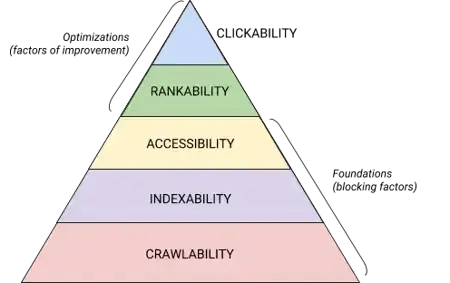
These five categories (crawlability, indexability, accessibility, ranking ability, and clickability) and how they stack up within the The technical SEO hierarchy is best illustrated in this graphic, which reflects Maslow’s hierarchy of needs but reinterpreted for search engine optimization.
Flag issues with real business risk.
Some results require immediate attention, not for SEO reasons, but for sales or reputation reasons. Security vulnerabilities, interrupted checkout flows, incorrect pricing pages or inaccessible and incorrect forms should be treated as non-negotiable priorities. These have a direct impact on conversions and trust.
Align tasks with business goals.
SEO specialists should prioritize the content clusters and pages that support the company’s specific goals, be it reaching a new audience, promoting a key product, or expanding into a new region.
An SEO audit should always reflect the direction of the company.
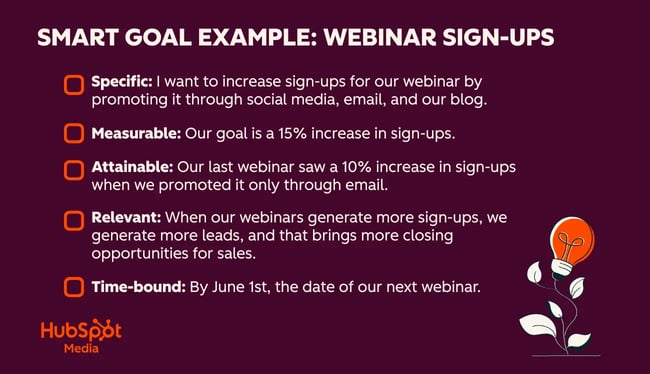
Pro tip: Ask stakeholders to do this CLEVER Goals, so they are specific, measurable, achievable, relevant and time-bound. The graphic below shows what SMART goals look like.
Identify content updates that support multiple channels.
Prioritize content that does more than just rank. Pages that support SEO, email nurturing, sales promotion or product training add value. A high-quality asset can bridge gaps across multiple touchpoints, especially when tied to a defined content cluster or campaign. HubSpot’s free AI content writer can help with this step.
Complete high-impact, low-effort achievements first.
Look for actions that take less than 30 minutes and deliver measurable improvements.
Updating a title tag or adding a favicon can make a big difference. Sometimes all it takes is moving the needle, and if that’s the case, just get it done.
Adding a few internal links, compressing images, or deleting an irrelevant, outdated page can get actionable work started and build momentum early in the process.
Pro tip: Celebrate the small successes, especially when other departments, such as B. Developers working on the project. A little positivity is motivating and these small, tricky tasks are surprisingly impactful. The goal? Motivate the team to complete the work.
Cluster recommendations into sprints.
Group related issues so teams can work efficiently. A “Page Speed Sprint,” “Schema Sprint,” or “Content Refresh Sprint” helps teams stay focused and reduce context switching.
This makes implementation smoother and helps achieve improvements faster.
You can also report on each sprint as it is completed and show everyone the fruits of their labor.
Focus developer time on site-wide and template-level issues.
Developer resources are usually limited, so use them wisely. Prioritize fixes that impact the entire site: template-level speed issues, schema improvements, navigation changes, or structural improvements. These updates can affect hundreds or thousands of URLs at the same time.
Pro tip: Do you want to improve your SEO skills? The HubSpot Academy SEO course will help teams learn the skills needed to carry out SEO work that gets results.
Tools to conduct an SEO audit
With the right tools, you can prioritize your audit faster, more accurately, and much more easily. Below are the tools I use most often.
HubSpot AI Grader
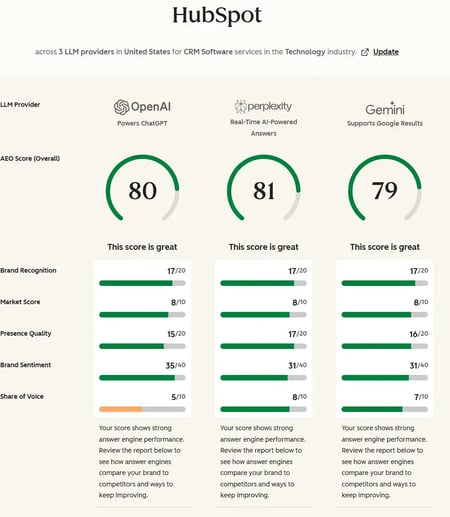
AEO from HubSpot Graders is one of the best tools for an SEO audit with AI insights. The AI Search Grader evaluates the visibility of brands and companies in AI search results. It evaluates how well your brand appears in AI search results, including generative engines, answer boxes, and conversational interfaces. This directly aligns with the AEO/GEO components highlighted in this article: legal personality clarity, authority signals, and brand visibility are now essential components of a complete audit.
What it is: HubSpot’s AEO Grader is a free tool that analyzes your website’s AEO (Answer Engine Optimization) and GEO (Generative Engine Optimization) readiness.
Why it matters: Traditional SEO audits do not provide insight into how AI systems interpret your brand. The AEO Grader does. It evaluates entity strength, content signals, structured data, and authority markers, all of which have a large impact on whether your brand appears in AI-generated responses.
Best for: HubSpot’s AEO Grader is best suited for marketers who want to go beyond traditional rankings and understand how AI search systems perceive their website.
Prices: Free
Read more about AEO in this comprehensive guide.
HubSpot Website Grader
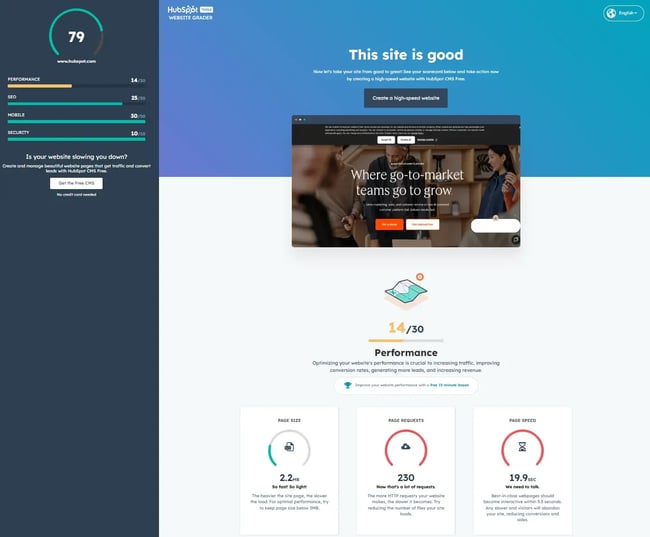
HubSpot’s website grader is one of the easiest ways to get a quick overview of your website’s SEO health. Marketers can use free tools like Website Grader to start an SEO audit; It fits perfectly with the “Quick Wins” section of this article. The tool uncovers issues related to speed, metadata, and basic technical hygiene that can be addressed early in the review process.
What it is: HubSpot Website Grader is a free tool that grades your website’s SEO, performance, mobile usability, and security.
Why it matters: HubSpot Website Grader provides a quick, easy-to-understand entry point into your audit before diving deeper into technical or competitive analysis. This is helpful for finding quick solutions that take less than 30 minutes.
Best for: HubSpot Website Grader is best for marketers who want to get a simple, high-level overview before pulling data from more extensive tools.
Prices: Free
Semrush
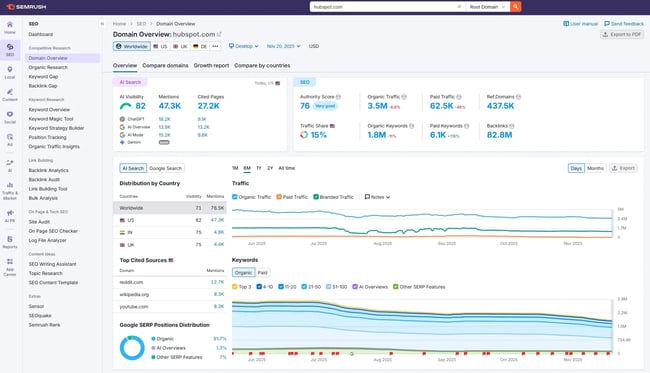
Semrush is one of the most comprehensive SEO platforms on the market. I’ve been using it for over 10 years. As mentioned earlier in this article, it continues to excel at keyword research, content insights, competition tracking, and now AI/LLM-driven recommendations.
What it does: A complete SEO toolkit that includes keyword research, competitor analysis, backlink audit, content insights, website audits and AI search intelligence.
Best for: Marketers or consultants who want comprehensive keyword data, competitive insights, and reliable reporting.
Prices: Plans start at $165/month and are billed annually.
Screaming frog
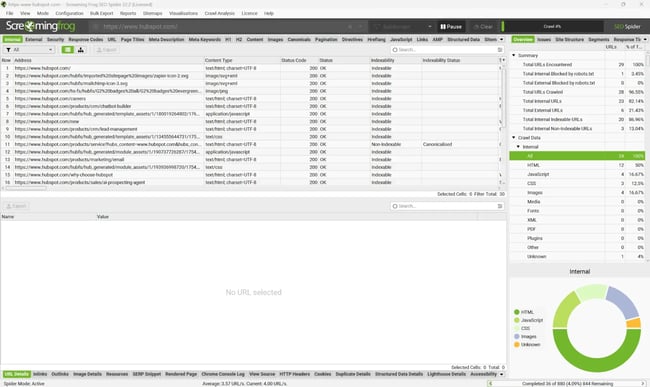
Screaming Frog is a must for technical audits, especially when dealing with issues like orphan pages, broken links, redirect chains, thin content, or missing metadata.
What it does: A fast, locally installed crawler that scans your website and uncovers any major technical issues.
Best for: Technical SEOs or marketers who want precise, crawl-based insights. To use this tool, you need to know how to gain insights from your data. Unlike the HubSpot tools listed here, it doesn’t provide insights.
Prices: Free version, plus licensed version for $279/year.
Marketing from HubSpot And Content Hub
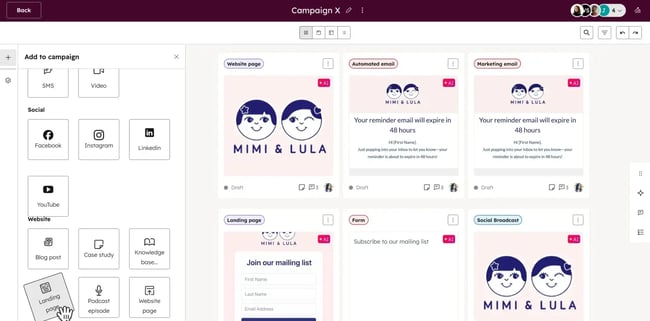
Together, HubSpot’s Marketing Hub and Content Hub make marketers unstoppable.
HubSpot Content Hub combines content management with built-in SEO intelligence, making it perfect for addressing many of the opportunities uncovered by an SEO audit, particularly those related to metadata, content quality, or stale content.
What it is: HubSpot’s Content Hub is a CMS with AI-powered SEO recommendations, content suggestions, and intelligent content tools that support editorial and technical improvements.
Why it matters: Content Hub helps optimize metadata, improve on-page signals, and manage content clusters.
Pro tip: SEO specialists and writers who use Breeze AI in the Content Hub automate content production.
HubSpot Marketing Hub includes SEO tools that link directly to your website data, content strategy and reporting, making it easier to find actions and implement the roadmap created in step 5 of your audit.
What it is: HubSpot’s Marketing Hub is a comprehensive marketing platform that includes SEO recommendations, content optimization tools, analytics, and reports.
Here’s a screenshot from Marketing Hub’s SEO report.
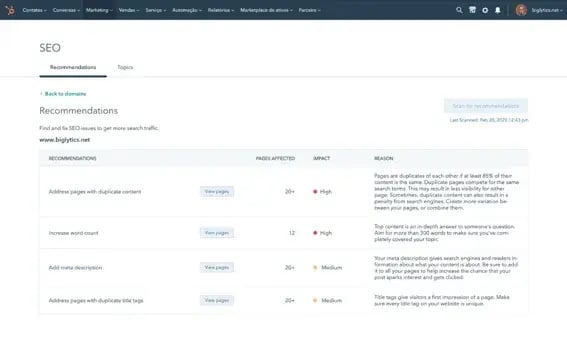
Why it matters: Marketing Hub connects your SEO insights with real business results. Track performance, analyze SEO growth, manage content clusters, assign tasks, and measure the impact of your audit on traffic and conversions.
Prices: Free plan; Starter – $9 per seat/month; Professional – $800/month; Enterprise – $3,600/month
Useful resources:
Frequently asked questions about SEO audits
How long does an SEO audit take?
Most SEO audits take between two and eight weeks, depending on the size and complexity of the site as well as the depth of reporting. For example, smaller websites can be completed in a few days, while corporate sites with thousands of URLs, multiple templates, and complex technical structures take longer.
The analysis and stakeholder alignment phases often take the most time and are the most important. While a large portion of the exam involves data collection and is fairly subjective, there are areas (e.g., brainstorming content) that require creativity. In my experience, creativity takes time to develop. Rush your exam and risk missing out on creative ideas.
Do I need a developer to perform an SEO audit?
SEO specialists should not rely on developers for this run the audit, but developers are often required to do so implement Parts of it. SEOs can diagnose and document technical issues, but fixes such as template-level changes, Core Web Vitals improvements, structured data implementation, and JavaScript cleanup typically require development support. The audit itself identifies the work; The developer helps with the execution.
How often should you do an SEO audit?
Most companies benefit from a quarterly, semi-annual or annual audit. Regular SEO audits help maintain and increase search performance over time.
Fast-moving businesses, sites with frequent content updates, or companies heavily impacted by changes in AI search may benefit from more frequent reviews. Conduct a full audit at least once a year to assess performance and identify unexpected declines.
What tools do I need for a free SEO audit?
You can perform a simple audit using free tools including:
These tools cover core areas: crawlability, indexability, content quality, and AI search visibility.
What is the difference between an SEO audit and a website audit?
A SEO audit focuses on the elements that influence rankings, visibility and conversions – technical health, content quality, backlinks and AI visibility.
A Website audit is wider. This can include UX design, accessibility, CRO, branding, navigation, and overall website performance.
You can think of an SEO audit as one part of a complete website audit. Both can be combined, but the SEO audit is more specialized and tied directly to traffic growth and search performance.
Modern SEO audits go beyond blue links.
A well-conducted SEO audit not only uncovers problems; It turns your website into a growth engine. By reviewing your technical health, content quality, authority signals, and AI search visibility, you can achieve quick wins, develop a long-term strategy, and create a roadmap that directly supports traffic, conversions, and pipeline.
Remember: modern audits go beyond blue links. They evaluate how well your brand appears in generative search and whether your content is truly understood as a whole. If you want a quick and accurate overview of your current status, tools such as… are available HubSpot Website Grader And HubSpot AEO Graders Make it easy to assess both SEO fundamentals and AI visibility in minutes.
In my experience, audits are most effective when they are based on business objectives and conducted collaboratively. I love the point in the process where the data clearly matches what stakeholders intuitively sense – or reveals something completely unexpected. When an audit is done well, teams leave focused, confident and energized because the path forward is so clear. That’s the sign of a great exam: one that doesn’t just diagnose but inspires action and produces real results.