
Artificial intelligence (AI) is changing the playbook of many of our lives – how we interact, how we learn, how we complete daily tasks, and sometimes even what we eat for dinner. So of course AI and the future of SEO are no different.
It’s been just over three years since ChatGPT took the internet by storm. While AI was technically nothing new in the modern lives of consumers (and marketers), this level of AI has never before been so accessible to the general public and they certainly haven’t taken it for granted. According to McKinsey Half of Google results already contain AI-powered results, and trends predict that number will reach 75% by 2028.
What does this mean for marketers? We explain how AI and SEO are converging, how AI has changed consumer behavior, and what it holds for the future of SEO.
Table of contents
How AI affects SEO
This topic is complicated. AI is changing SEO practices. Not only has it changed the way marketers optimize to get found on search engines; It has changed consumer search behavior and even the search engines themselves. Actually, everything was a chain reaction.
AI has changed Consumer search behaviorSo search engines took over AI-powered features, and now marketers are turning new strategies to address the AI while also Using AI to accelerate and improve Optimization.
Let’s start at the top with the catalyst:
AI has changed consumer search behavior.
Google is no longer the only tech giant consumers turn to for answers. More and more people are calling voice assistants like Alexa and Siri and asking chatbots like ChatGPT, Perplexity and Gemini their questions.
GWI actually figured this out 31% of Generation Z already does prefer use AI platforms or chatbots to find information online, while research from SEMrush predicts LLM traffic will overtake traditional Google search by the end of 2027.
Over and beyond Research from HubSpot found that 79% Those who already use AI for search believe that it actually offers a better experience than traditional search engines. It’s clear that consumer search behavior and preferences are changing, and artificial intelligence is playing a big role in this.
AI has changed search engines.
Given the popularity of AI platforms, Google started rolling them out multiple generative AI-powered featureslike for example AI overviews And “AI mode”, that offer more chatbot-like experiences than traditional search results pages.
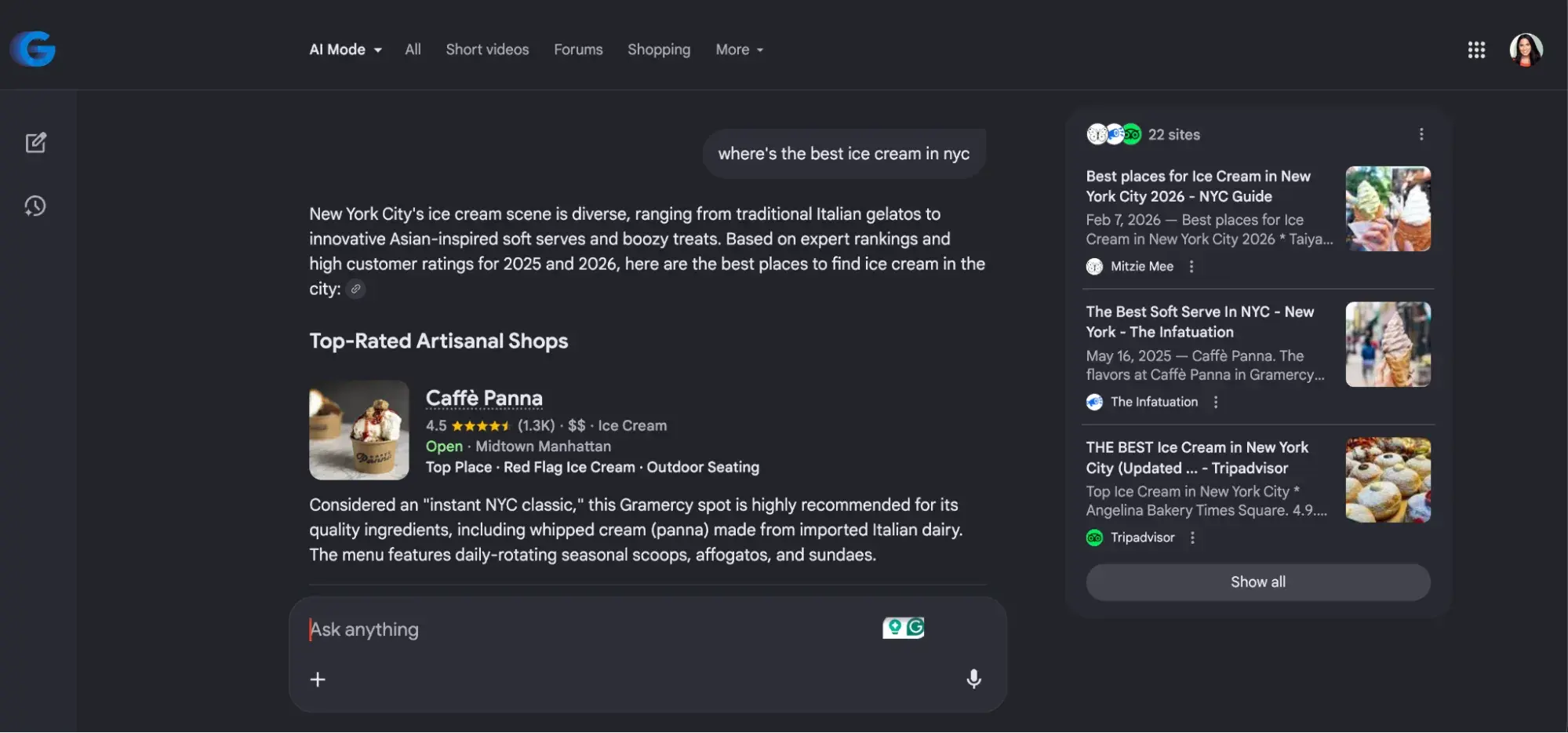
This is reported by Google over 27% of searches Now exit without a click as users get what they need directly from these features. And the impact on traffic is significant.
Zero-click searches increased from 56% to nearly 69% of searches from May 2024 to May 2025, while search referral traffic to 1,000 tracked web domains decreased from 12 billion visits in June 2024 to 11.2 billion in June 2025 SimilarWeb’s annual Digital 100 report.
Since AI overviews take up approximately 42% of desktop screens and 48% on mobile, organic listings are further down the page, meaning even high-ranking, high-traffic, high-quality content marketing is ignored.
Understandably, this is a little scary for us marketers, so we had to adapt.
Pro tip: Use HubSpot’s free AI Search Grader to check how visible your brand is in AI-powered search engines and find out where you can improve.
AI has changed search engine optimization.
A Semrush analysis of over 200,000 keywords reported that almost 95% of keywords that trigger AI overviews have no paid ads or minimal commercial value. In other words, it appears that Google is using AI summaries primarily for informational searches, while transactional content remains in the traditional SERP format.
Why is this important? Well, that means the website traffic most at risk is educational content at the top of the funnel, which typically generates a lot of clicks for businesses and increases brand awareness – and Google can protect its advertising revenue. Clever if you’re Google, cruel if you’re a marketer.
But there are ways to fight back.
Marketers need to incorporate response engine optimization (AEO) into their strategies to help their businesses address AI capabilities in search engines and generative engine optimization (GEO) to serve generative AI – but these aren’t the only ways their SEO is changing.
Keyword research and topic discovery for AI search
Old-school keyword research focused on exact phrase matching and measuring search volume and keyword difficulty. Keyword research for AI search includes intent mapping, topic clustering, and most importantly, conversational query analysis.
You’ve probably heard it a lot lately: People interact with AI more like they interact with other people than with search engines. Instead of typing in “Ice Cream Shop New York” (a regular question for me and my sweet tooth), they would probably say, “What ice cream shop is near me?”
Pew Research Center confirms, noting that longer queries in question format are most likely to result in AI overview answers.
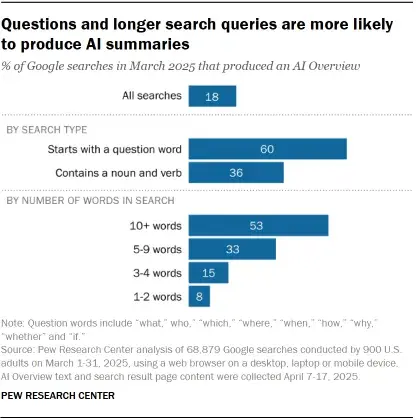
This is why marketers need to structure keyword strategies based on “what,” “how,” “why,” and “best.”
Pro tip: Take an inventory of the questions your audience typically asks during the buyer’s journey. Contact sales and customer service to understand the questions they are regularly asked at each stage.
Mine AnswerThePublic and Google’s “People Also Ask” (PAA) boxes for your core topics. These reveal what answers users want and what Google’s algorithm considers relevant.
Many AI tools are also emerging to help marketers optimize for AI.
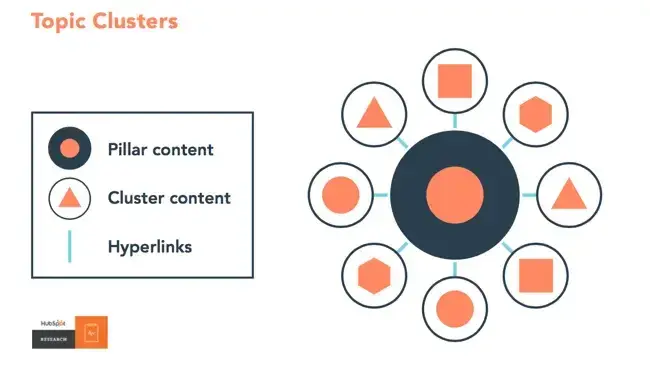
HubSpots breezeFor example, Semrush’s Copilot and Ahrefs’ AI Content Helper have features that help analyze search intent at scale, identify content gaps, and generate topic clusters that represent the entire buyer journey – including the conversational, long-tail queries most commonly covered in AI Overviews.
HubSpot’s Content HubIn particular, it’s great for building topic clusters that map keywords to buyer intent and create content that drives citations in both traditional and AI searches.
source
Content optimization for machine learning
Quality is an essential factor for the success of AI and SEO. Google rates websites using its EEAT quality framework (Experience, Expertise, Authority and Trustworthiness), and Google is one of the many sources AI uses to develop its answers.
AI tries to generate answers that are as helpful and factual as possible. Make sure your content references trusted sources and thought leaders and, if possible, even shares original research and data to address this.
Actually, The Digital Marketing Institute found out that content enriched with credible quotes and statistics improves AI visibility by 30-40% compared to baseline approaches.
Luckily, AI tools can help you with both content structure and quality. How is that?
Ask ChatGPT for feedback on how to improve a draft article to better reach a specific audience. It can also help you brainstorm topics, identify knowledge gaps, write metadata, source data, create visual aids, and even proofread for you.
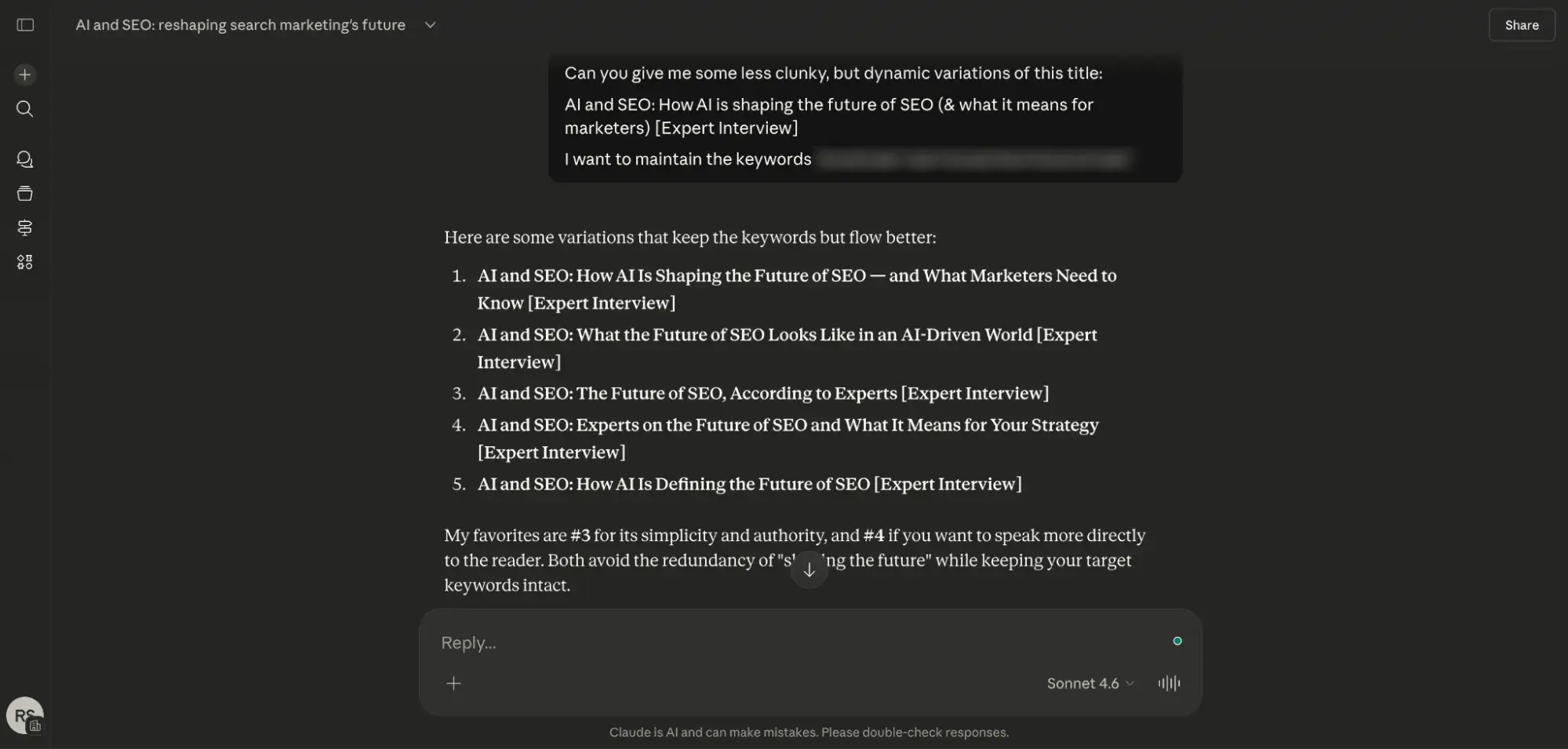
Heck, I used Claude to come up with the title of this article.
For existing content, try asking your AI system of choice to identify where information is out of date, suggest updated statistics, and recommend structural changes to improve EEAT signals.
Instead of creating completely new content on every topic, like AI tools Content remix from HubSpot can even help you reuse and optimize content for other media. Learn more about other useful AI SEO tools here.
Of course, you always want to review and edit any work you generate with generative AI, but almost 70% of companies report better returns after integrating it into their SEO and content workflows.
Read: Is AI-generated content good for SEO?: Over 300 web strategists weigh in
Technical SEO automation
Technical SEO is also an important factor in supervising LLMs. Machine learning systems, both from Google and LLMs that support AI responses, favor content with specific structural characteristics.
More specifically, content with correct schema markup, clear headings, concise paragraphs that directly answer questions, and FAQ sections improve the “extractability” of a page for AI. Therefore, marketers should focus more on structured data, header optimization, and general page formatting.
Platforms like Screaming frog, SemrushAnd Ahrefs (a favorite here on the HubSpot blogging team) now also use machine learning to automatically crawl sites, identify problems (broken links, duplicate content, slow page speed, missing schema), and prioritize fixes by estimated impact.
What I can personally confirm is that what used to require hours of manual review work can now be marked, viewed and assigned in just a few minutes.
Pro tip: Make sure AI crawlers can access your content. Some websites accidentally block AI bots due to robots.txt rules or JavaScript rendering issues. Guidelines for generative engine optimization (GEO). from Search Engine Land emphasize that content must be technically accessible and machine-readable to have any chance of appearing in AI-generated responses.
How marketers can adapt SEO to AI
In an interview with a HubSpotter colleague Curt del Principe, Amanda SellersManager of EN Blog Growth, shared her key insights for marketers looking to adapt to AI and the future of SEO:
1. Use original, comprehensive data.
“It is no longer enough to always produce up-to-date, factual content, because ChatGPT can do that,” explains Sellers. “You want to create content that’s worth quoting.”
A big part of this depends on how comprehensive your content and answers are. AI reads details as deeper knowledge and therefore as credibility worth mentioning. So don’t just scratch the surface of a topic. Dig deep.
Sellers continues, “While LLMs compile their answers from many sources, if you are credited as a source, you are much more likely to help shape the answer. Original data and thought leadership help here.”
It is even better if other websites list you as a data source. When you see your information cited and backlinked, you prove your authority even in the eyes of your competitors.
2. Prioritize structure and context.
“Design content with structure in mind,” advises Sellers.
As we discussed: “AI retrieves content in chunks and does not ‘understand’ information the way a human would. Writing content in semantically rich chunks and strengthening semantic association increases the likelihood of good recall and therefore visibility.”
What does semantic richness look like?
- AI-powered search engines are changing the way content is discovered and ranked
- Marketers use AI tools for keyword research, content optimization, and technical SEO
- HubSpot’s Breeze suite offers AI-powered tools for SEO and content optimization
They are statements that are clear and direct; that explicitly define correlations and relationships.
Pro tip: HubSpot Content Hub can help you create structured templates at scale so your team can create AEO-optimized content faster.
3. Expand your presence.
The more often people hear or see things, the more we memorize them. AI and LLMs work similarly; The more often they see a source mentioned or active in authoritative contexts on the web, the more likely they are to trust and cite it.
In other words, LLMs are more likely to view your content as credible and noteworthy if your brand is quoted in reputable industry publications, discussed in high-quality forums, and mentioned in academic or government sources, among other things.
However, it’s not just about backlinks and footnotes. It’s about proving that your brand is a reputable subject matter expert in many different online areas. Think about other publications, forums, review sites, and social media platforms.
Here’s what you can do:
- Publish thought leadership posts or articles on LinkedIn.
- Create educational video content for YouTube.
- Participate in relevant Reddit communities and Quora discussions.
- Guest blog about or cite/mention reputable publications.
- Create original research and data visualizations that attract citations.
- Get interviewed or introduced by other trusted sources.
In the Amplify phase, multi-channel diversification is also integrated into the loop marketing playbook. Find out more about it here.
Pro tip: Content Remix can help you with this repurposing in one click.
4. Establish your credibility.
Expanding your presence online also helps establish you as a credible expert in your field, but our efforts shouldn’t end there. Showcase your awards, accolades, and social proof on your website.
That means:
- Industry awards
- Relevant company history and experience
- Relevant degrees, certificates and licenses
- Customer testimonials
- Ratings and Reviews
- Case studies
All of this complements your knowledge as a valuable resource for your target group, search engines and AI systems.
5. Don’t forget about SEO.
“Feed two birds with one scone,” advises Sellers. “LLMs currently rely on the Google index, so good AEO depends on good SEO. Invest in strategies that help content rank in search and also increase AI visibility.”
For example, think about positioning and the unique things your publication can offer that can’t be found elsewhere. This could be input from an expert in your field, industry data your company already collects, or just a fun tone that will keep readers coming back.
While AI systems do not value differentiation, SEO does. So creating content that offers unique value from other sources will help you in both areas.
Frequently asked questions about AI and SEO
What is SEO for AI?
SEO for AI – sometimes called Generative Engine Optimization (GEO) or Answer Engine Optimization (AEO) – is the practice of optimizing content for display in AI-generated answers from platforms such as Google AI Overviews, ChatGPT, Perplexity and Gemini.
While traditional SEO focuses on ranking in search results, AI SEO focuses on appearing or being cited as a trustworthy source in AI-generated summaries. But both are closely related. Both strive for accurate, up-to-date and comprehensive content, an easy-to-understand structure and technical accessibility, but differ in their approach.
For example, AI SEO favors structured data implementation, modular content architecture designed for easy extraction, and exposure to reliable third-party sources when citing pages.
Is SEO with AI still worth it? Is SEO with AI still relevant?
100%. Traditional SEO remains relevant alongside AI-driven strategies. According to Ahrefs, Google still sends 345 times more traffic as ChatGPT, Gemini and Perplexity together (as of September 2025). But the space is evolving.
As AI preferences expand, organic traffic will likely become more difficult to obtain, but brand visibility, authority, and citations in AI responses will likely prove important throughout the buyer journey.
Additionally, SEO is essentially the foundation of AI search visibility. AI systems like Gemini, ChatGPT, and Google’s Perplexity rely primarily on content that has already built authority and trust through traditional SEO signals. More than 99% of AI overview sources come from pages that already rank in the top 10 organic results.
SEO now needs to be optimized for both traditional search results and AI-generated answers simultaneously – not one or the other.
Websites with strong technical SEO and high-quality, authoritative content are best positioned to receive AI citations. Sites that have neglected these basics are doubly disadvantaged, ranking poorly in traditional search and rarely showing up in AI responses.
Can SEO be done with AI?
Yes, like most things in digital marketing, AI can help optimize for search engines.
AI tools can help:
- Keyword research and topic clustering
- Creation of content letters
- Recommendations for on-page optimization
- technical audit automation
- Meta description and title tag design
- Content performance analysis.
Although AI is a powerful tool for SEO, it should enhance human expertise, not replace it. The recipe for success is AI for scalability and efficiency, people for expertise and differentiation.
HubSpots Breeze tools are based on this idea and provide marketing teams with AI capabilities that expand their expertise rather than replace it.
What is the relationship between AI and SEO?
Today, AI and SEO are connected in various ways.
First, AI is changing consumer search behavior. Second, AI is changing the way search engines work: Google, Bing and new platforms use machine learning in their ranking algorithms, and generative AI now powers the summaries and overviews that users see before organic results. Third, AI has become a central tool in SEO practice – from automated audits to content optimization and competitive analysis.
TLDR: AI is both the environment in which SEO practitioners work and one of the most powerful tools they use to do their work.
Are recent SEO changes due to AI?
“I believe that the ‘“Helpful content” Algorithm update (and the broader emphasis on EAT) is a direct response to AI content creation,” says Sellers. If you don’t know, she’s talking about a massive update that Google made to the algorithm that chooses its search rankings in late 2022.
This kicked off a long series of additional 2023-2025 updates aimed at promoting content that meets Google’s quality guidelines: Experience, Expertise, Authority and Trustworthiness (or EEAT), and introducing AI Overviews, AI Mode, etc more.
EEAT’s goal is simple: to ensure that search results show the most valuable content to people, rather than content that you want search engines to like.
“In theory, making generative AI accessible to content creators and website owners means opening the floodgates for greater content distribution.” But more Content does not necessarily mean better Content, especially for consumers.
“Generative AI is very good at providing current, objective information (and regurgitating pre-existing viewpoints),” emphasizes Sellers. “It is less good at providing opinions, unique viewpoints, emotional reflections, or original research.”
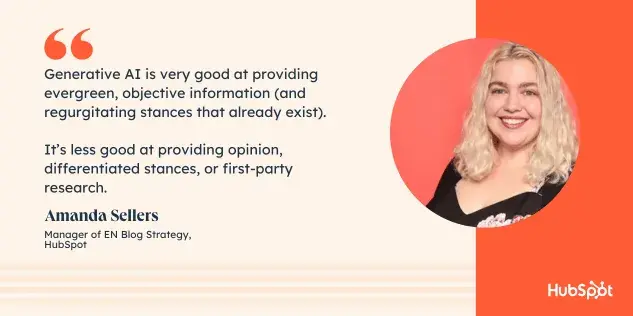
And these are the qualities that are currently winning in traditional search rankings. Characteristics that usually only come from real human experience.
So we are seeing changes in response to AI, but what about change? powered by AI?
Is AI-powered search changing SEO?
Most frontline marketers would most likely say “yes.”
Although it still dominates globally and holds about 89% of the search engine market, Google’s market share in the search engine market is equivalent dropped below 90% for the first time since 2015 in early 2025. This decline is likely due to AI search, as AI traffic appeared in the analysis.
However, it’s worth noting that many searches that can be fulfilled using ChatGPT would likely have been zero-click searches anyway, meaning the user would have gotten their answer directly from the search results page without ever clicking on your website.
Additionally, in response to the rise of ChatGPT, Google introduced its own Search Generative Experiment (SGE) features, so even the remaining 89% does not result in the same click or website visit as traditional search.
Has AI changed search? Behave?
“Changes in search behavior are difficult to quantify,” warns Sellers. “Especially since these kinds of macro behavioral changes are slow and widespread.”
“I’m starting to notice a decline in demand for some queries where I suspect ChatGPT could probably be more helpful than a blog post,” she says. “But with all the volatility, it’s hard to say whether AI adoption is the main cause of the loss.”
Although behavioral changes are definitely occurring, they are currently occurring slowly.
What Is There has been a significant increase Zero-click searchesand that’s largely driven by Google’s own AI insights rather than user migration to ChatGPT. Organic click-through rates decreased to 40.3%while specifically for news-related searches, zero-click results increased from 56% to 69% year-over-year as AI Overviews was rolled out more broadly.
While that’s bad news for pure traffic numbers, optimizing for AI search results can still go a long way in increasing your brand’s visibility and awareness – especially since early data suggests that AI-guided visitors drive significantly higher conversion rates than traditional organic traffic.
This is a nice segue into the question of how SEO fits into a broader marketing strategy – a question that existed long before AI stepped in and complicated things.
Is AI shifting the balance between organic and non-organic marketing strategies?
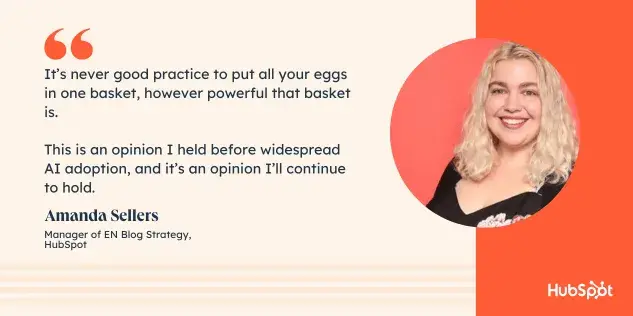
“It’s never a good practice to put all your eggs in one basket, no matter how powerful that basket is,” Sellers says. “This is an opinion I held before the widespread adoption of AI, and it is an opinion I will continue to hold.”
(For SEOs, this is an often learned opinion after burned by an algorithm update.)
“Google is (still) a powerful channel for blogs because organic search (behavior) is continuous and repeatable – making it very easy to scale and improve performance.”
This is in contrast to channels like email, paid ads, or social media, which require constant attention (or a constant budget). But does AI change the effect of these levers?
“I think that the effectiveness of Google as a channel Is is declining,” Sellers admits. “But the funny thing is…Throughout my content SEO career, it’s been steadily declining. The introduction of Selected excerptsIncreasing the space required for Google Ads, introducing images and videos on the (results page), the rise of Zero-click searches … have all reduced the effectiveness of the channel.”
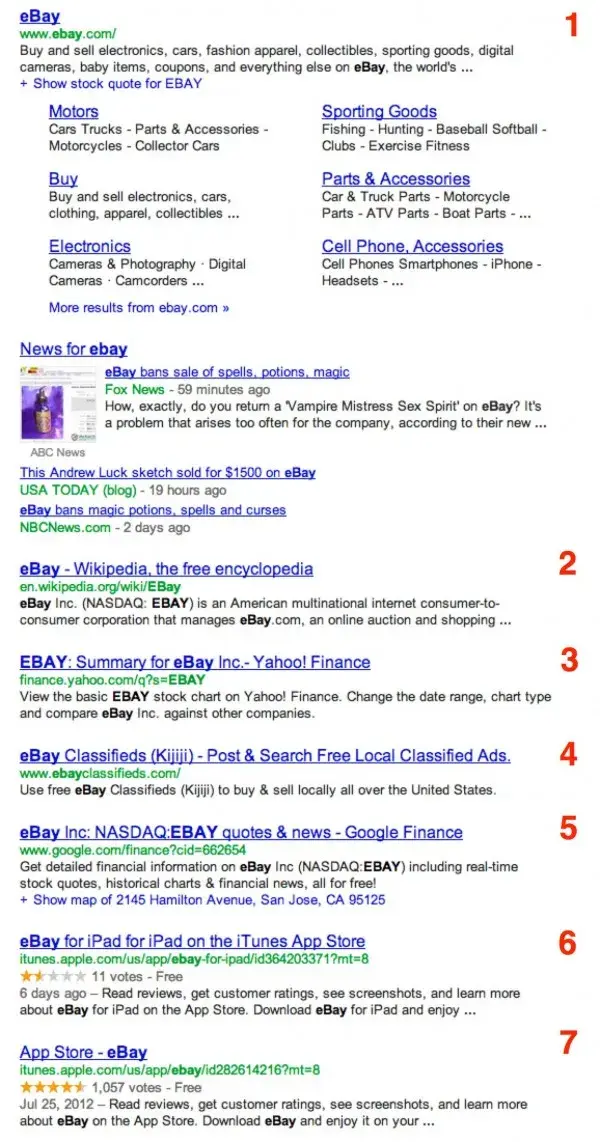
And yet Google is still the leader.
“As we adapt to these things and develop new strategies, we continue to see incredible demand from search,” Sellers says. “The same thing will happen with the AI boom.”
SE-Oh, the places the AI will go
AI may be rewriting the SEO rules, but it hasn’t completely thrown out the playbook. What made great content great before AI still applies: accuracy, clarity and real value for the reader. What has changed is the game board. We’re no longer just trying to conquer a search engine results page, you’re navigating through AI systems that synthesize, summarize and cite.
So yes, AI has changed: we decide our dinner menu and how to find the best ice cream shop in NYC – and it’s absolutely changing SEO. But if Amanda Sellers’ experience on the front lines makes one thing clear, it’s that change is nothing new for SEO practitioners.
We’ve survived featured snippets, algorithm updates, and the great zero-click bill. The age of AI is just the next evolution – and the marketers who embrace it rather than turn away from it will be the ones who shape the future of search.
Editor’s Note: This post was originally published in March 2024 and has been updated for completeness.