

When I first started learning about content and incorporating SEO into my strategy, I treated Page Authority like a report card: the higher the score, the better I did. It took a few humiliating losses to a competitor with a lower PA rating to make me change my mind.
It turns out that Page Authority is more of a compass than a finish line. In this post, I’ll explain what it actually is, how it’s calculated, what a good score looks like, and what you can do to improve it – so you can use it to guide your strategy, not just evaluate it.
Table of contents
What is Page Authority?
Page Authority (PA) is a metric created by a third party Moz This estimates the relative ranking potential of a given web page on a scale of 0 to 100. A higher score indicates that the page is more likely to be competitive on search engine results pages (SERPs).
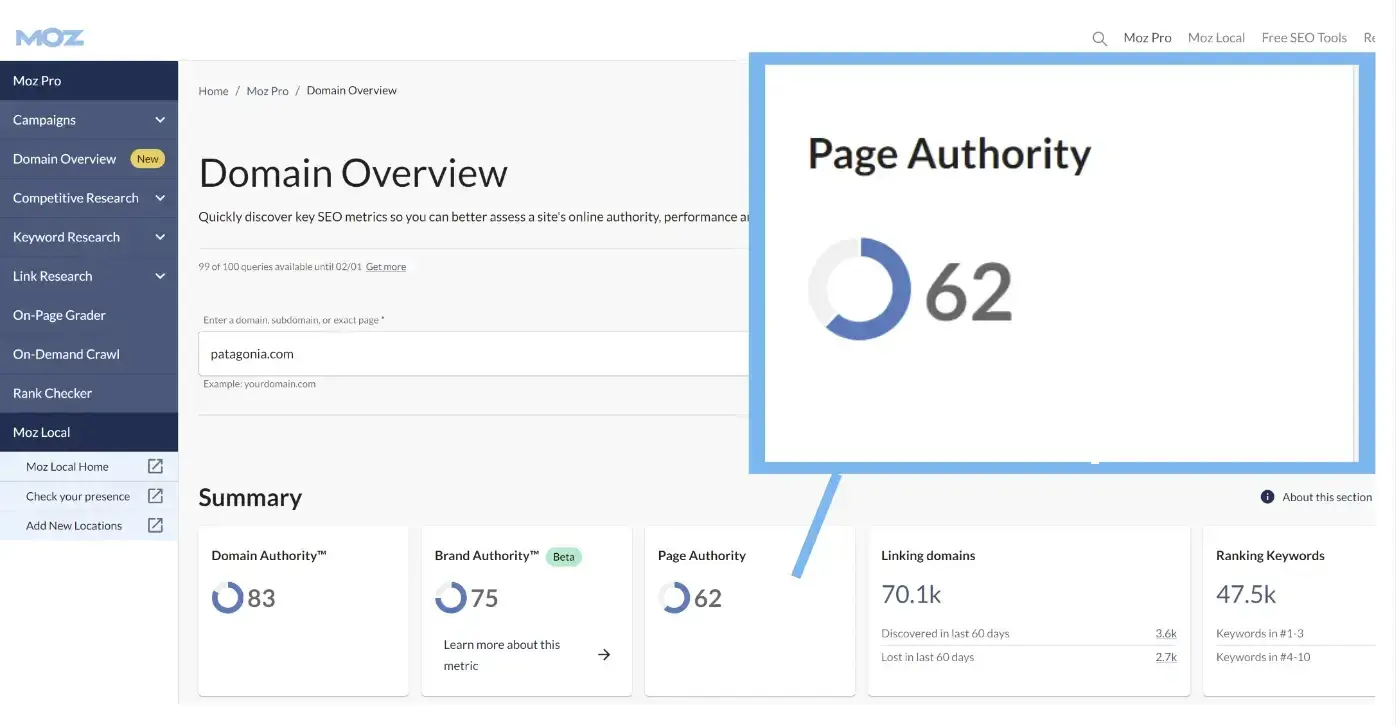
PA is scored on a logarithmic scale from 0 to 100, meaning that improvement becomes increasingly difficult to achieve as the score increases. Moving a page from a PA value of 20 to 30 requires far less effort than moving it from 70 to 80.
Moz calculates page authority using a machine learning model trained on thousands of search results data points. The primary input is the quality and quantity of inbound links pointing to a specific page. Other signals, including root domain linking and MozRank, also play a role.
Pro tip: Since PA is logarithmic, focus your energy on gaining relevant backlinks rather than worrying about moving the score a few points. The connections drive the movement, not the other way around.
An important clarification: PA measures a single page, not an entire website. If you want a domain level signal, that is the job of the Domain Authority (DA). I will discuss the difference in detail in the comparison section below.
Is Page Authority a Google Ranking Factor?
No. Page authority is not a Google ranking factor. Google does not publish a Page Authority score and does not use Moz’s PA metric in its algorithm.
Why is page authority still important? Because it correlates with rankings. Sites with strong PA scores tend to have strong backlink profiles – something Google cares deeply about. PA is a proxy, not a cause. When a page has a high PA score, it usually signals that the page has received credible links, a signal that Google respects.
What we like: Using PA as a comparative benchmarking tool rather than an absolute goal. If your competitor’s ranking page has a PA of 55 and yours has a PA of 30, this gap tells you something you can do about your link building opportunities. It’s the delta that matters, not the pure number.
My experience has taught me that the most dangerous thing a team can do is to set a PA goal as a KPI. When PA becomes a goal rather than a diagnosis, teams begin to seek score improvements through shortcuts such as acquiring low-quality links, which can harm long-term performance. Treat PA as context, not a scoreboard.
Page Authority vs. Domain Authority vs. PageRank
These three terms are often mixed up. Here’s a clear breakdown of each feature, when to use it, and what sets it apart.
Page Authority (PA): Created by Moz. Estimates the ranking potential of a specific page. Scored 0-100. Updated regularly based on Moz’s link index.
Domain Authority (DA): Also created by Moz. Measures the relative strength of an entire domain rather than a single page. A website’s DA score is influenced by the combined link equity across all pages. Learn more about Domain Authority here.
PageRank: A Google algorithm previously associated with link analysis. Google uses PageRank internally, but has not published public PageRank scores since 2016. PageRank is not a tool for practitioners; This is an internal Google signal.
Here’s a side-by-side comparison to make the differences clearer:
When to Use Page and Domain Metrics:
- Use Page Authority when analyzing a specific URL, such as a blog post, landing page, or product page.
- Use Domain Authority when evaluating a site-level link building strategy or comparing your domain’s overall strength to that of a competitor.
- Neither metric is superior; They answer various questions.
Pro tip: When evaluating link building goals, check both PA and DA. A low PA site on a high DA domain is often a good acquisition target because the domain has high equity but the specific site has room for growth.
What is a good Page Authority Score?
There is no one-size-fits-all answer because page authority is a relative metric. A PA of 40 could be great for a niche B2B services site and woefully inadequate for a highly competitive finance or healthcare keyword. Context determines what counts as a good score.
However, here is a general reference guide for interpreting PA results:
I’ve seen pages with PA scores in the 20s perform better than pages with PA scores in the 50s because the lower authority page matched the search intent significantly better. That’s why PA is a signal, not a guarantee. A targeted, technically sound page with strong on-page optimization can punch above its PA weight.
The most important measure is competition, not absolute. Use tools like Moz’s Link Explorer, Ahrefs, or SEMrush to analyze the PA scores of pages that currently rank in the top three for your target keyword. This area becomes your practical goal. You can also use Website AEO Grader by HubSpot to evaluate the overall performance of your website and interface gaps that could affect the authority of your pages.
How to check page authority
Page authority checking doesn’t require a single tool. The goal is to evaluate ranking potential and link profile strength at page level. Several platforms offer this data. Here is a tool independent process:
- Identify the specific URL you want to evaluate. Copy the exact URL, not just the domain. PA is site specific.
- Open a link analysis tool. Options include Moz Link Explorer, Ahrefs Site Explorer, SEMrush Backlink Analytics, or Majestic. Most offer free, limited queries or trial access.
- Enter the URL. Paste the URL of the entire page into the tool’s search bar and run the analysis.
- Record the PA score and note the number of linked root domains. The number of linking root domains is often more useful than PA alone because it shows how diverse the link profile is.
- Repeat this process to rank competitor pages for the same keyword. Perform the same analysis on the top three results for your target keyword and note their PA and link domain counts.
- Calculate the gap. If your site has a PA of 28 and the highest ranking pages have an average PA of 48, you now have a directed link building goal.
- Document and track the passage of time. PA fluctuates as Moz updates its index. Track month by month rather than reacting to day-to-day changes.
For continuous SEO performance tracking, HubSpot’s Marketing Hub SEO tools This feature allows you to monitor on-page optimization, keyword ranking, and content performance in one place, giving you the context to link PA data to real ranking results.
Best suited for: Teams conducting competitive content analysis should create a simple tracking table that logs the PA, DA, and link root domains of the top three ranked pages for each target keyword. Run this audit quarterly to see which content gaps have widened and which pages are on the rise.
How to increase page authority without manipulating the system
Chasing shortcuts is the quickest way to undermine a site’s long-term authority. Buying links, joining link programs, or overloading pages with exact match anchor text can put a strain on your PA in the short term, but they are also tactics that tend to attract algorithmic flags or manual penalties. Here’s what actually works based on that SEO best practices and lasting signal improvement:
1. Earn HOh-QQuality bAcklinks from Relegant SSources.
PA is primarily a link-based metric. The most effective way to increase this is to get links from pages and domains that are themselves authoritative and topically relevant to your content.
Tactics that work include original research (data studies, surveys, proprietary reports), creating truly useful reference content, developing tools or calculators that your industry will cite, and proactively reaching out to sites that link to similar competitor content.
What we like: Original data that makes your site a primary source. When a piece of content becomes a reference that others cite, the links form over time without additional public relations effort.
2. Strengths jour Iinternal lColoring SStructure.
Internal links distribute link equity across your website. A page buried without internal links will receive none of the authority flowing through your parent PA pages. Conduct a review of your ranking metrics while analyzing your internal link structure to identify pages that deserve links but are not receiving them.
The ideal internal linking strategy connects your highest value pages with the pages you want to rank most. If your homepage or cornerstone content has strong PA, make sure it links to your landing pages with descriptive, keyword-relevant anchor text.
Pro tip: Perform a site crawl using tools like Screaming frog or Ahrefs and filter for pages with heavy organic traffic but few internal links pointing to them. These are your quick wins for internal link equity transfer.
3. Produce CContents That Matches Slook InthsT
A site that generates clicks, reads, and repeat visits signals quality to Google, even if its PA is modest. Content that truly matches what searchers want tends to attract more organic links over time, which then drives up PA.
Before you optimize for authority, make sure the page does the basic job: fulfilling the request. A page with excellent intent targeting and a PA of 35 will often outperform a page with mediocre relevance and a PA of 55.
4. Keep Ttechnical Hhealth in Order.
Page Authority cannot do its job if the site has technical problems. Crawling errors, slow page speed, broken links, and poor mobile performance affect a page’s ability to rank, regardless of its PA score. Check sites for technical issues before investing in link building.
- Check for crawl errors and redirect chains
- Make sure the page exceeds Core Web Vitals thresholds
- Confirm that the page is indexable (not accidentally blocked by robots.txt or noindex).
- Fix broken internal and external links on the page
5. Update and Iimprove eavailable PAge.
Updated content signals freshness and often generates new links when citing updated statistics or insights. I’ve found that some of the fastest PA gains come not from new sites, but from significantly upgrading existing sites that already have some link equity. Adding new data, deeper analysis, or better multimedia content can prompt existing linkers to update their credentials and encourage new linkers to discover the page.
6. Build Toptically Aauthority Aaround the page.
Pages rarely rank in isolation. A single page about email marketing will rank better if it is part of a group of related, well-connected content about email marketing in general. Building a content cluster around a core topic distributes authority from supporting pages to the pillar page and signals to Google that your site has deep expertise in the field.
Best suited for: HubSpot’s Content Hub is designed for this approach, enabling teams to create interconnected content clusters with clear pillar pages, topic coverage, and internal links at scale.
7. Prioritize link DDiversity, Not Just vOlume.
Ten links from ten different relevant domains are more valuable to PA than ten links from the same domain. Moz’s model rewards linking root-domain diversity. When building links, prioritize reaching new domains over collecting additional links from sites that already point to you.
Page Authority FAQs
How often should you check page authority?
Monthly follow-up is an appropriate cadence for most teams. PA fluctuates as Moz updates its link index, which happens regularly. Daily or weekly checking introduces disruption and can lead to reactive decisions based on index crawl variations rather than actual link profile changes. A quarterly deep dive audit is usually sufficient to track competition.
Does internal linking increase page authority?
Internal links can improve page authority, but not directly. When you link from one page to another, some link equity transfers to the linked page, which can increase PA slightly. However, it is external backlinks that actually drive PA forward in a meaningful way. Internal links help you get more out of the authority your site has already gained – it doesn’t create new authority on its own.
Can a page with low page authority still rank?
Yes, often. PA is one signal among many. Low PA pages consistently rank higher than higher PA pages if they better match search intent, have stronger on-page optimization, or face low competition. For niche topics with a few authoritative pages, a PA of 15 or 20 can be more than enough to rank on page one.
Should I compare page authority across industries?
A cross-industry comparison of PA is not particularly useful. A PA of 50 in technology might be competitive, while the same score would be below average in the news or financial sectors, where large publishers dominate. Always compare PA to the actual SERP in which you want to compete, rather than an abstract industry average.
Why is my new site’s page authority so low?
New pages start with a PA close to 1 because they haven’t received any backlinks yet and PA is primarily a link-based metric. This is expected and normal. A new site won’t improve its PA through on-page optimization alone. Gaining the first few relevant backlinks, building internal links from established sites, and making the site available for indexing and crawling all contribute to gradual PA growth over weeks and months.
Are you ready to create high ranking pages?
Knowing your Page Authority score is just the beginning – the real work is matching content to intent, building targeted links, and keeping your technical foundation solid. HubSpot’s Content Hub and Marketing Hub SEO tools give you the infrastructure to do all three at scale.
Start improving your pages today: Download the AEO Guide to learn how to create content that answers questions, gains authority, and ranks.