
AI-powered email content suggestions are transforming the way marketing teams write, test, and scale email campaigns. Instead of guessing which message will resonate, marketers can now use AI to analyze data, predict interactions, and generate personalized content that leads to conversions.
But there’s a big difference between emails that sound good and emails that don’t sound good carry out.
In this guide, you’ll learn how to use AI email content suggestions to achieve better open rates, higher click-through rates, and measurable revenue impact.
Table of contents
What AI-powered email content suggestions are and why they matter
AI-powered email content suggestions use machine learning to tailor your subject lines, body copy, and CTAs to each audience segment and lifecycle stage. The system analyzes engagement data like open rates and replies to recommend which message, tone, or offer is most likely to lead to an action.
Practically this means:
- Generate Email subject lines to increase open rates
- Optimize email copy that generates more clicks and replies
- We recommend CTAs that move contacts from MQL to SQL faster
When connected to your CRM, AI turns raw interaction data into actionable insights. Instead of guessing what your audience is could When you respond, you’ll see which phrases, formats, and offers actually convert. As the AI tool collects and analyzes more data, it deepens these insights with each send.
The real benefit comes when these suggestions are applied internally automated email campaigns. This integration creates a feedback loop between your content and data, allowing AI to adapt to audience intent and performance signals in real-time.
Real results in practice: HubSpot’s own demand generation team used AI to transform its email nurturing strategy by analyzing user behavior and website data to provide hyper-personalized content recommendations.
By using GPT-4 to understand intent and match users with relevant courses, we achieved an 82% higher conversion rate, a 30% better open rate, and a 50% increase in click-through rates.
Read more about it in State of Marketing 2025 Report.
Best AI tools for email content suggestions
When it comes to email creation, the true power of AI lies in tools that integrate with your CRM and connect with your customer data. With this insider information, it’s easy to create compelling headlines or body copy.
Here are some top options to consider, starting with HubSpot’s Breeze Copilot.
1. Breeze Copilot from HubSpot
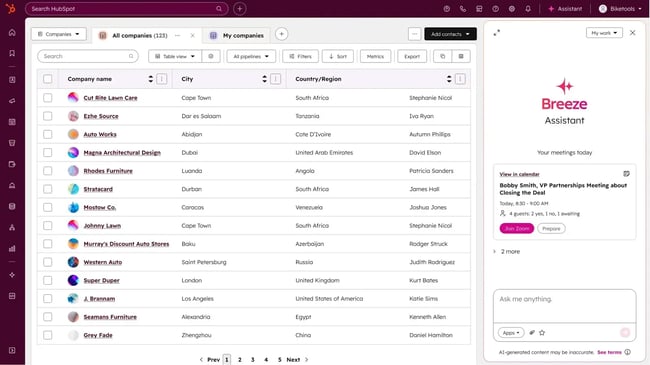
HubSpot’s Breeze Copilot integrates directly into HubSpot’s email editor, giving marketers an AI assistant that knows their audience as well as their CRM. It leverages existing data such as lifecycle stage, engagement history, and past campaign performance.
With these insights, Breeze can:
- Create personalized subject lines
- Tailor the email text to your target audience’s preferences
- Create CTAs that align with conversion goals
Why it stands out: Most AI writers create generic texts. Breeze Copilot is different because it grounds each suggestion in your own CRM data and campaign analytics. This means smarter recommendations that match actual buyer behavior.
What I like:
- Creates content that adapts to your contact’s stage, behavior and preferences
- Located in HubSpot, so there is no need to copy and paste between tools
- Suggests entire email structures, not just sentences or subject lines
- Syncs seamlessly with automated email campaigns for integrated tests and reports
Best for: Marketing teams looking to combine creativity with data-driven precision.
Prices:
HubSpot Pro Tip: Pair Breeze Copilot with AI-powered content creation to create reusable, modular assets like headers and footers. You can then drag and drop these assets into future campaigns.
2. WriteSonic’s email generator
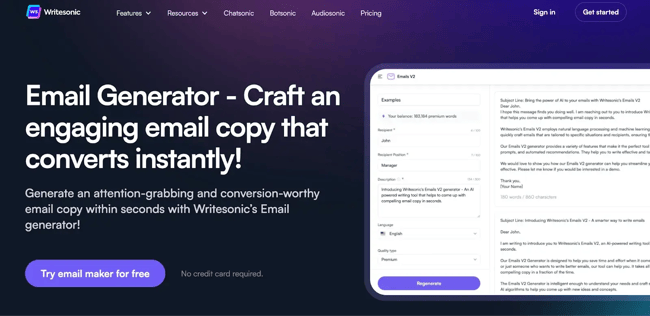
Writesonic’s dedicated email generator helps marketers quickly create targeted email campaigns in more than 25 languages.
Its strength lies in how easy it is to iterate. Whether you’re writing onboarding sequences, announcing a product launch, or sending a recurring newsletter, Writesonic’s saved templates let you start with proven frameworks instead of a blank page.
What I like:
- Speed and assists. With Writesonic, you select an email template, enter your details and create a first draft in just a few minutes.
- Multilingual support. Useful when sending to global audiences; The platform supports email copying in more than 25 languages.
- Pre-built performance frameworks. For SaaS brands, for example, Writesonic offers over 100 free email templates and over 500 subject lines designed to increase opens and clicks.
Best for: Marketing teams that need to quickly handle multiple campaign emails, especially newsletters, product updates, or launches, but have not yet committed to a fully CRM-embedded AI writing workflow.
Prices: Plans start at $49/month.
3. Seventh sense

The seventh sense is the secret weapon for timing. It uses machine learning to predict when each contact is most likely to open or click on an email and then schedules delivery accordingly. By learning from historical interaction patterns, you ensure your perfectly written, AI-generated emails land in inboxes exactly when they’re most likely to be seen.
What I like:
- Predictive optimization. Learn individual engagement habits to send emails at peak times.
- Integration with HubSpot. Works seamlessly with automated email campaigns to improve deliverability and engagement.
- Personalized pace: Prevents fatigue by timing shipments based on recipient behavior.
Best for: Teams focused on maximizing open and click-through rates through smarter send times.
Prices: Plans start at $80/month and are billed annually.
4. Copy.ai
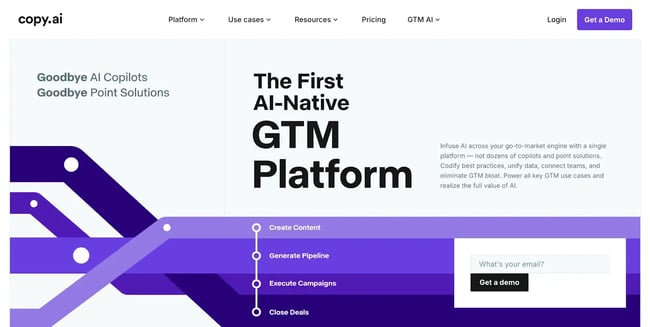
Copy.ai is a creative AI platform that helps teams build multi-step campaign creation workflows. It includes templates for complete email sequences, making it a great tool for teams managing complex lifecycle or drip campaigns.
What I like:
- Workflow automation. Generate entire sequences in minutes.
- Collaboration tools. Enable multiple team members to refine designs together.
- Prompt library. Save custom prompts that can be reused for similar campaigns or customer segments.
Best for: Marketing teams that need to quickly scale high-quality email across multiple products or regions.
Prices: Plans vary. For Chat, plans start at $29/month.
5. MailMaestro
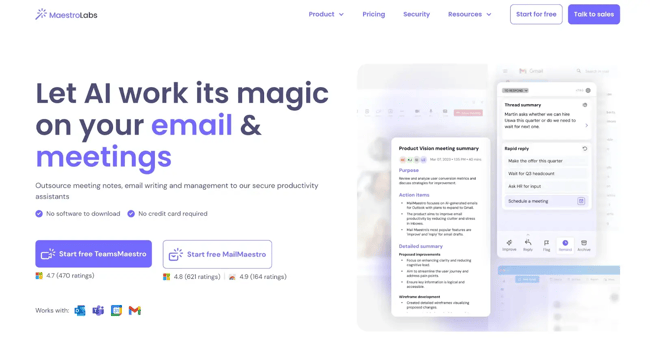
MailMaestro is an AI-powered email writer and assistant that integrates directly with Outlook and Gmail, enabling teams to compose, respond to, and manage professional email content faster and more effectively.
It supports multiple languages, tone adjustments, and contextual authoring, helping marketers scale email content production without sacrificing clarity or brand integrity.
What I like:
- Fast, contextual designs. You enter a short instruction and the tool generates three differentiated versions in seconds.
- Sound and voice control. Choose a desired tone and language variant for global campaigns.
- Integration into the inbox workflow. Because it’s in Outlook or Gmail, email authors stay in their workflow and don’t have to switch between tools.
Best for: Marketing and operations teams processing large volumes of email communications.
6. ChatGPT
ChatGPT is the most versatile large-language model for marketers who want to quickly brainstorm, draft, and refine email content. You can use it to outline entire nurturing workflows, generate subject line variations, rewrite CTAs, or test tone and voice before syncing the copy with your CRM.
Because ChatGPT isn’t limited to pre-built templates, it’s great for creative ideation, making it an ideal starting point for teams looking to experiment with AI before committing to a fully embedded system.
What we like: Ideal for brainstorming prompts or rephrasing CTAs across lifecycle stages.
Best for: Teams developing a prompt library to drive CRM-connected workflows.
Prices: $20/month for the Pro plan.
How to set up AI email suggestions in your existing workflow
AI tools are fantastic for quickly creating email content that engages readers. However, these tools work better when linked to your data and approval processes.
Here’s how to set it up successfully.
1. Unify your CRM data.
AI email suggestions are only as intelligent as the data they learn from. Create a single source of truth in your CRM and consolidate:
- records
- Deal phases
- Engagement activity
When your data is unified, your AI can recognize important patterns, such as: E.g., which content drives MQLs and which stalls in the SQL phase, and create copy that reflects these insights.
HubSpot Pro Tip: Treat data hygiene as part of the content strategy. The more accurate your CRM, the better your AI recommendations.
2. Confirm consent and define segments.
AI tools increase personalization. This means any weak points in your Consents for personalization or segmentation are highlighted. Avoid this by:
- Revisit opt-ins
- Check the settings again
- Compliance policy updates
Once confirmed, define your key lifecycle segments. This segment-level context helps AI tailor tone and CTA strength based on a contact’s location in their journey.
Example: A top-of-funnel lead might see “Learn more,” while an active test user might see “Schedule your onboarding call.”
3. Connect your AI assistant.
Use HubSpots AI email assistant to start creating contextual copy right in your email editor. Because this is a native feature of HubSpot, the wizard automatically points to the following:
- Contact details
- Deal information
- Past campaign results
You can also switch between AI-generated subject lines, body copy, or CTAs while maintaining the CRM context. With these insights and user options, content suggestions can be automatically tailored to your brand and goals.
4. Enable modular content.
If you manage multiple campaigns or teams, modular content is the best choice for efficiency. Using HubSpots AI-powered content creation Use tools to create a shared library of pre-approved assets like intros, feature blurbs, and CTAs that AI can incorporate into future campaigns.
With this structure you can:
- Maintain brand and compliance consistency
- Track the performance of specific snippets over time
- Allow non-authors to create conversion-ready emails in minutes
HubSpot Pro Tip: Label modules with tags like “BOFU CTA – Demo” or “Awareness Body – Product Value” so your AI assistant learns which assets perform best at each stage.
5. Enable version control and approvals.
This cannot be emphasized enough: AI-generated content should never be sent with one click.
Create approval workflows that pass new email versions through a human reviewer before launching, especially for campaigns involving pricing, compliance, or regulated industries.
In HubSpot, you can set role-based permissions to give marketing managers, compliance officers, or product marketers the ability to review drafts before publishing. This keeps your AI both efficient and responsible.
When your CRM, content library, and approval process work together, AI ceases to be just a typing shortcut and becomes a conversion engine. Each email is aimed at the right audience and offers a real chance of the expected result.
AI email content prompts for every lifecycle stage
Good AI depends on good direction. Without clear context, even the most advanced model will result in generic, one-size-fits-all copy. The key is to manage your AI like a strategist and not just a writer.
That means telling it WHO with whom you speak, What You want them to do it, and why now.
Whether you use ChatGPT, Claude, or HubSpot’s AI email assistant, a few well-structured ones Prompts can be used to transform general suggestions into powerful, lifecycle-specific content.
Here’s how you should think about it.
1. Welcome and activation prompts that create dynamism
Goal: Quickly add value and drive engagement.
Prompt example: “Write a 120-word welcome email for new signups who have downloaded our guide. Add a clear CTA to start a free trial and reference their interest in (topic). Maintain a confident, approachable tone.”
HubSpot Pro Tip: Use HubSpot’s AI Email Assistant to instantly generate multiple versions of your welcome email and test the open rates of your automated email campaigns.
2. Encourage prompts that convert interest into intent
Goal: Deepen trust through education.
Prompt example: “Generate a follow-up email that highlights a customer success story that is relevant to prospects in the middle of the funnel. Keep the tone helpful, not sales-oriented. Conclude with a soft CTA to schedule a demo.”
HubSpot Pro Tip: For more tested examples, see HubSpot’s AI Prompts for Email Content Library.
3. Sales accelerator prompts for product and sales-focused promotions
Goal: Move prospects from intent to action.
Prompt example: “Write an email to contacts who interacted with pricing pages twice this week. Use urgency and social proof to encourage booking a demo.”
HubSpot Pro Tip: Combine this with CRM filters to ensure only active, high-intent contacts receive the message.
4. Invitations to renewal and expansion that deepen trust
Goal: Retain and expand existing customers.
Prompt example: “Write a renewal reminder for existing customers. Reinforce previous ROI, introduce a new feature, and incentivize early renewal.”
HubSpot Pro Tip: Use HubSpot’s automation rules to trigger this sequence 30 days before the contract expires and measure the conversion increase over time.
The prompt framework
Use this simple, repeatable structure for every prompt you write. It works whether you compose in ChatGPT, Claude, or directly in HubSpot’s AI email assistant.
- Goal: What you expect from the reader
- Segment: Who the message is intended for
- Stage: Consciousness, consideration, decision or retention
- Context: Data or insights from CRM
- Restrictions: Word count, tone of voice, compliance rules or localization requirements
- Voice and tone: Brand-specific wording or notes on the style guide
- Offer/CTA: The clear next step
When used consistently, this framework helps AI create more personalized, compliant, and performance-oriented email copies. You can also test variations directly in automated email campaigns to see which elements result in higher open, click-through, and response rates.
Need more ideas? Explore AI email content prompts and find pre-built examples that you can adapt to your workflows.
Guidelines for AI email content generation
While it’s true that AI can scale content production, without the right systems in place, it can also scale errors. A strong QA process protects your brand voice, ensures compliance, and ensures that every AI-generated email meets your audience’s expectations.
Whether you use HubSpot’s AI email writer or a large language model like ChatGPT, build guardrails into your workflow from the start.
This is where you should place your focus.
Editorial standards for AI-generated email copies
Before an AI-generated email goes live, it should go through a two-step quality assurance process:
Level 1: Copy quality
Review content for clarity, tone, accuracy, and alignment with the campaign goal.
Questions:
- Does that sound like us?
- Does it say something true, valuable, and easily actionable?
Layer 2: Compliance
Ensure claims, disclaimers, and data usage comply with regional privacy and consent rules.
Quick quality checklist
Your email is ready for use when:
- The message is relevant and specific to their segment
- The tone matches the brand personality
- Claims and data are verified – no “AI hallucinated” metrics or testimonials
- CTA is clear and action-oriented
- Internal links take the reader to the next logical step
- Accessibility is taken into account
For sensitive or important topics such as finance, health, legal, or regulated industries, add a subject matter expert (SME) review loop before publishing. A five-minute review by an in-house expert can prevent weeks of damage control later.
HubSpot Pro Tip: Paste into your Command Prompt library unacceptable patterns (e.g. exaggerated claims, pressure tactics or speculative findings). Then train your team to flag and rewrite any AI-generated content that falls into that language.
Example of a disallowed list:
- “Guaranteed results”
- “You will regret missing out”
- “We are the only solution that works”
- “100% success rate”
Embedding these tone and compliance rules directly into prompts will prevent your AI from overstepping your brand boundaries, even when generated at scale.
Privacy, consent and opt-in personalization
Personalization creates trust when it is based on values. Handle data responsibly and design prompts that always respect permission settings.
1. Create prompts with explicit consent in mind.
Include a privacy-preserving context in each statement: “Use only approved data points (e.g. name, company, or product type) to personalize this email.”
2. Add fail-safe defaults.
When key data is missing, AI should generalize elegantly: “If the user’s location is unknown, use a neutral greeting like “Hey!” instead of referencing city data.”
3. Apply data minimization.
Only provide data necessary for relevance. Avoid sensitive attributes, even if they are technically available in your CRM.
4. Strengthen preference management.
Close every personalized email with an easy way to manage settings or unsubscribe.
HubSpot Pro Tip: Document your personalization guidelines in the same place as your prompt templates. When a team member or AI assistant creates a new draft, privacy is a default setting.
When implemented correctly, guardrails make email content creation safer and faster. By defining how your brand writes, what it never says, and what data it uses, you can confidently scale content creation across every campaign and segment.
How to measure AI email content performance and iterate quickly
AI-powered content is like any other part of your content strategy: you need to measure performance. A meaningful measurement plan will help you differentiate “sounds good” from “actual performance.”
Use a test-and-learn approach to understand what works, prove ROI, and continually refine your email strategy.
Here’s how to measure.
1. Define your test matrix.
Start by mapping your tests to lifecycle phases. Each stage focuses on a different power lever:
|
Life cycle phase |
What to test |
Metric to watch |
Typical test duration |
|
consciousness |
Subject lines, preview text |
Open rate |
3-5 shipments |
|
thoughtfulness |
Value framework, content length |
Click rate |
1-2 weeks |
|
Decision |
CTA placement, creating clarity |
Conversion rate |
2-3 weeks |
|
Retention |
Dynamic content and broadcast time |
Response rate, renewal rate |
30 day cycles |
2. Change one variable at a time.
Multivariate testing sounds efficient, but it can skew your results. To isolate the true effect, adjust only one variable per variant, e.g. B. the length of the subject line, the CTA wording or the tone.
Each experiment should include the following:
- A single hypothesis: “Shorter subject lines increase open rates for awareness campaigns.”
- A clear success metric: “+10% open rate within the same segment.”
- Run stop rules: “Stop after 1,000 sends or when the confidence interval reaches 95%.”
HubSpot Pro Tip: Use automated email campaigns to automatically plan, randomize and record your variants so you don’t lose data in the middle of testing.
3. Attribute results using CRM and campaign analytics.
The power of testing in a connected CRM lies in attribution. Every click, response, or conversion can be traced back to the specific AI suggestion that influenced it.
In HubSpot’s Campaign Analytics you can:
- Track how AI-generated texts impact contact movement throughout the sales funnel
- Compare AI-written and human-written variants based on open and conversion rates
- View engagement by persona, deal stage, or segment
This end-to-end transparency helps you answer the ultimate question: Has AI made us more effective or just more efficient?
4. Expand insights beyond email.
Your email results are also signals of broader brand visibility. Use AI search grader to analyze your brand in AI search and see how your messaging performs in AI-driven search experiences.
When the language that performs best in email also appears in AI search summaries, you’ve achieved market targeting of your messages. This step ties your email testing back to top-funnel visibility, closing the loop between engagement and discovery.
5. Create a shared performance dashboard.
Create a unified view of your most important metrics so your team can quickly see what’s working. Contain:
- Variant name and date range
- Lifecycle stage and audience segment
- Prompt used to generate the content
- Important metrics such as opens, clicks, conversions, unsubscribes
- Result and decision
HubSpot Pro Tip: Create this as a shared HubSpot dashboard or Google Sheet that syncs via the API. Over time, you’ll notice which prompt types, sounds, or CTA structures produce consistent lifts. You can then train your AI email assistant to automatically prioritize these patterns.
Common AI email content pitfalls and how to avoid them
Even experienced teams make some common mistakes when scaling AI workflows. Here’s how to avoid them.
|
trap |
Why it happens |
How to fix the problem |
|
General expenses |
Insufficient context in prompts |
Add CRM data, persona details and campaign goals |
|
Brand drift |
No standardized tone rules |
Use a branded prompt template and QA checklist |
|
Hallucinated claims |
AI invents data or experience reports |
Require verification by SMEs for factual accuracy |
|
Over-personalization |
Prompts include non-consented data |
Use fail-safe defaults and consent-based fields |
|
Unclear measurement |
No control group or test tracking |
Set rules for variant logging and mapping |
Frequently asked questions about AI-powered email content suggestions
What is the fastest way to use AI for email content suggestions?
Start with a clear use case, like onboarding or nurture, and a prompt library. Before scaling, test your process in a controlled environment. HubSpot’s Breeze Copilot makes it easy: Open your email editor, generate subject line and text variations, and instantly compare the results in your campaign dashboard.
How do I keep AI-generated content on brand and accurate?
Train your AI to use your voice, not someone else’s. Include a short brand voice brief in every prompt, maintain a “do not use” list for banned phrases or exaggerated claims, and pass sensitive messages through a brief human review before publishing. This two-step process ensures that every AI-generated email is consistent, compliant and trustworthy.
How can I personalize AI without being intrusive?
Personalization should feel like relevance, not surveillance. Use only approved data and focus on delivering clear value. HubSpot’s consent-based personalization tools make it easy to provide subscribers with transparent controls and preference management.
How do I measure whether AI suggestions actually improve performance?
Start small and measure clearly. Create a simple testing matrix by lifecycle stage – subject lines for awareness, CTAs for decision – and change one element at a time. Track each variant in HubSpot’s campaign analytics and link the results directly to CRM metrics such as open rate, CTR, MQL or SQL conversion. Keep what works, remove what doesn’t, and document the findings for your next round.
Which HubSpot tools help with AI email content and measurement?
HubSpot’s Marketing Hub allows you to create, review, and deploy automated email campaigns. Content Hub manages reusable assets and branded language libraries. Breeze Copilot and Agents automate AI-driven workflows and suggest optimized copy in your editor, while AI Search Grader helps you analyze your brand in AI search and measure visibility in new AI-powered discovery channels.
TL;DR: AI-powered email content suggestions
AI-powered email content suggestions use machine learning to generate subject lines, body copy, and calls to action tailored to your audience and lifecycle stage. By connecting these suggestions to your CRM data and workflows, you can increase open rates, clicks, and conversions—while saving time and maintaining brand consistency.
To start:
- Unify your CRM data
- Set up your AI email assistant
- Use prompt frameworks for each lifecycle stage
- Measure results with clear A/B testing
Are you ready to see the impact? Get started with HubSpot’s Marketing Hub for free and see how AI-powered content can transform your email performance.