
Email deliverability is cumulative, and AI email deliverability optimization reinforces the sending behavior that mailbox providers already measure over time. Mailbox providers assess authentication targeting, complaint rates, interaction patterns, and unsubscribe behavior across domains. In 2024, Gmail and Yahoo formalized stricter requirements for bulk senders, reinforcing a core principle: Inbox placement depends on the collaboration of authentication, permissions, and recipient behavior.
Accordingly HubSpot’s 2026 State of Marketing Report22% of marketers cite email as the top revenue driver. AI strengthens this infrastructure by improving segmentation discipline, detecting reputation changes earlier, managing cleaner lists, and stabilizing interaction patterns – without overriding provider policies.
This guide explains what AI-powered email deliverability optimization is, how it impacts content, reputation, list quality, and timing, and which platforms support these workflows.
Table of contents
What is AI-Powered Email Deliverability Optimization?
AI-powered email deliverability optimization uses machine learning to increase the likelihood that emails end up in the inbox rather than the spam folder or rejection queue. It works by analyzing the same signals that MBPs evaluate: content structure, sender reputation, interaction behavior and list quality.
Large providers like Gmail rely on machine learning systems that rate senders. These systems evaluate authentication targeting, spam complaint rates, bounce trends, interaction patterns, and send consistency. A single word or formatting issue rarely triggers filtering decisions; they reflect cumulative sender behavior.
In 2024, Gmail and Yahoo formalized stricter expectations for bulk senders – defined by Google as Domains that send around 5,000 or more messages per day to personal Gmail accounts. Requirements include:
- Valid SPF and DKIM authentication
- A published DMARC policy with alignment
- Spam complaint rates below 0.3%
- One-click unsubscribe feature for marketing messages
- Encrypted TLS delivery
These standards reinforced a fundamental principle: Inbox placement depends on the collaboration of authentication, authorization, and recipient behavior.
AI becomes relevant because inbox providers are already using predictive models. Instead of reacting after complaint rates rise or engagement declines, AI systems analyze patterns early and uncover risks before filtering is intensified.
In practice, AI-powered deliverability optimization focuses on four signal categories that are of great importance to MBPs:
Content analysis
AI evaluates the structure of an email before sending, including subject line patterns, link density, promotional tone, and rendering stability. Mailbox providers react to the behavior of the recipient and not to isolated “spam words”. By flagging content patterns that correlate with lower engagement or more complaints, AI helps teams adjust messaging before performance deteriorates.
Reputation monitoring
Sender reputation reflects authentication targeting, complaint rates, bounce rates, and send consistency. AI continuously tracks these signals and detects early changes, such as increasing complaints within a specific segment. This transparency allows marketers to adjust targeting or cadence before filtering becomes more stringent.
Engagement Modeling
Inbox placement increasingly depends on clicks, replies, and sustained engagement patterns, especially as open rates become less reliable. AI analyzes responsiveness across contacts and cohorts rather than relying on static inactivity windows. Stronger engagement stability supports more consistent delivery results.
Predictive analytics for list quality
The quality of the list influences both engagement and complaint risk. AI identifies inactive clusters, risky acquisition sources and segments with declining click-through rates. Behavioral suppression helps maintain healthier engagement ratios and reduces unnecessary exposure.
Two forms of AI support this framework:
- Generative AI helps iterate and personalize content.
- Predictive AI Identifies behavioral and reputational trends before they escalate.
It is important to define boundaries. AI does not overwrite failed authentication, neutralize damage from purchased lists, or compensate for persistent spam complaint rates above provider thresholds. Authentication, consent and frequency discipline remain fundamental.
AI-powered email deliverability optimization is actually an operational layer that aligns sender behavior with machine learning-driven filtering systems. When content, reputation, engagement, and list quality are analyzed together and sending behavior is adjusted in response, inbox placement becomes more consistent.
How to Use AI to Improve Email Deliverability
AI supports deliverability when applied across four interrelated areas: content structure, sender reputation, list quality, and send timing. Content influences engagement, engagement shapes reputation, and reputation influences inbox placement. The goal is coordinated optimization, not isolated fixes.
Use AI to evaluate and optimize email content.
Email content influences deliverability indirectly through interaction behavior. Modern filtering systems evaluate patterns – not isolated words – and these patterns often reflect how recipients interact with a message.
AI can analyze structural elements before sending, including:
- Repeat subject line in all campaigns
- Advertising intensity relative to segment intent
- Link density and tracking domain consistency
- Image-text balance
- HTML stability and rendering integrity
Rendering consistency also impacts engagement. Emails that display poorly across all clients reduce engagement, which weakens performance signals. Optimizing emails for different customers supports robust engagement by reducing technical friction.
Breeze AI by HubSpotavailable in Marketing Hub, supports tools like AI email author to generate subject lines and text variations that align with segment intent. When content personalization reflects CRM data and lifecycle stage, engagement stabilizes and complaint risk decreases.
Content optimization strengthens deliverability by improving relevance and maintaining structural consistency. It does not replace authentication or list management.
Use AI to monitor and protect sender reputation.
Sender reputation reflects cumulative behavior in terms of complaint rates, bounce rates, authentication targeting, and engagement consistency. MBPs enforce clear expectations, including complaint thresholds and authentication standards.
AI supports reputation protection by tracking trends in the following areas:
- Spam complaint rate by segment
- Hard and soft jump tips
- SPF, DKIM and DMARC alignment stability
- Decay of commitment within the life cycle phases
- Abrupt changes in volume or frequency
Basic concepts like sender score still apply; The difference is the speed. Instead of reviewing monthly reports, AI uncovers anomalies as they occur, allowing teams to adjust segmentation or frequency before domain-level trust erodes.
Effective reputation management requires ongoing monitoring of technical compliance, behavioral engagement, and broadcast discipline, rather than periodic cleanup after issues arise.
Use AI to detect and prevent email list quality issues.
The quality of the list directly impacts engagement rates and the likelihood of complaints. Inactive or improperly acquired contacts dilute positive signals and increase the risk of filtering.
Traditional hygiene regulations are often based on static inactivity windows. This approach is less reliable because privacy measures further distort open rates. AI models broader behavior, including click activity, conversion history, purchase recency, and unsubscribe patterns.
Effective list quality monitoring focuses on:
- Hard bounce clusters tied to acquisition sources
- Role-based or low-intent addresses
- Segments with decreasing click-through and increasing unsubscribes
- Newly added contacts without interaction history
Maintaining a clean list remains essential. Re-engagement campaigns allow teams to confirm their interest before disengaged contacts are automatically excluded from future marketing sends.
Frequency discipline also overlaps with list health. Over-sending low-intent segments accelerates fatigue and increases the risk of complaints. AI links suppression and cadence controls with engagement scoring, ensuring stronger signal integrity within active segments.
Deliverability stabilizes when suppression is proactive rather than reactive.
Use AI to personalize send times for maximum engagement.
Optimizing airtime affects engagement consistency, which in turn impacts reputation stability. Timing can’t override poor segmentation or poor list hygiene, but it can reinforce positive interaction patterns.
Industry benchmarks for email send times provide directional insights but smooth out behavioral differences between segments. AI analyzes contact-level behavior, such as:
- When recipients typically click
- Post-delivery engagement speed
- Interaction patterns by campaign type
- Incidence tolerance across cohorts
Instead of sending to an entire list at once, prediction systems classify delivery within a defined time window based on these patterns. If emails arrive regularly at times that correspond to the recipient’s behavior, click stability improves and the susceptibility to complaints often decreases.
Airtime optimization works best as a refinement layer. Combined with segmentation discipline and list hygiene, it supports sustained engagement rather than isolated spikes.
Best AI tools for improvement e-mail Delivery ability
The best AI email deliverability tools integrate machine learning directly into segmentation, timing, and list governance workflows. The following platforms differ in how deeply AI is tied to CRM data, automation, and engagement reporting – a difference that impacts long-term consistency in inbox placement.
The following comparison provides a high-level overview of how each platform’s AI capabilities support inbox placement before diving into detailed breakdowns.
HubSpot Marketing Hub (E-mail)
HubSpot’s email tools run in its Smart CRM, which combines contact data, lifecycle stage, automation and reporting into a single system. This integration supports consistent segmentation and frequency control across campaigns.
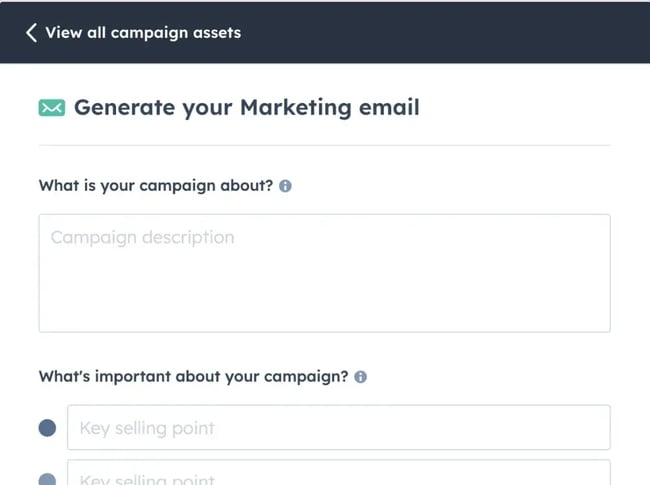
AI features relevant to deliverability include:
- AI-powered Subject line and email creation via Campaign Assistant
- CRM-powered segmentation based on lifecycle stage, business activity and behavioral engagement
- Automated suppression rules tied to inactivity and subscription preferences
- Optimize shipping time through historical engagement at the contact level
- Unified reporting of bounce rate, complaint rate and segment performance
Because AI-generated content comes directly from CRM properties and lifecycle data, personalization reflects actual contact behavior rather than static templates. This alignment supports stronger engagement consistency and reduces the risk of complaints over time – influential signals for inbox placement.
The structural advantage is alignment. Segmentation, suppression and performance monitoring are based on the same data set. As engagement decreases within a specific audience segment, marketers can systematically adjust targeting and frequency rules instead of manually recreating them.
Prices: HubSpot Marketing Hub uses tiered pricing (Starter, Professional, Enterprise) based on features and contact volume. Advanced automation and AI-driven segmentation are only available in the Professional and Enterprise levels.
Best for: Mid-market and enterprise teams that want to directly link deliverability to CRM lifecycle management, not just campaign-level optimization.
Klaviyo
Klaviyo’s AI capabilities are integrated into the e-commerce focused customer data platform. The focus is on predictive targeting based on purchasing behavior and churn risk.
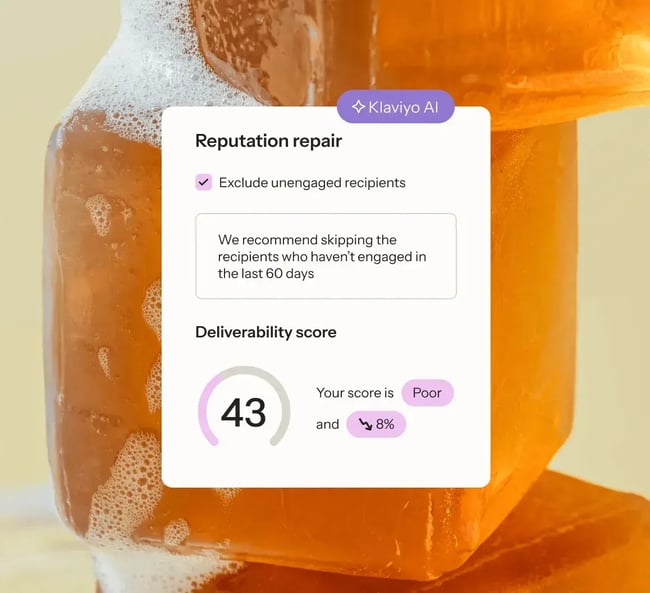
AI features relevant to deliverability include:
- Predictive segmentation (customer lifetime value, churn prediction, next order prediction)
- Building a natural language audience
- Smart Send Time to optimize timing at the contact level
- AI-powered generation of emails and subject lines
- Deliverability monitoring and performance alerts
Predictive churn modeling helps teams reduce the frequency of contact with disengaged contacts before complaint rates rise. Optimizing send time at the contact level supports greater engagement visibility.
Prices: Pricing tiers based on active profiles (contacts). AI features are included in paid planswith enterprise orchestration available in enterprise-level plans.
Best for: Ecommerce brands with strong transactional data who want predictive targeting to manage engagement and reduce sending fatigue.
Mailchimp
Mailchimp’s AI tools Work under Intuit Assist and focus on predictive segmentation and airtime. The platform prioritizes ease of use and automation over deep CRM complexity.
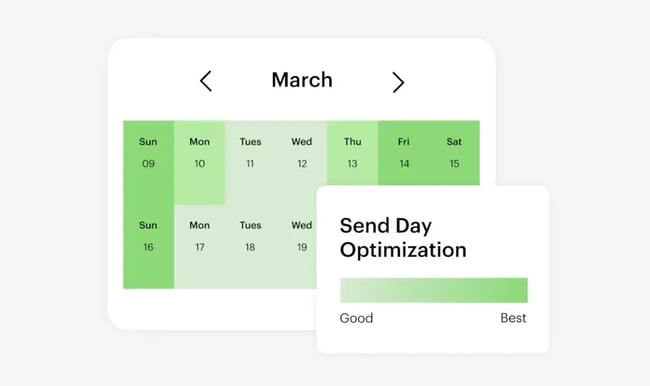
AI features relevant to deliverability include:
- Predictive segmentation based on purchase probability and customer value
- Optimization of broadcast day and time
- Automated email journeys (welcome, abandoned cart, re-engagement)
- AI-powered subject line and content generation
- Integrated A/B testing
Mailchimp positions AI to improve performance and workflow efficiency rather than direct deliverability claims.
Prices: Advanced prediction and optimization features are usually available in Standard and Premium tiers. The price tier depends on the number of contacts and function access.
Best for: Small to medium-sized teams that want AI-driven targeting and timing without building a complex CRM infrastructure.
ActiveCampaign
ActiveCampaign is a marketing automation platform that combines behavior-driven email workflows with contact-level send time to improve engagement consistency. ActiveCampaign focuses its AI capabilities on automation depth and engagement-based timing.
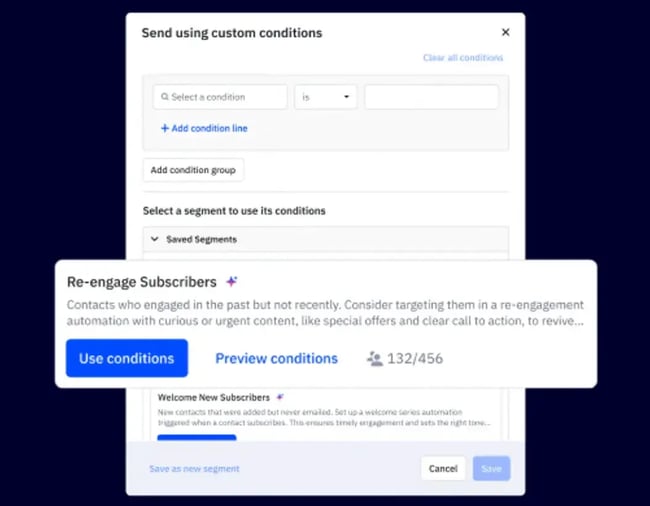
The most relevant feature for deliverability is Forward-looking sendingwhich:
- Uses historical open activities per contact
- Sends at the predicted optimal time within a 24-hour window
- Recalculates timing weekly
- Uses exploratory broadcasts to refine the model
- Requires sufficient interaction data to function
Other AI features include:
- Dynamic personalization of content within automation workflows
- AI-supported creation of subject lines and body text
- Behavior-driven workflow automation
Deliverability improvements come from replacing broad batch campaigns with targeted, engagement-focused sends.
Prices: Predictive sending and advanced AI features are usually available Rates for professionals and above. Price tiering based on contact volume.
Best for: Automation-focused SMBs that want contact-level send times and behavior-driven lifecycle campaigns.
On these platforms, AI supports deliverability by enabling more precise segmentation, timing, frequency control, and suppression of inactive contacts. None circumvents the mailbox provider’s rules; They influence the behavioral signals that shape reputation.
HubSpot integrates AI most deeply into CRM lifecycle data, Klaviyo emphasizes e-commerce targeting, Mailchimp prioritizes accessible automation, and ActiveCampaign focuses on workflow depth and predictive sending. The right choice depends on data maturity and how closely email needs to be connected to broader marketing systems.
How to measure the impact of AI on email Delivery ability
AI email deliverability optimization only produces measurable impact if performance signals consistently improve over time. The goal is greater engagement, lower risk, and a more stable sender reputation.
To evaluate impact, create a baseline across multiple comparable campaigns, introduce one AI-driven change to each, and compare sustained trends rather than spikes in individual shipments.
Focus on the following metrics:
- Inbox placement rate (if measurable): The clearest indicator of deliverability. Track placement consistency across Gmail, Outlook, and Yahoo – especially after authentication updates or segmentation changes. Not all platforms provide direct inbox placement data, so third-party seed testing may be required.
- Spam complaint rate: MBPs treat complaints as direct negative feedback. The Gmail Bulk Sender Guide recommends keeping complaint rates below 0.3%. If AI-driven segmentation and frequency control works, complaint rates should remain consistently low even as volume increases.
- Hard bounce rate: Typically, permission-based lists are managed Bounce rates below ~2%. These rates are important for the sender’s reputation. For example from HubSpot Deliverability protection system Triggers automatically with a 5% hard bounce rate to avoid reputational damage. Effective suppression logic and acquisition filtering should reduce invalid sends and stabilize bounce trends across campaigns.
- Click-through rate (CTR) and click-to-open rate (CTOR): Data protection like Apple’s mail privacy policy are increasingly distorting opening rates. Click-based metrics better reflect the quality of engagement. AI-powered personalization and timing should drive clicks within target segments – not just the entire list.
- Unsubscribe rate: Stable unsubscribe rates while increasing clicks indicate a healthy focus and frequency discipline. Spikes often indicate excessive emailing or misaligned segmentation.
AI strengthens deliverability when engagement indicators are trending up while risk indicators are trending down. A sustainable balance – not isolated improvements – has significant impact.
Frequently asked questions
Does AI-generated email content affect deliverability?
AI-generated email content does not fundamentally affect deliverability. Inbox placement issues are typically due to permissions issues, authentication errors, high complaint rates, or poor list hygiene. AI can pose risks when it enables over-sending, creates repetitive templated messages at scale, or ignores segmentation discipline. When used within appropriate suppression and targeting controls AI-generated content can work similar to human-written campaigns.
How much does AI-powered email deliverability cost?
AI-powered email deliverability costs vary depending on platform tier, contact volume, and feature access. Most marketing automation platforms bundle AI content generation, predictive sending, and segmentation tools into mid- or higher-tier plans. Additional costs may apply for dedicated deliverability monitoring tools, inbox placement testing, or enterprise-level infrastructure. The price depends mainly on the database size and the sending volume.
Can AI deliverability tools be integrated into my existing platform?
Most modern email platforms offer AI capabilities natively or through API integrations. However, effectiveness depends on data access. AI models require unified CRM, engagement and suppression data to make accurate predictions. When engagement signals and list controls exist in separate systems, limited optimization can occur.
How quickly can improvements occur?
Improvements depend on the underlying problem. Authentication fixes and list purges can produce measurable improvements within just a few campaigns. Restoring reputation after increased complaint rates typically requires sustained positive engagement over weeks or months. The stabilization of deliverability occurs cumulatively and not immediately.
Will AI replace deliverability specialists?
AI automates monitoring, anomaly detection, segmentation scoring and predictive analysis. It does not replace strategic oversight. Deliverability specialists remain essential for interpreting mailbox provider policies, managing infrastructure changes, resolving block events, and driving compliance decisions. AI reduces manual labor, but does not eliminate the need for expertise.
AI strengthens the deliverability infrastructure – not replaces it.
AI improves email deliverability by encouraging disciplined sending behavior. It sharpens segmentation, automates suppression before risks worsen, makes reputation changes visible earlier, and aligns airtime with proven interaction patterns.
However, deliverability remains structural. Authentication, consent management and governance are fundamental. AI does not override mailbox provider policies. it works in them.
For teams working in a unified CRM ecosystem, deliverability is less about individual campaigns and more about lifecycle consistency. When the segmentation logic, interaction history, and suppression rules have a single source of truth, inbox placement often stabilizes because sending behavior stabilizes.
The real risk with AI in email marketing is not poor writing, but unrestrained acceleration. When tools make it easier to generate more campaigns and variations, the temptation is to increase volume rather than precision. Here’s how inbox fatigue leads to spam complaints.
The teams that will benefit the most view AI as an optimization engine, not a megaphone. They use it to analyze engagement trends before increasing volume, adjusting suppression and segmentation based on performance signals. You let performance data determine the expansion.
Email deliverability rewards restraint, relevance and consistency. AI can help implement these principles faster and more transparently. It cannot replace the discipline required to follow them.