

AI search visibility refers to how a brand appears in AI-generated results from tools like ChatGPT and AI-powered search engines like Gemini or Perplexity. Unlike traditional SEO, which tracks ranking positions and blue links, AI visibility measures how often your brand is mentioned, how your own content is cited, and how those mentions are represented in model responses.
As more users rely on direct answers rather than click-through results, a strong AI search visibility profile influences not only discovery and trust, but ultimately conversions.
Table of contents
What is AI search visibility?
AI search visibility is a marketing metric that measures how often and how accurately a brand appears in AI-generated answers across platforms. If SEO tells Google who you are, AI search visibility tells the internet who you are mean.
Think less about where you stand and more about how you will be remembered. When someone asks ChatGPT or Perplexity who makes the best CRM platform, does your name come up? Is it linked? And does the model describe you the way you want a potential customer to hear it? This is basically AI visibility.
In practice, AI search visibility depends on four signals:
- mentions, How frequently your brand appears in AI responses to your key topics.
- quotes, whether these answers refer to your own content or just describe it in abstract terms.
- Feeling, whether this context is positive, neutral or critical.
- share of the vote, how often you appear in a consistent prompt set compared to competitors.
These are the new “positions” of 2026 – invisible on a results page, but visible everywhere it matters.
The difference from traditional SEO is pretty clear. SEO evaluates websites. AI search ranks Knowledge. A top-ranked article on Google may be completely missing from AI responses if the model hasn’t linked your brand to the entities or signals it trusts.
This change is more than just theoretical. AI search interfaces are already changing the way users find information:
- Pew Research found Google’s AI overviews appeared in 18% of desktop searches in the US in March 2025.
- Up to 60% of searches exit without clickingbecause the answer now lies within the interface.
- And a growing share of younger users – 31% of Generation Z, according to HubSpot 2025 AI Trends for Marketers Report. – Start searches directly in AI or chat tools instead of search engines.
This means that the brand’s visibility has shifted up from the SERP Sentence. Visibility is no longer something you “earn” once. Brands must train AI systems over time to be understood by the AI.
How does AI search visibility differ from organic search?
AI search visibility is different from organic search because it measures how frequently and how positively a brand is referenced in AI-generated answers, rather than how high their webpages appear in search results. Organic search rewards relevance, backlinks and user behavior. AI search rewards clarity, reputation and structured context. Instead of deciding Which link to the rankinglarge language models decide which brands you can trust in synthesizing their answers.
Traditional SEO vs. AI search metrics
The shift from organic to AI search changes which metrics are important for brand visibility:
|
Traditional SEO |
AI search visibility |
|
Keyword ranking |
Brand mentions in AI prompts |
|
Backlink Authority |
Citation frequency for your own content |
|
Click rate |
Sentiment framing within AI responses |
|
Organic share of voice |
Share of voice across models and platforms |
The four core AI search visibility metrics explained
1. Brand mentions
Frequency of your brand appearing in AI-generated responses. Mentions reflect recall – they show whether a model recognizes your brand as relevant to a topic or category.
2. Quotes on your own pages
Cases where an AI engine maps information directly to your website or assets. Quotes become the new trust signal. Seer Interactive’s 2025 analysis found that traditional SEO strength (rankings, backlinks) has little correlation with strength Brand mentions in AI responsesThis highlights that citation behavior emerges as a key indicator of trust and authority.
3. Mood frame
The tone and context of a brand mention. Positive or neutral framing contributes to user credibility and trust, while negative framing can suppress engagement even when the brand is visible.
4. Share of Voice across all prompts
Your comparative visibility – how often your brand is mentioned compared to competitors when users ask similar questions across multiple AI tools. Tracking this monthly allows you to quantify “model discovery momentum.”
Why is this change important?
The answers are penetrating AI environments at an ever-increasing pace. ChatGPT is now processing 2.5 billion prompts per dayand industry analysts expect AI-driven search traffic surpass traditional search by 2028. This means that visibility within AI ecosystems will become the new basis for brand discoverability.
Brands are already adapting to this change. Conrad Wang, Managing Director at EnableUexplains how his team approaches AI search optimization:
“Google’s AI mode gives you a query fanout that shows where people are searching for answers, and we’ve found that it often pulls data from obscure, trusted directories and best-of lists rather than the top organic search results. We’ve built a small task force to review these pages that the AI trusts and focus our efforts on getting EnableU included in the list. We know it works because our brand mentions in AI-generated answers for local searches have increased by over 50%, even when the click-through rate is zero.”
AI search visibility depends on mentions, citations, and sentiment, as LLMs use these signals to decide which brands to include in the synthesized responses. The more consistent these signals are, the more confident AI systems can show up and recommend your brand across platforms.
AI search visibility: How to start tracking
AI search visibility tracking measures how AI engines refer to a brand by capturing mentions, quotes, sentiment and share of voice across a defined set of prompts and platforms. This framework provides marketing teams with a simple, governance-friendly process to measure and improve AI search performance over time.
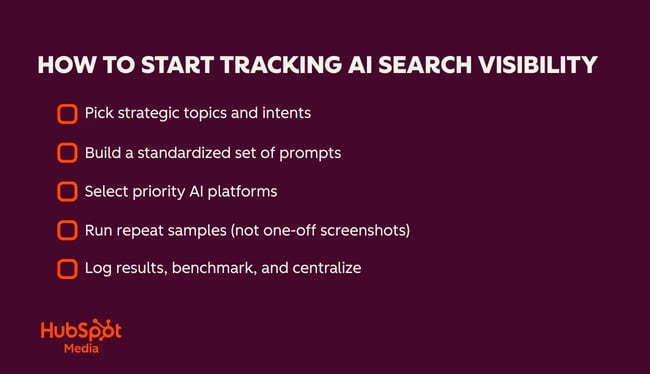
1. Select strategic themes and intent
Start by identifying queries that actually drive sales and influence purchasing decisions.
- Core product categories: “Best B2B CRM for SMEs”, “Top Marketing Platforms”.
- Priority use cases: “AI marketing automation tools”, “multi-channel attribution software”.
- Comparative and Evaluative Prompts: “HubSpot vs (competitor)”, “Top platforms for…”
These topics should align with existing content clusters, sales narratives, and named entities such as product names, frameworks, or proprietary methodologies. Select 10-30 prompts per topic set to allow for benchmarking over time without creating an unmanageable volume
2. Create a standardized set of prompts
After defining topics, create a consistent prompt library to test engines in a controlled format. Insert patterns like:
- “Who are the leading (category) platforms?”
- “What is the best tool for (use case)?”
- “Which platforms are recommended for (target group)?”
- “What is (brand) known for in (category)?”
Standardization is important. Research published by the Association for Computational Linguistics found that even small changes like adding a space after a prompt can change an LLM’s answer. Controlling prompts reduces noise and isolates real changes in model behavior.
Save this prompt set to a shared content hub asset, internal wiki, or AEO playbook so marketing teams can test against the same questions.
3. Select priority AI platforms
AI visibility is multi-faceted. A practical baseline usually includes:
- ChatGPT — general discovery + research
- Gemini – Behavior of the Google ecosystem
- Microsoft Copilot – Enterprise and M365 users
- confusion — Research and technology audience
The selection should reflect where the audience actually works and searches. Start with 3-4 motors and then expand as patterns warrant.
Pro tip: Use that HubSpot AEO Grader to establish a baseline across all supported AI engines and track mentions, quotes, and sentiment when available.
4. Do repeat rehearsals (not one-time screenshots)
Tracking AI search visibility is about trends, not a dramatic screenshot in Slack. An operating pattern for continued sampling is as follows:
- Run each selected command prompt in each engine.
- Collect responses three to five times per engine per prompt in the same session or day.
- Repeat this process monthly (or biweekly for critical campaigns).
AI models do not give the same answer twice – a consequence of their design. Running each prompt multiple times helps marketing teams identify real trends instead of chasing random noise.
5. Log, compare and centralize results
Raw answers are useless if left in screenshots. Teams should structure results into a simple query-level data set. For each prompt and engine combination, log the following:
- Brand mentioned? (Y/N)
- Which brands were mentioned?
- Quotes on your own pages (Number and example URLs)
- Mood frame (Positive / Neutral / Negative)
- position in the answer (Early / Middle / Late)
- Notes (hallucinations, outdated information, miscategorization)
This can be done in a shared spreadsheet, a custom Content Hub report view, or other AI SEO tools that support automated scoring.
Centralized AI visibility data can be fed directly into existing HubSpot dashboards and attribution workflows. From there, marketing teams can:
- Calculate share of voice across prompts and engines.
- Highlight gaps where competitors are dominating mentions.
- Prioritize content, schema, and PR efforts where visibility is least.
- Align insights with HubSpot reports on content engagement and impacted pipeline.
Think of this process as an extension of existing SEO and attribution reports. The visibility of AI within the same operational rhythm ceases to be mystical and becomes measurable.
How to improve brand visibility in AI-generated responses
Large language models learn which brands to trust by observing how clear, consistent, and credible those brands appear online. AI brand visibility improves when a company is easy to understand, easy to cite, and easy to trust wherever models collect data – ultimately improving brand visibility in AI-generated responses.
Recent industry data shows that brands that optimize for AI interfaces, such as ChatGPT, Gemini and Google’s AI Overviews, are already seeing increased engagement in social media and search discovery.
Actually, BrightEdge’s September 2025 analysis found that 83.3% of AI overview citations came from pages beyond the traditional top 10 results. This analysis suggests that structured, responsive content directly supports downstream user discoverability and engagement.
Start by building a foundation that AI systems can actually read. Structure your content using clear units, credible sources, and repeatable authority signals. Then add the human elements—FAQs, social proof, and community engagement—that show major language models that your brand is both reliable and relevant. Each step reinforces the next, creating a feedback loop between the way people experience your content and the way AI engines describe it.
Create entity-based content clusters.
AI models represent relationships. Building clusters around key entities (e.g. products, frameworks, or branding methods) makes these connections clear and helps AI engines retrieve accurate associations.
As John Bonini, founder of Content brandsNotes on LinkedIn“LLMs (seem to) reward clarity. Models bring to light sources that demonstrate clear thinking. People remember brands that have a consistent narrative.”
This principle is at the heart of AI search visibility. By maintaining consistency across your entity clusters and brand language, models learn to describe you – not just what you sell.
Here’s how:
- Review existing content by entity, not just keywords.
- Link pillar and subtopic pages and support them with appropriate schemas (AboutPage, FAQPage, Product Schema) to highlight machine-readable relationships.
- Reinforce semantic triples like Content Hub → supported → entity governance workflows.
Create source-friendly pages.
Pages that summarize definitions early, highlight key data points, and use structured lists or tables are easier for AI systems to analyze and understand. Google points out that there are no special technical requirements for this AI overviewsIts guidance emphasizes that clearly structured, searchable content remains critical for approval and accurate citation.
Here’s how:
- Add an “answer first” summary directly under each heading so that both readers and AI systems can grasp the core idea immediately.
- Add timestamps alongside statistics – freshness signals reliability for models that prioritize current data.
- Replace vague transitions like “say many experts” with named sources and clear attribution to reduce the risk of hallucinations.
It’s one thing to structure content so that it’s readable. It’s another thing to see how this structure actually changes visibility.
“The biggest difference was that we recognized that AI engines look for clarity of the original source, so we ensured that every article contained relatable data and not just opinion,” said Aaron Franklin, Head of Growth at Ylopo. “About two weeks after we added expert quotes and inline quotes to our articles (and also started tracking), we started appearing in AI-generated responses.”
Franklin’s experience underscores what Google’s guidelines imply: clarity and attribution are structural signals that teach AI models which sources to trust.
Expand FAQs and conversation reporting.
FAQs reflect the way people query AI – in natural language, with specific intent. Adding question-based sections improves both human readability and machine discoverability, and teaches large language models to associate your brand with clear, authoritative answers.
Here’s how:
- Add three to five contextual questions per topic page that reflect common conversational phrases.
- Use specific topics—“content marketers,” “RevOps teams,” “small business owners”—instead of generic “you” language to create stronger semantic signals.
- Update quarterly based on prompt tracking data from ChatGPT, Gemini and Perplexity queries to keep reporting fresh and relevant.
In practice, this structure helps AI systems recognize expertise in the same way readers do – by grouping questions, context, and verified answers.
“We optimized our top-performing content with clearer structure, FAQs and schema markup to help AI models more easily recognize our expertise. Within weeks, we saw our brand mentioned in AI-generated summaries and conversational queries on platforms like Perplexity,” said Anand Raj, digital marketing specialist at GMR web team. “The real proof was the increase in direct traffic and brand search in HubSpot analytics, without a corresponding increase in ad spend.”
Raj’s results highlight how FAQs serve as lightweight training data for generative systems. When brands formulate answers in conversation and support them with data, models recommend them.
Strengthen social proof and digital PR.
AI models interpret external validation as a signal of authority. Independent mentions, interviews and case studies give models – and buyers – peace of mind that a brand’s claims are credible and well-supported.
Here’s how:
- Get coverage on reputable industry, analyst or review sites – not just high authority domains, but also contextually relevant domains.
- Transform customer success stories into short, data-rich case snippets that answer “how” and “what changed.”
- Cite proprietary research such as: HubSpots 2025 AI trends for marketers to anchor your claims in brand-specific data.
In practice, digital PR and original research create reinforcing trust signals. Each mention becomes another node that AI systems can connect to your brand, increasing the likelihood of inclusion in future generative results.
“We shifted budget from generic content to publishing original research reports with quotable statistics and made our brand the primary source that AI models cite when answering industry questions,” said Gabriel Bertolo, creative director at Radiant elephant.
Bertolo points out that validation happened quickly: within 60 days of publishing the first data study, Radiant Elephant appeared in 67% of AI responses on key topics, up from 8% previously.
“We track this through monthly instant testing and correlate it with a threefold increase in the AI-detected pipeline in our CRM,” says Bertolo.
Bertolo’s approach highlights a simple truth: visibility follows credibility. Original data acts like a magnet for journalists and algorithms, turning every external mention into a microcitation that strengthens your authority.
Participate in active communities.
AI models learn from public conversations. Participation in trusted communities such as LinkedIn, Reddit, G2 and industry forums increases your brand’s exposure across the discourse that LLMs continually pursue. For example, Semrush research found that Reddit generates a citation frequency of 121.9% in ChatGPT answers, meaning they are referenced more than once per prompt.
Here’s how:
- Bring expert insights, not product pitches – authority grows through participation, not advertising.
- Encourage employees and advocates to participate in discussions as themselves to build a good reputation.
- Coordinate interaction with HubSpot Loop marketing “Amplify” phase that connects distributed brand activity across all channels with measurable visibility results.
Community engagement is a long but complicated game. Every authentic interaction becomes another data point, illustrating who your brand helps and what it knows.
“Given that AI Overviews and Perplexity are largely sourced from Reddit, we stopped just monitoring brand mentions and started with strategic engagement,” says Ian Gardner, Director of Sales and Business Development at Sigma Tax Pro. “We are seeing great progress in brand search in these communities and with each model update we have seen an increase in our AI citations.”
According to Gardner, Sigma Tax Pro uses teammates to find and answer complex questions in niche subreddits and build visibility there. They post as themselves, with their own user sensibilities, to build real authority, notes Gardner, “not just to delete links and spam communities – that would get them banned and destroy trust.”
Gardner’s approach reflects the new dynamics of credibility in the age of AI: authority is distributed. The conversations that take place in Reddit threads and niche forums are now incorporated into the LLM training data. Brands that regularly appear with useful, verifiable posts create unmissable visibility.
Improve AI search visibility with HubSpot’s AEO Grader.
AI search visibility is now measurable – and HubSpot’s AEO grader shows exactly how major language models see your brand. The AEO Grader analyzes visibility on leading AI platforms such as ChatGPT (GPT-4o), Gemini 2.0 Flash and Perplexity AI, using standardized prompt sets and real-time data when available.

HubSpot’s AEO Grader shows how often your brand appears in AI-generated responses, how your own pages are cited, and how your sentiment and share of voice perform within your category.
Each report provides five key visibility metrics:
- Brand awarenesshow often your brand appears.
- Market competitionYour share of voice compared to your competitors.
- Presence qualitythe strength and reliability of quotations.
- Brand sentimentTone and polarity between mentions.
- Context analysishow consistently AI engines describe what your brand does and who it serves.
HubSpot’s AEO Grader identifies underlying factors like mention depth, source quality, and confidence level, so teams can see exactly what’s working—and where visibility can be improved.
The result is a data-rich snapshot of visibility in AI platforms that helps marketers move from guesswork to clear performance optimization. Run AEO Grader quarterly or before larger campaigns to compare improvements and understand how AI perceptions are changing.
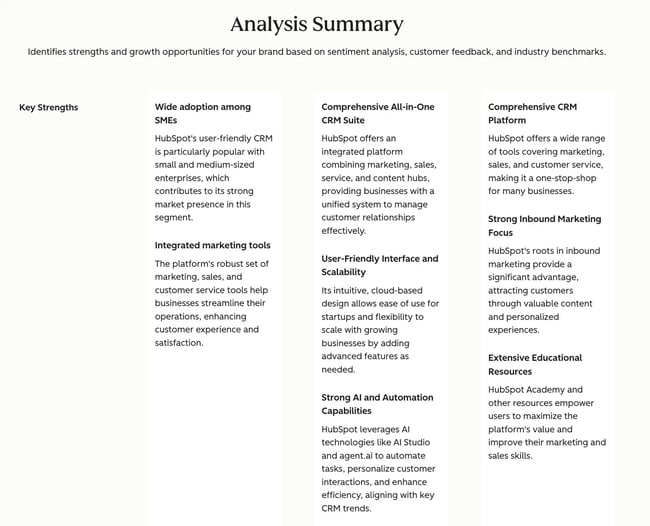
The tool also aligns naturally HubSpot’s loop marketing Framework: The insights you gain from AEO Grader reports drive this Evolve phase and turns AI visibility tracking into a continuous feedback loop of learning, change and growth.
Find your visibility on AI platforms now HubSpot’s AEO Grader.
AI Search Visibility FAQs
AI search visibility is new territory for most marketing teams. Here’s what you should know when creating a visibility program for 2025 and beyond.
How often should we track AI search visibility?
Track AI search visibility monthly for optimal trend analysis, with quarterly tracking as a minimum frequency. Large language models update their training data, weights, and answer generation patterns more frequently than traditional search algorithms. Running your AEO Grader monthly will give you a clear trend line with enough data to identify meaningful moves without creating noise.
Do we need llms.txt or special files for AI platforms?
No, llms.txt or any special AI-specific files are not currently required or generally supported. Unlike web crawlers that take robots.txt into account, AI systems currently do not follow a universal “robots.txt for models”. While some companies are Experimenting with llms.txtAdoption remains voluntary and inconsistent.
Instead, focus on structured transparency: Schema markup, clear attribution and accessible license signals. This makes it easier for models to identify and cite your content, which is the practical goal llms.txt tried to achieve.
Can we track AI search visibility without paid tools?
Yes, AI search visibility can be tracked manually with structured processes and consistent execution. Manual tracking starts with a spreadsheet and a repeatable workflow: select prompts, test them with major AI engines, log mentions and citations, and review the results monthly.
Be consistent: Repeat the same prompts with the same frequency and grading rules. Teams that start manually often develop better habits and intuition before adopting automation.
How do we deal with the variability of AI results across runs?
Treat variability in AI results as an expected characteristic, not a problem. AI systems are “non-deterministic,” meaning two identical prompts can result in slightly different answers. The key is to examine patterns across multiple runs rather than relying on individual snapshots.
Summarize five to ten examples per prompt and record the average mention rate, sentiment, and citation frequency. This smoothing helps you separate meaningful shifts from randomness.
How do we connect AI search visibility to pipeline and revenue?
Connect AI search visibility to pipeline by viewing visibility as a leading indicator of awareness and demand. When AI engines mention your brand more often, this recognition is often reflected in the brand’s downstream search volume, direct traffic, and higher click-through rates on comparison queries.
For example, if your brand’s mention rate in AI responses increases from 10% to 20% within a quarter, track whether brand traffic or demo requests followed the same trajectory. Although there is rarely a one-to-one correlation, visibility trends almost always precede awareness gains. By integrating with HubSpot’s reporting tools, the AEO grader helps teams connect AI visibility trends to measurable outcomes like influenced contacts, content-driven opportunities, and pipeline from AI discovery sources.
Turning AI search visibility into a growth engine
AI search visibility has become the next area for brand discovery – and improving AI search visibility is now a core part of how brands protect and grow their share of demand. The teams that learn to track how large language models describe them, measure sentiment and quotes, and connect that data to sales are already shaping the narratives of their industries.
HubSpot’s AEO Grader makes this visibility measurable. Content Hub turns insights into structured, answer-ready content. And loop marketing closes the loop by turning insights into continuous iteration: build, test, develop, repeat.
I have witnessed this change first hand. Marketers who started measuring their AI visibility six months ago already know how AI defines their categories and where to intervene. The takeaway is simple: AI will describe your brand regardless of whether you measure it. The advantage lies in the teams that ensure that the models tell the right story.