

SEO keyword research tools are essential for marketing teams looking to improve their content. Keyword research software can help identify search opportunities that match a company’s offerings. This SEO strategy is almost crucial a third of internet users Those 16 or older discover new brands through search engines.
The good news is that there are many free SEO tools for keyword research. Teams can develop a powerful keyword strategy without spending a dime.
In this guide, I’ll highlight the best free and affordable SEO keyword research tools I’ve tested, explain step-by-step how to use them, and show how HubSpot helps you bring it all together on one connected platform.
Table of contents
How I tested the best keyword research tools
TL;DR: The best keyword tools combine data quality, ease of use and workflow integration.
If you are looking for “What is the best free keyword research tool?” If you google it, you’ll likely come across pages of sponsored posts and affiliate lists that don’t tell you much about the actual performance of these tools.
So I decided to test them myself.
To ensure consistency across tools, I focused on a single keyword: “AI search.” It’s one that I often optimize for blog content linked to my podcast, so it provides a handy way to compare the performance of each tool on a real-world topic. I ran this keyword through several free tools to evaluate:
- Ease of use
- Depth of insight
- How actionable the data felt for content planning in the real world
Why this is important: Good tools don’t let you drown in data. Instead, they surface the few signals that drive traffic and conversions. When developing an SEO strategy, you need information you can do something with.
Best Free Keyword Research Tools for 2026
The best keyword research tools don’t overwhelm users with metrics. They highlight the few insights that actually increase traffic and conversions.
Here are the best free keyword research tools I’ve found.
|
Tool name |
Free/paid |
Key Features |
restrictions |
Best for |
|
WordStream |
Free |
Generates hundreds of keyword ideas per seed term; Shows estimated search volume, competition and CPC |
No advanced SERP or backlink data; limited to Google data sources |
Quick keyword validation and early-stage brainstorming |
|
Semrush’s free keyword tool |
Freemium |
Displays keyword, search volume, keyword difficulty (KD) and CPC; Displays keyword intent types |
Limited number of daily searches; Registration is required for advanced features |
Data-rich keyword validation and understanding search intent |
|
Ryan Robinson’s free keyword tool |
Free |
Retrieves results from Google Autocomplete; Includes the Ideas tab for long-tail keywords |
No volume or competitive data; Lists cannot be exported directly |
Quickly brainstorm and ideate content topics |
|
Free Ahrefs Keyword Generator |
Free |
Generates 20 keyword ideas per search; Provides search volume and difficulty metrics |
Limited to 20 results; No exporting or filtering without a paid plan |
Fast, high-quality keyword validation and question-based content ideas |
|
Word tracker |
Freemium |
Shows keyword, volume, competition and KEI; Includes “No Click Searches” and “Is Question” filters. |
Daily Search Limits; requires a saved list account |
Identifying intent-driven keywords and crafting SEO content series |
1. WordStream
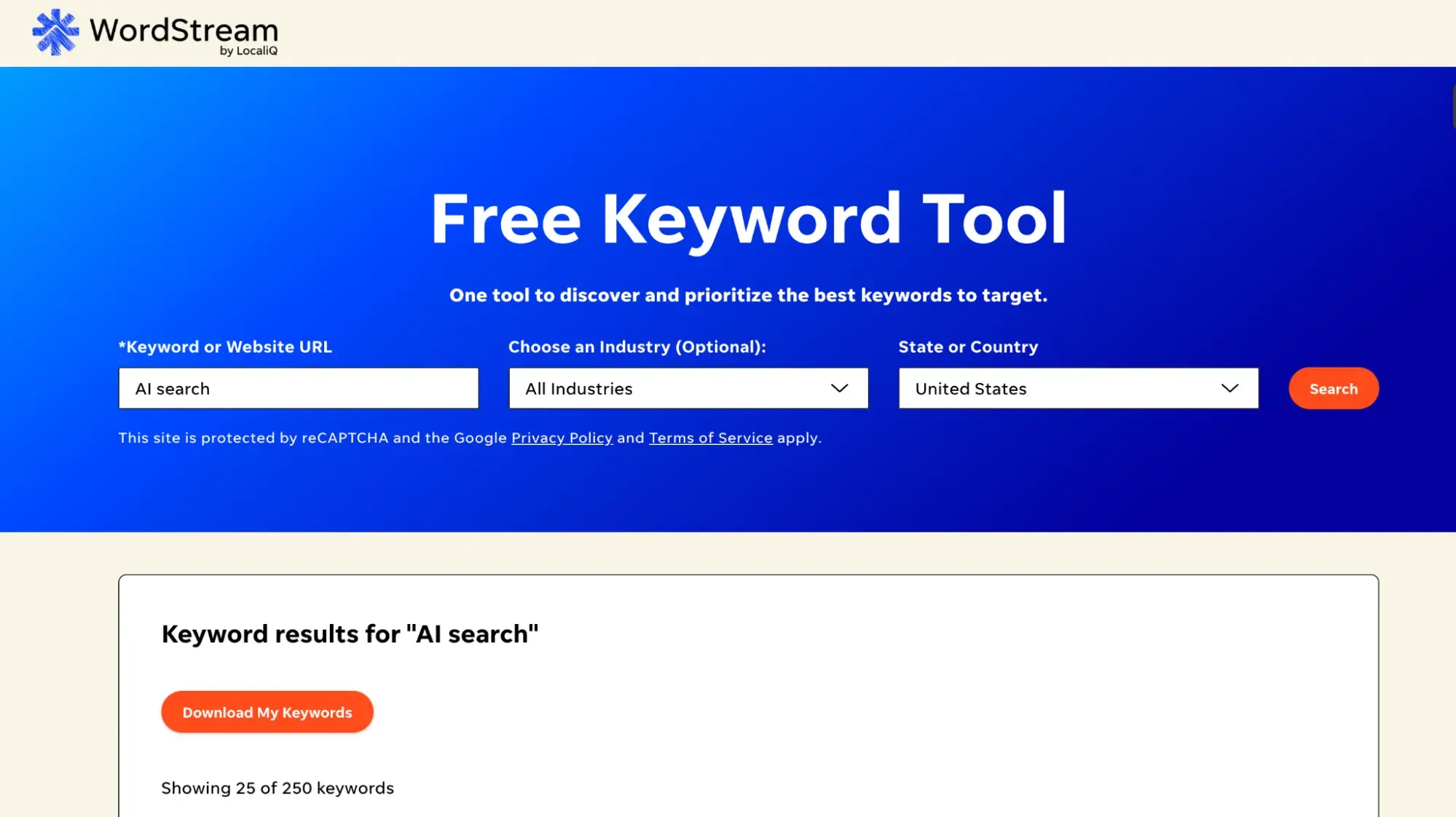
Best for: Quick keyword ideas and competitive benchmarks without requiring an account.
Key Features:
- Free keyword generator that provides hundreds of ideas per seed term
- Shows estimated search volume, competition level and CPC
- Filters by industry and geographic location
- Keyword list export function
What I like: WordStream gives me a quick overview of whether a topic is worth pursuing. It’s clean, fast, and doesn’t require registration, making it perfect for early brainstorming or keyword topic validation before diving deeper into analysis elsewhere.
2. Semrush’s free keyword tool
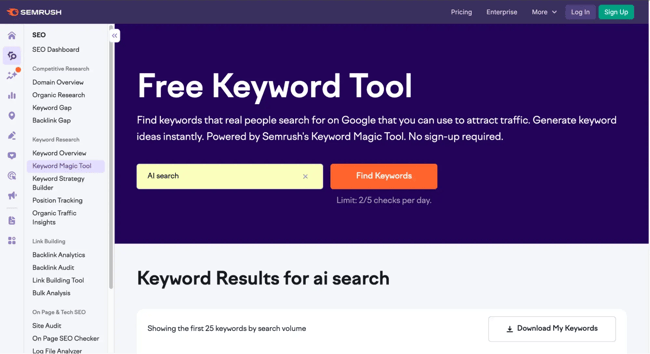
Best for: Comprehensive keyword insights with limited free daily searches.
Key Features:
- Shows keyword, search volume, keyword difficulty (KD) and CPC (USD).
- Displays the keyword intent
- Lists the top 25 keywords by search volume
- Accessible via the Keyword Magic Tool in the free version
What I like: SEMrush’s free view is straightforward and data-rich. I can quickly see how competitive a keyword is, what the intent is, and whether it’s worth investigating further – all on one screen. I can use it at the beginning of my content research process to check which topics have real search demand before turning them into blog posts.
3. Ryan Robinson’s Free Keyword Research Tool
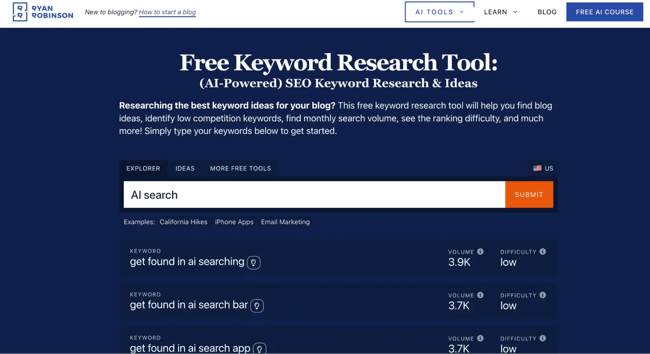
Best for: Fast, browser-based keyword brainstorming with no sign-ups or clutter.
Key Features:
- 100% free, no registration required
- Generates keyword suggestions directly from Google Autocomplete
- Includes an “Ideas” feature to display related long-tail keyword variations
Displays results instantly in the browser for quick scanning - Ideal for validating early content ideas or expanding topic clusters
What I like: RyRob’s tool is one of my favorite tools when I need quick inspiration. It’s lightweight, intuitive, and surprisingly effective at uncovering long-tail keywords that reflect how people actually search.
I particularly like the “Ideas” tab. When I searched for “AI search,” dozens of related questions popped up around the topic. These insights make it easier to brainstorm new angles for upcoming podcast episodes or blog posts that address similar topics.
4. Free Ahrefs Keyword Generator
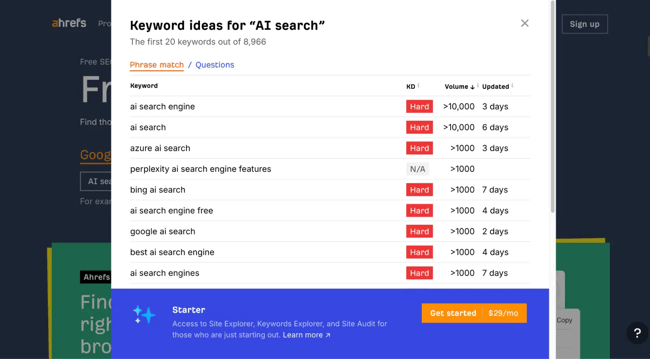
Best for: Fast, high-quality keyword ideas for multiple search engines.
Key Features:
- Returns up to 20 keyword ideas per search
- Provides search volume and keyword difficulty
- Free to use, no registration required
- Asks questions for long-tail keyword research
What I like: Even though it’s limited to 20 results, those 20 are worth gold. The data quality is excellent and I like to use Ahrefs’ free generator to check whether a keyword is really competitive before investing more time.
I’m also a fan of the Questions tab. As long-tail keywords and natural language queries become increasingly important, creating content around these question-based terms is critical to any SEO strategy – and even new GEO strategies. Ahrefs offers 20 question suggestions per search to help you plan your content calendar or expand your research in other tools.
5. Word tracker
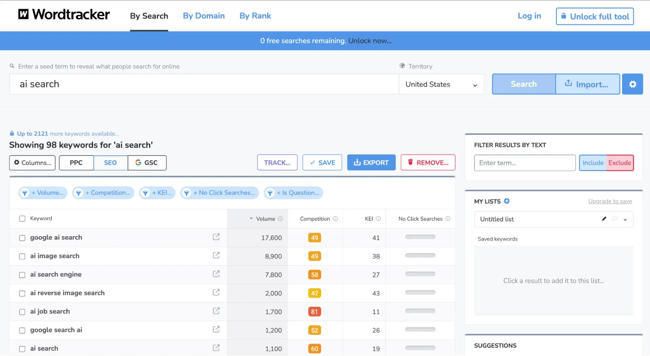
Best for: Detailed keyword metrics and competitive insights in a clear, browser-based dashboard.
Key Features:
- Shows keyword, search volume, competition and KEI (Keyword Effectiveness Index).
- Includes the “No Click Searches” and “Is Question” data columns.
- Displays up to 100 keyword results in the free version
- Allows area filtering (e.g. United States)
- Easy export and save options to organize keyword lists
What I like: Wordtracker’s layout allows for effortless keyword comparison. I like being able to see volume, competition and KEI in one place. It provides a balanced overview of which keywords are worth targeting.
The Is Question filter is particularly helpful for identifying intent-based topics that I can convert into SEO-friendly content. I can use this data to create blog outlines or evaluate whether a keyword is strong enough to build an entire content series.
How HubSpot helps with SEO
Most free keyword research tools help with discovery What how you should rank, not how the content actually ranks. HubSpot’s SEO tools are different. Instead of switching between tools to research, optimize and measure performance, it brings SEO strategy into a connected space.
With HubSpot’s SEO tools built into CRM, teams can:
- Research topics and content ideas
- Optimize content in real time
- Track results in a blog, landing pages, and campaigns
Why this is important: HubSpot helps marketers connect research results How They actually rank and allow SEO teams to plan, optimize and measure in one place.
HubSpot’s SEO marketing software
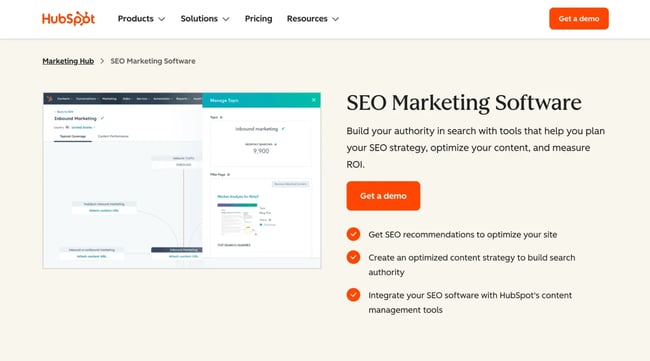
HubSpot’s SEO marketing softwareincluded in Marketing Hub, transforms a potentially messy research task into a clear SEO strategy. It helps you plan, optimize, and track your organic performance for each campaign and content asset.
Here’s how:
- Plan precisely: Organize keywords into topic clusters to strengthen a site’s topic authority and develop internal linking strategies that search engines reward.
- Get actionable recommendations: HubSpot’s built-in SEO tools automatically scan websites and make interface optimization suggestions. This is helpful because it gives users a priority list so they always know what to focus on.
- Track progress in one place: Monitor page performance for specific keywords, see position changes over time, and measure which topics generate the most organic leads and conversions.
- Seamless collaboration: Because SEO tools are integrated with the rest of the marketing ecosystem, content, web, and demand generation teams can work together.
What I like: I love that this setup combines automation with strategy. I can see in real time which keywords are driving performance – and how they are directly linked to leads or pipeline within HubSpot. Instead of exporting reports or juggling spreadsheets, I can map keyword data directly to the content and campaigns I manage.
It’s a complete feedback loop that shows what’s working and what’s not, so I can further pursue the ideas that actually make a difference. For me, this visibility is the difference between guessing what drives growth and knowing it.
SEO features in HubSpot’s CMS Hub
When creating or updating web content in HubSpot’s CMS Hub, SEO optimization has never been easier. Marketers can optimize content exactly where the work gets done.
Instead of juggling separate plugins or performing manual audits, HubSpot integrates SEO intelligence directly into the writing and publishing workflow.
This is what it looks like in practice:
- Real-time SEO recommendations: As marketers write, HubSpot automatically highlights missing meta tags, weak headlines, and unconnected topic clusters. This makes it easy to troubleshoot before hitting publish.
- Built-in page performance metrics: Easily see how each page performs in search, what keywords it ranks for, and how those visitors convert.
- Technical optimization made easy: HubSpot automatically manages redirects, canonical URLs, and site structure to ensure content works without developer intervention.
- Integrated reporting: Because CMS Hub connects directly to the team’s CRM, marketers can see everything – traffic, rankings, and which SEO-driven visitors are converting into qualified leads and customers.
For growth-oriented teams, this integration saves time. This means that SEO strategy becomes part of the everyday content workflow. Marketers publish faster and rank higher without adding additional tools or steps or hiring an outside SEO agency.
How to Conduct Keyword Research Using Free Tools
When conducting keyword research, marketers should start with a topic or question they want to cover. From there, marketers can use free keyword search tools to see demand for the phrase and see how competitive it might be in rankings. Teams can then target longer keywords and map searches to broader topics.
Follow these steps to turn raw keyword data into a targeted, effective strategy.
1. Start with a general topic or question.
Start with a starting idea that reflects the audience’s goals or challenges. Choose something like “Email automation” or “AI for small businesses.”
Then use a brainstorming tool like RyRob’s free keyword tool or WordStream to create initial keyword lists. Look for wording that reflects curiosity and purchase intent. Think, how, why, or What.
2. Validate search demand and competition
Once the team has a list of potential keywords, check how often people search for them and how competitive they are.
Tools like Semrush’s free keyword tool or Ahrefs’ free keyword generator display search volume and difficulty scores. This helps prioritize conditions that balance demand and accessibility.
3. Expand your keywords to include long-tail or question-based keywords
Long-tail keywords – those longer, colloquial phrases – offer the most SEO opportunities.
Use RyRob’s Ideas tab or Ahrefs’ Questions feature to uncover real questions your audience is asking. These often become perfect blog post titles or FAQ sections that attract steady traffic.
4. Organize keywords and assign them to topics
Create a simple table to group related keywords by topic. Each cluster should fit a key topic or offer on a website.
By associating keywords with topic clusters, teams can plan supporting blog posts, pillar pages, and internal links on the same topic.
5. Track performance
Free tools typically don’t record searches. Therefore, build a system to track progress. Use a simple spreadsheet like Google Sheets to record each keyword, the page it’s linked to, and monthly performance data. This manual tracking helps teams see what’s working and where to optimize next.
HubSpot Pro Tip: If you’re ready to go beyond spreadsheets, HubSpot’s SEO marketing software can streamline this process. It connects your keyword data, content planning and analytics in one place.
Pro tips for using free tools effectively
To make the most of free keyword research tools, cross-validate the data across multiple free platforms to ensure accuracy. Marketers can use Google’s “People Also Ask” feature for long-tail keywords that reveal search intent. Additionally, teams can manually track keyword performance over time in spreadsheets to build a custom data library that informs content optimization decisions.
You’ve probably heard the claim: “SEO is dead, and GEO killed it.” After dozens of conversations with SEO strategists and marketers on the Found in AI Podcast, I can tell you that’s not true.
SEO remains one of the strongest drivers of ROI – it simply continues to evolve. GEO (or generative engine optimization) is built on a strong SEO foundation.
Here you will find tips that can help.
1. Use multiple tools to cross-validate data.
No single free keyword research tool provides a complete picture. Each platform collects data in different ways. So using several of these together can help confirm trends and uncover gaps.
Start by combining tools to cross-check results. If one limits the search, use another to validate the data.
If tools don’t provide historical trends, track performance manually in a spreadsheet or project management tool. Log once a month:
- Search volume
- Ranking position
- Traffic for each keyword
The teams soon realize which topics are becoming more important and which need refinement.
I use this approach because it gives me confidence that the data I’m seeing is directionally accurate and isn’t just an outlier. When multiple sources point to the same trend, I know it’s worth pursuing.
2. Use Google’s “People Also Ask” for free long-tail keywords.
Google’s “People Also Ask” feature is one of the most underrated keyword research tools – and it’s free.
These question fields show what people are really curious about and how they formulate their search queries in natural language. Every time searchers click on a question, Google generates more related searches, creating an endless stream of long-tail keyword ideas that teams can use to create content.
This feature is particularly valuable because it reveals search intent. Each question represents the following:
- Pain points
- curiosity
- Moments of consideration in a buyer’s journey.
Use these insights as a guide for blog posts, FAQs, or supporting pages that answer these exact questions.
I rely on the results of People Also Ask to identify new perspectives on familiar topics. I usually collect a few of these questions, group them by topic, and turn them into a content cluster or blog series that expands on a main keyword.
An important note about long-tail keywords and the future of SEO:
In a current one recorded interview with Charlie GrahamFounder of RivalSeewe talked about the growing importance of long-tail keywords. Graham told me that long-tail phrases are more likely to be cited in AI search results compared to shorter three- or four-word terms.
This is important when planning an SEO keyword strategy.
Make sure the content contains complete, colloquial phrases that reflect how people actually search. Not only do they strengthen traditional search engine optimization, but they also provide future-proof content for new search behaviors.
3. Take advantage of your competitors’ free data.
Teams don’t need paid tools to learn from competitors’ SEO strategy – much of their keyword data is already public. By analyzing the topics and structure of top content in a niche, teams can discover what is working with competitors and identify gaps that need to be addressed.
Start with a simple Google search for target keywords. Look at the titles, meta descriptions, and headings of top results to see which phrases appear consistently. Tools like Wordtracker also allow users to include a competitor’s domain to see what keywords they are ranking for (many of these insights are available in the free versions!).
From there, look for patterns. Are competitors targeting:
- Specific long-tail keywords?
- Question-based phrases?
- Buyer intent terms like “best,” “compare,” or “like”?
These are clues to what resonates with the common audience.
I like to use competitive data as a shortcut for idea generation. As you see which topics increase visibility for others, you can reverse engineer that success and create similar content that adds your own expertise, brand voice, or perspective.
HubSpot Pro Tip: If you already use HubSpot, you can track competitor domains and keywords right in your dashboard. This makes it easy to monitor ranking changes over time and identify opportunities to outperform similar brands.
4. Bypass the limitations of free tools.
The key to using free tools is to creatively close these gaps so that teams can still develop a reliable SEO strategy. Free keyword tools are powerful, but they all have disadvantages such as:
- Daily search limits
- Missing historical data
- Incomplete SERP insights
Use free features from other platforms to complement research. Google Search Console shows which search queries content is already ranking well for, and Google Trends helps identify emerging topics before the competition notices. Combined with the free tools in this guide, these insights will help you make data-driven decisions without having to pay for premium software.
I have found that consistency is the best solution. As you collect and organize your data over time, you create a custom keyword library that is often more valuable than what you would get with a paid plan. This is an extra effort up front, but it pays off when you can clearly see what will produce the results.
HubSpot Pro Tip: If you’re ready to automate this process, HubSpot’s SEO marketing software can bring together keyword, performance, and page-level data into one dashboard so you can analyze everything without switching between tools.
5. Track your progress without premium tools.
Most free tools don’t store historical data, making it difficult to measure progress over time. Setting up a simple tracking system ensures that marketers can see which keywords and content are actually driving traffic, engagement, or conversions.
I track keyword performance monthly using a simple spreadsheet and Google Analytics data. When I see how certain posts are ranking or converting, I can make data-driven decisions about what to optimize or expand on next. Over time, this data set becomes a roadmap, showing what content works consistently and where new opportunities arise.
Frequently asked questions about keyword research tools
What is the best free keyword research tool?
For quick brainstorming and early validation, WordStream and RyRob’s free keyword tool are good starting points. For more structured data, Semrush’s free keyword tool and Ahrefs’ free keyword generator provide reliable insights into search volume and keyword difficulty.
When teams are ready to go beyond research and start optimizing content, HubSpot’s SEO marketing software can help organize keywords, monitor performance, and turn insights into strategies.
How accurate are free keyword research tools?
Free tools are directional, but not perfect. They often rely on smaller data sets or averages, so use them to identify trends – not exact numbers. To check performance, combine the results with analytics or a platform like HubSpot that measures how organic traffic for those keywords translates into engagement and conversions over time.
Can I only do effective SEO with free keyword research tools?
Yes, an SEO strategy can be effective with free keyword research tools – especially for teams just starting out. Free tools can help discover opportunities and plan content. The biggest limitation is tracking and scaling.
When a company starts to grow, tools such as: HubSpot’s marketing hub can centralize this data and connect keyword research, content creation and campaign results in one place.
What is the difference between free and paid keyword research tools?
Free tools are ideal for generating ideas and assessing potential. Paid tools offer deeper insights, such as competitor analysis, SERP tracking, and long-term keyword trends.
Platforms like HubSpot go beyond research. They help teams put SEO into practice, measure ROI, and manage optimization across multiple channels.
How many keywords should I research for my website?
Start small by focusing on 25 to 50 high-impact keywords that match products or target audiences. Over time, expand your search to include related long-tail keywords and supporting content. HubSpot’s SEO tools make it easier to connect this content, help visualize topic clusters, and track which pieces are generating meaningful traffic and leads.
Which platform is best for keyword research if I’m just starting out?
For SEO newbies: Start with WordStream, RyRob’s free keyword toolor Semrush’s free keyword tool. Together they enable both creativity and affirmation.
As an SEO program becomes more sophisticated, paid tools such as HubSpot’s SEO marketing softwarebecome a natural next step. Paid software helps apply these keyword insights at scale and link them directly to content performance and lead generation.
Turn keyword research into real results.
Free keyword research tools provide you with the data to get started successfully. However, turning these insights into measurable growth requires strategy, consistency and the right systems.
HubSpot’s SEO marketing software can make a real difference in your SEO strategy. It combines your keyword research, content planning, and performance tracking into one connected workspace. With HubSpot, you can find out what you’re ranking for, understand why your content works, and see exactly how it contributes to ROI.
I’ve tested dozens of SEO tools over the years and what I like most about HubSpot’s approach is the way it puts research into action. Instead of exporting data or juggling multiple platforms, you can plan topics, optimize pages, and measure results right from your marketing hub. It’s SEO in practical form. And if you’re ready to scale beyond free tools, it’s a no-brainer.
Start optimizing smarter HubSpot’s SEO marketing software and turn your keyword research into measurable growth.