

When I set up my first online store, I thought that a great WooCommerce store was enough.
I had clean product pages, great photos, and prices that people couldn’t argue with. But sales were slow. Then a friend asked me, “Are your products showing up on Google Shopping?”
They weren’t. Not on Facebook or Instagram. Not anywhere outside of my own website.
See, shoppers today don’t start looking for products in your store. You start at Google. You scroll on social media platforms like Facebook and Instagram. And if your products aren’t there, your competitors’ products are.
That’s exactly what a WooCommerce product feed fixes.
It automatically syncs your store catalog with Google Shopping, Facebook Marketplace and over 100 other channels. This will help you reach people who are already looking for what you sell.
I tested ten products and listed the five best WooCommerce product feed plugins to help you quickly find the right one for your business. Here’s what actually works.
Key insights
- I’ll show you how to automatically sync your WooCommerce store with Google Shopping, Facebook, and 100+ channels without touching a single line of code
- I mention a free plugin that manages unlimited products and unlimited feeds out of the box
- Discover which plugin is best for Google-only sellers versus shops looking to dominate every social channel
- I tested all 5 product feed plugins to make sure you don’t face a trial-and-error setup
- I’ll show you which option includes real-time feed updates so your prices and inventory are always accurate
Additionally, you can use the table of contents below to view all plugins at once. You can also click any link to jump to this section.
How to test WooCommerce product feed plugins
Hello, I’m Alvin, the IsItWP author and this is my testing process for the best product feed plugins for WooCommerce.
🔍 Click here to see my testing methodology
Here’s how I evaluate each plugin exactly:
- Supported channels – How many platforms can you connect to? Google, Facebook, TikTok, Instagram, Bing, Pinterest and more
- Easy setup and field mapping – Can a beginner get a live feed in less than 30 minutes?
- Feed refresh automation – Does it offer scheduled updates? Real-time synchronization for product changes?
- Product variation and filter support – Does it cover variable products, out-of-stock product exclusions, and custom rules?
- Breakdown of free vs. paid features – How much can you actually do before you hit a paywall?
- Support quality and documentation – Is help available if something breaks?
Tools I use:
- WooCommerce shops with simple and variable product types
- Google Merchant Center to review feed submission and approval
- Facebook Commerce Manager to check catalog sync
- IsItWP site performance tool and GTmetrix to measure the influence of the plugin on shop speed
- WordPress test environments with over 100 product catalogs
Why trust IsItWP?
At IsItWP, we’ve been the go-to source for the WordPress community since 2009, helping over 2 million users choose better plugins. Unlike review sites that never actually use the products, we maintain active accounts, run real customer sites, and offer ongoing WordPress advice.
The best WooCommerce product feed plugins reviewed, compared and rated
If you run a WooCommerce store and don’t sync your products with external channels, you’re leaving money on the table every day.
These five plugins make syncing easy without the need for developers. So you can quickly compare all the tools at a glance, take a look at the table below.
| Plugin | Best for | Channels | Free version | Evaluation | Starting price |
|---|---|---|---|---|---|
| 🥇 Product Feed PRO by AdTribes |
All-round range |
100+ |
✅ |
⭐⭐⭐⭐⭐ |
$99.50/year |
| 🥈 ELEX WooCommerce Google Shopping |
Google-focused stores |
Google + more |
✅ |
⭐⭐⭐⭐⭐ |
$79 one-time |
| 🥉 WebToffee product feed |
Facebook and Instagram |
Google, FB, IG, Pinterest |
✅ |
⭐⭐⭐⭐⭐ |
$89.00/year |
| 4. CTX feed |
Maximum export formats |
130+ |
✅ |
⭐⭐⭐⭐ |
$119/year |
| 5. Conversios Product Feed Manager |
Ad performance |
Google, Facebook, TikTok |
✅ |
⭐⭐⭐⭐ |
$49.00/year |
Before diving into the full reviews, check out my picks along with the BEST WordPress eCommerce plugins for a more comprehensive overview of building a powerful store.
With that out of the way, let’s get started.
1. Product Feed PRO by AdTribes ⭐⭐⭐⭐⭐
Ideal for: Store owners who want to reach over 100 channels with a powerful free plan
Here’s what no one tells you about product feeds: Most plugins require you to pay before you can even test whether they work. AdTribes is completely changing that.
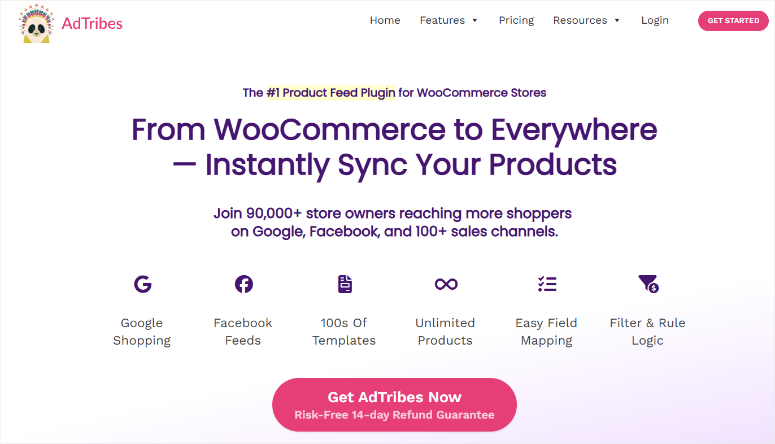
The free version of AdTribes offers you unlimited products, unlimited feeds and over 100 pre-built channel templates.
This includes Google Shopping, Facebook, TikTok, Instagram, Bing, Pinterest and dozens of price comparison sites. You are not tied to one or two channels; You can be everywhere at the same time.
Why is Product Feed PRO one of the best WooCommerce product feed plugins?
The standout feature for me is the automated field mapping, which is really impressive.
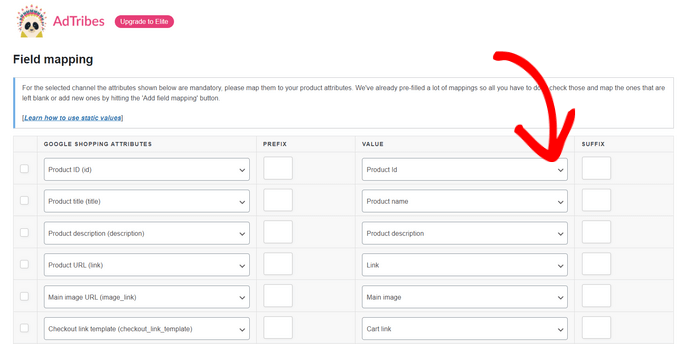
When you create a new feed, AdTribes pre-populates the required Google attributes such as product ID, title, description, and image URL based on your existing WooCommerce data.
After that, all you have to do is check the mappings and adjust the empty mappings. For most stores, this means a time savings of 30 to 45 minutes of manual setup per channel.
Additionally, the Feed Validator tool detects errors before you even submit them to Google Merchant Center.
It can detect missing Global Trade Item Numbers (GTINs), broken image links and invalid price formats. It flags them all in advance so your feed doesn’t get rejected.
Additionally, scheduled updates ensure your prices and inventory levels automatically remain accurate across all channels.
You can also set it to only update when products change, which keeps server load low for large catalogs.
For anyone serious about eCommerce SEO, this is the most powerful free starting point I’ve found.
My experience with Product Feed PRO
I set up a Google Shopping feed for a clothing store with 340 products using AdTribes. The entire process took less than 20 minutes.
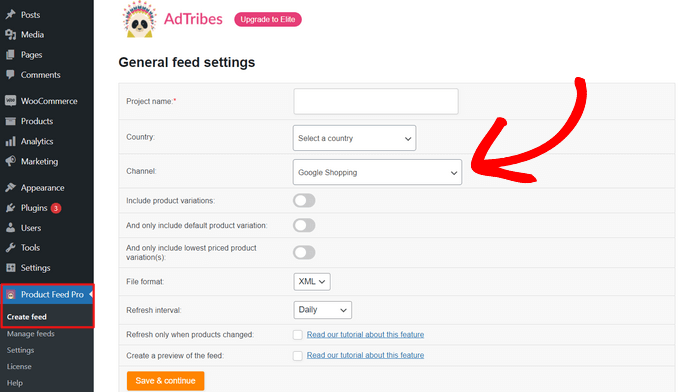
First I went to Product Feed Pro » Create feed and fill out the general settings which include project name, country and channel.
AdTribes then took me straight to field mapping. Almost all of the required Google attributes were already filled out in advance. I only had to manually map two custom fields.
After saving, I downloaded the XML feed file and uploaded it directly to Google Merchant Center.
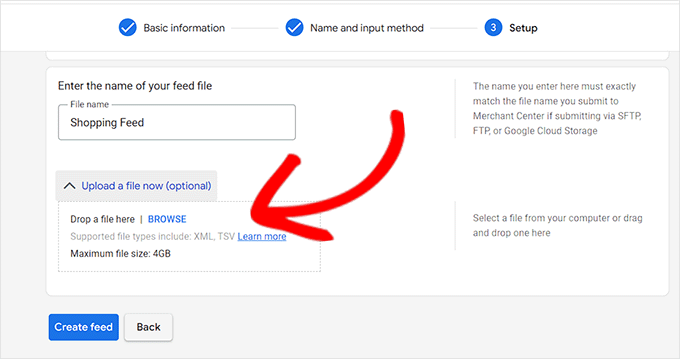
The feed went live without any rejections. This rarely happens on a first attempt.
The only thing I would like to mention: Advanced features such as product category mapping and priority support are available in the Elite (Premium) version. The free tier is generous, but growing businesses will eventually want to upgrade. However, most beginners will only hit the wall after months.
Tip: Before upgrading, make sure your WooCommerce hosting can handle the additional traffic your product feeds will bring. I’ve seen stores get their feeds approved and immediately crash under the new traffic load because they were on shared hosting. Repair your infrastructure first and then update your feed plugin.
► Advantages
- The free plan includes unlimited products and unlimited feeds, so you can scale without paying anything upfront
- Over 100 channel templates mean one plugin manages TikTok, Google, Facebook and Pinterest at the same time
- The feed validator detects errors before submission, eliminating rejection loops in Google Merchant Center
- Pre-populated field mapping significantly reduces setup time, even for stores with complex product data
► Disadvantages
- Advanced category mapping and priority support requires the Elite upgrade
- Feed configuration can be overwhelming when setting up five or more channels at once
My verdict: Product Feed PRO by AdTribes is my top choice because it gives you serious multi-channel reach without spending a dime. For stores just starting out using WooCommerce plugins to increase sales, I would install this one first. With the free plan alone, most small businesses can get online on Google Shopping and Facebook within an hour.
Prices: Free plugin available; Pro starts at $99.50/year
Get started here with Product Feed PRO by AdTribes
2. ELEX WooCommerce Google Shopping ⭐⭐⭐⭐⭐
Best for: Google-focused businesses that need powerful rules-based attribute mapping
Most product feed plugins treat Google Shopping like another checkbox in a list of channels. ELEX WooCommerce Google Shopping treats it like a specialty.

If Google Merchant Center is your primary sales channel, ELEX WooCommerce Google Shopping gives you a level of control that most WooCommerce feed plugins simply can’t match.
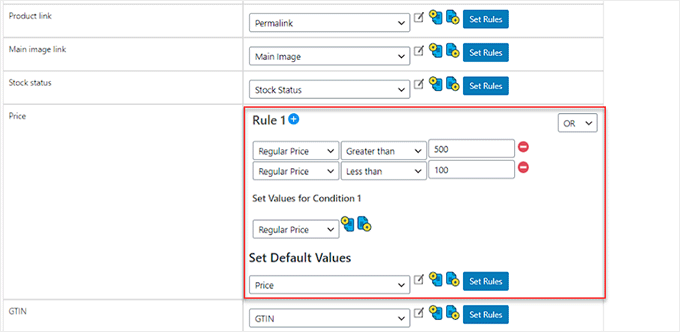
First of all, the rule-based attribute mapping is the standout feature. You can set conditional logic for each attribute.
For example, if a product’s regular price is more than $500, assign a different value. If it is less than $100, apply a different rule.
This type of precision is important when managing a large catalog with many variations in product types.
Why is ELEX WooCommerce Google Shopping one of the best WooCommerce product feed plugins?
ELEX WooCommerce Google Shopping supports multiple feed file formats including XML, CSV and TSV. This means you can match exactly what Google Merchant Center needs at any time.
The free version handles simple products cleanly and is a real starting point for stores just launching their first Google Shopping campaign.
For WooCommerce stores with more complex setups, the premium version offers full support for product variants, multilingual categories, and priority support.
Feed scheduling works for daily, weekly or monthly cron jobs. You set it once and ELEX WooCommerce Google Shopping ensures that your product data remains correct on Google without any manual work.
My experience with ELEX WooCommerce Google Shopping
I have used ELEX WooCommerce Google Shopping to create a Google Shopping feed for a home goods store with 180 products in a wide price range.
The biggest problem was that some cost less than $50 while others cost over $800.
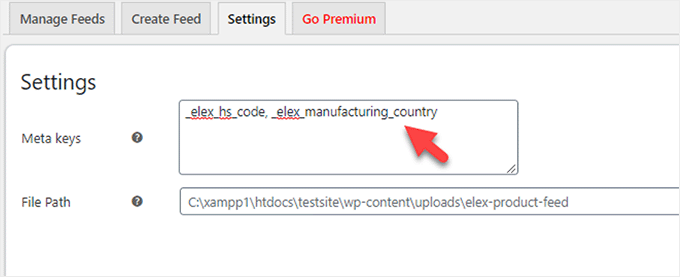
The first thing I did was add custom meta keys in the plugin settings.
This WooCommerce tool allows you to add custom product fields directly to your feed, which is handy if you sell internationally and need to meet customs data requirements.
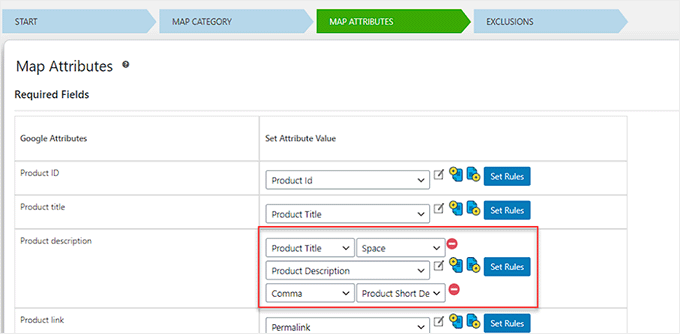
Next I moved on to attribute mapping.
The “Card Attributes” step is where ELEX really shines. I combined the product title, a space, and the product description into a single, more comprehensive description field.
This rewards Google with better ad relevance scores.
Then I set conditional pricing rules for the mid-range and high-end products separately. This kept my bid strategy clean in Google Ads.
The entire setup took about 35 minutes. The feed was validated correctly the first time it was submitted to Google Merchant Center.
The disadvantage worth reporting: Product variants are locked behind the premium version. If you sell variable products with different sizes, colors or configurations, the free version won’t quite get you there.
Tip: But to help you stick with the free version and still get results, you can use eCommerce tracking tools like MonsterInsights to measure which products actually increase sales before deciding to upgrade.
► Advantages
- Rules-based conditional attribute mapping gives you granular control that most plugins don’t offer in any plan
- Multiple feed formats (XML, CSV, TSV) cover every Google Merchant Center submission method
- Support for custom meta keys allows you to expose product-level data that other plugins completely ignore
- The free version is a solid, real starting point for simple, paywall-free product catalogs
► Disadvantages
- Product variation support requires a paid upgrade, limiting the free version for most modern WooCommerce stores
- Focuses almost exclusively on Google, so it’s not the right choice if Facebook or TikTok are a priority
My verdict: ELEX WooCommerce Google Shopping is the right call if Google Shopping is your main channel. And you need conditional mapping logic that can handle a large, diverse catalog. It’s not about being everything, and it’s that focus that makes it so good at what it does. Combine it with solid WooCommerce checkout plugins to ensure that the traffic it generates actually converts.
Prices: Free plugin available; Pro starts at a one-time fee of $79
Get started here with ELEX WooCommerce Google Shopping
3. WebToffee Product Feed for WooCommerce ⭐⭐⭐⭐⭐
Best for: Shops that want Facebook and Instagram feeds with a beginner-friendly setup
Most shop owners I know don’t try to master feed specs from day one. They just want their products to appear on Facebook, Instagram or Google Shopping as quickly as possible.
WebToffee Product Feed for WooCommerce is designed to do just that.
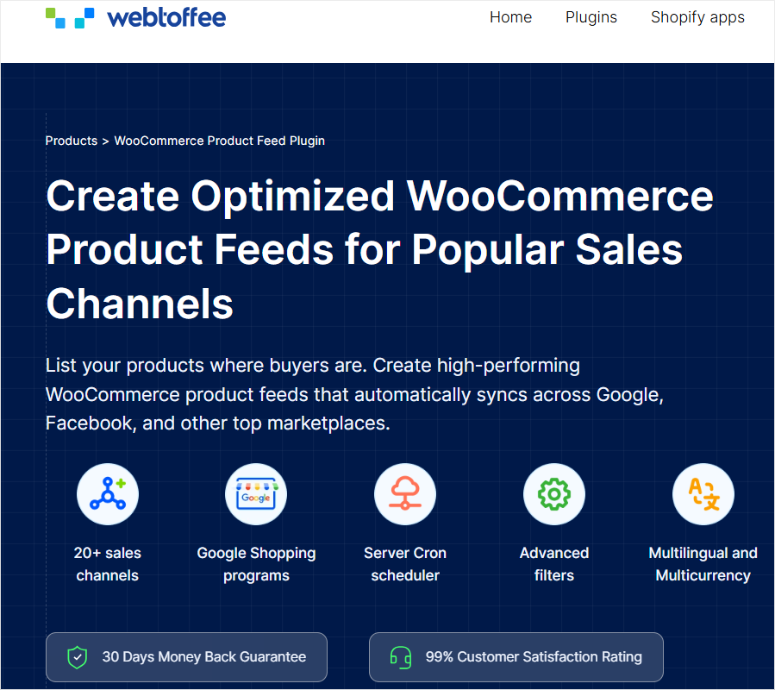
This is because it supports over 20 marketing channels out of the box, such as Facebook/Instagram Shop, Google Shopping, Pinterest and Bing.
This allows you to create and deliver your feed without having to switch between multiple plugins or put things together manually
In addition, the setup follows a clear 4-step wizard.
You name your feed, select your country, your channel and set your automatic update interval. Even a beginner can have a live feed in under 15 minutes.
Why is WebToffee Product Feed one of the best WooCommerce product feed plugins?
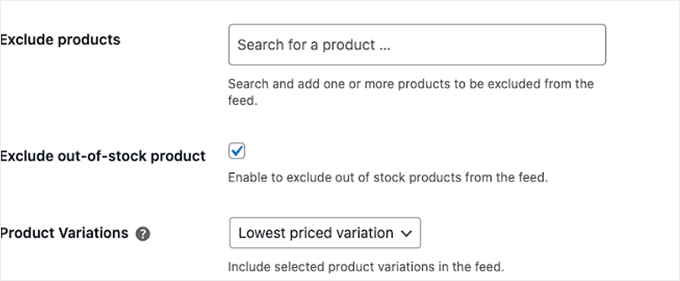
What I really like is the exclusion control for out-of-stock items. Just one checkbox and the WebToffee product feed for WooCommerce will automatically remove out-of-stock products from your feed.
That sounds small, but it’s actually huge. Directing Facebook shoppers to a product page with a “Sold Out” message is one of the quickest ways to increase your ad performance.
In addition, the product variation control is intelligent.
You can choose to only include the lowest priced variant in your feed. This means your offers remain competitive in price comparison without overloading the catalog with every single variant.
For stores with lots of product variations and upsell opportunities, this is a really useful filter.
In addition, daily automatic updating ensures that prices and availability are correct across all connected channels without manual effort.
For anyone who wants their WooCommerce products to appear quickly in Instagram and Facebook feeds, WebToffee removes almost all technical hurdles.
My experience with WebToffee product feed
I set up an Instagram and Facebook Shop feed for a handmade jewelry store with 95 products. The goal was to make their catalog live on meta platforms before the next advertising campaign.
Step 1 of the wizard was clean.
I gave the feed a name, set the country to the United States, and selected Facebook/Instagram Shop as the channel. I also turned on daily auto-refresh to keep the feed fresh without having to touch it again.
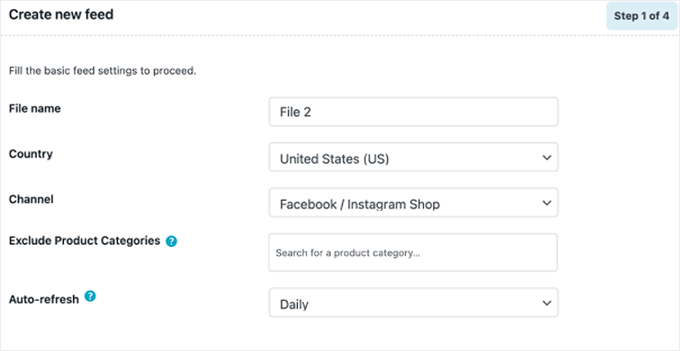
Then I moved on to the exclusion settings. I checked the “Exclude out of stock products” checkbox and set the product variants to “Lowest Price Variant”. This meant the feed remained clean and competitively priced from day one.
Total assembly time: 12 minutes. The feed exported cleanly on the first try and connected to Facebook Commerce Manager.
The store saw an increase in Facebook product reach within the first two weeks of the feed going live. Your catalog was finally indexed by Meta instead of relying on manual product posts.
The only honest scam: WebToffee’s channel list is smaller than AdTribes. If you need feeds for 50+ niche comparison sites or affiliate networks, you’re reaching your limits. But for the big platforms like Google, Facebook, Instagram, Pinterest and Bing, it covers everything that most businesses actually need.
Tip: To maximize your social commerce strategy, combine WebToffee with a social media feed plugin like Smash the balloon to display your Instagram catalog directly on your WordPress site. This creates a complete loop. Your products appear in Instagram feeds AND in your shop, building trust and strengthening your brand presence on both channels.
► Advantages
- The 4-step wizard makes setup faster than any other plugin on this list, even for complete beginners
- One-click out-of-stock exclusion automatically protects your ad performance without the need to configure rules
- The lowest-cost variation filter ensures your catalog remains price-competitive without overwhelming feed channels with duplicates
- Covers the four channels that are most important to most businesses: Google, Facebook, Instagram and Pinterest
► Disadvantages
- Smaller channel library than AdTribes or CTX Feed, so niche market sellers can outgrow it more quickly
- Some advanced filtering options require the Premium version
My verdict: WebToffee Product Feed for WooCommerce is my recommendation for store owners who want to publish their products on Facebook and Instagram quickly and without a steep learning curve. The control over out-of-stock exclusion and variation control alone makes the installation worthwhile. If social commerce is a priority for you and you don’t need more than 100 channel templates, this is a smarter place to start than a more complex plugin.
Prices: Free plugin available; Pro starts at $89.00/year
Get started with the WebToffee product feed for WooCommerce here
4. CTX Feed – WooCommerce product feed manager ⭐⭐⭐⭐
Best for: Businesses that require a reach of 130+ channels with flexible export formats
CTX Feed differs from all the other plugins on this list in that it not only supports more channels, but also more export formats.
Most WooCommerce feed plugins handle XML and CSV. CTX feed continues with TSV, XLS, TXT and JSON.
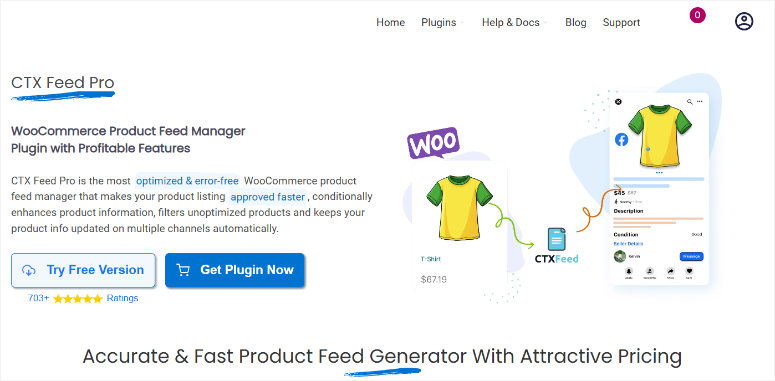
Supporting additional export formats is important when sending to affiliate networks, niche marketplaces, or price comparison sites that have their own format requirements.
You don’t need a developer to reformat your data. CTX Feed takes care of that.
The 130+ channel-ready templates cover everything from Google Merchant Center and Facebook to PriceRunner, Rakuten, Kelkoo, eBay, Snapchat, and TikTok.
This applies to more than 200 countries, making it the world’s most powerful plugin on this list for businesses with an international audience.
Why is CTX Feed one of the best WooCommerce product feed plugins?
Fail-safe feed validation is one of CTX Feed’s strongest selling points.
Before you submit, it automatically checks for Global Trade Item Number (GTIN) errors, missing descriptions, broken image links, and variant mismatches.
This means fewer rejections and less time spent diagnosing why your feed was flagged.
Where CTX Feed really earns its place is in compatibility.
It works smoothly with Dokan and WCFM for multi-vendor marketplace stores, WPML and Polylang for multilingual catalogs.
Plus, all standard WooCommerce product types, including subscriptions and bundles. If you run a complex shop setup, this compatibility list will save you a lot of problems.
My experience with CTX Feed
I tested CTX Feed on a multilingual WooCommerce store running WPML with products listed in English, French and German. The store also used Dokan for multiple suppliers.
This combination usually breaks things. Feed plugins either ignore the translated product data or create duplicate entries that confuse Google. CTX Feed handled both WPML and Dokan cleanly.
Each language generated its own correct feed without any manual intervention.
I then conducted a thorough analysis MonsterInsights to track which channel generated the most traffic.
CTX Feed’s multi-format export made it easy to submit separate feeds for Google, Facebook and two regional price comparison sites.
The honest scam: The interface has a steeper learning curve than other eCommerce feed plugins on this list. There are a lot of settings and first-time users may feel lost.
Tip: Before diving into CTX Feed’s settings, spend 20 minutes watching the setup tutorials and reading the documentation. Then test advanced filters and rules on your first feed in a staging environment or on a WordPress test site before making it live.
► Advantages
- The most flexible export options on this list: XML, CSV, TSV, XLS, TXT and JSON are covered
- Over 130 channel templates in over 200 countries make this the best choice for international sellers
- Thanks to the integrated WPML, Polylang, Dokan and WCFM compatibility, complex shop setups work without workarounds
- Automatic validation detects feed errors before submission, significantly reducing rejection cycles
► Disadvantages
- The interface is more complex than WebToffee or AdTribes, so beginners may need more time to get used to it
- Some advanced filter rules require trial and error to configure correctly on the first try
My verdict: CTX Feed is the right choice if your store has multiple vendors, is multilingual, or needs to route products in multiple export formats to a long list of niche channels. It’s not the most beginner-friendly plugin, but it’s the most powerful for stores that have really outgrown the simpler tools.
Prices: Free plugin available; Pro starts at $119/year
5. Conversios Product Feed Manager ⭐⭐⭐⭐
Over 10,000 active installations | Best for: High-performance advertisers who need product catalogs without rejection
Most product feed plugins focus on getting your feed delivered. This eCommerce feed plugin focuses on staying approved.
Remember, a submitted feed that is consistently rejected will cost you your ad dollars, waste time, and ultimately impact your campaign’s performance.
Conversios Product Feed Manager is designed to fix the problem at the source.
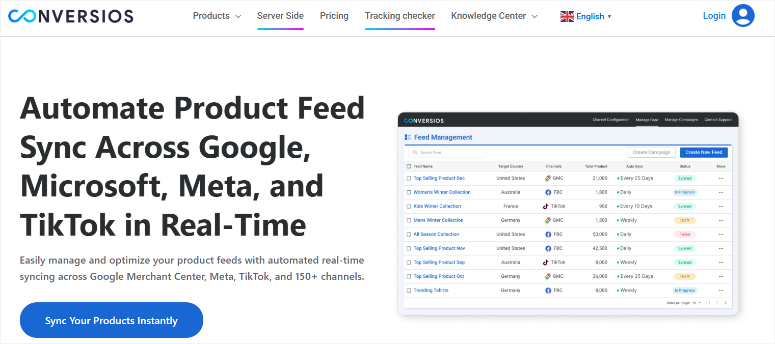
The real-time approval status dashboard is what sets it apart.
Instead of logging into Google Merchant Center to look for rejection reasons, Conversios shows them directly in your WordPress dashboard.
You can see exactly which products are being rejected and why, then fix them without leaving your website.
Additionally, real-time sync ensures your product data is accurate across Google Shopping, Facebook, and TikTok as your catalog changes.
Price updates, inventory status updates, and product availability updates all happen automatically without you having to schedule anything manually.
Why is Conversios Product Feed Manager one of the best WooCommerce product feed plugins?
The no-code setup is really beginner-friendly.
You configure your channel connections, assign your attributes, and Conversios does the rest. There is no XML to write, no cron jobs to configure, and no developer required.
For stores running campaigns on Google, a clean feed directly improves campaign delivery.
My experience with Product Feed Manager from Conversios
I tested Conversios at a fashion accessories store that runs Google Performance Max campaigns.
The store had a recurring problem. About 12% of products were reported for price mismatches between the feed and the product page.
The problem was simple but painful. Sales prices were not updated quickly enough in the feed after they were posted on the site.
Google compared the feed price to the live page price, found a mismatch, and rejected those products.
Conversios’ Product Feed Manager addressed this issue with real-time syncing. After I connected the store and configured the Google Shopping feed, price changes on the site appeared in the feed within minutes.
The rejection rate then fell to less than 2% within the first week.
The dashboard made it easier to diagnose the remaining rejections. I was able to see every rejected product and the exact reason and fix it right in WordPress. No switching between tabs.
The honest disadvantage: Conversios supports fewer channels than AdTribes or CTX Feed. It focuses on the big three – Google, Facebook and TikTok. If you need Pinterest, Bing, or niche comparison sites, you’ll need a different plugin. But for stores whose online marketing efforts focus on these three platforms, this focus is a feature, not a limitation.
The honest scam: Conversios supports fewer channels than AdTribes or CTX Feed. It focuses on the big three, i.e. Google, Facebook and TikTok. If you need Pinterest, Bing, or niche comparison sites, you’ll need a different plugin.
Tip: If these three channels account for the majority of your revenue but you still want greater reach, run Conversios for your paid campaigns and add a second feed plugin like AdTribes for the remaining channels. This dual-plugin approach ensures that your high-quality feeds with Conversios remain error-free while being present everywhere.
► Advantages
- The real-time approval status dashboard displays rejections directly in WordPress, allowing you to troubleshoot issues without switching between tools
- Real-time sync resolves price discrepancies between your feed and product pages in minutes, not days
- The no-code setup keeps the barrier to entry low, even for stores without an on-site developer
- Proven impact on return on ad spend (ROAS) using documented case study results in extensive catalogs
► Disadvantages
- Smaller channel library than AdTribes or CTX Feed. Best for Google, Facebook, and TikTok-focused stores
- Less suitable for stores that need niche marketplace or price comparison feeds
My verdict: If your store runs paid campaigns on Google or Meta and feed rejections are impacting your return on ad spend, Conversios’ Product Feed Manager is the most targeted solution on this list. It’s not the most comprehensive plugin, but it’s the most focused on upselling and maximizing revenue from the traffic your feeds generate. For performance marketers, this focus quickly pays off.
Prices: Free plugin available; Pro starts at $49.00/year
Get started here with Conversios’ Product Feed Manager
This is my list of the best WooCommerce product feed plugins. However, when you leave this page, I want you to be fully aware of which tool is right for you.
With that in mind, take a look at the section below to find out which one suits your needs.
How to choose the right WooCommerce product feed plugin
Five solid plugins, five different strengths. Here’s how to sort through the options and find the one that’s right for your business.
Choose Product Feed PRO from AdTribes if:
- You want the widest reach with the most powerful free plan. AdTribes is my standard recommendation for most stores.
- With over 100 templates and unlimited product support, you won’t outgrow the free tier anytime soon.
Choose ELEX WooCommerce Google Shopping If:
- Google Shopping is your primary and most important channel.
- They sell products with wide price ranges or complex feature requirements; ELEX’s conditional mapping rules save you hours of manual cleanup every month.
Choose the WebToffee product feed if:
- Social commerce is your priority and you want to quickly publish your products on Facebook and Instagram.
- Exclusion and variation control for out-of-stock inventory is particularly valuable for fashion, jewelry, and lifestyle stores where inventory moves quickly.
Choose CTX feed If:
- Your store is multilingual, has multiple vendors, or needs to bring products to niche marketplaces in multiple export formats.
- It’s also the best choice for international sellers who need feeds in formats beyond XML and CSV.
Choose Conversios Product Feed Manager If:
- You’re running paid campaigns on Google or Meta and feed rejections are affecting your returns.
- You need real-time synchronization to keep prices accurate.
Well done! You now have a list of the best eCommerce feed plugins for WooCommerce. If something is unclear, check out the frequently asked questions below.
FAQs: Best WooCommerce Product Feed Plugins
What is a WooCommerce Product Feed?
A WooCommerce product feed is a file, usually XML or CSV, that contains your store’s product data: titles, descriptions, prices, images and availability. You transmit this file to platforms such as Google Shopping, Facebook or Pinterest. These platforms use it to display your products to buyers who are already looking for what you sell. Without a feed, your products will remain invisible outside of your own website.
Do I need a paid plugin to submit products to Google Shopping?
No. Both AdTribes and ELEX WooCommerce Google Shopping offer free versions that connect to Google Merchant Center without paying. AdTribes’ free plan includes unlimited products and unlimited feeds. The free version of ELEX WooCommerce Google Shopping processes simple products cleanly. For more advanced features like product variant support or priority support, you’ll run into paywalls, but for a basic Google Shopping feed, the free tiers are fully functional.
Can I use a plugin for Google, Facebook and TikTok at the same time?
Absolutely, and this is one of the main reasons to use a product feed plugin instead of submitting manually. AdTribes and CTX Feed both support over 100 channels with a single installation. You create separate feeds for each platform and the plugin manages them all. WebToffee covers Google, Facebook, Instagram, Pinterest and Bing from one dashboard. You don’t need a separate plugin per channel.
How often should my product feed be updated?
Daily updates are sufficient for most shops. If you frequently run flash sales or have high inventory turnover, it’s worth upgrading to real-time sync available through Conversios’ Product Feed Manager. Prices and inventory that are out of date in your feed cause two problems: disapproval from Google and disappointed shoppers who click through to find a product that’s sold out or costs more than advertised. A solid WordPress performance setup will help ensure scheduled feed updates don’t slow down your store.
What happens if my product feed contains errors?
Google and Facebook are rejecting the affected products and removing them from your listings until the errors are resolved. Some of the most common errors include missing GTINs, mismatched prices between your feed and product pages, broken image URLs, and incomplete descriptions. AdTribes has a built-in feed validator that intercepts these before submission.
Are product feed plugins slowing down my WooCommerce store?
Not if you choose the right tool. Plugins with good feed generation run in the background, usually via scheduled cron jobs, so it doesn’t impact your store’s front-end speed for visitors. The processing load occurs on the server side during off-peak times. However, generating feeds for very large catalogs can be resource intensive. If you’re using cheap hosting and running a large store, it’s worth taking a look at reliable eCommerce hosting.
Final Verdict: Best WooCommerce Product Feed Plugins
If you only install one plugin from this list, make it Product Feed PRO by AdTribes. The free plan covers more channels, more products and more formats than any competing free option.
For most WooCommerce store owners, it’s the fastest way to go from invisible to anywhere.
However, the right choice really depends on your situation. Read through this post and you will find the right choice for your business.
Product feeds aren’t complicated if you have the right tool.
The best WooCommerce feed plugins all have one thing in common: they take the work off your plate and get your products in front of more people. These five do exactly that.
Resources Hub: WooCommerce Product Feeds and Store Growth
Use these resources to get the most out of your product feed strategy:
These articles will help you improve your store’s performance and ensure that users enjoy shopping on your site.