
I almost lost a client before I even started working with them.
They ran a tourism business in Namibia and needed their website in English, Chinese and German. I chose a translation plugin based on its 5-star reviews.
Three hours later the website crashed and the booking system was crippled during peak season.
This mistake taught me that choosing translation plugins isn’t about star ratings. It’s about finding tools that actually work when real money is at stake.
After this lesson, I tested translation plugins for blog sites, business sites and WooCommerce stores. Some dropped out immediately, others delivered translations so bad that they were embarrassing.
Here are 9 translation plugins for WordPress that actually work to reach an international audience without any technical nightmares.
Key insights
- I’ll show you which plugins you can use to translate visually, so you can spot awkward translations before visitors see them
- I’ll mention the plugin that broke my test site within 3 hours (and the one that saved it).
- Discover why free auto-translate plugins work great for hobby blogs but boost your credibility on business sites
- I tested translation plugins on three real websites to find out which ones actually deliver on their “beginner-friendly” promises
- I’ll show you the SEO mistake some translation plugins make that kills your chances of ranking in local search results
If you don’t have time to go through the entire article now, you can use the table of contents below to determine the best options. You can also use the links to jump to any section of the article.
How I test WordPress translation plugins
Hello, I’m Alvin, the IsItWP author, and here is my testing method for translation plugins.
🔍 Click here to see my testing process:
Here’s how I evaluate each plugin exactly:
- Setup speed: I time the entire process from installation to the first translated page. If it takes longer than 30 minutes, that’s a warning sign for beginners.
- Translation quality: I compare machine translations with professional translators. Then I check how easy it is to fix Google Translate’s inevitable errors.
- Content coverage: I test whether plugins translate posts, pages, menus, widgets, contact forms and WooCommerce products. Many plugins claim “everything” but miss crucial elements.
- SEO implementation: I check the URL structure, hreflang tags and sitemap creation. Then I check Google Search Console to see if the translations are actually indexed.
- Impact on performance: I used the free IsItWP performance tool and GTmetrix Tests before and after plugin installation.
- WooCommerce compatibility: I test product translations, checkout processes and currency handling in real stores.
My test environment:
- Comparison between 12 different translation plugins
- 3 test sites: personal blog, company site, WooCommerce store with over 200 products
- Chrome DevTools for performance monitoring
- Google Search Console for SEO verification
- Real customer feedback collected over 18 months
Why trust IsItWP?
At IsItWP, we’ve been the go-to source for the WordPress community since 2009, helping over 2 million users choose better plugins and tools.
Unlike review sites that never actually use the products, we maintain active multilingual websites, serve international clients and offer ongoing WordPress advice.
I have personally tested every plugin on this list in real customer projects, not in demo sites with fake content.
The best WordPress translation plugins in comparison
Choosing the right translation plugin depends on the type of website you have, your budget, and whether you prefer manual control or automated speed.
Some plugins excel at visual editing, while others excel at team collaboration or WooCommerce integration.
This is how the best translation plugins perform at a glance:
| Plugin | Free version | Best for | Evaluation | Translation method | Starting price |
|---|---|---|---|---|---|
| 🥇 TranslatePress | ✅ | Visual Editing + Beginners | Manual + Automatic | 99 €/year | |
| 🥈 WPML | ❌ | Large companies + advanced | Manual + Automatic | 39 €/year | |
| 🥉 Weglot | ✅ | Teams + cloud-based | Auto + Manual | $17/month | |
| 4. Polylong | ✅ | Simple Blogs + Budget | manual | 99 €/year | |
| 5. Multilingual press | ❌ | Enterprise multisite | manual | $149/year | |
| 6. GTranslate | ✅ | Automated + SEO | Auto + Manual | $9.99/month | |
| 7. WPGlobus | ✅ | Bilingual websites | manual | Free | |
| 8. Multilingual | ✅ | RTL languages | manual | $39/year | |
| 9. Google Language Translator | ✅ | Fast automation | car | Free |
With that out of the way, let’s get started.
1. TranslatePress ⭐⭐⭐⭐⭐
Over 5 million active installs | Best for: Beginner-friendly visual translation
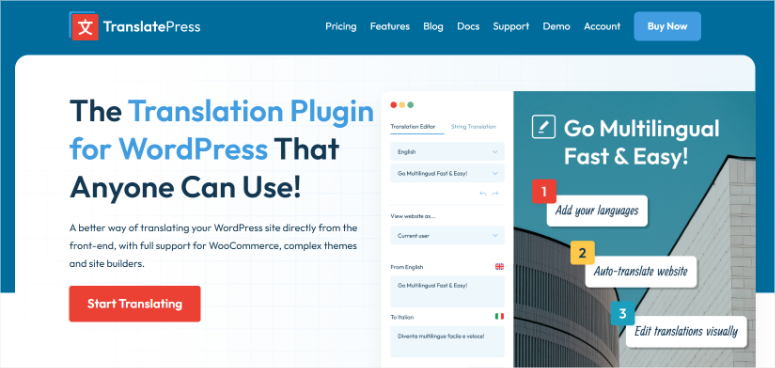
TranslatePress is one of the best translation plugins due to its ease of use.
First of all, the visual translation interface works exactly as you would expect.
You see your actual website, click on any text and enter the translation right there. There are no confusing backend menus, no guessing where text appears, or coding.
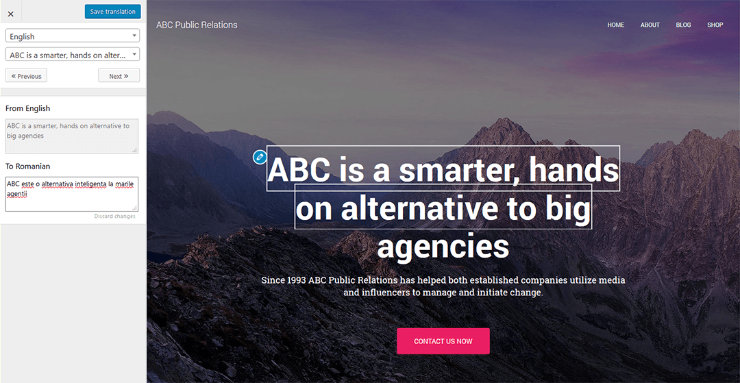
Why is TranslatePress one of the best translation plugins?
Google Translate integration speeds up the process. Click one button to automatically translate everything and then fix any Google Translate errors.
A funny translation I saw was “Giftladen,” which means “gift shop” in German.
The custom translator user role solves a major security problem. You can hire translators without giving them admin access. You only see the translation interface, nothing else.
If you’re building a multilingual website with popular WordPress page builders, TranslatePress will translate everything, including complex page builder elements that other plugins miss.
My experience with TranslatePress
I set up TranslatePress for a restaurant owner who needed her menu in English and Spanish. She had no technical knowledge and panicked at the thought of touching WordPress code.
The visual editor changed everything. She clicked on “Paella,” typed in the English translation, and watched as it updated instantly. No confusion on the backend or wondering if changes would be made.
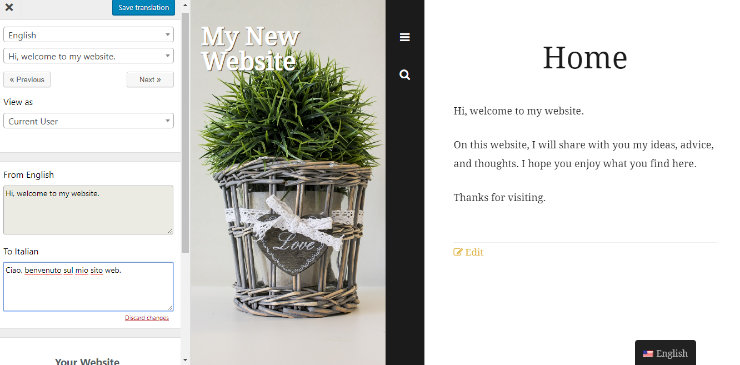
I used Google Translate to get the first Spanish versions in 10 minutes. Then she spent an hour correcting all the mistranslated words, of which there weren’t many.
Three months later, Spanish-speaking customers mentioned that the menu felt authentic and not machine translated. This attention to detail resulted from the ability to see and correct translations in context.
The plugin slowed down their website by around 0.3 seconds. On a restaurant site, this extra time barely registered. For a huge WooCommerce store with 1,000+ products, this delay could be more significant.
► Advantages
- Visual editing detects translation errors before visitors see them
- Google Translate integration and manual corrections ensure fast quality
- The “Translator” user role ensures the security of your WordPress admin panel
- SEO-friendly URLs help translated pages rank in local search results
► Disadvantages
- Upfront costs for premium features; No monthly option can impact cash flow
- Can increase page load time by 0.3 to 0.5 seconds on websites with more than 500 pages
- Free version limited to 2 languages only (additional languages require upgrade)
- Some advanced features require separate add-ons
My verdict: TranslatePress removes the intimidation factor of multilingual websites. The visual editor alone justifies the price if you value being able to see exactly what you’re translating.
For more information, see my TranslatePress review.
Prices: Free plugin available; Pro starts at €99/year
Get started with TranslatePress here
2. WPML ⭐⭐⭐⭐⭐
Over 1 million active installs | Best for: Large company websites + advanced features
WPML is my answer when clients outgrow simpler translation plugins and need professional control.
The string translation system translates everything that other plugins miss.
This includes plugin settings, theme options, custom post types, taxonomies, and widgets. If it exists in your WordPress database, WPML can translate it.
Why is WPML one of the best translation plugins?
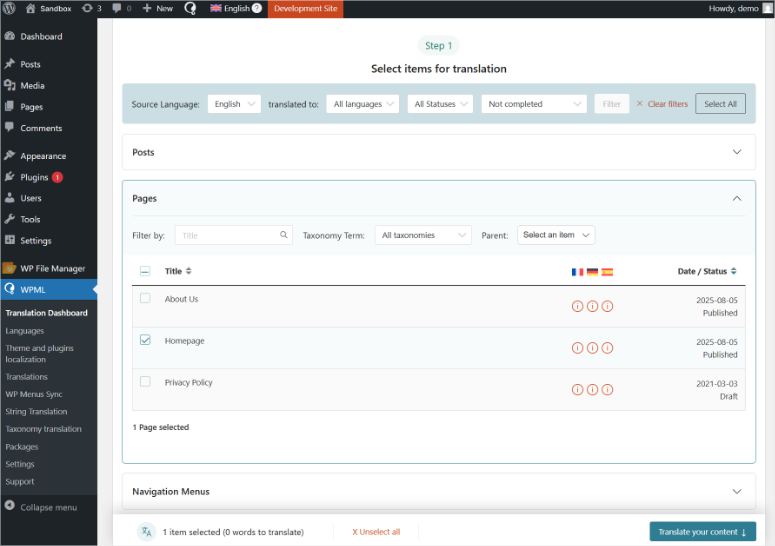
The translation management dashboard manages team workflows like real translation agencies do.
They assign specific pages to translators, track their progress, and approve translations before they go live. You no longer have to wonder who is translating what or whether they are finished.
WooCommerce integration goes deeper than simple product translations. WPML translates product variants, shipping methods, payment gateway messages, email templates and even dynamic pricing rules.
I tested it in a store with more than 300 configurable products and it handled everything.
WPML doesn’t just translate content created by other plugins; It connects to most major payment gateways and shipping calculators without compromising functionality.
My experience with WPML
I installed WPML for a furniture store that sells to customers across Europe. They needed 5 languages with different pricing per country and custom checkout messages in each language.
Setup took longer than TranslatePress, about 90 minutes to configure all the advanced options. The learning curve exists because WPML offers so many features.
I watched three tutorial videos before I understood the string translation system.
The good news is that they also offer a setup wizard to streamline the setup process. Once configured, WPML handled complex scenarios that caused simpler plugins to crash.
Currency conversion based on language, translated product variants (leather sofa vs. canapé en cuir), country-specific shipping rules.
When testing with real customer orders, the consistency of the translations remained stable.
A customer could browse in German, add products, switch to English during checkout, and complete the purchase without losing their shopping cart.
I was initially concerned about the impact on the database. WPML creates duplicate posts for each language. This caused the database to grow from 45 MB to 180 MB with 5 languages.
For high traffic websites, this requires appropriate WordPress backup solutions.
► Advantages
- String translation captures elements that visual editors miss (theme options, plugin settings).
- The translation management dashboard manages teams like professional agencies
- WooCommerce integration goes deeper than simple product translations
- Handles complex scenarios that cause simpler plugins to crash (currency conversion, variations)
► Disadvantages
- Steeper learning curve than visual editors
- No free version to test before committing
- Database size can increase quickly, especially with multiple languages
- Annual renewal required to continue receiving updates and support
My verdict: WPML is the plugin you switch to when your website grows beyond the entry-level tools. The learning effort pays off when you need professional features.
For more information, see my WPML review.
Prices: From €39/year
Start here with WPML
3. Weglot ⭐⭐⭐⭐⭐
Over 60,000 active installations | Best for: Team collaboration + cloud-based speed
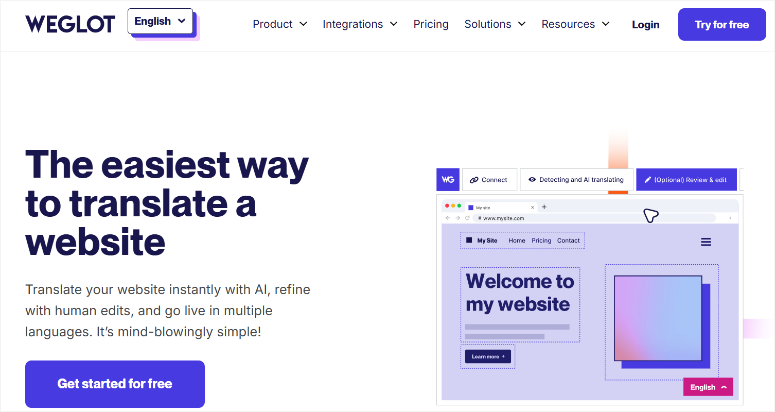
Weglot is my recommendation if your marketing teams need to collaborate on translations without technical bottlenecks.
The cloud-based approach ensures that your WordPress site’s database is not overloaded. The translations run on Weglot’s servers, not on your hosting.
Your website will load at normal speed regardless of how many languages you add.
Why is Weglot one of the best translation plugins?
The setup speed beats any other plugin I’ve tested. Install the plugin, connect your API key and select languages.
Your entire website will be automatically translated in under 5 minutes, with no configuration windows, searching for string translations, or confusion.
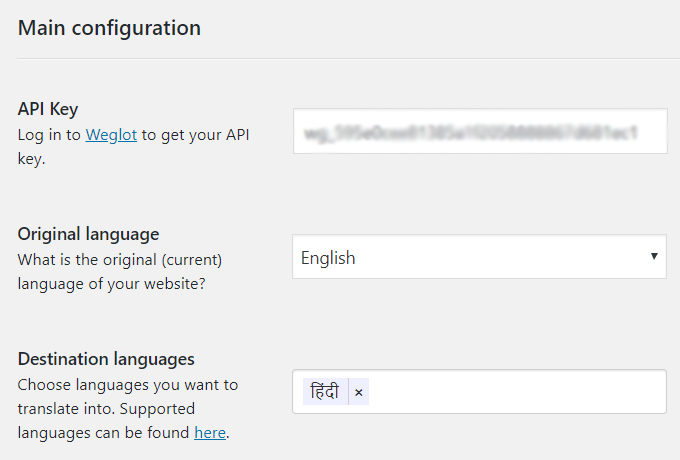
Multiple people can edit translations at the same time using the team dashboard. I refer French to one translator, Spanish to another and German to a third.
They work in parallel without interfering with each other’s edits.
If you work with WordPress page builders, Weglot will automatically translate the content of the page builder. It catches everything, even dynamic content that confuses other plugins.
My experience with Weglot
I set up Weglot for a software company launching in four European markets simultaneously.
Their marketing team needed to review and polish translations before the product launch, but none of them knew WordPress.
The cloud dashboard has completely solved this problem. Each team member was given Weglot interface credentials, not WordPress admin access.
They edited the translations in a simple text editor, approved the changes, and moved on.
The first automatic translation of 120 pages took 8 minutes. The team then spent three days improving the translations, correcting technical terms and adjusting the tone.
The visual context feature showed exactly where each phrase appeared on the website, simplifying the entire process.

During these tests, I closely monitored performance. The page loading times remained identical to those of the English-only version. However, I should mention that the translation proxy added about 50 milliseconds.
The monthly subscription hurt more than expected. For teams that need cloud collaboration, this extra charge makes sense. It’s harder for solo bloggers to justify this.
► Advantages
- Cloud-based storage ensures that your WordPress site’s database doesn’t become overloaded
- Automatic translation and team editing ensure speed and quality
- Setup takes less than 5 minutes from plugin installation to live translation
- The translation proxy intercepts dynamic content that confuses other plugins
► Disadvantages
- The monthly subscription costs add up
- Translations stored externally create a dependency on Weglot’s service
- Word count limits at lower levels can quickly come into play on content-heavy websites
- An internet connection is required to access the translation interface
My verdict: Weglot trades cost for convenience. The cloud approach and team features justify the additional cost if you run a corporate website with multiple translators.
Prices: Free plugin available; Pro starts at $17/month
Start here with Weglot
4. Polylong ⭐⭐⭐⭐
Over 600,000 active installs | Best for: simple blogs + budget-conscious users
Polylong is a budget translation plugin that you can switch to after using free translation plugins.
The free version has everything small blogs need. Translate posts, pages, categories, tags, menus and widgets without paying anything.
You only upgrade to Pro if you need WooCommerce support or automatic translation integration.
Why is Polylang one of the best translation plugins?
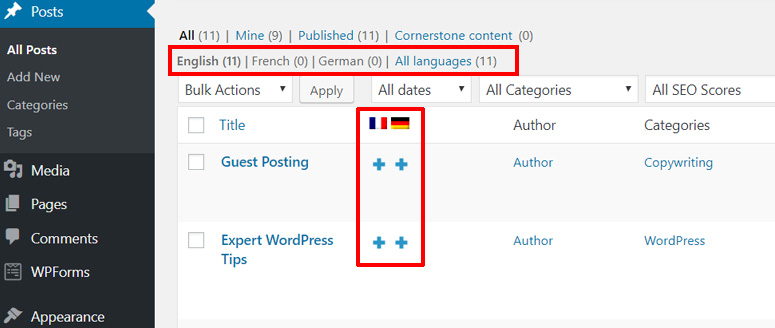
The interface remains simple without overwhelming beginners. All you have to do is create a post, click the language flag icon and write your translation.
Apart from that, the language switcher widget can be easily integrated into any top WordPress theme.
You get dropdown flags, language names or custom flags that work with simple widgets or shortcodes that you can use anywhere.
My experience with Polylang
I installed Polylang on a personal travel blog with 50 posts in English and Spanish. The free version did everything I needed.
Setup took about 20 minutes and included adding languages, assigning menu translations, and setting up the language switcher. The straightforward interface meant less time reading documentation.
The manual translation approach requires more work up front but offers complete control. Unlike automated plugins that cause embarrassing errors, each translation reflects exactly what I intended.
► Advantages
- The free version is great for blogs without WooCommerce
- The simple interface doesn’t overwhelm beginners with options
- Manual translation means complete quality control
- The lightweight plugin will not slow down your website
► Disadvantages
- No automatic translation option (you translate everything manually)
- WooCommerce support requires an upgrade from the Pro version
- The team collaboration features are basic compared to WPML
- String translation for themes requires Pro
My verdict: Polylang offers the best value for money if you run a simple blog and don’t mind manual translation work.
For more information, see my Polylang review. Compare Polylang to WPML when deciding between the #2 and #4 translation plugins on my list.
Prices: Free plugin available; Pro starts at €99/year
Start here with Polylang
5. MultilingualPress ⭐⭐⭐⭐
Over 10,000 active installations | Best for: WordPress multisite networks
MultilingualPress is perfect for large companies that need separate websites per language instead of translations of individual websites.
The multisite approach creates completely independent sites for each language. For example, your English website is at example.com, your Spanish one is at es.example.com, and your German one is at de.example.com.
Each runs separately with its own posts, plugins and settings.
Why is MultilingualPress one of the best translation plugins?
The MultilingualPress approach to setting up independent websites eliminates the database flooding problem that hit me with WPML.
Each language site maintains its own database, without translation tables complicating queries.
But that doesn’t mean it’s more work for you. The content connection system links related posts on different language sites.
So if you publish an English-language article, then select the Spanish equivalent and MultilingualPress will do the language switching automatically.
My experience with MultilingualPress
I set up MultilingualPress for a media company that runs separate editorial teams for each language. Each team needed complete control over their website without affecting other language versions.
The multisite requirement required a more complex hosting setup. Standard shared hosting doesn’t work. You need VPS hosting or dedicated hosting with multisite enabled.
This increases hosting costs but gives you better performance overall.
Translation management felt more isolated than collaborative. Each translator logged in separately to their language page. Good for independence, cumbersome for coordinating launches.
This also means that you need to properly secure your multisite to avoid problems.
► Advantages
- Separate databases per language prevent performance bottlenecks
- Complete independence allows different plugins per language site
- No single point of failure affecting all language versions
- The enterprise-class architecture scales to huge networks
► Disadvantages
- Requires WordPress multisite setup (complex for beginners)
- Higher hosting costs due to the resource requirements of multiple locations
- There is no free version available to test before committing
- Coordination between language locations requires more planning
My verdict: MultilingualPress solves business problems but creates complexity that small websites don’t need. Skip this unless you are already using Multisite.
Prices: Starts at $149/year
Start here with MultilingualPress
6. GTranslate ⭐⭐⭐⭐
Over 200,000 active installs | Best for: Automated translation + SEO features
GTranslate is great if you want automated translation and you also care about search rankings.
The SEO-friendly URLs in the paid version create proper language subdomains.
Instead of a visitor-side translation like Google Language Translator, GTranslate actually generates translated pages for Google to index and rank.
Why is GTranslate one of the best translation plugins?
You can use the manual editing feature to fix machine translation errors. Google translates everything automatically, then polishes the awkward phrases, giving you the best of both worlds: speed and quality.
The URL translation option creates clean language-specific links.
Your English /about-us/ becomes Spanish /acerca-de-nosotros/ and German /uber-uns/. Therefore, search engines treat these pages as unique pages and not as duplicate content.
My experience with GTranslate
I tested GTranslate at a local service company that targets Spanish-speaking customers. They needed quick translations but wanted to rank in Spanish search results.
The free version worked like Google Language Translator with slightly better widget options. The true value came after updating the business plan.
With the right subdomain setup (es.example.com), their Spanish pages appeared in Google.es search results within a few weeks.
Additionally, they can use the manual editing dashboard to correct company-specific terminology that was destroyed by machine translation.
As you can see, translation quality still requires supervision. You will spend approximately 2 hours per month reviewing and correcting automated translations.
For companies that require more than 10 languages, this time investment quickly multiplies.
► Advantages
- SEO-friendly URLs help translated pages rank in search engines
- Manual editing eliminates errors in machine translation
- Subdomain setup creates a proper multilingual architecture
- Affordable monthly price compared to premium alternatives
► Disadvantages
- The free version offers hardly any advantages over Google Language Translator
- Monthly monitoring required to detect translation errors
- Need a premium version for automated convenience
- Translation quality still depends heavily on manual corrections
My verdict: GTranslate bridges the gap between free automated tools and manual premium plugins. If you need SEO-friendly automation, the extra cost is worth it.
Prices: Free version available; Pro starts at $9.99/month
Start here with GTranslate
7. WPGlOBus ⭐⭐⭐
Over 40,000 active installations | Best for: Bilingual websites + free option
WPGlobus is one of the best free translation plugins. It offers basic bilingual features without spending any money upfront.
The side-by-side editor displays both languages when translating. Type English in the left pane and Spanish in the right pane and view both versions at the same time.
This revealed translation inconsistencies that I had missed with other plugins.
Why is WPGlobus one of the best translation plugins?
WPGlobus is completely free for simple bilingual websites. The pressure to upgrade does not come from feature limitations or surprise paywalls. What you see in the free version is what you get forever.
The language switcher integrates naturally into WordPress menus. You can add flags or language codes directly into your navigation, without custom widgets or shortcodes.
My experience with WPGlobus
I tested WPGlobus on a Canadian company site that requires English and French versions. The side-by-side editor made translation straightforward for their bilingual employees.
The setup took about 30 minutes. I had to configure the languages and add the menu switcher before I could start translating posts. The interface felt dated compared to modern plugins, but the functionality worked.
Here’s what stopped me from ranking it higher: Plugin development has slowed noticeably after 2019, even though it has recently picked up speed.
WPGlobus has a free WooCommerce add-on, but lacks the polish of paid alternatives. What I mean by this is that product translations work, but checkout flow translations require manual string searching.
► Advantages
- Completely free and with no hidden upgrade requirements
- The side-by-side editor detects translation consistency issues
- The lightweight plugin does not cause database bloat
- The menu integration feels natural without additional widgets
► Disadvantages
- After 2019, development activity slowed down significantly
- Support responsiveness concerns based on forum activity
- The interface looks dated compared to modern alternatives
- WooCommerce support lacks premium plugins
My verdict: WPGlobus works well for simple bilingual websites if you’re happy with minimal ongoing support. The free price justifies the compromises.
Prices: Free; Offers Pro extensions starting at $15.00/year
8. Multilingual ⭐⭐⭐
Over 30,000 active installations | Best for: RTL languages + simple websites
Multilingual provides “right to left” language support without complex setup.
RTL (right to left) language processing works better than plugins that handle Arabic or Hebrew after the fact.
Additionally, text direction changes automatically, alignment is properly adjusted, and UI elements are flipped to accommodate reading patterns.
Why is Multilingual one of the best translation plugins?
The uncomplicated user interface does not overwhelm beginners. Add languages, translate content and insert language switcher. Three steps and your website is multilingual.
The free version covers basic blogging needs with no pressure to upgrade. This allows you to translate posts, pages, and categories without encountering paywalls or functionality limitations.
My experience with multilingualism
I set it up Multilingual for a non-profit NGO with content in English and Arabic. RTL support saves hours compared to plugins that require CSS optimizations.
The setup took about 25 minutes. The plugin automatically detected the RTL requirements when I selected Arabic and adjusted the text alignment and navigation without manual intervention.
This is why it ranks low on my list: The feature set feels basic compared to top plugins. No visual translation editor, team collaboration and limited WooCommerce support.
It handles RTL languages well, but doesn’t compete with TranslatePress or WPML in terms of overall functionality.
The plugin works well for simple bilingual blogs, especially with RTL languages. If you have complex websites or advanced features, you will quickly outgrow them.
► Advantages
- RTL language support works fine without any CSS hacks
- The free version meets basic blog translation requirements
- The simple interface does not confuse beginners
- Automatic text direction detection for RTL languages
► Disadvantages
- The feature set feels limited compared to top plugins
- No visual translation editor or advanced tools
- WooCommerce support is basic at best
- Development updates are rare
My verdict: Multilingual solves the RTL language problem better than most plugins. If you need Arabic, Hebrew, or Persian support on a simple website, this is the best free option.
Prices: Free plugin available; Pro starts at $39/year
Start here with multilingualism
9. Google language translator ⭐⭐⭐
Over 300,000 active installs | Best for: Fast automation + hobby blogs
If you need an instant multilingual presence without translation budgets, then Google language translator is a great option.
Automated translation is instant and requires no manual work. Visitors click on their language, Google Translate processes your content in real time and they see the translated version.
This means there is no setup time required beyond the plugin installation.
Why is Google Language Translator one of the best translation plugins?
Google language translator automatically supports over 100 languages. Small languages for which professional translators charge premium prices appear just as good as Spanish or French.
Additionally, the floating widget remains accessible on every page. Visitors can change languages at any time without having to navigate menus or settings.
My experience with Google Language Translator
I installed this as an experiment on a hobby photography blog. The photographer wanted international reach but wanted an affordable option with professional translation.
The setup took a total of 5 minutes. I installed the plugin, selected the widget style and languages to display. Completed.
The reality check came quickly. Google translated “taken with main lens” in Spanish as “taken with the first lens”. In addition, some technical terms in photography confused the algorithm.
In the end, visitors mentioned the awkward wording in the comments.
For simple blog posts about travel or recipes, the translations worked acceptably. For technical content, business pages, or anything that requires credibility, machine translation can result in awkward wording.
The SEO impact worried me. In fact, Google’s own documentation warns that auto-translated content impacts search rankings.
► Advantages
- Completely free with unlimited translations
- Over 100 languages are immediately available without configuration
- No maintenance is required after the initial setup
- Perfect for hobby blogs that need basic international reach
► Disadvantages
- The translation quality ranges from acceptable to awkward
- Technical terms and industry jargon confuse the algorithm
- No ability to correct mistakes or polish awkward phrases
My verdict: Google Language Translator is suitable for hobby blogs where the quality of the translation is less important than quick access. Avoid business websites where credibility is important.
Prices: Free
Start using Google Language Translator here
This is my list of the best translation plugins for WordPress. But there are a few options that just barely made it onto my list. Let’s look at them next.
Bonus: Other WordPress translation plugins worth knowing
Translate locomotive ⭐⭐⭐
This plugin translates theme and plugin text strings directly into WordPress. I use it when WPML or TranslatePress misses plugin-specific phrases like “Add to Cart” buttons or error messages.
Loco Translate is perfect for translating interface elements rather than content. The in-browser editor beats editing files manually.
The free version works great for most websites. If you’re doing theme translation or customizing plugin text, Loco Translate belongs in your toolkit alongside your main translation plugin.
Lingotek translation ⭐⭐⭐
Lingotek Translation uses a different approach than other translation tools on my list. It is a cloud-based professional translation management system that connects you with human translators.
You submit content, professional translators take care of it, approve it and publish it. It is best suited for companies that need certified translations for legal or medical content where machine translation creates liability risks.
The workflow automation is impressive, but the costs of professional translations add up quickly. Works well with other translation plugins after automated first drafts.
Google Website Translator ⭐⭐
Another automated Google Translate widget plugin. Works similarly to the Google Language Translator that I covered in my list, but with fewer customization options.
I tested both and found minimal differences in translation quality or features. The interface feels more dated. Stick with Google Language Translator or upgrade to GTranslate for better control.
Only use this if you specifically need the classic look of the Google Translate widget.
You now have 12 translation plugins to choose from. This can be overwhelming. Next, I’ll help you choose an option that fits your budget and needs.
How to choose the right translation plugin for your needs
Start with your budget and site type
If you run a hobby blog without a translation budget:
- Choose Polylong or WPGlobus.
- Both free versions handle basic bilingual content without any pressure to upgrade.
- You translate manually, but the interface remains simple enough for beginners.
If you run a corporate website and translation quality compromises credibility:
- Invest in TranslatePress or WPML.
- Visual editing or professional translation management justifies the cost if errors damage your brand.
If you need a multilingual WooCommerce store:
- Go with WPML or Weglot.
- They solve the complex problems that free plugins cannot handle.
- You get currency conversion, translated checkout flows and product variation management.
Consider the plugin’s translation approach
Do you love being able to see exactly what you’re translating before publishing?
- TranslatePress wins.
- The visual editor catches errors that backend translation panels miss.
- I recommend this to anyone who panics at the thought of blindly publishing translations.
Do you need to translate more than 50 pages quickly and fix errors later?
Do you work with a team of translators?
- Choose WPML or Weglot.
- They offer the collaboration features that solo plugins lack.
- Assign pages, track progress, and approve translations before they go live.
Do you have special requirements?
Running WordPress Multisite?
- Choose Multilingual press.
- The architecture with separate sites per language adapts naturally to the multisite structure.
Do you need Arabic, Hebrew or Persian?
- Go with Multilingual.
- It handles RTL languages better than plugins that treat them as afterthoughts.
Translate plugin settings and theme options?
That’s all about the best WordPress translation plugins in my opinion. If something is unclear, check out the frequently asked questions below.
FAQs: Best WordPress translation plugins
What is the best WordPress translation plugin for beginners?
TranslatePress and WPML are beneficial for beginners because you can see exactly what you are translating in real time. Visual editors take the guesswork out of where text appears on your website. I’ve watched clients with no technical knowledge translate entire websites without asking me a single question.
Can free translation plugins work for business websites?
Free plugins work for simple business sites with two languages and basic needs. I have successfully used Polylang on service company websites. The manual translation approach allows for complete quality control. Upgrade to paid plugins if you need WooCommerce support, team collaboration, or more than two languages. The quality of the translation affects credibility on company websites.
Which translation plugin works best with WooCommerce?
WPML handles WooCommerce integration most comprehensively. It translates product variants, checkout flows, shipping methods and payment gateway messages. I tested it in stores with over 300 configurable products without any problems. Weglot is also a good fit for WooCommerce if you prefer cloud-based translations. Avoid free plugins for shops as they miss important e-commerce elements.
Do translation plugins affect WordPress search engine optimization?
Premium plugins like WPML, TranslatePress and Weglot create appropriate hreflang tags and language-specific sitemaps. This helps search engines index your translations correctly. Free automated plugins can harm search engine optimization as Google warns about low-quality machine translations. Invest in appropriate translation plugins if ranking in international markets is important to your business strategy.
Should I use manual or automated translation?
Automated translation (Google Translate) is suitable for hobby blogs where speed is more important than accuracy. Manual translations provide higher quality but require time investment. The best approach combines both: use automated translation for bulk work, and then manually correct important pages and awkward wording. This hybrid method appears in the premium versions TranslatePress, WPML and Weglot.
Final Verdict: Should You Invest in WordPress Translation Plugins?
Yes, if reaching an international audience is important to your business growth. The translation plugins I cover solve the technical complexities of multilingualism without requiring developer knowledge.
They allow you to reach a global audience without hiring a translation team or learning the languages yourself.
The biggest mistake is avoiding translation plugins because they seem complicated.
Your international competitors already serve customers in their native language. Don’t let technical hesitation cost you those visitors.
- Over 50 of the best WordPress plugins I recommend – Multilingual websites need solid foundations that go beyond translation plugins. So check out our full plugin recommendations for security, performance, and functionality.
- Best WordPress speed optimization plugins – Translation plugins can slow down your website. So combining them with appropriate caching and optimization plugins will ensure your multilingual pages load quickly.
- 30+ Best WooCommerce Plugins to Increase Sales – Running a multilingual store requires special WooCommerce plugins for currency conversion, international shipping and localized payment methods.
- Best WordPress Hosting Companies – Multilingual websites with multiple language versions require hosting that can handle increased database queries and traffic without sacrificing performance.
- Top tools to optimize online content for SEO – Multilingual SEO requires optimizing content in each language separately. Therefore, these tools help you search for keywords and optimize for different markets.
- Best SEO Plugin: All-in-One SEO vs. Rank Math – Translation plugins handle hreflang tags, but you still need a solid SEO plugin for sitemaps, schema markup, and technical optimization in any language.
In these posts you’ll learn how to make your multilingual website work better for your audience. Learn how to improve your website visibility on a global scale.