
Community marketing is a growth strategy that focuses on participation. It brings customers together to share knowledge, solve problems and build trust. This promotes advocacy, customer loyalty and lower customer acquisition costs.
When built intentionally and linked to CRM and lifecycle data, community programs can shorten sales cycles, reduce support costs, and turn customers into credible advocates.
This guide explains what community marketing is, how it fits into modern lifecycle marketing, and how marketing teams can build and scale community programs that deliver measurable business impact.
Table of contents
What is community marketing?
Community marketing is a strategy that brings customers, partners, and advocates together around shared interests or challenges to foster ongoing engagement, loyalty, and long-term advocacy. In practice, community marketing improves engagement rates, generates referrals, and reduces support costs by enabling peer-to-peer problem solving and authentic advocacy.
Unlike social media management, which focuses primarily on content distribution, community marketing focuses on participation and engagement. Actually, 40.1% of consumers say they are more likely to remain loyal to a brand after engaging with it in an online brand community.
This preference is also reflected in how people experience these channels. 67% of consumers say they feel more connected to brands through community than social media. This shift is moving brands away from spreading messages and toward facilitating conversations and collaboration.
Community marketing is also different from generic “community building.” While community building emphasizes belonging, community marketing ties that sense of belonging to measurable business outcomes like customer loyalty, referrals, product adoption, and support effectiveness.
In terms of lifecycle, community marketing plays a crucial role in the Amplify phase of Loop marketing. It helps increase post-conversion value and encourages customers to share, contribute, and more importantly, advocate.
When community activity is linked to CRM data, marketers gain insight into the impact of engagement on sales, renewal and growth.
How community marketing drives advocacy and reduces acquisition costs
Community marketing is effective because trust is built between like-minded people much faster than between brands and buyers. Actually, 55% of social users say they are more likely to trust brands that publish human-generated content.
Seeing real people ask questions and speak honestly about their experiences builds trust through word of mouth faster than sophisticated communication ever could. This trust helps ensure decisions are made sooner and takes the burden off paid campaigns.
Nicole van ZantenCo-President and Chief Growth Officer ICUC.socialtold me “When it comes to meaning, engagement and purpose, we find that customers convert faster, stay with a brand or company longer, and recommend more often.”
From a cost standpoint, community marketing reduces reliance on paid channels and support teams by:
- Increase community-driven recommendations
- Organic user-generated content
- Peer-to-peer support
Instead of acquiring every customer through advertising or outbound measures, brands benefit from increasing the value of existing customers. The metrics that most clearly demonstrate this impact include:
- Repeat engagement
- Referral traffic
- Assigned revenue
- User Generated Content
- NPS increase
When community members feel seen and heard, they are more likely to continue spending money on that brand. This trust is also reflected in purchasing behavior – trustworthy relationships lead to repeat purchases 2.3 times more likely.
Community marketing strategy
66% of companies say their community has a positive impact on customer loyalty. The strongest community marketing programs are built on a clear outcome, driven by audience behavior, and supported by the right platforms and workflows.
This is how brands can develop a community marketing strategy that actually delivers results.
1. Define a specific problem that the community will solve.
Effective community marketing programs start with solving a specific customer problem, such as: B. improving onboarding, improving product training or enabling peer support. Community efforts lose focus when they try to serve every audience and use case at once. High-performing communities are anchored to a clear outcome, such as:
- Improving onboarding
- Increased product training
- Enabling peer support
- Build advocacy.
Starting with a defined problem gives the community a reason to exist beyond mere engagement. It also provides a decision-making framework for everything that follows, from platform selection to programming and measurement.
What the expert says: van Zanten says: “Community efforts fail when they try to be everything to everyone. The most successful teams identify a problem area or opportunity and bring everything back to that outcome.”
2. Understand customer behavior before choosing a platform.
Platform decisions should be based on audience behavior, not trends. Communities have a greater chance of success if they are built in spaces where members already spend time and enjoy getting involved.
Before choosing a platform, marketers should look for patterns in:
- How customers communicate
- The types of conversations they participate in
- The channels they return to most often
This context helps teams avoid forcing engagement in unfamiliar environments and instead design communities that feel intuitive from day one.
What the expert says: van Zanten emphasizes that it is important to first use social listening to observe. She says, “Understand what customers are talking about, what tensions exist, and what parallel interests are emerging. This context shows brands what they are actually building for.”
HubSpot Pro Tip: Offline community marketing can achieve the same engagement and advocacy impact as online communities, provided engagement is tracked and integrated into your broader marketing systems.
3. Choose a platform that meets audience needs and operational realities.
There is no single platform that works best for every community. What matters most is how an audience already interacts online and what the community needs to function day-to-day as it grows.
In practice, platform decisions typically depend on a handful of practical questions:
- Where are members already spending time and feeling comfortable getting involved?
- How much moderation will the community need?
- What level of access is required to understand participation and outcomes?
- What security and governance features are required?
- Can the platform be used without additional effort?
What the expert says: van Zanten points out, “Some brands thrive on Discord or Reddit, while others do better in close-knit Facebook groups or LinkedIn communities. The best platform is the one that aligns with the audience and operational needs.”
HubSpot Pro Tip: The choice of platform also influences how easily community data can be integrated into a CRM. Choosing tools that connect natively to platforms like HubSpot makes it easier to link engagement to lifecycle metrics and business outcomes.
4. Design engagement programs that encourage participation, not diffusion.
Communities thrive when members are invited to participate. Programs based on interaction consistently outperform passive content streams. Interaction often looks like this:
- Moderated discussions
- Live sessions
- Feedback prompts
- Peer-led threads
When engagement is intentional, members are more likely to ask questions or help each other. This involvement builds trust and keeps the community active long after the initial launch.
What the expert says: “We’ve seen great success with dedicated Discord communities where brands host live AMAs, exclusive content and behind-the-scenes access.” van Zanten adds: “When community members feel included in the process, engagement increases significantly.”
HubSpot Pro Tip: HubSpots Marketing software can help teams promote community discussions and events through scheduled social media posts and a unified platform social inbox. This makes it easier to drive engagement across all channels and keep conversations going without incurring additional manual effort.
5. Enable peer-to-peer support and contribution.
One of the most scalable benefits of community marketing is peer-to-peer support. When members help each other solve problems, answer questions, and share experiences, communities create value that doesn’t just rely on internal teams.
Over time, this dynamic reduces support volume, speeds resolution, and increases trust among members. When advice comes from colleagues who have faced similar challenges, clients are more willing to engage, learn and contribute.
The result is a community that is self-sustaining. And the community becomes more useful and credible as participation increases.
What the expert says: van Zanten mentions: “In a healthcare community, peer-generated responses reduced the number of support tickets by almost 30%. This insight justified expanding the program and investing in more structured workflows.”
6. Align community data with CRM and lifecycle metrics.
Community marketing typically brings in ongoing investment when teams can clearly link participation to outcomes and metrics that leadership actually cares about. This connection typically comes from linking community activity to CRM data so that engagement can be viewed in the context of the entire customer lifecycle.
With this visibility it becomes easier to see:
- Which members stay longer?
- Which segments contribute the most?
- Whether community participation is accompanied by expansion or fewer support requests
Without these insights, the impact on the community is difficult to defend. Commitment may look healthy on the surface, but it remains anecdotal – and anecdotes rarely survive budget reviews.
HubSpot Pro Tip: With the Customer service softwareLifecycle metrics transform the community from a standalone initiative into a measurable growth channel. Marketing, sales, and customer service teams can use this data to evaluate performance from the same shared perspective.
7. Build on long-term advocacy, not short-term campaigns.
Community marketing creates the most value when viewed as an ongoing relationship. Programs designed primarily to promote product launches, discounts, or announcements often experience a brief spike in activity—and then stall again once the push ends.
Things are completely different when members feel noticed, supported and actually heard. In these communities, people begin to share experiences or advocate for brands themselves. Seeing who regularly helps others or appears in discussions makes it easier to create ambassador programs or referral initiatives.
With these programs, advocacy is no longer a vague success story, but rather something that teams can actively support and scale.
What the expert says: “The strongest communities build belonging first and products second.” Transporter Zanten adds“People resonate more with real, authentic customer voices than with sophisticated brand messages – and that’s what drives long-term advocacy.”
8. Integrate community data with CRM.
When community engagement is linked to CRM data, patterns emerge that would otherwise not be visible. Brands can see how participation impacts customer retention, referrals, and even reduced demand for support.
With this data, it is much easier to understand who is actually participating, how the community activity fits into the broader customer lifecycle, and whether the community represents real business value.
HubSpot Pro Tip: HubSpot’s CRM allows teams to connect community engagement to the broader customer journey, making attribution clearer and alignment across teams easier.
9. Empower community managers with automation
As communities grow, operational bottlenecks begin to emerge—such as comment moderation, content creation, and approvals. AI-powered tools can support community moderators by automating:
- Welcome announcements for new members
- Make relevant content visible
- Summarize discussions
- Create visual assets for events or announcements
I’ve found that automation tools allow community managers to focus less on repetitive tasks and more on relationship building and program strategy.
HubSpot Pro Tip: Content Hub‘s AI tools, including its Image generatorcan help teams quickly create guides, discussion prompts, event graphics, and educational resources that keep communities active without slowing down teams.
Community engagement programs you could start now
Not every community program needs to be complex to be effective. The most successful engagement initiatives are often those that meet a clear customer need and consistently create reasons to participate.
Below are some proven community engagement programs and explain why they tend to work well in practice.
1. Customer forums.
Customer forums create lasting value because they give people a place to ask questions, share solutions, and learn from each other in context. Over time, these conversations become a searchable resource that customers actually use.
When forums are tied to product training and support workflows, they feel less like a help center and more like a shared workspace.
Best for: Product adoption and support diversion
Why it works: I’ve found that forums are particularly effective because they provide value. A good answer will help the next ten searching for the same problem. As this library grows, peer-generated answers often become the most trusted reference point, sometimes even more than official documentation.
2. Virtual events and office hours.
Virtual events and office hours create a real-time connection between brands and community members. These sessions may include:
- Live questions and answers
- Complete product solutions
- Onboarding support
- Informal discussions about common challenges
Best for: Building trust, education and early engagement
Why it works: In practice, smaller, recurring sessions outperform large, infrequent webinars. Consistency lowers the barrier to participation and builds familiarity. I’ve found that members are more likely to engage when events feel like a conversation rather than an advertisement.
3. Ambassador programs.
Ambassador programs formalize advocacy by providing engaged customers a clear opportunity to promote the brand through recommendations, content creation, testimonials, or speaking opportunities. These programs typically include incentives, recognition and defined expectations.
Best for: Advocacy, Recommendations and Social Proof
Why it works: What I like about ambassador programs is their scalability. When incentives and recognition are clearly defined, advocacy becomes repeatable rather than ad hoc. Ambassadors often act as community leaders by helping to set norms and encourage participation across the group.
4. Partner communities.
Partner-led communities bring customers, experts and complementary brands together for common goals. These communities often offer shared programs, co-created content, or shared learning initiatives.
Best for: Achieve expansion, credibility building and mutual growth
Why it works: Partner communities work best when employees already serve overlapping audiences. I’ve found this approach expands reach while spreading operational effort, allowing communities to grow faster without losing relevance or trust.
5. Content-driven communities.
Content-driven communities are built on education and thought leadership. Members participate in discussions related to articles, guides, events, research, or ongoing learning series.
Content Hubs Image generator can support these programs by helping teams quickly create visual assets that stimulate discussion and encourage sharing within the community.
Best for: Early lifecycle engagement and long-term brand affinity
Why it works: Educational communities attract members before they’re ready to buy, giving them a reason to come back regularly. When content stimulates conversation – rather than sitting passively – it becomes a catalyst for engagement and relationship building
Community platforms and partners to consider
Choosing the right community platform is both a strategic and an operational decision. Platforms influence how easily members engage and how effectively engagement data can be linked to business outcomes.
Own vs. third-party community Platform comparison
|
thoughtfulness |
Own platforms |
Third party platforms (Slack, Discord, LinkedIn) |
|
Best for |
Long-term community programs, attribution and lifecycle integration |
Early-stage communities and rapid experimentation |
|
Data control |
Full control over data, governance and integrations |
Limited control over data and customizations |
|
CRM integration |
Easier integration with CRM systems like HubSpot; Engagement is directly linked to contact records and lifecycle stages |
Difficult to integrate with CRM and marketing systems; restricted data access |
|
Setup time |
Longer initial setup; requires hosting or platform management |
Lower barrier to entry; reduced setup time; Members are often already familiar |
|
Measurement and assignment |
It’s easier to track how participation impacts retention, expansion, and advocacy |
Limited insight into business results; Engagement data is harder to extract |
|
Scalability |
Built for long-term growth and operational scalability |
As communities grow, limitations arise in terms of governance and long-term scalability |
|
Familiarity of members |
Integration into a new platform may be required |
Members are already familiar with the tools, which speeds up early participation |
|
Cost considerations |
Typically requires investment in a platform and hosting |
Getting started is often free or inexpensive |
|
Governance & Moderation |
Full control over security, moderation policies and governance features |
Limited control; depending on the integrated functions of the platform |
|
Ideal use case |
Programs that focus on measurement and link community to business outcomes |
Test engagement formats and build momentum before choosing your own platform |
The most important thing to take away: Third-party platforms are best used as a stepping stone rather than a permanent solution. Third-party options are great for testing engagement formats and building momentum, but proprietary platforms become necessary when measurement, CRM integration, and long-term scalability matter.
Below are some common options and where each works best.
1. Own community platforms
Own community platforms give brands full control over data, making management and integration easier. These platforms are typically hosted or managed directly by the organization and can be tightly linked to CRM and lifecycle data.
Best for: Long-term community programs, attribution and lifecycle integration
Why it works: I prefer dedicated platforms for programs where measurement is important. When community engagement can be linked directly to contact records and lifecycle stages, it’s much easier to understand how engagement impacts retention, expansion, and advocacy – especially when integrated with a CRM like HubSpot.
2. Slack or Discord
Third-party platforms like Slack or Discord lower the barrier to entry and reduce setup time. Members are often already familiar with these tools, which can help accelerate early participation.
Best for: Early-stage communities and rapid experimentation
Why it works: In my experience, these platforms work best as a stepping stone rather than a permanent home. They are great for testing engagement formats and building momentum. However, as communities grow, limitations in data access, governance, and long-term scalability often arise.
3. LinkedIn groups
LinkedIn Groups offer built-in discoveries and access to professional audiences. They can be useful for encouraging discussion without requiring members to join a new platform.
Best for: Early engagement and professional networking
Danger: LinkedIn groups can be helpful for bringing like-minded professionals together. However, they offer limited control over data and customizations. As a result, over time they may be difficult to scale operationally or integrate with broader marketing and CRM systems.
4. Partner ecosystems.
Partner-led communities bring customers, experts and brands together for common goals. These ecosystems often include:
Best for: Achieve expansion, credibility and mutual growth
Why it works: Partner ecosystems combine multiple incentives into a single community experience. The HubSpot ecosystem is a strong example. It brings together agencies, consultants and technology partners to support education and advocacy for diverse audiences.
How to measure community marketing and prove ROI
Measuring community marketing is about looking beyond superficial engagement and focusing on signals that reflect real business impact. The strongest programs combine behavioral metrics with lifecycle and revenue data to make a clear statement about value.
Here are the metrics that always do the main work.
1. Engagement rate
What it measures: Participation, not just growth.
Engagement rates provide insight into whether members are actually attending, contributing, and coming back—or quietly defecting.
By tracking engagement trends over time, it is also easier to identify dynamics early or intervene before engagement stalls.
What I learned: I learned to prioritize active members over total members when reporting success. A smaller, continually engaged community almost always provides more value than a large group of passive members.
2. Impact of retention and expansion
What it measures: Long-term customer value and account growth.
Retention and expansion metrics show whether community participation helps customers stay longer and strengthen their relationship with the brand. Communities that support onboarding, education, and peer problem-solving often influence these outcomes.
Tracking community engagement across lifecycle stages helps identify these patterns. When engagement data is considered alongside renewal and expansion metrics, the connection between community engagement and customer lifetime becomes much clearer.
What the expert says: van Zanten explains, “The most reliable ROI signals are based on community member retention and renewal rates, contribution and engagement levels, sentiment, and how conversations evolve over time.”
What I learned: The impact on customer loyalty rarely occurs overnight. Community members who get involved early often stick around longer and grow more naturally, especially when the community helps them realize value more quickly.
3. Referral and advocacy activities
What it measures: Willingness to recommend, share and speak on behalf of the brand.
Referral traffic, reviews, testimonials, and user-generated content signal advocacy. These behaviors show that members trust the brand enough to hide their own credibility behind it.
Communities that encourage contributions consistently outperform passive groups. When members are given space to share experiences and help others, advocacy becomes a natural extension of participation.
What I learned: Advocacy is first shown in behavior. The first signals are often small – thoughtful replies, shared screenshots, unsolicited recommendations – but these moments are usually the foundation for recommendations and long-term word-of-mouth growth.
4. Impact on pipeline and sales
What it measures: Impact on the community on sales and business performance.
Pipeline influence examines whether community engagement is reflected in real sales activity. Things like:
- Deals move faster
- Higher completion rates
- Recommendations entering the pipeline.
This is often when community marketing takes over. When community data is linked to CRM records, it’s much easier to see where engagement and revenue overlap, rather than guessing after the fact.
What I learned: Once participation can be tied to pipeline or cost savings, the community is no longer viewed as a brand initiative and is instead treated as a growth lever.
Examples of community building in the B2B and D2C sectors
A look at strong community programs across all industries helps clarify what effective community marketing looks like in practice. Here are a few examples of success Community management initiatives.
1. HubSpot Community
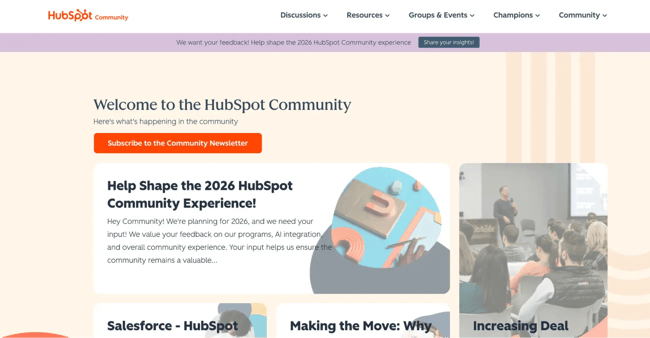
The HubSpot Community brings together customers, partners and experts to support product training, peer-to-peer problem solving and continuous learning. Members can ask questions, share insights, and access tutorials about HubSpot’s tools and use cases.
What stands out: Community activities complement, rather than compete with, support, content and product training. To me, this integration makes the community feel like a natural extension of the customer experience.
2. Community of imagination
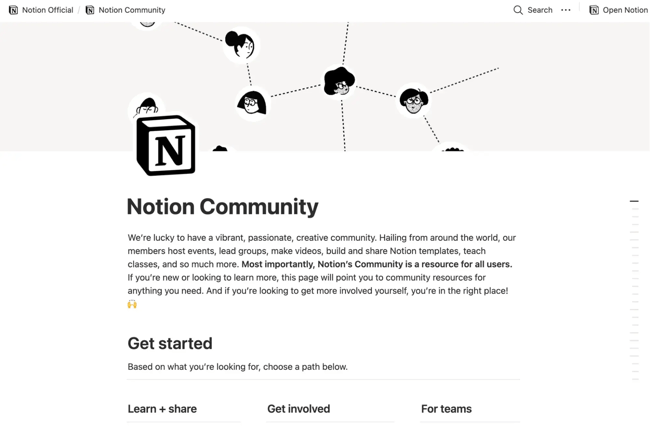
Notion’s community focuses on co-creation. Members share templates, workflows, and use cases that help others get more value from the product while demonstrating the flexibility of the platform.
What stands out: I appreciate how emphasizing contribution turns customers into employees. By making it easy for users to create and share, the Notion community scales product education while fostering a strong sense of ownership and pride among members.
3. Peloton Community
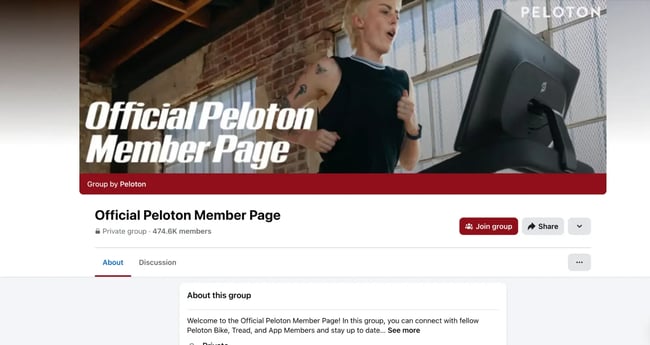
Peloton’s community spans multiple platforms, including Facebook. It integrates content, challenges and shared progress to create a sense of dynamism and accountability. Members engage not only with the brand, but also with each other through milestones and shared experiences.
What stands out: As a Peloton user, I’ve seen firsthand how emotional investment drives customer loyalty. By combining progress tracking and shared performance, the Peloton Community turns individual use into a collective journey, making participation feel motivating rather than transactional.
Community Marketing FAQs
Is community marketing the same as social media marketing?
No. Social media marketing is primarily a distribution channel to reach a wide audience, while community marketing focuses on building relationships within a defined group. Social platforms value visibility and reach; Communities value participation, trust and long-term value creation. While social media can support community growth, it does not replace the depth or durability of a real community.
How long does it take to see community marketing results?
Community marketing typically shows early engagement signals within the first few months, such as: B. Participation and discussion activity. Measurable business results – such as improved customer retention, referrals or deflection from support – typically occur within six to twelve months. The timeline depends on the purpose of the community, the readiness of the audience, and how well engagement is linked to lifecycle metrics.
Which platform is best for a brand community?
There is no optimal platform for every community. The right choice depends on audience behavior, internal resources, data needs and long-term goals. Proprietary platforms offer greater control and integration with CRM systems, while third-party platforms can reduce setup friction and accelerate early onboarding. The most effective communities select platforms based on suitability, not popularity.
How can I resource a community program if I have a small team?
Small teams can run effective community programs by prioritizing focus and leverage. Clear programming, repeatable interaction formats and the reuse of content reduce manual effort. Automation and AI-powered tools can support onboarding, moderation, and content creation, enabling teams to scale participation without increasing headcount.
How do I get started if I don’t have an existing audience?
Most communities don’t start from scratch. Early members often come from customers who are already participating in onboarding, support, training or partner programs. Starting with a small, relevant group allows you to establish norms, add early value, and create momentum before expanding to a broader audience.
Building customer-centric growth through community marketing
Community marketing achieves its greatest value when viewed as a long-term growth strategy rather than a side project. When communities are designed with intention and measured against real business outcomes, they become powerful drivers of advocacy, retention and lower acquisition costs.
By connecting community activity with content, CRM, and lifecycle marketing, teams get the visibility they need to understand what’s working and where to invest next. HubSpot’s connected platform supports this approach by bringing engagement, automation, and customer data together in one place.
For marketing teams focused on converting engagement into measurable impact, community marketing is a fundamental part of building lasting, customer-centric growth.