A few years ago I helped a local animal shelter set up its first online fundraising page. They were excited and started with great confidence that they would grow their charity. And then… crickets.
Not because people didn’t care. But the site felt empty, with no visible supporters or progress updates. Just a form asking for money.
See, donors don’t just give to causes they believe in. They donate to causes they do themselves Trust. And online, trust is built through transparency, social proof and clear communication.
The challenge?
Most donation plugins force you to compile these trust-building features from multiple sources, such as different plugins.
Additionally, these plugins have add-ons that introduce various features, making the entire project cost more and take more time.
That’s where I found Charitable. It is the only WordPress donation plugin that combines all trust-building features in one system.
In this guide, I’ll walk you through 9 proven strategies to increase donor trust in your fundraising campaigns with Charitable.
These are not theories. They’re practical tactics that help me turn hesitant visitors into committed supporters.
KEY FINDINGS
What you will learn in this guide:
By the end of this article, you will know exactly how to:
- Build donor trust by leveraging social proof and real-time transparency
- Increase completed donations by showing active community support
- Build trust through clear progress tracking and impact communication
- Choose the right tools to implement these strategies without any coding
These 9 strategies work for nonprofits of all sizes. Whether you’re running your first campaign or optimizing an existing one, you’ll find actionable ways to give donors the confidence to give.
How I use Charitable to build donor trust
As mentioned, Charitable is the best donation plugin because it combines different trust signals to improve conversion.
At the same time, it makes it easier for you as an organizer to manage the entire campaign from one place.
So that you can go through all the tips for improving donor support, I have created a table of contents below. You can use it to jump to any section of this article you want.
With that out of the way, let’s get started.
1. View donation activity in real time
Picture this: you land on a beautifully designed donation page. It’s quiet. No activity. No signs of life. You ask yourself, “Does anyone really give a damn?”
This silence kills donations!
Real-time donation notifications are a game-changer. When visitors see “Sarah from Austin just donated $50” appear on the screen, something clicks.
This is not a dormant campaign. Real people are giving right now.
This is social proof in action.
Why real-time activities create trust
Humans are programmed to follow the crowd. We look for signals that others have done something before us. It’s called social proof and it’s one of the most powerful psychological triggers in fundraising.
When donors see live activity, they think:
- “Other people trust this organization”
- “My donation will actually make a difference”
- “I join a movement and don’t donate alone”
Blank donation pages seem risky. Active people feel safe.
What real-time activity looks like
You don’t need any fancy technology to view fundraising activity. The following works:
- Live donation notifications The information displayed on your page shows current donors (with permission, of course). These can display names, amounts, or just “Someone just donated $25.”
- Anonymized updates for donors who prefer privacy. Something like “Anonymous supporter from California just donated $100” still creates momentum without invading privacy.
- Timestamp displays which show how current the activity is. “2 minutes ago” feels more urgent than “today.”
How to implement real-time activities
You can manually update your page with current donor recommendations. Then publish them weekly or after large donations. While it’s not real time, it still shows activity.
Or you can automate it.
Non-profitis new Real-time notifications Feature does just that. When someone donates, a small notification will appear on your page indicating the activity.
The best part is that no coding or manual updates are required. Simply automatic social proof that creates trust with every gift.
The notifications are fully customizable. You decide what information is displayed, how long it remains visible and where it appears on your page.

Even better: you control the privacy settings. Donors can donate anonymously and their names will not appear in the feed.
2. Visually display goal progress
Let me ask you something: Would you rather donate to a campaign that says, “Help us reach our goal” or to a campaign that says, “We’ve reached $8,500 of our $10,000 goal”?
The second one, right?
Because transparency creates trust. Donors want to see exactly where their money is going and how close you are to achieving it.
In short: hidden goals create doubt, while visible progress creates trust.
Why visual progress is important
When donors see a progress bar fill, something psychological happens. They can visualize the impact of their gift.
A $50 donation doesn’t just disappear into nothing. It moves the needle and pushes the bar closer to 100%. It becomes part of a tangible result.
Additionally, progress bars trigger what researchers call the “goal gradient effect.” The closer you are to a goal, the more motivated people are to help you achieve that goal.
Translation: A campaign that is 85% funded will receive more donations than one that is 15% funded because people want to be part of the winning team.
What visual progress looks like
Effective goal tracking is not complicated. This is what donors need to see:
- A visual progress bar which fills up as donations come in. The bar should be eye-catching, colorful and unmissable.
- Specific dollar amounts Shows exactly how much you have collected and what goal you want to achieve. For example, “$8,500 raised out of $10,000” beats vague wording every time.
- Percentage Complete for quick scanning. “85% Funded” tells the story straight away.
- Time remaining if your campaign has a deadline. “3 more days to reach our goal” increases the urgency of transparency.
How to implement a progress bar in your fundraising campaigns
You can track progress manually and update a text field with your current total every few days. It is simple but still shows transparency.
But manual updates are forgotten. Donors see outdated numbers and wonder if the campaign is still active.
So what is the better approach?
Non-profit has one Goal progress bar Function that solves this problem automatically. You set your fundraising goal when you create a campaign, and the progress bar updates in real time with each donation.
This means there is no manual tracking or outdated numbers. Your users receive live transparency.
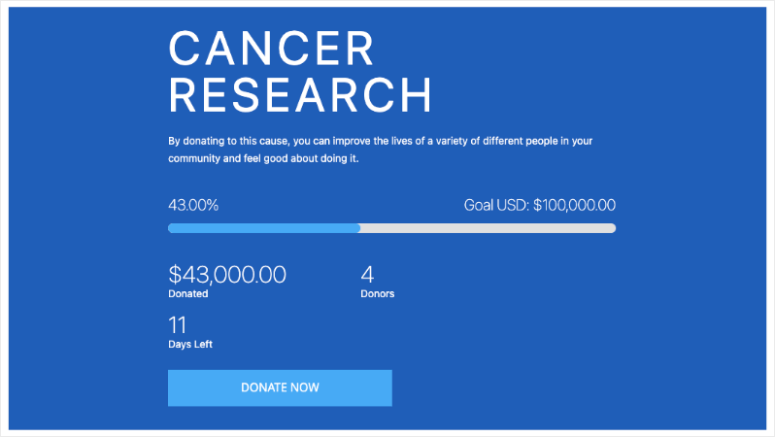
Additionally, the bars are fully customizable. You control the colors, display style, and where they appear on your donation page. This means they fit your brand while keeping donors informed.
3. Show how many people donated
Here’s a simple truth about charity campaigns: Numbers confirm trust.
When a donor sees “247 people have already donated to this campaign,” they immediately think: That’s legitimate because other people believe in it. Here I can give with confidence.
But if no donor number is visible, doubts creep in. “Am I the first? Is this even real? Why hasn’t anyone else donated?”
You see, donors don’t just want to support your cause. They want evidence that others are already doing it. Additionally, FOMO arises from seeing others donating, which motivates them even more to contribute.
Why donor numbers create trust
This is social validation at its most basic level. We trust what other people trust.
Think about it. You are more likely to try a restaurant with 500 reviews than one with zero. Or you can attend a webinar with 1,000 registered participants instead of one with 10. The same principle applies to donations.
When donors see a community of supporters, they feel confident joining that community.
It’s not about peer pressure. It’s about eliminating uncertainty. A visible donor count answers the silent question every first-time donor asks: “Is this organization trustworthy?”
What the donor count displays look like
You don’t need complex analysis. Simple, visible numbers work best:
- Total number of donors will be prominently displayed on your donation page. You can display something like “Join over 500 supporters” or “342 donors donated.”
- Milestone News that celebrates the growth of the community. “We just reached 100 donors!” feels like movement.
- Running totals These are automatically updated as new donations are received. Static numbers feel old. Live counts feel active.
- Emphasis on community and not just money. “500 supporters” sounds more inclusive than “raised $50,000.” Both are important, but they resonate with people.
How to implement donor counting displays
Like the strategies above, you can also choose the manual route. Count your donors and update a text box on your page weekly. It’s better than nothing, but it ages quickly.
And here’s the thing: Donors can tell when the numbers are out of date. If your count shows “50 donors” for three weeks, that raises more questions than it answers.
My solution is to use Non-profit.
It is Number of donors is displayed Keep your numbers current and accurate. Every time someone donates, the count is automatically updated across your website.
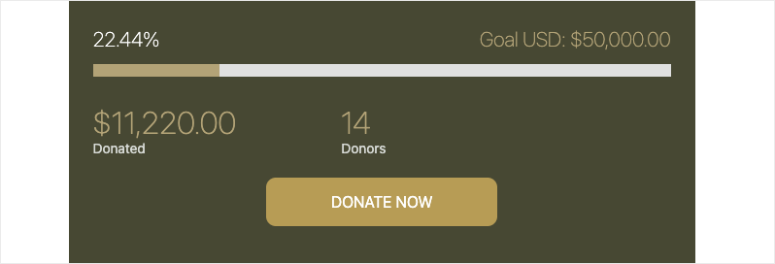
You can customize how the count is displayed. I like to display it as a simple number and then add a message like “Join our community of X donors” or display it next to your progress bar.
The choice is yours.
4. Highlight current donors publicly through feeds
There’s something powerful about seeing real names attached to a cause.
When a donor scrolls down your page and sees “Recent Supporters: Mike T., Jennifer L., Sarah from Portland,” something changes.
This is not a faceless organization asking for money. This is a community of real people supporting something important.
That’s credibility you can’t fake.
Why visible donors are important
Let’s be honest. Anyone can create a donation page and ask for money. Scams exist and donors know it.
Therefore, most people who want to donate pay attention to trust signals. They’re looking for evidence that real people actually give. And a recent donor feed provides exactly that evidence.
When visitors see names, locations, and timestamps, trust is immediately built. This makes active campaigns feel safe.
What current donor feeds look like
Effective dispenser displays don’t have to be fancy. They just need to be visible and up to date:
- Current donor lists Shows the most recent 5-10 contributors with timestamps. “Jennifer M. donated 2 hours ago.”
- Optional location displays adding authenticity without compromising privacy. “Mike from Austin” feels personal and real.
- Donation amounts if donors are happy to share. Some feeds show amounts, others only show names. Both work.
- Anonymous options for donors who prefer privacy. “Anonymous supporter from California donated $100” still provides social proof while respecting preferences.
The key is to give donors control. Some people love public recognition, while others prefer to give quietly. Your system should take both into account.
How to implement current donor feeds
You could take a screenshot of donation receipts and manually add names to your page. It is tedious but time-consuming and often neglected.
Plus, as we learned above, manual lists quickly become outdated. A donor feed from three weeks ago does not inspire trust. It raises the question of why no one gives more.
My solution to display automatic feeds from donors?
Charities Current donor feed Automatically keeps your supporter list up to date. It helps you build a donor wall where every new donation appears in the feed without you having to lift a finger.
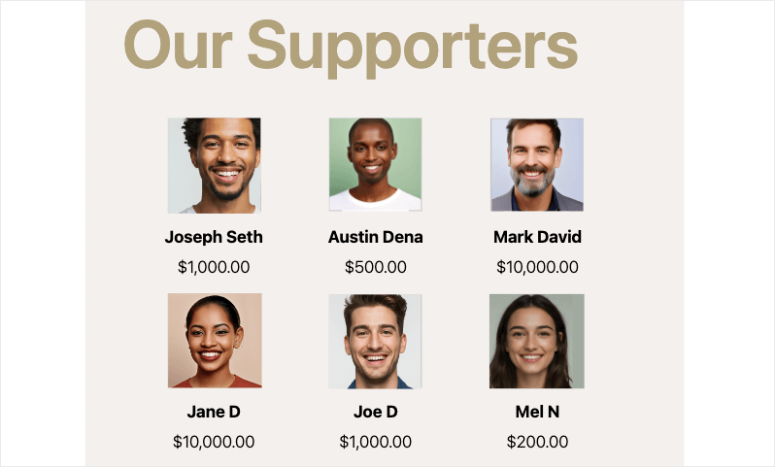
The feed respects donors’ preferences. If someone chooses to donate anonymously during checkout, their name will not be displayed. If they are happy to be public, they will appear in the feed with their permission.
Additionally, you control how the feed looks. You can choose how many donors to display, whether to display amounts, and where to display the feed on your page.
You can also customize it to fit your brand and the comfort level of your dispensers.
5. Communicate your impact clearly
This is where most nonprofits lose donors: vague impact statements.
“Your donation will help families in need.” Okay, but how? How many families? What kind of help? When will it happen?
Donors don’t just want to donate money. They want to know that their money is making real, measurable change.
Against this backdrop, concrete impact statements transform abstract generosity into concrete results. And concrete results create trust.
Why specificity is important
Think about the last time you donated to something. You’ve probably asked yourself, “Will this actually help? How will my $50 make a difference?”
Vague language does not answer these questions. It simply asks you to trust blindly.
But when an organization says, “Your $50 will cover 10 meals for local families this week,” everything changes. You can imagine the implications while understanding the math.
In the end, you will know exactly what your contribution will achieve.
This clarity eliminates hesitation and ensures donors give with more confidence when they know where their money is going.
What clear effective communication looks like
You don’t need complex metrics. You need honest, specific language:
- Focus on Punch failures that convert money into results. This is why you see so many charity campaigns with tags like “$25 = 5 meals, $50 = 10 meals, $100 = 20 meals.”
- Clarity of time frame This shows when the impact occurs. “This week” feels more immediate than “someday.”
- Milestone updates celebrate progress toward specific goals. Something like: “Thanks to supporters like you, we provided 500 meals this month.”
- Results-oriented language instead of activity-oriented language. Not “we distribute food,” but “we end hunger for 200 families every week.”
The more specific you are, the more trust you will build because donors can judge your effectiveness for themselves.
This is how you communicate your impact clearly
Start by honestly breaking down your costs. What does $25 actually fund in your organization? What about $50 or $100?
Then display these breakdowns directly on your fundraising page to provide donors with clear choices with visible impact.
My approach?
Non-profit comes with one Impact-based updates Feature that allows you to create custom messages for each campaign.
You can set different impact statements for different donation amounts, so donors can see exactly what their specific donation does.
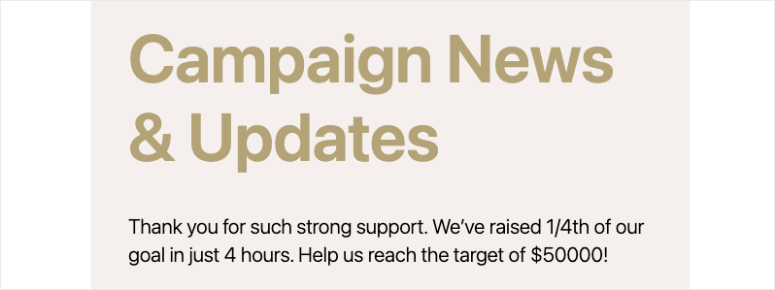
This donation plugin also allows you to add impact updates throughout your campaign. When you reach a milestone, you can immediately communicate it to your donors via automated emails or on-page updates.
6. Allow donors to leave messages and comments
Charities feel transactional when it’s just a simple donation form and submit button.
But if donors can leave a message and share why they are giving, they can encourage others and celebrate the cause together. The campaign becomes a conversation that leads to community building.
Just look at any GoFundMe campaign. The comments section is often more meaningful than the campaign description itself. People share stories, tag friends, and rally support through messages.
And communities build trust faster than any sales pitch ever could.
People connect with people, not with organizations.
When a potential donor scrolls through your page and sees comments like “So proud to support this cause! – Karen M.” or “This organization has changed my family’s life. I like to give back – David P.”, they read real human stories.
These messages do three powerful things:
First, they confirm your organization through personal testimonials. Second, they create an emotional connection that statistics cannot match. Third, they demonstrate active engagement in the community and not just passive giving.
A donation page with comments feels alive. Anyone without it feels barren.
What donor messages look like
You don’t need a complex commenting system. Simple, visible messages work best:
- Optional comment fields during the checkout process to give donors the opportunity to cast their vote. You can add a button like “Want to share why you’re donating?” add.
- Another approach is to create one public comment section, Display supporter messages on your fundraising page. Keep them visible but not overwhelming. My recommendation is to view the most recent 5-10.
- Moderation controls This allows you to approve comments before they are published. This keeps your site positive and on-brand while still feeling authentic.
- Anonymous comment options for donors who want to share their story without giving their name. “Anonymous Supporter: This Thing Saved My Sister’s Life” still has impact.
The goal is not to collect hundreds of comments, but to create an impact. Just 10-15 meaningful messages will completely change the appearance of your site.
You can add a manual testimonials section to your page. First, ask donors to email you their thoughts, then copy them. It works, but it’s extra steps for donors, which leads to a lot of abandonment and most don’t bother.
Or you can build a comment section directly into your donation flow.
Non-profit‘S Comments and messages from donors The feature adds an optional comment field to your streamlined checkout process. Donors can share why they are giving without leaving your donation page.
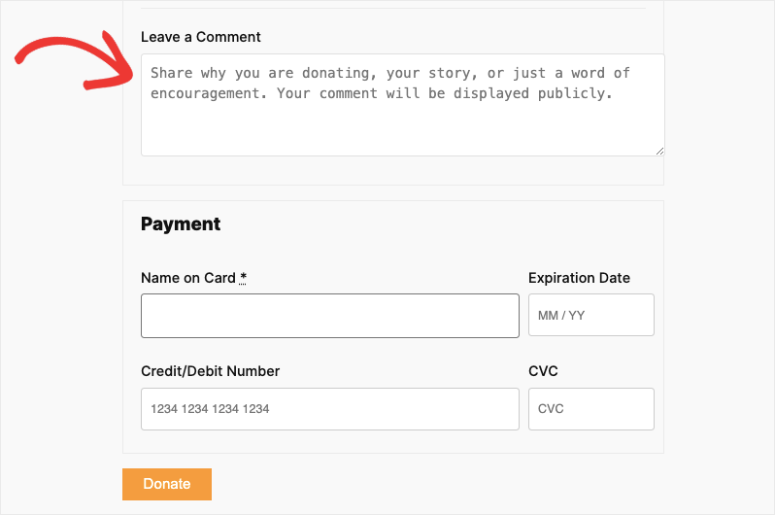
The messages will automatically appear on your campaign page after you approve them. You control what is published and ensure that everything remains appropriate and aligned with your mission.
It’s not just about collecting nice words. It’s about showing future donors that real people care deeply enough about your cause to speak up.
7. Send professional, personalized thank you emails
The donation doesn’t end when someone clicks send.
What happens next determines whether the donor donates again or disappears forever.
A generic, automated “Thank you for your donation” email feels cold. It’s transactional. It says, “We have your money, we’ll never see each other.”
But a personalized, thoughtful thank you email? This builds a relationship. And relationships create loyal supporters who give year after year.
Why thank you emails are important
What most nonprofits miss: The thank you email is not just about gratitude. It’s about increasing trust.
When a donor donates, there is a brief moment of doubt. “Have I made the right choice? Will they actually put my money to good use?”
Your thank you email answers these questions immediately.
A well-worded email states: “Yes, you made the right choice. This is exactly what your donation will do. We see you as a person, not a transaction.”
This endorsement keeps donors engaged and shows them they matter beyond their wallets.
What great thank you emails look like
You don’t need a fancy email design. You need personal, specific language:
- Personal greetings using the donor’s actual name. “Hello Sarah” is better than “Dear Donor” every time.
- Specific impact explanations tied to the donation amount. “Your $50 will provide 10 meals for families this week” is far better than “Your donation will help.”
- Instant confirmation that your gift has been accepted and will be used immediately. Donors want to know that their money is already working.
- You can also include Tax receipts for donors who need them. Make it easy by including the receipt or a link to a downloadable version.
- Next steps or updates about how they can stick with it. “Follow our progress on Instagram” or “Subscribe to our monthly newsletter” keeps the connection going.
Send these emails within 24 hours of donating. Expressing gratitude immediately shows that you are organized, attentive, and respectful of the support.
How to set up personalized thank you emails
You can manually send thank you emails after each donation. If you are a small nonprofit, this can be a great approach and can be very customized.
However, as you grow, scaling can be difficult. If an email is missed, the donor feels forgotten.
Automation solves this problem while maintaining the personal touch.
That’s why I use Charitable’s Customizable emails Feature that allows me to create branded, personalized thank you messages that are automatically sent after each donation.
You can use merge tags to automatically insert donor names, donation amounts, and campaign details. The email feels personal because it is. It was written specifically for this donor and their contribution.
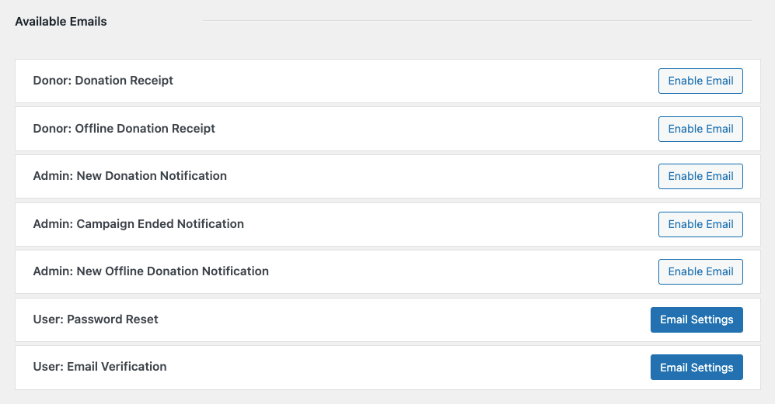
The drag-and-drop email builder makes customization easy. Add your logo, customize the colors to match your brand, and write copy that reflects your voice. No coding required.
You can even create different email templates for different campaigns. A one-time donation may receive a different message than a recurring monthly donation.
Remember to tailor your reaction to the action.
8. Enable peer-to-peer fundraising
Here’s a fact about trust: people trust their friends more than organizations.
When your nonprofit asks someone for a donation, there is natural skepticism. “Is this legitimate? Where is the money really going?”
But when Sarah creates a personal fundraising page and asks her friends to support her cause, that skepticism disappears because her friends trust her. If Sarah believes in your organization, they will believe it too.
This is the power of peer-to-peer fundraising.
Why peer-to-peer creates trust
Think about the last time a friend asked you to support their fundraiser. Maybe they ran a marathon for cancer research or raised money for a local animal shelter.
You probably donated without hesitation. Not because you researched the organization extensively, but because you trusted your friend’s judgment.
Peer-to-peer fundraising focuses on existing relationships to build trust for your cause. Every supporter becomes an ambassador and stands up for your organization within their own network.
Essentially, this is large-scale word of mouth advertising. And word of mouth is still the most trustworthy form of marketing there is.
What peer-to-peer fundraising looks like
It’s not complicated. It gives your supporters the opportunity to collect donations on your behalf:
- Personal fundraising pages where supporters set their own goals and tell their own stories about why they care.
- Individual tracking This allows fundraisers to see their progress and celebrate their own milestones.
- Social sharing tools integrated directly into your pages. One-click share to Twitter, Instagram, Facebook and email.
- Leaderboards (optional) that create friendly competition. “Top fundraisers this month” can motivate supporters to pool their networks.
The key is to make it simple. If setting up a personal page requires technical knowledge or multiple steps, most supporters won’t bother.
How to implement peer-to-peer fundraising
You can manually create individual campaign pages for each supporter who wants to raise funds. First, copy your main campaign, customize it, and track it separately. But it’s a lot of work and doesn’t scale.
Or you can use a system designed for peer-to-peer campaigns.
Charitable has a peer-to-peer fundraising and crowdfunding feature that allows supporters to create their own fundraising pages in minutes. No technical knowledge required.
Here’s how it works: A supporter visits your campaign’s main page and clicks “Start your own fundraiser.” You set your personal goal, write why you are collecting donations, add a photo and start.

Your page connects to your main campaign. So any donations they raise count toward your overall goal, but you also see their individual progress. This is motivating for them and beneficial for you.
In addition, social sharing tools are integrated. This allows supporters to share their page directly on social media or send personal emails to friends and family. With every share you expand your reach into new networks.
9. Offer multiple secure payment options
You did everything right. Your site looks great and your impact is clear. A donor is willing to give.
Then they see that you only accept credit cards. However, they prefer PayPal payment. Maybe they want to use Apple Pay or a bank transfer.
And you lose the donation.
Payment flexibility is not only convenient, it is a signal of trust. Multiple secure payment options tell donors, “We want to make it easy and safe for you.”
Why payment options create trust
The reality is that different people trust different payment methods.
Some donors feel safest with PayPal because they trust the buyer protection. Others prefer credit cards for the reward points. Younger donors expect QR code payment, Google Pay or Apple Pay.
Additionally, older donors may want to mail a check.
If you only offer one option, you’re telling some donors, “Our convenience is more important than yours.” This creates tension and leads to loss of donations.
But when you offer multiple trusted payment methods, donors think, “You’ve thought of my needs. You’re making it easy for me.”
This consideration creates trust. It shows that you are professional, flexible, and focused on the donor experience.
What multiple payment options look like
You don’t need every existing payment method. You need the most trustworthy:
- Credit and debit cards (Visa, Mastercard, Amex, Discover) for universal acceptance.
- PayPal for donors who prefer not to enter their card details directly on your website.
- stripes for secure, modern payment processing with fraud protection.
- Bank transfers (ACH) for donors who would like to donate directly from their checking account.
- Digital wallets like Apple Pay and Google Pay for mobile donors who want to pay with a tap.
- Offline donations for supporters who prefer checks or cash, with manual receipt tracking.
The more options you offer, the fewer donors you turn away. However, the key is not just in quantity, but also in displaying trustworthy brand logos that donors recognize.
How to add multiple payment options
Setting up multiple payment gateways traditionally requires creating separate merchant accounts. After that, you need to integrate each one individually and manage different dashboards for reporting.
It is technical and time consuming. For small nonprofits without IT staff, it’s overwhelming.
So what’s the best approach to adding lots of payment options to your charity campaign?
Use charities Multiple payment gateways Integration to completely simplify this.
You can connect multiple payment processors via one dashboard. Stripe, PayPal, Authorize.net and offline donations all work seamlessly together.
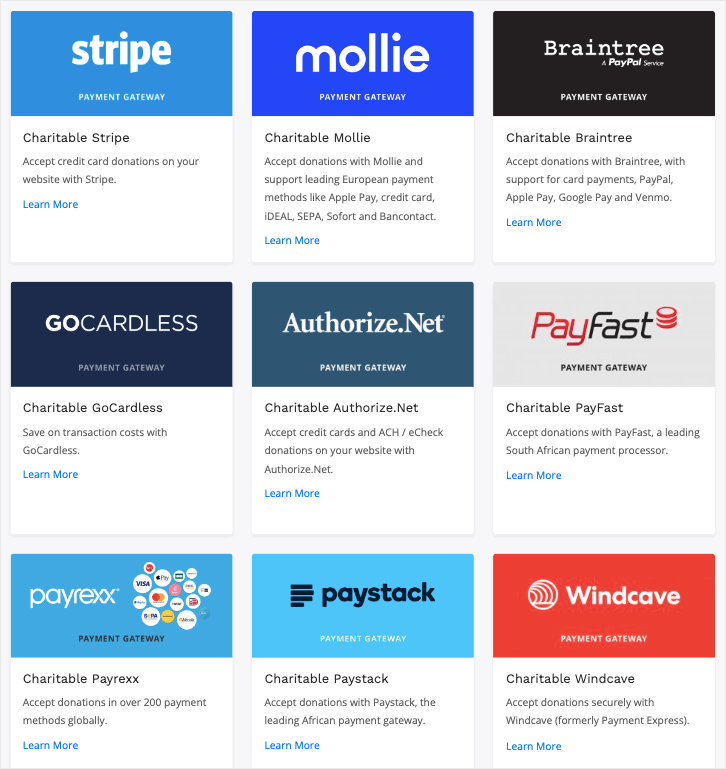
Donors will see all available options at checkout and choose their preferred method without having to create separate forms or set up redirects. Simply smooth and flexible payment processing.
❗Side quest: How to strengthen multiple payment options with security signals
What donors look for: proof that their payment is secure.
These visual cues answer the silent question every donor asks: “Is my financial information safe here?”
When donors see well-known, trusted payment brands on your site, they will no longer be wary. Not only do they trust you, but they also trust companies with billion-dollar reputations for security.
That’s it! You now know my 9 tactics to help charitable campaigns build donor trust. But how do you actually use these strategies to improve your fundraising campaigns?
Implementation of all 9 trust strategies: The complete solution
As you can see above, each of these strategies can work on their own. But the real power lies in using them together to power your fundraising campaigns.
But here lies the challenge most nonprofits face: Implementing all of these strategies typically requires dealing with multiple tools, plugins, and platforms.
Real-time notifications? This is a plugin. Donor walls? Another plugin. Peer-to-peer fundraising? You need a special platform. Multiple payment gateways? More integrations to manage.
Before you know it, you’ll be maintaining five different systems, paying multiple subscription fees, and fixing compatibility issues when something breaks.
There is an easier way.
Non-profit: Built for donor trust
For WordPress users, Charitable offers all 9 trust-building features in one plugin.
This is not a generic payment form with PayPal fields. It is a fundraising platform designed specifically for nonprofit organizations and based on the psychology of giving.
Everything we discussed, real-time notifications, progress bars, donor counts, comment sections, peer-to-peer campaigns, and multiple payment options, is built into Charitable.
Additionally, it offers easy-to-setup integrations and extensions to ensure you add the features you need.
Charitable is a plugin with a dashboard and a learning system.
The best thing about it: Charitable offers a free version So you can test it beforehand get the pro version.
The free version includes:
- Unlimited donation forms
- Basic goal progress tracking
- Donor management and reporting
- Email receipts
- Offline donation tracking
With Charitable, you don’t have to enter your credit card information to get started. You can start collecting donations professionally right away.
On the other hand, Charitable Pro taps into all 9 trust-building elements:
- Real-time notifications (DonorTrust)
- Donor walls and current donor feeds
- Peer-to-peer fundraising campaigns
- Advanced email customization
- Easy to set up recurring payment options
- Fee refund (pass on processing fees to donors)
- Priority support
Prices: Starts at $69/year
For more information, see my detailed charity review here.
Charitable Alternatives: Other Fundraising Solutions for WordPress
Charitable is my top recommendation for easy-to-use donor trust features, but it’s not the only option. Depending on your specific needs, you might consider these alternatives:
GiveWP
GiveWP is a popular donation plugin with a strong feature set and an active community. It’s been around for years and supports thousands of nonprofit websites.
I recommend this nonprofit plugin because it offers detailed reporting and analytics, which is great if you need detailed insights into donors.
Form customization is flexible and allows you to create multi-step donation forms with conditional logic. Recurring donations are built into the core plugin, making it easy to set up monthly donation programs.
The disadvantage: Most of the trust features we discuss require paid add-ons. For example, you need a premium add-on for goal progress bars, donor walls, and peer-to-peer fundraising
Best for: Nonprofits that prioritize detailed reporting and analytics over built-in trust features. Or organizations that only need simple donation forms without extensive social proof.
Prices: Free version available. The Premium plan starts at $149/year.
Check out my GiveWP review here.
Get started with GiveWP here.
WPForms
WPForms is not a donation plugin; It is a form builder with payment functions. But I’m impressed by how well it handles charitable donations too.
First of all, the drag-and-drop form builder is incredibly user-friendly. If you already use WPForms for contact forms or surveys, you can also use it to add a donation form that feels natural.
Additionally, it integrates with Stripe and PayPal for payment processing.
The reason I added WPForms as a non-profit alternative is because of its conditional logic. You create intelligent forms that adapt to user input.
This allows you to display relevant donation options depending on the user’s input in the form.
The disadvantage: WPForms does not have built-in trust features. No donor walls, progress bars, or social proof tools for donations without workarounds. Additionally, you cannot manage charity campaigns directly.
Best for: Small organizations that just need a simple donation form without advanced trust-building features. Or nonprofits that already use WPForms Pro and want to add a simple “Donate” option without installing another plugin.
Prices: Offers a free plugin. The Pro plan starts at $49.50/year.
Check out my WPForms review here.
Get started with WPForms here.
WP Simple Pay
WP Simple Pay is a lightweight Stripe payment plugin. Although it is not specifically designed for fundraising, it is the best plugin for any type of payment collection.
If you want the cleanest and easiest Stripe checkout, this is for you. This payment plugin is fast and light. It supports both one-time and recurring payments.
Aside from that, checkout is seamless because it uses Stripe’s native interface, which many donors already trust.
The disadvantage: WP Simple Pay is primarily a payment plugin. There is no campaign management, no social proof features, no donor blocks and no progress tracking. You need workarounds to add these trust elements.
Best for: Nonprofits who want the absolute easiest fundraising setup with Stripe and don’t need any trust-building features. Or organizations running one-off fundraisers where social proof is not a priority.
Prices: Free version available for basic payments. The Pro plan starts at $49.50/year.
Check out my WP Simple Pay review here.
Get started with WP Simple Pay here.
Quick Comparison Chart: How Charitable compares to its competitors
Here is the breakdown at a glance:
| Special feature | Non-profit | GiveWP | WPForms | WP Simple Pay |
|---|---|---|---|---|
| Real-time notifications | ✅ | ❌(Add on) | ❌ | ❌ |
| Progress bar | ✅ | ✅(Add on) | ❌ | ❌ |
| Donor walls | ✅ | ✅(Add on) | ❌ | ❌ |
| Peer-to-peer fundraising | ✅ | ✅(Add on) | ❌ | ❌ |
| Multiple payment gateways | ✅ | ✅ | ✅ | Just stripes |
| Free version available | ✅ | ✅ | ✅ | ✅ |
| Best for | All-in-one donor trust features | Detailed analysis and reports | Simple payment forms | Cash register only with strips |
| Starting price | $69/year | $149/year | $49.50/year | $49.50/year |
I hope you enjoyed learning my tips and strategies for improving your charitable campaigns. If something is unclear, check out the frequently asked questions below.
FAQs: How to build donor trust in charitable campaigns
Do I really need all 9 trust-building strategies for my fundraising efforts to be successful?
Not necessarily. Start with the basics like progress bars, donor counts, and secure payments to see an improvement in donor trust. Implementing just three to four of these strategies makes a noticeable difference. The goal is not perfection. It’s progress.
As your campaigns grow and you become more comfortable, you can add additional features such as real-time notifications and peer-to-peer fundraising. Build trust gradually and you will build it sustainably.
Can I build donor trust without a plugin?
Yes, but it requires manual work and constant maintenance. You can manually add testimonials to your donation page. You can update goal progress weekly in a text box. You can also send personal thank you emails individually. None of this requires a plugin.
However, the reality is that manual methods are not scalable and are often neglected. If your donor count still says “50 supporters” three weeks later because you forgot to update it, you’re actually damaging trust rather than building it.
Plugins like Charitable automate these trust signals, ensuring they stay current and accurate without you having to remember them. This consistency is more important than the method.
Is the Charitable plugin free?
Yes, Charitable offers a free version with basic donation forms, goal tracking, and donor management. You can fundraise professionally without spending anything.
However, advanced trust features such as real-time notifications, donor blocks, peer-to-peer fundraising, and customizable emails require a premium version.
Which payment gateways does Charitable support?
Charitable integrates with all major payment processors: Stripe, PayPal, Authorize.net, and offline donations (checks, cash, bank transfers).
Stripe and PayPal are the most popular options because donors trust these brands. Stripe processes credit cards, debit cards, Apple Pay and Google Pay. PayPal allows donors to use their PayPal balance or linked accounts.
If you need other gateways, Charitable’s premium plans support additional processors. But honestly, Stripe and PayPal cover 95% of donor needs.
Can donors donate anonymously?
Absolutely. Charitable (and most fundraising plugins) allows donors to choose whether they want their name to appear publicly on donor walls and feeds.
During checkout, donors will see a checkbox option: “Show my name publicly” or “Donate anonymously.” If they choose anonymity, their donation will still count toward your goal and appear in your reports, but their name will not appear on your public pages.
This respects the donor’s privacy while showing social proof.
How do I migrate to Charitable from another donation plugin?
Charitable offers migration support for switching from other plugins like GiveWP. The process typically involves exporting your donor data from your current plugin and importing it into Charitable.
The exact steps depend on which plugin you’re coming from, but Charity documentation Includes migration guides for the most common scenarios.
If you have a premium plan, you can do this too Contact Charitable’s support team for migration assistance. They help you move your data without losing donor history or campaign information.
Final Thoughts: Improve donor trust with these simple tips
Building donor trust is not about manipulating people to donate. It’s about removing uncertainty and showing them exactly why they should feel confident about supporting your cause.
Transparency, social proof and clear communication make this happen naturally. They answer donors’ questions before they even ask them.
Simply implementing a few of these strategies will improve your donation conversion rates. Start small, test what resonates with your audience, and expand as you grow.
Your concern is important. Make sure donors can see this immediately when they land on your page. This is how you create trust, lasting support and achieve real, lasting impact.
Resource Center
Are you ready to grow your nonprofit?
Building donor trust is just the beginning. Check out these helpful guides to strengthen your nonprofit’s online presence and fundraising strategy:
Fundraising & Campaigns:
Nonprofit Website Design:
Commitment & Forms:
These resources will help you build a complete nonprofit online presence. Start with donor trust and then expand to design, engagement and community building.
Your cause deserves a website that converts visitors into loyal supporters. Use these instructions to achieve this.