
Every few years, marketing headlines herald the failure of one fundamental strategy or another. Email first; then blog; then search engines. With the rise of AI, the question now arises: “Is AI destroying web traffic?” — But the curiosity is actually justified.
Starting in December 2025, AI overviews will reduce the organic click-through rate (CTR) for top-ranked content by an average of 58%and that is no coincidence. We’re in the midst of a massive shift in the way search engines display information, and it’s rewriting the rules for marketers and content teams across industries.
First, Google’s AI overviews answer queries directly on the results page, intercepting search queries that previously led to clicks on websites. And second, a growing portion of searchers are skipping Google entirely and turning to AI engines like ChatGPT and Perplexity for answers.
Both trends reduce the traffic that search engines send to your website, but it hasn’t completely disappeared. I’ve spent the last year navigating the ebbs and flows of traffic with HubSpot, fine-tuning to balance AI behavior and website traffic expectations. Here’s what you need to know:
Table of contents
TLDR: Summary
AI overviews are changing the way users interact with search results by reducing CTR for some information queries and redistributing clicks rather than eliminating all website traffic. Simple fact-based queries are more likely to result in zero-click results, while more detailed, brand-related questions like comparisons are more likely to result in clicks when users need depth and validation.
Marketers and brands that invest in AEO to capture AI insights instead of ignoring them will be the brands that stay competitive. Original research improves the citation potential of AI answers, structured data improves machine readability of page content, and concise question and answer sections help answer engines extract and cite content. Learn more about how you can improve your AI search performance HubSpot’s free AEO guide.
What AI overviews change on the SERP
AI summaries are generated summaries that appear at the top of Google search results. above both paid ads and organic listings. When one appears for your target query, it answers the user’s question and pushes all the blue links we’re used to further down the page.
And we all know what happens the further down you appear in a SERP.
If you are the website mentioned in the overview, impressions remain high (or increase), but clicks decrease. Even if you rank well, clicks will decrease because users have probably already received their answer in the overview.
In my example: “What is Bollywood?” Note that even big names like Masterclass and popular media like YouTube Videos can get multiple scrolls under the fold.
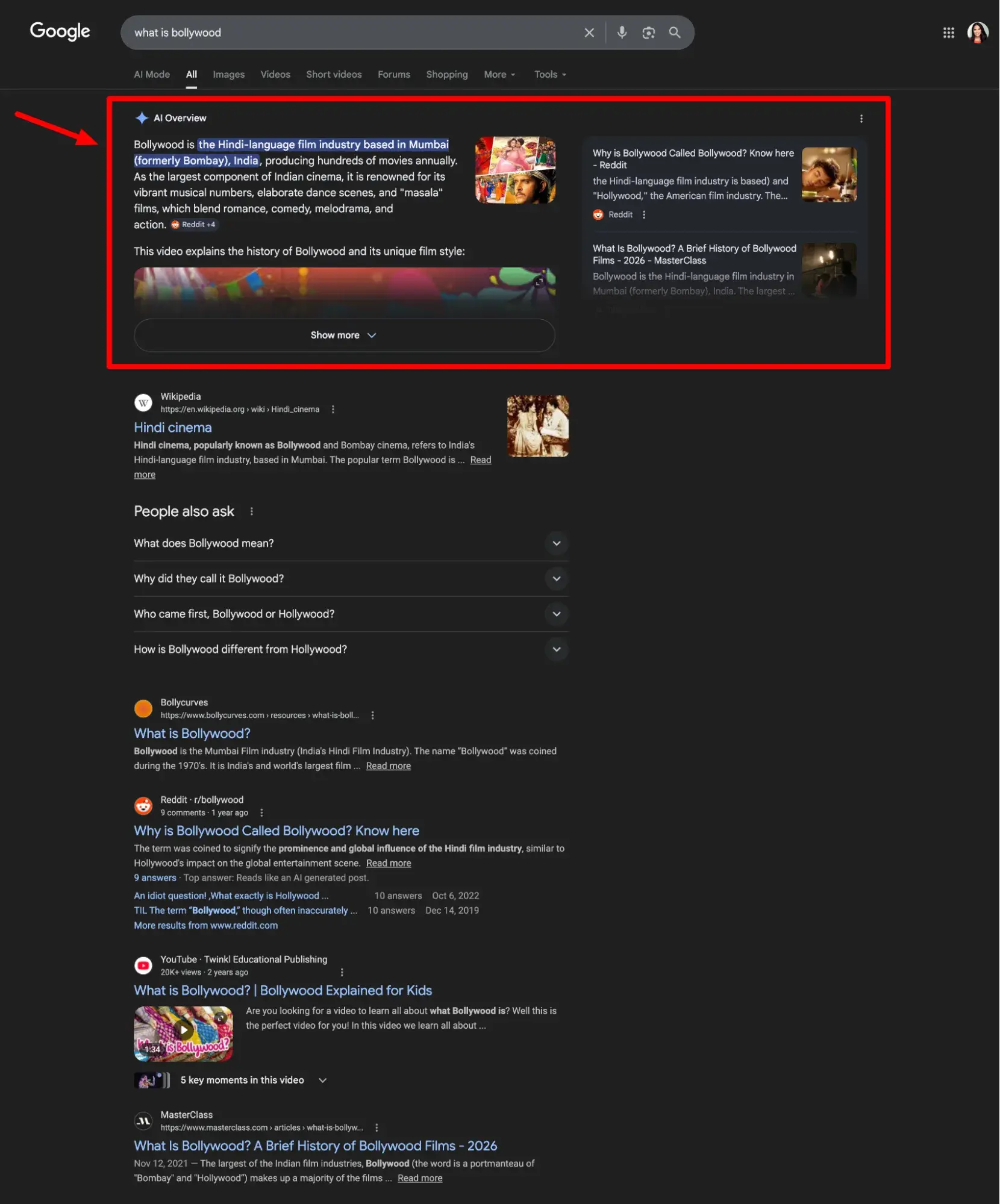
If you’re looking at your traffic reports and asking yourself, “Why did my website traffic decrease after AI search?” – this is the “zero-click” reality.
A study by Seer Interactive found that organic CTR for AI overview queries fell 61% from June 2024 to September 2025. Even more alarming: the CTR of the queries without AI overviews also fell by 41% over the same period.
This suggests that broader behavioral changes are at play. In other words, users are using search engines less often as search behavior on social media and AI engines increases.
But let’s bring all this big picture back down to earth and what it means for your business.
Pro tip: Use HubSpot’s free AI Search Grader to check how visible your brand is on AI-powered search engines. This will give you a reliable basis for seeing where you can improve, along with the rest of the advice we share.
How to measure the impact of AI overviews on your traffic
The measurement problem is real. Google Search Console currently does not provide a direct way to isolate or filter data for AI overviews.
All AI Overviews performance metrics are aggregated with standard web search data. For example, if your content is cited in an AI overview, Search Console won’t tell you. Your impressions and clicks are logged but merged with everything else.
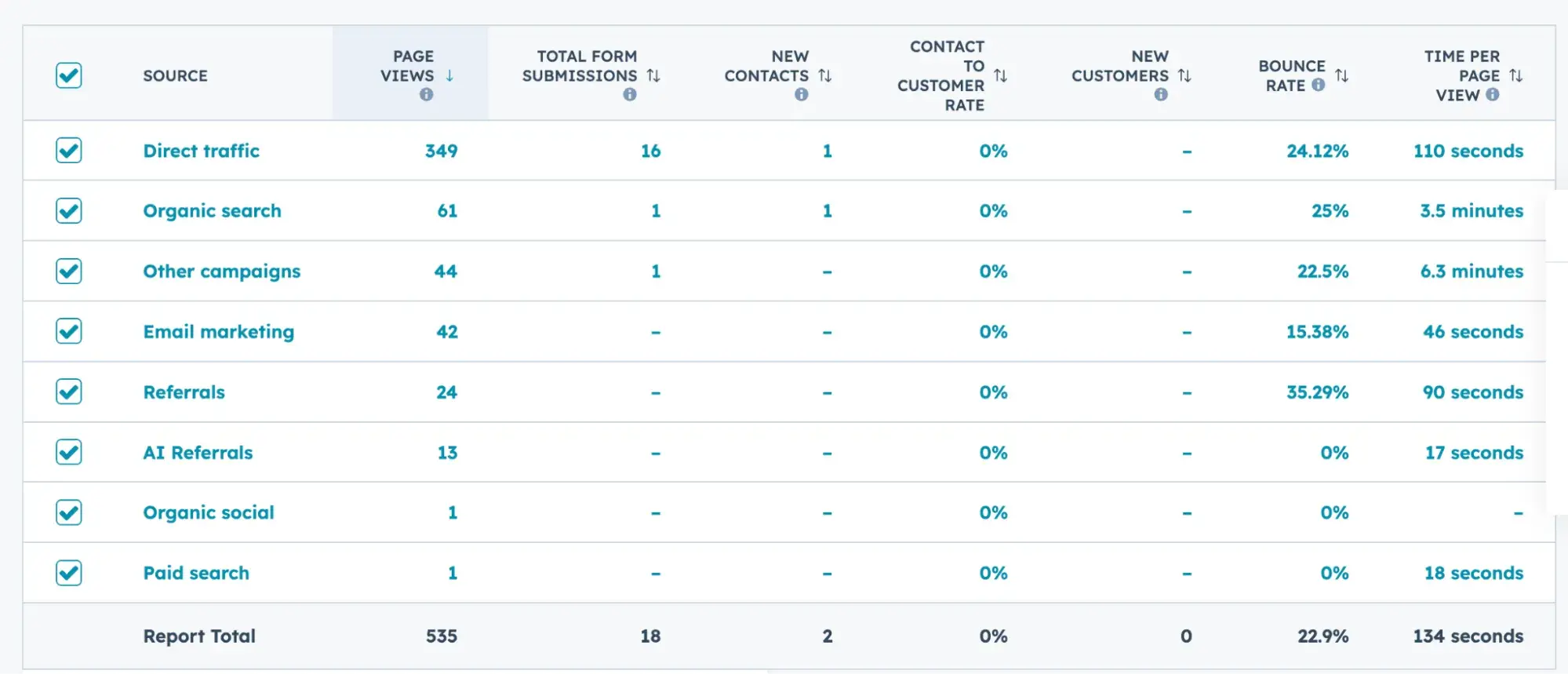
HubSpot recently added “AI Referrals” to its list of traffic sources (which is great), but it is currently referencing it only for AI assistants and chatbots like ChatGPT, Claude and Perplexity. This includes visitors who click on links provided in AI-generated responses.
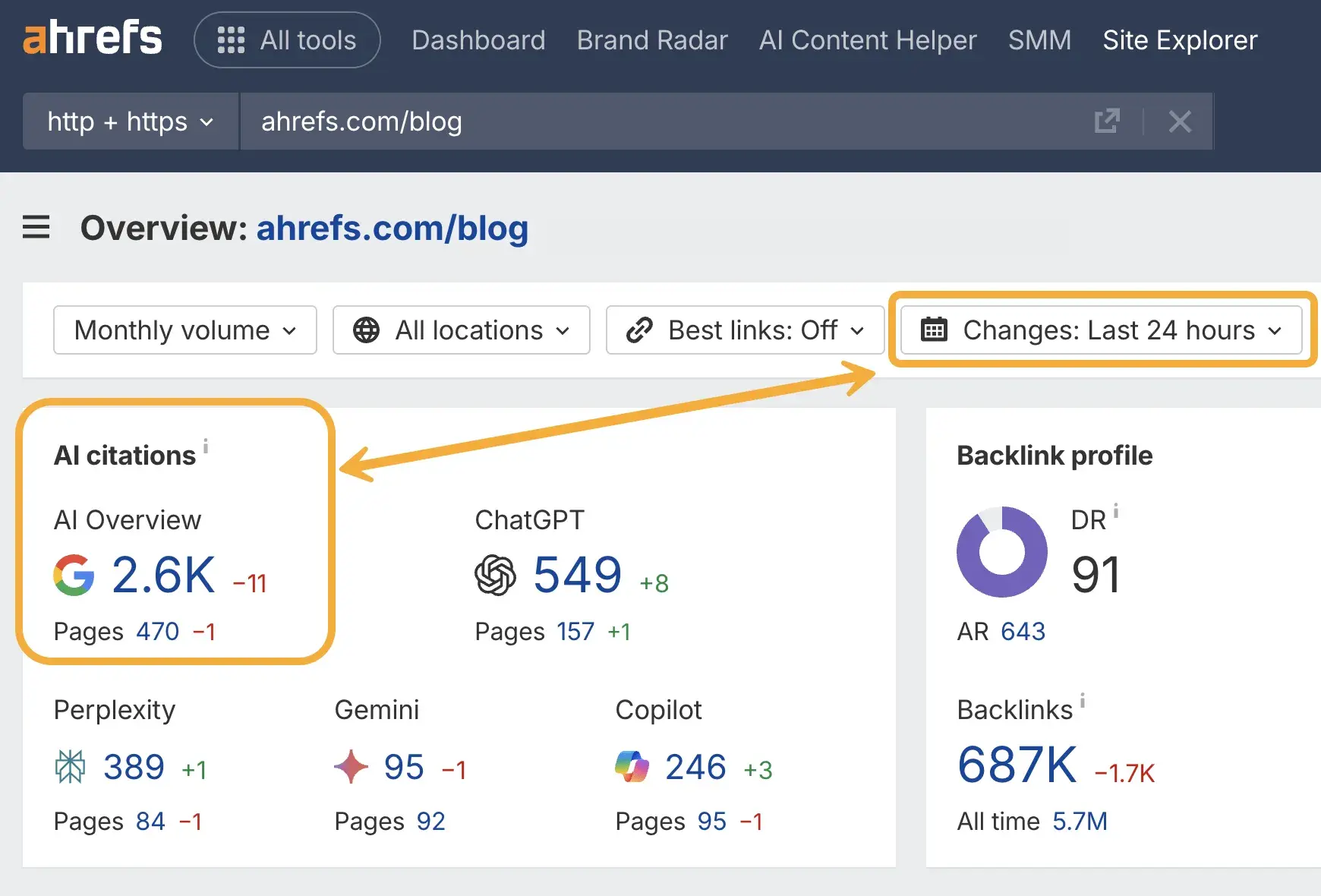
However, you can make informed predictions using third-party data. For example, Ahrefs provides estimates of which keywords have AI overviews, whether your brand has been cited, and approximately how much traffic this equates to.
What is the best way to predict traffic among AI overviews?
I spoke with Amanda Sellers, HubSpot’s blog growth manager, about the best ways to predict traffic using AI overviews.
She recommends using linear regression, a mathematical method that uses past data to simulate a trend into the future. A linear regression assumes that nothing major – like an algorithm update or an expansion of SERP features like AI overviews – will disrupt this trend.
“You and I both know that Google likes to mess things up,” Sellers says.
“At one point, AI overviews were displayed for less than 10% of the HubSpot blog’s keywords, most of which were informative definition intents. Today, almost 50% of the keywords that the HubSpot blog ranks for have an AI overview at the top.”
For this reason, sellers often check the AI overview presence in Ahrefs and perform CTR curve analysis using data from Google Search Console. This allows multiple scenarios to be predicted in addition to the base linear regression, e.g. E.g. “What if AI reviews increased by 20%” or “What if we were negatively impacted by an algorithm update.”
How do you attribute changes to AI overviews to seasonality?
Linear regressions can also help you quantify seasonal changes and identify patterns in historical data.
For example, due to the holiday season, there might be a historical pattern of low traffic in December compared to November. Linear regression can help marketers and SEO strategists create seasonality modifiers that adjust the traffic baseline according to the average pattern.
She continues: “If we use baseline traffic, December is typically 65% below baseline because fewer people are searching. January tends to be one of our strongest months, at around 135% above baseline. Incorporating these fluctuations into our model can help us understand if there are unexpected performances in one direction or the other.”
If a traffic forecast already accounts for seasonality in this way, any performance anomalies would mean, one way or another, that seasonality is not the cause. From there, an SEO strategist can use Ahrefs to determine whether Google increased the visibility of AIOs or whether another factor played a role. However, it’s not always that easy.
“Keywords rise and fall, AIOs appear and disappear, algorithm updates come and go… and there are internal technical factors that can impact performance. In reality, performance attribution is much more complex.”
For example, after a particularly difficult algorithm update, sellers noticed that 46.7% of a subsection of HubSpot keywords lost their positioning And gained an AI overview. It’s much harder to attribute the extent to which the change in performance is due to the AI overview siphoning off traffic, as opposed to a drop in CTR due to a simple lower SERP position.
For this reason, it’s best to let the data speak for itself. Sellers divide the keywords into different categories:
- Position reduced AND AIO present
- Position reduced. NO AIO available
- Position gain/flat AND AIO available
- Position gain/flat NO AIO available
By comparing the performance of these buckets with each other and exchanging CTRs, Sellers was able to estimate how much positioning changes changed performance compared to AIOs.
(Spoiler alert: AIOs were the much bigger culprit.)
Through the comparison, sellers discovered that even keywords for which we had not lost positioning still had significant CTR losses. This means there was less traffic even when we performed well. Meanwhile, we were able to estimate the traffic drop by swapping the CTAs and multiplying them by the impressions.
Does AI destroy web traffic more for certain search queries?
Not all queries are affected by AI overviews. Fortunately, the data is becoming clearer about which types experience the greatest zero-click effect and which can still drive website traffic for your business.
Queries most vulnerable to zero-click:
This means that website traffic is most at risk when it comes to high-end educational content, which typically generates a lot of clicks for businesses and increases brand awareness.
Think of simple true-or-false searches (“What is (concept),” “How” explanations, definition queries, and single-source information questions) like this example: “Who is Shah Rukh Khan?”
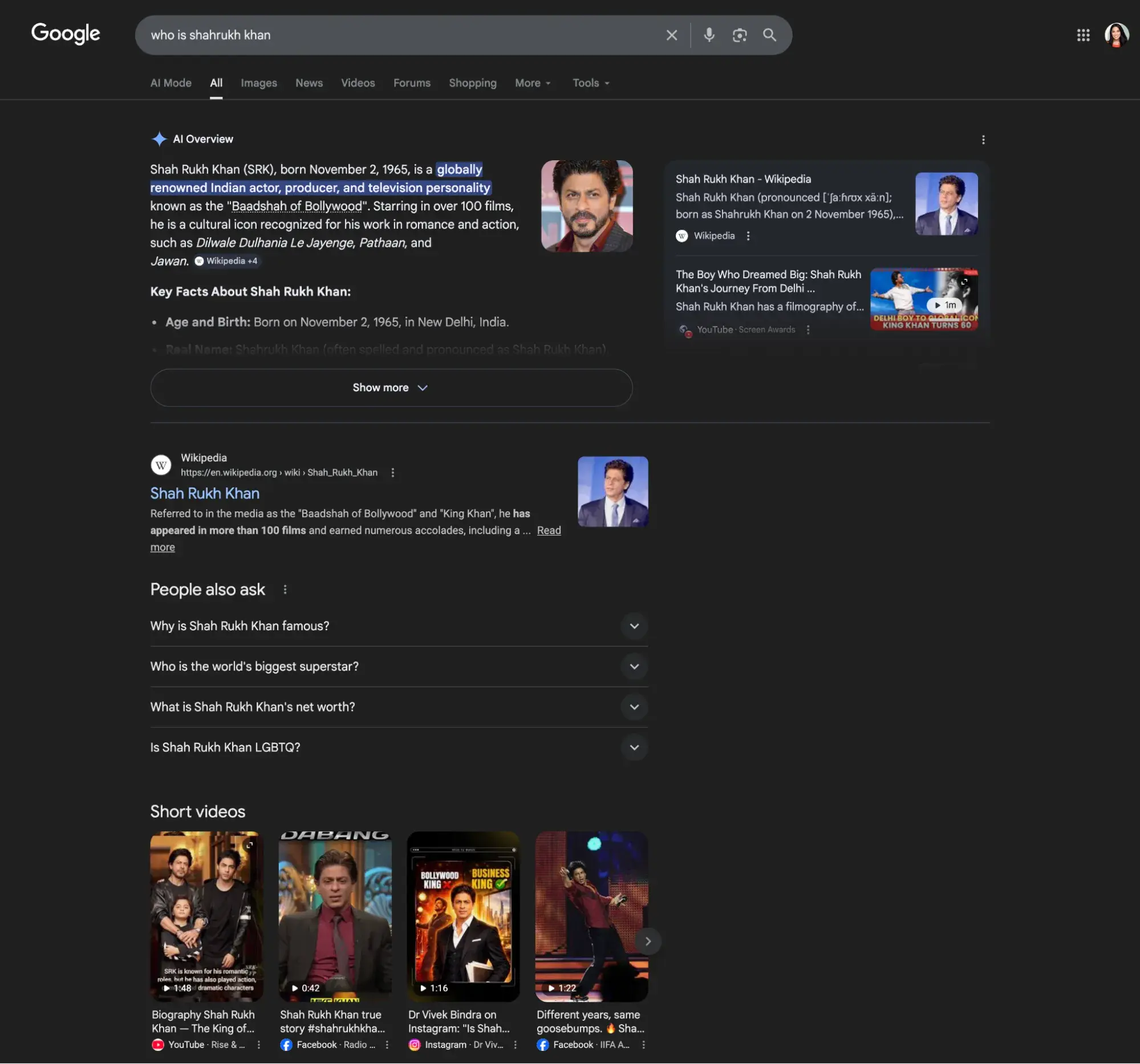
This question is answered by Google in an AI overview, so you don’t have to continue with the other results.
Searches that still get the click:
The same study found that transactional keywords like “buy,” “compare,” and “near me” tend to have higher CTRs because AI doesn’t typically close transactions. Continuing our example, look at the “Buy Shahrukh Khan DVD” results. (A DVD for my younger parents is a “digital video disc” that we used to watch movies before streaming.)
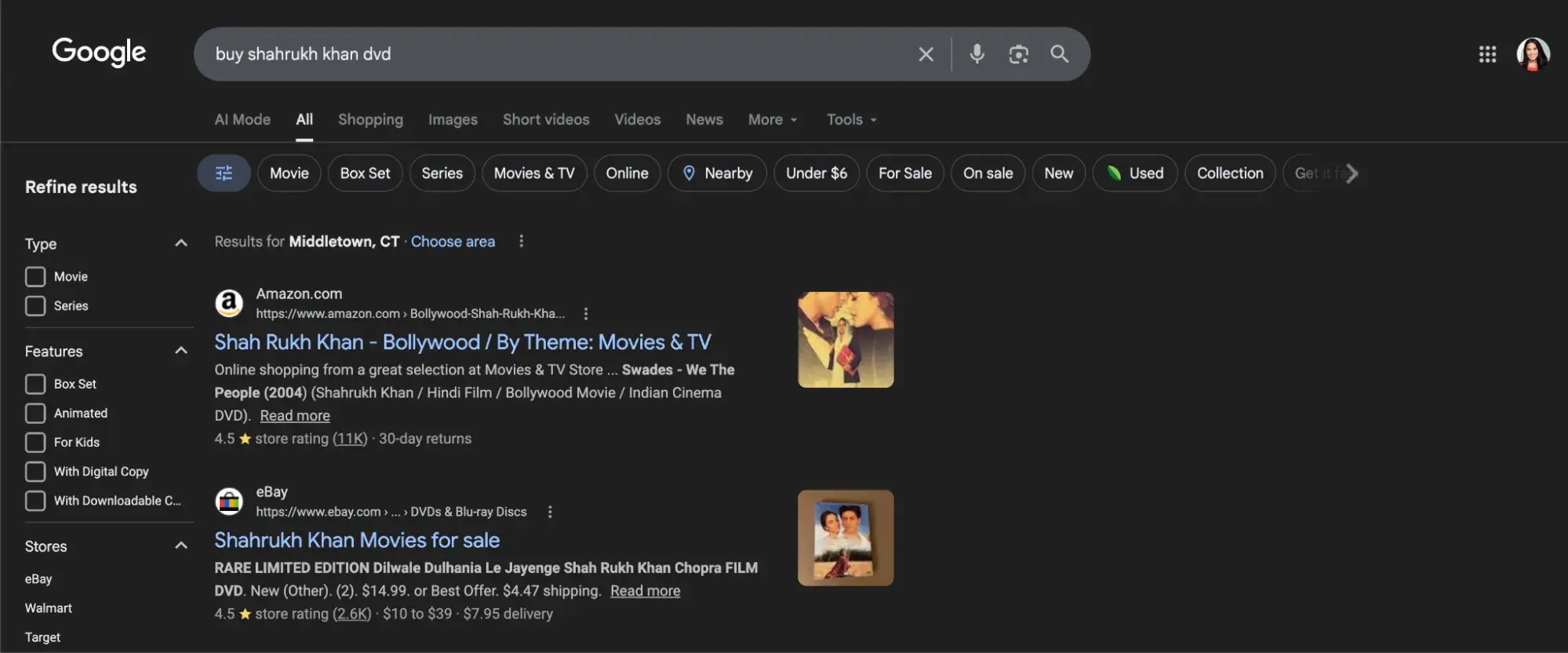
Also comparison queries like “X vs. The same applies to queries that require local, real-time or highly specific information.
Overall, the best content for generating clicks and website traffic right now is bottom-funnel content (pricing pages, comparison guides, case studies), local service requests, niche technical requests, and original research that AI can’t synthesize from other sources.
Does AI destroy web traffic or do you get traffic through AI citations?
Okay, here’s where the picture changes from bleak to nuanced: being cited in an AI overview can reduce your traffic at the top of the funnel and reduce your awareness website traffic, but those who do Do Visitors are probably more qualified.
Current studies found that brands mentioned in AI overviews receive 35% more organic clicks and 91% more paid clicks than brands not mentioned in the same searches. Whether this is due to greater awareness or other factors is difficult to say, but it is encouraging nonetheless.
Of course, you can’t control whether an AI summary appears for your target query, but you can work to get the mention if it does.
Optimization for AI overviews
To improve your chances of getting an AI scoop, you need to learn to write for AI search and invest in answer engine optimization (AEO). This means the following:
- Write in clear semantic blocks. Structure content into 200-400 word sections with explicit headings, summary boxes, and logical Q&A formatting. AI systems use Retrieval-Augmented Generation (RAG) and prefer content that is rich and scannable in this way.
- Lead with the answer. AI doesn’t read your entire article. Instead, answer-like structures are identified (short paragraphs after questions, numbered steps, comparison tables). So start each key section with a direct 40-60 word answer that fully answers the question, similar to how you would normally search for “featured snippets” on Google.
- Use structured data. Schema markup (FAQ, HowTo, Articles) improves machine readability and increases the likelihood that your content will be parsed and displayed.
- Cite primary sources online. Verifiable, dated claims with source links are the hallmark of quotable content. Vague claims are not addressed.
- Publish and update regularly. Fresh content outperforms outdated content for AI citations – update timestamps and material regularly to reflect freshness.
- Build current authority. AI wants you to know that it is providing users with trusted and reliable experts. Therefore, make sure that you demonstrate your specialist knowledge comprehensively in your online presence. This means sharing your knowledge through content on and off your website, but also being quoted and cited by others, having good product reviews, etc.
HubSpot Content Hub can help you use these patterns and schemas as a template, streamline content descriptions, and maintain editorial control at scale as your team produces more AEO-optimized content.
Optimization for generative AI engines (GEO)
Even aside from Google, more and more users are starting their search journey with AI via ChatGPT, Perplexity or other AI engines.
Research from BrightLocal shows that Google still accounts for 61% of all general searches, but more importantly, AI referral traffic is trending higher Convert at a significantly higher rate.
To get this high-intent traffic, you need Generative Engine Optimization (GEO):
- Create quotable content. Structured, binding content with specific, verifiable claims is the basis for AI engines. Data-intensive articles and in-depth guides consistently outperform opinion pieces.
- Build a cross-platform presence. Mentions and backlinks from credible third parties act as authority signals for AI systems. LinkedIn, Reddit, and industry publications are among the most cited domains across all AI platforms.
- Answer specific questions using multiple words. AI engine users formulate search queries conversationally and in detail – the average length of AI queries is 23 words compared to 4 words for traditional search. Optimize explicitly for these long questions.
- Keep information consistent across all properties. AI models skip naming brands with conflicting data on their website, LinkedIn, review sites and Wikipedia. Check your entity information for consistency.
- Target bottom-funnel queries. Lower funnel content like case studies and pricing pages receive the highest AI referral traffic, while upper funnel “what’s” content saw the largest decline. Position digitally
HubSpots AEO tools Help marketers track AI citation performance and optimize content for visibility in AI overviews and response engines – so you can measure the channel missing from traditional analytics.
FAQs about AI overviews and web traffic
How can I determine if my pages are being used as sources in AI Overviews?
Google Search Console doesn’t display this natively, and tools like HubSpot group things into a general “AI recommendation” bucket.
Your best approach is to manually search your top target queries in an incognito browser and note whether your site appears as a cited source in the AI overview. Then use linear regression to simulate a trend into the future. For systematic tracking at scale, third-party tools like SEMrush, Ahrefs, and Authoritas can monitor which of your URLs appear in AI digests and track citation counts over time.
Do AI Overviews Affect Branded and Non-Branded Traffic Differently?
Yes, clearly. For non-branded information queries, AI overviews are shown most often and CTR losses are greatest. Branded traffic tends to be more resilient because navigation and branded queries are less likely to trigger AI overviews.
Try it with Google Search Console’s new branded/non-branded filter to track both segments independently.
Should I change my keyword strategy based on AI Overviews?
Partially, but not completely, omit informational content. Factual, educational content is still valuable for building topic authority and getting AI citations. However, you should shift your investments to comparison content, bottom-funnel queries, and original research that AI cannot fully synthesize.
The goal is to be the source that cites AI, not to avoid the queries AI covers. Shift your success metrics from pure click volume to share of voice, citation frequency and branded search growth.
When should you shift your budget to your own channels?
At the risk of sounding dramatic. If more than 50% of your traffic currently comes from non-branded organic search, you are overexposed.
Email lists, communities, newsletters, and direct audience relationships are immune to AI overview cannibalization, algorithm updates, or shifts in Google’s presentation. The value of owning your audience increases over time; It’s the only distribution channel where your results are entirely yours.
Publishers with high brand and direct traffic, like the Daily Mail (their over 60% of traffic is direct) have proven to be significantly more resilient to AI disruption than sites that rely on non-branded organic search.
Website traffic is increasing
AI doesn’t kill web traffic, it redistributes it. Clicks decline for information requests, especially those that are not brand-related. But AI citation traffic converts at rates that dwarf traditional organic search for the brands that earn it.
The marketers who will win in the battle against AI’s impact on website traffic are the ones who stop measuring success solely in clicks and clicks Start by measuring visibility, citation frequency, and audience engagement. The structural change is real and will not be reversed. What changes is whether you are on the right side.