Two-thirds of marketers say marketing has changed more in the last three years than in the last 50 years. Understanding loop marketing versus traditional marketing has become essential for marketers in 2026. The two frameworks differ fundamentally in how brands reach, engage and retain customers in an AI-driven world.
Unlike traditional marketing, which views the customer journey as a straight path from awareness to purchase, loop marketing is a continuous, adaptive system powered by AI. This post explains the key differences between loop marketing and traditional marketing, how they both work in practice, and how marketing teams can transform using HubSpot’s tools.
Table of contents
TL;DR: The loop
Why the traditional funnel is broken
Marketing needs a new framework because customer acquisition is no longer linear. Tactics that worked two years ago are losing their power. As many as 60% of Google searches end without a single click as shoppers rely on AI summaries and chatbots for instant answers. The attention is spread across TikTok, YouTube and various communities.
The responsibility for the conversation no longer lies with the brands, as before, but with them may Despite it Join in. You simply need a new, iterative approach. The answer to these challenges is Loop Marketing, HubSpot’s new marketing framework and the evolution of inbound marketing for the AI age. When comparing loop and funnel marketing, the main difference is adaptability: the funnel is static, the loop is self-improving.
What is loop marketing compared to traditional marketing?
How the traditional marketing funnel works
Traditional marketing follows these steps: Attract, Engage, Delight (sometimes called Awareness, Consideration, Decision). Under this framework, marketers plan campaigns months in advance, create content for broad segments, and measure success incrementally or retrospectively. Optimization happens slowly, if at all.
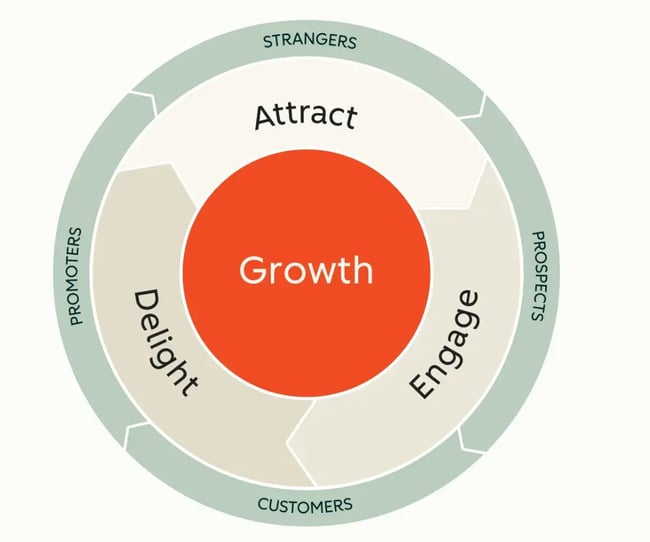
For comparison, here you can see how the classic inbound funnel is structured as follows:
Put on
Create valuable content (blogs, SEO, social networks) to attract strangers to a company’s website. The goal is visibility and traffic.
Engage
Convert visitors into leads with offers, forms, and workflows. The focus shifts to funding and qualification.
Joy
Support customers post-purchase with service, training and community. The goal is retention and advocacy.
While customers still go through the same stages (awareness, consideration, decision), buyers no longer start with a website. In the age of AI, they learn about brands early on through third-party sources. When they engage with the brand, they are more educated and have higher intentions than in the past.
How loop marketing works
In contrast, loop marketing is cyclical and responsive. The buyer journey is believed to be non-linear and AI plays a central role in discovery. Within this framework, marketers use AI to automate tasks, express brand identity, personalize at scale, amplify across channels, and develop strategies in real-time.
The table below compares loop marketing stages to traditional funnel stages across seven key dimensions, from core model and personalization approach to channel strategy and cadence.
Level comparison: loop marketing vs. traditional marketing
How loop marketing phases work
The four phases of loop marketing all play a crucial role – don’t skip any of them. Express and Tailor lay the foundation for the loop that defines who is targeted, what is important to them, and what messages are most likely to resonate. Amplify is the execution and distribution engine, while Evolve is the intelligence that enables companies to improve the cycle from start to finish.
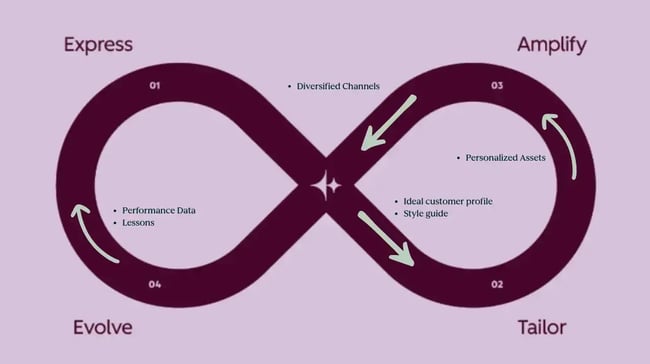
Let’s break down each phase.
Express: Define the brand
Before generating content, brands need to clarify who they are and who they serve. Of course, any valuable marketing team already has an ideal customer profile (ICP) and branding.
The difference is that marketers must translate these documents from PDFs that only the marketing team maintains to comprehensive documentation that an LLM can use to educate a brand, its messages, and its audience.
The following video shows how to conduct market research using AI in the express phase.
Assemble a library of content including:
- Company mission, vision and values
- Brand voice and style guide
- ICP and Persona Profiles
- Messaging and positioning frameworks
- Examples of branded content
- Sales call transcripts
- Customer quotes and testimonials
Teams that don’t already have these resources should take the time to create them, as they power everything else in the cycle. While AI can support this process, don’t ask AI to invent these – the model needs real, company-specific customer insights.
This is what the Express phase looks like in HubSpot:
- Use Breeze Assistant to analyze top performing customers and extract key themes.
- Upload the company’s style guide Brand identity (Professional or Enterprise plans), so each AI-generated asset reflects the brand’s unique voice. Brand Identity uses Breeze to tailor AI-generated content to a company’s voice, tone and ideal customer profile.
Tailored: Make messages feel personal
In the tailor phase, marketers make decisions What You will personalize and How. In a traditional funnel, the customer journey can branch into two or three paths depending on the industry or a behavioral trigger set by the marketing team. In AI marketing, customer journeys rely heavily on behavioral and contextual data. With AI, brands can create personalized customer journeys at scale.
The Tailor phase defines what will be personalized, how deeply and to what extent, giving the AI the context it needs to tailor messages to each individual. Instead of two or three possible variations, brands offer hundreds, all personalized and optimized for each person. To do this, brands need to set up their CRM with rich data and dynamic audience segments.
This is what the Tailor phase looks like in HubSpot:
- Enable AI-powered contact enrichment to automatically fill in missing details like job changes or company news. HubSpots Data enrichment automatically adds company and behavioral data to personalize reach at scale.
- Create dynamic audience segments with Smart CRM and intent signals.
Amplify: Show up where buyers are
The Amplify phase includes many of the steps that comprise a marketer’s daily activities: content strategy, content creation, execution, and distribution.
Most marketing teams are already publishing strong content. Loop marketing requires brands to go beyond good content to meet buyers where they are – including AI chatbots.
In this phase, brands optimize their content for Answer Engine Optimization (AEO) so that the brand is mentioned in AI-generated summaries. Brands can also reuse content across channels and remix their best insights for short-form videos.
This is what it looks like in HubSpot:
Evolve: Optimize in real time
Finally, the Evolve phase closes the loop by evaluating results and optimizing campaigns in real time. That doesn’t happen after the other phases take place; it happens simultaneously. This allows teams to replace their post-campaign reports with live learning. Using AI, teams can predict what will work, run quick experiments, and adjust the model to produce better results.
This is what it looks like in HubSpot:
- Run AI-powered A/B testing on landing pages to discover winning messages faster.
- Analyze cross-channel performance in HubSpot Marketing analytics. The analytics suite shows which channels are driving sales – not just traffic – so marketers can evolve their strategy based on business impact.
Most marketers hit publish and move on, but the ones who grow the fastest treat their marketing like experiments. You start fast, learn early and optimize often. This is exactly what Evolve Stage Loop Marketing is designed for. It helps teams review the data from the last experiment, see what worked and what didn’t, and decide what needs to be changed before running the next experiment.
Loop Marketing offers marketing teams a system that gets smarter with every use.
How to go from funnel marketing to loop marketing
Here’s the good news: teams don’t have to abandon their current strategy to adopt loop marketing. The principles of good marketing – defining your target audience, identifying pain points, personalizing content, measuring and optimizing – still apply. Instead, layer the loop principles on top. Move from creating individual campaigns to AI-powered systems that personalize and distribute a message at scale. Here’s how to get started.
1. Set targeted goals.
First, teams should determine where there is a leak in their funnel. Watch out for low blog-to-lead conversion rates, generic emails, or a poor post-click experience. These show the best entry point into the loop. Identify the brand’s strengths and weaknesses and set specific goals, e.g. E.g. “Increase demo requests by X” or “Increase engagement/conversions by Y”. Teams can also aim for efficiency goals, such as increasing production or saving time.
2. Clean and unify data.
Loop marketing doesn’t work without clean, high-quality data. The company’s CRM should contain accurate, enriched contact records. Use Data Studio for synchronization with external sources such as Google Sheets or Snowflake.
3. Lay a strong foundation.
Before running the first loop marketing campaign, every team needs to lay a foundation. Host a Hackathon and involve the entire team. Assign one person as brand champion to be responsible for the Express phase and another person to be responsible for the Tailor phase. Build the content library that trains the AI and give it test use cases. If it doesn’t work well, tweak it and try again. For testing purposes, set up test contacts with segments and behavior triggers.
4. Avoid over-automation.
AI marketing is exciting because it can automate so many things, but it should always start and end with humans. Everything in loop marketing should create value for the customer and not just be a shiny object. As teams move into the Amplify phase, ensure every action has value. Always incorporate human quality checks into AI output to ensure accuracy, brand alignment, and emotional resonance.
5. Start with quick success.
Loop marketing can be a big change for marketing teams and, like any process change, is daunting. Instead of overhauling every marketing workflow at once, aim for quick success first. For example, if web traffic is declining, try increasing AI mentions in the first quarter. If prospects download a resource like Hotcakes but rarely get to a demo, focus on the follow-up email sequence.
Starting with a quick win builds the team’s confidence in the cycle and shows what the framework can do. Every time, teams repeat, improve, and grow.
Frequently asked questions about loop marketing versus traditional marketing
Does loop marketing replace the funnel?
No. Understanding the marketing loop versus the marketing funnel begins with recognizing that one builds upon the other. Loop Marketing adapts Inbound’s Attract, Engage, Delight foundation for non-linear, AI-driven buyer journeys. The funnel is a customer flow; The loop is the operating system.
How long does it take to see results with loop marketing?
Many teams see improvements within 30 to 90 days, especially when optimizing for AEO or personalizing high-intent emails. The loop thickens over time, so each cycle sharpens the next.
Can small teams take a loop marketing approach?
Yes, loop marketing is designed for efficiency. Tools like Breeze Assistant enable lean teams to work like larger teams and achieve more and better results in less time.
How does loop marketing impact sales and service teams?
Loop Marketing helps align marketing, sales and service teams, benefiting all three. Sales reps receive better qualified, AI-enriched leads thanks to Loop Marketing. With AI agents helping with routine queries, service teams see fewer tickets. All teams share a unified view of the customer.
What’s the best way to get started if we’re new to AI?
Start with HubSpots free loop marketing playbook And AEO grader. These resources help brands assess their current position and identify their starting point with the greatest impact – no AI skills required.
Loop marketing vs. traditional marketing: new framework, same goals
With loop marketing versus traditional marketing, teams don’t have to completely reinvent the wheel or change the way marketing is done. Marketers just need to understand how these phases work together and how AI intervenes in each one. The goals are the same – except instead of following a linear journey, the teams design campaigns for the fragmented, non-linear way customers look for answers today.
In my experience, the biggest change when working with marketing teams is not about producing a standout piece of content, but rather about creating personalized, timely content with a data-driven strategy. Loop Marketing turns human insights and creativity into a scalable system and another growth engine. This is how brands are successful in the AI age.
Ready to get started? Download HubSpot’s Loop Marketing Prompts Library.