
The Marketing Efficiency Ratio (MER) measures how much revenue marketing generates for every dollar spent. MER is calculated by dividing total sales by total marketing spend for a defined period. Unlike ROAS, which focuses on the return on investment of specific advertising campaigns, executive-level MER provides a mixed view of the overall effectiveness of marketing across all channels. A higher MER indicates more efficient marketing performance. However, what is considered “good” depends on margins, customer behavior and the business model.
As search, analytics, and attribution have evolved, marketing efficiency and MER have become key metrics for marketers, revenue leaders, and finance teams. MER captures the holistic performance of marketing investments and shows whether the organization is generating sustainable returns.
This guide explains what MER means, how to calculate it, when to use it, how to improve it, and which complementary metrics are most important.
Want to track and optimize MER with unified data? Get started with HubSpot for free.
Table of contents
What is the marketing efficiency ratio?
The marketing efficiency ratio (MER) is the total revenue generated divided by the total marketing spend for a given period and gives a mixed view of how efficiently marketing contributes to total revenue.
What is MER?
MER measures Overall effectiveness of marketing across all channels and reflects the combined impact of paid, organic, referral, affiliate and brand-driven activity. Because all revenue is compared to all marketing spend, it reflects the performance of the entire marketing ecosystem – campaigns, organic traffic, referral channels, brand building, partnerships and everything in between. That does that Marketing Efficiency Ratio One of the easiest ways to evaluate the performance of the entire funnel.
MER should contain all income generated during the reporting period – paid, organic, referral, partner and direct – as long as the revenue definition remains consistent across all reporting windows. This ensures that MER accurately reflects the overall commercial impact of marketing activities.
HubSpot’s intelligent CRM enables consistent tracking and reporting of MER across all channels by bringing together revenue, expense and attribution data in one place.
What does MER measure?
MER measures the overall effectiveness of marketing ROAS (Return on Advertising Spend) measures the return on advertising spend at the channel levelThis makes MER particularly valuable for cross-functional decisions. By capturing the entire revenue picture, MER cuts through attribution noise and helps executives understand whether marketing investments support sustainable growth. This broader view is particularly helpful for eCommerce brands, omnichannel marketers, revenue leaders, and B2B teams that report mixed performance across long sales cycles. For this reason, the marketing efficiency ratio is now commonly used in executive dashboards and board-level reporting.
HubSpot’s marketing hub Strengthens MER analysis by unifying revenue, expense and attribution data in a connected system. When all marketing activities run through a single platform, MER becomes more precise and easier to interpret across channels.
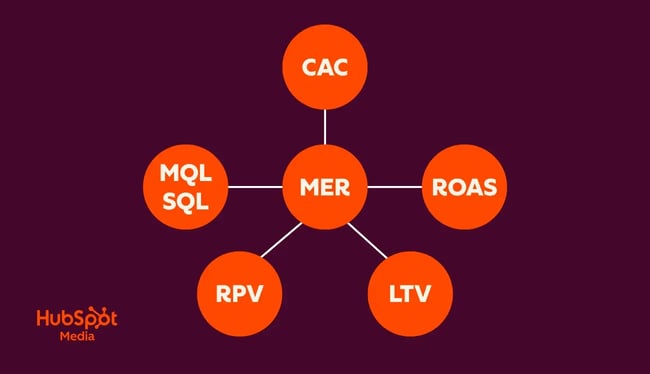
Although MER provides an essential top-down view of efficiency, it cannot diagnose which individual campaigns or channels are driving performance. Instead, MER is most meaningful when combined with metrics like ROAS, CAC, LTV, and channel-level revenue.
At the core is that Marketing Efficiency Ratio highlights whether marketing activities generate sustainable, profitable revenue.
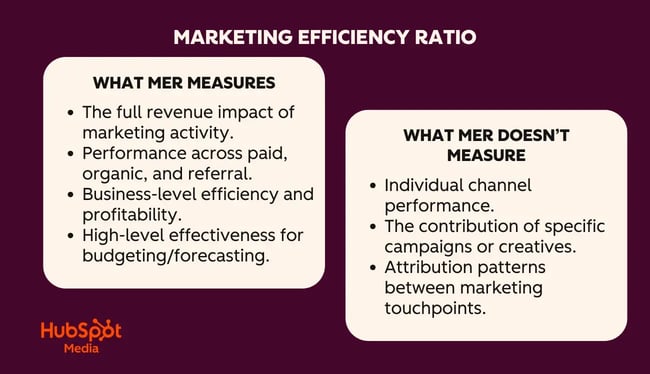
What MER measures:
- The full impact of all marketing activities on sales.
- Mixed performance across paid, organic and referral channels.
- Efficiency and profitability at the enterprise level.
- Highly effective for budgeting, forecasting and board reports.
What MER does Not Measure
- Performance of individual channels.
- The contribution of specific campaigns or creatives.
- Attribution patterns between marketing touchpoints.
How to Calculate Marketing Efficiency Ratio
The marketing efficiency ratio is calculated by dividing total sales by total marketing expenses for a given period. This creates a single, combined metric that shows how efficiently marketing is generating revenue. MER equals total sales divided by total marketing expenses. This structure facilitates the calculation, comparison and standardization of MER.
The Marketing Efficiency Ratio Formula
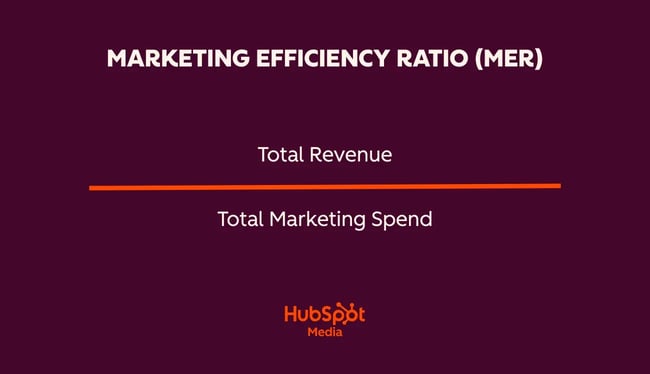
MER relies on two consistent inputs: total revenue generated during the period (gross or net, as long as it is defined the same way each time) and total marketing expenditure for the same period. Because MER covers all revenue – not just attributed revenue – it provides a holistic signal that reflects the entire marketing ecosystem.
Teams often revisit this Marketing Efficiency Ratio weekly or monthly to monitor efficiency trends.
Example: MER calculation
A company generates $500,000 in total sales in a quarter and invested $100,000 in marketing in the same quarter.
$500,000 ÷ $100,000 = MER of 5.0
A MER of 5.0 means the business generated $5 in sales for every $1 spent on marketing. This example makes that clear MER measures the overall effectiveness of marketingno channel level performance.
A consistent one Marketing Efficiency Ratio allows companies to compare efficiency across channels, seasons or growth phases.
Platforms like HubSpot’s marketing hub Simplify this calculation by centralizing campaign data, revenue attribution and expense tracking in Smart CRM. With unified reporting, MER can be calculated consistently without the need to pull spreadsheets from multiple tools.
Why period consistency is important
MER becomes unreliable when revenue and expense periods do not match. Monthly MERs help teams identify short-term fluctuations in efficiency, while quarterly or annual MERs are better suited for long-cycle B2B models. Consistent compliance with inputs ensures that the MER remains stable and comparable across all reporting periods.
Pro tip: Compare MER periods consistently: month-over-month, quarter-over-quarter, or year-over-year.
How to track marketing efficiency ratio in HubSpot
Marketers can track marketing efficiency ratio in HubSpot by combining total revenue and total marketing spend in a unified dashboard. HubSpot’s intelligent CRM Connects revenue, attribution and expense data across all channels and enables teams to calculate MER using standard or custom reports. Teams typically create a single dashboard tile that divides total revenue by marketing spend for a selected time period, then overlay it with ROAS, CAC, and channel-level data for deeper analysis.
Marketing Efficiency Ratio vs. ROAS
MER is different from ROAS, which measures the return on advertising spend at the channel or campaign level. Because the marketing efficiency ratio measures overall When it comes to marketing effectiveness across all channels, the two metrics complement each other and are not interchangeable. MER measures overall efficiency, ROAS measures channel-level performance, and together they help allocate budgets more effectively. In order to compare both metrics across channels and business models, it is important to understand the difference between MER and ROAS.
What ROAS measures
ROAS (Return on Ad Spend) evaluates the efficiency of individual advertising channels or campaigns.
ROAS = advertising revenue / advertising expenses
ROAS helps media buyers optimize budgets, bids, audiences and creative assets. It provides detailed insights into how specific tactics are performing, but cannot show whether the entire marketing function is generating sustainable returns.
What MER measures
The MER calculator reflects the overall performance of all marketing activities by comparing total sales to total marketing expenses.
MER = Total Sales / Total Marketing Spend
This broader view helps executives understand whether overall marketing investments are driving efficient sales results, even if attribution is inaccurate or incomplete.
How MER and ROAS work together
Because MER measures the overall effectiveness of marketing, while ROAS measures the return on advertising spend at the channel levelTeams gain the most insight when they use both metrics together. ROAS shows where expenses should be allocated. MER shows whether total marketing spend is generating profitable revenue.
A high ROAS with decreasing MER may indicate overspending on upper funnel channels, while a constant MER with decreasing ROAS may indicate channel saturation or diminishing returns.
When to use each metric
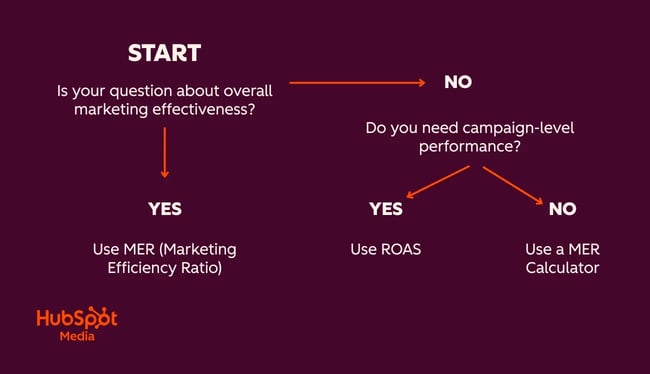
- Use ROAS for media planning, channel optimization, creative testing and performance marketing decisions.
- Use MER for budget planning, forecasting, executive reporting and assessing whether marketing as a whole contributes efficiently to sales.
Marketing Hub’s attribution dashboards Make it easier to compare channel-level ROAS to store-level MER. With both metrics in the same reporting environment, teams can see which channels contribute meaningfully to overall revenue and which only appear efficient in isolation.
What is a good marketing efficiency ratio?
A “good” marketing efficiency ratio depends entirely on the business model, margin profile and growth strategy. There is no one-size-fits-all MER target because companies generate and deploy marketing spend differently, and these differences significantly change what efficiency looks like.
A strong one Marketing Efficiency Ratio typically reflects aligned spending, healthy margins and predictable customer behavior.
Companies with higher contribution margins can often maintain a higher MER threshold, while companies with lower margins typically require a more conservative efficiency baseline. This reinforces the principle that A good MER depends on the business model, gross margin and growth objectivesnot on a single benchmark.
How to evaluate MER by business model
DTC and eCommerce
MER typically varies depending on contribution margin, customer repeat behavior and advertising intensity. Brands built on high-margin products or strong LTVs often have more room to scale their spend while maintaining an efficient MER.
Retail and low-margin consumer goods
Lower margins typically require stricter efficiency targets. In these models, MER is often combined with a contribution margin or cost of goods sold analysis to determine whether marketing spend supports profitable growth.
B2B SaaS
Long sales cycles can cause closed-revenue MER to be misleading. Many companies use pipeline MER – pipeline generated divided by marketing spend – to understand early-stage efficiencies before deals close.
Enterprise and high-ticket B2B
Deal velocity and deal size cause MER to fluctuate significantly. For these organizations, the CAC payback period is or The LTV to CAC ratio often provides a more reliable efficiency signal than MER alone.
Some organizations also track a sales and marketing efficiency ratio to evaluate combined commercial performance. For more detailed information on commercial performance, see our guide to revenue performance management.
What influences a “good” MER?
- Contribution margin and COGS
- Customer Lifetime Value (LTV)
- Refund and Return Fees
- Length of sales cycle
- Channel mix and acquisition model
- Growth phase (scaling vs. efficiency orientation)
Track changes in the Marketing Efficiency Ratio Over time helps managers understand whether efficiency is improving, decreasing or stabilizing. In most cases, companies determine a “good” MER by looking at their own historical performance, not by comparing themselves to other industries.
Pro tip: Combine MER with contribution margin to ensure marketing generates profitable growth.
How to improve your marketing efficiency ratio
Improving MER requires better conversion, cleaner data, and more efficient channel allocation. Additionally, improving MER requires increasing revenue per visitor, reducing wasted spend, and maintaining accurate, consistent data across all channels. Therefore, the most effective tactics focus on strengthening the inputs rather than manipulating the metric itself.
Many of the most effective ways to improve marketing effectiveness – better data, better attribution, better conversion, and better automation – are significantly easier with HubSpot Marketing Hub. Because Marketing Hub connects campaigns, leads, sales, and reports within Smart CRM, teams can optimize efficiency without having to juggle multiple tools.
Each of the following tactics directly impacts the Marketing Efficiency Ratio by improving sales quality or reducing unnecessary expenses.
Consolidate marketing data into a Smart CRM.
Unifying marketing, sales and customer data ensures MER is calculated based on consistent, reliable inputs. HubSpots Smart CRM connects revenue, attribution and contact behavior across all channels, creating a single source of truth for tracking efficiency. Better yet, it makes it easier Automate your processes End-to-end.
Pro tip: MER becomes much more stable when sales and expense data are available flow through a single system instead of multiple separate platforms.
Optimize yours Media mix Leveraging attribution insights.
Attribution models show which channels make a meaningful contribution to sales. HubSpots Marketing Hub includes first-touch, last-touch, linear, and data-driven attribution, helping teams compare channel-level ROAS to organization-level MER.
Pro tip: If a channel has strong ROAS but MER is not improving, it is likely shifting revenue from other sources rather than providing net new growth.
Improve on-site conversion rates.
Higher conversion rates increase sales without increasing expenses, which directly leads to an increase in MER. Improvements in message clarity, page speed, CTAs, and user experience result in significant efficiencies. Teams that focus on high-traffic, high-intent pages initially find that small conversion increases on these pages have a disproportionate MER impact.
Pro tip: HubSpot’s forms, CTAs, and chatflows offer built-in A/B testing and conversion analysis.
Automate nurture workflows to increase revenue per lead.
Automated workflows Keep leads moving through the funnel and encourage more prospects to convert without additional spending. Lead scoring, lifecycle automation, and behavior-based nurturing deepen engagement over time.
Teams exploring automation at scale can benefit from centralized workflow management, branching logic, and multi-tiered maintenance tools. Overview of HubSpot’s automation features explains how these features support more efficient revenue generation.
Automation often has one of the biggest impacts Marketing Efficiency Ratio because it increases sales without increasing expenses.
Pro tip: Identify drop-off points in the buyer journey and Build targeted automation to close these specific gaps.
Reduce spending on underperforming channels.
Channels that consume budget without contributing to revenue impact MER. Using ROAS and MER together helps identify where expenses are not significant. With channel performance, ROAS and MER visible in one place, Marketing Hub makes it easy to quickly identify and reduce inefficient spending.
For more comprehensive strategies for optimizing marketing investments, check out our guide to optimizing marketing spend.
Pro tip: Review MER at the same frequency as budget grading – weekly or monthly – to identify inefficient spending early.
Prioritize high-intent campaigns and content.
Content and campaigns aimed at purchase-ready behavior ensure more efficient sales. Pricing pages, comparison content, and solution-specific assets typically produce the largest MER increase. Search data can help teams identify queries related to late-stage purchase intent and prioritize advanced content in these areas.
Pro tip: HubSpot’s SEO and content tools reveal which topics drive sales and enable teams to prioritize the content that most efficiently improves MER.
Marketing effectiveness metrics you can track along with MER
The marketing efficiency ratio becomes more actionable when combined with supporting metrics that demonstrate profitability, channel contribution, customer value and performance quality. Because MER is a composite metric, teams gain deeper insights when they compare it to metrics that reveal underlying drivers such as cost, lifetime value, and conversion efficiency.
These supporting indicators help explain the movement in the Marketing Efficiency Ratio and make it easier to identify the drivers of efficiency gains or losses.
Reporting inside HubSpot Marketing Hub makes it easy to track these metrics along with MER in a single dashboard, simplifying efficiency analysis. For more ways to evaluate content and channel performance, check out our breakdown of easy ways to measure content effectiveness.
Customer Acquisition Cost (CAC)
Customer acquisition costs measure the average cost of acquiring a new customer. When combined with MER, CAC helps determine whether revenue efficiency is consistent with sustainable profitability. A high MER and increasing CAC can indicate inefficient scaling, while a constant CAC with increasing MER indicates healthy growth. If the CAC increases faster than the Marketing Efficiency RatioEfficiency usually decreases.
Pro tip: Compare CAC trends with MER trends. Differences between the two often reveal hidden channel inefficiencies.
Return on Ad Spend (ROAS)
ROAS evaluates the revenue generated by specific advertising campaigns. Because ROAS measures channel-level efficiency, while MER measures overall effectivenessthe two metrics work best together. ROAS identifies which channels are performing well; MER determines whether this performance contributes to overall revenue growth.
ROAS works best when evaluated alongside Marketing Efficiency Ratio to align decision making at the channel and business levels.
Pro tip: Prioritize channels where ROAS improves MER, not just channels with isolated high ROAS.
Customer Lifetime Value (LTV)
Customer Lifetime Value measures the predicted long-term value of a customer. The combination of LTV and MER helps teams understand whether efficient acquisition leads to profitable retention. A high MER with low LTV can indicate short-term efficiency but weak long-term profitability.
Pro tip: Evaluate the LTV to CAC ratio along with MER to confirm that efficient revenue today contributes to profitable growth tomorrow.
Marketing Qualified Leads (MQLs) and Sales Qualified Leads (SQLs)
The quality of the pipeline has a direct impact on sales and therefore on the MER. Tracking MQL and SQL volumes – and their conversion rates – reveals whether marketing investments are generating meaningful demand that ultimately contributes to revenue.
Pro tip: If MER decreases but MQL/SQL quality decreases at the same time, the problem is likely upstream in targeting or messaging.
Revenue per visitor (RPV)
Revenue per visitor measures how much value each website visitor generates. RPV directly impacts MER by increasing total revenue without increasing expenses. This makes RPV a strong indicator of conversion strength and content effectiveness.
Pro tip: Improving RPV often requires optimizing both website experience and content intent. Start with the highest traffic pages for maximum impact.
Marketing Efficiency Ratio Pitfalls to Avoid
The marketing efficiency ratio becomes misleading when revenue and expense inputs are inconsistent, allocation is incomplete, or calculation windows are misaligned. Avoiding these pitfalls ensures that MER remains accurate and useful for decision making.
Inconsistent mixing of revenue streams or definitions.
MER relies on clean, consistent revenue streams. If gross sales are used in one period and net sales in another – or if returns, discounts or partner revenue are treated differently in different periods – MER trends become unreliable. Because MER compares total revenue to total expenses, inconsistent definitions can skew the metric.
Pro tip: Document the exact revenue definition used for MER and apply it identically each time.
Measure MER too rarely or irregularly.
Long report windows hide fluctuations in efficiency. Quarterly MERs can mask short-term volatility, while promotional periods often require more frequent monitoring. Regular intervals keep MER comparable and ensure early signals are not missed.
Pro tip: Track MER monthly (and weekly during high spending cycles) to spot changes before they worsen.
Refunds, returns or allocation gaps will be ignored.
Refunds and returns reduce actual sales, and excluding them from the MER artificially inflates performance. Attribution gaps – such as offline conversions or missing UTM parameters – also lead to incomplete sales data.
Pro tip: Subtract returns from total sales and ensure all channels consistently pass tracking parameters to your CRM.
Marketing Efficiency Ratio Frequently Asked Questions
Should organic revenue and referral revenue be included in MER?
Yes. MER includes all revenue generated during the reporting period – paid, organic, referral, partner-driven or other – as long as the revenue definition remains consistent across all reporting windows. This approach supports the basic principle that MER measures the overall effectiveness of marketing across all channels.
How often should MER be calculated?
Most companies calculate MER monthly to keep the metric stable, comparable, and sensitive to significant changes in expenses or revenue. Teams running large advertising cycles or launching large campaigns often evaluate MER on a weekly basis to identify shifts in efficiency earlier. Many teams use Marketing Hub dashboards to automatically monitor MER at weekly or monthly intervals.
How do returns and refunds affect MER?
Returns and refunds reduce actual sales and should be deducted before calculating MER. Excluding them increases total sales and introduces inaccuracies because MER is defined as total sales divided by total marketing spend.
How does MER apply to B2B SaaS with long sales cycles?
B2B SaaS can take months to generate revenue, making traditional MER less reliable. Many teams do the math instead Pipeline MERby comparing pipeline value created with marketing spend, which more accurately reflects efficiency within long, multi-stage buying cycles.
Is there a difference between the media efficiency ratio and the marketing efficiency ratio?
In most cases, the media efficiency ratio and the marketing efficiency ratio are used interchangeably. Marketing efficiency ratio is the broader term as it includes all marketing expenses, not just media or advertising costs.
Build a more efficient marketing engine with MER
The marketing efficiency ratio provides a simple way to evaluate how effectively marketing investments generate revenue by comparing total sales to total marketing expenses. The Marketing Efficiency Ratio reduces noise at the channel level, clarifies the impact of the entire marketing ecosystem, and supports better forecasting and budgeting.
Because MER is different from ROAS – it measures overall effectiveness rather than campaign-level efficiency – it is most useful when combined with supporting metrics such as CAC, LTV, ROAS, RPV and lead quality. Improving MER requires increasing revenue per visitor, reducing wasted spend, and maintaining clean, consistent data across all channels. All of this is made easier with built-in integrated reporting HubSpot’s intelligent CRM and the Marketing Hub.
From my perspective, having worked in marketing organizations that are constantly asked to demonstrate ROI, MER is often the metric that ultimately expands the conversation. This shifts the focus away from the performance of individual channels and towards whether the entire marketing machine is aligned with commercial goals and driving growth.
MER becomes most valuable when teams no longer view it as an outcome but as a signal. It’s the moment when executives realize that MER is not a judgment on the marketing team, but a lens for smarter decisions. The organizations that use MER well tend to revisit it regularly, layer it with complementary metrics, and create workflows that turn data into action. These are the teams that improve efficiency without sacrificing momentum – and build growth engines that can scale predictably.
The latest State of Marketing Report shows exactly why this matters: Teams that use unified data, combined efficiency metrics, and cross-channel measurement outperform their counterparts that rely solely on isolated reports. For a deeper insight into how top marketers improve efficiency and achieve measurable ROI, check out the full report.
Get the latest insights in the State of Marketing Report.