AI-related traffic has increased by 600% since January 2025, and marketers are trying to figure out what that means for brand recognition. For teams seeking clarity on how AI impacts brand and pipeline, they need to invest in new tools like Profound or Athena AI for Answer Engine Optimization (AEO).
This guide provides a comprehensive comparison between Profound and AthenaHQ, explaining what each platform does and how they differ in practice. For SEO strategists building a new AEO practice, marketing leaders evaluating AI search tools, or agencies scaling visibility programs across multiple clients, this comparison shows which tool fits which growth package.
Table of contents
Profound vs. AthenaHQ AI for AEO: At a glance
Profound vs. AthenaHQ in comparison
Here’s a breakdown of some key features of Profound and AthenaHQ and how they work The GEO tool takes over the function.
Monitoring vs. Action
One of the biggest differences between Profound and Athena AI in the AEO comparison is the main problem that each tool solves.
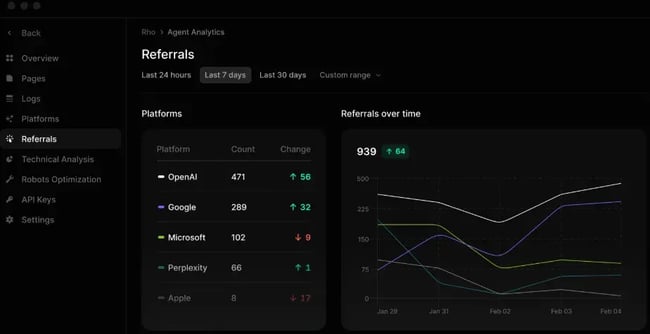
Profound is an AEO monitoring and analysis platform. It includes a visibility intelligence command center that aggregates data from multiple engines into competitive insights.
Here is a screenshot showing what the monitoring analysis looks like. The screenshot shows a graphic with referral traffic from AI systems in one place. SEO experts can use this chart to identify the AI agents that work best for the business and offer the greatest opportunities:
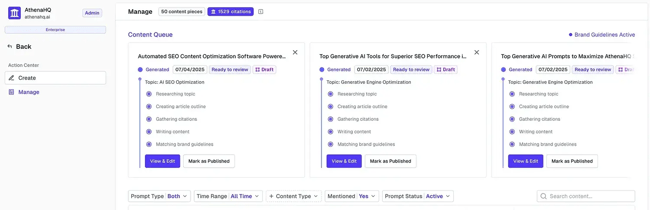
AthenaHQ AI is an AEO and GEO platform focused on automation and workflow integration. It is designed to bridge the gap between insights and execution through its action center, automated content production and outreach tools.
The screenshot below shows the Action Center:
Which platform wins? Both platforms are great for monitoring, but AthenaHQ offers the added value of Action Center, which helps teams turn insights into action. The best tool depends on team needs and existing skills. For teams whose SEO staff can identify actions through analytics, Profound is the way to go. For teams that need support with briefings and next steps, AthenaHQ is the more guided option.
AI engine coverage
Profound supports ChatGPT, Perplexity, Google AI Overviews, Copilot, Gemini and Claude and extends coverage to more than 10 AI engines including DeepSeek, Grok, Meta AI and Google AI Mode.
Athena AI supports ChatGPT, Perplexity, Google AI Overviews, Copilot, Gemini and Claude, covering the core engines with additional platforms available upon request. It also covers Google AI Mode and Grok.
|
AI Agents Covered by AthenaHQ vs. Profound |
|||
|
Plan |
AI engine coverage |
Price |
Features with custom plans |
|
Profound’s growth package |
ChatGPT confusion Google AI overviews |
$399/month for the growth package |
Google Gemini Microsoft Copilot Meta AI Grok DeepSeek Anthropic Claude Google AI overviews |
|
AthenaHQ |
ChatGPT confusion Google’s AI overviews Google’s AI mode Gemini Claude co-pilot Grok |
$295/month |
Other models available on request |
Which platform wins? Athena covers more AI engines in its plan than Profound, but with custom plans, both solutions cover many AI engines.
Analysis and visibility tracking
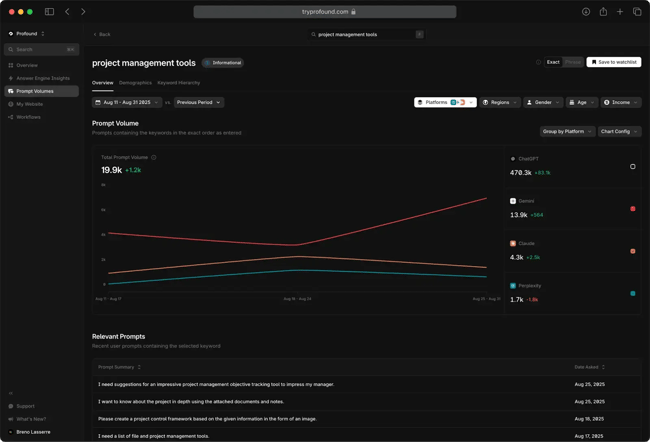
Profound provides agent tracking analytics, conversation analysis, and purchasing visibility. Its Answer Engine Insights monitors AI answers and citations across AI engines. Profound users can track up to 100 prompts (depending on the plan) and change them at any time.
Here’s a look at what the Prompt Volume tool looks like, exploring conversations around “project management tools”:
AthenaHQ’s analyzes are based on the proprietary company Query volume estimation model and real-time trend tracking. The advanced tier includes real-time trends, unlimited monthly response analysis, and full data history with custom export options. It’s more accessible to teams without dedicated analysts and displays prioritized recommendations instead of raw data.
Which platform wins? For teams deep into AI SEO, Profound’s analytical depth is unmatched. For teams that need a clearer solution to an AI best practice workflow, AthenaHQ helps them achieve faster results.
Content optimization and workflow tools
Profound’s workflow layer uncovers gaps between current content and what’s needed to increase citations using the AEO Content Score built from millions of the most cited pages. It’s powerful, but requires teams to be able to respond to detailed, data-intensive briefs.
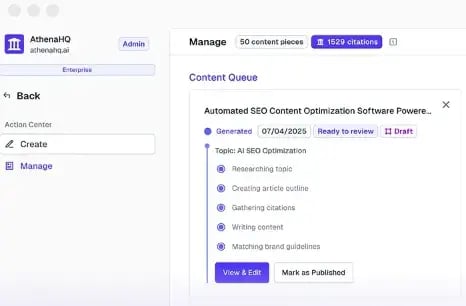
Athena AI offers content letter creation, optimization suggestions, and automated outreach. Its Action Center combines automated content production, unlimited outreach to influential third-party sources, and operational recommendations. In the Action Center, content teams can manage their workflow:
Who wins? Profound helps teams understand what content will win. AthenaHQ helps them produce it faster. Both AI tools will help content teams create the best content for Search Generative Experiences (SGE).
Monitoring brand sentiment and reputation
Profound’s advanced sentiment analysis and brand accuracy scoring are designed to detect misinformation, which is particularly important for enterprise brands where AI hallucinations about products or prices can cause real reputational damage. The time-stamped screenshot archive also creates an evidentiary record useful for compliance and reporting.
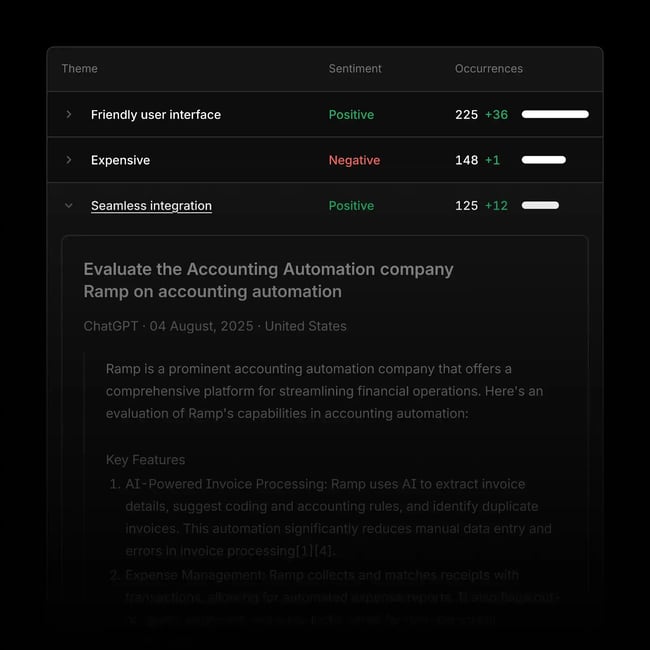
AthenaHQ measures brand sentiment, analyzes market trends, compares share of voice and identifies trending topics. Using Intelligent PR Search, the company also monitors brand reputation across news and social channels.
Who wins? For brand protection and compliance, Profound’s accuracy rating is a better solution. For growth and communications teams looking for an AI vibe integrated with PR and social media in one view, AthenaHQ is more intuitive to use in everyday life.
How to evaluate Profound vs. AthenaHQ for your growth stack
When choosing between tools, leadership should clarify which evaluation criteria are actually important to team and business goals. Here are three factors to consider when deciding whether one of the platforms will become a core part of a growth stack or an expensive subscription that the team will no longer sign up for.
Integrations and tech stack compatibility
Both platforms integrate with CRM, CMS and analytics tools, but in different ways. Profound’s integrations are primarily at the server and infrastructure level, connecting to Vercel, AWS, Cloudflare, and Google Analytics for data collection, rather than providing a direct connection to marketing workflows like a CRM. This makes Profound powerful for technical teams managing AI crawler data, but less plug-and-play for marketing ops teams living in their CRM every day.
AthenaHQ takes a more workflow-native approach to integration. Its platform includes unlimited seats, SSO/SAML, and white glove onboarding – a sign that it is designed for use with multiple teams in larger martech ecosystems.
Particularly for HubSpot-led growth teams, it’s worth thinking about what’s already built into the stack.
HubSpot Content Hub offers:
- SEO recommendations
- Features for creating AEO websites
- Content suggestions
Content Hub comes with built-in AI Breeze Content Assistantthat can design, expand and customize copy to ensure clarity and conversational tone, while automated SEO recommendations help ensure every asset is ready for both search and consumption by AI engines. When marketing teams combine Content Hub with HubSpot’s intelligent CRM, Marketing HubAnd Breeze AI SuiteGet a native AEO execution layer that works with every monitoring platform in the tech stack. HubSpot offers AI search graderSmart CRM, Marketing Hub, Content Hub and Breeze AI Suite to operationalize AEO.
For teams assessing the broader AEO tools landscape, the integration question often boils down to: Does marketing need a platform that feeds data? into it an existing stack or one that replaced Parts of it?
Prices and accessibility
Pricing is a key differentiator when comparing Profound vs. Athena AI for AEO. The cost of AI could easily help with the decision, as decisions are made when the budget simply isn’t enough for more expensive tools.
Profound’s pricing starts at $99/month for ChatGPT only, but for brands serious about AI, the Growth package costs $399/month. The platform’s most valuable features, including full AI model coverage and API access, are reserved for the growth plan.
Prices for AthenaHQ start at $95/month for the first month, then $295/month, and there is a credit-based system. The credit model offers flexibility, but can add up quickly as more prompts and AI answer engines are enabled beyond the base 3,500 credits.
For teams not yet ready to commit to either platform: HubSpot is free AEO Graders is a strong starting point. It analyzes a brand’s AI visibility, sentiment and competitive positioning on leading AI platforms – including GPT-4o, Perplexity and Gemini. The analysis shows how generative AI characterizes a brand when users ask questions about an industry, products or services. It won’t replace a full AEO platform, but it gives teams a clear starting point before investing.
Ease of use and learning curve
User feedback on Profound often describes the interface as data-intensive and unintuitive. Without a dedicated analyst, teams can quickly become overwhelmed by the amount of data the platform provides. Several reviewers also note recurring technical issues and a steep onboarding curve, both of which should be factored into the total cost of ownership beyond the subscription fee.
AthenaHQ is more accessible by design. Its Action Center displays prioritized recommendations instead of raw data, and its AI-generated suggestions are tailored fixes, content restructures, additional FAQs, schema changes, or strategic outreach, saving marketers from manually evaluating prompts and responses. For growth teams without dedicated data analysts, this guided workflow makes a real difference in adoption and time to value.
The honest summary: Teams with analysts skilled at interpreting multi-layered data sets will find that Profound’s depth rewards this investment. Teams that are leaner and need to move quickly from insights to results will find AthenaHQ offers a smoother path.
Which should you choose for AEO: Profound or AthenaHQ?
The right platform depends largely on where a company is located and what AEO is supposed to do for the company.
Startups should start lean. AthenaHQ’s lower entry price and guided workflow make it more accessible to small teams with limited analyst capacity. It’s also worth running HubSpot AEO Grader as a free basic version before committing to a paid platform.
Medium-sized teams With a growing content operation and moderate analytics maturity, AthenaHQ’s balance of visibility tracking and workflow automation will be a good fit. It connects insights to execution without requiring a data engineering layer, which is exactly what most mid-sized growth teams need from them Types and tools of AI agents.
Business organizations With compliance requirements, global audiences, and dedicated analytics resources, Profound earns its premium. Profound is designed specifically for enterprise brands that require cross-machine monitoring, programmatic AEO content workflows, SOC 2 compliance, and dedicated support with SSO. Its HIPAA compliance certification also makes it one of the few viable options for healthcare and life sciences brands operating in regulated environments.
Agencies I make a strong case for Profound’s agency growth plan, which includes pitch workstations and consolidated billing designed specifically for agencies selling AEO services, with 10 pitch workstations per month for new client acquisition and client workstations for ongoing management. AthenaHQ is also a viable agency option, particularly for those running mid-sized client programs that prioritize action over deep analysis.
International teams should put a lot of strain on the engine cover. Profound’s broader suite, including DeepSeek, Meta AI and regional LLMs, gives the company a significant advantage for brands with significant audience shares outside of English-speaking markets.
It is also worth checking out Xfunnel here as it is suitable for any organization. HubSpot was recently acquired Xfunnelan innovative platform that helps companies monitor, test and optimize AEO performance across LLM ecosystems, signaling a clear strategic direction towards native AEO capabilities within the HubSpot platform itself.
For teams already deeply embedded in the HubSpot ecosystem, integrating Xfunnel into the platform may reduce the need for a standalone AEO tool over time, especially in the mid-market.
Frequently Asked Questions about Profound vs. AthenaHQ for AEO:
How do Profound and AthenaHQ differ in their approach to measuring AI search visibility?
Profound measures visibility using comprehensive, multi-engine data – tracking share of voice, citation rate, and request volume across 10+ AI platforms for teams looking to crunch the numbers. AthenaHQ tracks the same core metrics, but displays them as prioritized recommendations, allowing for faster response but less granular raw output.
What are the unique features that differentiate Profound from AthenaHQ?
Profound’s standout USPs include Conversation Explorer (based on more than 400 million real user inputs), Agent Analytics with GA4 integration, Shopping Analysis for AI commerce visibility, and SOC 2 Type II compliance. These features have no direct equivalent in AthenaHQ and are designed specifically for enterprise teams with technical depth and compliance requirements.
Which tool is better for tracking brand sentiment across AI-generated responses?
Profound’s sentiment layer focuses on brand accuracy and misinformation detection – particularly for regulated industries or brands where AI hallucinations pose a real risk. AthenaHQ combines sentiment with PR and social monitoring in a single view, making it more practical for daily communications and growth teams.
Do Profound and AthenaHQ support integration with existing marketing technology stacks?
Both integrate with CRM, CMS and analytics tools, with Profound relying on infrastructure-level connections such as GA4, Cloudflare and AWS, while AthenaHQ offers easier multi-team deployment with SSO/SAML and unlimited seats in a single plan. For HubSpot users, both Content Hub and Breeze AI can complement – but neither replaces the native AEO features are already included in the HubSpot stack.
Choosing the right AEO platform for your growth stack
The choice between Profound and AthenaHQ for AEO comes down to one key question: Does the team need depth or speed to operate? Profound provides unparalleled analytical accuracy for enterprise teams and has the resources to act based on detailed data. AthenaHQ delivers faster time to value for growth teams that need insights and execution in one place. For teams already in the HubSpot ecosystem, the native AEO capabilities in Content Hub, Breeze AI, and the recently acquired Xfunnel platform offer a compelling third way – one that can reduce the need for a standalone tool over time.