As companies adapt to the new AEO landscape, marketers are seeing increasing convergence with marketing automation – HubSpot’s recent acquisition of Xfunnel signals this shift and brings AI search optimization directly into the CRM ecosystem, where attribution and revenue tracking take place.
Therefore, marketers need the right AEO tools to reach their target audience who are flocking to AI search engines. Two platforms that are gaining traction are Profound and Scrunch for AEO.
Both platforms have useful tools designed to increase discoverability and reach. But which of the two is best for your business? Read on for a breakdown of Profound vs. Scrunch for AEO and find out which one is best for you.

Table of contents
What is profound?
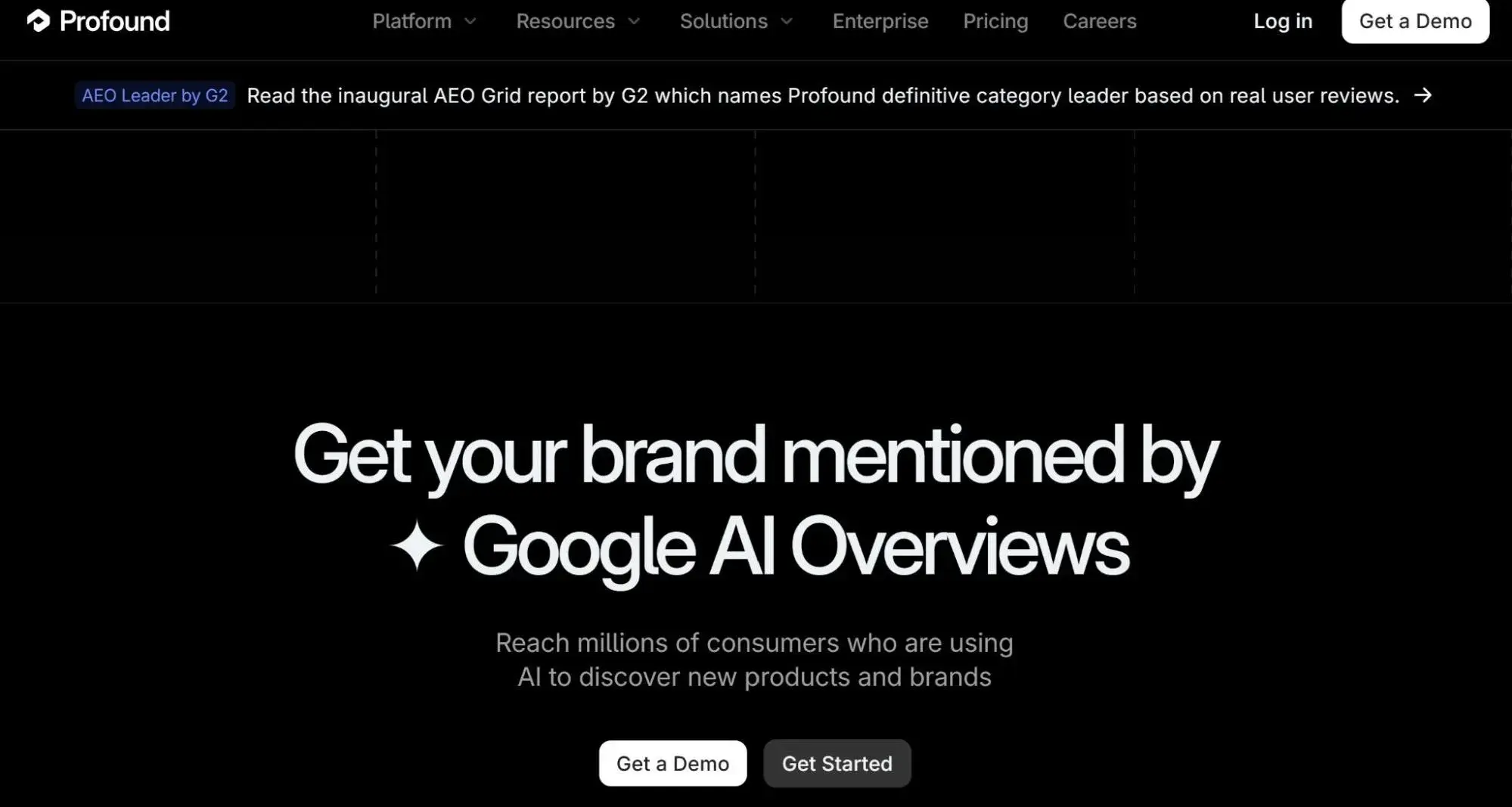
Profound is an enterprise-class response engine optimization platform that helps brands improve discoverability on AI-powered search engines such as ChatGPT, Perplexity, Claude and Google AI Overviews
Profound combines comprehensive monitoring across 9+ AI engines with powerful content creation tools called Agents, enabling teams to produce AI-optimized content at scale.
My research shows that Profound is particularly known for its Prompt Volumes feature – the first tool to reveal actual search volume data for AI conversations – and its dedicated ChatGPT shopping optimization features for eCommerce brands.
What is Scrunch?
Scrunch is an AI customer experience platform focused on technical optimization and helping brands control how AI agents interpret and cite their content. Instead of focusing on content creation, Scrunch identifies technical barriers that prevent AI crawlers from accessing your site, analyzes which sources AI engines prefer to cite, and provides actionable recommendations to improve visibility.
My favorite feature and fan favorite is the Agent Experience Platform (AXP), which creates parallel, AI-optimized versions of your web pages that are specifically designed for AI use – dramatically improving the effectiveness with which AI systems can process and reference your content.

Profound vs. Scrunch for AEO: Comparison at a glance
Here’s a general comparison I put together to help you quickly understand how Scrunch and Profound differ:
Profound
- Primary Strength: Content creation and production at scale
- Best suited for: Enterprise brands need to generate large amounts of AI-optimized content
- Outstanding features:
- Agent tool with dozens of AI-optimized content templates (listicles, guides, comparisons)
- Prompt volumes showing actual AI search demand by topic
- ChatGPT shopping optimization for eCommerce brands
- Monitoring across 9+ AI engines (ChatGPT, Perplexity, Claude, Gemini, Grok, Copilot, Meta AI, DeepSeek, Google AI Overviews)
- Implementation schedule: 4-6 weeks until the first improvements in vision
- Pricing model: $99/month for starter tier; $399/month for growth tier; Custom Enterprise Pricing
- Ideal customer: Large marketing teams with content production bottlenecks, e-commerce brands, and businesses that need quick volume forecasts
- Integration approach: Custom enterprise integrations with your content stack
Crunch
- Primary Strength: Experience in technical optimization and AI agents
- Best suited for: Organizations with strong existing content that requires technical optimization
- Outstanding features:
- Agent Experience Platform (AXP) creates AI-optimized parallel versions of web pages
- Real-time error detection to identify AI crawler problems
- Citation analysis showing which sources AI prefers
- Data API for seamless CRM and analytics integration
- Performance tracking by person, topic and geography
- Implementation schedule: 2-4 weeks until the first technical improvements
- Pricing model: For brands: $250/month for the Core tier and individual pricing for the Enterprise tier. For agencies: $500/month for the Core tier and individual pricing for the Enterprise tier.
- Ideal customer: Technical teams, companies with developer resources, brands that prioritize ROI efficiency and CRM integration
- Integration approach: Robust data API that enables custom integrations with HubSpot, Salesforce, and BI tools
The most important distinguishing features at a glance
|
Special feature |
Profound |
Crunch |
|
Content creation |
✅ Extensive (agent tool) |
⚠️ Limited focus |
|
Technical optimization |
⚠️ Basic (Agent Analytics) |
✅ Advanced (AXP + error detection) |
|
Browse volume data |
✅ Fast volumes |
❌ Not available |
|
CRM integration |
⚠️ Custom work required |
✅ Data API provided |
|
Free trial |
❌ No |
✅ 7 day trial |
|
E-commerce features |
✅ ChatGPT shopping |
⚠️ Limited |
|
Speed of implementation |
4-6 weeks |
2-4 weeks |
|
Best for budget |
Pursue |
From medium-sized businesses to companies |
Profound vs. Scrunch in comparison
Join me now as we take a deep dive into how these platforms stack up in terms of the features that matter most to marketers and SEO professionals.
AI visibility monitoring and dashboards
Profound’s approach: Profound’s Answer Engine Insights dashboard serves as a central hub for tracking brand visibility. The platform displays a primary visibility score that evolves over time, allowing you to see performance over 7-day, 30-day, or custom time periods.
The dashboard includes competitive benchmarking that shows your brand’s industry ranking compared to direct competitors with weekly performance trends for each company. Users can filter visibility data by AI model or region, making it easy to see where your brand is performing the strongest.
The platform saves screenshots of AI responses for audit trails and verification, which is valuable for proving citation patterns to stakeholders.
Scrunch’s approach: Scrunch organizes its monitoring around a clear, modern dashboard that emphasizes timely analysis. Instead of a single visibility score, Scrunch displays mention frequency, share-of-voice percentages, and sentiment analysis for each prompt tracked.
The platform excels at competitive benchmarking by displaying mentions of competitors in addition to AI answers, enabling direct head-to-head comparisons.
A standout feature is Scrunch’s real-time AI crawler feed, which shows exactly when AI bots visit your site, what pages they access, and traffic trends over time. This granular visibility helps technical teams identify crawling issues before they impact visibility.
The platform also offers robust filtering by topic, persona, funnel stage, AI model, and custom tags – making it extremely flexible for organizations with different tracking needs.
Winner for Monitoring: Scrunch is on the rise for teams that need detailed, timely insights and real-time crawler monitoring. Profound success for enterprise teams that want leadership-friendly visibility, assessment, and comprehensive screenshot documentation.
Prompt analytics and search volume data
Profound’s approach: Profound’s Prompt Volumes feature is truly revolutionary – it’s the first platform to expose actual search volume data for AI conversations.
Similar to how Google Keyword Planner shows monthly search volume, Prompt Volumes shows how frequently topics are discussed on ChatGPT, Perplexity, Copilot, and other platforms.
Prompt Volumes enables traditional SEO-style content planning, allowing you to prioritize topics based on demand rather than guesswork.
Conversation Explorer lets you drill deeper into specific prompts to see exactly how AI engines respond, with full-text extraction and context around your brand mentions. Users can customize prompts, turn off irrelevant ones, or add their own queries for tracking.
This flexibility is essential to tailor monitoring to your specific brand strategy and messaging priorities.
Scrunch’s approach: Scrunch takes a different approach to prompt analytics. Instead of providing volume estimates, the platform turns your keywords into synthetic tracking prompts. Therefore, you are not monitoring actual user queries, but rather structured questions that the system generates based on your industry and target keywords.
The Starter plan includes 1,000 pre-built industry prompts organized by topic, as well as 350 custom prompts that you can define. Each prompt runs on multiple AI platforms, with the system capturing complete answers, highlighting your brand mentions, and displaying competitor quotes in context.
Scrunch’s quick trend tracking shows which topics are gaining or losing momentum over time. However, user reviews indicate that the available trend data is somewhat limited compared to Profound’s volume insights.
Prompt winners: Profound clearly wins here. If forecasting search volume is critical to your content planning (and it is for most marketing teams), Prompt Volumes provides data you simply can’t get elsewhere.
Scrunch’s synthetic prompt approach is useful for monitoring, but it doesn’t answer the question “What’s the opportunity?” Questions.
Content creation and optimization
Profound’s approach: Profound’s Agents feature is a complete content production system designed for AI optimization. The platform offers dozens of templates, including listicles, how-to guides, comparison articles, and other formats proven to earn AI citations.
Each template is pre-optimized for AI understanding and includes structural elements that increase the likelihood that response engines will reference the content.
Agent Workflow lets you refine audience targeting, select specific topics and prompts to optimize, and create custom content pipelines that integrate with your existing CMS and workflow tools.
Human-in-the-loop checkpoints ensure quality control while significantly speeding up production. According to Profound’s positioning, teams can create AI-optimized content in minutes instead of weeks.
The platform also provides insights into optimizing existing content. However, some users report receiving a “No recommendations found” message, suggesting that the optimization guides are not always comprehensive for every item.
Scrunch’s approach: Scrunch explicitly focuses on content creation. Instead, the platform assumes that you have high-quality content and needs technical optimization to make it more accessible to AI systems.
The Insights module offers actionable recommendations such as “Update FAQ” or “Add Structured Data”, but these are more diagnostic than generative.
Scrunch’s Site Audit feature lets you examine individual URLs to see what AI bots see when they visit them, providing a content quality score and a checklist for improvements. However, manually checking individual pages is not scalable for brands with large websites.
The platform identifies content gaps and opportunities, but does not provide any tools to generate or edit the text – you have to export recommendations and use separate tools like ChatGPT or dedicated content platforms to create the optimized content.
Winner for Content: Profound dominates when content creation is a priority. Scrunch is better suited for teams with strong existing content that need technical insights rather than production support.
Technical optimization and crawler management
Profound’s approach: Profound’s Agent Analytics tool provides technical insight into how AI crawlers interact with your website. The platform integrates with major CDN providers (Cloudflare, Vercel, Netlify, Fastly, Akamai, Amazon CloudFront, GCP Cloud CDN, and WordPress) to track which AI bots access your content, when they visit it, and which pages they crawl most often.
The integration approach is particularly robust: Profound compares IP addresses with published ranges from OpenAI, Anthropic, Google and other providers to verify AI identity and ensure accurate attribution.
The platform provides technical analytics to ensure your website is optimized for AI indexing and retrieval, and the GA4 integration helps measure how many human visitors come from AI-driven search.
However, Profound does not provide the same level of proactive error detection or remediation guidance as technically focused platforms. The tool tells you what’s happening, but offers less concrete instructions on how to troubleshoot technical issues.
Scrunch’s approach: This is where scrunch really shines. The platform’s error detection feature automatically detects when AI bots are unable to properly crawl your website and provides specific, actionable recommendations to resolve the issues.
Instead of general advice, Scrunch shows exactly which technical barriers are blocking AI visibility – be they JavaScript rendering issues, robots.txt misconfigurations, or page speed issues.
The real-time AI crawler feed is particularly valuable for technical teams. You can see a live log of bot visits, including the specific URLs accessed from platforms such as Anthropic (Claude), Perplexity, and OpenAI (ChatGPT).
The system categorizes visits into segments such as “Citations,” “Training,” and “Indexing,” helping teams understand domain activity patterns and prioritize optimization efforts.
The Agent Experience Platform (AXP) is Scrunch’s most sophisticated feature. AXP sits on your CDN layer (typically Cloudflare) and automatically detects AI bot traffic. When an AI crawler visits, AXP serves an optimized, code-light version of your page, often reducing the file size by 98% (from 263KB to 4.4KB in Scrunch’s example).
This “shadow site” approach significantly improves the effectiveness with which AI systems can process and reference your content without requiring you to rewrite your human-facing website.
Winner for technology: Scrunch clearly wins when it comes to technical optimization. The combination of error detection, real-time crawler monitoring and the groundbreaking AXP makes it the clear choice for technically demanding teams.
Profound’s agent analytics are solid, but don’t come close to the depth of Scrunch.
Quote analysis and competitive intelligence
Profound’s approach: Profound’s quote tracking shows which external websites AI engines link to when they mention your brand or industry topics. The platform displays citation patterns of all monitored AI engines and helps you understand which domains have the most authority among AI systems.
This information is valuable for link building strategy and understanding content partnerships that could increase visibility.
The competitive benchmarking module shows your brand’s visibility score compared to direct competitors, with weekly trend data showing who is gaining or losing ground. Users can apply filters to view competitive data for specific AI models or regions.
The platform also offers sentiment analysis that shows whether AI mentions are positive, neutral or negative.
Scrunch’s approach: Scrunch excels at detailed citation analysis. Instead of just showing the total number of citations, the platform displays the actual AI responses with highlighted brand mentions, surrounding context, and sources cited by the AI.
You’ll see competitor mentions in the same answers, allowing for an accurate side-by-side comparison.
The Competitive Insights Dashboard shows share of voice percentages for each prompt tracked, showing exactly where your competitors are outperforming you.
Scrunch’s persona-based analysis is particularly sophisticated – you can track how AI presents your brand to different audience segments (CTOs vs. developers vs. IT managers) and identify visibility gaps for specific personas that would miss generic tracking.
The platform’s citation analysis shows which websites AI likes to cite in your industry, helping to inform both content strategy and link building priorities. According to customer reports, companies like BairesDev used these insights to go “from invisible to cited right alongside the biggest players” in just a few weeks.
Winners for quotes: Scrunch provides more actionable citation information with its context-rich responses and persona-based segmentation. Profound offers solid competitive benchmarking, but with less granular detail.
E-commerce and shopping optimization
Profound’s approach: Profound is the only core AEO platform with dedicated ChatGPT shopping optimization features. With the rise of AI-powered shopping experiences (ChatGPT now displays shopping tiles for product queries), this feature is becoming increasingly valuable for eCommerce brands.
The Shopping feature tracks how your products appear in ChatGPT shopping results, monitors shopping triggers (keywords that trigger ChatGPT to display shopping tiles), analyzes response patterns in which your products are featured, and provides product-level analytics including visibility, retailers, and reviews. For eCommerce brands, this specialized functionality alone could justify the cost of the platform.
Scrunch’s approach: According to user reviews, Scrunch has “strong e-commerce features that allow you to track how specific SKUs appear in ChatGPT responses.” However, the platform doesn’t place as much emphasis on purchasing optimization as Profound, and specific purchasing features aren’t highlighted in Scrunch’s marketing materials or documentation.
The standard monitoring and citation analysis features work for eCommerce brands tracking product mentions, but lack the specialized shopping-specific insights that Profound provides.
E-commerce winner: Profound successes critical for eCommerce brands focused on AI shopping optimization. If ChatGPT Shopping visibility is a priority, Profound is currently the only option for businesses with purpose-built features.
Integration options and data access
Profound’s approach: Profound values integration into your existing content tech stack. The platform’s agent functionality can be connected to your CMS, content scheduling tools, and publishing workflows.
For enterprise deployments, Profound supports custom integrations with dedicated CSM support to coordinate implementation across content, SEO, and IT teams.
The platform includes GA4 integration to map AI search traffic and conversions to actual business results. However, CRM integration is not highlighted and typically requires custom API work.
According to our analysis, HubSpot users should plan 20 to 40 hours for initial integration work to connect Profound data to HubSpot properties and workflows, and 5 to 10 hours per month for ongoing maintenance.
Data export options include standard report formats. However, some users note that exporting data for external analysis can be challenging – a common complaint in user reviews about workflow limitations.
Scrunch’s approach: Scrunch’s data API is a key differentiator. The platform offers robust API access specifically designed to integrate with CRMs, BI tools and custom dashboards, enabling:
- Create custom HubSpot properties for AI visibility scores by contact company
- Create Salesforce dashboards that show rapid performance by opportunity
- Transfer data to internal analytics platforms like Looker or Tableau
- Set up webhook-based triggers for marketing automation workflows
The API approach provides technical teams with maximum flexibility to build sophisticated attribution models and link AEO performance to downstream business metrics. Scrunch also supports standard data exports (CSV, Sheets) that integrate with Looker Studio and existing report stacks.
Specifically for HubSpot users, the Data API makes implementation easier than Profound’s custom approach – initial setup typically requires 10 to 20 hours instead of 20 to 40 hours.
Winner for integration: Scrunch wins for companies with technical resources or marketing operations teams that can leverage the data API. Profound is better suited for teams that want top-notch enterprise integration support but are willing to invest more time and resources.
The HubSpot Advantage: With the takeover of XfunnelHubSpot makes AEO a first-class citizen in its platform ecosystem. This integration means marketers can ultimately track AI visibility, prompt performance and citation data alongside traditional channel metrics – all within a unified attribution model.
While both Profound and Scrunch offer integration options, XfunnelHubSpot’s native integration (now part of the HubSpot platform) provides the most seamless way to connect AEO performance to closed revenue.
For HubSpot customers, this acquisition means AI search optimization will become as integral a part of your marketing stack as email or SEO.
User experience and learning curve
Profound’s approach: Profound’s interface prioritizes comprehensive data analysis over a simplified user experience. The platform is data intensive and has sophisticated dashboards that require an investment to master.
User reviews consistently mention a “steep learning curve,” with some describing the interface as “overwhelming” for new users.
However, with this complexity comes power. The platform offers highly customizable dashboards and reports tailored to specific brand needs, allowing advanced users to create personalized views that highlight their most important metrics. For teams willing to invest the time to learn, Profound becomes a robust analytics engine.
The platform’s rapid feature releases mean that the interface evolves frequently. While this demonstrates product innovation, it also means teams must continually adapt to new capabilities. Enterprise customers receive premium support via email or Slack to help them navigate complexities.
Scrunch’s approach: Scrunch consistently receives praise for its clean, modern, and intuitive interface. User reviews highlight fast onboarding with guided setup for prompts, competitors, and brand configuration. Navigation is straightforward and features clear dashboards that make tracking brand presence accessible even to team members without extensive technical knowledge.
The excellent filtering features (by topic, persona, stage, model, and custom tags) are easy to use and don’t need to be buried in complex menus. The organization at the prompt level makes the platform flexible without appearing confusing. According to reviews, the platform’s “intuitive interface” means that “the dashboard is easy to navigate despite its technical backend for day-to-day management.”
The main UX limitation noted in reviews is that while Scrunch identifies great optimization opportunities, the interface doesn’t guide you to fix gaps as comprehensively as some users would like. The insights are there, but feel “underdeveloped compared to the sophisticated monitoring dashboards.”
Winner for UX: Scrunch wins crucially for the user experience. If team adoption and day-to-day usability are important (and they should be), Scrunch’s intuitive interface significantly reduces the learning curve. Profound is better suited for power users who value customization over ease of use.
Platform coverage and geographic support
Profound reporting:
- AI engines: ChatGPT, Perplexity, Claude, Gemini, Grok, Microsoft Copilot, Meta AI, DeepSeek, Google AI Overviews (9 platforms)
- Geographic support: Multi-region tracking for enterprise deployments
- Language support: Not explicitly specified, but implied by global deployment
- Update frequency: Real-time monitoring with continuous updates
Scrunch’s coverage:
- AI engines: ChatGPT, Claude, Perplexity, Gemini, Google AI Mode, Google AI Overviews, Meta AI (7+ platforms)
- Geographical support: Persona-based tracking includes geographical parameters
- Language support: Multilingualism for global brands
- Update frequency: System updates every three days
Winner for Coverage: Profound has a slight lead in total number of AI engines (9 vs. 7+), which is particularly valuable as newer engines like DeepSeek and Grok become increasingly popular. Both platforms cover the major search engines that drive the most AI search volume.
Support, security and compliance
Profound Enterprise Readiness:
- SOC 2 Type II compliant with an independent audit
- Single Sign-On (SSO) via SAML or OIDC
- Daily automated backups are retained for one week
- Premium support via email or Slack with a dedicated enterprise CSM
- Role-based access controls
- Enterprise-focused security posture tailored to the needs of the Fortune 500
Scrunch’s Corporate Readiness:
- SOC 2 Type II compliant with an independent audit
- Role-based access control (RBAC) for granular permissions
- Global deployment capabilities in all regions
- Data API security with careful key management requirements
- Business support with a rapid product development cycle
- AXP security considerations for AI-specific content delivery
Enterprise Security Winner: Both platforms meet enterprise security requirements with SOC 2 Type II compliance. Profound is slightly ahead with explicit SSO support and Fortune 500 positioning, while Scrunch offers a more granular RBAC for complex team structures.
What should you choose for AEO: Profound or Scrunch?
Both Profound and Scrunch have unique properties that make them excellent tools for improving AEO strategies. However, which one is best for your strategy depends primarily on your budget and where your company is on the journey.
Early-stage startups on a tight budget should choose Scrunch as it is the most budget-friendly option compared to Profound and is much easier to set up thanks to the intuitive user experience. Scrunch also offers robust citation-focused analytics, making it the best option for teams looking to quickly increase AI citation mentions.
However, if your business is growing quickly and you need enterprise-level analytics and comprehensive brand sentiment tracking, Profound is the right platform for you. Profound offers deeper AI agent analysis, more tools, and longer data retention than Scrunch.
Frequently asked questions about Profound vs. Scrunch for AEO
What is the main difference between Profound and Scrunch for response engine optimization?
The main difference between Profound and Scrunch lies in their core approach to AEO: Profound is a content creation powerhouse designed to scale the production of AI-optimized content, while Scrunch is a technical optimization specialist focused on making existing content more accessible to AI systems.
Profound’s standout feature is its agent tool, with dozens of templates for generating listicles, comparisons and how-tos, as well as prompt volumes that uncover real AI search needs – making it ideal for teams with content production bottlenecks.
Scrunch excels in technical infrastructure, with its Agent Experience Platform (AXP) building AI-optimized “shadow pages,” real-time error detection, and a robust data API for CRM integration – perfect for technically demanding teams with strong existing content.
In terms of accessibility, Profound requires enterprise pricing and individual sales advice, while Scrunch offers transparent pricing with a 7-day free trial. Think of it this way: choose Profound when you need to create more content, and Scrunch when you need to optimize what you already have.
What AI engines and platforms do Profound and Scrunch pursue?
Profound monitors 9 major AI platforms:
- ChatGPT
- confusion
- Claude
- Gemini
- Grok
- Microsoft Copilot
- Meta AI
- DeepSeek
- Google AI overviews
Scrunch tracks at least 7 platforms including:
- ChatGPT
- Claude
- confusion
- Gemini
- Google AI mode
- Google AI overviews
- Meta AI
Both platforms cover the major AI engines that account for the majority of AI search volume. Still, I’d say Profound has a slight edge in total platforms, especially with newer engines like DeepSeek and Grok.
What is Scrunch’s Agent Experience Platform (AXP) and does Profound offer something similar?
Scrunch’s Agent Experience Platform (AXP) automatically detects AI bot traffic. It provides you with a parallel, AI-optimized version of your pages – reducing file sizes by up to 98% to dramatically improve the way AI systems process and cite your content.
This “shadow site” approach solves technical crawling problems without altering your human website. Profound does not have a comparable function; Instead, it offers Agent Analytics, which monitors AI crawler activity and tracks which bots visit your website, but does not provide optimized content specifically for AI agents.
Do Profound and Scrunch help with content creation and optimization?
Profound excels at creating content with its agent feature, which provides dozens of AI-optimized templates (listicles, guides, comparisons) and enables teams to generate content at scale with human-in-the-loop checkpoints and custom pipeline integration into your CMS.
Designed specifically to solve content production bottlenecks, the platform can help teams create AI-optimized content in minutes rather than weeks. Scrunch takes the opposite approach – it assumes you already have high-quality content and focuses on technical optimization rather than creation.
Scrunch identifies optimization opportunities through error detection and site audits (providing recommendations such as “update FAQ” or “add structured data”). Still, it doesn’t offer any tools for generating or editing content – you’ll have to use separate tools like ChatGPT or content platforms to implement the recommendations.
If content creation is your primary concern, Profound is the clear choice. If you have strong existing content that needs technical optimization, Scrunch is a better solution.
Which tool is easier to set up and use for teams without dedicated AEO specialists?
Profound excels at creating content with its agent feature, which provides dozens of AI-optimized templates (listicles, guides, comparisons) and enables teams to generate content at scale with human-in-the-loop checkpoints and custom pipeline integration into your CMS.
Designed specifically to solve content production bottlenecks, the platform can help teams create AI-optimized content in minutes rather than weeks. Scrunch takes the opposite approach – it assumes you already have high-quality content and focuses on technical optimization rather than creation.
Scrunch identifies optimization opportunities through error detection and site audits (providing recommendations such as “update FAQ” or “add structured data”). Still, it doesn’t offer any tools for generating or editing content – you’ll have to use separate tools like ChatGPT or content platforms to implement the recommendations.
If content creation is your primary concern, Profound is the clear choice. If you have strong existing content that needs technical optimization, Scrunch is a better solution.