
For years, SEO followed a fairly predictable formula: create valuable content, optimize for search engines, and compete for rankings on Google. But the way people find information online is changing rapidly. Tools like ChatGPT, Perplexity and Gemini introduce a new layer between users and search engines where answers are generated and synthesized, not just retrieved.
In a recent episode of the Get Discovered podcast, Joe Walsh, CEO of Prerender.io, spoke Yoast’s main architect Alain Schlesser to discuss what this shift means for SEO and online discoverability. Their conversation is about how AI answer engines are changing the search landscape and why many traditional SEO assumptions no longer fully apply.
Alain shares insights:
- How AI systems retrieve information and bring it to the surface
- Why brands need to rethink their online positioning and
- What should companies prepare for as AI-powered discovery evolves over the next 12 to 18 months?
Watch the full conversation between Joe Walsh and Yoast’s lead architect Alain Schlesser on the Get Discovered podcast below.
The new level of discovery: AI becomes the gatekeeper
“There is now a pre-search layer that acts as a gatekeeper before you even access these search engines.”
This is how Alain describes one of the biggest structural changes taking place in online discovery today. For years, the search process was straightforward: a user entered a search term into a search engine, the search engine returned a list of results, and the user decided which link to click.
But AI-powered systems have added a new layer to this process.
From search queries to conversational discovery
Today, many users begin their search journey by asking questions in tools like ChatGPT, Perplexity, or Gemini instead of typing traditional keyword queries. The AI system then determines whether it needs external information and may generate multiple search queries behind the scenes to retrieve relevant sources.
The discovery flow now looks something like this:
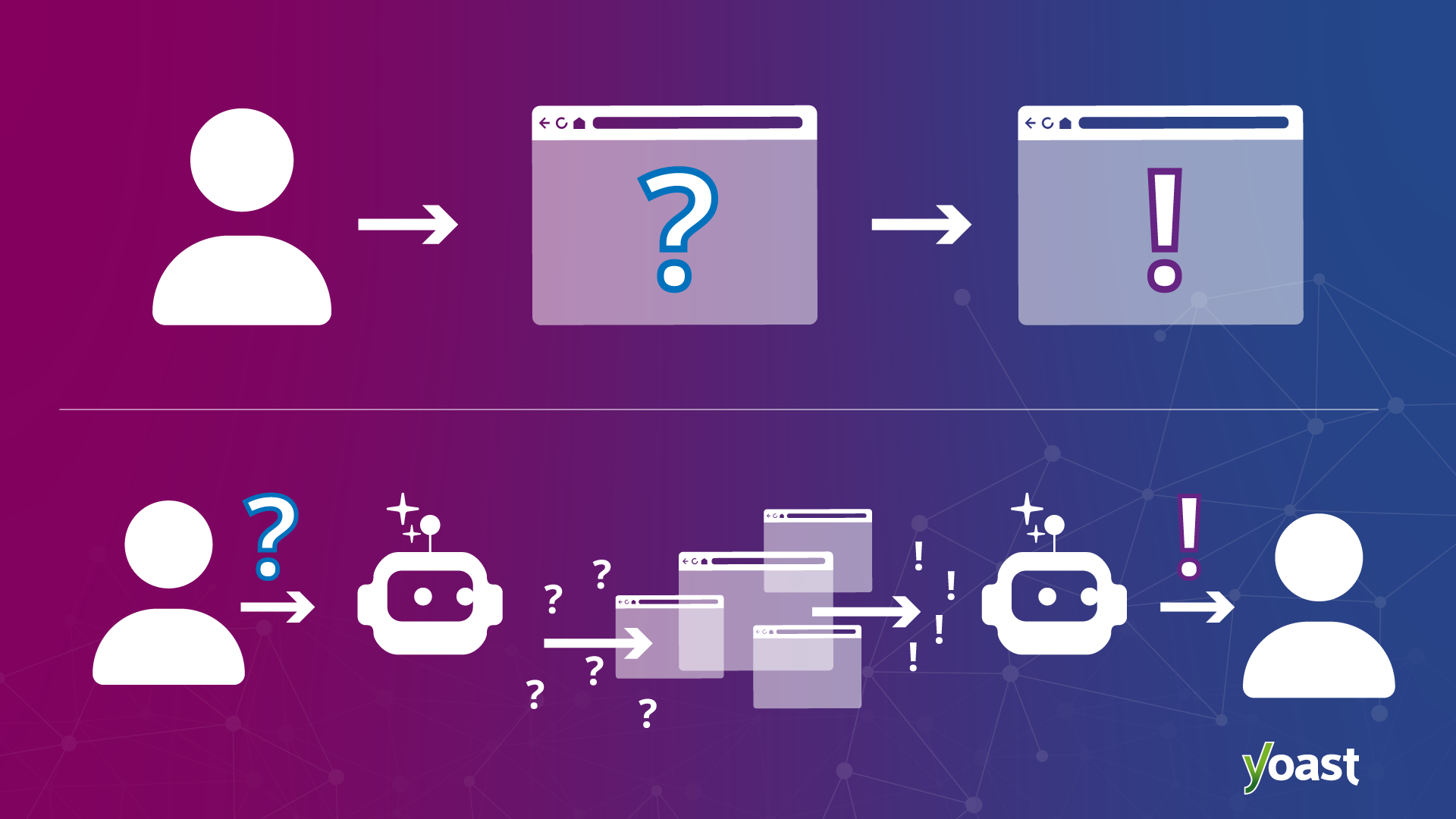
Previously:
User → Search Engine → Website
Now:
Users → AI model → Search engine → Website → AI synthesis → Users
Instead of displaying a list of links, the AI model interprets and combines information before generating a response. Alain explains this process in more detail in the podcast, highlighting how AI systems now act as a filter layer between users and the web.
Search is fragmenting beyond Google
“We were in a pretty comfortable situation where all we cared about was finding a monopoly.”
For the past two decades, SEO has mostly meant optimizing for one ecosystem: Google. Even though there were other search engines, Google dominated the way people searched for information online.
But this environment is changing.
As Alain explains, AI systems introduce a new level of fragmentation in discovery. Different AI platforms rely on different combinations of search engines, indexes and training data, meaning results can vary widely between them.
In practice, this means that a brand can appear prominently in one AI system while barely appearing in another. For SEO teams, this means a shift towards visibility across multiple AI-driven environments rather than just a single search engine.
Proceed to checkout: Why is it important for brand visibility to have insights into multiple LLMs?
What hasn’t changed: The basics of SEO
Despite technological changes, Alain emphasizes that the basic principles of good search engine optimization remain intact.
“You shouldn’t try to trick the search engine. You need to create valuable content that people actually want to read and structure it in a way that search engines can understand.”
At its core, search still aims to provide users with the best possible answers. Whether the request comes from a person entering a query or an AI model generating a query behind the scenes, the goal remains the same: providing useful, reliable information.
This means SEO teams should continue to focus on basics like:
AI systems may be changing the way information comes to light, but they still rely on the same underlying signals of quality and relevance.
The “top results or nothing” reality
As the discovery landscape continues to evolve, another important shift is emerging in the way AI systems interact with search results.
“You don’t see the full search results page. What the LLM typically sees are just the top five items per search query.”
Unlike human users, AI systems typically work with a very small set of retrieved sources before generating a response. This means that if your content doesn’t appear in the top results, it may not reach the AI system at all.
In a world where AI answers rely on aggregating modern content, only the sources that make it into this small retrieval window will influence the final answer.
Therefore, strong search visibility is more important than ever. Ranking well is no longer just about earning clicks. It determines whether your content is even considered when AI systems construct a response.
Why “safe” content strategies are no longer enough
Even if your content reaches these top results, there is another layer of filtering taking place in the AI model itself.
Large language models compress enormous amounts of information during training. As Alain explains:
What the model retains are the dominant signal and the outliers. Everything in between is often compressed as statistical noise.
In the podcast, Alain uses this idea to explain why brands that try to be universally acceptable or “safe” may struggle to stand out in AI-driven discovery.
The insight is clear: in a world where AI systems summarize and compress information, a clear and unambiguous perspective is becoming increasingly important.
Why Yoast introduced AI visibility tracking
As AI systems change the way information is discovered and summarized, a new challenge arises for companies: understanding how their brand appears in AI-generated responses. This is exactly the problem Yoast wanted to address with Yoast SEO AI+, a feature designed to help companies monitor how their brand appears on major AI platforms.
At the beginning of this article, we examined how AI systems today stand between users and search engines, retrieving only a small set of results and synthesizing answers by aggregating modern content. Taken together, these changes create a new level of discovery that is far less transparent than traditional search.
As Alain explains in the podcast:
“We need more visibility and observability in that AI-based layer to figure out what’s going on there. Right now it’s largely a black box.”
Unlike traditional search engines, AI systems do not provide clear rankings, impressions, or click data that explain why a source was chosen. Instead, answers are generated from a mix of retrieved content, training data, and model reasoning. This makes it much more difficult for companies to understand whether their brand is visible in AI-driven recognition.
This is where AI visibility tracking becomes valuable. Instead of just focusing on search rankings, teams also need insights into how their brand is represented in AI responses.
Yoast SEO AI+ helps bring visibility to this layer by allowing teams to monitor how their brand appears in AI systems like ChatGPT, Perplexity, and Gemini.
Must Read: What is ChatGPT Search (and how does it use Bing data)?
The goal is not simply to track a different metric. It is intended to help companies understand how AI systems interpret and represent their brand.
As Alain notes, visibility in AI systems can vary significantly depending on the platform, as each relies on different combinations of the following:
- Search engines
- Indices
- Training datasets
This means that a brand may appear frequently in one AI system but rarely in another. Without visibility into these differences, it will be difficult for teams to understand how their content performs in the new discovery landscape.
With this in mind, tools like Yoast SEO AI+ are less about selling a new SEO feature and more about helping businesses monitor a rapidly changing ecosystem where discoverability no longer just happens in search results.
The next evolution: AI agents make decisions
“What we will increasingly see are automated transactions where AI agents navigate websites and take actions on behalf of users.”
To date, much of the discussion around AI and search has focused on how answers are generated. But according to Alain, the next phase of this development could go even further.
In the next 12 to 18 months, AI systems may move beyond answering questions to performing tasks on behalf of users. Instead of guiding someone to a website to make a decision, AI agents could increasingly compare options, interact with websites and carry out actions automatically.
If this shift occurs, the traditional customer journey could change significantly. In the full podcast conversation, Alain shares a fascinating perspective on what this could mean for businesses in the coming years.
SEO is more important than ever
AI does not replace SEO. If anything, it highlights why good SEO matters in the first place. What is changing is the path between users and content. Instead of navigating search results themselves, users are increasingly receiving answers that AI systems retrieve, interpret and synthesize.
That’s why strong fundamentals are more important than ever. Companies must continue to focus on:
- valuable content
- clear structure
- discoverable and indexable pages
- a distinctive brand identity
But the central question for SEO continues to evolve. It’s no longer just:
“Can Google find my website?”
It is now:
“Does the AI have a reason to remember my brand?”
Find more insights from Alain Schlesser on how AI is changing SEO here Get Discovered podcast episode.
