
You saw it with your own eyes, dear reader. The way shoppers discover brands is changing faster than most marketing teams realize.
But the audience is not quite disappear. However, it’s about a channel where your brand is either mentioned in the response or is completely invisible.
This channel is Generative Engine Optimization (GEO). This is about structuring your content and brand presence in a way that AI platforms like ChatGPT, Google AI overviews, confusionAnd Gemini can accurately understand, quote and recommend you in your answers. GEO differs from traditional SEO in that it prioritizes structured data and machine-friendly content over link-based rankings, but it does not replace your SEO investment. It reinforces it.
Still, many marketing teams hesitate—unsure how to measure AI visibility, uncertain about implementation, or afraid of risks like AI hallucinations. Hell, you could be one of them.
Luckily for you, this post breaks down six benefits of generative engine optimization that are making a tangible, measurable difference for marketers right now, along with the data behind them and the practical steps to start capturing them.
Let’s dive in.
Why the ROI of generative engine optimization is higher than ever
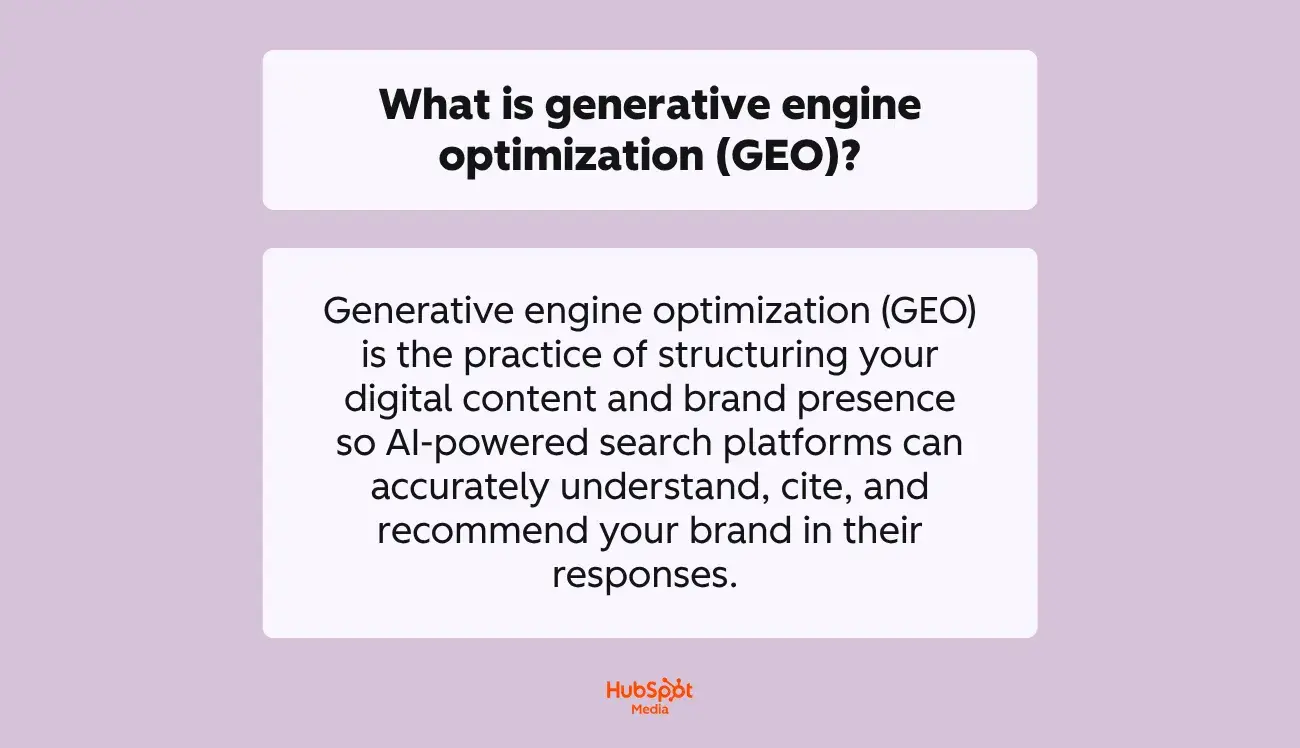
Generative search engine optimization (GEO) structures your digital content and brand presence so that GEO platforms (e.g. ChatGPT, Google AI Overviews, Perplexity, Gemini) can accurately understand, cite, and recommend your brand in their responses.
For marketers looking to future-proof their organic visibility, GEO differs from traditional SEO in that it prioritizes structured data and machine-friendly content over purely link-based rankings. But here’s what’s most important for marketing strategists when making investment decisions: GEO does not replace SEO. It reinforces it.
Data from HubSpot’s State of Marketing Report 2026 explains that almost half of marketers (49%) agree that search web traffic has declined due to AI answers. However, 58% Note that AI recommendation traffic has much higher intent than traditional search.
Where GEO and SEO differ (and where they converge)
Marketers benefit from increased AI search visibility, improved lead quality, and stronger brand engagement when they view GEO and SEO as complementary rather than competing strategies.
For reference, I’ve created a comparison below that breaks down the key dimensions:
The advantages of generative engine optimization are obvious:
- Traffic with higher intent
- Stronger conversion
- Brand integration into the fastest growing discovery channel in marketing
But the challenges of generative engine optimization are also real. Accordingly current data from SEO Sandwitch, 67% of digital marketers say GEO tracking is more complex. New measuring frames are required; Traditional metrics like rankings and CTR don’t capture what matters to GEO:
- Citation frequency
- AI Share of Voice
- Brand sentiment in generated responses
Without structured data and schema markup, AI engines cannot reliably understand or cite your content, increasing the risk of brand misrepresentation or complete invisibility.
Pro tip: HubSpot’s AEO Grader measures brand visibility in AI search engines by evaluating your brand across five scored dimensions. It’s free, doesn’t require an account, and provides a scored baseline that you can use to compare with the competition and track improvement over time.
How to put GEO into practice (without the guesswork)
Structured data and schema markup help AI engines understand and cite your content. Still, implementation remains one of the biggest obstacles marketing teams face when adopting GEO.
Here’s what high-performing GEO practitioners are doing now:
- Publish content in Q&A and direct response format. FAQs are the most commonly cited format by generative engines because they correspond to the way users query answer engines.
- Add FAQ, HowTo and Product Schema to high-quality pages. These structured markup types provide AI with a machine-readable map of the claims, relationships, and context of your content.
- Build entity authority beyond your own domain. AI engines rely on third-party sources (e.g. press reports, analyst reports, rating platforms and industry publications). The more your brand appears in authoritative external contexts, the more likely it is to be cited.
- Provide clear origin and provenance. Content with specific statistics, expert quotes, and cited sources are referenced more often in AI answers. EEAT signals (experience, expertise, authority, trustworthiness) carry even more weight with GEO than with traditional search engine optimization.
- Track and iterate. Run your AEO baseline at least monthly. AI models are regularly updated, training data shifts, and your competitors are also optimizing.
However, the trade-offs in adopting GEO are real obstacles. They are as follows:
- Complexity of measurement
- Schema learning curve
- There is a risk of an AI hallucination misrepresenting your brand
But they can also be solved with the right frameworks. In the next section, I’ll go into detail about how to do __.
Top Benefits of Generative Engine Optimization for Marketers
Generative Engine Optimization (GEO) enables brands to appear in search results and conversational responses – a level of visibility that traditional SEO alone can no longer guarantee.
But, dear reader, I assure you: there Is Light at the other end of the tunnel.
Here are the most impactful benefits marketers gain from a conscious GEO strategy:
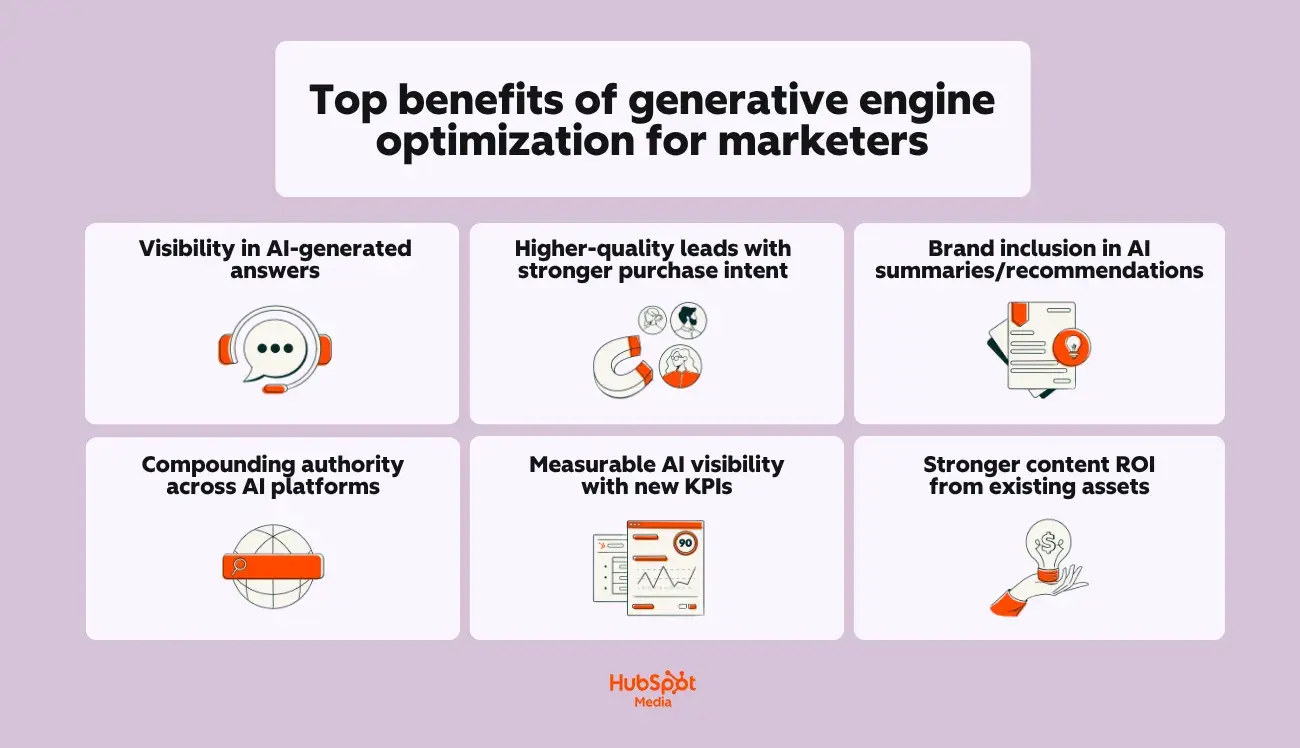
1. Visibility in AI-generated responses
The most immediate benefit of GEO is its presence where it matters most: within the AI-generated response itself. When a prospect asks ChatGPT or Perplexity, “What is the best CRM for remote teams?” and your brand appears in that response, you’ve reached that buyer at the moment of highest intent (without competing for a click in a list of ten blue links).
This is important because, how HubSpot’s State of Marketing Report 2026 Notes, almost 24% are considering updating their SEO strategy for generative AI in search (e.g. ChatGPT, Gemini, Claude).
Therefore, as Semrush shared in this article about the impact of AI search on SEO trafficThe marketers already investing in GEO are capturing higher-intent traffic that converts 4.4x faster than traditional organic search, proving that GEO isn’t a speculative bet on the future – it’s a measurable revenue benefit available now.
2. Higher lead quality with stronger purchase intent
AI-powered traffic not only increases volume but also leads to better results.
Visitors arriving via response engines have already taken in context about your product, compared alternatives, and formed an initial opinion before they even click on your website.
Furthermore, current data confirms this:
For marketing strategists managing pipeline goals, this conversion benefit means GEO doesn’t just expand the top of the funnel; it compresses the path from discovery to decision.
3. Incorporate the brand into AI summaries and recommendations
Generative engines do not organize websites into a list. Conversely, they summarize information from multiple sources and present a curated answer.
When your brand is included in this synthesis (cited alongside or ahead of the competition), it signals authority and trust to the buyer reading this response.
But unfortunately the recording is not automatic (at least not yet). The top 50 brands account for a disproportionate share of AI citations, and the brands that receive these mentions are those that proactively provide:
- Structured data
- Reliable third-party coverage
- Entity-rich content that AI engines can analyze and trust
4. Summary authority across all AI platforms
One of the most underrated GEO benefits is how citation authority increases over time, similar to how domain authority works in traditional SEO, but across multiple AI platforms simultaneously.
When your content is cited in ChatGPT, the same authority signals strengthen your presence in Perplexity, Gemini, and Google AI Overviews.
AI models rely on overlapping training data and real-time retrieval sources. So if a brand wants to create a citation flywheel that reinforces itself on every platform, it needs to build entity authority through:
- Published Research
- Case studies
- Expert Bylines
- Consistent third party mentions
5. Measurable AI visibility with new KPIs
A common concern for marketing teams evaluating GEO is measurement uncertainty (also known as one of). the most (Frequently mentioned challenges in generative engine optimization).
You see, dear reader, traditional metrics like rankings, impressions, and CTR do not capture how AI engines represent your brand in generated responses. But unfortunately there is good news: There are now special measuring frames.
However, KPIs that are important at GEO include:
- Citation frequency (how often your brand appears in AI responses to target queries)
- AI Share of Voice (your percentage of total category mentions in ChatGPT, Perplexity, and Gemini)
- Brand sentiment (whether AI characterizes you positively, negatively or neutrally)
- Source quality (which domains AI points to when mentioning your brand)
- Conversion from AI traffic (revenue and pipeline attribution from response engine referrals)
6. Higher content ROI from existing assets
Ready for more GEO good news? Here it is: GEO doesn’t require starting from scratch.
The content that performs best in AI citations is already ranking well in traditional search. This means that your highest ROI GEO step is to optimize the content you already have.
Restructure all existing blog posts, guides, and product pages with:
- Formatting direct answers
- FAQ schema
- Clear origin
- An entity-rich language can unlock AI visibility of assets your team has already invested in creating
Next, let’s talk about what makes GEO difficult – and how to fix it.
Common challenges in generative engine optimization
The benefits of GEO are well documented, but are often oversimplified to understand how GEO actually works.
In plain language, GEO simply means:
- Higher conversion rate traffic
- Brand integration into AI responses
- Increased visibility benefit
However, to realize these benefits, a number of challenges must be overcome that are fundamentally different from those of traditional search engine optimization. You see, dear reader, many of the challenges marketers face in generative engine optimization are not about content quality. In contrast, it is about:
- Data structure
- Clarity of entity
- Measurement infrastructure
- Risks that traditional search never entailed
To help you navigate this change, I’ve compiled a list of the most common GEO obstacles and the practical solutions to each of these obstacles.
Take a look:
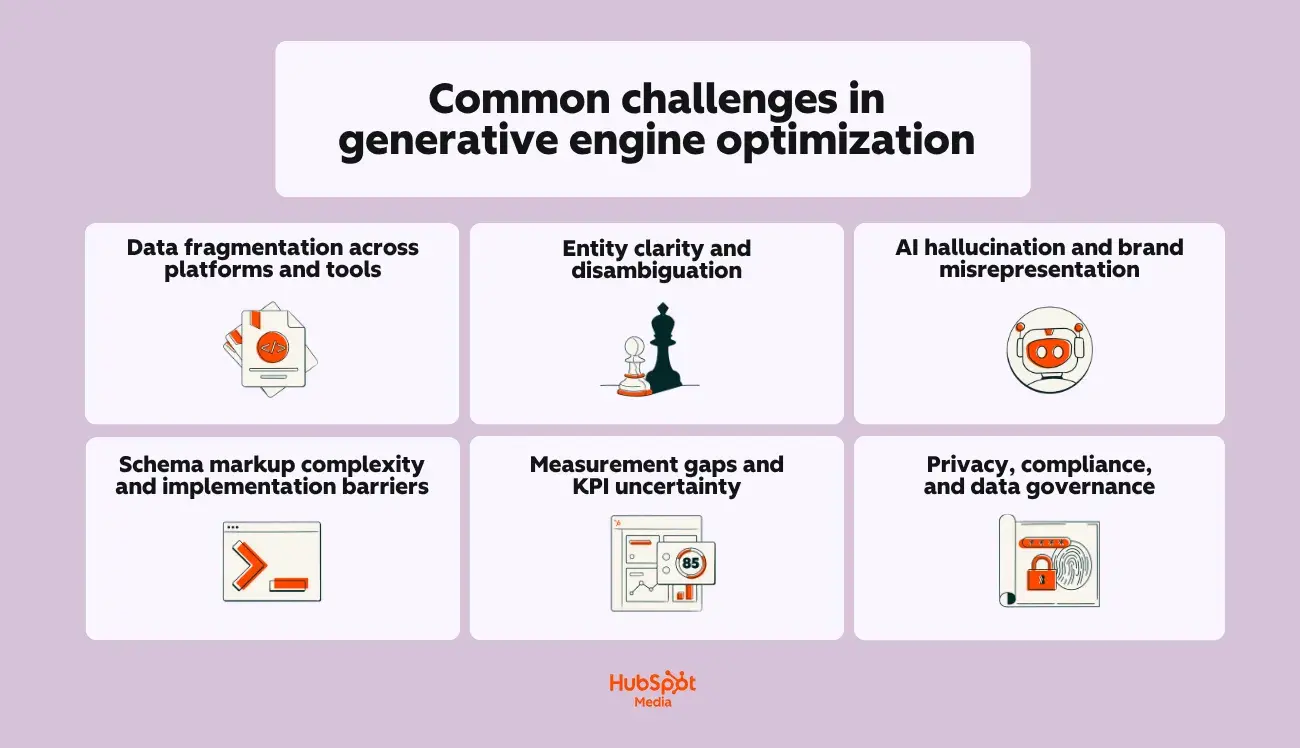
1. Data fragmentation across platforms and tools
GEO requires your brand information to be consistent and machine-readable across all surfaces from which AI models originate:
- Your website
- Third Party Directories
- Review platforms
- Social profiles
- Structured data markup
Most marketing teams manage these surfaces in separate tools without a single source of truth, creating fragmented entity signals that confuse AI engines.
If your LinkedIn company page says one thing, your Google company profile says something different, and your website schema doesn’t match, AI models will receive conflicting inputs.
The result? Lower “entity confidence” – the model’s internal certainty about who you are and what you do – which reduces your chances of being cited or, worse, results in an inaccurate representation.
The solution:
- Check your brand’s footprint across all platforms that AI models are known to target. Update your website, Google Business Profile, LinkedIn, G2, Capterra, Wikipedia, business directories, and major publications that mention your brand.
- Create a canonical brand fact sheet. This is a single document that defines your company name, description, key products, leadership, founding date, and differentiators – and matches all external profiles to it.
- On your homepage, implement an organizational schema with sameAs properties that point to each relevant external profile. This gives the AI a machine-readable map that connects your fragmented presence into a single verified entity.
- Use HubSpot’s marketing hub And Content Hub to support GEO implementation through unified data and content automation, consolidating your brand’s digital presence into a single CRM-connected system rather than dispersing it across separate tools.
2. Clarity and disambiguation of the entity
AI engines don’t just match keywords; They resolve entities.
If your brand name is generic (think “Summit,” “Atlas,” or “Relay”), shares the name with another company, or lacks unique entity signals, generative models can do the following:
- Confuse you with another organization
- Merge your properties with those of a competitor
- Leave them out completely (since the model can’t confidently decide which “peak” the user means, for example)
This is one of the disadvantages of generative search engine optimization that traditional SEO teams rarely face. In traditional search, disambiguation is done through domain authority and link signals. In generative search, this is done through entity resolution. If your entity is not unique, you lose.
The solution:
- Create entity-rich content that explicitly states relationships (e.g. “Acme Corp is a B2B SaaS company headquartered in Boston that provides marketing automation for mid-sized teams.”) Direct declarative instructions give the AI the structured claims it needs to correctly resolve your entity.
- Use the most specific one Schema.org Subtypes available. Don’t default to the generic organization – use ProfessionalService, SoftwareApplication, or the subtype that most accurately describes your business.
- Create a comprehensive “About” page that acts as the canonical definition of your entity. Then link to external authority sources using sameAs references (Wikipedia, Crunchbase, LinkedInIndustry profiles).
- Publish content under named, accredited authors with a proven external presence. AI systems are increasingly taking the author’s identity into account when determining source authority. Anonymous bylines are a GEO penalty.
3. AI hallucination and branding
Large language models do not retrieve facts, but rather predict statistically likely word sequences.
When they encounter gaps in the training data or ambiguous signals, they produce confident-sounding answers that may be completely made up.
For brands, this means that AI:
- Assign product features incorrectly
- Manufacture prices
- Invent partnerships that don’t exist
- Describe your company inaccurately with full confidence
The solution:
- Proactively monitor what AI platforms are saying about your brand by regularly querying ChatGPT, Perplexity, and Gemini with the questions your buyers are asking (“What is (Brand)?”, “Best (Category) Tools,” “Is (Brand) Trustworthy?”). Document answers and flag inaccuracies.
- Use HubSpot’s AEO Grader. I’ve mentioned this tool before, but it measures brand visibility in AI search engines by scoring your brand on sentiment, quality of presence, brand awareness, share of voice, and market position (cross-validated via ChatGPT, Perplexity, and Gemini). It shows exactly how AI characterizes your brand and where misrepresentations exist, giving you an evaluated basis for tracking improvements over time.
- Reduce the risk of hallucinations by providing clear, structured and verifiable content. Replace vague language with concrete statements: precise pricing with dates (“starts at $49/month starting March 2026”), named integrations, and cited statistics. Structured data and schema markup help AI engines accurately understand and cite your content instead of guessing.
- Build a correction flywheel. If you notice a hallucination, post authoritative clarifications on owned channels, provide feedback to the affected platform, and update your structured data to close the information gap.
4. Schema markup complexity and implementation barriers
Structured data is the translation layer between your content and AI systems. Still, most marketing teams find schema implementation technically intimidating, and many who implement it make mistakes (mismatched schema types, stale data that conflicts with visible page content, or missing entity connections that leave AI models guessing).
The solution:
- Start with the three types of schemas that have the greatest impact. Organization (site-wide, defining your entity), Articles (for blog and editorial content) and FAQ page (for Q&A content). These three cover most use cases for GEO citations.
- Use JSON-LD provided in the document header. It is Google’s recommended format, the cleanest for AI analysis and is separable from your HTML content structure.
- Validate the schema quarterly Google’s rich results test And Search Consoleand update immediately if the content changes significantly (prices, services, team, hours). A legacy schema where markup no longer matches visible content actively undermines AI trust.
5. Measurement gaps and KPI uncertainty
Traditional SEO has metrics that have been established for decades:
- Rankings
- Impressions
- Organic traffic
- CTR
GEO introduces a visibility layer that does not capture any of these metrics. You can rank #1 on Google for a target keyword and still be completely absent from the AI-generated response that appears above your listing.
The solution:
- In addition to traditional SEO KPIs, also track GEO-specific metrics. Citation frequency, AI share of voice, brand sentiment in generated responses, source quality analysis and conversion rates from AI-targeted traffic.
- Segment AI recommendation traffic in GA4 by creating custom channel groups for ChatGPT, Perplexity, and other AI recommendation sources. Measure this traffic separately from traditional organic traffic to isolate GEO’s contribution to pipeline and revenue.
- Use HubSpot’s AEO Grader as a free starting point for establishing your AI visibility baseline across five assessed dimensions. As a content marketer who writes for GEO every day, I highly recommend this tool. Use it! (That’s all I’ll say here.)
6. Data protection, compliance and data management
Finally, GEO introduces privacy and compliance considerations that traditional search engine optimization has largely avoided.
AI models are based on publicly available data, meaning brand information, employee details, product specifications, and customer opinions posted on your website may be collected, recombined, and displayed in AI responses in unexpected ways.
For companies in regulated industries (healthcare, finance, legal), this raises questions about data accuracy obligations, liability for AI-generated claims, and compliance with evolving AI transparency regulations.
The solution:
- Review your publicly available content for any claims that could result in liability if it is displayed inaccurately by an AI model. Remove or update outdated pricing, discontinued products, expired certifications, and outdated employee information.
- Add time tags (“as of Q1 2026”) to all factual claims so that AI models and users can assess timeliness. Update the dateModified property in your article schema each time you revise content.
- Set up an AI brand monitoring workflow. Assign responsibility (be it an individual or a cross-functional team across SEO, PR, and legal), document known hallucination risks, and incorporate AI reputation checks into your quarterly marketing review.
Each of these challenges in generative engine optimization is solvable with the right framework, tools and a systematic approach.
The teams that view these obstacles as implementation issues rather than reasons to wait are the ones building AI visibility while their competitors are still debating whether GEO matters.
How to get started with GEO now
Fortunately, you don’t need a six-month roadmap or a new tech stack to take advantage of generative engine optimization.
The most effective GEO implementations build on the SEO foundation you already have:
- Layering in structured data
- “Reply first” formatting.
- AI visibility tracking in focused sprints
Generative engine optimization enables brands to appear in GEO results and conversation responses, and the fastest path to that visibility starts with the content and infrastructure your team has already invested in.
Here’s a handy quick-start framework you can start implementing this week:
Step 1: Establish jour AI vIsibility baseline
Before you optimize anything, you need to know where you stand. Most marketing teams have no idea how (or if) AI engines represent their brand in generated responses.
First, run your brand HubSpot’s AEO Grader. As I have mentioned several times in this post, it measures brand visibility in AI search engines by evaluating your presence across five dimensions (i.e. sentiment, quality of presence, brand awareness, share of voice and market position).
Then supplement with manual testing: query ChatGPT, Perplexity, and Gemini with 10-15 prompts that your ideal buyers would actually ask (“What is the best (your category) for (use case)?”). Document whether your brand is performing, how it is characterized, and which competitors are being cited instead. This exercise alone often uncovers the most pressing gaps in content.
Pro tip: For a more comprehensive view of the monitoring landscape, check out the HubSpot blog’s guide to answering engine optimization tools that help marketing teams systematically track AI visibility.
Step 2: Restructure your most valuable content for AI extraction
Here’s the (frustrating but true) bottom line on GEO: AI engines don’t read your content the way humans do.
Rather than reading linearly or interpreting nuance, they look for direct, extractable answers—usually within the first 40 to 60 words of a paragraph—and prioritize content structured with question-based headings, factual statements, and cited statistics.
To quickly create measurable impact, select your five highest-traffic blog posts or landing pages and apply the following changes:
- Lead with a direct answer. Provide a clear, self-contained answer in the first two to three sentences of each section. If an AI had to raise a paragraph to answer a user’s question, that paragraph should work on its own.
- Reformat headings as questions. “How does content marketing generate ROI?” gives the AI a clear extraction signal. “Content marketing ROI” doesn’t.
- Include specific, dated statistics every 150-200 words. Factual content is cited significantly more often because AI engines target verifiable, quantifiable claims.
- Add an FAQ section in the FAQPage schema. FAQ sections serve to optimize both answer engines and GEO goals. They provide structured question-and-answer pairs that the AI can extract directly.
Pro tip: For a comprehensive breakdown of the content formats that perform best in AI-generated answers, check out this guide to the best content types for AI search.
Step 3: Implement core schema markup on priority pages
Structured data and schema markup help AI engines understand and cite your content, but most websites either lack schema entirely or have implemented it incorrectly.
Now read the next sentence slowly: You don’t have to mark your entire website on the first day.
I recommend starting with the three schema types that produce the most GEO value:
- Organizational schema on your homepage, with properties pointing to all relevant external profiles. This defines your entity in AI knowledge graphs and is the single highest leverage schema implementation available.
- Article schema for each blog post and editorial page with the properties “Author”, “Published Date” and “Date Modified”. Named, recognized authors with a demonstrable external presence are more likely to be cited. (Anonymous bylines are a GEO penalty.)
- FAQ page schema on each page with a Q&A section. FAQ schema pages receive disproportionately more AI citations because they conform to the conversational format that users use when querying answer engines.
Then use JSON-LD in the document header for all implementations. It is the format recommended by Google and the cleanest for AI analysis. Then validate each page with Google’s rich results test before publication.
Step 4: Set up AI reference traffic tracking in Google Analytics 4 (GA4).
One of the most persistent challenges in generative engine optimization is measurement. Teams can’t justify continued investment in things they can’t report on. But what these teams don’t know is that the repair takes about 10 minutes.
Create custom channel groups in GA4 to segment traffic from AI recommendation sources:
This allows you to isolate AI-related sessions, measure conversion rates separately from traditional organic sessions, and build a reporting infrastructure that connects GEO effort to pipeline results.
In the future, track two parallel metric streams:
- Traditional SEO performance (rankings, impressions, organic traffic)
- GEO performance (citation frequency, AI share of voice, AI recommendation conversions)
Both are important. (HubSpot’s State of Marketing Report 2026 even confirmed that the channel is the top channel by ROI and personalization success Despite it SEO (at 27%right ahead of paid social media content at 26%.) As a marketer, you simply need to measure and optimize both at the same time.
Pro tip: For a deeper dive into how AI is changing the SEO landscape and which metrics to prioritize, this AI and SEO resource covers convergence in detail.
Step 5: Establish entity authority beyond our own domain
AI platforms rely more on third-party sources than branded content to compile answers.
This means that if AI engines cannot find independent verification of your brand’s claims, your website alone (no matter how well optimized) will not receive citations.
Prioritize these external authority signals:
- Get liability insurance. Press mentions, analyst reports, industry publications, and expert summaries all feed into the knowledge graphs that AI engines draw from. The more your brand appears in relevant external contexts, the higher your trust score is for the company.
- Invest in review platforms. G2, Capterra, TrustRadius and similar directories are often used by AI models to generate product recommendations. Encourage satisfied customers to leave detailed, specific reviews.
- Publish original research. Data studies, benchmark reports and proprietary survey results become citation magnets; other publishers point out that AI models then appear.
- Maintain consistent entity information. Your brand name, description, product details, and key differentiators should be identical across all surfaces: website, LinkedIn, Google Business Profiles, Wikipedia, and business directories.
For an overview of how AI agents discover and process brand information in these sources, this explanation of AI agent types provides helpful context on the retrieval mechanisms at work.
Step 6: Integrate GEO into your existing content workflow
Believe it or not, the biggest barrier to GEO adoption is not complexity, but the perception that it requires a parallel workflow. And do you want to know something truly mind-blowing? That is not the case.
You see, dear reader, GEO integrates directly into the content production process your team is already running.
Here’s how you can embed it without any extra effort:
- When planning content Research conversation prompts alongside traditional keywords. Check what AI engines return for your target topics and identify gaps where your brand should appear but isn’t. Resources like this breakdown of response engine optimization best practices can inform your planning criteria.
- While writing Apply the reply-first structure from Step 2 as a standard editorial requirement, not as a separate GEO pass. Lead with definitions, include cited statistics, and use clear sentences that explicitly state relationships (“HubSpot CRM integrates with over 1,700 tools” rather than “Many integrations are available”).
- During editing Add schema and entity consistency checking to your quality assurance process. Ensure all factual claims contain data, sources, and specificity that can be validated by AI engines.
- During distribution Share content on platforms actively crawled by AI models (e.g. LinkedIn, Reddit, industry communities and press channels) to build the third-party mention footprint that strengthens citation authority.
Pro tip: HubSpot’s marketing hub And Content Hub Support GEO implementation through your AEO productwhich unifies data and content automation and enables teams to manage content creation, SEO optimization, and performance tracking through a single CRM-connected system.
Step 7: Monitor, iterate and scale
GEO is not a one-off project. AI models update their knowledge regularly, competitors also optimize, and the response engine optimization trends that characterize this area are evolving rapidly. Create a monthly review cadence:
- Re-run your AEO Grader baseline monthly to track movements in sentiment, share of voice and competitive positioning.
- Test your 10 to 15 buyer prompts on all AI platforms and document changes in citation patterns, brand sentiment, and competitive presence.
- Check GA4 AI recommendation data to measure whether restructured content leads to more AI-attributed sessions and conversions.
- Update existing content with fresh statistics, revised scheme and current product details.
A well-known disadvantage of GEO is that results require continuous attention rather than a set-and-forget approach. But the complex nature of citation authority means that each month of consistent effort builds on the last.
However, early movers create structural advantages that late adopters find difficult to exploit.
Choosing the right tools for your GEO stack
No corporate budget is required to operationalize GEO. Understanding AI costs helps you plan realistically, and many basic GEO actions (e.g. content restructuring, schema implementation, FAQ creation, and manual prompt testing) cost nothing except your team’s time.
Where the budget helps the most is in monitoring and automation. Dedicated generative engine optimization tools can automate citation tracking, competitive benchmarking, and content review recommendations to a degree that manual testing cannot achieve.
Evaluate tools based on the generative engine optimization challenges your team faces most, be they:
- Visibility measurement
- Content optimization
- Schema management
- Competitive intelligence
Marketers benefit from increased AI search visibility, improved lead quality, and stronger brand engagement when they view GEO as a complement to their SEO foundation rather than a separate initiative.
Start with your baseline, restructure your top content, implement the core schema, track results, and iterate. The framework above is intended to take you from “thinking about GEO” to “measuring GEO impact” sooner rather than later.
Frequently asked questions (FAQ) about the benefits of generative engine optimization
How long does it take to see the benefits of GEO?
Initial benefits of generative engine optimization can be seen within 2 to 4 weeks, which is significantly faster than the typical time frame of traditional search engine optimization of 3 to 6 months.
AI models update their knowledge bases more frequently than search engines rescan the web, so structured improvements to existing content are implemented quickly.
However, the schedule depends on what you are optimizing:
- Fast results (2 to 4 weeks). Adding specific statistics, restructuring content in a reply-first format, and implementing an FAQ schema on high-traffic pages.
- Basic improvements (1 to 3 months). Implemented a site-wide organizational schema, built entity consistency across external profiles, and set up AI recommendation tracking in GA4. These structural changes compound over time as AI models encounter consistent signals across multiple surfaces.
- Authority Compounding (3 to 6+ months). Get third-party citations, publish original research, and build a cross-platform business presence. (Citation authority works like domain authority; it accumulates and reinforces simultaneously in ChatGPT, Perplexity, Gemini, and Google AI Overviews.)
Can small teams quickly benefit from GEO?
Yes. GEO’s actions with the highest ROI require time investment, not budget.
Truth be told, dear reader, a team of just one can start getting results by restructuring existing content and implementing a basic schema, none of which costs more than hours of execution.
Here’s a realistic first week plan for a small team:
- Day 1. Run HubSpot’s AEO Grader to determine your brand’s AI visibility in ChatGPT, Perplexity and Gemini. It’s free, doesn’t require an account, and delivers a rated benchmark in minutes.
- Day 2. Manually test 10 buyer intent prompts across all AI platforms. Document where your brand appears and where it is missing.
- Day 3 to 4. Restructure your top 3 pages: Start with a direct answer in the first 40 to 60 words, add an FAQ section, and add at least one specific statistic per 200 words.
- Day 5. Add an organizational schema to your homepage and an FAQPage schema to the pages you just restructured. Confirm with Google’s rich results test.
You don’t need any business tools to get started. You need consistent implementation of the basics.
How do I reduce the risk of AI hallucinations about my brand?
AI hallucinations (cases in which models generate certain but fabricated information about your brand) are among the most commonly cited disadvantages of generative engine optimization.
Now you can’t completely eliminate hallucinations (they’re related to the way LLMs predict text), but you can may Significantly reduce their frequency and impact by doing the following:
- Provide clear, structured and verifiable content. Replace vague marketing language with concrete statements: precise pricing with data, named integrations, source statistics, and explicit product descriptions. Structured data and schema markup help AI engines accurately understand and cite your content, rather than inferring (and potentially making up) details.
- Build company trust. Make sure your brand information is consistent across your website. Google business profile, LinkedInRating platforms and business directories. When AI models encounter conflicting signals, they are more likely to hallucinate your brand or skip it altogether.
- Monitor proactively. HubSpot’s AEO Grader measures brand visibility in AI search engines and reveals how AI platforms characterize your brand, including sentiment analysis that flags negative or inaccurate representations. Conduct this assessment at least quarterly and supplement it monthly with instant manual tests.
- Create a remediation workflow. If you experience a hallucination, post authoritative clarifications on owned channels, provide feedback to the affected AI platform, and update your structured data to fill the information gap that caused the error.
Should I update my existing content or create new content for GEO?
Start with existing content. It is both faster and higher ROI.
Your pages that already rank in the organic top 10 are the strongest candidates for GEO optimization, as AI engines disproportionately cite content that performs well in traditional search.
Restructuring a top ranking page for AI extraction (e.g. adding a direct response opening, FAQ schema, specific stats, and time markers) unlocks AI visibility of an asset your team has already invested in.
Create entirely new content when you identify citation gaps (e.g. searches where your buyers are asking AI platforms questions and your brand has no relevant content at all). Then prioritize these formats for new GEO content:
- Comparison article
- Definitive guides with original data
- FAQ and Q&A pages
The most effective approach is a 70/30 split: 70% of your GEO effort on optimizing existing high-performing businesses, 30% on creating new content for unmet citation opportunities.
One of the persistent challenges in generative engine optimization is the temptation to treat GEO as an entirely new content program, when in practice most of the work involves restructuring what already exists.
How can GEO best be aligned with sales and service?
GEO creates the most business value when connected to your CRM and revenue operations, rather than in isolation within the content team.
Here’s how you can align GEO with marketing, sales and service:
- Connect AI traffic with pipeline attribution. Segment AI recommendation sources in GA4 and map them to CRM records so sales can see which leads come from response engine citations.
- Bring sales objections back into the content. The questions your sales team hears most often (e.g., pricing concerns, competitive comparisons, implementation timeline) are the very questions buyers ask AI platforms. Create structured, answer-oriented content for each objection and implement an FAQ schema so AI engines can extract and cite your answer.
- Use service data to reduce the risk of hallucinations. Your support team knows which product claims cause confusion or misalignment. Add common misunderstandings and clarification needs to your content calendar to proactively fill information gaps that AI models might otherwise fill with made-up details.
- Short sales pitches about your AI presence. Share your AEO Grader results and timely test data with sales leadership. When your sales reps know which queries are surfacing your brand in AI responses (and which competitors are surfacing), they can tailor their outreach to reinforce the narratives buyers are already encountering in ChatGPT and Perplexity.
The benefits of generative SEO multiply when every customer-facing team understands how shoppers discover and evaluate your brand through AI.
In the GEO era, a modern revenue engine should work like this:
- The content team creates cite-worthy assets
- Sales uses the targeted traffic generated by these quotes
- The service feeds real-world insights back into the content loop to keep your AI presence accurate and up-to-date
GEO is the future of content marketing
Simply put, generative search engine optimization allows brands to appear in search results and conversation responses. It’s not the future of search, it’s about where we are now.
Fortunately, at this point, the benefits of generative engine optimization are measurable: higher intent leads, greater brand involvement in the responses that influence buyer decisions, and a compounding visibility advantage that rewards teams that act early.
However, the challenges of generative engine optimization are just as real. Measurement frameworks are newer, schema markup requires conscious effort, and the drawbacks of generative engine optimization (including hallucination risk and entity ambiguity) require proactive monitoring rather than passive hope.
However, each of these obstacles is solvable with the right tools and a systematic approach. The brands that come out on top aren’t the ones with the biggest budgets. More specifically, they are those who:
- Started with their existing SEO foundation
- They have restructured their most valuable content for AI extraction
- Basic scheme implemented
- Developed a measurement cadence that tracks citation frequency in addition to traditional KPIs
Ready to see how AI search engines represent your brand today? Get started with HubSpot’s AEO Grader. It’s free, only takes a few minutes, and gives you a rated baseline for ChatGPT, Perplexity, and Gemini so you know exactly what to focus on first.