
When I saw a LinkedIn post from today’s master that said, “The job of marketing is not to increase sales,” I hesitated a little and thought, “She gets it!”
We started talking and I discovered one entire pharmacopoeia of difficult-to-swallow pills. “I love talking straight about marketing!” she grinned.
I asked for three of the harshest truths marketers need to hear. And, folks…it’s time to take your medication.
Moni Oloyede
Founder, educator at MO MarTech
- Interesting fact: Moni is from the same city as Edward Norton, Aaron McGruder, Christian Siriano and Druski. (Do you know without Googling?)
Lesson 1: The job of marketing is not to increase sales.
Every CMO in the audience reflexively twitched toward the “unsubscribe” button. Stay here with us.
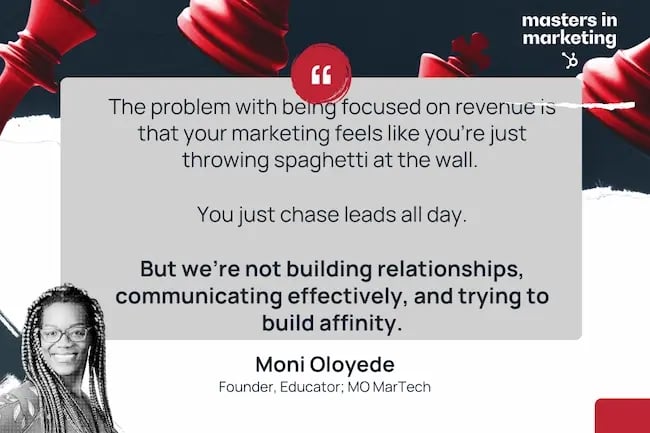
“The problem with focusing on sales is that your marketing feels like you’re just throwing spaghetti at the wall,” says Oloyede. “You just chase tracks all day long. “You didn’t click on my email, let me move on to the next topic and see if this works.” And you jump and jump and jump.’”
She points out that instant gratification in digital marketing has created a generation of marketers who were never educated on the basics. What works until it doesn’t work anymore.
“I grew up in the field of digital marketing. Before that, I didn’t know any time. And when I went to graduate school, I realized: We don’t actually do any marketing. We send content and get leads. But we don’t build relationships, we don’t communicate effectively, we don’t try to build affinity.”
“You can’t serve two masters. If I serve the CEO, that’s sales. If I want to serve the customer, I have to slow down. I have to be patient.”
Lesson 2: Demand generation is not a strategy.
“The word ‘strategy’ is used a lot and distorted to hell. Demand generation is not a strategy. Demand generation is Execution a strategy.”
Tell me if this next part sounds familiar.
“A typical marketing campaign is: let’s pick a topic, create content around that topic, then collect leads and just Email them the crap until they die. This is not a strategy.”
“Contrast that to the Dove Real Beauty campaign. A multi-year, consistent story based on the consumer psychology of women who don’t feel beautiful in their bodies because of beauty standards. That is a strategy.”
Instead of one-off content that jumps from topic to topic, all marketing efforts—whether lead generation, demand generation, or brand awareness—aligned with Dove’s core message.
And that message didn’t come from Dove, who simply threw spaghetti at the wall until they found the noodle that was stuck.
Oloyede explains the process: “I hear my audience saying that they are afraid of moving forward with new software. They are worried about lack of resources. This is my campaign to combat these messages Mark, you give me X more dollars to expand. Agreed. THEN you are going to execute.”
It’s slow. It is difficult. It’s tedious. And since AI allows the competition to flood every channel with the same slop, it’s the only thing that stands out.
Lesson 3: Technology second.
“Technology won’t solve your marketing problems,” says Oloyede. “People think I’m anti-tech. I’m not. (The technology is) just out of order.”
Whether it’s AI, analytics software, or even your CRM, it’s important to recognize that these are tools that get things done. The why behind these tasks must come first.
“Technology is just for execution, management and operationalization. That’s all. It works when it supports good, basic marketing principles. So if you don’t understand your market, if you’re not sure of your message, if you don’t understand your audience psychologically, emotionally and culturally, then you have to go back to the drawing board.”
And once you have all of that, you can put your tools on autopilot, right? Not quite.
“We need to add that human touch to all of these digital tactics. (Currently) we send leads to an automated 10-touch nurturing campaign and then to sales to see if there is intent to purchase. And then discard them if they’re not ready to purchase.”
“What if you invited them to a small, intimate focus group instead? Or a premiere event? Some kind of human touch where they see you face to face. How much more likely are they to open your email?”
And here we rediscover this old marketing wisdom that was almost lost over time:
“People buy from people. People buy from people they like, trust and have a connection with. The more you do that, the more successful you will be.”
THE. That means The task of marketing.
