

Understanding Answer Engine Optimization (AEO) vs. Traditional SEO has become critically important for content managers and marketing leaders as search shifts toward AI-generated answers, voice results, and zero-click experiences. While page ranking on Google is still important (for now), success increasingly depends on whether a brand remains visible when an AI system summarizes an answer.
Traditional SEO still drives long-form content performance, rankings, and organic traffic. However, AEO determines whether a brand appears in AI overviews, featured snippets, and voice search. Response engine optimization and traditional SEO models run in parallel and are based on different signals, content structures and measurement frameworks.
This guide breaks down AEO vs. SEO, where each is most effective, and how teams can combine the two. The post also highlights tools – including HubSpot’s AEO Grader, Website Grader, Marketing Hub and Content Hub – helping teams create content for both AI-driven and classic search visibility.
Table of contents
Why response engine optimization is different from traditional search engine optimization
Answer engine optimization is different from traditional SEO because AEO prepares content for direct answers in AI overviews, voice search, and featured snippets, while SEO focuses on ranking entire pages in organic search results. These approaches support two very different ways in which content is rated and displayed online. One is used to extract short, precise answers, the other is used to evaluate the relevance and authority of entire pages.
AEO is based on a simple idea: Answer machines require structured, explicit and manageable information to cite. AI systems work by identifying a clear definition, recognizing the supporting context, and validating their structure with schema and internal linkage. Traditional SEO takes a broader view by evaluating page depth, intent targeting, crawlability, backlinks, and topic authority.
These patterns show how response engine optimization and traditional SEO interpret structure differently:
- AEO prioritizes direct responses that support AI overviews.
- SEO prioritizes full-page rankings that drive organic traffic.
- AEO improves zero-click visibility, resulting in AI citations.
- SEO strengthens long-form content, which increases domain authority.
Semantic signals determine how content appears in AI-driven results and traditional search. Content managers who optimize for response engine optimization versus SEO (or vice versa) often see strong performance in one area and unexplained gaps in the other.
While good SEO can lead to some AEO wins, it is no replacement for explicitly structured answers, schemas and consistent terminology. Content that only follows SEO conventions may rank well, but still not appear in AI overviews or answer interfaces.
What response engine optimization focuses on
Answer engine optimization focuses on creating structured answers that AI systems can extract and cite. AEO requires clear definitions, direct explanations, and a schema that reinforces meaning. It works best when the content presents the answer immediately and follows with a concise context.
AEO increases the likelihood of occurring in the following cases:
- AI overviews.
- Selected excerpts.
- Voice search results.
- Citations generated by LLM.
- Chat-style reply fields.
These elements help the AI interpret content with fewer assumptions and increase the chances of generating correct citations.
What traditional SEO focuses on
Traditional SEO focuses on improving the ranking of entire pages in search results through authority, depth, and technical performance. SEO emphasizes comprehensive content, strong links, and clean metadata that help search engines gauge relevance. SEO is based on:
- Topic clusters.
- Backlinks.
- Keyword targeting.
- Metadata optimization.
- Page Experience and Core Web Vitals.
These elements signal that a page deserves to rank for certain keywords.
Why content teams need both
Content teams need both AEO and SEO as AI-driven experiences highlight short answers while search engines continue to evaluate entire pages. Answer-focused content helps brands appear on zero-click interfaces, and zero-click visibility drives early-stage awareness. Meanwhile, detailed pages increase conversions and reinforce topic depth, and greater topic depth increases the credibility of answer blocks.
As AI-generated results spread across search engines and devices, teams balancing AEO and SEO ensure transparency wherever users look for information, whether they’re scrolling through SERPs, triggering a voice prompt, or reading an AI-generated summary.
How Answer Engine Optimization and traditional SEO differ in practice
Answer engine optimization differs from traditional search engine optimization in the way content is structured, discovered, scored, and displayed. AEO prioritizes short, extractable answer blocks for AI search, while SEO prioritizes deep, comprehensive pages that rank in search results.
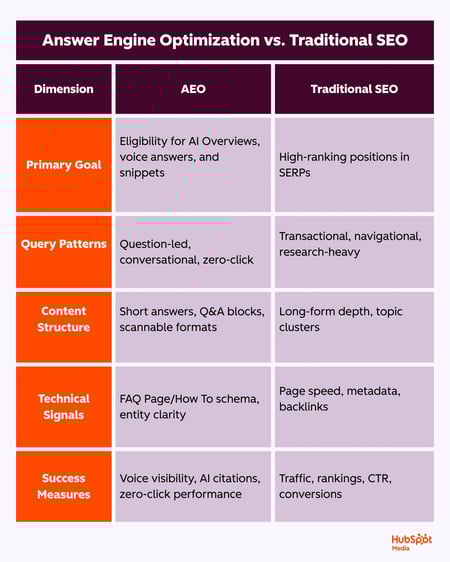
Below is a clear comparison between response engine optimization and traditional search engine optimization that content managers can use when planning.
Answer Engine Optimization vs. Traditional SEO: 5 Key Differences
|
dimension |
AEO |
Traditional SEO |
|
Primary goal |
Eligibility for AI overviews, voice responses and snippets |
High-ranking positions in SERPs |
|
Query pattern |
Question-driven, conversational, no-click |
Transactional, navigation-oriented, research-heavy |
|
Content structure |
Short answers, question and answer blocks, scannable formats |
Long depth, topic clusters |
|
Technical signals |
FAQ Page/How-To Schema, Entity Clarity |
Page speed, metadata, backlinks |
|
Measures of success |
Language visibility, AI citations, zero-click performance |
Traffic, rankings, CTR, conversions |
Pro tip: HubSpots AEO grader analyzes responsiveness across structured content, schema, and semantic clarity, a capability that most SEO tools do not yet offer.
1. Goals
AEO focuses on making content appear as direct answers, while SEO focuses on improving the ranking of entire pages for relevant searches. These goals serve different phases of the user journey. While AEO prioritizes clarity in the first sentence, SEO prioritizes depth, UX, and topic relevance throughout the page.
When AEO and SEO goals align, response visibility supports early discovery and sustainable rankings support ongoing traffic and conversions.
2. Query patterns
AEO is characterized by question-based queries, while SEO covers a broader range of intent, including transactional, navigational, and research-intensive queries. Users tend to trigger answer machines when typing or speaking questions, and they turn to SERPs when they need comparisons, pricing, or detailed context.
Clear questions improve answer extraction and more contextual pages improve ranking stability.
3. Content structure
AEO requires short, structured answers placed high on the page, while SEO requires long-form content built around topic clusters. AEO content reads like a direct answer to a specific question. SEO content reads like an in-depth guide or resource.
Many high-performing pages use a hybrid structure:
- The first section answers the question directly.
- Subsequent sections are expanded with SEO-rich explanations.
- FAQs reinforce alternative wording and the intent associated with it.
When AEO and SEO strategies work together, answer blocks improve AI suitability and long-form depth strengthens the surrounding cluster.
4. Technical signals
AEO relies on schema markup, entity clarity, and consistent terminology, while SEO relies on page performance, metadata optimization, and internal linking. Schema gives AI systems a structured map of meaning and technical SEO supports discoverability and crawlability.
When AEO and SEO work in parallel, schema sharpens the interpretation of content and technical SEO ensures that the page can be found, indexed and ranked.
5. Success metrics
AEO measures visibility on reply interfaces, while SEO measures performance in search rankings and organic traffic. AEO metrics include AI Overview presence, voice response visibility, and non-click CTA engagement. SEO metrics include keyword rankings, organic sessions, and search conversion rates.
Together, AEO and SEO metrics provide a more comprehensive picture of visibility – both response-level influence early in the journey and page-level conversions later.
When should AEO strategies take precedence over hybrid SEO approaches?
Content managers often have to decide when to move forward with response engine optimization over traditional SEO and when a hybrid approach will produce better results. AEO should be a priority for marketers when users want clear, direct answers, while SEO becomes essential when they need depth, comparison or evaluation.
The following four scenarios outline how this balance can be implemented in practice.
AEO vs. traditional SEO overview
|
scenario |
First priority (AEO vs. SEO) |
Why it matters |
What could change the priority? |
How the other strategy supports success |
|
The audience uses question-based or conversational queries |
AEO |
Ensures the best answer is displayed quickly while still providing a path to more in-depth content when needed. |
If the intent shifts toward evaluation or comparison, further detail is required |
SEO provides deeper context, related articles, and support for topic clusters |
|
The topic requires depth, comparison or buyer evaluation |
SEO |
Helps buyers compare options, understand trade-offs and make a decision – not just get a one-line answer. |
When the query is simplified into a definition style or a “what is…” search |
AEO helps capture snippets and AI overview placements that link to the detailed page |
|
The goal is visibility in AI overviews, language results or LLM citations |
AEO |
Increases the likelihood that answer search engines will cite the brand directly instead of a competitor. |
When the query becomes more commercial, feature-oriented, or brand comparison-oriented |
SEO strengthens domain authority and strengthens the credibility of the cited page |
|
Need for both early discovery and long-term performance |
Hybrid (AEO + SEO) |
Protects visibility across changing SERP layouts and AI experiences by not relying on a single channel. |
When AI starts dominating more informational results or SEO competition for key terms increases |
AEO ensures quick visibility without clicking; SEO ensures that traffic, engagement, and conversions are maintained over time |
1. When audiences search using question-based queries
AEO should take the lead when the audience starts with clear, question-based questions like “What is…”, “How does…” or “When should…”. These searches trigger answer-oriented systems that display structured, concise answers instead of long lists of links.
If the decision is answer engine optimization vs. SEO, AEO works well here because answer engines look for simple definitions, consistent wording, and answer blocks placed high on the page. SEO still plays a supporting role by anchoring this short answer within a broader topic cluster that provides depth to users who click through.
As the intent shifts from asking a question to evaluating options, SEO becomes increasingly important as audiences need more than a one-sentence answer.
- Answer Engine Optimization vs. Traditional SEO: AEO should take the lead as answer engines emphasize short, structured explanations.
- User intent: Users want a quick, factual answer to the question “what is”, “how does it work” or “when should”.
- Why it matters: Strong AEO performance ensures the brand appears in AI synopses, snippets, and voice responses before users see traditional SERPs.
- What could shift priority: As the intent shifts from comprehensive understanding to evaluating options, SEO becomes more important.
- How SEO supports success: SEO provides deeper context, internal linking, and reference content for users that goes beyond the original answer.
2. When the topic requires details, comparisons or decision support
SEO should take the lead when the audience needs comprehensive information, a structured explanation, or a comparison that cannot be delivered in a short answer. Product research, pricing and review queries are based on full-page depth, internal linking and a clear visual hierarchy.
AEO continues to contribute via reply blocks at the top of the page, which help secure snippets and AI visibility. These blocks provide early visibility, while the SEO-driven sections below guide users through more complex questions.
If the question can be answered with a simple definition, AEO temporarily gains influence. But once depth becomes necessary, SEO determines performance.
- Answer Engine Optimization vs. Traditional SEO: SEO should take the lead because users need detailed information – not just a concise answer.
- User intent: Users want a structured review, including comparisons, prices, pros and cons, or specific use cases.
- Why it matters: SEO ensures users can navigate long-form content that makes decisions and supports the buyer’s journey.
- What could shift priority: As the query shifts to early-stage or definition-style searches, AEO may temporarily take precedence.
- This is how AEO supports success: AEO helps capture snippets and AI summary placements that guide users to the detailed page.
3. If the goal is visibility in AI overviews, language results or LLM citations
AEO should take the lead when teams want to appear in AI-generated summaries, voice responses, or assistant-style responses. These systems look for short, stable explanations, consistent terminology, and a schema that reinforces meaning.
SEO supports this work by helping search engines assess the authority of the domain, which improves the reliability of these answers. Strong authority increases answer visibility and a consistent answer structure increases citation accuracy.
As the query becomes more commercial or comparison-oriented, SEO becomes a priority again as the audience’s needs shift beyond a single extracted statement.
- Answer Engine Optimization vs. Traditional SEO: AEO should take the lead as AI systems rely on clear definitions, consistent terminology and structured responses.
- User intent: Users expect a quick, meaningful explanation through AI summaries or voice responses.
- Why it matters: AEO increases the likelihood that answer search engines will cite the brand directly instead of a competitor.
- What could shift priority: As the query becomes more commercial, feature-oriented, or comparison-oriented, SEO becomes more important.
- How SEO supports success: SEO strengthens domain authority and strengthens the credibility of the cited page.
4. When teams want sustained organic traffic and reply-level visibility
A hybrid approach should take the lead when teams want both early visibility in answer interfaces and ongoing traffic from long search results. Hybrid sites integrate AEO and SEO: a structured answer block at the top, followed by detailed sections that support rankings, conversions and internal linking.
AEO ensures the site appears in AI synopses and snippets, while SEO ensures the site remains competitive on traditional SERPs. When these elements work together, response interfaces encourage early discovery and rankings support the entire buyer journey.
As one of the visibility types becomes more dominant for a given query – such as when AI systems take over more informational results or when competitive SEO is intensified – the balance shifts accordingly.
- Answer Engine Optimization vs. Traditional SEO: A hybrid (AEO + SEO) approach should take the lead since the site needs to serve both AI interfaces and classic SERPs.
- User intent: Users may want a brief definition upfront, followed by more in-depth explanations, comparisons, or examples.
- Why it matters: A combined strategy protects visibility in both AI-driven results and traditional search rankings.
- What could shift priority: As AI begins to dominate more information requests, AEO will become more influential; As SEO competition increases, SEO becomes more important.
- How AEO and SEO work together to support success: AEO ensures early visibility and snippet capture, while SEO ensures long-term rankings, engagement and conversions.
Measuring AEO alongside traditional SEO
To measure AEO alongside traditional SEO, response-level visibility must be combined with classic page-level metrics to understand how content performs in AI-generated results and search engines.
AEO focuses on whether content is cited, displayed, or summarized by AI systems, while SEO focuses on how entire pages rank, attract traffic, and convert. When these metrics are evaluated together, content managers gain a complete overview of how audiences are discovering and engaging with their brand.
It is not response engine optimization compared to traditional search engine optimization. AEO and SEO do not replace each other. They reinforce each other throughout the search journey. Reply visibility reflects early detection, and page performance reflects deeper assessment. When both are strong, clarity of answers improves AI citations, and strong sides reinforce the authority behind those answers.
|
Metric |
AEO Focus |
SEO focus |
Example of a measuring tool |
|
AI overview and voice responses |
Appears in AI-generated summaries and voice responses |
Appears in SERP answer boxes and rich results |
AEO graderSearch Console |
|
Snippets and rich search results |
Extractable, structured answers |
Improved SERP visibility and CTR |
Search Console |
|
Zero-click engagement |
Intelligent CTA interactions within AI results |
Assisted conversions and pre-page visit behavior |
|
|
Keyword rankings |
Entity clarity and definition alignment |
SERP positioning and demand transparency |
|
|
Topic cluster performance |
Terminology consistency across all answers |
Authority across all pillar and subtopic content |
Topic cluster tool |
|
Conversions from organic + zero-click activities |
Early influence of response surfaces |
On-page conversion results |
1. AI overview and visibility of voice responses
AI Overview and Voice Response Visibility measures whether content appears in AI-generated summaries and voice assistant responses – interfaces that are increasingly preceding traditional SERPs. For AEO, this metric is fundamental because response engines rely on short, structured explanations. For SEO, it depends on how rich results and featured snippets build authority.
To track AI Overview and Voice Response Visibility as an AEO vs. SEO performance metric:
- Monitor appearances in AI Overviews, Gemini Snapshots, and Perplexity Quotes.
- Check voice responses (Siri, Alexa, Gemini) for accuracy.
- Look for snippet-like response patterns in Search Console.
- Evaluate the clarity of the answer block and the schema markup.
Helpful HubSpot tools for measuring this AEO/SEO metric:
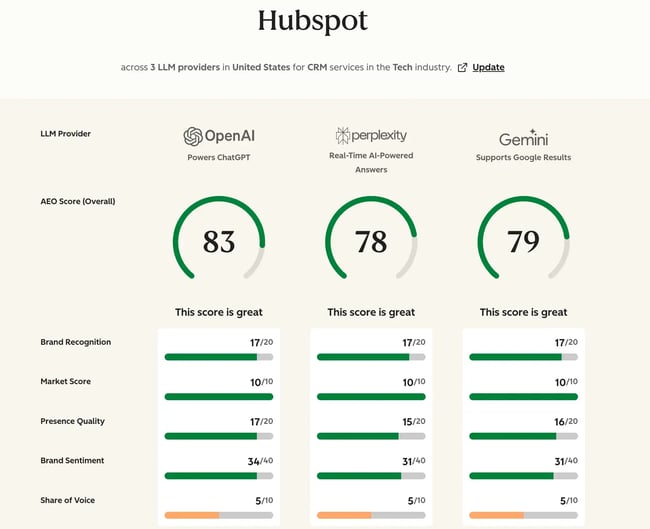
- AEO graderwhich assesses answer structure, schema readiness and clarity.
- AEO Guidethat provides structured recommendations to strengthen response authority.
2. Snippet and rich result performance
Snippet and rich result performance measures how often content is highlighted in featured snippets, FAQ panels, and structured SERP enhancements. For AEO, the clarity of the snippet signals that the page provides extractable answers. For SEO, snippets increase visibility and increase CTR.
How to track snippet and rich result performance as an AEO vs. SEO metric:
- Monitor featured snippet wins and FAQ rich results through Search Console.
- Add one FAQ page or Instructions for the scheme to improve eligibility.
- Track impressions and CTR for snippet-based keywords.
Helpful HubSpot tools for this AEO/SEO metric:
- Content Hub, Here users can add schemas and optimize the semantic structure.
- Website Graderthat identifies technical blockers that affect snippet eligibility.
- Marketing Hub SEO toolswhich can be used to validate metadata, headings and internal links.

3. No-click CTA engagement
Zero-click engagement measures actions taken directly in AI results or snippets – before users reach a webpage. AEO considers this a primary engagement metric; SEO traditionally evaluates what happens after the click.
How to track zero-click CTA engagement as an AEO vs. SEO metric:
- Add smart CTAs to reply blocks.
- Track CTA engagement in Marketing Hub.
- Log interactions with AI summary links when available.
- Attribute assisted conversions to these interactions using CRM data.
Helpful HubSpot tools for this AEO/SEO metric:
- AEO graderwhich confirms a response structure that supports CTA interfaces.
4. Organic keyword rankings and impressions
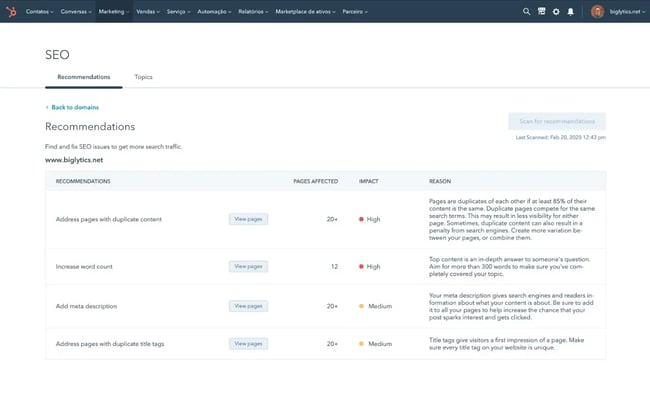
Organic keyword rankings and impressions measure how well entire pages perform in traditional SERPs. These metrics are based on strong content depth, internal linking and technical SEO.
They are important because high-ranking pages strengthen overall authority, and stronger authority improves the way AI systems interpret and trust related answer blocks.
How to track organic keyword rankings and impressions as an AEO vs SEO metric:
- Monitor rankings and impressions with HubSpot SEO Tools + Search Console.
- Track ranking stability across the topic cluster.
- Use ranking trends to refine answer definitions.
Helpful HubSpot tools for this AEO/SEO metric:
5. Performance of the topic cluster
Topic cluster performance measures how well a group of related pages performs overall and reflects the interconnected authority of the entire content ecosystem. Clusters support both AEO and SEO by strengthening the relationships between terms and concepts.
This metric is important because strong clusters increase the clarity of definitions and the stability of rankings, and strong clarity improves answer eligibility.
How to track topic cluster performance and impressions as an AEO vs. SEO metric:
- Check the performance of pillars and subtopics in Marketing Hub.
- Evaluate internal linking and terminology consistency.
- Ensure that cluster pages support the definitions used in response blocks.
Helpful HubSpot tools for this AEO/SEO metric:
- Marketing Hub SEO toolsform topic clusters, monitor performance and strengthen semantic structure.
- Content Hubwhich ensures consistent terminology and entity references across the cluster.

6. Conversion rate from organic and zero-click activities
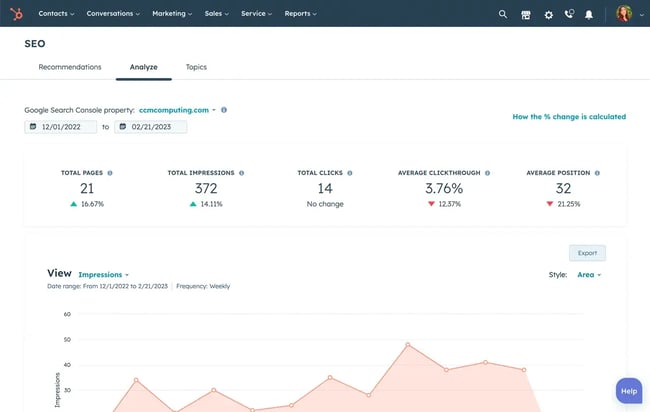
Organic and zero-click conversion rate measures how effectively content converts visibility into leads, trials, or sales. AEO influences early detection; SEO influences conversions in the evaluation phase.
This metric is important because it ties response visibility to actual results in the CRM, making it easier to demonstrate the value of AEO beyond impressions.
How to track conversion rate from organic and zero-click activities as an AEO vs. SEO metric:
- Attribute conversions from organic traffic CRM attribution.
- Monitor intelligent CTA clicks + AI overview interactions.
- Combine organic session conversions with zero-click influence.
Helpful HubSpot tools for this AEO/SEO metric:
Tradeoffs between Answer Engine optimization and SEO
Answer engine optimization compared to traditional SEO comes with practical trade-offs that content managers must consider when strategizing, structuring content, and scheduling. AEO improves the visibility of AI responses and voice responses, while SEO anchors visibility in SERPs and long-form content. Both are important, but each creates different operational requirements, content formats, and measurement challenges.
Below are the five trade-offs that are most important when deciding how to balance the two.
1. Content format flexibility
AEO requires concise, structured answers, while SEO allows for long details and greater narrative flexibility. Answer machines require precise definitions, direct wording and a predictable structure. SEO takes into account depth, storytelling, subheadings and multimedia.
- AEO perspective: Prefers short answers, consistent terminology and clear schema markup.
- SEO perspective: supports detailed guides, examples, images and broader context.
- The compromise between AEO and SEO: AEO tightens the format; SEO expands the amount and style of content you can include.
- What to consider: Start the pages with AEO-friendly answer blocks, then expand into SEO-rich depth further down.
2. Time and maintenance
AEO requires frequent updates to answer blocks, while SEO requires more comprehensive updates across entire pages or clusters. AI systems are evolving rapidly, so AEO-focused content must remain current and adapt to new wording patterns. SEO requires updating metadata, internal links, and content depth.
- AEO perspective: requires regular updates to wording, schema, and clarity of answers as AI models evolve.
- SEO perspective: requires regular updates to page depth, internal linking, and metadata across clusters.
- The compromise between AEO and SEO: AEO maintenance is rapid but ongoing; SEO maintenance is slower but more comprehensive.
- What to consider: Review response blocks monthly and update SEO pages or clusters quarterly.
3. Complexity of measurement
AEO relies on new visibility metrics, while SEO is based on established analytics frameworks. This makes measurement one of the clearest trade-offs between AEO and SEO.
- AEO perspective: Tracks AI overview attendance, voice responses and CTA interactions without a click.
- SEO perspective: Tracks keyword rankings, SERP impressions, traffic and on-page conversions.
- The compromise between AEO and SEO: AEO visibility is more difficult to quantify. SEO performance is easier to evaluate and compare.
- What to consider: Link AEO and SEO touchpoints to revenue using CRM-based attribution.
4. Impact on the user journey
AEO influences early-stage discovery, while SEO influences evaluation and conversion. Users often come across AEO content via AI responses or voice responses before they ever see the SERP. SEO remains crucial as users compare options, explore features, or make decisions.
- AEO perspective: increases top-of-funnel reach by showing direct answers in AI and voice results.
- SEO perspective: supports mid- and lower-funnel research, comparison, and conversion paths.
- The compromise between AEO and SEO: AEO creates awareness; SEO drives decisions and results.
- What to consider: High-performing content typically requires both AEO to be found and SEO to convert.
5. Level of control
AEO offers limited control over how answers are displayed, while SEO gives content managers more control over ranking, snippets, and page experience. Response machines retrieve content in ways that are not always predictable or transparent. SEO provides clearer signals and more established levers.
At a glance:
- AEO perspective: depends on the AI extraction logic, which varies depending on the system and update.
- SEO perspective: influenced by metadata, technical SEO, structured content and user experience.
- The compromise between AEO and SEO: AEO increases visibility but offers less control; SEO increases control but requires deeper investment.
- What to consider: Consistent terminology and schema markup increase stability for both AEO and SEO.
Frequently asked questions about Answer Engine optimization compared to traditional search engine optimization
Does AEO replace traditional SEO?
AEO does not replace traditional SEO. The two serve different functions and work best together rather than being treated in isolation as AEO vs. SEO. AEO improves visibility in AI responses, voice responses, and zero-click interfaces, while SEO boosts page rankings, traffic, and on-page conversions. Content teams typically achieve best results when both approaches support each other – AEO for early discovery and SEO for deeper evaluation.
Which schema types are most important for AEO?
The FAQ page schema and How-To schema are most important to AEO because they provide the structured patterns that answer engines rely on. These schema types help AI systems interpret definitions, steps, and short answers more consistently. Organizational, Article, and Breadcrumb schemas also support clarity, but FAQPage and HowTo schemas typically provide the greatest increase in answer extraction.
How often should answer blocks be updated?
Answer blocks should be updated monthly as AI models evolve faster than traditional SERP algorithms. The update ensures that the wording remains correct, the terminology remains consistent, and the schema remains consistent with current extraction patterns. For more in-depth SEO-focused pages, quarterly updates are usually sufficient unless rankings start to shift.
How do brands appear in AI overviews and language results?
Brands appear in AI overviews and voice results by providing clear, structured answers that match the way users phrase questions. Short definitions, consistent terminology, and supporting schemas increase the likelihood of extraction. Strong topic clusters, internal linking, and entity clarity further strengthen suitability for both AI and traditional search systems.
What is the best way to start AEO when the team is small?
Small teams should begin AEO by identifying the 10-15 most important questions and creating clear answer blocks for each. These blocks can be added to existing pages, supported with FAQ page schema, and measured using tools like HubSpot’s AEO Grader. From there, content managers can move to larger refresh cycles, cluster updates, and response level measurement.
Here’s how to start building a unified AEO and SEO strategy
A unified AEO and SEO strategy begins with the recognition that AI systems and search engines play different but equally important roles in today’s search. It’s no longer about choosing response engine optimization or traditional SEO. Modern visibility requires both.
In my experience, the biggest strategic shift was abandoning the assumption that visibility starts at the page level. AI systems often decide what to cite based on the first few lines alone, making clarity a strategic priority rather than something to gradually work toward. If the content never reaches the user, it doesn’t matter how strong the rest of the page is.
Once I understood how AEO and SEO work at different stages of the same journey, it became easier to approach them one at a time rather than as answer engine optimization compared to traditional SEO. AEO drives discovery by helping models interpret terminology and surface answers. SEO drives intent and evaluation by giving users the depth they need once they decide to click. Thinking in terms of discovery → intent resulted in far more consistent performance of content across both AI and traditional search interfaces.
If the goal is to develop a unified AEO and SEO strategy, it’s best to first understand whether your existing content is responsive. HubSpots AEO grader Evaluates answer clarity, schema structure, and AI visibility. Run your content through the free AEO Grader to see how well it performs in AI search.