
Email personalization leads to measurable sales effects. According to HubSpot’s 2026 State of Marketing Report, 93.2% of marketers say personalized or segmented experiences generate more leads and purchases, and nearly half are exploring AI to scale these efforts.
Many teams still rely on static merge tags or broad segments for personalization, which limits relevance and downstream conversion.
This guide explains what AI-driven email personalization is, how it works with unified CRM data in HubSpot, and how to implement it without sacrificing trust or deliverability.
Table of contents
What is AI-driven email personalization and how does it work?
AI-driven email personalization leverages artificial intelligence and unified CRM data to generate dynamic, 1:1 email experiences at scale. Instead of relying on static merge tags, it analyzes structured CRM data such as lifecycle stage, firmographic attributes, website behavior and interaction history to automatically customize subject lines, body copy, offers and timing.
Two types of AI make this possible.
Generative AI creates the message.
It designs subject lines, email content, and calls to action based on prompts and CRM context, allowing marketers to create segment-specific variations without having to manually rewrite each version.
Predictive AI determines goal setting and timing.
It evaluates behavior patterns to determine which contacts should receive a message, what content fits their journey stage, and when delivery is most likely to result in engagement.
When these functions are carried out within a unified platform, personalization becomes systematic. HubSpot’s email marketing automation tools combine intelligent CRM segmentation, AI-generated content, dynamic personalization tokens, and send time optimization in one environment. CRM data informs segmentation, segmentation guides content creation, and predictive systems refine delivery timing. Reporting then links the results to lifecycle history and revenue.
Personalization works at scale when content, data, and delivery logic share the same source of truth.
What basics do you need for AI email personalization?
AI personalization depends on reliable data and disciplined email practices. Without it, automation increases volume without improving relevance.
Teams need structured CRM records that include lifecycle stage, company attributes, engagement history, and subscription status in one system. Clean property definitions and accurate contact data enable segmentation and AI-generated messaging to reflect actual context rather than assumptions. Tools that support data synchronization and quality help maintain this integrity.
Pro tip: Verify the accuracy of the lifecycle stage before enabling AI drafting. When lifecycle fields are inconsistent or stale, AI-generated messaging reinforces these errors across segments.
You also need clear personalization boundaries and healthy, permission-based lists. Define which fields are appropriate for referencing, respect consent and subscription preferences, maintain suppression lists, and authenticate sending domains. With governance and deliverability standards in place, AI personalization can scale without compromising trust.
How to start AI email personalization with unified CRM data
AI-driven email personalization becomes practical when segmentation, dynamic content, and AI-generated copy occur in a single workflow. HubSpot Marketing Hub connects Smart CRM data, dynamic email engines, and AI Email Writers so teams can create, personalize, and measure campaigns without having to export lists between tools.
The process takes place in three steps.
Step 1: Create Smart CRM Segments.
Smart CRM Segmentation groups contacts based on lifecycle stages, firmographic data, and behavioral signals. Active lists are automatically updated when contact properties or interaction data change to ensure campaigns reflect current intent.
For example, a team might aim to:
- Marketing qualified leads who viewed the pricing page in the last 14 days
- Subscribers who have opened recent campaigns but not converted
Segmentation directly impacts performance. Show marketing data Segmented emails generate 30% more opens and 50% more clicks than non-segmented campaigns. Structured audience grouping gives the AI the context it needs for tailored messaging.
The same logic applies to sales approach. Even in cold email scenarios, grouping contacts by trusted business attributes improves relevance before personalization.
Pro tip: Start with a high-intent behavioral segment – such as pricing page visitors – before incorporating company graphics or predictive scoring. Clear intent signals outperform complex segmentation logic in early experiments.
Step 2: Connect segments with dynamic email content.
After defining segments, marketers apply dynamic modules and Personalization token to adapt the messages to the context of the target group.
Rather than swapping out a single name field, dynamic email content personalization allows entire sections of an email – value propositions, proof points, and calls to action – to change depending on lifecycle stage or company type.
Because all properties are in Smart CRM, personalization references verified data and not external spreadsheets. Segmentation determines who receives emails. Dynamic modules determine what changes within them.
Step 3: Generate segment-specific copy with AI Email Writer.
AI email author designs subject lines, body copy and calls to action directly in the Marketing Hub. Marketers can have the tool adjust the tone, highlight specific features, or generate multiple variations tailored to a selected segment.
For example, the same campaign can create different versions for pricing page visitors and long-term customers without the need for manual rewrites.
Since the AI works within the CRM, the interaction data automatically flows back into the contact records. Segmentation, content generation and reporting remain connected.
When intelligent CRM segmentation, dynamic modules and AI Email Writers work together, personalization becomes repeatable and measurable rather than manual and fragmented.
See how AI Email Writer works in HubSpot:
How to personalize send times and subject lines with AI
Subject lines and sending time determine whether a personalized email is even opened. AI can improve both, without additional manual work. AI-powered subject line generation reduces design time and enables structured experimentation across segments without the need for manual rewrites for each variation.
HubSpot’s AI email writer makes it possible for marketers Generate subject lines directly in Campaign Assistant and the email editor. Teams can enter campaign goals, audience context, and tone, then generate multiple subject line variations without having to start from scratch. Marketers can customize these designs to suit specific segments, such as: B. to MQLs evaluating prices or to customers who are about to renew. This structure makes experimenting with subject lines at scale more manageable.
HubSpot’s email marketing automation tools also support Predictive shipping time optimization for individual contacts. When activated, the platform analyzes past interaction patterns to estimate when each recipient is most likely to open an email. Instead of sending each message at a single scheduled time, delivery occurs within a defined window based on this optimization.
Varying the subject line and optimizing the sending time influence whether a message is opened at all. Teams should validate both with controlled holdouts and compare open and click performance before scaling changes across campaigns.
Pro tip: Test one lever at a time. When subject line structure, preview text, and send time optimization change simultaneously, it becomes difficult to isolate the performance drivers.
How to responsibly personalize marketing and sales emails using AI
AI makes it easier to scale personalization. It does not remove the need for judgment.
When AI tools generate content from CRM data, marketers can tailor messages to more segments and lifecycle stages than manual workflows allow. This speed increases performance. It also increases responsibility. Personalization should increase trust and clarity, not create discomfort or compliance risk.
Responsible, AI-driven email personalization balances performance, consent, and context.
Marketing vs. Sales: Different rules for emails.
Marketing emails and sales emails have different expectations.
Marketing emails usually go to subscribers who have opted in. In this environment, AI can personalize messages based on lifecycle stage, interaction history, and stated preferences. Segmentation improves relevance by matching content to behavior, which is why subscriber segmentation remains one of the most important Effective Email Strategies for Marketers.
Sales emails – especially cold calls – require more restraint. If recipients have not opted in for marketing communications, personalization should be based on professional context such as industry, role or company information. Effective cold calling is based on segmenting contacts by professional characteristics such as industry, company size or role before personalization occurs.
AI can help compose and structure these messages. This should not mean that you are familiar with personal information that was never shared.
Legal considerations and data limits.
Personalization must comply with current privacy standards and platform policies.
Data-driven marketing requires responsible handling of data. Regulations like GDPR and CCPA require transparency, consent management and clear opt-out mechanisms. Responsible data-driven marketing requires transparency, consent management and clearly defined opt-out mechanisms as regulatory standards evolve.
Teams using AI for email personalization should:
- Use of the data collected through express consent
- Maintain accurate subscription preferences
- Provide visible opt-out options
- Avoid scraping personal or sensitive information
Pro tip: If a personalization variable cannot be explained in one sentence (“You receive this because…”), you should reconsider its use. Transparency protects both trust and deliverability.
Use CRM context to personalize email sequences.
Effective personalization reflects signals that recipients recognize.
Lifecycle stage, prior engagement, and stated interests provide reliable context. An email that references a recent visit to a pricing page or a downloaded guide feels appropriate because it’s linked to observable behavior.
This alignment becomes more permanent within structured sequences. Drip campaigns perform best when they define a clear goal, segment audiences by lifecycle stage or behavior, and automate progress based on engagement signals. AI can support monitoring and iteration, but structural logic must come first.
Personalization should clarify why a message was sent. When the context seems expected, AI strengthens relevance. If it feels unexpected, it weakens trust.
A/B testing introductions and calls to action.
AI makes it easy to generate multiple versions of subject lines, introductions, and calls to action. This flexibility supports experimentation, but testing should remain structured and not reactive.
Teams can A/B test subject lines for open impact, introductions to increase engagement, and calls to action for downstream conversion. The order of emails is also important – adjusting the frequency of sending or the spacing between emails can affect response behavior and the health of the list. By monitoring response patterns and click-through and unsubscribe rates, you can determine whether personalization is strengthening the conversation or just driving short-term interaction.
As AI personalization expands in segmentation, timing, and content, attributing incremental impact becomes increasingly complex. Define clear KPIs and compare performance with controlled variations to find out what influences results. If a personalization tactic improves clicks but hurts engagement quality or list health, it is not sustainable.
Responsible experimentation protects both performance and long-term trust.
How to measure and optimize AI personalization for growth
AI-driven email personalization should improve measurable business outcomes, not just surface-level engagement. Intelligent CRM segmentation, AI-generated content, and send time optimization influence different stages of the funnel. A clear measurement framework ensures systems drive pipeline and revenue, not isolated metrics.
Tailor metrics to the funnel stage.
AI personalization impacts the funnel in layers. The measurement should reflect this structure.
Top of the funnel: commitment
Engagement metrics show whether AI-generated content and timing align with audience expectations.
Key indicators include:
- Open rate (subject line and timing effectiveness)
- Click-through rate (message relevance and clarity)
- Time to first open (delivery orientation)
When segmentation and AI copy are properly aligned to lifecycle stage and behavior, engagement metrics should reflect this precision.
Mid-Funnel: Conversion
Conversion metrics show whether personalization leads to meaningful actions.
Relevant indicators include:
- Form Submissions
- Demo requests
- Test activations
- Reply to sales emails
- Offer returns
If click-through rates are increasing but conversions are not, the problem may be with offer targeting, landing page experience, or lifecycle targeting rather than the quality of the AI content.
Bottom of the funnel: sales
Revenue metrics confirm whether personalization supports growth goals.
Teams should monitor:
- Marketing influenced pipeline
- Sales per campaign
- Revenue per email sent
- Customer lifetime value over time
McKinsey research shows that effective personalization can increase sales by 5-15% and increase marketing ROI by 10-30%. Results vary depending on the maturity of the implementation, which is why controlled measurement is essential.
Evaluating performance on these three levels avoids over-emphasizing open rates while ignoring the impact on revenue.
Create a simple scorecard.
AI-driven personalization requires consistent monitoring. A weekly scorecard creates accountability without encouraging reactive decision making.
A practical scorecard should include:
Performance metrics
- Open rate
- Click rate
- Conversion rate
Quality and deliverability metrics
- Unsubscribe rate
- Spam complaints
- Bounce rate
Rising unsubscribe rates or spam complaints as well as declining engagement signal that personalization is crossing boundaries of relevance. AI should increase clarity and added value for recipients and not create friction.
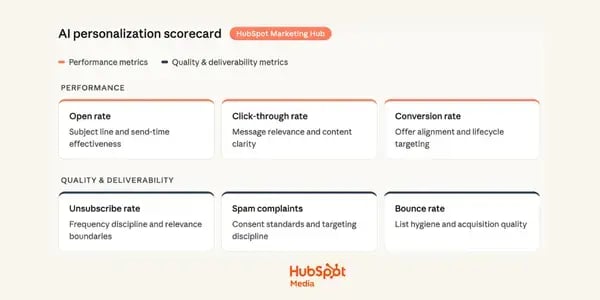
Tracking performance and quality metrics ensures that personalization efforts improve results without harming domain reputation or subscriber trust.
Conduct controlled experiments.
AI personalization introduces multiple variables at once: segmentation logic, dynamic content, subject line variations, and send time optimization. Without controlled testing, it will be difficult to isolate the effects.
Marketers should run structured experiments to measure incremental lift.
Practical testing approaches include:
- Sending an AI-personalized version to a segment and a static version to a corresponding control group
- Testing shipping time optimization based on a fixed delivery time
- Comparing dynamic content modules with unified messaging
Define KPIs before starting the test. Set a sufficient sample size and run campaigns over multiple cycles to reduce noise.
HubSpot’s reporting tools allow marketers to compare performance across segments and campaign variants directly in the CRM. Measuring incremental improvement—rather than absolute performance—clarifies whether AI personalization leads to meaningful improvement.
Because personalization often impacts multiple touchpoints simultaneously, controlled testing prevents profits from being incorrectly attributed to a single feature.
Iterate before results plateau.
AI shortens design time but does not eliminate the need for strategic refinements.
Performance may plateau for several reasons:
- Segments become too broad or outdated
- Content fatigue reduces click-through rates
- Due to seasonality, interaction patterns change
- Personalization logic no longer reflects customer priorities
A practical rhythm ensures sharp personalization:
Monthly
- Review performance at the segment level
- Update AI prompts and message perspectives
- Exchange offers if necessary
Quarterly
- Check the segmentation criteria in Smart CRM
- Re-evaluate the transmit power
- Review personalization limits and compliance standards
AI-driven email personalization performs best when segmentation logic, messaging strategy, and governance grow with audience behavior.
Should you use native AI or standalone tools for personalization?
AI-driven email personalization depends on where data, segmentation, and automation intersect. Many standalone AI tools can create email copy or suggest subject lines. The strategic question is whether these tools work inside or outside of a marketing team’s CRM.
When AI operates separately from customer data, marketers must export lists, manually reconcile segmentation logic, and re-import performance metrics. This fragmentation increases operational overhead and weakens the clarity of measurements.
The table below compares native CRM-connected AI to standalone tools on the dimensions that have the greatest impact on personalization accuracy, operational efficiency, and measurement clarity.
Native CRM AI vs standalone AI tools
HubSpot’s Marketing Hub embeds AI directly into Smart CRM. Segmentation, dynamic content, AI Email Writer, send time optimization and reporting occur in the same environment. AI email author designs subject lines and body copy in the context of lifecycle stage and engagement history, and campaign performance connects to pipeline reporting without the need for external tools.
This structure keeps personalization logic, delivery timing and performance measurement connected, reducing operational friction. Marketers can move from audience definition to sales analysis without having to rebuild context in separate systems.
Pro tip: Evaluate AI tools based on where performance data flows. When campaign results require manual reconciliation between systems, personalization insights deteriorate over time.
Standalone AI tools can support specific design workflows. But for teams running ongoing marketing automation, the native AI in HubSpot ensures personalization is operationally focused and analytically measurable.
Frequently asked questions about AI-driven email personalization
How do I avoid “creepy” AI personalization?
Avoid referencing data that the recipients did not knowingly share or that you did not expect to be used. Personalization should reflect professional context and observable behavior – such as lifecycle stage, recent downloads, or product interest – rather than inferred or sensitive information.
Clear boundaries prevent discomfort. Define which CRM fields are appropriate for messaging, respect subscription preferences, and avoid the appearance of familiarity beyond previous interactions. When personalization reflects context, the recipient recognizes that it feels relevant and not intrusive.
What data do I need to start personalizing with AI?
At a minimum, teams need structured CRM records that include lifecycle stage, company attributes, engagement history, and subscription status. Even a small number of reliable fields – such as industry, role, and recent site activity – can support meaningful segmentation.
AI-driven email personalization doesn’t require dozens of custom properties. It requires clean, centralized data and clear segment definitions. As interaction history increases, predictive timing and content variations become more precise.
Can I use AI personalization for cold emails?
Yes, but with restraint. Cold outreach should be based on professional, business-relevant data such as industry, company name or job function. Segmenting contacts based on common characteristics improves relevance without relying on personal data. AI can help craft tailored messaging for these segments, but should never assume prior approval or familiarity that doesn’t exist.
How do I keep deliverability high with AI personalization?
Deliverability depends on infrastructure and list hygiene, not just content quality. Teams should maintain authenticated sending domains, suppression lists, clear opt-in records, and consistent engagement monitoring. Many deliverability failures are due to fundamental neglect of list hygiene and engagement, rather than subject line wording or the use of AI per se.
Test AI-generated messages carefully. Monitor unsubscribe rates, spam complaints and bounce rates, as well as engagement metrics. If personalization increases clicks but also complaints, adjust the strategy before scaling.
Should I use a standalone AI tool or HubSpot’s native AI?
Standalone AI tools can help with email copywriting or generating subject line ideas. However, when personalization occurs outside of CRM, segmentation logic and reporting are often disconnected from the data that informs them.
HubSpot’s native AI tools are used in Marketing Hub and Smart CRM, where segmentation, dynamic content, send time optimization and reporting leverage a single data source. For continuous marketing automation, keeping personalization in a unified system reduces fragmentation and simplifies measurement.
AI-driven email personalization works when the strategy leads
AI-driven email personalization delivers impact when segmentation, content, timing, and reporting are based on a common foundation of data. Unified CRM records provide audience context, the strategy translates that context into lifecycle-specific messaging, and predictive systems adjust delivery timing based on interaction patterns.
HubSpot’s Marketing Hub supports this model by unifying segmentation logic, AI content generation, delivery controls, and reporting in a single environment – allowing teams to move from audience definition to revenue analysis without having to recreate context across disparate systems.
The strongest teams view AI as an extension layer. Trust, positioning and building long-term relationships require conscious human oversight. As AI expands a team’s ability to respond to real-world customer contexts, personalization strengthens both performance and credibility.