

Every company’s competitors show up in AI-generated responses, but do marketers know which ones, for which queries, and why? This is exactly what the AEO competition analysis is intended to convey to the teams.
Response engines like ChatGPT, Perplexity and Google’s AI Overviews do not rank pages. You cite sources. This shift changes everything about how competitive visibility works. A brand can be in the top three organic rankings and still be completely missing from the AI response that a potential customer reads first.
When brands don’t track who gets these citations and how, they make content and SEO decisions without telling half the picture. In this guide, you’ll learn how to conduct an AEO competitor analysis from scratch – what to measure, what tools to use, and how to turn the results into content that closes the gap.
Table of contents
What is an AEO competitor analysis?
AEO competitor analysis is about identifying which brands, sites and sources answer engines cite in AI-generated answers – and comparing a brand’s own visibility compared to competitors for the same searches.
AEO competitor analysis extends this practice outward – instead of marketing teams just optimizing their own content, they track it systematically who else The engines quote, WhyAnd what gaps they can close.
I’ve found that teams often confuse AEO with traditional SEO competitive research. The Key Difference: Traditional SEO competitor analysis tracks keyword rankings and backlinks. AEO competitive analysis tracked Citation frequency, Share answer, Corporate coverageAnd QA content depth across AI-generated answers. The metrics are different because the underlying competition is different – marketers and SEO leaders aren’t fighting for ranking position, they’re fighting to be the source an LLM trusts.
HubSpot AEO helps marketers track how their brand appears in response engines, showing which prompts competitors are citing instead and where they’re missing altogether, allowing teams to compare visibility against the competition in a single view.
Why AEO competitor analysis is important now
Emerging channels may favor leaders.
Looking for answers is not a future trend, so stop thinking like that. It is a current channel with increasing acceptance. Accordingly Search engine land58.5% of US Google searches and 59.7% of EU searches result in zero clicks. Meanwhile, ChatGPT has surpassed 900 million weekly active users.
Teams building AEO measurement and content infrastructure are now establishing citation authority before most competitors have even begun to track it.
I’ve spoken to SEO leaders who view AI visibility as a wait-and-see channel. My experience has taught me that this is a mistake. Citation patterns in LLMs tend to be sticky – once a model associates a brand with authority on a topic, that association persists across queries and model updates.
AI answers compress traditional SERPs.
Google’s AI overviews push organic blue links further down the page, often below the fold. For high intent questions – “What is the best CRM for startups”, “How to calculate customer lifetime value” – the AI answer Is the SERP result for most users. If a competitor is always mentioned in these answers and a brand is not, that brand is effectively invisible for these searches, regardless of its ranking.
Visibility shifts to quotes, entities and QA patterns.
Traditional search rewards sites. Reward answer machines Entities And Answer. Response engines rate content based on:
- Citation frequency. How often is a brand or URL cited for a specific group of topics?
- Corporate coverage. Does the content clearly explain what the brand is, what it does, and who it serves?
- Quality assurance depth. Does the content directly and completely answer the questions users are actually asking?
In this environment, competitive analysis means not only understanding what a brand’s competitors are publishing, but also what they are publishing how their content is structured And why LLMs prefer it.
HubSpot AEO breaks down which domains, content types, and sources answer engines cite the most, giving marketers clear insight into the content they currently prefer and what they need to create or optimize to improve visibility.
Impact on pipeline influence, support diversion and brand authority.
AEO visibility has downstream business implications beyond traffic. Brands that regularly appear in AI answers to purchase-stage questions—“best (category) software,” “how to choose a (tool),” “(Brand A) vs. (Brand B)”—influence purchasing decisions before a prospect ever visits a website.
Teams that track AEO competitor data also use it to identify support and product FAQ opportunities and deflect inbound questions by having AI-generated answers to common customer issues.
HubSpot AEO and AEO features in Marketing Hub Pro and Enterprise Provide a prioritized list of recommendations based on visibility and citation data, helping teams turn competitor insights into a clear plan to improve their presence in AI-generated responses.
How to conduct an AEO competitor analysis step by step
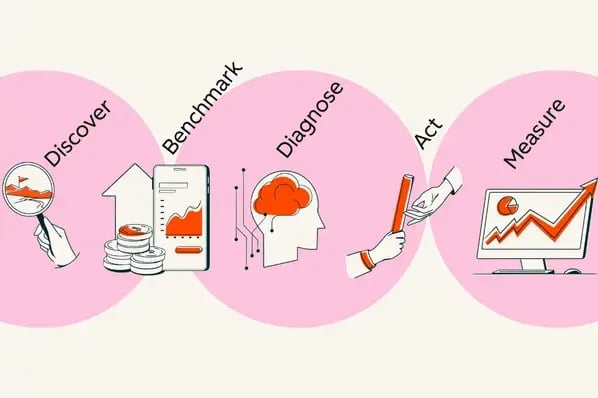
Step 1: Collect priority questions that search engines need to answer.
First, create a query set, which is a representative list of questions from your target audience that answer machines are likely to answer with a generated answer. These should include:
- Questions about the disclosure phase – “What is (category)?” / “How does (the process) work?”
- Questions in the consideration phase – “Best (tool type) for (use case)” / “(Brand A) vs. (Brand B).”
- Questions about the decision-making phase – “How much does (the product) cost?” / “Is (brand) suitable for (type of company)?”
- Support and FAQ questions – Common problems customers search for after purchasing.
Pro tip: Pull questions from existing keyword research, customer support tickets, sales call transcripts, and “People Also Ask” fields in Google. Marketers need 30 to 100 queries on their core topic clusters to get a statistically meaningful overview of response share. Integrated for HubSpot users AEO features in Marketing Hub Pro and Enterprise suggest follow-up prompts based on what they know about their company and customers.
Step 2: Test queries across chatbots and AI overviews.
Execute any query manually or with an AEO tool across multiple response engines: ChatGPT, Perplexity, Google AI Overviews and Gemini. Record:
- Which sources are cited (URLs and domain names).
- Which brands are mentioned by name (even without a citation link)?
- The structure and format of the answer (list, paragraph, table, step-by-step).
- Whether your brand appears at all.
At scale, AEO tools become essential here – manual testing of 50+ queries across four platforms is not sustainable. However, I recommend starting with manual testing for a brand’s top 10 to 15 search queries. It builds the intuition for Why It cites specific content that dashboards alone cannot provide you with.
With HubSpot AEOMarketers can automatically track prompts in ChatGPT, Perplexity, and Gemini and see which answers cite their brand and which competitors, and how visibility changes over time, without the need for manual testing.
Step 3: Extract cited sources and entities.
For each query, document each cited source and named entity in a sentence. Marketers create a map of:
- Which competing domains are cited most frequently? (Citation frequency by domain).
- What specific pages or content types are cited? (Blog posts, documentation, landing pages, research reports).
- Which entities are regularly mentioned? (brand names, product names, people, organizations).
Look for patterns. If a competitor’s blog is regularly cited but their product pages are not, that tells marketers something about which content format LLMs prefer. When a direct competitor emerges for its core requests, it represents a new competitive threat worth keeping an eye on.
Step 4: Classify competitors by topic cluster and response share.
Marketers should organize the citation data they collect by topic clusters – not just competitors. Calculate a rough value Share answer for each brand: the percentage of searches in a topic cluster that cite that brand.
This card reveals two things:
- Where the competition dominates. Topic clusters where a competitor has a high response rate and you have a low or no response rate – these are priority gap areas.
- Where the field is open. Topic clusters where no brand dominates – these represent fast mover opportunities where strong content can quickly build citation authority.
Here is an example of an AEO competitor analysis chart:
Step 5: Find out why competitors are winning.
This is the step most teams skip – and it’s the most valuable. Don’t just identify yourself The A competitor wins awards. Diagnose Why.
For each competitor site that regularly receives citations, analyze the following:
- Content format. Is it a listicle, a detailed guide, an FAQ page, a comparison article?
- QA structure. Does the site answer the question directly in the first sentence or two and then provide supporting details?
- Clarity of entity. Does the page clearly state what brand/product/topic it is, who it is for, and what problem it solves?
- Freshness. When was the content last updated? LLMs often prefer recently updated content on fast-moving topics.
- Schema markup. Does the site use FAQ, HowTo or other structured data?
- Backlink Authority. Is the site well cited by other authoritative sources?
What I like: The most actionable diagnostic question is: “If I were a language model trying to answer this question, would this page give me a clear, trustworthy, and complete answer?” This framework reduces much of the complexity.
AEO in HubSpot Marketing Hub generates prioritized, understandable recommendations with clear next steps, helping teams move from insights to action. Teams gain valuable insight into the interface they already know.
Tools and workflows for AEO competitor analysis
1. HubSpot AEO
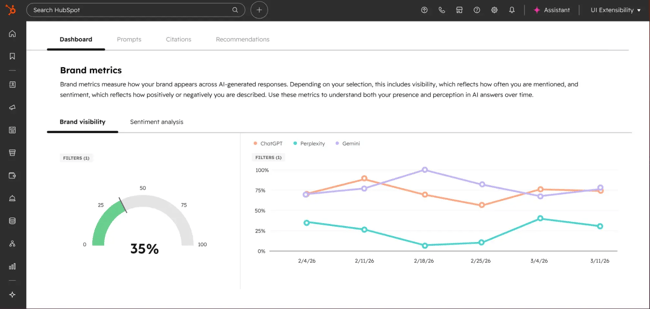
HubSpot AEO gives marketers a clear view of how their brand appears in major response engines like ChatGPT, Perplexity, and Gemini. It tracks share of voice at the prompt level, showing exactly which prompts cite a brand, which cite competitors, and where a brand is absent at all. Instead of requiring AEO expertise, it translates complex visibility data into understandable insights that teams can act on immediately.
The tool also links this visibility data to a concrete strategy. Marketers can track priority calls, analyze which sources and content types AI engines cite, and see where competitors are gaining their share of the voice. From there, HubSpot AEO generates prioritized recommendations with clear next steps, helping teams move from “We’re not showing up” to a defined plan to improve visibility.
What I like: HubSpot AEO doesn’t just uncover gaps – it shows marketers exactly where they’re losing ground to the competition and provides a prioritized, clearly articulated action plan they can apply immediately.
Best for: Marketers looking for a quick and accessible way to understand how their brand appears in AI-generated responses and get a clear plan of action.
2. HubSpot AEO features in Marketing Hub
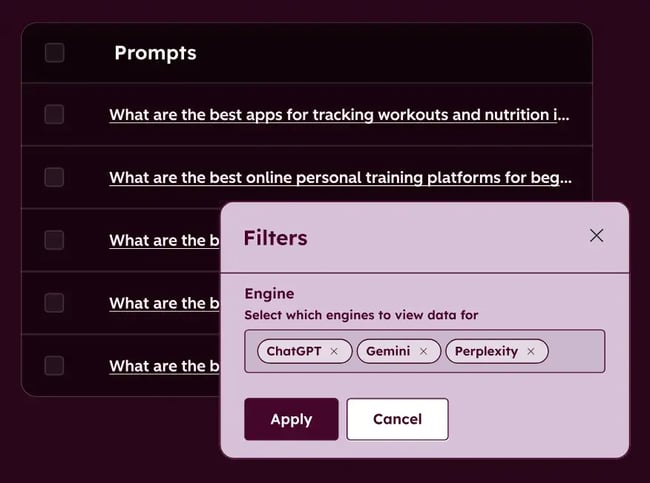
The AEO features in Marketing Hub Pro and Enterprise give marketers a clear overview of how their brand appears in response engines. Merchants can also get a visibility improvement strategy and the tools to execute it, all in one end-to-end system.
Because Marketing Hub is connected to HubSpot CRM, it automatically suggests the most relevant prompts based on a company’s industries, competitors, and customer segments, making insights more specific and actionable from day one. Recommendations also become more specific over time as more CRM data flows into the system.
HubSpot AEO uncovers visibility gaps in prompts and competitors, tracks response share trends over time, and connects AI visibility data to contact and pipeline reports in HubSpot CRM – allowing marketers to tie AEO performance to actual business results, not just impressions.
What I like: Teams with multiple hubs can take AEO suggestions from the Marketing Hub and implement them in the Content Hub. When the AEO tool discovers a gap, marketers can inform and publish new content.
Best for: Marketing teams looking to link AI visibility insights directly to execution by leveraging their CRM data and existing marketing workflows.
3. HubSpot AEO Grader
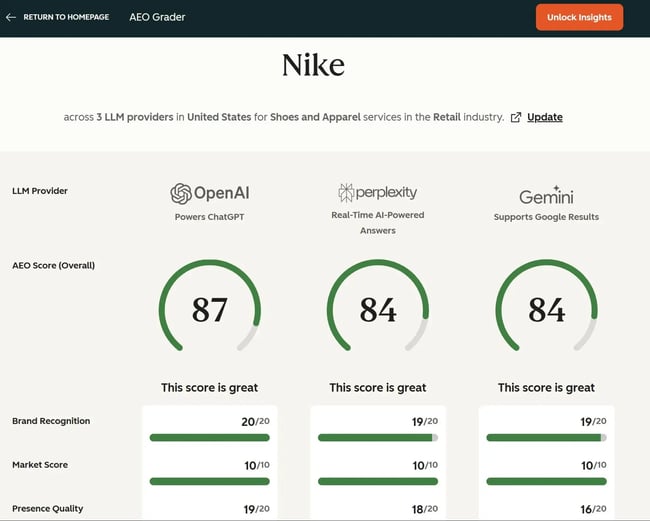
The HubSpot AEO Grader measures response engine visibility by measuring how often a brand appears in AI-generated responses compared to competitors. It gives teams an overview of their share of voice on key prompts and provides insight into how their brand is represented in those responses. This makes it easier to understand not only whether a brand is visible, but also how it performs in the competitive environment.
The tool acts as an entry point into AEO by helping marketers quickly assess where they stand and identify if any visibility gaps exist. Using this initial benchmark, teams can begin to understand which questions are most important to their organization and where they may need to improve their presence in AI-generated answers.
AEO Grader is also completely free, making it a great starting point for marketers just diving into AEO.
What I like: It provides a quick and seamless way to understand how often a brand appears in AI responses and how it compares to the competition, without requiring any setup or prior AEO experience.
Best for: Marketers compare AI visibility across the funnel.
4. confusion
Running priority queries directly in Perplexity gives marketers quick, free visibility into cited sources and response structure. Perplexity displays citations inline so you can easily see which competitor URLs deserve ranking.
Pro tip: Use Perplexity’s “Focus” modes (Web, Academic, Writing) to test how answer sources vary depending on query context.
Best for: Fast qualitative sample checks.
5. ChatGPT with Browse
ChatGPT’s browser mode displays quotes for recent searches. It is particularly useful for testing queries in the consideration stage and comparison queries (“Best X for Y” format), where brand mentions in AI responses have the greatest influence on purchase.
Best for: Testing conversational and mid-funnel queries.
6. Ahrefs
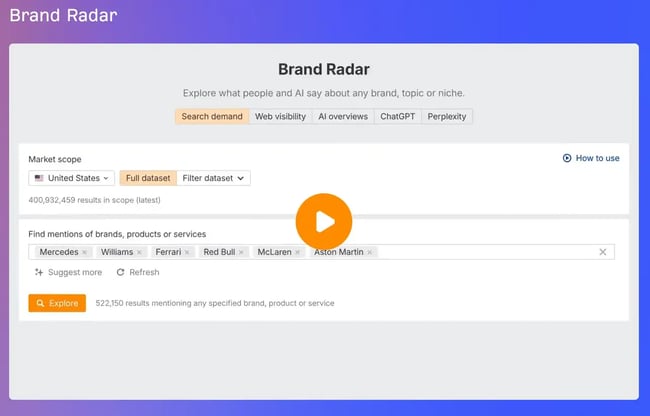
Traditional SEO tools remain valuable for diagnosis Why Certain pages receive AI citations – backlink authority, on-page optimization, and current authority signals all contribute to LLM citation patterns.
Use Ahrefs to review competitor pages that regularly receive citations and identify the SEO factors that could improve their AI visibility.
Best for: Combining traditional SEO data with AEO insights.
7. BrightEdge or Director
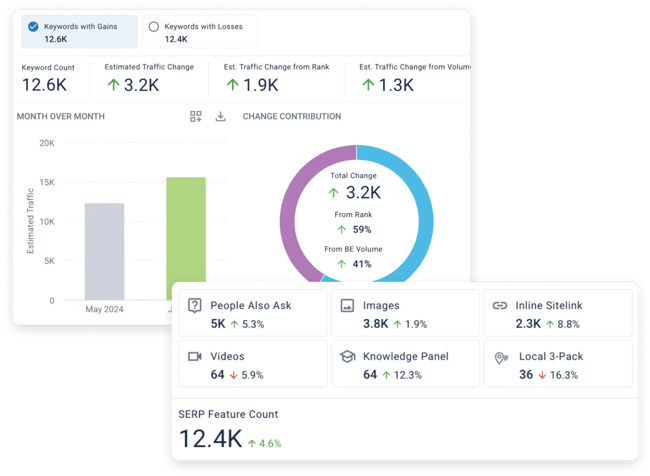
Enterprise SEO platforms are starting to add AI overview and response engine tracking features. These are best suited for large teams managing hundreds of topic clusters that require automated citation monitoring and executive-grade reporting.
Best for: Corporate teams conduct AEO at scale.
AEO competitive analysis metrics and dashboards
Measure response rate and citation frequency.
Share answer is the basic AEO metric: the percentage of queries in a defined set that cite a brand in the AI-generated response. It is the AEO equivalent of organic market share.
Track response proportion on three levels:
- In total. Across a complete query set.
- By topic cluster. To find out where a brand wins and where it loses.
- Over time. To measure whether content investments improve visibility.
Citation frequency is the raw number behind response share – how often a domain or URL is cited in the entire query set. A high citation count on a small number of pages may indicate an over-reliance on a few content resources. A high citation frequency across many pages signals strong thematic authority.
Track entity coverage and quality assurance depth.
Corporate coverage measures whether a brand, a product and key topics are explicitly recognized and correctly assigned by response machines. Test this by asking LLMs directly, “What is (your brand)?” / “What does (your brand) do?” / “Who uses (your product)?” If answers are vague, incomplete, or incorrect, marketers have an entity clarity problem that suppresses citations across their query set.
Quality assurance depth measures how completely a brand’s content answers the specific questions in its query set. Evaluate your competitors’ content and your own using one simple rubric:
- Does the page answer the question directly in the opening paragraph?
- Is the question addressed comprehensively (including follow-up questions and borderline cases)?
- Is the answer structured so that it can be easily extracted (headings, bullet points, numbered steps)?
Connect AI response visibility to conversions.
The hardest – and most important – challenge in AEO measurement is connecting AI visibility to the pipeline. I recommend a multi-touch approach:
- UTM tracking on quoted URLs. Ensure all high-priority content assets have UTM parameters so teams can track traffic from AI-related clicks in HubSpot or GA4.
- Self-reported attribution. Add: “How did you hear about us?” Insert fields into forms and track AI Search or ChatGPT/Perplexity as a source option. This captures influenced pipelines that never generate a tracked click.
- Dark social surveillance. Monitor branded search volumes and direct traffic trends alongside AEO investments – AI response visibility often drives branded searches that convert through direct channels.
Pro tip: In HubSpot, create a custom contact property for AI-mapped first touch. Over time, this creates a data set that correlates investment in AEO content with actual contact and deal creation.
AEO in HubSpot Marketing Hub Pro and Enterprise combines AI visibility tracking with CRM data, enabling response engine performance to be linked to contacts, pipeline and revenue in the same reporting system.
Turn AEO competitor insights into action
Once your analysis is complete, translate the results into a prioritized action list. Here are the most common and effective moves I’ve seen when analyzing AEO competitors:
- Create direct answer content for search queries with large gaps. If a competitor gets citations for 8 out of 10 searches in a topic cluster and you get 0, the quickest way to close this gap is to publish specifically designed QA content that directly answers these questions – structured with a clear question as the H2, a direct answer in the first 1-2 sentences, and supporting details below.
- Update and restructure existing pages. Many citation gains come from reformatting existing content rather than creating new content. Add direct answers, FAQ sections with schema markup, and clearer entity instructions to pages that are already indexed and authoritative.
- Create entity disambiguation content. If LLMs provide incomplete or inaccurate answers about your brand, post a meaningful “About” or “What is (brand)?” Structured entity information page. Amplify entity signals on your website and in third-party sources (Wikipedia, Crunchbase, press coverage).
- Prioritize topic clusters where response rates are low but competitive content is weak. Not every gap requires competition with a dominant rival. Look for clusters where no competitor has strong AEO content – these are the fastest ways to establish first-party citations.
- Add comparison and “best for” content. Comparison queries (“X vs. Y”, “Best (tool) for (use case)”) are high-intent and frequently answered by LLMs. If competitors are winning these requests and you aren’t, comparison content is a high-priority gap to fill.
- Strengthen internal linking between high-performing and low-performing pages. LLMs index current authority signals in a domain. Pages that don’t receive citations can benefit from stronger connections to your most cited content.
- Submit updated content to Google for re-indexing. For pages that you have updated to improve QA depth or entity clarity, use Google Search Console to request re-indexing to quickly capture updated signals.
- Track changes on a monthly basis. AEO’s competitive dynamics change as competitors release new content and LLMs are updated. Create a monthly cadence for running your priority query set and updating your response share benchmarks.
AEO Competitor Analysis Frequently Asked Questions
How often should you conduct an AEO competitor analysis?
I recommend a full AEO competitive analysis – running your complete query set, documenting citations, and updating benchmarks – on one monthly cadence for most teams.
In competitive markets or during active content campaigns, it’s worth investing in bi-weekly monitoring of top-priority query clusters. Unlike traditional SEO rankings, which are continually updated, AI citation patterns can change significantly after a competitor publishes new content or a model is updated. Therefore, regular snapshots are required to detect changes.
How do you map the pipeline impact of AI answers?
Pipeline attribution for AI responses requires a combination of methods because AI-generated responses don’t always generate trackable clicks.
Use URLs with UTM tags for quoted content to capture direct referral traffic, add response engines as a self-reported attribution option in forms and sales calls, and monitor branded search and direct traffic trends as a proxy for AI-driven awareness.
In HubSpot, you can create a longitudinal view of an AI-attributed pipeline over time using custom contact properties and deal source fields. In the HubSpot Marketing Hub, marketers can use CRM data, custom properties, and reporting tools to track AI-influenced contacts and get a clearer view of how AEO contributes to pipeline over time.
What is the best way to structure QA content for LLM citations?
The content format most commonly cited by LLMs is this Direct answer structure: The target question appears verbatim (or nearly verbatim) as an H2 or H3 heading; The first one to three sentences provide a complete and direct answer to this question. Supporting details, examples, and nuances follow in clearly organized subsections.
FAQ Schema markup reinforces this structure for Google’s AI overviews. The HowTo schema works similarly for process-oriented content. Avoid burying the answer in long introductions – LLMs prefer content that gets straight to the point.
When should you prioritize AEO over traditional SEO?
AEO and traditional SEO are not mutually exclusive – the same content quality signals that influence rankings (authority, depth, structured formatting, freshness) also influence AI citations.
However, if analytics show declining organic click-through rates despite stable or improving rankings, that’s a signal that AI answers are intercepting clicks for your target queries. In this scenario, investing in AEO content structure and citation optimization will likely yield higher marginal returns than pursuing further ranking improvements.
More broadly, for any query type where AI overviews or LLM answers already predominate, AEO should be the primary optimization lens.
From analysis to action: turning AEO insights into competitive advantage
AEO competitive analysis offers marketers something that traditional SEO could never fully provide: direct insight into how brands are actually recommended at the time of decision making. Instead of just optimizing for rankings, teams can now measure citation frequency, response share, and company presence – and understand exactly why competitors are showing up in AI-generated answers.
However, the real value comes from what happens next. Identifying gaps only makes sense if teams can respond quickly and consistently. This is where tools like HubSpot’s AEO Grader provide an easily accessible starting point to help marketers assess their current visibility and understand how they compare. From there, HubSpot AEO and AEO capabilities in the HubSpot Marketing Hub enable continuous tracking, competitor analysis, and prioritized recommendations—while connecting these insights directly to content execution, CRM data, and pipeline reports.
For teams investing in AEO, the path forward is clear: build a reliable query set, track response share over time, and continually refine content based on what AI engines actually cite. The companies that implement this process early can not only keep up with the competition, but also define how their category is represented in response engines.