

I’ve spent a lot of time testing free response engine optimization tools in dozens of brand audits, and the verdict is clear: you don’t need a five-figure tech stack to get meaningful AEO data.
Using the right free tools in the right order will tell you whether ChatGPT, Perplexity, and Gemini know your brand exists, what they say about it, and where you should focus your optimization efforts first.
The catch? Most marketers don’t know where to start. AEO is a newer discipline than SEO, the tool landscape is evolving quickly and it’s easy to confuse monitoring your AI presence with actually improving it. This guide clears up that confusion with a curated list of the best free and freemium options available today, as well as a practical workflow for implementing them.
Whether you’re an individual marketer conducting your first response engine audit or an SEO leader adding AEO to an established program, you’ll leave with a clear starting point – and a faster path from “invisible to AI” to “cited by AI.”
Table of contents
What are response engine optimization tools?
search has fundamentally changed. Most Google searches now end without clicks – around 60%according to current data. ChatGPT has been exceeded 900 million weekly active users. Google’s AI overviews appear in at least 13% of all searches. The question is no longer just “Do I rank on page one?” – it’s “Does AI even quote me?”
Answer Engine Optimization (AEO) is the process of structuring your content so that AI engines—like ChatGPT, Perplexity, Google Gemini, and others—can discover, understand, and cite it when generating answers for users.
While traditional SEO focuses on improving search results pages, AEO focuses on becoming the source of truth from which those results come.
Here’s the simplest way I’ve found to state the distinction:
- SEO asks: Can Search engines Rate this page?
- AEO asks: Can answer machines cite this page as an authoritative answer?
They complement each other and do not compete. Studies show this again and again 92% of AI overview citations Link to pages that are already ranking in the top 10 organic results. But ranking #1 on Google doesn’t automatically mean ChatGPT will mention you. AEO requires its own signals: direct answers, entity clarity, structured data, strong EEAT, and content formatted so that language models can cleanly extract meaning.
Response engine optimization tools help you measure and improve these signals. They fall into two main categories:
- Monitoring tools These track whether and how often answer search engines cite or mention your brand
- Optimization tools that check your content structure, schema coverage, and entity clarity to make you more quotable
The good news: you don’t need a big budget to get started. Below I’ve compiled the most useful free and freemium options available today.
Free response engine optimization tools you should try first
1. HubSpot AEO Grader
I absolutely recommend this as the first tool every team uses. HubSpot’s AEO Grader provides a free overview of brand performance in response engines. Teams can see their visibility and whether their brand is being described positively or negatively. AEO Grader creates a composite score out of 100 for the following dimensions:
- Sentiment analysis — How positively response machines describe your brand.
- Presence quality — The richness and reliability of AI’s understanding of you.
- Brand awareness — How frequently does your brand appear in relevant AI responses?
- share of the vote — Your reputation compared to direct competitors.
- Market position – Whether AI portrays you as a leader, challenger or niche player.
Research from HubSpot shows that even well-known brands often perform in the “average” range, meaning early, deliberate optimization creates a real window of competition.
In addition to your own brand, run the grader on two or three competitors. The share of voice and market position data becomes much more useful when you can see them side by side.
Best for: Marketers and brand teams want a quick, scored AI visibility baseline – completely free.
Free plan: Completely free. No credit card, no usage restrictions, no functions behind a paywall.
Complete your free AEO audit with HubSpot’s AEO Grader
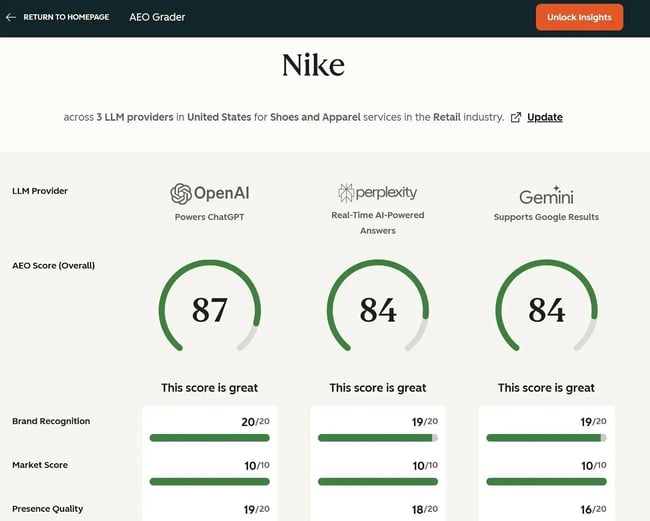
Pro tip: After a snapshot is taken, teams can use it HubSpot AEO to delve deeper into their performance. With HubSpot AEO, teams can see how often their brand is cited by AI and for what reasons. Teams can start with a free trial and then upgrade for $50 per month.
2. Google Search Console
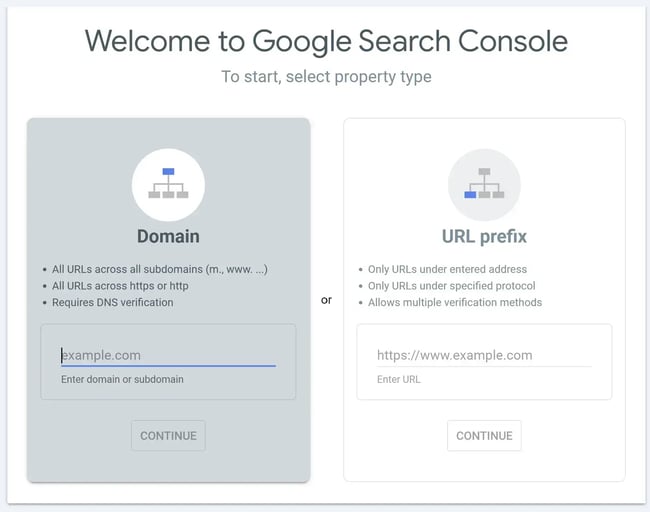
Google Search Console remains one of the most underused AEO tools available. In the performance report, filter for queries that start with question words (who, what, how, why, when, which). Deep impressions with low click-through rates often indicate that your content is appearing in AI overviews or featured snippets, but users are not clicking through.
What we like: The data comes directly from the Google index and is therefore crucial for diagnosing visibility gaps in the AI overview. The coverage and improvements reports also show structured data errors that would prevent response engines from interpreting your pages correctly.
Free plan: Completely free for verified website owners.
Best for: Identify which questions and queries lead to impressions – even if clicks don’t follow.
3. SE Ranking AEO tool (Free trial)
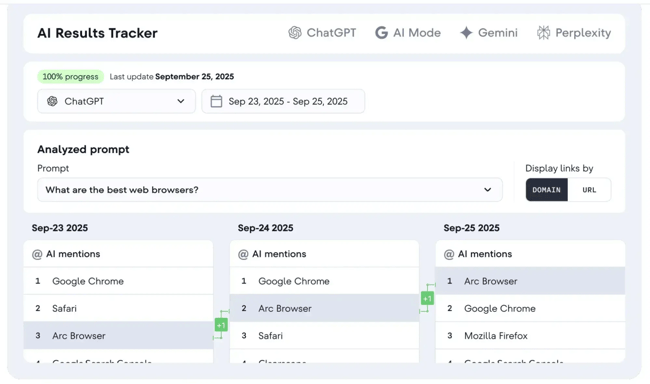
SE Ranking’s special AEO tool Monitors brand mentions and citations with built-in competitor benchmarking.
SE Ranking’s published study – covering more than 129,000 domains – found that pages structured into sections of 120-180 words receive 70% more ChatGPT citations than pages with shorter sections. This is the type of data that makes optimization concrete, not speculative.
What we like: The platform covers both Google AI Overviews and ChatGPT and is supported in development by Perplexity. Five separate trackers cover AI Overviews, AI Mode, ChatGPT, Gemini and Perplexity with platform-specific metrics.
The research behind the product provides direct insight into how you optimize.
Free plan: Free trial available. Paid plans start at $103/month with 100 daily AI prompts; The AI Search add-on ($71/month) opens the full tracker suite.
Best for: Teams looking to move beyond a one-time review to ongoing citation tracking via ChatGPT and Google AI Overviews.
4. Ahrefs brand radar (Free Tier)
Best for: Technical teams want to verify that LLM crawlers are actually accessing their website.
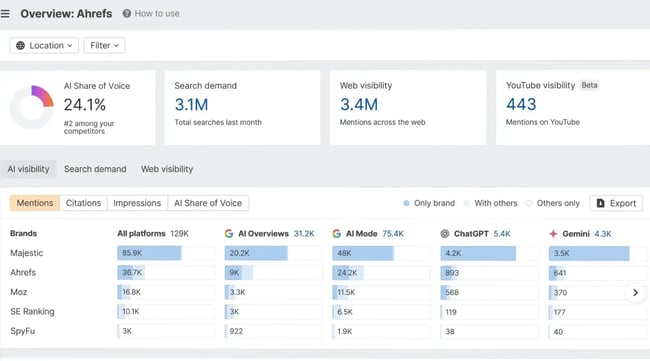
Before you can be cited by response engines, these systems must crawl your content. Ahrefs brand radar provides a free dashboard view of AI crawler traffic – including GPTBot (OpenAI), ClaudeBot (Anthropic), and PerplexityBot. Checking whether they are reaching your website is a prerequisite for any AEO strategy.
What we like: It bridges the gap between technical SEO and AEO in a way that no pure brand monitoring tool can. If your server logs show that these bots are being blocked or throttled, no amount of content optimization will make a difference.
Free plan: Basic AI crawler traffic monitoring available.
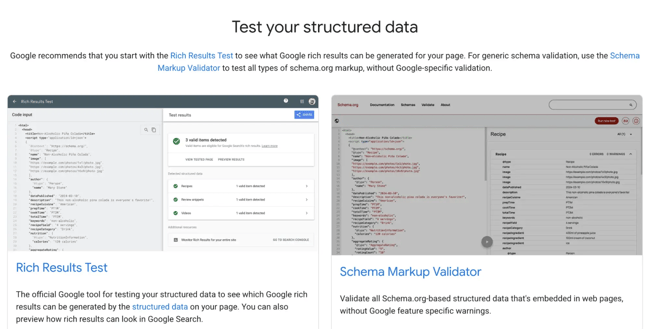
5. Googles Rich search results test + Schema markup validator
Structured data is the backbone of AEO. FAQ page, articles and product schema help answer engines interpret the structure of your content and not just its surface text. Googles Rich search results test (free) validates your schema implementation and shows which rich result types your page is suitable for.
The Schema markup validator Detects syntax errors before they reach production.
What we like: These are the only tools that give you deep validation of structured data from source. Neither an account nor payment is required.
Free plan: Both tools are completely free.
Best for: Diagnose and fix errors in structured data that prevent response engines from understanding your content.
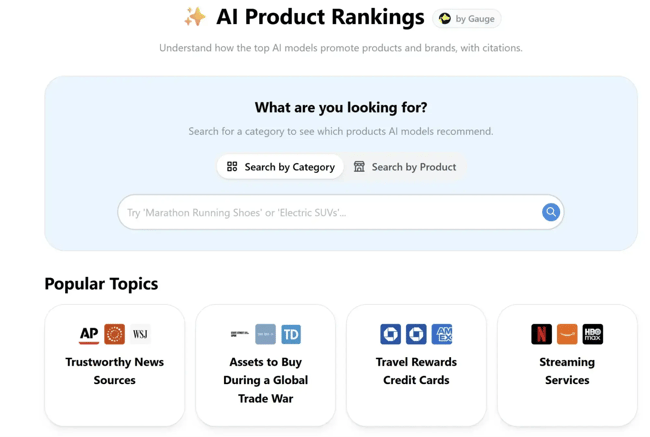
6. ProductRank.ai
ProductRank.ai Offers free brand visibility checks across major LLMs – useful for validating response machine citation presence beyond pure technical readiness scores. As a second opinion, I find it particularly helpful when the HubSpot AEO Grader produces surprising results.
What we like: Runs quickly, doesn’t require an account for basic checks, and covers multiple answer engines in a single pass.
Free plan: Free brand visibility checks available.
Best for: A quick, free cross-check of your brand visibility in the top LLMs.
7. ChatGPT, Perplexity and Gemini (Manual Prompt Test)
Before investing in a paid tool, spend 30 minutes testing prompts manually. Enter questions like:
- “What are the best (in your product category) tools?”
- “What are people saying about (your brand)?”
- “How does (your brand) compare to (competitors)?”
Introduce these ChatGPT, confusionAnd Gemini. Document what each platform says and which sources it cites. This manual exercise provides the intuition you need to intelligently interpret automated tool output.
What we like: It’s free, direct, and forces you to think in terms of prompts rather than keywords – the key mental shift that AEO requires.
Pro tip: Take a screenshot or export these results monthly. Response engines update as their training data evolves, so the same prompt may produce different results 60 days later.
Free plan: Free (free ChatGPT tier, free Perplexity tier).
Best for: Now, at no cost, understand exactly how response engines describe your brand and your competitors.
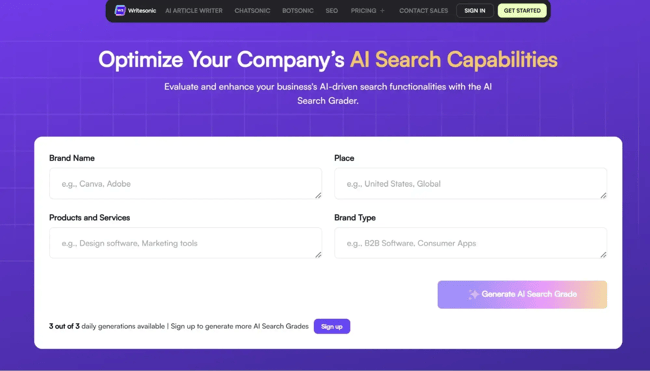
8. Writesonic AI Search Grader
Writesonic’s response engine optimization tool Tracks how reply machines cite your brand and, importantly, explains it Why You are missing citations and there are gaps in the content. It includes ChatGPT, Gemini, Perplexity and more.
What we like: Most monitoring tools stop at “You haven’t been cited.” Writesonic seeks to uncover the underlying content and authority gaps that explain why, making it more actionable for content teams.
Free plan: Free trial available; Paid plans vary depending on the functionality.
Best for: Content teams looking to combine visibility monitoring and content recommendations into a single workflow.
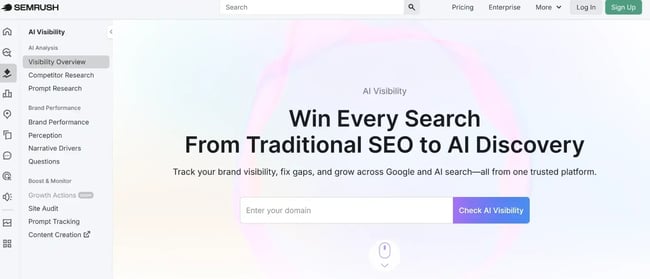
9. Semrush AI Toolkit (Freemium)
Semrush has added response engine visibility and AI overview tracking to its existing suite. If you already track keywords, backlinks, and site audits in Semrush, the AI Toolkit displays the AI overview presence for your tracked keywords and monitors changes over time.
What we like: By integrating with Semrush’s existing keyword and content data, you can see both traditional SEO and AEO signals in the same reporting environment – reducing the fragmentation that makes measurement frustrating.
Free plan: Freemium (limited queries on free plan; AI features available in paid plans).
Best for: Teams that already use SEMrush and want to extend their existing workflow to AEO without integrating a new platform.
Quick Comparison: Free AEO Tools by Use Case
A convenient workflow with free response engine optimization tools
The above tools are only useful if you use them one after the other. Here is the workflow I recommend for teams starting from scratch.
Step 1: Audit jour Answer machine vIsibility and Citations.
Tools: HubSpot AEO Grader, ChatGPT/Perplexity manual testing, Ahrefs Brand Radar
Start by establishing your baseline. Run HubSpot AEO Grader on your brand and your top two or three competitors. Write down your overall score and which of the five dimensions are the weakest.
Then run manual prompt tests in ChatGPT and Perplexity to see exactly what each platform says about you.
At the same time, check Ahrefs Brand Radar to confirm that LLM crawlers (GPTBot, ClaudeBot, PerplexityBot) are accessing your website. If they are blocked by your robots.txt or server configuration, this is the first thing to fix – everything else depends on crawlability.
What you should pay attention to: Is your brand even mentioned? Is the description correct? Which sources are cited? Which competitors appear when you are away?
Step 2: Structure PAge up to wIn AAnswer.
Tools: Google Search Console, Google Rich Results Test, Schema Markup Validator
Once you know your visibility gaps, address the structural signals that AEO depends on:
- Content structure. Add direct answers of 40 to 60 words immediately after question-based H2 or H3 headings. Research from SE Ranking found that pages with structured sections of 120-180 words achieve significantly more ChatGPT citations than shorter or less organized alternatives. Answer engines extract meaning from structure, not just keywords.
- Schema markup. Implement FAQPage schema for Q&A sections and article schema with clear author and publication date signals. Validate everything before publishing using Google’s Rich Results Test and Schema Markup Validator.
- Clarity of entity. Reference your brand name, key people and core product names consistently and completely. Answer machines build knowledge graphs around entities – ambiguous references create gaps.
- EEAT signals. Update author bios with credentials, add publication and revision dates, and link to primary sources. Answer machines place a high value on credibility signals when deciding what content to cite.
Pro tip: HubSpot Content Hub supports content creation, optimization, and publishing workflows with built-in AI-powered structuring – useful when scaling AEO across a large content library.
Step 3: Competitive analysis to find gaps and opportunities
Tools: HubSpot AEO Grader (competitor analysis), manual prompt testing, SE ranking
Return to your tools with a competitive lens:
- Run HubSpot AEO Grader on competitive brands. Compare your level of voice, mood, and narrative themes to theirs.
- Do the same prompts you used to test your own brand, but now focus on the person Is Show up when you’re not. What content do these competitors have that you are missing?
- Identify “prompt clusters” – groups of related questions that your audience is asking that aren’t answered on your website. Create content specifically for these clusters.
Connect AEO to revenue. The conversion data here is remarkable: visitors from response engines convert significantly faster than organic visitors. An analysis found that LLM visitors convert 4.4x better than organic search visitors.
To capture this, you need attribution – that is, linking AEO activity to your CRM and marketing reports. HubSpot Marketing Hub Pro and Enterprise Offer AEO features that connect response engine citations to the team’s CRM so you can see how response engine visibility impacts the business.
When to update your AEO tools
You’ve outgrown free tools when putting them together costs more than it saves. A few common signs:
- You need to track visibility week-over-week based on specific buyer prompts, not just re-run a one-time assessment
- Reconciling exports across multiple tools takes longer than acting on insights
- Raw scorecards aren’t enough – you need prioritized recommendations to know what to do next
- AEO deserves a recurring position in your strategy rather than relying on quarterly reviews
HubSpot AEO
For teams that want continuous monitoring without committing to a full marketing platform, HubSpot AEO continues where the AEO Grader leaves off. The tool tracks your answer engine visibility week-over-week in ChatGPT, Perplexity, and Gemini. Teams see what prompts competitors are citing and receive prioritized, understandable recommendations—no HubSpot subscription required.
It is the right solution for teams that want a sustainable AEO program without relying on a broader marketing platform.
AEO in Marketing Hub Pro and Enterprise
For teams already marketing in HubSpot – or for executives who want the gap and the action in the same place – AEO is built right in Marketing Hub Pro and Enterprise. HubSpot uses your existing CRM data to suggest prompts that are important to your business. Because recommendations increase as your CRM data grows, the longer you use HubSpot, the smarter the system becomes – something a separate monitoring tool can’t replicate.
If you’re already a HubSpot customer, AEO in Marketing Hub is the lowest-friction path. If not, HubSpot AEO gives you the visibility and recommendation tier at a price suitable for a single line item.
Frequently asked questions about free response engine optimization tools
How quickly can AEO take effect?
It depends on your starting position. Brands with strong organic authority and existing high-quality content typically see citation improvements within four to eight weeks of structural optimization.
Brands building from the ground up should expect three to six months of consistent publishing before response engines reflect these changes.
One important nuance: ChatGPT appears to have a freshness bias of about 30 days in its quotes, meaning regular content updates are more important than a single big optimization push. AEO-focused papers (cited in Perplexity and ChatGPT) tend to move slower than papers targeting Google AI Overviews, which are based on a newer index.
Do I need to change my entire SEO strategy for AEO?
No. AEO complements SEO – it doesn’t replace it. The basic work is the same: high-quality content, strong domain authority, clean technical infrastructure. The main difference is measurement and targeting.
SEO asks you to track keyword rankings and organic traffic. AEO encourages you to track brand mentions, citation counts, sentiment and share of voice in reply engines. You need tools that give you visibility into both channels.
The brands that thrive on response engines aren’t the ones with the biggest budgets. They are the ones who understand how response machines make decisions and create content that makes those decisions easier.
First steps
If I were starting from scratch, I would work through the following order:
- HubSpot AEO Grader — Get your baseline and see exactly how ChatGPT, Perplexity and Gemini characterize your brand. This takes about five minutes and costs nothing.
- Manual instant check – Spend 20-30 minutes running queries in ChatGPT and Perplexity. Document what comes back and which sources are cited.
- Google Search Console — Filter for question-based queries with high impressions and low clicks. These are your AI overview candidates.
- Google Rich Results Test — Validate your schema on your top five traffic pages.
- Ahrefs Brand Radar (free tier) – Confirm that LLM crawlers are accessing your website.
This is a complete diagnostic workflow for free. Once you know where your gaps are, you can decide whether investing in a paid monitoring tool is worth it.