
Google shared some interesting information about the future of search and AI in its most recent earnings call. While many focus on its first negative cash flow since going public 20 years ago, I think Google is well on its way to massive improvement.
Google’s revenue increased 24% year-over-year. The reason for the negative cash flow is because they spent $6 billion on property, plant and equipment this quarter. Specifically, 60% went to servers and 40% to data centers. This is the foundation for AGI and ultimately the goal they are working towards. There is also more demand for Google’s AI chips, models, and computing power than it can currently meet.
Did you know that Google isn’t actually primarily a search engine? If you don’t believe me, try one Search for “search engines”. You may see Bing and DuckDuck Go there, but you probably won’t see the Google.com homepage. I’ll tell you more about what Google’s ultimate goal is – creating artificial general intelligence – at the end of this article.
In case you missed it, here are mine Full conference call notes. And here is this PDF published by Google with all official statistics.
Watch the video for my thoughts on what we can learn from this recent conference call
Here are a few things that stood out to me about Google’s earnings release and recent announcements.
Gemini Flash-Lite: The new engine for AI overviews
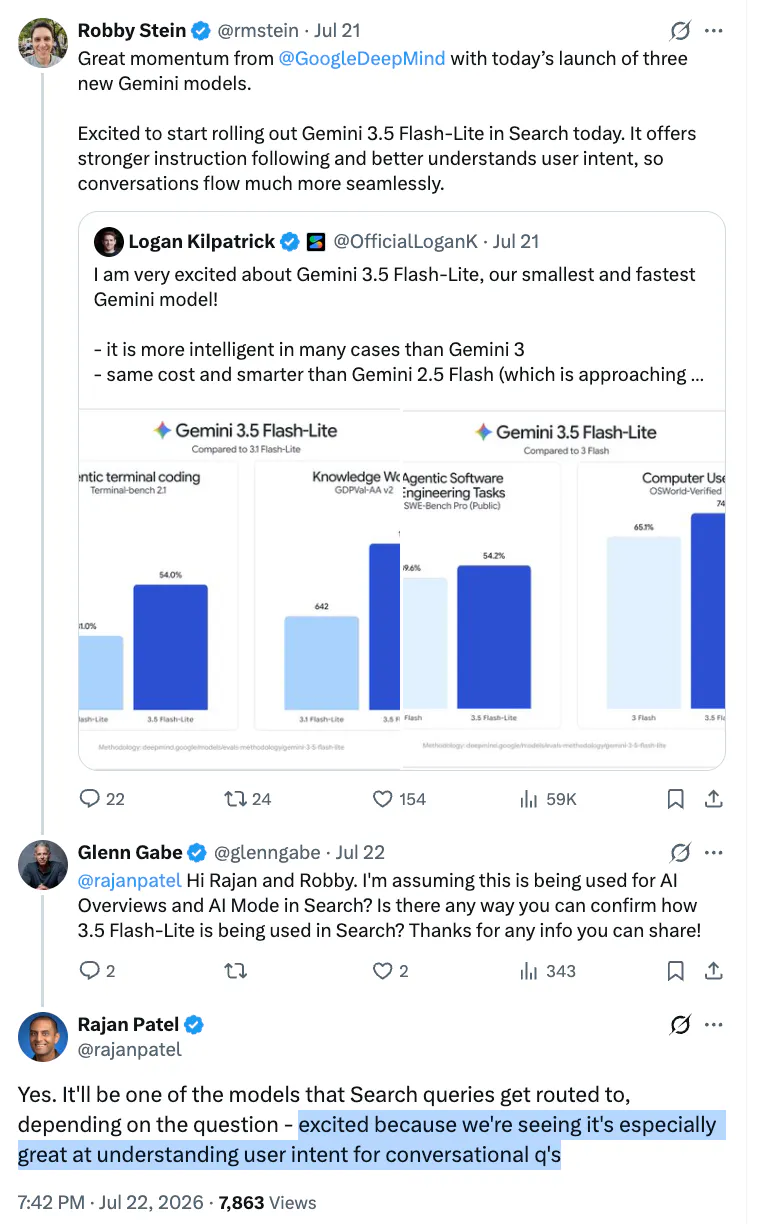
While we wait for Gemini 3.5 Pro, Google has released Gemini 3.6 Flash and 3.5 Flash Lite. It turns out 3.5 Flash-Lite is now the primary search query routing model for AI Overviews. Google is seeing significant improvements in understanding user intent in conversational questions. For website owners, this likely means AI Overviews will be even more capable of answering queries directly, potentially reducing traditional search traffic.
The rise of agent search
Google CEO Sundar Pichai continues to use the word “agent” in the context of search. Search is transforming from an information machine to an agent manager. They said we’ll see it soon Connections to apps like Instacart and Canva directly in the search interface. Instead of finding a recipe, the agent finds the ingredients, adds them to your cart, and orders them for you from Instacart. This represents a fundamental shift in the way people use the Internet.
I’ve recommended companies start developing tools that can be used by agents over WebMCP. Given Google’s recent push to use apps in AI mode, I’m now wondering if this part of the web will evolve like this?
In any case, a website will be valuable in the near future based on whether it helps people or their agents achieve something. We should all work on making our websites actionable. (With that in mind, I have a set of tools that I will release someday that you can use along with my website.)
Introducing Codemender and Cyber Security Models
One of the most interesting updates is Gemini 3.5 Flash Cyber in a tool called Codemender. This system remains active to find and fix code vulnerabilities in real time. As software evolves and AI models become more powerful, security must be automated. While these features are currently limited to enterprise users, I expect they will eventually become the standard for web security.
I actually think it’s possible that Google hasn’t released a version of Gemini as powerful as Anthropic’s Fable or OpenAI’s GPT-5.6 because they’re working on improving Gemini 3.5 Flash Cyber. Safety is so important. We saw that The US government has blocked access to Fable for security reasons. Perhaps 3.5 Flash Cyber is what is needed to make Gemini’s upcoming, more powerful models safe enough for widespread public use.
The future of online trading
Google mentioned several times in the earnings call the possibility of “Purchase with Google Pay” and particularly how people can do this by watching YouTube in their living room. I’m keeping an eye out for more sites that use this Universal trading protocol. So far I’ve only seen it on Wayfair and a few Walmart products in the SERPs. I have a few customers who are on Google’s waiting list for this feature.
Soon there will be more activities where agents not only shop for us, but also check out and pay!
The path to artificial superintelligence (ASI)
Google recently published a paper outlining this Roadmap from AGI to ASI. AGI is intelligence on par with a human, but ASI is a system that recursively improves until it surpasses the collective intelligence of humanity. In the earnings call, we were told that Google’s top priority is deploying its vast computing resources to ensure the company is at the forefront of this evolution.
When asked how Google decides computing power, he replied:
“In terms of allocation, the baseline we start with is what is needed to continue AGI development at the forefront.”
I’ll be releasing a video soon with more on Google’s push to develop AGI and ASI.
Final thoughts
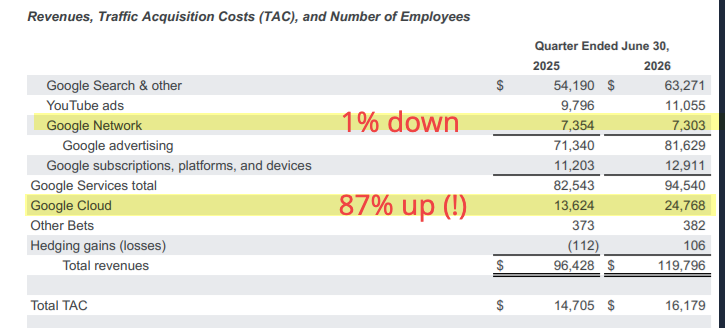
Here’s what I think is the most interesting news from the conference call: Google’s network ad revenue (also known as Adsense on websites) fell 1% compared to Q2 2025, but cloud revenue (sales of AI infrastructure and models) increased 87%. I think this is a stunning statistic.
Google marches on. We’re in the midst of a significant shift from Google being a place where you find information to a place where it helps you get things done.
Remember Google’s mission statement? The first part is to organize the world’s information. We have been supporting Google in this regard for many years. The second part is, to make it generally accessible and usable. This is the era of agent hunting we are now entering.