
Around 58% of consumers are now using AI answer engines for their product research every week – and that number is rising quickly. As AI-powered response engines like ChatGPT, Perplexity, and Google AI Overviews become primary discovery surfaces, content and SEO teams are asking the right question: Is there a connection between Backlinks and AEOor is it time to rethink the entire authority playbook?
The short answer is: contextually relevant backlinks are more valuable to AEO than high-volume, low-relevance links. But they no longer tell the whole story.
This post breaks down exactly how backlinks and AEO interact, where the differences between AEO and SEO show up in practice, and what a balanced authority strategy currently looks like.
Before diving in, remember that tools like HubSpot AEO are specifically designed to help marketing teams track and improve their brand visibility across AEO – more on this shortly.
Table of contents
Backlinks and AEO: What has changed and why it matters
Traditional search engines use backlinks as their primary authority signal. A link from a trusted domain to your site is, at its core, a vote of trust – one that is weighted by the linking domain’s own authority, the relevance of the context, and the anchor text used. Answer machines do not abandon the traditional logic of Off-page SEO. But they layer a lot more on top of it.
When an AI answer engine like ChatGPT or Google’s AI Overviews puts together an answer, it doesn’t simply rank pages based on backlink count. The point is to identify sources that can reliably substantiate the answer. These sources are:
- Current content
- Content that is clearly structured
- Content is always assigned to the correct entities and topics
For content and SEO teams, this means that a high authority backlink profile is a necessary but no longer sufficient requirement for AI visibility. This is exactly the gap that HubSpot AEO aims to close. The tool gives marketing teams a central place to monitor how often their brand appears in AI responses – and what content is driving (or missing) that visibility.
Backlinks and AEO: Are Links Still Moving the Needle?
Backlinks are still important for AEO, especially considering that SEO is the foundation of any good AI search strategy. However, the type of link is far more important than it used to be.
Nathaniel Millermarketing director at Ashbrook Technologies said in a recorded interview for the Found in AI Podcast: “The companies that perform best across all AI platforms tend to be those with strong authority and strong backlink profiles.” He added: “If you’re not getting qualified traffic from that link, it’s essentially a logo punch. The real value is in relevance and authority – not just size.”
In traditional SEO, strong domain authority and link volume influence rankings. But with AEO, it’s much more about relevance and semantic alignment between the linking source and your brand’s topic cluster. This is how different link types affect their influence in AEO compared to classic SEO:
|
Link type |
Classic SEO influence |
AEO influence |
|
Link with high DA and low relevance |
High (Domain Authority Boost) |
Low (weak semantic signal) |
|
High DA link with high relevance |
Very high |
Very high |
|
Link to industry publication |
High |
High – especially if the publication is a fundamental source of AI |
|
Niche blog link with strong thematic depth |
Moderate |
High – semantic proximity strengthens the authority of the entity |
|
Directory or aggregator link |
Low – moderate |
Minimal |
|
Co-quote in the expert tour |
Indirect |
High – positions the brand next to recognized authorities |
In addition to backlinks, mentions and co-citations are also important. A brand mention – even one without a hyperlink – tells an AI system that a source refers to your brand in a specific thematic context. When this happens repeatedly in credible sources, it creates the kind of authority that influences the likelihood of citation in AI-generated answers.
Even though brands with a strong backlink profile are often cited, that doesn’t mean the AI-generated answer is linked to the brand. As Charlie GrahamFounder of RivalSee, shared on the Found on AI PodcastApproximately 85% of brands mentioned in ChatGPT responses have no citation link at all. Users see the name, remember it, and then search for it.
This downstream effect is a real signal of authority. It simply doesn’t show up in traditional analyses.
Pro tip: Using HubSpot AEO, you can determine which of your pages are being cited and which link types are actually making the difference in AI-generated answers.
Differences between AEO and SEO in practice
AEO extends SEO rather than replaces it, building on SEO fundamentals and extending them in an environment where the interface – and scoring criteria – are significantly different.
SEO is primarily about ranking: the goal is to appear in search results for a specific query, attract a click, and drive traffic to a page. AEO is all about answers, about becoming the source an AI system trusts enough to quote, paraphrase, or quote when a user asks a question.
This difference in goals leads to different structures, success metrics and optimization priorities. And tools like HubSpot AEO are designed to measure citation-based visibility alongside traditional search metrics.
Goals, structures and KPIs: AEO vs. SEO
|
dimension |
SEO |
AEO |
|
Primary goal |
Rank in search results |
Earn citations in AI-generated answers |
|
Priority of content structure |
Keyword placement, internal linking |
Direct answers, factual statements, FAQ blocks |
|
Authority signal |
Backlink profile |
Backlinks + Mentions + Entity Clarity + Structure |
|
Primary KPIs |
Organic traffic, ranking position, CTR |
AI citation frequency, brand mention share, in-depth query coverage |
|
Optimization goal |
Single page, keyword cluster |
Brand unity, topic authority across multiple pages |
|
Measuring tools |
Google Search Console, Rank Tracker |
AI visibility tools, AI performance in Bing Webmaster Tools, HubSpot AEO |
The organizations that achieve the best AEO results do not conduct AEO instead of SEO. They execute their SEO programs more precisely—prioritizing quality over volume, clarity over keyword density—and layering entity and mention strategies on top.
Pro tip: HubSpot AEO helps marketing teams measure AI visibility and identify optimization gaps. If you run an SEO and AEO program simultaneously (which you should), combining your existing SEO tools with HubSpot AEO for citation-based performance will give you a clearer picture of how your content is performing on both channels.
Need help keeping up with all the acronyms and definitions? Check this out SEO glossary.
How links and mentions are interpreted by response engines
Response engines collectively evaluate links, brand mentions, entity clarity, and page structure.
This means that when an AI answer engine like ChatGPT, Perplexity, or Google AI Overviews puts together an answer, it doesn’t necessarily rely on it Google’s traditional ranking factors. Instead, it attempts to base its answer on trusted source material from content or brands that reliably present accurate information on the topic at hand. This is how it works.
1. Source analysis
AI systems read and index content from across the web, training or retrieving large corpora including news sites, blogs, publications and structured data sources. What is parsed is determined not only by backlinks, but also by crawlability, freshness and the semantic structure of the page itself.
2. Authority weighting
Authority weighting works differently than PageRank. A response engine doesn’t count links to determine a score. This assesses whether content – or a brand – appears consistent and credible in contexts relevant to the search query.
A brand that is quoted in 10 major industry publications, mentioned on expert panels, and consistently associated with a specific topic area has more AI authority than a brand with a strong backlink profile built primarily through directories and generic reach.
3. Signal merging
Response engines do not evaluate links, mentions and page structure in isolation. They combine these signals into an overall assessment of source reliability for a particular topic.
A page can have strong backlinks and still not be cited if its content is ambiguous, outdated, or poorly structured. Conversely, a page with modest link authority but exceptional clarity – clear headings, direct answers, supporting data, consistent entity signals – may be cited ahead of more technically powerful competitors.
Backlinks build trust, but structure and timeliness determine whether a page is actually cited. HubSpot AEO maps these aggregated signals so marketing teams can see where they are strong and where gaps are costing them citations.
What signals beyond links are most important?
Backlinks are an input in a larger authority graph. In addition to link authority, three other signals most directly influence the likelihood of an AEO citation – and a fourth factor, the way they interact with backlinks, ties them together.
|
# |
signal |
What it is |
Why it matters to AEO |
|
1 |
Unlinked brand mentions |
Your brand name appears in credible sources without a hyperlink |
Maps your brand to topic clusters; builds entity authority that makes you an obvious citation choice |
|
2 |
Co-quotes |
Your brand will be mentioned along with other brands or sources in the same content (no link required) |
Signals to answering machines that you belong in a reputable society; one of the most underused AEO tactics |
|
3 |
Clarity of entity |
Consistent naming, structured data (organization/person/sameAs schema) and a clear area of expertise across all channels |
AI engines won’t name a brand they can’t confidently identify – entity confusion is a silent AEO killer |
|
4 |
Interaction with backlinks |
How all three signals above work in combination with your backlink profile |
No signal wins alone; The brands that receive the most AI citations have all four firing at the same time |
|
+ |
High quality content |
Content that is really useful, clear and well structured |
“If your content isn’t great, no amount of backlinks will help.” |
1. Unlinked brand mentions
Unlinked brand mentions reinforce AEO’s authority signals. Every time a brand name appears in a credible source – without a hyperlink – it is registered as a mention signal. AI systems use this to map which brands are associated with which topics.
A brand that is frequently mentioned alongside a topic cluster (without requiring a link to convey the signal) builds what one might call entity authority—the kind of broad recognition that makes a brand an obvious citation choice.
2. Co-Citations
Co-quotes help answer search engines associate a brand with a topic. A joint citation occurs when two brands or sources are referenced together in the same content – not linked to each other, but mentioned in the same context.
For response engines, co-citations are a strong semantic signal: they suggest that a brand belongs to the same relevant company as the other brands mentioned. Regular co-citation with recognized experts or respected publications within a category is one of the most underused AEO tactics.
3. Entity clarity
An entity in AI search is a clearly defined, consistently described thing – a brand, a person, or a concept. As Lars Lofgren, SEO consultant for enterprise brands like Automattic and Perplexity, said Found on AI PodcastWhat matters is not just a brand’s domain, but the primary entity of the company – and AI engines essentially map the relationships between everything they can search.
Answer engines are far more likely to cite brands with strong entity clarity, meaning those brands have:
- Consistent naming conventions across all channels
- Structured data (organization, person and SameAs schema)
- A clear, recognizable area of expertise
If an AI system can’t reliably determine who a brand is, what it stands for, and verify that information across channels, it won’t risk citing it. Entity confusion is a silent AEO killer. HubSpot AEO helps marketing teams identify these gaps early. It shows which pages are being cited and shows prioritized recommendations on where content can be created, updated or improved.
4. Interaction with backlinks
A strong entity with a high mention share but no backlink profile is harder to verify. A strong backlink profile without entity clarity or mention frequency will still underperform in AI citation environments.
The brands that receive the most AI citations tend to have all four signals triggered simultaneously: authoritative links, consistent mentions, strong co-citation associations, and a clearly defined entity. Let’s not forget about quality content either. As Miller put it, “If your content isn’t great, no amount of backlinks will.”
How to structure content for backlinks and AEO citations
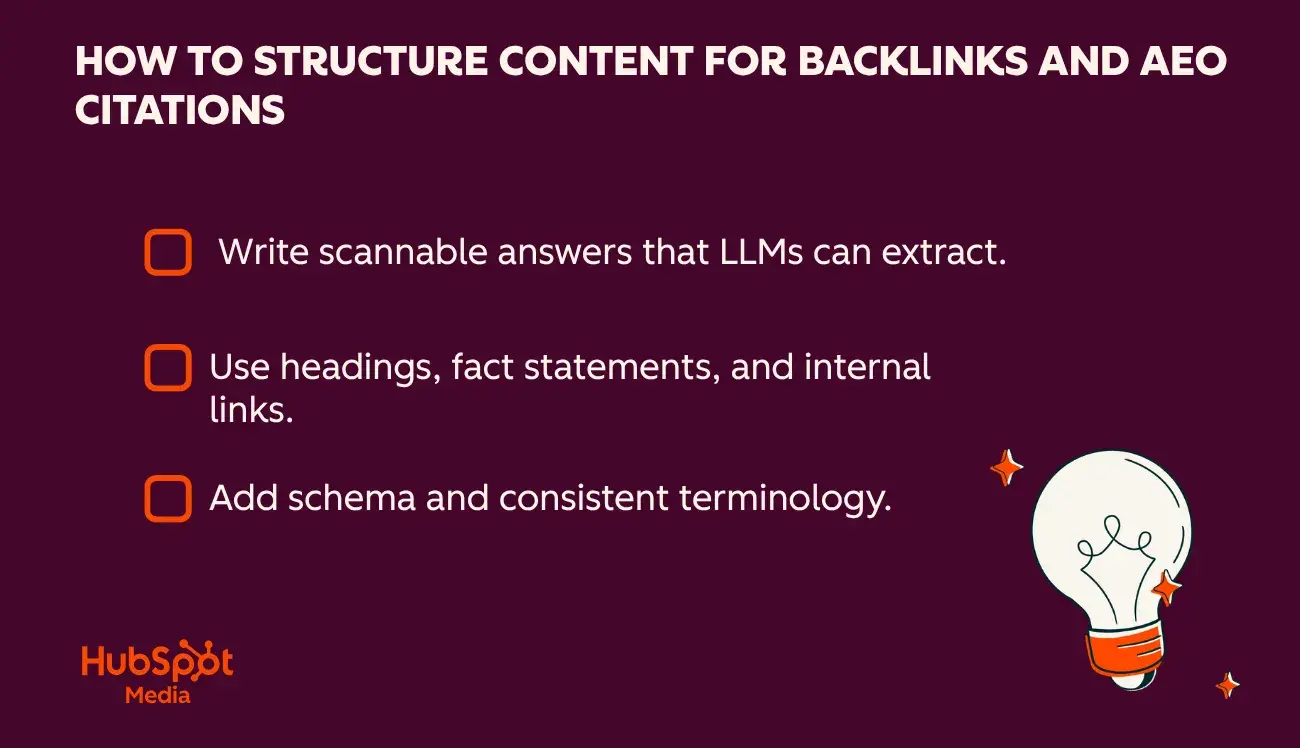
AI systems retrieve from indexed content, and content that is easy to analyze, clearly organized, and responds directly to questions is systematically more likely to be cited. How to structure content for backlinks and AEO citations.
1. Write scannable answers that LLMs can extract.
Scannable content improves LLM extraction and citation likelihood, and each major section of a page should contain a direct, self-contained answer to the question implied in the heading.
Provide the answer and then support it with context, data, or examples. Language models are far more likely to extract and quote content that follows this pattern than content that buries the answer in a narrative. In practice this means:
- Open each H2 and H3 section with a declarative sentence that directly addresses the query
- Use short paragraphs (3 to 4 sentences maximum) that can stand alone as a complete idea
- Avoid filler language that requires the reader – or the model – to infer the actual point
Pro tip: Pages that follow the “answer first, evidence second” structure perform better in both AI citations and featured snippets. You can use HubSpot AEO citation tracking to verify that your pages are being extracted correctly. It shows exactly which pages AI engines are pulling from and which content types and source categories are triggering these citations.
2. Use headings, factual statements and internal links.
Add:
- Clear heading hierarchies, like H2s and H3s to help AI systems understand the thematic structure of a page.
- FInstructions and question-and-answer blocks Make it easier for AI systems to summarize content.
- Internal links Adjust equity within your site and strengthen entity relationships between related pages.
When a response engine crawls your content, a dense internal link structure around a topic cluster signals thematic depth – the “A” in it FSA framework (freshness, structure, authority).
3. Add schema and consistent terminology.
Schema markup clarifies the purpose and content structure of the page. This is machine-readable metadata that makes clear the purpose and structure of a page for both search and AI systems. The most valuable schema types for AEO include:
- FAQ page – Highlights question and answer blocks for easy extraction
- HowTo – Structures procedural content in a format that AI systems can follow and cite
- Article – signals content type, author and publication date
- Organization/person – establishes entity identity and links to authoritative profiles (sameAs)
A consistent terminology is just as important as a schema. If a brand alternates between using three different names for a concept on its website, it becomes more difficult for AI systems to establish a clear entity mapping.
Choose the canonical term for each concept and use it consistently across all pages, social profiles, and external mentions.
Pro tip: Once your schema is set up, HubSpot AEO will help you monitor whether your pages are being cited in AI responses. This gives teams a signal that content is being recognized and displayed by AI engines.
How to create cross-platform backlinks and AEO mentions
1. Prioritize formats that AI engines love.
Certain content formats receive disproportionately more AI citations than others. This includes:
- Original research and data reports – AI systems gravitate towards primary sources with verifiable statistics
- Expert summaries and attributed quotes — Position brand voice in a credible company
- FAQ and How-To content – corresponds directly to the question-answer structure that AI systems are designed to extract
- Comparison and versus content – Captures decision-stage queries where AI-driven discoveries are most common
Pro tip: If you publish original research, include a stand-alone “Key Findings” section at the top with three to five clearly labeled statistics. This format is easy to extract and significantly increases the likelihood of citation.
2. Earn relevant links and co-citations with original research.
Original research is the most efficient way to get backlinks and co-citations at the same time. A well-designed study or data report gives other publishers a reason to point to a brand as a primary source, and in the publications that cover it, the brand is often mentioned alongside other respected voices in the category. This creates the co-citation signals that strengthen AEO authority.
Beyond research, digital PR – earned media placements, expert commentary in industry publications, and podcast appearances – is a great backlink strategy that provides both link authority and authentic mentions.
As Miller put it, “Digital PR is the fastest way to build momentum.” A single well-placed expert quote in an industry publication can generate a backlink, brand mention, and shared citation with other recognized experts in a single placement.
Best for: Brands in competitive categories where link volume alone has not changed AEO visibility – original research and digital PR create nuanced authority signals that generic content cannot.
3. Get involved where answers arise.
AI systems don’t just index branded content. They refer to places where authoritative conversations take place, such as:
- Quora
- Niche forums
- Media with structured metadata
- Wikipedia
- Crunchbase
Participating in these channels – providing expert commentary, publishing thought leadership, appearing as a guest on podcasts – expands a brand’s presence across the sources AI systems are designed to trust.
Once a brand has established credibility in the industry and built relationships with the people behind the usernames, others are more likely to ask them for support for their own work – leading to another mention on a third-party site.
“It’s a lot of relationship building,” Miller said. “Once you join a company or connect on LinkedIn, they’re much more likely to reach out and say, ‘Hey, I’m working on this article and would love your insights.'”
Pro tip: Qwoted and HARO are particularly valuable here. Use HubSpot AEO citation analysis to monitor whether third-party placements appear as sources in AI responses and which external domains contribute the most to your brand visibility.
Measure backlinks and AEO impact with a repeatable loop.
The brands currently making the most progress in AEO are experimenting intensively and measuring the effectiveness of their strategies. Without a clear feedback loop between what a brand publishes, how authority signals change, and what AI systems ultimately cite, optimization is pure guesswork.
A useful lens for structuring is Loop marketingThe HubSpot framework is based on the principle that every content and outreach effort should feed data into the next iteration. The same logic applies to AEO measurement, which is divided into three phases: benchmarking, linking changes to activities, and reporting the values to scale.
1. Benchmark AI visibility and citations.
Establish a baseline before optimizing for AEO. That means:
- Test a brand directly in AI engines – Query ChatGPT, Perplexity, and Google AI Overviews with the questions a brand’s buyers are most likely to ask and document if and how the brand appears
- Tracking brand search volume in Google Search Console – Increasing brand impressions without proportional backlink growth is a proxy signal for AI-driven mention activity
- Monitoring citation frequency with special tools – Platforms built for AI visibility tracking can measure how often and in what contexts a brand appears in AI-generated responses
Pro tip: HubSpot AEO is specifically designed to help marketing teams benchmark and track AI visibility alongside traditional search performance. Instead of maintaining separate dashboards for SEO and AEO metrics, marketing teams can monitor citation frequency, query coverage, and page-level citation activity in one place – making it much easier to see what’s working and where gaps exist.
2. Link changes to content and outreach activities.
Measurement for AEO requires tracking AI visibility, pages cited, and changes related to content and outreach work. Measurements are only useful if changes in visibility can be linked to specific content or outreach actions. This requires disciplined activity logging when a brand:
- Publishes a new piece
- Updates an existing page
- Deserves an important placement,
- Adds a schema.
Write down the date and type of change. Over time, patterns will emerge, such as:
- Certain types of content generate citations faster than others
- Certain publication placements result in measurable spikes in brand searches
- Entity clarity improvements increase citation frequency on multiple pages at once
3. Specify what to scale and what to stop.
The final step in the loop is translation, specifically converting measurements into prioritization decisions. The questions that need to be answered on a monthly basis are:
- Which pages are most frequently cited and what do they have in common?
- Which outreach placements resulted in measurable visibility changes?
- Where are there gaps in content – topics where competitors are quoted but the brand is not?
- What should you enjoy, refresh or double up at sunset?
This rhythm transforms AEO from a one-off project into an intensifying strategy. Each measurement cycle produces cleaner inputs for the next.
Frequently asked questions about backlinks and AEO
Do unlinked mentions help with search engine optimization?
Yes, unlinked brand mentions are a meaningful signal in the AEO. When your brand name appears in credible sources without a hyperlink, AI systems register this association and use it to assign your brand to a subject area. The more your brand is mentioned in relevant, authoritative contexts, the stronger the company association becomes.
Are nofollow links important for AEO?
Nofollow links contribute less to traditional PageRank, but in an AEO context, a nofollow link from a highly relevant, trusted source can still contain meaningful entity and mention signals. AI systems that analyze content from this source register the reference to your brand regardless of the link attribute. When assessing AEO link value, prioritize relevance and source authority over follow/nofollow status.
How long does it take for the AEO effects of link building to become visible?
The AEO impact of link building typically follows a similar time frame to traditional SEO – you can expect significant change from a sustained campaign within three to six months, with results compounding over a 12-month period. Entity and mention-based signals can sometimes emerge more quickly, especially when a single high-visibility placement (an important paper in a publication or a widely disseminated research paper) results in a significant increase in brand mention volume.
Should I abandon classic link building in favor of AEO?
No, classic link building remains central to AEO performance – backlinks support response engine optimization when they come from relevant and trustworthy sources. The right approach is to evolve your link building strategy—prioritizing relevance, co-citation opportunities, and business-boosting rankings—rather than replacing it with a pure AEO program. SEO and AEO complement each other and do not compete.
Backlinks still have their place.
The future of SEO does not include a battle between backlinks and AEO. They are different layers of the same authority infrastructure. Backlinks provide the structural credibility that ensures content is indexed, trusted, and used as a foundation. Brand mentions, co-citations, entity clarity, and content structure form the broader signal that tells an AI system that your brand belongs in the response.
The content teams currently making measurable progress in AI visibility are the ones that haven’t given up on their SEO programs. Instead, they structured them more precisely, more entity-aware, and more consistently.
If you’re looking for a place to start measuring where you stand, HubSpot AEO provides the visibility data to move from guessing to iterating.