
A customer once called me because I was panicking. They had received a legal letter claiming that their website violated the Americans with Disabilities Act. Your contact form didn’t work with screen readers. It’s that simple.
Here’s the thing: over 4,600 ADA website lawsuits (Americans with Disabilities Act Standards for Accessible Design) were submitted in 2023 alone.
And most website owners have no idea that their websites exclude people with disabilities.
I’ve spent weeks testing accessibility plugins to find out what actually works. Some simply add fancy toolbars that don’t fix any real problems. While others quietly solve problems you didn’t know existed.
In this guide, I’ll show you the plugins that have made real accessibility differences on actual websites. Whether you need free fixes or premium protection, you’ll find the right solution here.
Key insights
- Learn which plugins address real accessibility issues
- Discover tools that beginners can use without programming
- Find solutions that work with your forms
- Better understand overlays versus code-level fixes
- Choose plugins that fit your budget and needs
How I test accessibility plugins for WordPress
I test accessibility plugins in the same way you would use them. I install each one on a new WordPress site and see what actually happens.
What I did to test WordPress accessibility plugins:
First I check if beginners can set it up without calling a developer. If the settings page looks like a spaceship control panel, that’s a problem.
Next I run the website through real screen readers. NVDA And Voiceover Tell the truth. A plugin could claim WCAG (Web Content Accessibility Guidelines) Compliance, but screen readers don’t lie about whether your website actually works.
I also check the website speed before and after. Some accessibility plugins add so much code that they slow down your website. That defeats the purpose.
Finally, I compare the free versions with the premium version. You shouldn’t have to pay $500 just to add skip links. But some premium features are worth it if you’re serious about compliance.
Why trust IsItWP?
At IsItWP, we’ve been the go-to source for the WordPress community since 2009, helping over 2 million users choose better tools and plugins.
Unlike review sites that never actually use the products, we maintain active accounts, run real customer websites and provide ongoing WordPress advice.
When I say I tested these accessibility plugins, I mean I installed them on actual websites and ran screen readers.
Then I checked the compliance reports and dealt with the same frustrations you face when a plugin doesn’t work as advertised.
Quick comparison of the best WordPress accessibility plugins
Now, if you don’t have time to read the entire article, here is a quick comparison table to help you quickly choose the best WordPress accessibility plugins.
I describe each tool’s best feature, pricing, whether there is a free version, who it is best for, and star ratings.
| Plugin | Evaluation | Best for | Free version | main feature | Starting price |
|---|---|---|---|---|---|
|
🥇 |
⭐⭐⭐⭐⭐ | WCAG compliant forms | ✅ Yes | Full keyboard navigation | $39.50/year |
|
🥈 |
⭐⭐⭐⭐⭐ | Beginner-friendly shapes | ✅ Yes | Accessible CAPTCHA options | $49.50/year |
|
🥉 |
⭐⭐⭐⭐ | Font/contrast corrections | ✅ Yes | Visual customization | Free |
|
4. |
⭐⭐⭐⭐ | Text-to-speech | ❌ No | Multilingual TTS | $19 license |
|
5. |
⭐⭐⭐⭐ | Compliance scanning | ✅ Yes (15 pages) | Automated reports | License for $179.99 |
|
6. |
⭐⭐⭐⭐ | AI-powered toolbar | ✅ Yes | Automatic correction | $490/year |
|
7. |
⭐⭐⭐ | Simple toolbar | ✅ Yes | Quick setup | $7.99/month |
That being said, here is a table of contents where you can jump to any accessibility plugin you want to read about.
With that out of the way, let’s get started!
Best WordPress accessibility plugins for any type of website
1. Impressive shapes ⭐⭐⭐⭐⭐
Active installations: 400,000+ | Best for: WCAG compliant form builder
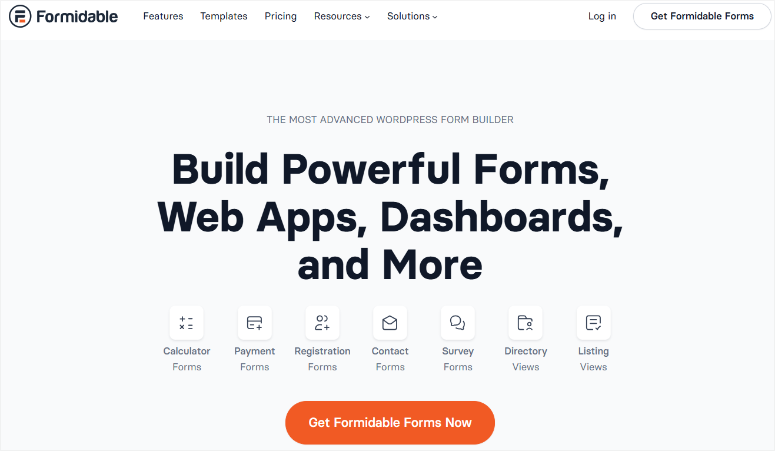
I recommend Formidable Forms to any client who is creating forms that need to work for everyone. This is my first choice because it handles WCAG compliance automatically without any custom code.
The reality is that most form builders force you to manually add ARIA (Accessible Rich Internet Applications) labels.
Formidable Forms integrates these into every field from the start. This allows users with screen readers to navigate forms as easily as anyone else.
My experience
I created a registration form for a non-profit organization that serves visually impaired members.
The entire form worked with keyboard navigation alone, no mouse required. Additionally, screen readers clearly announced each field.
Additionally, error messages appeared in a way that the assistive technology could understand and announce.
What stands out
The biggest advantage is how forms are automatically translated into speech. Everything remains accessible without having to hire a developer.
I also tested error handling and displayed the messages clearly for both sighted users and screen readers.
►Advantages
- Full WCAG compliance works out of the box
- Screen readers process forms seamlessly and without additional code
- Full keyboard navigation integrated into every form
- Error handling is clearly understandable to all users regardless of their skills
►Disadvantages
- Premium pricing higher than basic form builders
- Advanced features provide a learning curve for beginners
- Some accessibility features require a Pro version
- Might be overkill for simple contact forms
My verdict: Formidable Forms is best suited for WordPress website owners who serve users with disabilities and need easy-to-function forms. Select this option if WCAG compliance is important and you want it to be handled automatically.
Check out my latest review on Formidable Forms.
(You can get started with impressive forms here)
Prices: Free Lite Version; Pro plans start at $39.50/year
2. WPForms ⭐⭐⭐⭐⭐
Active installations: 6,000,000+ | Best for: Beginner-friendly, barrier-free forms
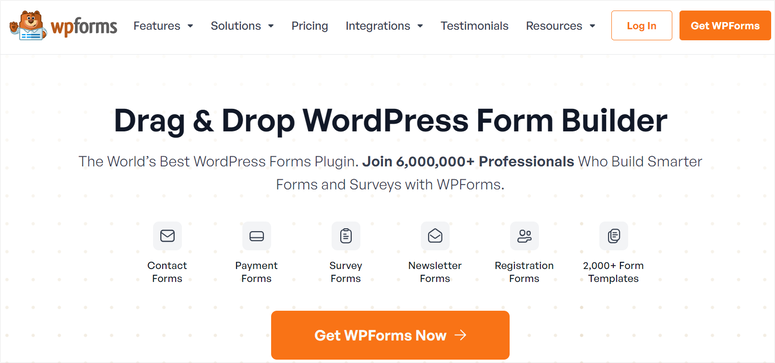
I recommend WPForms for every beginner who wants to make their forms accessible without technical knowledge.
This form builder not only helps you with accessibility, but can also help you prevent losing customers at the form stage.
Here’s what most people don’t realize: inaccessible forms cost actual sales. A restaurant customer observed customers abandoning their reservation form because screen readers couldn’t navigate it.
WPForms prevents this by automatically managing accessibility.
My experience
I replaced a broken contact form that was blocking visually impaired users. The plugin installed in minutes and added the correct ARIA labels with no code required.
Even better, the honeypot CAPTCHA stopped spam while letting everyone through.
Which actually works
Intelligent error handling makes a real difference. If someone misses a field, screen readers immediately announce it. Additionally, accessible alternatives replace hurdles such as image-based verification.
►Advantages
- 6 million active installations prove cross-topic compatibility
- Accessible CAPTCHA options do not block assistive technology users
- Proper semantic markup works without custom code
- The free Lite version supports simple, accessible contact forms
►Disadvantages
- The default border contrast requires CSS customization to ensure full compliance
- The date picker is not yet fully accessible via the keyboard
- The Terms expressly disclaim full compliance with the WCAG
- Required field indicators could use a darker color
My verdict: WPForms is best for beginners who need accessible forms without having to hire developers. Choose this option if you want proven compatibility and don’t want to write code.
For more information, see my updated WPForms review. You can also compare WPForms and Formidable Forms to see how the number one and two accessibility plugins on this list compare.
(You can get started with WPForms here)
Prices: Free Lite Version; Paid plans start at $49.50/year
3. WP Accessibility ⭐⭐⭐⭐
Active installations: 10,000+ | Best for: Font size and contrast adjustments
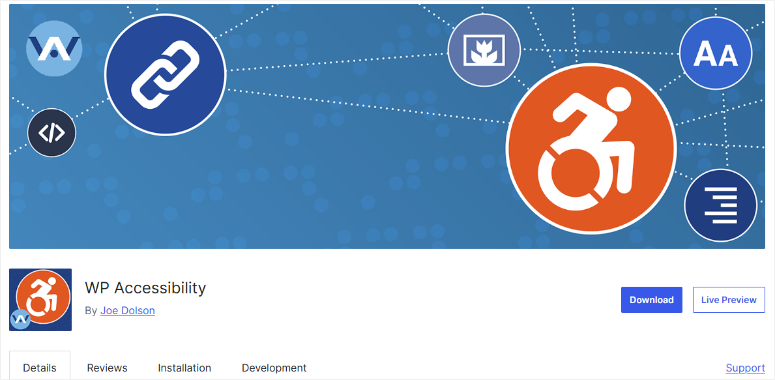
I turn to WP Accessibility when customers need visual customization options for their visitors.
I particularly like how this plugin solved one of the biggest accessibility problems. It allows an older or visually impaired audience to read tiny text on a beautiful but inaccessible design.
Too many designers forget that not everyone sees the same thing. Some visitors need larger fonts, while others struggle with low contrast. This plugin gives each person control over how they see your website.
My experience
Installation only took a few seconds and visitors immediately had the option to adjust the font size and change the contrast mode.
One customer reported fewer readability complaints after adding it. Additionally, the grayscale and high contrast options helped users with different visual needs without having to recreate the theme.
How it deals with visual barriers
Font controls allow visitors to enlarge text until they can read it. On the other hand, contrast adjustments help people with color blindness or visual impairment.
Additionally, it works with all themes and top page builders that I have tested.
►Advantages
- Completely free, with no premium upsells or restrictions
- Compatible with all tested themes and advanced plugins
- Visitors control their own viewing experience preferences
- Easy setup process, perfect for absolute beginners
►Disadvantages
- Covers only visual adjustments, not code-level fixes
- Does not address underlying accessibility issues in the content
- Limited to font and contrast features only
- Does not help with accessibility or navigation of forms
My verdict: WP Accessibility works best when you need to give visitors visual control. Combine it with code-fixing plugins for comprehensive accessibility coverage.
(You can get started with WP accessibility here)
Prices: Free
4. Accessibility WordPress Plugin (CodeCanyon) ⭐⭐⭐⭐
Active installations: Premium plugin | Best for: Text-to-speech functionality
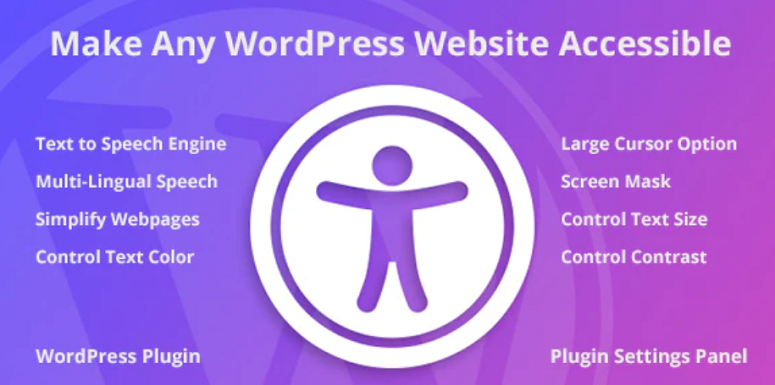
I use the Accessibility WordPress plugin when clients serve an international audience or users with reading difficulties.
Text-to-speech became essential after working with a training site where learners struggled with written content but absorbed the information perfectly while listening.
Reading disabilities affect more people than you think. Dyslexia, low literacy, and visual impairments all benefit from reading content aloud.
This accessibility plugin automatically detects your website’s language and converts text to speech without requiring any configuration.
My experience
Setting up the WordPress accessibility plugin simply requires uploading and activating it. The plugin immediately gave visitors the opportunity to speak in their own language.
I tested German and Japanese content and both worked without manual selection. The distraction blocker cleared the screen so users could only focus on the content.
What makes it different
Automatic language recognition saves you from manually managing translations.
Visitors hear content in six languages based on your website. Additionally, distraction blocking helps users focus without visual clutter.
►Advantages
- Comprehensive multilingual support for international audiences
- The distraction blocking feature helps users focus
- Automatic speech recognition requires no configuration
- One-time payment instead of recurring subscription fees
►Disadvantages
- Premium price, no free version available
- Limited to text-to-speech functions only
- Requires purchase and creation of a CodeCanyon account
- For small websites on a tight budget, it can be expensive
My verdict: This accessibility plugin for WordPress is useful for international websites or companies that serve users with reading disabilities. Skip it if you just need basic visual adjustments.
(You can get started with the accessibility WordPress plugin here)
Prices: $19 for the license
5. WP ADA Compliance Check⭐⭐⭐⭐
Active installations: 3,000+ | Best for: Scanning and compliance reports

I’m withdrawing WP ADA Compliance Check when customers believe their website is accessible but want proof. The scanner detects problems on a “compliant” website that would have later led to legal issues.
Most website owners have no idea what’s broken until someone complains or sues. Scanning shows exactly what is wrong in the reports and everyone can understand it.
My experience
The first scan took minutes to complete and revealed missing alt text, heading structure issues, and contrast issues that I had missed.
The reports break down each issue with clear explanations. It flagged specific posts and pages rather than vague warnings.
Where it actually helps
Detailed reports show exactly which pages are experiencing problems and what needs to be fixed. The free version copes well with small websites. Pro scans an unlimited number of pages and automatically fixes 28 common errors.
►Advantages
- Free version available to start identifying problems
- Clear, actionable reports that everyone can understand
- Compatible with major page builders like Elementor
- The Pro version includes automatic fixes for common errors
►Disadvantages
- Free version, limited to 15 pages only
- Pro pricing higher than some competing tools
- Theme file scanning is only available in Pro
- Automatic fixes require a paid upgrade
My verdict: Start with the free version to find problems, then upgrade to the pro version if you need automatic fixes across your site.
(You can start the WP ADA Compliance Check here)
Prices: Free Basic (15 pages); Pro starting at $179.99 for the license
6. Accessibility through UserWay ⭐⭐⭐⭐
Active installations: 80,000+ | Best for: AI-powered visitor toolbar
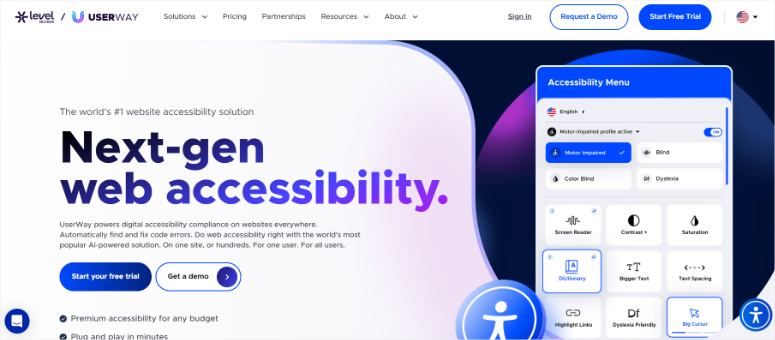
I’m thinking UserWay For larger companies, there is concern about legal risks. This toolbar became valuable after a customer needed multilingual accessibility that no code correction plugin alone could handle.
Visitor-focused toolbars allow each person to customize their experience without having to rebuild your website. AI scans content every 24 hours and automatically generates missing alternative text.
Companies like Chevron and Verizon are using this approach, showing that companies have confidence in the technology.
My experience
Testing the free version showed that the contrast and text size options worked out of the box. Unlocked premium AI repair that captured images without description.
Litigation support includes legal advice. However, a 2024 lawsuit challenged compliance claims, so you should be aware of the limitations.
Understanding overlay reality
Toolbars complement good design, but never replace proper, accessible development. AI-generated alternative text helps, but it’s not perfect.
Premium tiers make more sense for companies facing lawsuits than sites that are just trying to be inclusive.
►Advantages
- AI-powered auto-correction continuously scans content
- Free version available for basic features
- Premium includes legal advice and support
- Used by large companies like Chevron
►Disadvantages
- Premium prices for small businesses very high
- The 2024 lawsuit raised questions about compliance claims
- Overlays do not fix underlying code issues
- Some users report persistent admin banner notifications
My verdict: UserWay is suitable for companies that need more litigation support than actual accessibility fixes. Understand what overlays can’t do before relying on them.
(You can get started with UserWay here)
Prices: Free basic version; Premium $490-$3,990/year
7. Ally by Elementor (formerly One Click Accessibility) ⭐⭐⭐
Active installations: 400,000+ | Best for: Simple toolbar with quick setup
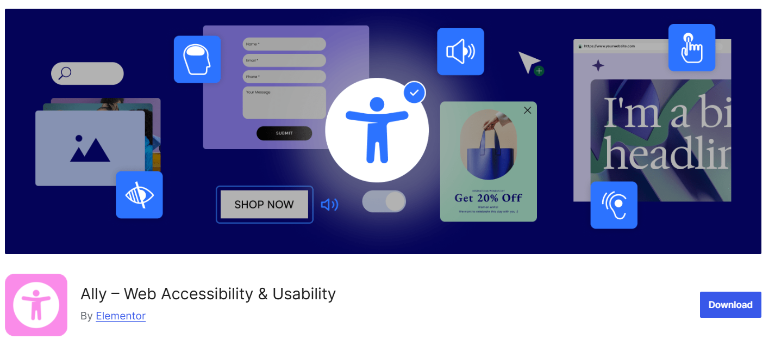
I recommend often Allies for Elementor users, although the renaming caused tension in February 2025.
The plugin moved from One Click Accessibility to Ally and now requires an Elementor account, frustrating long-time users who appreciated the original simplicity.
The rebrand added AI scanning to detect more than 180 issues, significantly improving the free version. However, Elementor states that this is not a replacement for proper audits and alone does not make sites legally compliant.
My experience
Even with the free standalone plugin, Ally setup now requires you to first create an Elementor account, which requires an additional step.
Once connected, the toolbar appeared with font adjustments, contrast modes, and link highlighting. The AI scanner has reported real problems, although the free features master the basics for most small websites.
Why simple sometimes works
The over 400,000 installations prove that people want uncomplicated solutions. Free features cover everything visitors need for visual customization. Just don’t expect this to solve serious accessibility issues.
►Advantages
- A huge install base proves stability and compatibility
- Free core toolbar features work without paying
- Minimal impact on website performance
- Quick setup process, perfect for beginners
►Disadvantages
- After the rebrand, an Elementor account is now required
- Mixed reviews after changing account requirements
- Expressly not a replacement for a professional accessibility check
- AI features are only locked behind premium tiers
My verdict: Choose this option if you already use Elementor or just want a free basic toolbar. Don’t rely on it for compliance.
(You can start with Ally here)
Prices: Free standalone plugin available; Comes with the free Elementor version; Pro starts at $7.99/month on the Elementor plan
Great! This is my list of the best WordPress accessibility plugins. But it is also important that you find the right plugin that meets your needs. I’ll break this down next.
How to choose the right accessibility plugin
Choosing the right accessibility plugin depends on what problems you actually want to solve. Here’s how to narrow down your options based on your situation.
According to budget
Free/Start
Growing Business ($50-$200/year)
- WPForms or Impressive shapes Handle your form requirements correctly.
- If visitors need customization options, The free version of UserWay Adds a toolbar at no cost.
- This combination covers most small business accessibility needs without breaking the bank.
Corporate/Legal Matters (over $500/year)
- UserWay Premium includes litigation support and legal advice.
- Combine it with WP ADA Compliance Check for automatic corrections on unlimited pages.
- This setup is more important for companies that are under compliance pressure or operate in highly regulated industries.
Through technical skill
Complete beginners
- WP Accessibility And AlliesFormerly known as One Click Accessibility, both can be installed in seconds and work immediately.
- You don’t configure anything complicated or write any code.
- Visitors get customization options while you focus on the content.
Advanced users
- WPForms or WP ADA Compliance Check gives you more control without requiring developer knowledge.
- The interfaces make sense, reports explain problems clearly, and you can troubleshoot problems yourself using the instructions provided.
Developers/agencies
- Impressive shapes And WP ADA Compliance Check Offer the flexibility you need.
- You get granular control over accessibility features while automatically resolving repetitive tasks.
- The white label reporting of the Pro version works perfectly for customer projects.
Out of primary need
Form accessibility
- WPForms or Impressive shapes, Depending on your budget and complexity requirements.
- Both handle ARIA labels, keyboard navigation, and screen reader compatibility automatically.
- Forms represent your biggest legal risk, so invest here first.
Visual adjustments
- WP Accessibility Gives visitors control over fonts and contrast without having to recreate anything.
- It’s free and works with every tested theme.
Visitor customization toolbar
- UserWay or Allies depending on whether you need AI functions.
- Free versions cover the basics.
- Premium only makes sense if you need litigation support or advanced scanning.
Compliance scanning
- WP ADA Compliance Check Identifies exactly what is broken and where.
- The free version supports small websites.
- Upgrade to Pro if you need unlimited scanning and automatic corrections.
Text to Speech
Legal protection
- UserWay includes legal advice and litigation support programs.
- This is more important for companies that are afraid of lawsuits than for websites that are just trying to be inclusive.
The best combination approach
No single plugin solves everything.
This combination costs nothing and covers the essentials.
Then upgrade individual parts as your needs grow instead of purchasing expensive premium packages upfront.
FAQs: Best WordPress Plugins for Accessibility
Can accessibility plugins ensure WCAG compliance?
No plugin alone guarantees full WCAG compliance. Plugins help fix common problems, but true accessibility requires proper design from the start. Also, regular testing with actual assistive technologies. Think of accessibility plugins as helpful tools, not magical solutions. You’ll still need manual reviews and possibly professional audits to make sure your website really works for everyone.
Do I need both an overlay and a code fixing plugin?
The best approach is to combine different solutions together. Code fixing plugins like WP Accessibility address underlying HTML issues. Overlays like UserWay provide visitors with customization options. Forms require special plugins like WPForms. The combination of these approaches covers more areas than relying on a single plugin type.
Will accessibility plugins slow down my website?
No, most simple plugins like WP Accessibility have minimal impact on performance. Overlay toolbars with rich AI features can easily increase loading times. WP ADA Compliance Check performs scans in your admin area without affecting front-end speed. Test your website speed before and after installation to measure the real impact.
Are free accessibility plugins good enough?
Yes, free plugins meet many accessibility needs well. The free version of WP Accessibility, WPForms Lite and WP ADA Compliance Check covers the essentials for small websites. Upgrade to premium versions if you need unlimited scanning, automatic corrections, or litigation support—and not just because the free version isn’t enough.
What is the difference between overlays and code fixers?
Overlays add toolbars that allow visitors to customize their experience with font sizes, contrast modes, and other customizations. Code fixers modify your actual HTML by adding ARIA labels, jump links, and correct semantic markup. Overlays help individual visitors. Code fixes improve the foundation of your website for anyone using assistive technology.
Which plugin works best with WooCommerce?
WPForms manages checkout and contact forms barrier-free. WP ADA Compliance Check scans product pages and identifies issues specific to eCommerce layouts. Formidable Forms works when you need complex multi-step checkout processes. Combine form plugins with scanning tools for comprehensive WooCommerce accessibility coverage.
Do accessibility plugins work with page builders?
In any case, most accessibility plugins work with Elementor, Beaver Builder, Divi, and other major page builders. WP ADA Compliance Check explicitly supports these tools. One Click Accessibility (Ally) integrates directly into Elementor. Test compatibility with your specific page builder before opting for premium versions.
How do I know if my website is accessible?
Use WP ADA Compliance Check to check for technical issues. Then test manually using real screen readers like NVDA or VoiceOver. Navigate your entire website using just one keyboard. Better yet, hire someone with disabilities to review your website and provide real feedback on the obstacles they encounter.
Final Verdict: Should I Make My WordPress Site Accessible?
Yes, you should make your website 100% more accessible.
Remember the panicked client who received the ADA lawsuit letter? Your problem started with an inaccessible contact form that blocked screen reader users.
You don’t have to wait for a legal ruling to fix accessibility issues. Get started with the free tools available now.
The most important? No plugin replaces barrier-free design right from the start. Regularly test your website with real screen readers and navigate using only the keyboard.
I also recommend that you consider hiring people with disabilities to review your website and identify real barriers.
Accessibility isn’t a checkbox you check once. It’s an ongoing commitment to ensuring that everyone can use your website, regardless of their abilities.
Resource Center
Accessibility works best when combined with other aspects of running a successful WordPress site. Here are some resources to complement what you’ve learned about making your website accessible.
AI-Powered WordPress Tools:
Modern AI tools can help automate some accessibility improvements.
User Feedback and Analytics:
Understanding how visitors use your website can help you identify accessibility barriers.
- Read our full UserFeedback Rating to see how heatmaps and surveys show where users are having trouble navigating or interacting.
Site creation and design:
Building an accessible website from the start saves time later.
Maintenance and communication:
Keeping your accessible website running smoothly requires constant attention.
With these guides, you’ll not only learn how to support accessibility for people with disabilities, but also how to improve your overall user experience.
Is there an accessibility tool I missed? Write a comment and tell me which one.