

Whether I’m looking for a new car, email marketing software, or a pair of shoes, sometimes I wish I had a personal shopper – someone to give a second opinion, make suggestions when I’m undecided, and help me find the best deal. In recent years, ChatGPT product recommendations and its Shopping research function have become that way for many.
More and more buyers are skipping search engines and going straight to ChatGPT with questions like “Best CRM for startups under 50 people” or “What are the best gifts for chai lovers?” According to G2 actually 2025 Buyer Behavior ReportGenerative AI chatbots now have the greatest influence on provider shortlists, ahead of review sites, provider websites and sellers.
This is a huge shift in the way people shop, and marketers and ecommerce teams must adapt if they want to remain visible. This guide will explain exactly how ChatGPT decides which products to show – and more importantly, what you can do today to be one of them.
Table of contents
What’s changed in ChatGPT shopping for businesses?
In one G2’s 2025 survey of more than 1,000 B2B software buyershalf of respondents said they now start their buying journey in an AI chatbot instead of Google Search. ChatGPT took notice.
Last fall, ChatGPT has launched ChatGPT Shopping and immediate purchase processing. These new features allow users to find and even purchase products (on Etsy and Shopify) without leaving their chat.
ChatGPT suggests products, prices, reviews and a link to purchase the item immediately for the Etsy and Shopify brands. You can also purchase the item on their websites and add it to your shopping cart.
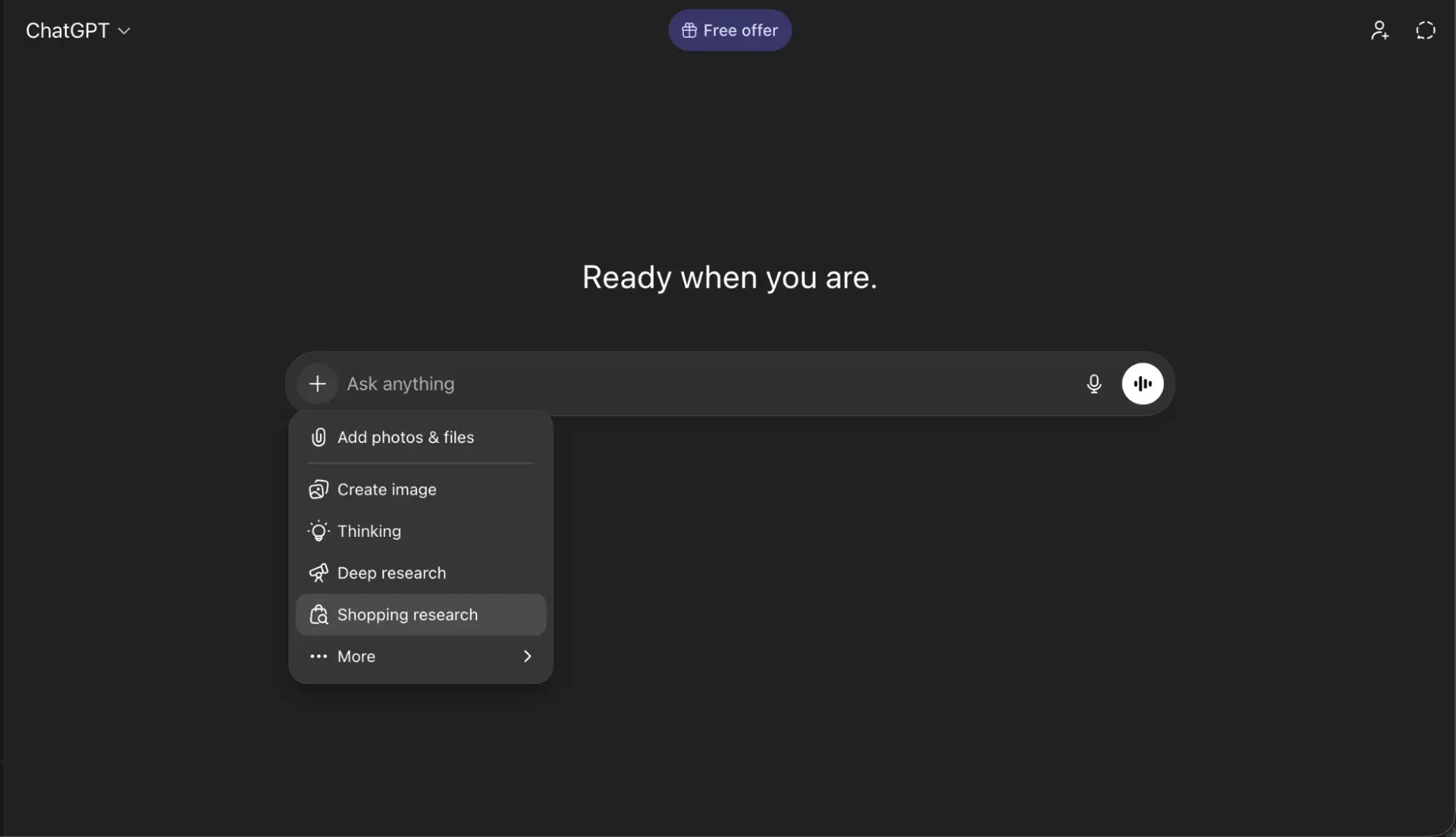
Here is a quick example. To start the shopping experience on mobile or desktop, I clicked the plus sign (+) next to the query box and selected “Shopping Research.”
From there, I typed in what I was looking for (in this case, “the best gifts for authentic Indian chai lovers”) and hit enter. When generating its product recommendations, ChatGPT asked me a few questions about price and preferences to refine its suggestions.
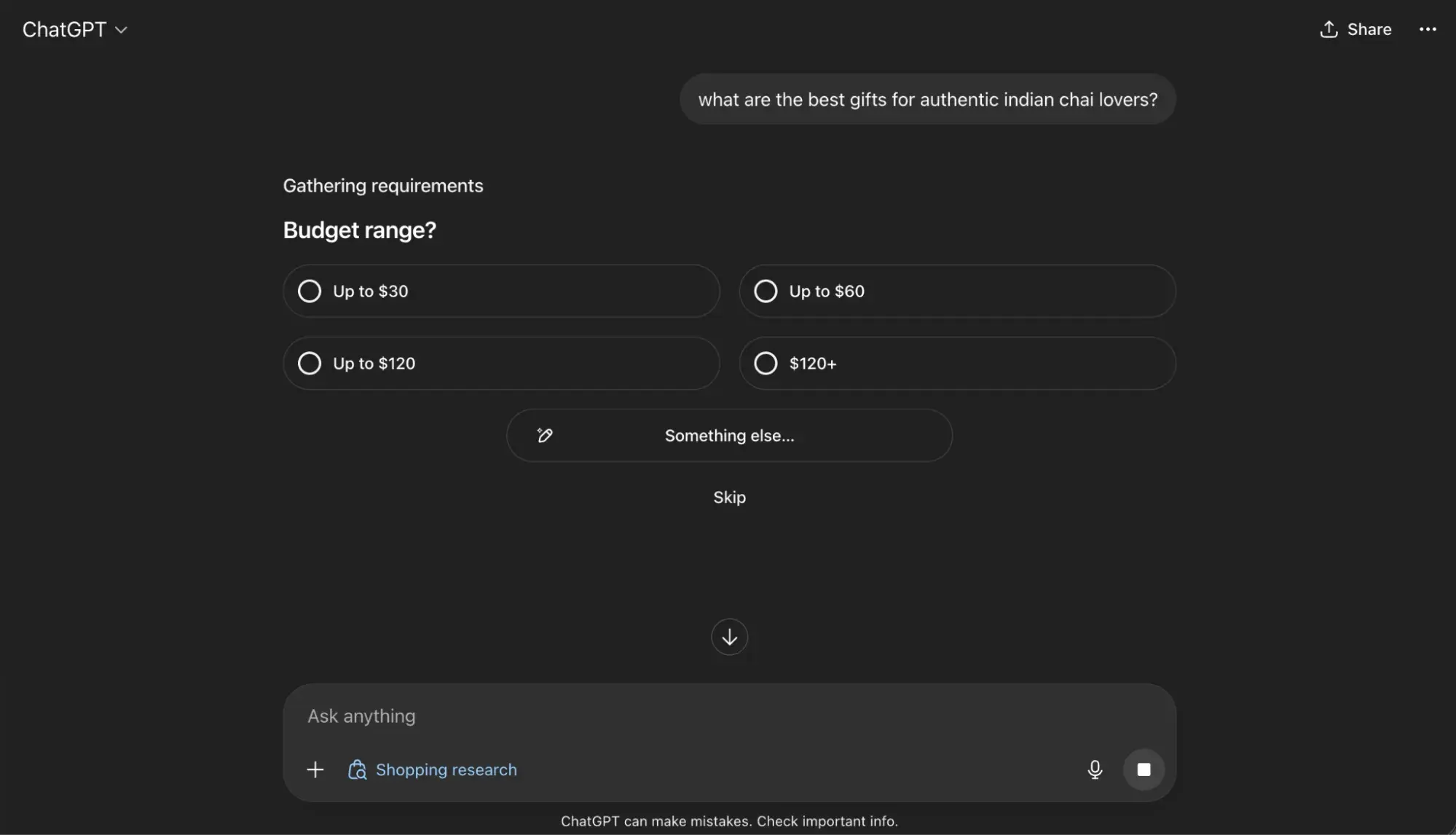
However, if you don’t answer the questions, you’ll still get a detailed list of what you think is best.
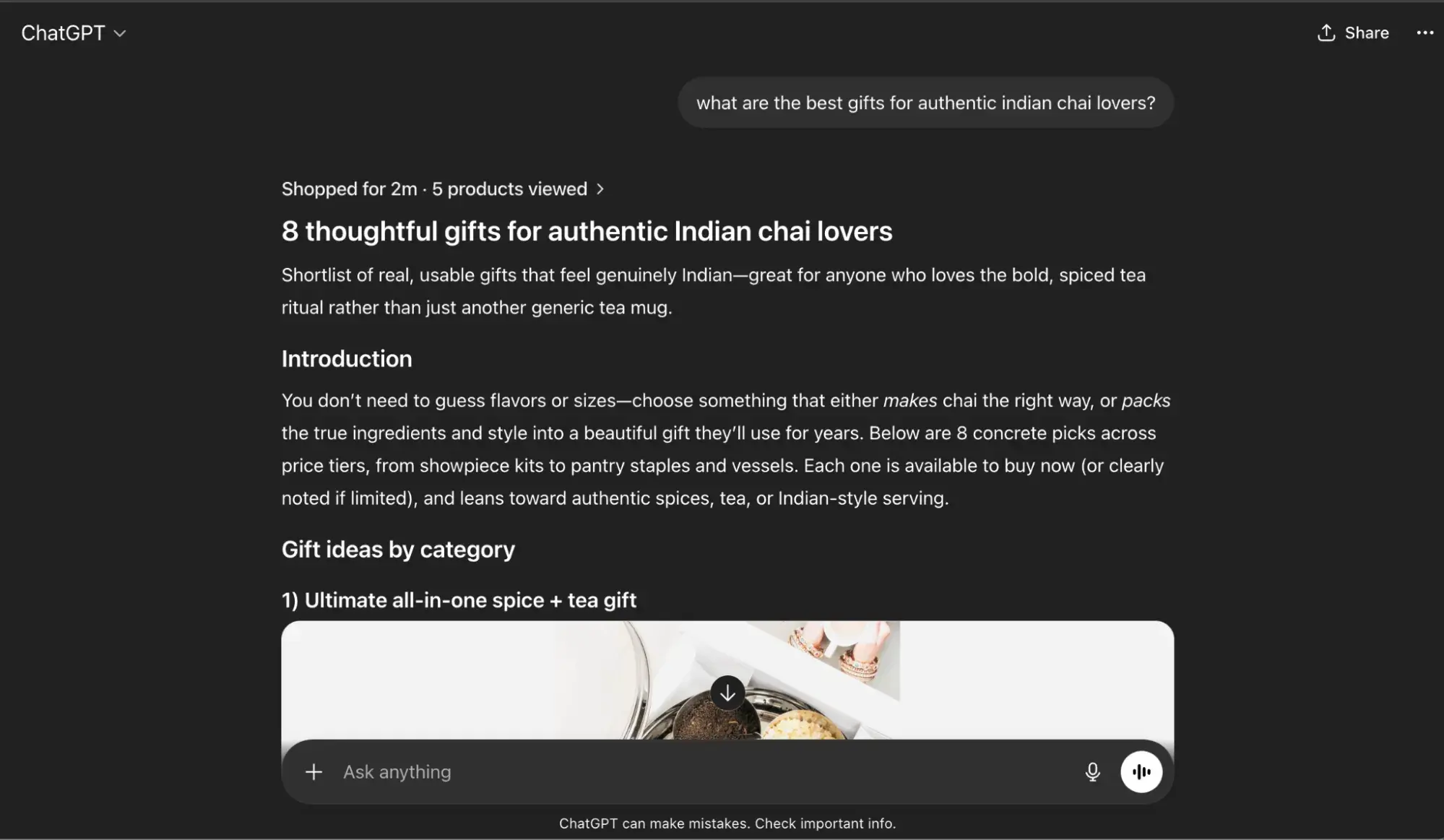
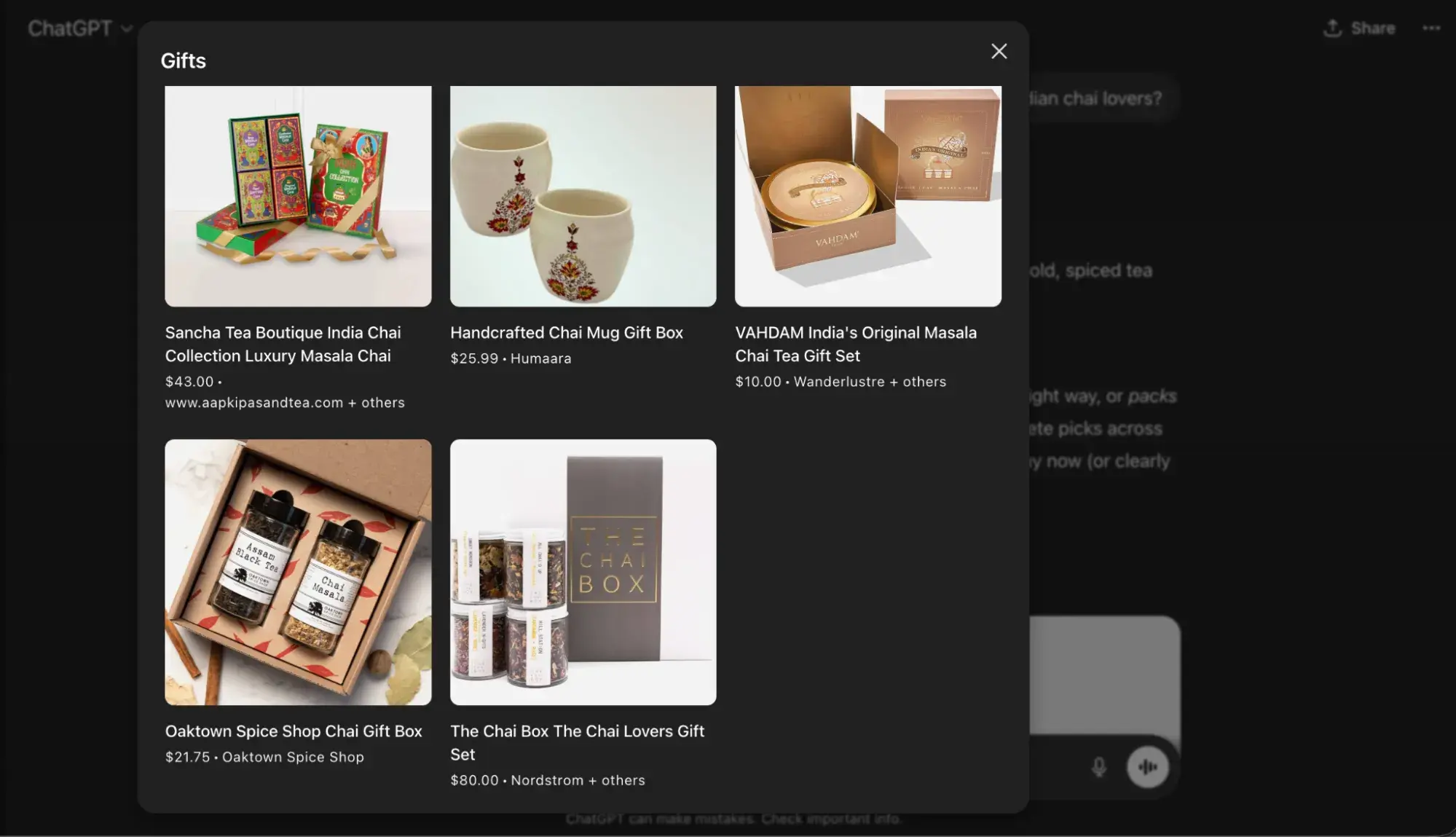
As I scrolled through, I saw some suggestions in the chat about purchasing the product, such as this gift set from VADHAM.
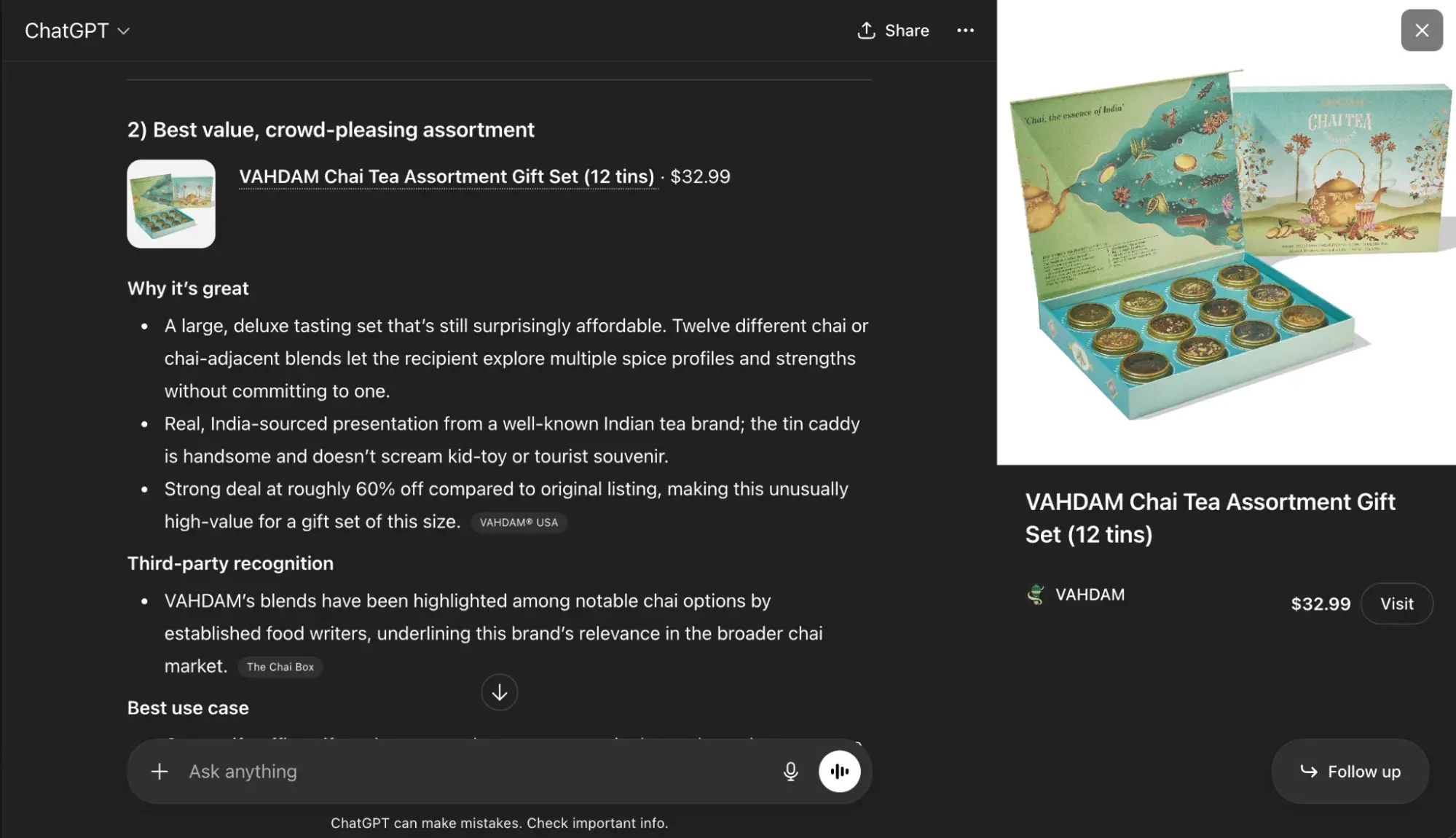
And others let me click through to the website.
You’re probably wondering: How is this different from a normal ChatGPT query? If you don’t use the Shopping Research tool, ChatGPT shares general gift ideas rather than specific products you can buy right away.
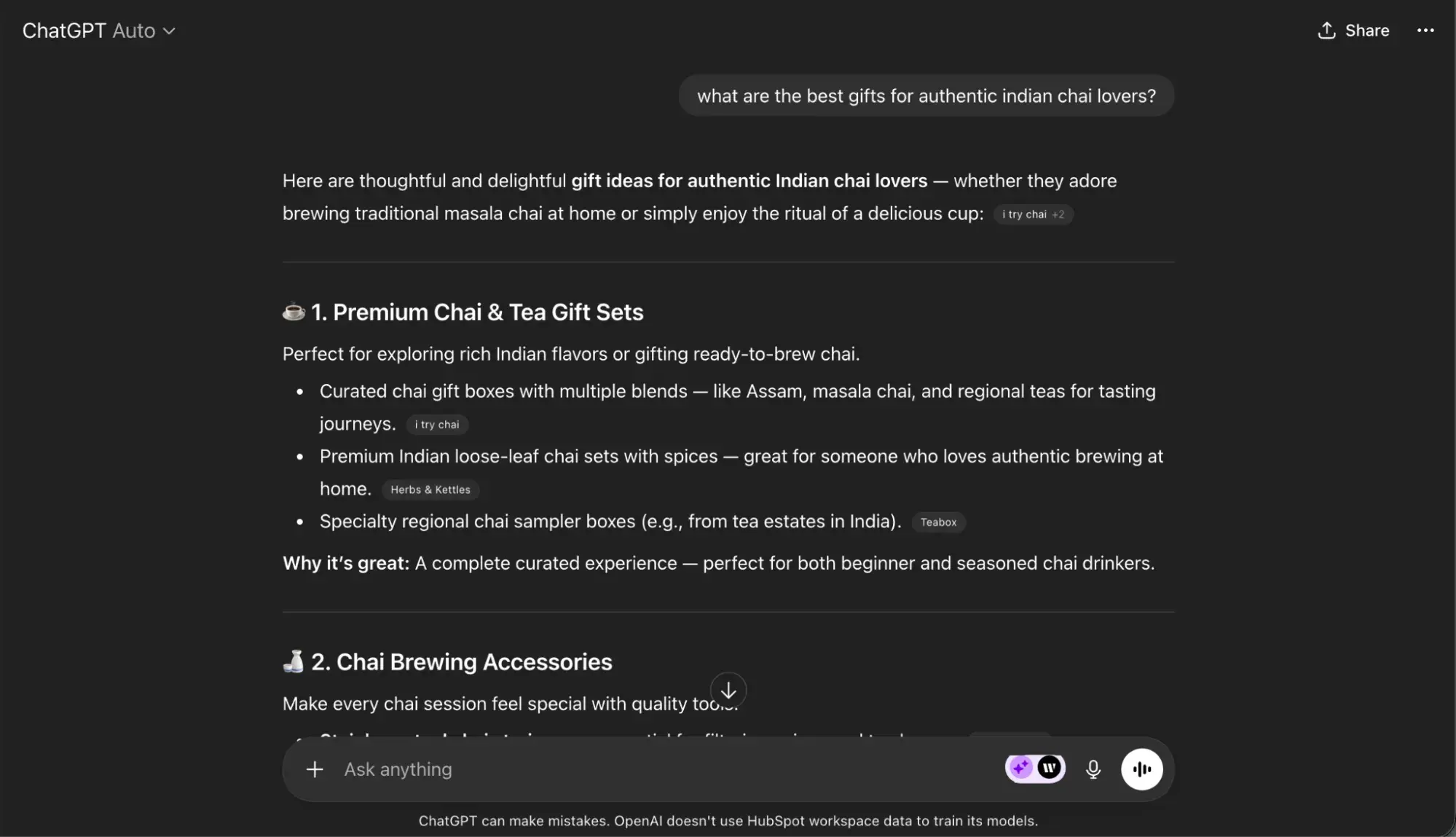
Let’s take a closer look at what’s changing with ChatGPT shopping in 2026:
- A special purchasing model enables recommendations. ChatGPT Shopping Research runs on a special variant of GPT-5 mini that has been trained specifically for shopping tasks. Accordingly OpenAI’s own In benchmarks, this model achieves 52% product accuracy on complex queries with multiple constraints, compared to 37% for standard ChatGPT search.
- The ChatGPT merchant program is live. OpenAI’s merchant program allows companies to submit product feeds directly, increasing the likelihood that ChatGPT can access accurate, structured product information. One is planned Instant checkoutallowing users to shop directly on the platform.
- B2B and SaaS are on board. Product discovery is not limited to e-commerce or B2C. ChatGPT regularly recommends software tools, platforms and services when users ask for solutions to business problems.
- No paid internship (yet). Unlike Google Shopping, ChatGPT product recommendations are not currently ad-driven. According to OpenAI“ChatGPT shows the most relevant products from across the web. Product results are organic and unsponsored and are ranked solely based on relevance to the user.” Visibility is earned here, not bought – but more on that soon.
Why ChatGPT product discovery is important for B2B and SaaS
Being crawled by ChatGPT means potential visibility for the platform reported 900 million weekly active users. And ChatGPT’s product recommendations aren’t just limited to consumer products.
If your company sells software, professional services, or other high-priced products, ChatGPT discovery may already be impacting your pipeline, whether you’ve optimized for it or not. Let me explain.
B2B buyers use AI to create shortlists.
Decision makers at midsize and large companies run AI queries like “Which HubSpot competitors should I evaluate?” before You ever visit a provider’s website. In other words, AI limits their choices right from the start of their buying journey.
Furthermore, 6sense figured this out In 95% of casesthe successful vendor is already on the buyer’s shortlist, while 80% of deals are won by the vendor the buyer contacts first. So if the AI doesn’t spot you early, you’re probably not even in the running.
AI search is already the second largest source of leads for B2B.
Accordingly a study by 10Fold Communications from 2025, AI-based platforms like ChatGPT and Perplexity are now the second most common source of qualified leads. They are only behind social media and ahead of organic search, email marketing and paid media.
AI traffic converts much better.
Research shows ChatGPT traffic the equivalent of 31% higher than brand-independent organic search. ChatGPT offers one especially for B2B 56.3% higher completion rate as leads that come from Google or Bing.
Users coming from ChatGPT often have already completed early research. You’re closer to a decision, which usually means higher conversion rates and shorter sales cycles. These results are consistent with theories that AI is changing buyer behavior and preferences, and marketers should adapt.
Rating platforms have even more weight.
For B2B products, ChatGPT relies heavily on aggregator signals from platforms such as G2, Capterra and TrustRadius. A weak review presence is a visibility killer.
Pro tip: Now run a few ChatGPT queries on your category. Search for “best (your product type) for (your ICP)” and note who appears. This gives you a solid AI visibility benchmark to work from.
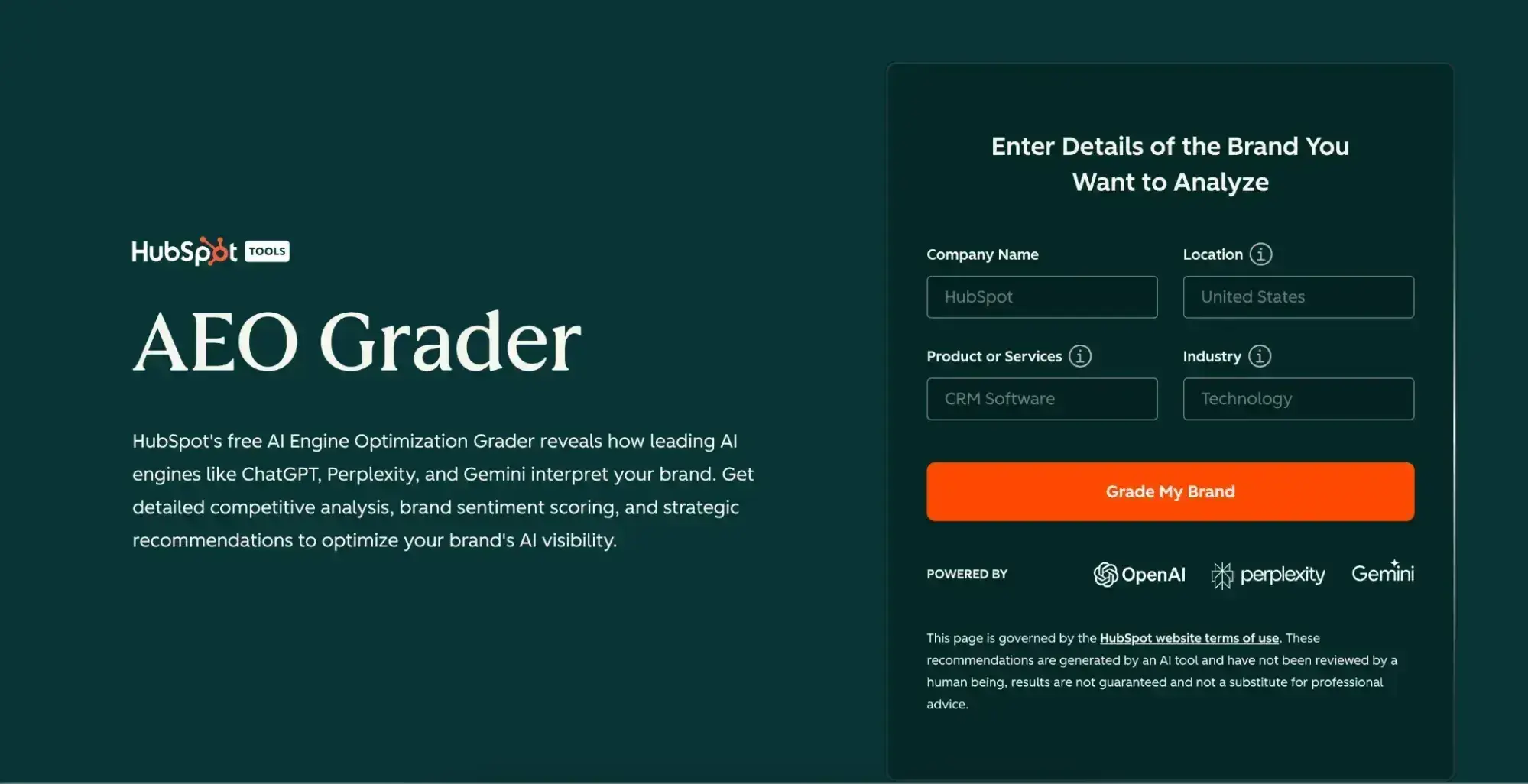
You can also use HubSpot’s free AEO Grader to see how your content is currently being interpreted by AI systems.
This is how ChatGPT product recommendations work
ChatGPT does not have a top secret algorithm in the sense of Google. Rather, it claims to synthesize and apply information from multiple sources Large Language Model (LLM) reasoning for answering purchasing queries.
However, there are some consistent signals that seem to do so influence what is recommended.
ChatGPT product recommendations are influenced by query relevance, structured data on product pages, product availability and price, reviews and authority, and contextual targeting of buyer intent.
1. Query relevance
The most basic signal is how well your product’s content matches the intent of the user request. ChatGPT loves semantic matching. It doesn’t just look for keyword overlap; it interprets meaning and intent.
For example, if a user asks for “a lightweight CRM for individual advisors,” a product page that specifically states that use case will outperform a page that broadly claims to serve all businesses.
Aside from that, Nectiv’s analysis from October 2025 found that requests for commercial intent were significantly more likely to trigger web searches in ChatGPT (53.5%) than requests for information (18.7%). The most common terms that trigger a search include “reviews,” “free,” “features,” and “comparison.”
2. Structured data on product pages
ChatGPT’s web browser capability indexes product pages and, as with all content, structured data (especially Schema markup) helps to analyze product attributes more precisely. Schema types that are particularly relevant to product pages include: Product scheme, Quotation schemeand product variants.
3. Availability and pricing information
ChatGPT product recommendations are also believed to be influenced by product availability and price. Price pages are known to attract the most concentrated AI traffic. So if your product is out of stock, no longer manufactured, or is difficult to price (e.g. “Contact for Pricing” without an assortment), it is at a disadvantage.
I mean, think about it: If a friend told you about a product, touted it, and then it turned out it was out of stock, you’d probably be really upset. (I would.) ChatGPT doesn’t want to provide this experience to its users.
4. Authority and verification signals
Authority signals in AI work similarly to traditional SEO, but extend to third-party platforms such as established review sites, industry publications, analyst reports, and platforms like LinkedIn.
5. Context Alignment
ChatGPT tailors recommendations based on the overall context of a conversation and what it knows about a person. However, a user who mentioned that they lead a 10-person remote team and need a free solution will receive different recommendations than someone who mentioned that they run a company.
Your content must appeal to specific use cases, people, and contexts, not just the general product category, to appear as ChatGPT product recommendations to qualified audiences.
How to help ChatGPT discover your products
According to the Anticipated State of AI Discovery Report 2025AI traffic is most concentrated on industry, tools, and pricing pages – aka “the very decision-stage pages we know drive B2B conversions.” Additionally, research from HubSpot has shown ChatGPT is the leading AI tool marketers use in their roles.
Despite the popularity of the platform Only 11% of companies say this to make the majority of their content AI-enabled. This represents a major competitive opportunity.
Getting discovered by ChatGPT isn’t about tricking a system; It’s about having really good, structured and accessible product information. Here are the most effective steps you can take to increase your chances of appearing in ChatGPT’s product recommendations.
Step 1: Add product schema markup to your pages/content
Structured data is a pillar of both response engine optimization (AEO) and generative response optimization (GEO) and is therefore naturally important to ChatGPT.
Without schema markup and good site architecture, ChatGPT’s web crawler has to “think” more to figure out your product details and what you are about. This makes this information structured and clear, making it more explicit and machine-readable.
Read: How to use schema markup to improve the structure of your website
However, for all your product pages, add the following:
- Product scheme: Provide name, brand, image URL, description, SKU or GTIN, and a URL.
- Offer scheme: Specify price, price currency, availability (use schema.org values such as InStock or OutOfStock), and a valid URL.
- AggregateRating scheme: Retrieve the number of reviews and average rating from your review platform or dataset.
- FAQPage schema: For landing pages that answer common buyer questions, FAQ schema improves contextual targeting.
And if you’re a B2B or SaaS company, treat your pricing page, feature comparison pages, and use case landing pages as “product pages” for schema purposes. For SaaS in particular, transparent pricing pages with a clear breakdown of tiers are a strong signal of trust and visibility.
Pro tip: Use Google’s rich results test to verify that your scheme is installed correctly before expecting it to influence AI recommendations.
With HubSpot Content HubUse HubSpot’s structured content tools and CMS developer documentation to implement JSON-LD schema directly in your page templates.
Step 2: Ensure crawlability and technical accessibility
As mentioned, ChatGPT uses web crawlers (OAI-SearchBot is the primary one) to index content. If your product pages aren’t crawlable, you can’t be recommended, period.
In addition to the schema, here are a few things you can do to improve your crawlability:
- Make sure OAI-SearchBot is not blocked in your robots.txt file.
- Submit a current XML sitemap containing all product and solution pages.
- Ensure product pages load quickly and do not require JavaScript execution to display important content. As with search engines, faster-loading content is measurably more likely to be picked up by AI systems.
- Use clear, descriptive URL structures (e.g. /products/crm-for-startups instead of /p?id=4421).
- Eliminate duplicate content issues that affect entity clarity.
Pro tip: Check your server logs or a similar tool Cloudflare Analytics for OAI SearchBot activity. If it doesn’t appear, check your robots.txt file and page rendering. Your site may not currently be crawlable.
Step 3: Optimize product page content for use case queries
Think like a buyer using natural language, not like a marketer writing for robots.
ChatGPT users formulate their search queries conversationally, and product content that answers questions or explicitly contains these phrases is often preferred.
Here’s what you can do:
- Approach with the use case or “benefit,” not the feature. Instead of “AI-powered pipeline automation,” you write, “HubSpot helps sales teams of 10 to 50 people close more deals without manual data entry.”
- Add comparison content. Sites like HubSpot vs. Salesforce for Small Business are exactly what ChatGPT turns to when users are weighing their options.
- Add explicit use case headers. Sections like “Best for Freelancers,” “Ideal for Enterprises,” or “How (Product) Handles (Specific Workflows)” provide context for AI systems.
- Answer the five to ten most common questions your buyers ask. Use FAQ sections on product pages. This content maps directly to ChatGPT conversation queries.
But don’t forget to differentiate! While you want to captivate your audience’s words, you also want to ensure that your unique offering and what makes you the right choice is clearly differentiated from your competition.
It’s also important to note that ChatGPT’s instant checkout is currently limited to Etsy and Shopify stores. If you use either platform, be sure to follow these tips in your Shopify product descriptions/pages and Etsy store descriptions.
Do you need help writing your content? There are a variety of AI content writing tools to help you get started, including HubSpots.
Step 4: Build verification and social proof infrastructure
ChatGPT product recommendations are heavily influenced by what reputable external sources say about your product, especially third-party review sites. This means your social proof strategy needs to extend beyond your own website.
For B2B and SaaS:
- Prioritize G2 and Capterra. These are among the most frequently crawled and referenced sources for software recommendations. Aim for at least 50 reviews with an average rating of 4.0+. The fewer, the smaller the sample size appears to be trustworthy, and any lower rating will reflect poorly on your service.
- Optimize your G2 profile. Treat your G2 listing like a landing page. Add a full description, feature tags, use case categories, website links, and comparison positioning.
- Pull social proof from LinkedIn. Customer testimonials, shared case studies, and product mentions on LinkedIn are increasingly featured by ChatGPT, especially for B2B inquiries.
- Get coverage from relevant industry publications. Being mentioned in respected trade publications (think MarTech, TechCrunch, industry newsletters) reinforces the authority that ChatGPT carries.
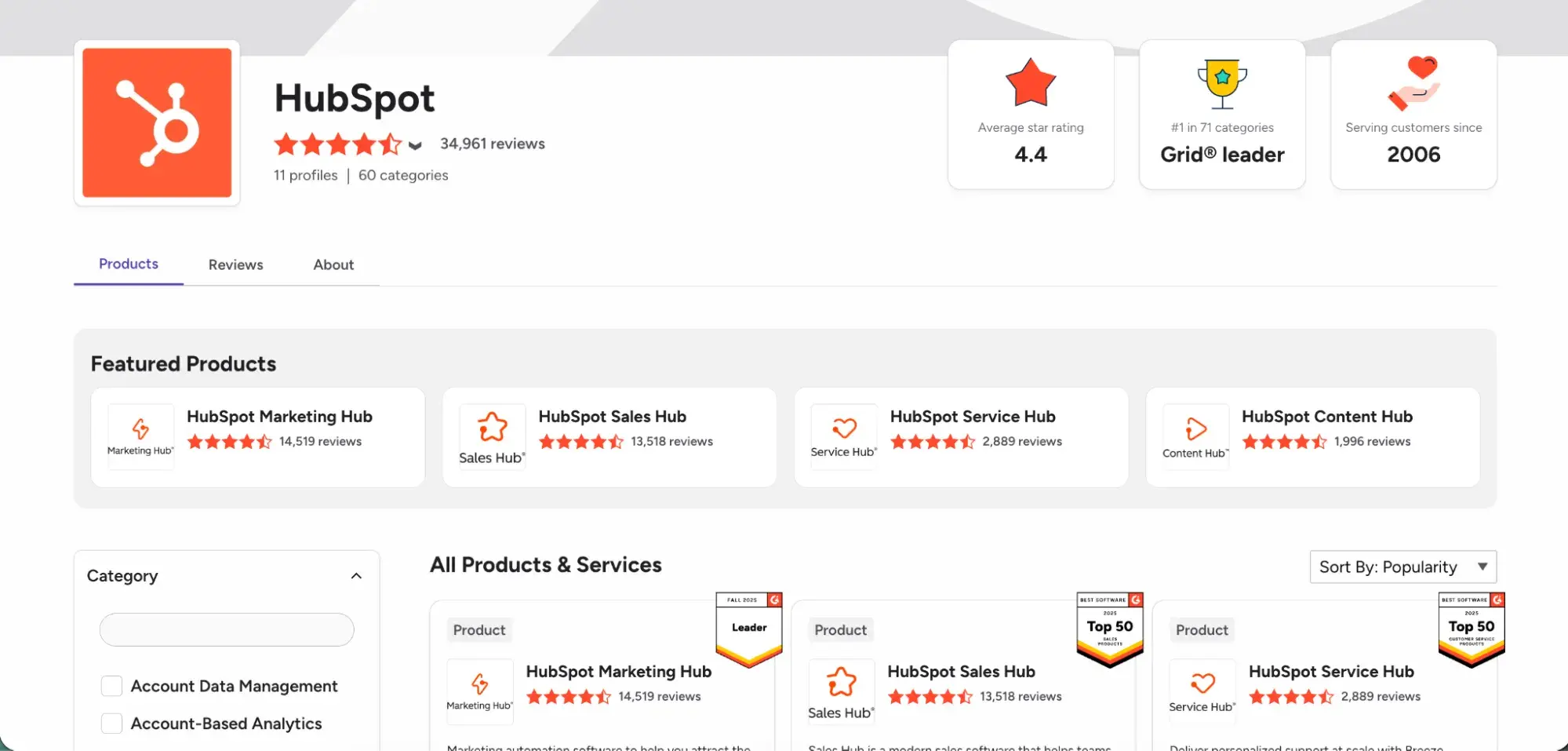
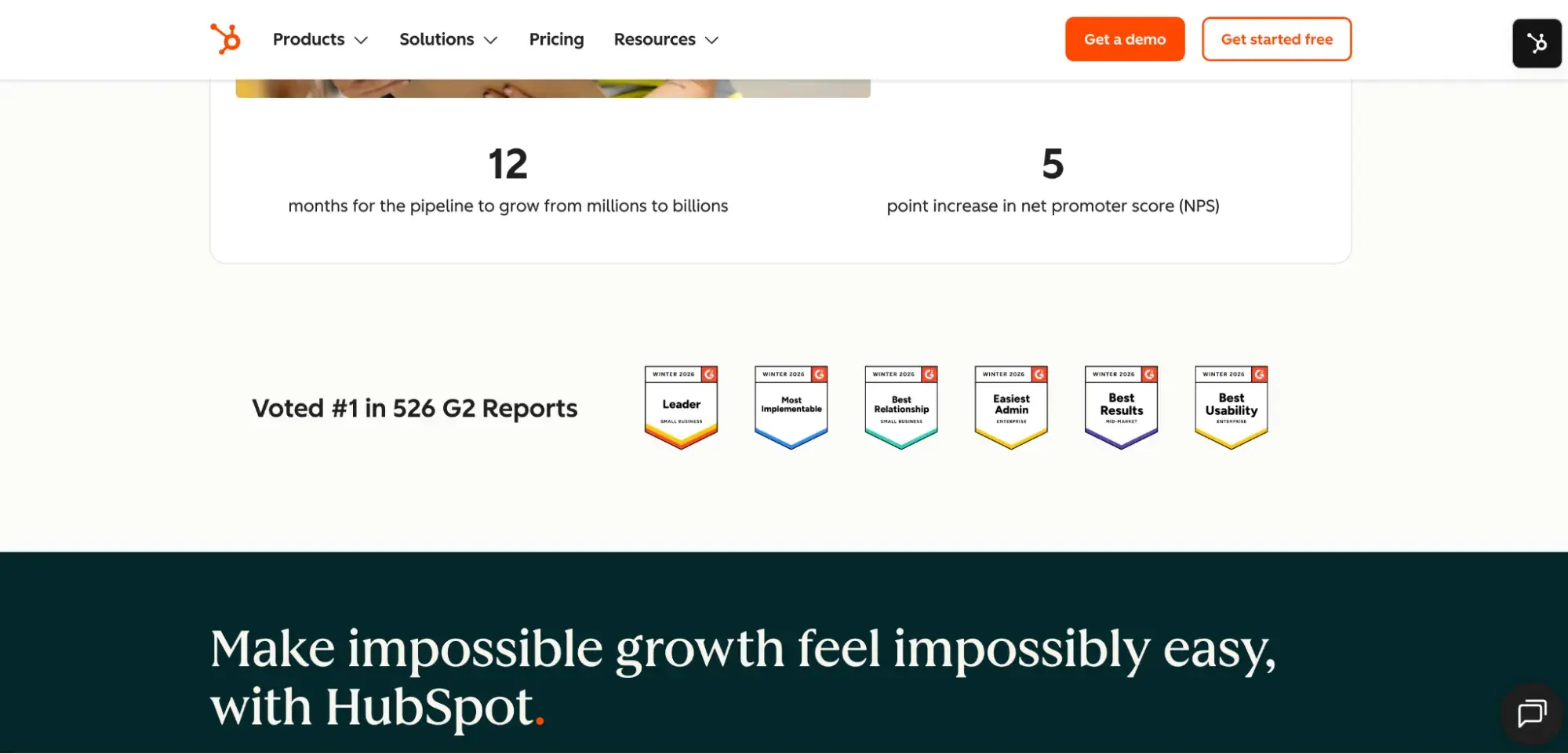
Notice how HubSpot has integrated social proof and reviews from G2 into our website. The more regularly your product is positively mentioned in these sources, the more likely it is to appear.
Pro tip: Use HubSpot’s intelligent CRM to connect review request workflows directly to customer lifecycle data. This makes it easier to trigger review requests at the right moment after onboarding.
Step 5: Submit a product feed to the ChatGPT merchant program
OpenAI’s merchant program provides businesses with a direct channel to make product information and purchases available in ChatGPT. Think of it like having a feed from Facebook Marketplace or Instagram Shops in a conversation, but with AI recommendations.
To start:
- Visit chatgpt.com/merchants and create a merchant account.
- Prepare a product feed in a supported format (typically JSON or CSV).
- Provide accurate product names, descriptions, prices, availability status, images and URLs.
- Keep the feed up to date – outdated or inaccurate data can actively affect your recommendation eligibility. However, OpenAI’s documentation specifically acknowledges that the model may still make errors regarding current pricing and availability and encourages users to check on retailer sites.
Pro tip: For B2B companies without a traditional product feed, consider creating a structured “solutions feed” that lists your key offerings, including pricing tiers, target audiences, and use cases. This helps ensure ChatGPT has clean, machine-readable data to work with.
Then use HubSpot’s AEO Grader to find problems with AI systems understanding your content.
Step 6: Create a measurement loop
You can’t manage what you don’t measure. Pursuing ChatGPT-driven discovery requires a slightly different approach than traditional SEO analysis.
Build your monitoring workflow around these signals:
- Tag your ChatGPT traffic with a UTM tag. If you are linked or quoted in ChatGPT answers, monitor direct/referral traffic patterns in Google Analytics 4 – AI-driven traffic is often shown as direct or from chat.openai.com. Segment and track it separately from your first day.
- Carry out regular test queries. Manually run 10-20 queries weekly in ChatGPT that match your target buyer’s language. Take note of when you appear, what competitors show up, and how the response positions you.
- Track brand mentions Monitoring tools. Tools like Mention, Brand24 or Social monitoring from HubSpot in Marketing Hub can capture when your product is mentioned on the web – which feeds the authority signals that ChatGPT draws from. You can also see AI traffic in HubSpot’s traffic report.
- Monitor G2 and check platform rankings. Your position in the category ranking on G2 correlates with the frequency of AI recommendations. Track it monthly.
ChatGPT Product Recommendations FAQs
Do I need a product feed to appear in ChatGPT Recommendations?
Not necessarily, but if you have one your chances improve significantly.
ChatGPT can discover products through web crawling alone, but a product feed submitted through the ChatGPT merchant program allows OpenAI direct, internal access to clean, structured data without additional effort.
For products with many variations, frequent price changes, or availability fluctuations (e.g. clothing and other consumer goods), a feed is strongly recommended.
How can I help ChatGPT discover new or seasonal products faster?
Update your sitemap immediately when new product pages go live and ensure they are linked from existing high authority pages.
For seasonal products, create up-to-date landing pages (e.g. “(Product) as a Christmas gift”) that you update every cycle instead of creating new URLs every year. This preserves crawling priority and authority signals.
Delivering updated product feeds in a timely manner also speeds discovery.
What happens if my competitors are superior to me despite the correct scheme?
To put it bluntly: this is very likely. A scheme is necessary, but not a panacea.
If competitors outperform you despite correct markup, the gap is usually in one of three areas: (1) review volume and quality on third-party platforms, (2) content authority and depth on use case-specific pages, or (3) frequency of brand mentions in external publications.
Check your G2 profile against competitors, compare the content depth of your product page, and evaluate how often you are cited in industry sources compared to your top competitors. 10Fold 2025 research found that content depth and readability matter most for AI citation, not traditional SEO metrics like backlinks or traffic.
How should I monitor product page performance using AI traffic?
In Google Analytics 4, segment traffic by source to identify sessions that come from chat.openai.com or appear as “direct” with AI-typical behavior patterns (low pages per session, high conversion rates).
Use the HubSpot Marketing Hub to track keyword and page-level performance alongside your CRM pipeline data to link AI-driven traffic to actual sales results. As a comprehensive framework, HubSpot’s AEO guide walks through the entire response engine optimization workflow.
Structure for ChatGPT purchasing success
The data is clear: AI recommendation traffic is growing 165x faster than organic searchconverts four to nine times faster than traditional visitors and is already the most influential force in shaping B2B vendors’ shortlists. So if you think you can ignore ChatGPT’s product recommendations, think again.
ChatGPT Product Recommendations is not a paid channel; They are deserved. The companies that will dominate AI-powered discovery in 2026 are those that provide AI systems with clean, structured, and reliable data to work with.
Start with your product schema. Fix your crawlability. Build your presence on the review site. And monitor everything consistently. All of this helps make ChatGPT the most reliable personal shopper for your target audience.