
It’s no secret that publishing SEO-friendly blog posts is one of the easiest and most effective ways to increase organic traffic and improve SERP rankings. However, in the age of artificial intelligence, blog posts are more important than ever. They help build brand authority by consistently providing fresh, valuable content that can be cited in AI-generated answers.
In this guide, we present a practical, detailed approach to writing SEO-friendly blog content that not only ranks in the Google SERPs but is also displayed by AI models.
Key insights
- SEO-friendly blog posts now mean writing with search intent and ensuring content is clear and citable by AI systems
- Key factors for SEO-friendly blog posts include trustworthiness, machine readability, reply-first structure, and topic authority
- Conduct thorough keyword research and find reader questions that effectively match search intent
- Use clear headings, improve readability, incorporate comprehensive language, and include relevant media to engage readers
- Write compelling meta titles and descriptions, link to existing content, and focus on building authority to improve visibility
What does an SEO-friendly blog post mean in the age of AI?
The way people search for information has changed and so has the importance of an SEO-friendly blog post. Before the advent of generative AI, writing an SEO-friendly blog post mostly meant:
“Writing content with the intention of ranking high in search engine results pages (SERPs).” “The content is optimized for specific target keywords, easy to read, and provides value to the reader.”
This definition is not wrong. But it is no longer complete.
In the AI era, an SEO-friendly blog post is written with search intent first and answers a user’s question clearly and efficiently. It’s not just about putting keywords in the right places. It’s about creating an information-rich piece with precise, well-structured, and quotable sentences that AI systems can safely extract and render as direct answers.
The new definition clearly shows that strong SEO fundamentals are still important, and more important than ever. What has changed is the way content is evaluated and discovered. Search engines and AI models today look beyond clicks and rankings to understand whether your content is trustworthy, helpful and easy to interpret.
Here are some key factors that play a crucial role in whether a blog post is truly SEO friendly:
- Trustworthiness (EEAT): Demonstrating real-world experience, expertise, and credibility will help your content stand out from inferior AI-generated iterations
- Machine readability: Clear structure, clean HTML and technical signals like schema markup help search engines and AI systems understand what your content is about
- Answer-first structure: Placing concise, direct answers at the beginning of sections makes it easier for AI models to extract and reference your content
- Professional authority: Publishing coherent, in-depth content on a topic is far more effective than creating isolated blog posts
9 Tips to Write SEO Friendly Blogs for LLM and SERP Visibility
Now we get to the meat of this guide. Below are some basic tips to help you plan and write SEO-friendly blog posts that are truly helpful, easy to understand, and focused on solving real reader problems. When implemented correctly, these practices not only improve visibility in search, but also shape the perception of your brand by both users and AI systems.
1. Conduct thorough keyword research
Before you start writing a single word, start with thorough keyword research. This step helps you understand how people search for a topic, what terms are in demand, and how competitive those searches are. It also ensures that your content matches the user’s actual intent and not assumptions.
You can use tools like Google Keyword Planner, Ahrefs or SEMrush for this. Personally, I prefer to use Semrush’s Keyword Magic Tool as it quickly uncovers thousands of relevant keyword ideas on a single topic.
That’s how I usually do it. I enter a general keyword related to my topic, for example “SEO”. The tool then returns an extensive list of related keywords along with important metrics. I’ll mainly focus on three of them:
- Search intent to understand what the user is really looking for
- Keyword Difficulty (KD%) to estimate how difficult it is to rank
- Search volume to measure demand
This combination helps me choose keywords that are realistic to rank for and meaningful to readers.
If you use Yoast SEO, this process becomes even easier. Semrush is integrated with Yoast SEO (both free and premium) and provides you with keyword suggestions directly in Yoast SEO. With a single click, you can access relevant keyword data as you write, allowing you to create more targeted, useful content from the start.
Looking for keyword suggestions? Once you have set a focus keyword in Yoast SEO, you can click “Get Similar Keywords” and our SEMrush integration will help you find high-performing keywords!
Also read: How to use SEMrush related Keyphrases feature in Yoast SEO for WordPress
2. Find reader questions
Keyword research tells you what people are searching for. Questions tell you why they are looking.
When you actively search for the questions your audience is asking, you get closer to matching search intent. This is especially important in the AI era, where search engines and AI models prioritize clear, response-driven content.
For example, consider these two queries:
What are the key features of good running shoes?
This shows the informational intent. The searcher wants to understand what makes a running shoe good.
What are the best running shoes?
This suggests a transactional or commercial intent. The searcher is likely to compare options before making a purchase.
Both questions are legitimate, but require very different substantive approaches.
I usually find relevant questions in two easy ways. The first is to check the People also ask in Google search results. By entering a broad key phrase, you can see related questions that Google itself considers relevant.
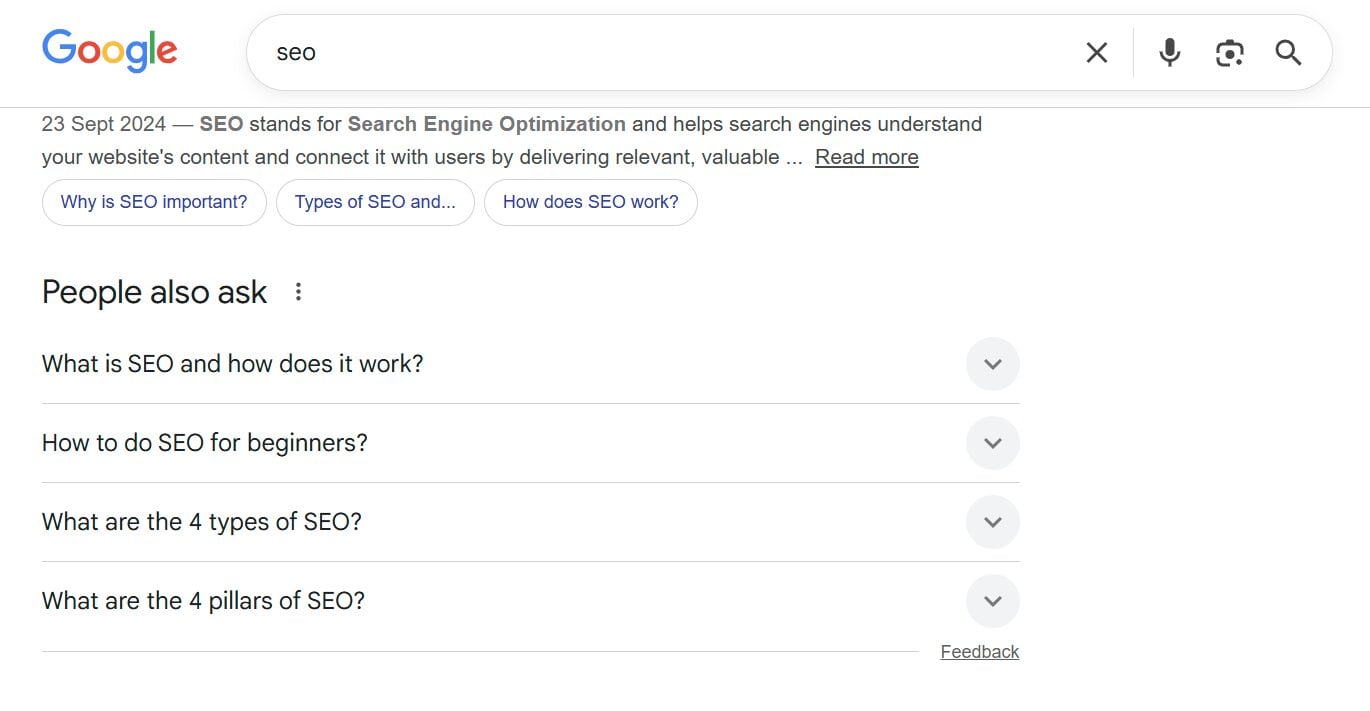
The second method is to use the question filter in Semrush’s Keyword Magic Tool. This helps uncover question-based queries that are directly linked to your main topic.
Aside from these methods, I also like to use Google’s AI Overview and AI Mode as a quick research layer. When I’m searching for my main topic, I pay particular attention to AI-cited sources because they often raise broad questions that people are actively searching for. The structured points and highlighted terms usually reflect the answers and subtopics that are most important to users. If I want to go deeper, I click “Show More” to see additional angles and follow-up questions that I might not have initially thought of.
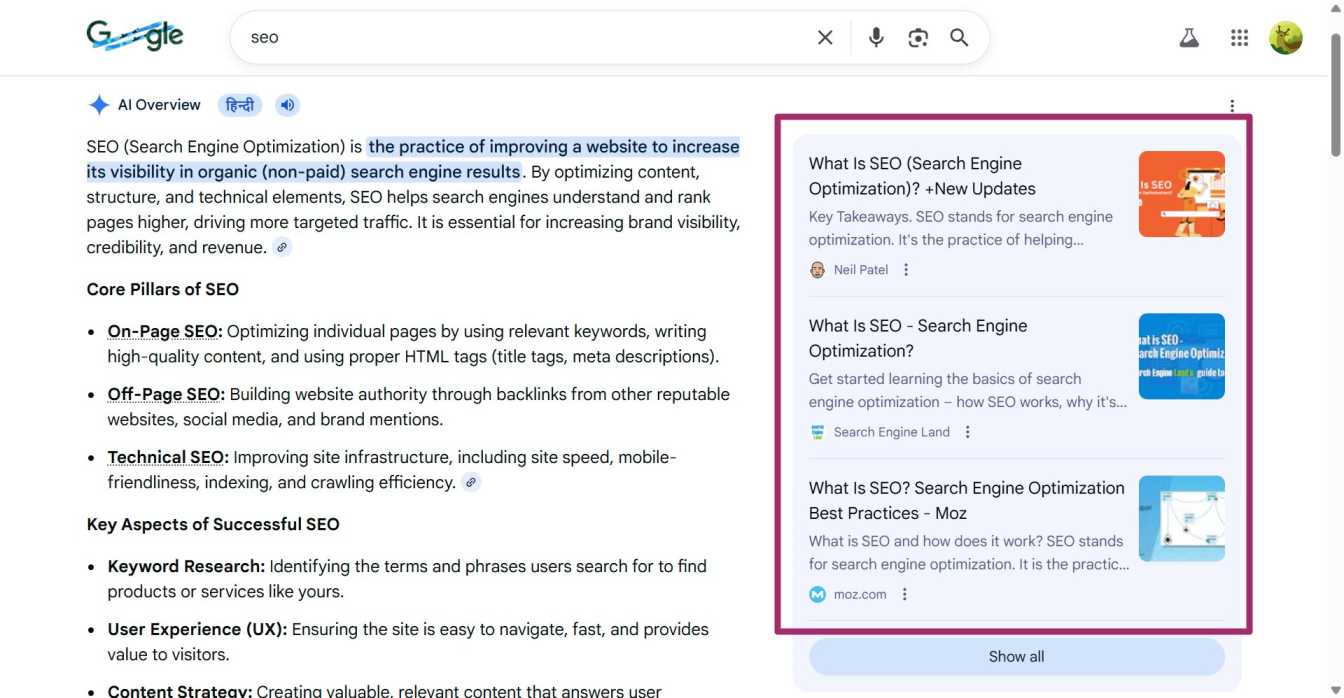
Finding and answering these questions will help you conduct straightforward online audience research and create content that feels genuinely helpful. It also increases the likelihood of your blog post being referenced in AI-generated answers, as LLMs are designed to provide clear answers to specific questions.
3. Structure your content with headings and subheadings
In our SEO predictions for 2026, we highlighted that editorial quality is no longer just about good writing. It has become a requirement of machine readability. Clearly structured content is easier to understand, reuse, and visible in both search and AI-driven experiences.
How LLMs use headings
AI models rely on headings to identify topics, questions, and answers on a page. When your content is divided into clear sections, it’s easier to extract important information and incorporate it into AI-generated summaries.
Why headings still matter for SEO
Headings help search engines understand the hierarchy of your content and the main points you want to rank for. They also improve scannability and usability, especially on mobile devices, and increase the chances of receiving featured snippets.
Good structure has always been a central SEO principle. In the age of AI, it remains one of the easiest and most effective ways to improve visibility and discoverability.
4. Focus on readability aspects
An SEO-friendly blog post should be easy to read before it gets ranked or picked up by AI systems. Readability helps readers stay engaged and helps search engines and AI models better understand your content.
Some important aspects of readability to focus on when writing:
- Avoid passive voice if possible
Active sentences are clearer and more direct. They make it easier for readers to understand who is doing what and reduce ambiguity for AI systems that process your content. - Use transition words
Transition words like “because,” “for example,” and “however” guide the reader through your content. They improve flow and make it easier to follow the relationships between sentences and paragraphs. - Keep sentences and paragraphs short
Long, complex sentences affect clarity. Breaking content into shorter sentences and paragraphs improves readability and comprehension. - Avoid consecutive sentences that begin the same way
Different sentence structure keeps your text engaging and prevents it from sounding monotonous or robotic.
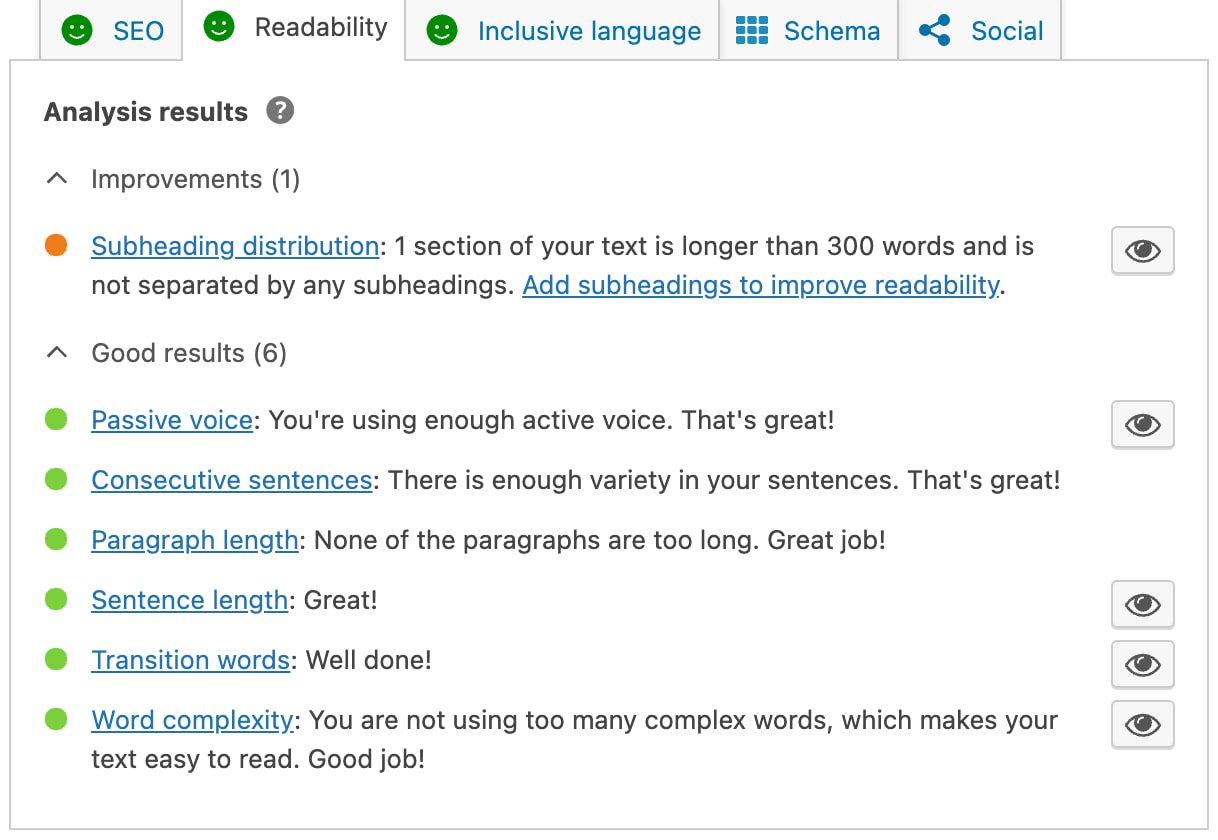
If you are a WordPress or Shopify user, Yoast SEO (and Yoast SEO for Shopify for Shopify users) can help here. The readability analysis checks for passive voice, transition words, sentence length and other clarity signals when writing. If you prefer designing in Google Docs, you can use the Yoast SEO Google Docs add-on to get the same readability feedback before publishing.
Use Yoast SEO in Google Docs
Optimize your design for SEO, inclusivity, and readability. The Yoast SEO Google Docs add-on allows you to export content for WordPress without the need for reformatting.
Good readability is not just about attractive algorithms. It helps readers understand your message faster and makes it easier to reuse your content in AI-generated responses.
5. Use inclusive language
Inclusive language helps ensure your content is respectful, clear, and inviting to a broader audience. It avoids assumptions about gender, ability, age or background and focuses on human-centered communication.
From an SEO and AI perspective, inclusive language also improves clarity. Content that avoids vague or biased terms is easier to interpret, digest, and more trustworthy. This directly supports brand perception, especially when your content appears in AI-generated responses.
Yoast SEO supports this through its inclusive language check, which flags potentially non-inclusive terms and suggests better alternatives. Available in Yoast SEO, Yoast SEO Premium, and the Yoast SEO Google Docs add-on, this feature makes it easy to integrate integrative habits directly into your writing workflow.
Inclusive language ensures that your content is intentional, thoughtful, clear, and closely aligned with the values of modern SEO and AI systems.
6. Add relevant media and interaction points
A well-written blog post shouldn’t feel like a long block of text. Adding the right media and interaction points helps guide readers through your content, engaging them and encouraging them to take action.
Why media is important
Media elements like images, videos, embeds, and infographics make your content easier to consume and more engaging. Blog posts that contain images are received 94% more views than those without, simply because visual elements break up large blocks of text and make pages easier to scan.
Video content plays an even bigger role. Embedded videos help explain complex ideas more quickly and can significantly improve organic visibility compared to text-only posts. Taken together, these elements encourage readers to stay on your page longer, which is a strong signal of content quality to both search engines and AI systems.
Media also improves accessibility. Properly optimized images with descriptive alternative text make content usable for screen readers, while original images, screenshots or diagrams help build credibility and expertise.
Use interaction points to guide and engage readers
Interaction does not always mean complex functions. Even simple elements can significantly improve engagement when used correctly.
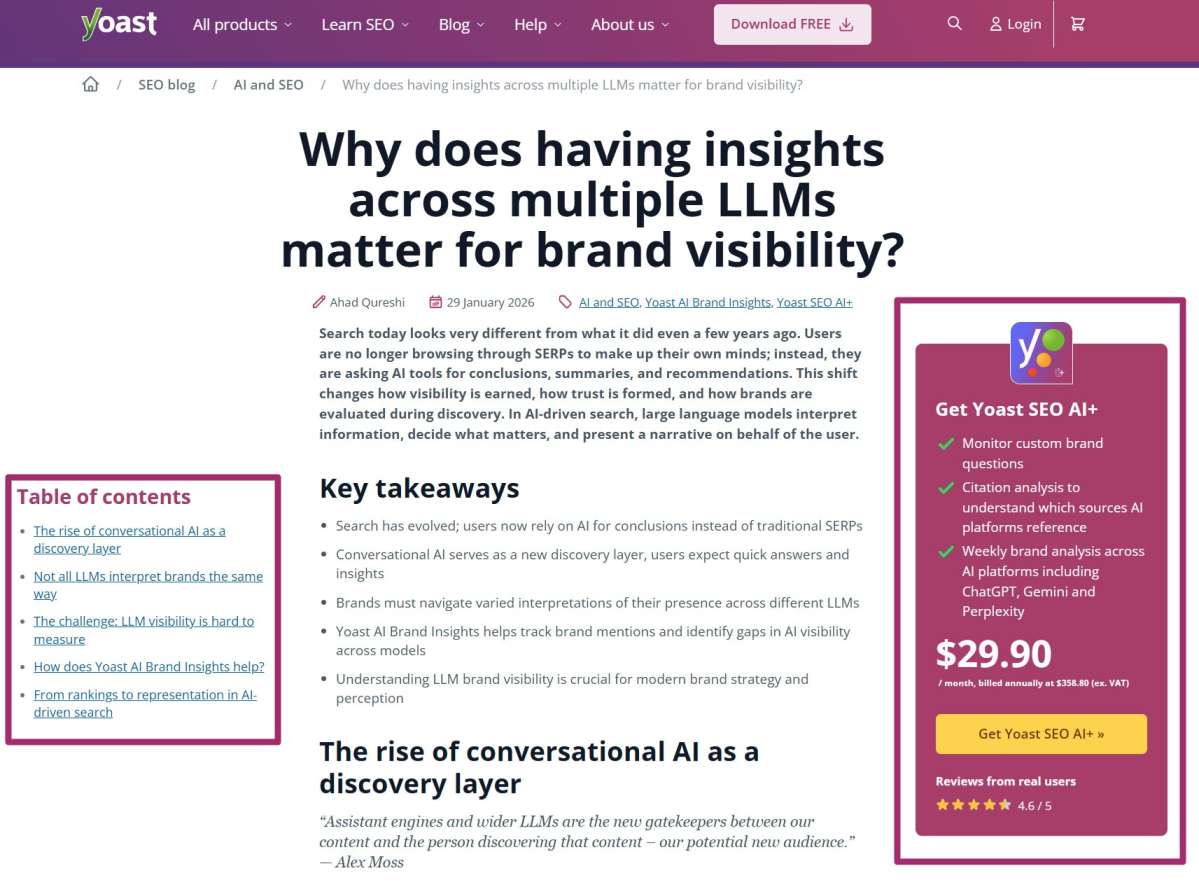
For example, a table of contents allows readers to jump directly to the section they care about most.
Other points of interaction include clear calls-to-action (CTAs) that guide the reader to the next step, relevant recommendations that encourage users to explore your site further, and social sharing buttons that make it easy to amplify your content. Interactive elements such as surveys, quizzes or embedded tools also encourage participation and increase the time spent on the site.
7. Plan the length of your content
Content length still matters, but not in the way many people think.
A frequently asked question is what is the ideal word count for a well-performing blog post. A 2024 study by Backlinko found that while longer content tends to attract more backlinks, the The average page ranking on the first page of Google is around 1,500 words.
However, this should not be viewed as a fixed benchmark. The ideal length is the one that fully answers the user’s question. In an AI-driven era, publishing long-form content that offers little value or is padded with unnecessary baggage can do more harm than good.
When a topic really requires a longer format, breaking the content into clear subheadings makes a big difference. I personally prefer structuring long articles this way because it improves readability, makes it easier for readers to navigate the page, and makes the content easier for search engines and AI systems to understand.
Must Read: How to use headings on your website
If you use Yoast SEO or Yoast SEO Premium, the paragraph and sentence length checks can be helpful here. These checks are designed to prevent pages from being too thin to provide real value. Pages with very few words often lack context and have difficulty demonstrating relevance or expertise. Yoast SEO flags such cases as a warning, but clearly states that adding more words alone does not guarantee better rankings.
Think of word count as a guideline rather than a goal. Your focus should always be on clarity, completeness and usefulness.
8. Link to existing content
Internal linking is one of the most underrated SEO practices, but it does a lot of work behind the scenes.
By linking to relevant content on your website, you help readers discover additional resources and help search engines understand how your content is linked. Over time, this strengthens topic authority and signals that your site consistently covers a topic in depth.
Good internal linking follows a few simple principles:
- Only link if it provides value and feels natural in the context
- Use clear, descriptive anchor text so users and search engines know what to expect
- Avoid linking to outdated URLs or pages that redirect as this wastes crawl signals
Internal links also retain readers longer by directing them to related articles. This improves overall engagement on the site while strengthening your expertise on a topic.
From an AI and search perspective, internal linking plays an even bigger role. Modern search systems analyze content structure, metadata hierarchies, schema markup, and internal links to assess topical depth and clarity. Well-connected content clusters make it easier for search engines and AI systems to understand what your website is about and which pages are most important.
For WordPress users, Yoast SEO Premium offers internal linking suggestions directly in the editor. This makes it easier to identify relevant linking opportunities as you write and helps you build stronger connections across content without interrupting your workflow.
A smarter analysis in Yoast SEO Premium
Yoast SEO Premium has one Intelligent content analysis This will help you take your content to the next level!
9. Write compelling meta titles and descriptions
Meta titles and meta descriptions help users decide whether to click on your content. Although meta descriptions are not a direct ranking factor, they have a strong influence on click-through rates and are therefore an essential part of writing SEO-friendly blog posts.
A good meta title clearly communicates what the page is about. Place your main keyword at the beginning, keep it concise, and aim for around 55-60 characters in length so it doesn’t get cut off in search results.
Meta descriptions act like a short invitation. You should explain how the reader will benefit from clicking and why it is important. Instead of stuffing keywords, focus on clarity and usefulness. Mention what aspects of the topic your content covers and how it will help the reader. Simple language works best.
Pro Tip: Using action-oriented verbs like “learn,” “discover,” or “read” can also encourage clicks and make your description more engaging.
If you use Yoast SEO Premium, this process becomes much easier. With the AI-powered meta title and description generation feature, you can create relevant, well-structured metadata with just one click. It follows SEO best practices and creates descriptions and titles that are clear, engaging, and aligned with search intent.
Bonus Tips
Once you’ve got the basics down, a few additional refinements can go a long way. The following bonus tips will help improve usability, clarity, and long-term discoverability. They’re not mandatory, but if used carefully, they can make your blog posts more helpful to readers and more likely to show up in search engines and AI-driven experiences.
1. Add a table of contents
A table of contents (TOC) helps readers quickly understand what your blog post is about and jump straight to the section that interests them. This is particularly useful for long content where users often scan instead of scrolling from top to bottom.
From an SEO perspective, a table of contents improves structure and readability and can create jump links in search results, which can increase click-through rates. It reduces bounce rates by helping users find answers faster and improves accessibility through clear navigation.
By the way, did you know that Yoast can help you here too? Yes, with Yoast SEO’s Internal Link Blocks feature, you can add a table of contents block to your blog post that automatically includes all headings with just one click!
2. Add key insights
Key Takeaways help readers quickly grasp the main points of your blog post without having to read the entire post. This is especially helpful for users with limited time who want quick, actionable insights.
Summaries also support SEO by strengthening topic relevance and improving content understanding for search engines and AI systems. Well-written insights can increase visibility in featured snippets and “People Also Ask” results.
If you use Yoast SEO Premium, the Yoast AI Summarize feature can generate key insights for your content with just one click, allowing you to add concise summaries without any additional effort.
3. Add an FAQ section
An FAQ section gives you the opportunity to answer specific questions your readers may have after reading your post. This improves the user experience by directly addressing concerns and building trust.
FAQs also help search engines better understand your content by clearly stating common questions and answers about your topic. While they can aid rankings, their real value lies in reducing friction, improving clarity, and even aiding conversions by eliminating doubts.
4. Short permalinks
A permalink is the permanent URL of your blog post. Short, descriptive permalinks are easier to read, easier to share, and more likely to be clicked.
Good permalinks clearly describe what the page is about, avoid unnecessary words and, where relevant, relate to the main topic. They improve user experience and help search engines understand page context at a glance.
5. Focus on building authority (EEAT aspect)
Construction oversight is crucial, especially for sites that cover sensitive or important topics. Demonstrating experience, expertise, authority and trustworthiness (EEAT) helps both users and search engines trust your content.
This includes citing reliable sources, highlighting practical experiences, maintaining consistent quality and clearly communicating who is behind the content. Strong EEAT signals are particularly important for YMYL topics where accuracy and credibility are most important.
6. Plan content distribution
Writing a great blog post is only half the job. Through distribution, your content reaches the right audience.
Sharing posts on social media, repurposing key insights in newsletters, and collecting backlinks from relevant websites can drive more traffic and visibility. Distribution also increases engagement signals and helps your content gain traction faster, supporting long-term SEO performance.
Always address your readers specifically!
With AI-driven search, retrieval is more important than ranking. Clarity, structure and linguistic alignment now determine whether your content is seen. –Carolyn Shelby
This perfectly sums up what writing SEO-friendly blog posts looks like today. Success no longer just depends on rankings. It’s about being clear, helpful and easy to understand for both readers and AI systems.
In this guide, we’ve focused on the basics that still matter: understanding search intent, structuring content well, improving readability, using inclusive language, and supporting your writing with media, internal links, and thoughtful metadata. These are not new tricks. They represent strong SEO fundamentals adapted to how search and discovery work in the AI age.
If there’s one takeaway, it’s this: always write for your readers first. Of course, if your content truly helps people, answers their questions, and respects the way they search and read, it will be easier to show up in SERPs and AI-driven experiences.
Good SEO hasn’t changed. It just became more human.
