


I still remember staring at my Google Analytics dashboard in frustration.
My landing page had solid traffic. But almost no one clicked on the call-to-action button. I knew something was wrong, but the analytics only showed numbers. It wasn’t shown to me Where People actually clicked.
That’s when I discovered heatmaps. Within a few minutes of installing, I realized the problem. Visitors clicked on an image that looked like a button but wasn’t clickable.
A simple solution and landing page conversions improved.
If you’ve ever wondered where visitors actually click, scroll, or hang on your WordPress site, heatmap plugins will give you answers that normal analytics can’t provide.
In this article, I’ll break down the 6 best heatmap plugins to help you better understand your users and get more conversions.
Key Takeaways:
- I test and evaluate 6 heatmap plugins for WordPress sites
- You will see my hands-on experience with the features of each tool
- I share honest pros and cons from real tests
- You’ll learn which free options actually deliver good results
- I’ll show you which plugin suits your specific needs
Quick overview table
I understand that you may not have time to go through the entire list. So here is the comparison table showing all 6 heatmap plugins at a glance:
| Plugin | Free version | Best for | Evaluation | Ease of use | Starting price |
|---|---|---|---|---|---|
| 🥇 User feedback | ❌ | WordPress native data ownership | Very simple | $149.50/year (Elite plan) | |
| 🥈 Microsoft Clarity | ✅ | Budget-conscious beginners | Very simple | Free forever | |
| 🥉 Crazy egg | ❌ | Analysis of traffic sources | Simply | $29/month | |
| 4. Mouse flow | ✅ | Form-heavy websites | Simply | $25/month | |
| 5. Hotjar | ✅ | All-in-one research platform | Simply | $40/month | |
| 6. Lucky orange | ✅ | Real-time visitor monitoring | Very simple | $32/month |
You can also find a table of contents here if you want to jump to a heatmap plugin on my list.
With that out of the way, let’s get started!
Choosing a heatmap plugin shouldn’t feel like a puzzle. I test each tool on actual WordPress sites to see how it works in real-world conditions.
That’s exactly what I rate:👇
- Easy setup: I estimate how long the installation will take. I check if coding is required and test if the plugin works smoothly with WordPress.
- User Interface Clarity: I check the dashboard to see if it is suitable for beginners. I’m checking whether heatmap visualizations make sense without a tutorial.
- Features included: I test all available heatmap types. I look for session recordings and additional tools and determine what is free or paid.
- Performance Impact: I run GTmetrix tests before and after installation. I monitor page load times and check if the plugin is slowing down my website.
- Value for money: I compare free tiers and their limits and check the prices against the features offered. I then look for hidden costs or surprise fees.
- Support quality: I read through the documentation. Then I test the response times when problems arise and evaluate how helpful the support is for beginners.
The key aspect of my testing is my personal experience. I installed each plugin on test sites and let them collect data from real visitors. This will give you an honest look at what actually works.
Why trust IsItWP?
At IsItWP, my team and I have been the go-to source for the WordPress community since 2009, helping over 2 million users choose better tools.
Unlike review sites that never actually use the WordPress products, we install these plugins on real websites, test them with actual traffic, and provide ongoing WordPress advice.
I have personally tested each heatmap plugin in this guide, observing the data collected, reviewing the reports, and addressing the kinks.
You’ll get honest feedback from someone who actually uses these tools, not just reads about them.
The best heatmap plugins for WordPress that I have tested
Now that you understand my testing process and what I was looking for when compiling this list of the best WordPress heatmap plugins, let’s get started with the list.
1. User feedback ⭐⭐⭐⭐⭐
Over 300,000 active installs | Best for: WordPress purists who want native integration

I recommend User feedback for any customer who does not want to send data to external platforms. This is my top choice for heatmaps because it is easy to use and keeps the data available in WordPress at all times.
The reality is that UserFeedback is the only heatmap plugin that runs entirely within your WordPress dashboard.
This eliminates the need to create accounts on external platforms or switch between different tools.
From setup to viewing reports, everything happens in the same place where you manage your content. For beginners who find even the best analytics tools overwhelming, this simplicity makes a real difference.
My experience
Setup took about 5 minutes from start to finish. I installed the plugin, entered the license key and activated the Heatmaps addon without leaving WordPress.
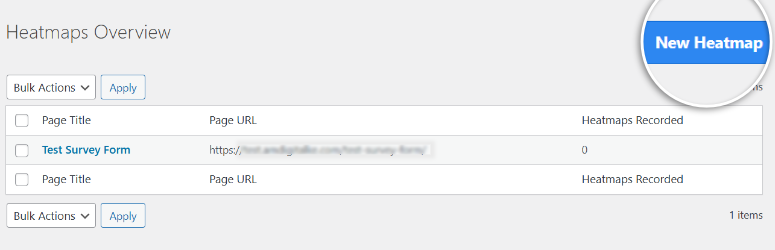
The clickmap showed me where visitors interacted the most on the homepage, and I used device filtering to compare how mobile users behaved differently than desktop visitors.
Additionally, the scroll map showed that most visitors stopped reading halfway down the page, which helped us restructure the content.
All data is displayed as color-coded overlays directly on the page screenshots, making it easy to spot patterns without the need for analysis training.

What stands out
As mentioned earlier, the biggest advantage of UserFeedback heatmaps is ownership of the data.
Everything stays on your server and is not sent to third-party platforms, meeting strict privacy requirements.
In addition to the heatmap data, I also tested the survey feature to get a complete picture of visitor behavior and feedback in one place.
►Advantages
- WordPress native solution only; Everything stays in your dashboard
- Complete data ownership with built-in GDPR compliance
- No coding required, easy setup process
- Lightweight script that won’t slow down your website
►Disadvantages
- Heatmaps joined the more expensive Elite plan
- Limited to WordPress only for multi-platform businesses
My verdict: UserFeedback is best for WordPress site owners who want native integration and complete data control. Choose this option if privacy and WordPress native tools are most important.
Check out my UserFeedback review.
Prices: Heatmaps are available on the Elite plan starting at $149.50/year
(Getting started with UserFeedback Elite can be found here →)
2. Microsoft clarity ⭐⭐⭐⭐⭐
Over 100 million monthly users | Suitable for: price-conscious beginners and heavily trafficked websites
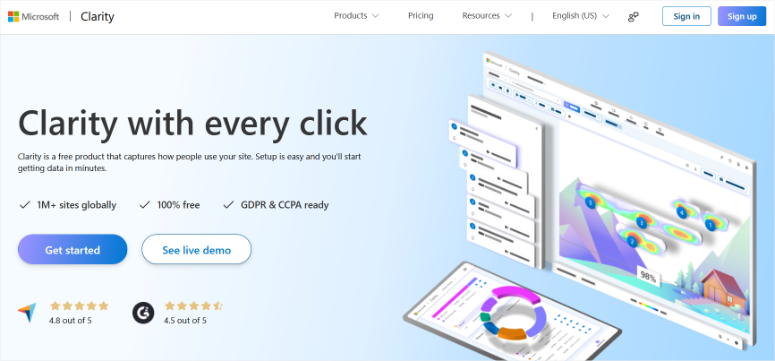
I tested Microsoft clarityexpecting to eventually find hidden limitations or forced upgrades. After using it on several client sites for several months, I still haven’t found the catch.
Microsoft launched Clarity as a completely free behavior analysis tool in 2020, and it has stayed that way.
There are no paid tiers, no session limits, and no restrictions on the number of sites you can track.
The fact that it comes from Microsoft means that it is well maintained and regularly updated. This gives me peace of mind that it won’t suddenly disappear like some free tools do.
My experience
Installing the WordPress plugin took about 3 minutes. There are several methods you can start with including a WordPress plugin, Google Tag Manager, manually via a tracking code, and so on.
I prefer using Google Tag Manager as it is a one-click solution. With this method, all you need to do is log in to the Clarity homepage and select “Get Started” under the Google Tag Manager tab.
Once connected, the data appeared within a few hours, which was faster than I expected.
The dashboard shows four heatmap types: click maps, scroll maps, area maps and conversion maps.
I first used the click map to see where visitors interacted on a landing page, then checked the scroll map to find where people stopped reading.
Additionally, Rage Click Detection flagged places where visitors repeatedly clicked, which alerted me to a broken contact form button.
What stands out
The session recordings paired with heatmaps give you the whole story. I was able to watch visitors actually navigate through the pages, not just see where they clicked.
My favorite feature is how the Clarity Copilot AI explains patterns in simple language, which is helpful if you’re not sure what the data means.
For an even more beginner-friendly approach, you can use the Chrome extension to display heatmap overlays directly on your live site. This makes it easier to spot problems without having to switch between tabs.
Additionally, the Google Analytics 4 integration links session replays directly to your existing analytics. This allows you to see the behavior behind your GA data.
►Advantages
- Completely free forever and unlimited everything
- Easy WordPress setup with special plugin
- AI explains patterns in simple language for beginners
- No impact on your website performance
►Disadvantages
- Only 30 days data retention for records
- No surveys or feedback widgets available
- Email support only with no live chat option
- Cannot be used on websites targeting users under 18 years of age
My verdict: The best value for money in heatmap tools. If you just need heatmaps and session recordings without surveys, Clarity delivers everything for free. Perfect for beginners or high traffic websites that don’t want to pay session prices.
Prices: Completely free forever.
(Getting started with Microsoft Clarity can be found here →)
3. Crazy egg ⭐⭐⭐⭐
Over 436,000 websites | Best for: Traffic source analysis and A/B testing
I have used Crazy egg Even at the beginning of my WordPress career, I learned something important about data traffic. Not all visitors behave the same.
Crazy Egg has been around since 2005, making it one of the first heatmap tools.
Founders Neil Patel and Hiten Shah developed it specifically for conversion optimization. What sets it apart from newer tools is the confetti reporting feature.
My experience
Like Microsoft Clarity, Crazy Egg also offers multiple setup methods. For me, using the WordPress plugin is the easiest solution.
After that, I pasted the tracking script from my Crazy Egg dashboard into the WordPress plugin. To make sure everything runs smoothly and loads properly, I cleared my cache.
Although Crazy Egg offers automated heatmaps that are easy to set up, they are limited. Scrollmaps, confetti reports, and other advanced analytics are not displayed. Therefore I prefer the manual approach.
I particularly like Confetti Reports. It segments your click data according to different traffic sources. This means you can see how visitors from Google behave differently than visitors who come from social media or email campaigns.
To view these results, I manually set up snapshots for each page I want to track, which takes a few extra minutes.
I created snapshots for my main landing pages and waited for there to be enough data to create useful heatmaps.
The clickmap showed me the interaction areas, but the Confetti report revealed something more interesting.
Visitors to Pinterest clicked on image galleries far more often than visitors to Google, who instead focused on the call-to-action buttons.
What stands out
Segmenting traffic sources really helps with conversion optimization. I used the overlay report to show the exact click counts for each element, filtered by referrer.
This showed me that organic traffic on certain pages was converting better than paid traffic, which helped adjust the ad strategy.
The A/B testing feature with the visual editor allows you to create page variations without coding. Additionally, AI analysis automatically interprets your heatmap patterns and session recordings.
This saves time when checking data from multiple sites.
►Advantages
- Confetti reports offer unique traffic segmentation by source
- The WordPress plugin makes installation quick and easy
- 30-day free trial with access to all features
- AI analysis included to interpret heatmap data
►Disadvantages
- Advanced heatmap tracking requires manual snapshot creation
- A/B testing requires the more expensive Plus plan
- Annual billing only, no monthly payment option
My verdict: Choose Crazy Egg if you want to understand how different traffic sources behave on your website. The Confetti reports are truly unique. However, manual snapshot setup and annual billing only may not be suitable for everyone.
Prices: Starts at $29/month. Free 30 day trial
(You can start with Crazy Egg here →)
4. Mouseflow ⭐⭐⭐⭐
7 Heatmap Types | Best for: Form-heavy websites and dynamic content

I use Mouseflow when forms are critical to the business. Form analysis shows exactly where people stop filling out your forms.
Mouseflow offers seven different heatmap types, more than any competitor on this list.
What really sets it apart is how interactive heatmaps work on dynamic content like dropdown menus, modals, and popups. Most other tools have problems with these elements or miss them altogether.
The platform also automatically generates heatmaps for all your pages, eliminating the need for manual setup for each individual page.
My experience
You can paste the tracking code directly into the header or footer of your WordPress site. However, this requires technical experience.
If you want to go this route, I recommend using it WP Code. It helps you add the tracking code as a simple snippet.
For beginners, use the native Mouseflow plugin. Installing the WordPress plugin only took a few minutes. After that, I inserted my tracking code from Mouseflow and it started collecting data immediately.
Automatic generation meant I didn’t have to configure individual pages, which saved a lot of time compared to tools that require manual snapshots.
I first tested the click maps on standard pages and then moved on to the interactive heatmaps in drop-down menus to see if they actually track clicks within those elements.
That’s what they did, which is impressive since some competitors completely overlook this.
The scroll maps showed me where visitors had stopped reading. And the attention heatmaps combined scroll depth with time spent to show the areas of interest for the longest time.
What stands out
The form analysis feature breaks down field-by-field behavior in an incredibly useful way.
I could see exactly which form fields were causing people to abandon, how long they spent on each field, and which ones they filled out and then deleted.
This level of detail helped identify confusing labels and unnecessary fields that led to conversions.
Friction detection uses machine learning to automatically score sessions based on angry clicks, dead clicks, and erratic movements.
Instead of looking at hundreds of session recordings, I could filter out just the most frustrated visitors and fix their problems first.
►Advantages
- Seven heatmap types; more variety than heatmap plugin competitors
- Automatic heatmap generation without manual setup
- Interactive heatmaps work with dynamic content and SPAs
- Free plan with 500 sessions available per month
►Disadvantages
- The participation plan is limited to one website only
- Data retention is only 1-3 months at lower levels
- Motion heatmaps only work on desktop
- It can be expensive for busy websites
My verdict: Best choice for websites with important forms or dynamic content that other tools miss. The seven heatmap types and automatic generation work well without adding complexity. Choose this option if you need form analytics in addition to behavior tracking.
Prices: Free plan with 500 sessions/month; Payment starts at $25/month
(You can start using Mouseflow here →)
5. Hotjar ⭐⭐⭐⭐
Over 1.1 million websites | Best for: All-in-one feedback and behavior analysis

Most conversion teams I work with have used it Hotjar Sometime. This is because it is one of the best tools for connecting What Users join in Why they do it.
Hotjar combines multiple research tools into one platform instead of just focusing on heatmaps.
You get heatmaps, session recordings, surveys, feedback widgets, and even user interview recruiting – all under one roof.
This makes it easier to understand the big picture of user behavior rather than piecing together data from different tools.
The free plan is really generous, offering unlimited heatmaps and up to 10,000 session recordings per month.
My experience
Installing the WordPress plugin took about 5 minutes. I entered my site ID via the Hotjar dashboard and data collection started within an hour.
The four heatmap types cover the basics well: click maps, scroll maps, move maps and rage click detection.
I first used the clickmaps to see engagement zones on a landing page and then checked the scrollmaps to find out where visitors dropped off.
Rage click detection highlighted areas where users repeatedly clicked out of frustration, which alerted me to broken elements.
Additionally, the session recordings allowed me to view actual navigation paths. The frustration score helped me prioritize which recordings to review first based on user difficulty.
What stands out
The survey function with the AI generator makes obtaining feedback much easier. I created a simple survey asking why visitors didn’t complete the checkout process. The AI roundup then compiled hundreds of answers on key topics.
I like how the feedback widgets allow you to collect real-time reviews on specific page elements. This helps validate changes quickly.
Additionally, the Google Analytics 4 integration links session replays directly to your existing analytics dashboard. This allows you to see the behavior behind your conversion data.
You can use this with the Journey Analysis feature to track how visitors move from entrance to exit, showing you the paths that lead to conversions and those that don’t.
►Advantages
- Generous free plan with unlimited heatmaps included
- All-in-one platform with multiple research tools
- No programming knowledge is required for the WordPress plugin
- Extensive integrations including Google Analytics and HubSpot
►Disadvantages
- Session limits create gaps on busy websites
- As usage increases, costs rise quickly
- No live chat; chatbot and email support only
My verdict: The balanced choice for beginners who want heatmaps, recordings, surveys and feedback together. The generous free plan allows you to test thoroughly. Best if you need multiple research methods working together, not just heatmaps alone.
Prices: Free plan with 10,000 shots/month; Growth starts at $40/month
(Getting started with Hotjar can be found here →)
6. Lucky Orange ⭐⭐⭐
Over 500,000 websites | Best for: Real-time monitoring and live chat combined
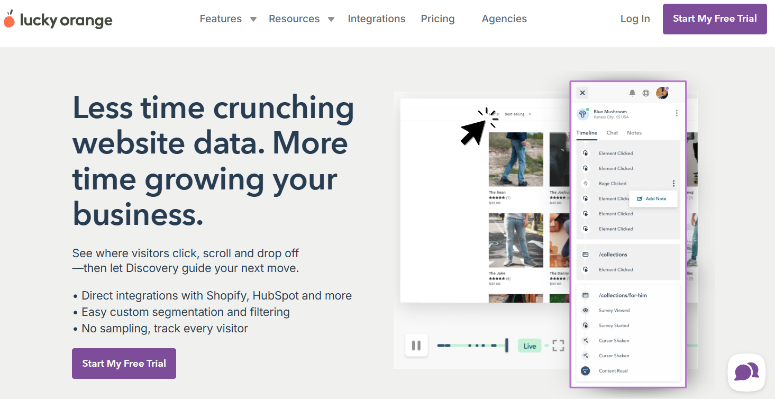
Lucky Orange turns passive data collection into active problem solving. This is done using the Live View feature, which allows you to observe visitors in real time as they navigate your website.
You can see where they click, where they get stuck, and even start a chat conversation if you notice someone having trouble.
This real-time capability, combined with live chat support, makes it unique among heatmap tools.
My experience
After logging into Lucky Orange’s website, I was prompted to add my website so I could get my site ID.
After that, I installed the WordPress plugin, activated it, pasted my site ID from the Lucky Orange dashboard and the tracking started immediately.
Live View immediately showed me active visitors to my site, which felt different than other tools that only show historical data.
I tested the dynamic heatmaps in dropdown menus and modal windows to see if they track interactions within these elements.
This is what they did, which helped me spot navigation issues that standard heatmaps miss.
The session recordings showed me how people moved through multi-step forms, and the form analysis broke down completion rates field by field.
What stands out
Live chat integration with behavioral data creates opportunities that other heatmap tools cannot.
For example, I saw someone struggling with the shipping calculator in live view and immediately started a chat to help them.
The best part? With the co-browsing feature, you can even see the screen while chatting, making problem resolution much faster.
The conversion funnels visualize where people descend in multi-stage processes. While Discovery AI answers questions about your data in a simple way that even beginners can understand.
Announcements allow you to create targeted popups based on visitor behavior. This is useful for identifying frustrations, such as when someone clicks on a page angrily or spends too long on a page.
This heatmap platform also includes all features of every plan, including the free tier, so you are not limited to key features.
►Advantages
- All features are available in every plan, including free
- Live View for real-time visitor monitoring
- Easy setup process
- Dynamic heatmaps work on interactive elements
►Disadvantages
- Free tier: only 100 sessions per month
- The participation plan is limited to one website only
- No built-in A/B testing features
- Big gap between limits for free and build plans
My verdict: This is the only tool that allows you to monitor and respond to visitors in real time. Good for eCommerce websites that want behavioral analytics with live support. Choose this option when real-time insights are as important as historical data.
Prices: Free with 100 sessions/month; The Build plan starts at $32/month
(You can start with Lucky Orange here →)
That’s it for my list of the best WordPress heatmap plugins. But educating yourself about the best options is only half the battle. You need to know the best heatmap option that suits your needs.
How to choose the right heatmap plugin
Choosing the right heatmap plugin depends on your budget and the actual needs of the tool.
If your budget is tight:
- Microsoft clarity gives you unlimited everything for free.
- You get heatmaps, session recordings, and friction detection without spending a dollar.
- It’s perfect for beginners who want to learn how heatmaps work before committing to paid tools.
If you need a native integration just for WordPress:
- User feedback Keeps all your data on your server instead of sending it to external platforms.
- This is important if you have strict data protection requirements.
- Or just prefer to keep everything in your WordPress dashboard.
If forms are critical to your business:
- Mouse flowForm analytics show exactly where users stopped filling out forms.
- Breaking it down by field shows which questions confuse people or which areas they leave behind most often.
If you want all-in-one research tools:
- Hotjar combines heatmaps, recordings, surveys and feedback widgets in one platform.
- You can see what users are doing and ask them why they do it without having to switch between different tools.
If you need real-time monitoring:
- Lucky orange You can watch visitors live as they navigate your website and start chat conversations when you notice someone struggling.
- This works especially well for eCommerce sites where quick support can save a sale.
If you analyze traffic sources differently:
- Crazy eggConfetti reports segment your click data by 22 different traffic sources.
- This shows you how visitors from Google behave differently than visitors from social media or email campaigns.
Remember to think about your budget first. Most beginners should try the free version of Microsoft Clarity to understand how heatmaps work.
Once you know what patterns to look for, you can add a paid tool User feedbackbased on your primary goal, be it form optimization, traffic segmentation or real-time support.
FAQs: Best Heatmap Plugins for WordPress
What is a heatmap plugin and why do I need one?
A heatmap plugin shows you where visitors click, scroll, and draw attention to your WordPress site using color-coded overlays. Hot colors like red and orange indicate heavily used areas, while cool colors like blue indicate neglected areas. You need one because normal analytics tools like Google Analytics tell you how many people visited a page. But heatmaps show you what they actually did on that page. This will help you identify broken buttons, confusing layouts, and content that visitors ignore.
Which heatmap plugin is completely free?
Microsoft Clarity is the best free heatmap plugin with no limitations on traffic, sites, or features. It includes unlimited heatmaps, session recordings, and friction detection forever. Mouseflow, Hotjar and Lucky Orange also offer free plans but limit you to 100-500 sessions per month. There are no free versions of UserFeedback and Crazy Egg at all. However, they offer more features and flexibility.
Are heatmap plugins slowing down my WordPress site?
Most modern heatmap plugins load scripts independently, meaning they won’t block your page from loading. I tested each plugin before and after installation with GTmetrix and in most cases the impact was minimal. UserFeedback and Microsoft Clarity had virtually no noticeable impact on loading times. Some users report that Hotjar can occasionally slow down websites slightly, but this depends on your hosting and existing plugins.
Can I use heatmaps with WooCommerce?
Yes, all six plugins work with WooCommerce stores. Lucky Orange and Mouseflow are particularly suitable for eCommerce because they include conversion funnels and form analytics for checkout flows. Microsoft Clarity offers conversion heatmaps specifically for tracking purchasing behavior. You can see where customers click on product pages, where they abandon cart, and which elements drive sales.
What is the difference between clickmaps and scrollmaps?
Clickmaps show you where visitors click on your page using colored dots or overlays. They reveal which buttons, links and images receive the most attention. Scroll maps show you how far visitors scroll down the page before leaving. They use color bands to show what percentage of visitors see each section, helping you see where interest is waning. You need both to get a complete picture of user behavior.
Final Verdict: Start tracking visitor behavior today
Choosing a heatmap plugin doesn’t have to be complicated. Which tool is right depends on your budget and what data you need most.
Start with a free option to learn how heatmaps work without spending any money. Install it, let it collect data for a week and check the patterns. You can quickly see where visitors click, where they get stuck, and which pages capture their attention.
Once you know what to look for in heatmap data, you can decide whether you need additional features from a paid tool based on your specific goals.
Related Resources:
Today, heatmaps are just the first step to fully understanding user behavior. Check out the posts below to learn more ways to understand your website analytics.
Track your marketing campaigns:
Understanding visitor behavior:
Analysis tools and alternatives:
These guides will help you build a complete analytics system that goes beyond heatmaps.
You not only see where visitors click, but also where they come from, which campaigns work best, and which metrics are most important to your business.
Thanks for reading! We would love to hear your opinion. So feel free to leave a comment with questions and feedback.