
Over the past year, I have had hundreds of conversations with business leaders about AI. The pattern is always the same. They have no shortage of tools or ambition. They struggle with where to start and how to add value.
The pressure to adopt AI is real. But pressure without direction leads to experiments not working, tools not being used and teams becoming more and more skeptical. Why? Because the AI results did not produce actual results.
Here’s what I’ve learned from watching teams succeed with AI: They don’t start with AI. You start with a problem. A specific, painful, and time-consuming part of their job that they want to fix. They then find the right AI use case to achieve that goal. When they see results, their confidence grows and they explore other AI functions – again with a clear goal.
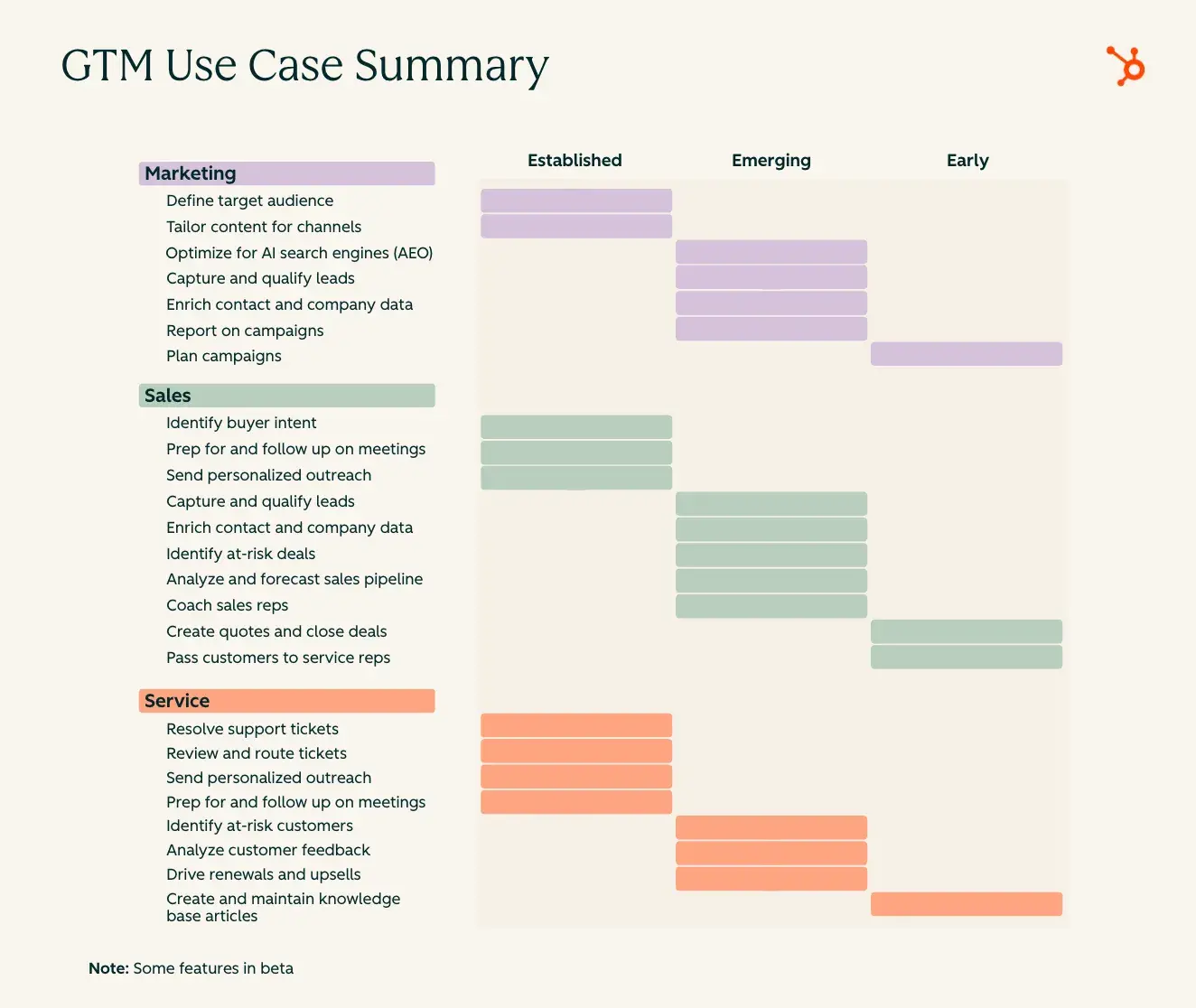
This is the approach I want to share. Not an exhaustive list of everything AI can do, but a practical guide to how marketing, sales and service teams can get started and see the real value of AI. For the sake of transparency, we have ranked use cases based on how mature the technology is today. At HubSpot, we build and improve these features every day. Let’s start with simple definitions:
- Founded: These are use cases where AI works reliably. The implementation is straightforward. Results are repeatable. If you’re wondering where to start, you’ll find it here!
- Emerging: These use cases are already available today and are being improved rapidly. They deliver value but continue to evolve. The more data and context the AI receives, the more powerful it becomes.
- Early: These are use cases with great potential that are still taking shape. If you consider yourself an early adopter, this is where you can experiment (with patience).
Jump to the use case that meets your team’s biggest challenges:
Marketing use cases
Marketing teams were under pressure to do more with less. More channels, more content, more personalization. All without more staff. But AI is helping marketers rethink the way they do all this work. Here are the use cases that teams can implement now and in the near future.
Founded
Define target group. Most segments were created based on job titles and company size, but that doesn’t tell you who’s actually buying. AI helps you find the right prospects who are most likely to convert. HubSpot customers can use Breeze Assistant to better understand customers, optimize their journey, and ultimately improve lead quality. Find out how here.
Customize content for channels. You write a blog post. Then you need to convert it into emails, social media posts, and ads. Each version takes time. With AI, you take one piece of content and adapt it for different channels – all in your brand voice. HubSpot customers can get started with Content Remix and Breeze Assistant to save time on content creation. See for yourself.
Emerging
Optimize for AI search. The way buyers find your business is changing. You don’t scroll through blue links; You ask ChatGPT, Claude, Perplexity. This is why your marketing strategy must include response engine optimization (AEO). HubSpot’s new AEO feature helps marketers understand how often their brand appears in AI-generated responses and provides recommendations to improve visibility. This is an area we are investing heavily in and the capabilities will continue to develop rapidly!
Capture and qualify leads. People visit your website 24/7, even if your team is only on site from 9 a.m. to 5 p.m. AI can talk to visitors in real time, answer their questions, find out if they’re a good fit, and schedule meetings with the right representative. This means you can get more leads without adding more staff. HubSpot customers can set up Breeze Customer Agent to capture and qualify leads. See it in action.
Early
Plan campaigns. Give AI a campaign brief and get a complete strategy, including content to create and channels to use. This allows your team to spend less time planning and more time rolling out. At HubSpot, we’re building this to help all types of businesses so marketing teams can move faster.
Sales use cases
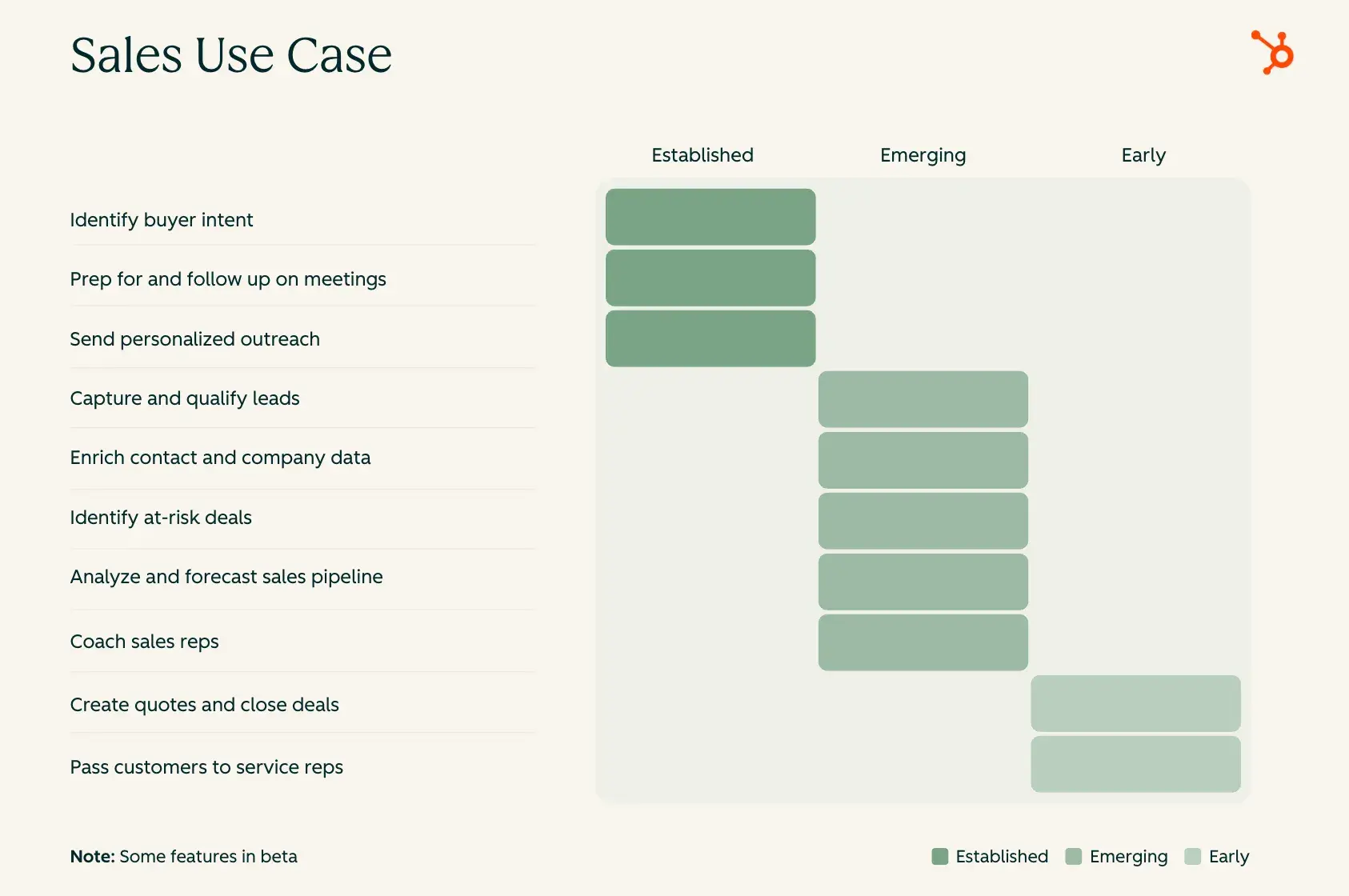
Only a fraction of a sales rep’s day is spent on sales. Most of the time they are researching, entering data, tracking or preparing for calls. AI is changing that. It takes over the tedious work so employees can focus on what matters most: the customer. This is where AI now offers added value.
Founded
Identify buyer intent. Sales reps often spend too much time on the wrong accounts – not because they’re bad at their jobs, but because they don’t always know who’s actually ready. AI monitors your target accounts for signals like funding news, new hires, and website visits and notifies your team when the time is right. The result is less time searching for non-committal customer accounts and more time talking to buyers who are already interested. HubSpot customers can get started with buyer intent. Learn more.
Prepare and follow up on meetings. Sales reps spend the first few minutes of each call trying to remember where things left off, then spend the next hour writing notes that they no longer have time to read. AI solves both ends of this problem. Before a meeting, contact history, business context, and recent interactions are displayed so you’re ready. After the call, it records what was discussed, retrieves the action items and automatically creates the follow-up email. Less administrative work means more time to actually conduct business. HubSpot customers can get started with Breeze Assistant and Call Recap Agent.
Send personalized contact information. Imagine having done your best research only to email a prospect a moment too late. AI tracks what’s happening with each account, alerts you to a change, and designs an outreach that feels timely and relevant rather than generic. HubSpot customers who use Breeze Prospecting Agent experience twice the response rates compared to traditional outreach. See how you can get started.
Emerging
Enrich contact and company information. Every salesperson knows the pain of a CRM with incomplete records. It’s missing job titles, company information, and all the fields you need to make segmentation, scoring, and personalization actually work. Now the AI can fill these in automatically. For HubSpot customers, this means access to a data set of over 200 million business and buyer profiles that is constantly updated. Your team spends less time updating CRM records. And they send messages that are tailored and relevant because the data behind them is accurate and up-to-date. HubSpot customers can get started with data enrichment today – Find out how.
Coach sales reps. Your sales reps shouldn’t have to lose a deal to learn from it. AI analyzes calls and business activity to find out what top performers are doing to win and helps managers quickly replicate this across the team. The result is a faster ramp time and a team that wins more consistently. HubSpot customers can get started with Conversation Intelligence and Sales Coach Assistant.
Early
Create offers and close deals. Creating offers is one of the most dreaded parts of a representative’s job because it can slow down deals. What if AI could answer buyers’ questions about pricing, create offers based on previous deals, and design offer emails? With AI handling paperwork, your employees can do their best work. At HubSpot, we build this to support even the most complex businesses so our customers can close deals faster.
Use cases for the service
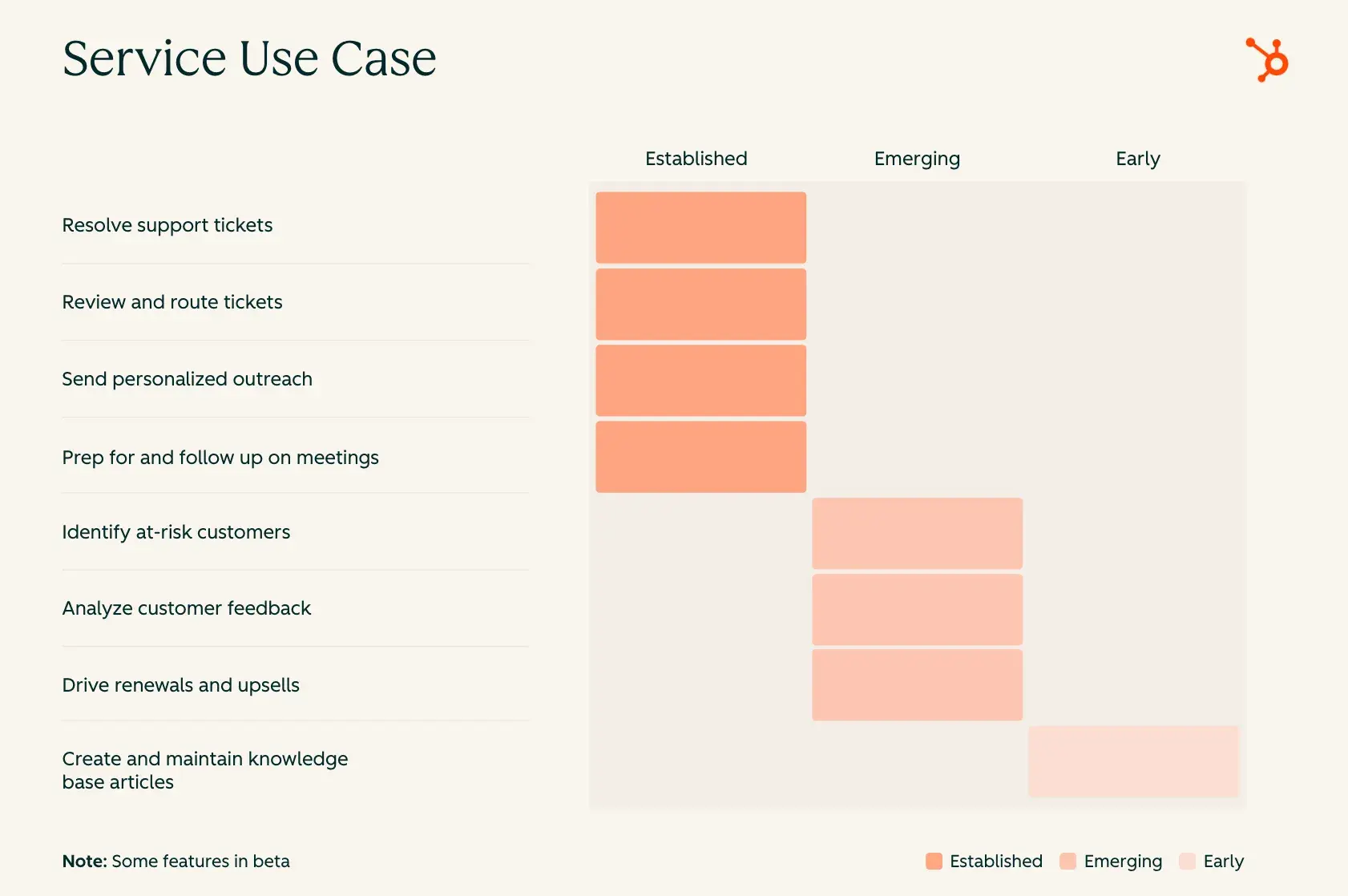
Service teams often find themselves in a difficult situation. Customers expect faster and better support, but the number of employees supporting them isn’t growing at the same pace. The teams that figure it out don’t necessarily work more hours. They let AI do things that don’t require humans so their people can focus on things they do. That’s how it works today.
Founded
Resolve support tickets. Customers shouldn’t wait hours for answers to simple questions. AI handles the routine matters instantly using your own help documents, so your team can focus on the problems that actually need a human. HubSpot customers using Breeze Customer Agent resolve up to 65% of tickets automatically. Here’s how to get started.
Review and forward tickets. If every ticket looks the same, pressing issues can get lost. This means teams spend more time sorting than solving. AI can help quickly understand, prioritize and assign tickets to the right agent. This makes the entire team more efficient. HubSpot customers using Customer Agent with Help Desk saw a 25% increase in ticket resolution. HubSpot customers can get started with Customer Agent and Help Desk today. See how it works.
Just like in sales, personalized contact and the preparation and follow-up of meetings are use cases that AI can also handle for service teams. Whether you’re emailing an at-risk customer or preparing for a renewal conversation, the same AI capabilities will help your team stay informed and follow up quickly. HubSpot customers can get started with Breeze Assistant.
Emerging
Identify at-risk customers. By the time a customer tells you they’re canceling, you’ve usually already lost them. AI can spot the warning signs – declining engagement, rising ticket volumes, changes in tone – and alert you while there is still time to act. This means higher customer satisfaction and better customer retention. HubSpot customers can use Customer Health Agent and Conversation Intelligence to get started.
Analyze customer feedback. Your customers tell you what they need, but it’s buried in hundreds of survey responses and call logs. AI scans everything to automatically surface topics and sentiment trends, so you can act on what customers are actually saying instead of guessing. HubSpot customers can get started with feedback survey summaries and conversation insights.
Early
Create and maintain knowledge base articles. By the time most of your customer FAQs are written, they are already out of date. So customers get wrong answers and employees waste time correcting them. AI can be used to create help articles based on how your team has actually resolved tickets in the past – and they can be updated if anything changes. A knowledge base that builds and maintains itself. Although it’s still early, the benefits are clear: better, faster responses for customers and less documentation work for your team.
What we learned
After working with thousands of customers on how to use AI in their go-to-market, the truth is simple: AI doesn’t create momentum. Solving a real problem is enough.
The teams that saw results didn’t start with a major transformation plan. They started with a clear bottleneck. A place where time was wasted. A workflow that needed to move faster. Then they used AI there.
And the results they see are affirming. Marketing teams reach the right audiences and convert more visitors into qualified leads. Sales teams achieve twice as high response rates when making contact. Customer teams resolve more than half of their tickets without human intervention. Small beginnings turn into real, measurable results.
For this reason, AI is no longer a thing of the future. For now it works for everyday business goals. It makes work faster, smarter and more effective.
The question is not whether AI can help your team.
This is where you will start.