
Scrunch vs. SEMrush comes down to one question: Do you need a dedicated AI visibility tool or a full SEO suite that now also tracks AI answers? Scrunch is an AEO specialist designed to monitor how your brand appears in AI-generated responses, while SEMrush is a traditional SEO platform that adds an AI visibility toolkit to a stack that marketers already use for keyword research, rank tracking, and backlinks.
This gap between specialist and suite determines all of the following practical differences: what each costs, how many engines it tracks, how each provides insight into the visibility of published content, and which of them fits the size and maturity of your team.
In this guide, I compare both in terms of pricing, monitoring coverage, optimization workflow, and content delivery risk, and then walk through step-by-step how to make a selection based on your goals.
Table of contents
Scrunch vs. SEMrush: What’s the Real Difference?
Scrunch is an AEO-specific tool that focuses on how your brand appears in AI responses, while Semrush is a broader platform that covers this traditional SEO and adds an AI Visibility Toolkit. In short: Scrunch has AEO features but not SEO features, while Semrush has both SEO and AEO features.
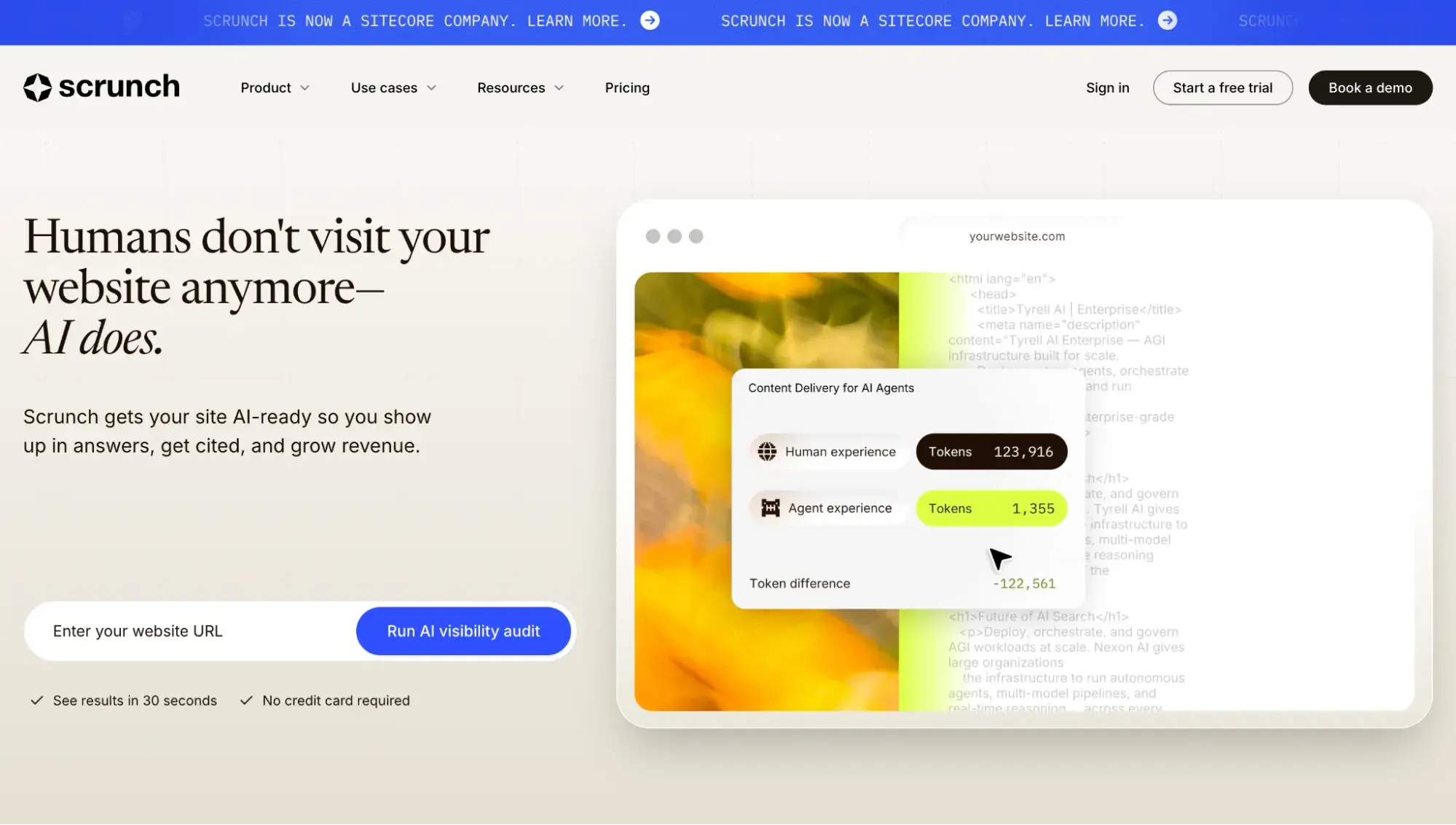
Crunch describes itself as “The AI Customer Experience Platform”. Functionally, it is an AI visibility platform that monitors brand presence, position, sentiment, quotes and share of voice across up to nine response engines on the Enterprise plan. The Self-Service Core and Agency Core plans include four: ChatGPT, Perplexity, Google AI Overviews, and Copilot.
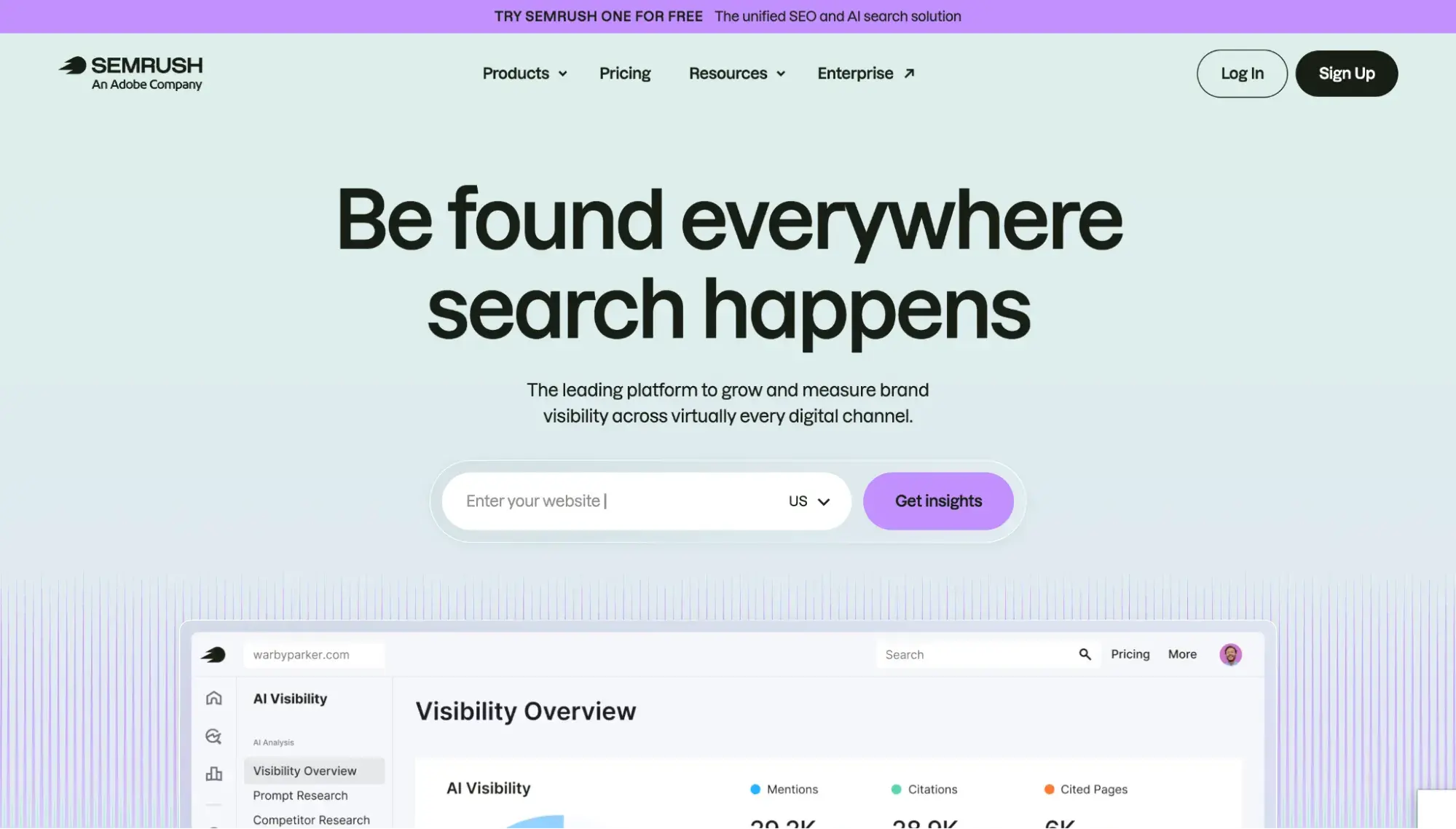
Semrush describes himself as “Brand visibility management platform“ includes “SEO, AI search, content marketing and paid media.” Most teams know it for traditional SEO functions: keyword analysis, rank tracking, audits and backlinks. Semrush’s AEO features are included in a dedicated AI Visibility Toolkit, which can be purchased as a standalone tool or bundled with the SEO Toolkit.
So the difference between Scrunch and SEMrush lies in specialization versus breadth. It is worth noting that none of the providers present AEO as a replacement for SEO.
Before committing to either, it’s helpful to know where your brand currently stands in terms of AI responses. HubSpots AEO grader Gives you a quick, free overview of your AI search visibility so you can choose a tool based on a real baseline instead of a guess.
|
Crunch |
Semrush |
|
|
Self-described category |
“The AI customer experience platform” |
“Brand Visibility Management Platform” |
|
Main focus |
AI Visibility/AEO |
All-in-one suite with built-in AI visibility |
|
Traditional SEO depth |
Complements SEO tools; does not have SEO functions itself |
Deep (rank tracking, audits, backlinks, keywords) |
|
AI response monitoring |
core product; nine locomotives tracked |
A toolkit within the broader suite; five engines for self-service plans (Google AI Overviews, AI Mode, ChatGPT, Perplexity, Gemini), expanding to nine at the custom Enterprise AIO tier (adds Claude, Copilot, Grok, DeepSeek) |
|
Attitude towards SEO |
Supplements, not replaces |
Supplements, not replaces |
|
Best fit |
Teams add a dedicated AI response layer to an existing stack |
Teams that want SEO and AI visibility on one platform |
|
Decision shorthand |
AI Visibility First: Complement Your SEO Stack |
SEO and AEO: A suite for both |
Scrunch vs Semrush Pricing and Total Cost of Ownership
Scrunch sells AI visibility as a standalone subscription. Semrush sells SEO and offers AI visibility as an add-on or bundle.
Scrunch prices
|
Plan |
Monthly price |
Seats |
Branded workplaces |
Prompts are tracked |
engines |
Free trial |
|
core |
$250 |
5 licenses |
1 |
125 |
4 |
7 days, self-service |
|
Agency core |
$500 |
Unlimited |
3 |
250 |
4 |
— |
|
Pursue |
custom |
custom |
custom |
custom |
9 |
Contact sales |
Semrush Pricing
|
Plan |
Monthly price |
Seats |
Websites/Domains |
Prompts are tracked |
engines |
Free trial |
|
AI visibility toolkit (Add on) |
$99 + SEO Classic starting at $139.95 |
Main User (+$99/Sub User) |
1 domain (brand performance) |
25 (+50 for $60/month) |
5 |
No trial version of the standalone add-on |
|
SEMrush One – Starter |
$199 |
Main User (+$99/Sub User) |
5 |
50 |
5 |
7 days |
|
SEMrush One – Pro+ |
$299 |
Main User (+$99/Sub User) |
15 |
100 |
5 |
7 days |
|
SEMrush One – Advanced |
$549 |
Main User (+$99/Sub User) |
40 |
200 |
5 |
7 days |
|
SEMrush for companies |
custom |
custom |
custom |
15,000 |
9 |
Contact sales |
The $99 AI Visibility Toolkit is a standalone subscription that covers AEO monitoring only, with no rank tracking or backlinks. To run SEO alongside this, add a separate SEO Toolkit subscription or switch to SEMrush One, which bundles both.
Budget factors to consider:
Total cost depends on seats, domains, prompts and engine requirements, not just list price.
Best for: For coverage beyond five engines, both providers’ Enterprise tiers reach nine. Scrunch Enterprise is the only company that includes Meta AI; Semrush’s Enterprise AIO is the only one that includes DeepSeek.
Scrunch vs. SEMrush Features: Monitoring, Auditing, and Optimization
Monitoring coverage: What each tool tracks
Scrunch’s approach: Scrunch monitors up to nine response engines on Enterprise (ChatGPT, Claude, Perplexity, Gemini, Meta AI, Google AI Mode, AI Overviews, Microsoft Copilot, Grok). It is prompt-native and estimates volume at the topic level, which it defines as clusters of related prompts. Scrunch updates new prompts daily for 14 days and then every 72 hours with on-demand pulls. It compares competitors in terms of share of voice, gaps and quotes describes the mood as positive, mixed or negative.
Semrush’s approach: The AI Visibility Toolkit tracks five engines (Google AI Mode, AI Overviews, ChatGPT, Perplexity and Gemini). These five apply to all self-service plans. The custom Enterprise level expands coverage to nine engines and adds Claude, Microsoft Copilot, Grok and DeepSeek, as well as daily prompt tracking of up to 15,000.
SEMrush defines the work as timely and thematic research, updates its core reports daily and brand performance weekly, compares competitors on the same axes and classifies sentiment as positive versus neutral. Like Scrunch, Semrush measures AI search volume at the topic level rather than per prompt Quick research report Estimating demand for related topic clusters from a database of over 289 million AI queries.
Winner for engine cover: SEMrush, close. At the entry levels that most buyers compare, Semrush tracks five engines to Scrunch’s four, including Gemini and Google AI Mode, which are skipped in Scrunch’s Core and Agency Core plans. Scrunch’s only entry-level advantage is Copilot. At the top end, the two converge: both track nine engines, with Semrush’s Enterprise tier including ChatGPT, Gemini, Google AI Overviews, Google AI Mode, Perplexity, Claude, Copilot, Grok, and DeepSeek. The only engine that Scrunch covers that SEMrush doesn’t cover at any level is Meta AI; The only engine SEMrush covers that Scrunch doesn’t is DeepSeek.
Auditing and optimization
Scrunch’s approach: Scrunch converts gaps into content letters that you hand to your team or paste into ChatGPT or Claude, and pushes data out through a data API, Looker Studio, GA4, and Adobe Analytics.
Semrush’s approach: Semrush maintains AI visibility in Semrush One, where the toolkit shares projects, data, and reports with SEO Toolkit, bringing ranking tracking, site audits, and AI visibility into one login. Its Prompt Research report can push a topic into the Content Toolkit with one click to start a draft, and its AI Search Site Audit integrates SEO-like crawl checks into the AI workflow.
Whatever tool comes along, implementation is often the hard part. Breeze agents by HubSpot can generate blog titles, outlines, and full post drafts in HubSpot, helping teams move reported content gaps into production with fewer context switches.
Winner for in-platform execution: SEMrush. One-click drafting within the suite outperforms Scrunch’s handoff. However, if you prefer to pipe AEO data into an existing analytics and content stack, Scrunch’s open integrations are for you (e.g. you can do this). Use Scrunch’s MCP to find citation gaps and then direct Claude to create blog posts based on them).
Scrunch vs. SEMrush: monitoring or actionable optimization
Scrunch’s approach: Scrunch keeps a person informed. The Content Gaps feature highlights prompts where you are absent and then redirects the call back to you. As Crunch Put it this way: “You decide what is worth implementing.” You choose the format, Scrunch generates the brief and you run it. To re-measure, Scrunch suggests checking back after 30 to 60 days to confirm that a citation gap has been closed.
Semrush’s approach: SEMrush relies on automated recommendations. Its brand performance reports highlight “AI strategic opportunities” and convert your data into a suggested action plan. To re-measure, Prompt Tracking logs daily visibility changes so you can link a content update to a movement.
The execution loop is the same regardless of the tool: review the answers you’re quoted in, find the gap, update or create content, and then measure again. Where both Scrunch and SEMrush stop is in publishing. Each takes you to a brief or draft, not a live page with regulated functionality. With HubSpots Content HubHowever, you can create, manage and publish this content in one place.
Winner for putting insights into action: SEMrush. Auto-generated recommendations and one-click drafts move faster, unless you want the last call on every gap, where Scrunch’s review-first model fits better.
Scrunch vs. SEMrush: Content Delivery and AEO Risks
Scrunch’s approach: Beyond monitoring, Scrunch’s Enterprise plan offers: Agent Experience Platform (AXP)a content delivery layer that resides on your CDN and returns a separate, simplified version of each page to AI bots while human visitors see your normal website. To put it simply, you get two versions of a page: one for humans and one for machines.
Note: This is not the same as llms.txt, that Scrunch says it does not use. Furthermore, this is the case with Scrunch not Make the bot-friendly version of a page available to Google crawlers, so it shouldn’t impact traditional search indexing.
Semrush’s approach: SEMrush does not offer a corresponding bot serving level. The optimization work is done on the live page for the user through the Content Toolkit and Site Audit, so that the content that people read is also the content that AI systems retrieve.
Personally, I can imagine that using Scrunch’s AXP would make a website owner nervous. Showing AI bots one version of a page and human visitors another is similar to cloaking, the practice Google cracks down on when a website feeds its crawler different content than what people see. The main difference is which crawler it is: AXP provides its alternative version to AI assistant crawlers and not Googlebot, and Scrunch says it never provides the bot version to Google search crawlers. For this reason, AXP does not fall under Google’s cloaking rule, which governs Google’s own crawler, and should not change what Google indexes. Scrunch directly defends its approach, arguing that it is not misleading because it is the AI version “reflects the same intention” like the page people read.
The riskier way is to create a page for both audiences at the same time. Scrunch’s own Citation help points in the same direction: lead each page with a direct answer, use appropriate headers, and add factual specificity. Structured data, scannable formatting, and reliable external links help machines analyze a page without a parallel version. Content created this way remains readable to readers and can be extracted by AI without the need for a second layer.
Low-risk delivery winner: SEMrush. It optimizes a page for each audience and avoids the danger of duplicate content that AXP may bring. Still, AXP is only available to businesses and is optional, so many Scrunch buyers never take advantage of it.
Scrunch vs. SEMrush: Who is each best suited for?
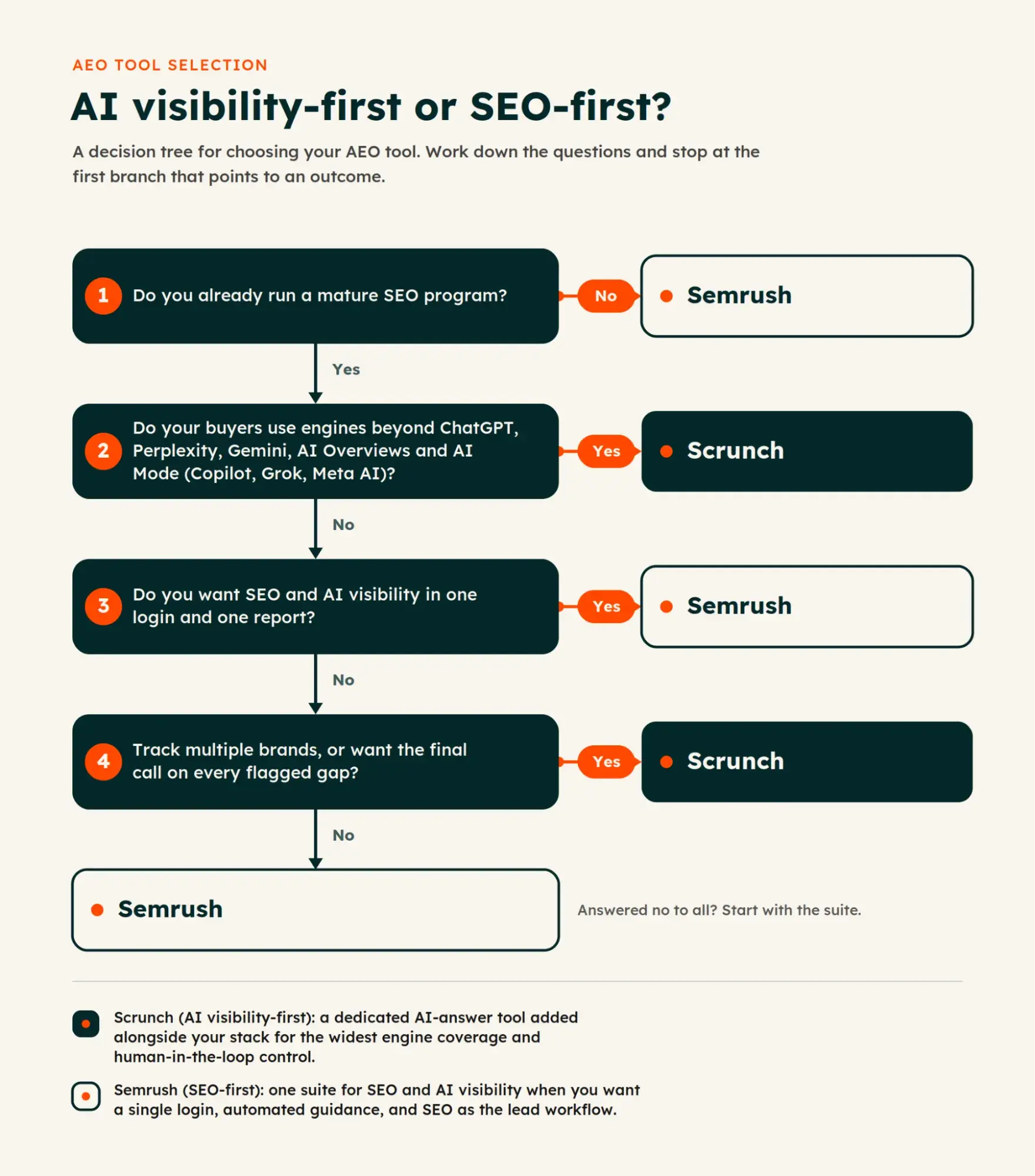
Three buyer profiles clearly translate to these tools: AI visibility-first teams, SEO suite-first teams, and teams that need both.
Best for Scrunch: Teams that already have a mature SEO program and want to add a dedicated AI response layer without having to rebuild their stack. Agencies also fit here, as Agency Core covers multiple branded workstations and unlimited seating. Scrunch is also suitable for teams that prefer a human-in-the-loop model, where one person decides which gaps are worth fixing before something goes into production, or that specifically need meta-AI tracking, the only engine that Semrush doesn’t cover at any level. Scrunch has an AI Recommendations tab where you can track earnings and conversions from AI visibility when you connect your GA4 account.
Best for SEMrush: Leaner teams that prefer to run SEO and AI visibility with one login rather than managing two subscriptions. It’s suitable for teams that continue to lead with rank tracking, audits, and backlinks, treating AI visibility as a report within that workflow rather than the main event. Buyers who prefer automated recommendations over a review-first model also end up here. SEMrush has a My Reports tool where you can link your GA4 data and use the AI Referral traffic channel filter to view sales data.
Use this decision matrix to prioritize the better choice:
|
Your priority |
Choose better |
|
Most entry-level AI engines |
Semrush |
|
Specifically meta AI tracking |
Crunch |
|
Rank tracking, audits and keyword research |
Semrush |
|
Backlink analysis |
Semrush |
|
Content operations tied to AI insights |
Semrush |
|
SEO and AEO reporting on one platform |
Semrush |
|
Routing AI data into an existing analytics stack |
Crunch |
|
Connect AI visibility to sales |
Crunch |
Are you looking for a tool that strongly links content to revenue? HubSpots Marketing Hub combines content performance with campaign automation, attribution and reporting so that AI visibility gains can be attributed to the businesses it influences, rather than just measured in citations.
Scrunch vs. SEMrush: Alternatives to Consider
Scrunch and SEMrush aren’t the only tools for tracking AI visibility. If neither fits your budget, team, or focus, the strongest alternatives are divided into three groups that vary depending on what you need most.
- AI visibility platforms for businesses
- Profound monitors brand presence in ChatGPT, Gemini, Claude, Perplexity and other engines and targets major brands with dedicated marketing teams.
- AthenaHQ calls itself “the command center for AEO and GEO,” tracking eight engines in each plan and combining monitoring with prescriptive content recommendations.
- Best for: Larger teams that need depth, governance and the widest possible engine coverage
- Focused trackers that put reporting first
- Peec AI maintains its focus on AI search analytics and reporting, with a Looker Studio connector that feeds visibility data into existing dashboards.
- Otterly AI focuses on optimizing the response engine and combines daily citation monitoring with on-page audits that flag specific corrections.
- Best for: Teams that want clean visibility data without a more extensive suite
- AEO integrated into your marketing stack
- HubSpot AEO starts at $50 per month and tracks brand visibility across ChatGPT, Gemini, and Perplexity. The same tools are built in Marketing Hub Professional and Enterprise, where it draws on your CRM data to refine recommendations.
- Best for: HubSpot users who want AEO to be linked to the content and customer data they already have
No matter which tool you choose, visibility data is only as useful as what you publish next. The structural decisions that make a page extractable are important regardless of the platform.
How to structure content for AI visibility without risk
We talked earlier about a lower-risk path: optimizing a page for both readers and response engines, rather than providing a separate version to bots. Now let’s cover how to structure content to be AEO friendly.
Run flagged pages through this checklist before republishing:
- Lead with the answer. Place the direct answer to the target question on the first line, not four paragraphs down.
- Match headings to questions. Phrase H2 and H3 the way buyers ask the question so an engine can map a query to a section and highlight the passage underneath.
- Keep entity names consistent. Use consistent spelling for your brand, products, authors, and executives on your own website and third-party profiles so search engines can attribute every mention to the same entity.
- Cite your sources. Organize your data, name the study or document behind each claim, and link to it. Factual specificity gives an engine a reason to choose you over a vague competitor.
- Write self-contained passages. Make sure each important paragraph can stand on its own when an engine extracts it from the surrounding page.
Built this way, a page remains readable by readers and extractable by AI without eliminating a parallel bot-only version, thereby avoiding this Duplicate content disclosure can be caused by an AXP-style layer.
The measurement loop is the one mentioned before: check the answers in which you are quoted, find the gaps, update or create the content, and check again after an update cycle. Going from the short description to the live page is usually the slow step. Marketers can use HubSpots Content operations platform You can design, approve and publish in one place to save time.
How to choose between Scrunch and SEMrush depending on your goals
Before structuring a page for citations, you must select the tool that shows which pages to correct. Here’s how to make a selection based on your goals instead of starting with a feature list.
- Assess where you are today. Make sure you have a baseline before you compare anything. HubSpot’s free AEO Grader assesses how response engines currently represent your brand so you can do so Check AI search visibility against real data instead of a hunch. Scrunch performs an AI visibility audit without the need for a credit card, and Semrush’s free plan shows where AI answers mention and cite your brand, as well as an overall visibility score.
- Define your goal and then read it from the matrix. Decide whether AI share-of-voice, traditional SEO depth, or both determine your priorities. The Fit Matrix earlier in this guide under “Scrunch vs. SEMrush: Who is each best suited for?” Already assigns each priority to the stronger choice, so double-check if necessary.
- Confirm budget and seating. Set the starting price for your team, not the list price. Scrunch’s core plan includes five seats for $250 per month; Semrush’s AI Visibility Toolkit starts at $99 per month as an add-on, with each additional space billed separately. The cheaper option depends on how many people need access and how many brands you track, which is fully covered in the previous pricing breakdown.
- First test, then validate. Scrunch’s Self-Service Core plan includes a 7-day free trial. Semrush’s standalone AI Visibility Toolkit does not have a free trial, but a free account has limited use 7-day SEMrush One trial. Use the window for a purpose: Make sure the tool tracks the engines and prompts your buyers actually use before they check out.
Three quick ways:
- Keep SEMrush and add Scrunch. It’s best if your SEO program is mature and you want the most search engine coverage possible as a separate layer. The two run in parallel, as Scrunch complements an SEO suite rather than replacing it.
- Use SEMrush for both SEO and AI visibility. It’s best if you’re pursuing a single brand and want to have both toolsets under one login. If you are already paying The SEMrush SEO toolkit (starting at $139.95 per month), adding the AI Visibility Toolkit for $99 per month is the cheapest way to add AEO tracking. The $99 toolkit purchased alone only covers AEO monitoring and does not cover traditional SEO features. So a buyer who is starting from scratch and wants both should make a decision SEMrush Onewhich bundles the two toolkits starting at $199 per month.
- Lead with a dedicated AI visibility tool. It’s best if AI answers are your primary channel and SEO is secondary. Start with Scrunch’s core plan and integrate SEO tools later.
Frequently asked questions about Scrunch vs. SEMrush
Do I need Scrunch if I already use SEMrush?
Maybe not. Semrush’s AI Visibility Toolkit monitors five engines in its self-service plans and shares data with your SEO workflow. So if your buyers stick with these engines, the toolkit can have you covered. The custom Enterprise tier closes most of the remaining gap and tracks nine engines including Claude, Copilot, Grok and DeepSeek. The only engine that Scrunch covers that Semrush doesn’t offer at any level is Meta AI. Scrunch still positions itself as a complement rather than a replacement.
How do I measure AI visibility without changing my SEO stack?
Forward the data instead of switching tools. Both connect to Looker Studio, but through different means: Scrunch through a Data Studio Community Connector on Enterprise, and SEMrush through its own native Looker Studio Connector on each paid plan. The two also handle GA4 differently. Scrunch reads your GA4 data over an OAuth connection and displays AI-related sessions and sales in its AI recommendations dashboard instead of writing anything back to GA4. SEMrush displays GA4 data in My Reports, its in-platform report builder, where an AI Referral filter isolates AI-driven sessions and conversions. Each also offers an API: Scrunch on Enterprise, SEMrush on Business and above.
What are Scrunch AI competitors?
Scrunch competes more with AEO tools than full SEO suites. The closest alternatives include HubSpot AEOSemrush’s AI Visibility Toolkit, Profound, AthenaHQ, Peec AI and Otterly AI. Scrunch’s own materials do not directly name competitors; It bills itself as “The AI Customer Experience Platform,” which differentiates it from the ranking tracking suites.
When should I use Semrush’s AI Toolkit instead of a separate AI visibility platform?
Choose SEMrush One if you want SEO and AI visibility in one login or if you already use SEMrush for SEO. It shares projects and data with Position Tracking, Site Audit, and the Content Toolkit, putting AI insights alongside rank tracking and audits. Semrush builds it for SMBs, agencies, and mid-sized teams that treat AI visibility as a report within an existing SEO workflow rather than as a standalone discipline.
How do I link increasing AI visibility with pipeline impact?
Connect AI visibility data with sales reporting. Scrunch’s AI Recommendations tab links to GA4 to track AI purchase sales and conversion rates, and SEMrush’s My Reports adds an AI Recommendation filter to every paid plan. Neither the native pipeline nor CRM reporting documents. AEO in HubSpot Marketing Hub connects citation data directly to CRM records, enabling teams to track response engine visibility from prompt to site visit to lead and pipeline.