
Unless you search every day, it’s hard to know how seriously you should take your search engine optimization strategy. There are currently two dominant camps: those who see generative AI as the most disruptive change search has ever experienced, and those who argue that AEO (or GEO) is merely an extension of traditional SEO.
Predictably, the truth lies somewhere in the middle – much of AEO is SEO, with some pivots, improvements, or attention drawn to standout tactics that help brands become more visible in AI tools. On the other hand, you can gain visibility with AI tools without ranking well in traditional SEO lists; The tactics can be separated.
What’s harder is separating your brand from the consequences of ignoring AI’s impact on search. Google’s AI Overviews (AIO) accepts clicks from websites; Clicks drop by 61% When AIO is present, and more worryingly, your potential customers are busy querying AI tools about brands before deciding to create a shortlist. If your brand doesn’t show up in these early searches, you’re out of the running before the shopper even discovers your site.
If you’re developing an answer search engine optimization strategy and want something more nuanced than “just do good SEO,” this article is for you. I’ll cover how answer engines choose what to cite, where SEO still does the brunt of the work, and what additional work is required to appear in AI-generated answers.
Table of contents
AEO Strategy Basics: How AI Engines and LLMs Select Sources.
The models that power LLMs, like ChatGPT, are trained on a combination of:
- Publicly available Internet content
- Licensed Third Party Data
- Information generated by human trainers and users
Together, these sources influence how models understand entities, topics, and relationships across the web.
Read more about the ChatGPT founded here.
A common misconception is that LLMs have been trained using a range of sources and that their answers are now fixed. However, this is not the case.
Input Get Augmented Generation (LAB).
RAG improves AI answers by adding external context when a question is asked. Rather than relying solely on what a model has learned during training, RAG allows it to incorporate relevant information to (theoretically!) provide more accurate, informed answers.
This is what a basic RAG workflow looks like:
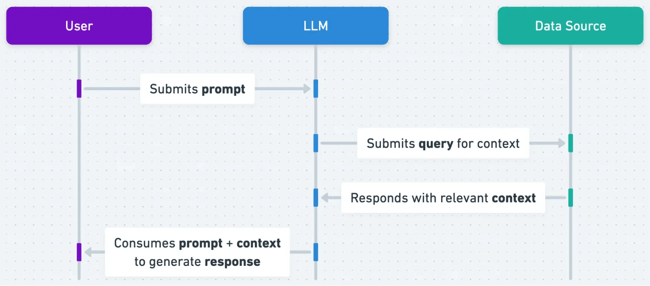
With this evolution of search, your content needs to be retrievable, which means making it clear in your content (and in the content others post about you on the internet) who you are, what you do, and how it all connects.
Entity clarity and consistency helps AI systems confidently identify, extract, and reuse your content, eliminating confusion and increasing the likelihood that your brand will be cited correctly in AI-generated answers. In addition, technical considerations must be taken into account, e.g. B. Ensuring that important content is accessible in HTML. I’ll cover these tactics later.
Response engine optimization strategy that goes beyond the basics
If you are a competent SEO specialist, the following five steps may sound familiar to you, but it is important to list these components of an answer search engine optimization strategy because SEO or AEO teams require some special focus if you want to be successful in AI-driven search results.
I’ve covered each component in detail below, but this table provides an overview of how to manage each area in an SEO vs. AEO strategy.
|
Area |
SEO |
AEO |
|
Target group targeting |
Keyword-driven intent and SERP analysis mean audience targeting can be as granular as SERPs allow. Sometimes only broader pages rank for certain keywords. |
Response-driven intent enables highly specific audience targeting based on roles, use cases, and challenges because AI can accurately match responses. |
|
Landing pages |
Pages are sometimes designed to rank broadly and fewer pages are created to avoid keyword cannibalization. |
Granular, audience-specific pages are created to address a single audience and their challenges in detail. |
|
Content formatting |
The content is optimized for readability, user experience and ranking signals. |
The content must be structured for extraction, e.g. B. through question-based subheadings and direct answer blocks. |
|
HTML and JavaScript |
Search engine bots crawl HTML and render JavaScript to discover dynamically loaded content. |
Content must be clearly presented in HTML so that AI systems can reliably retrieve, analyze, and cite it without running scripts. |
|
Keywords and timely follow-up |
Keywords serve as directional signals, but success is measured by whether the content meets needs and drives real results on the site. |
Prompts serve as directional signals, but success is measured by whether the content meets needs and drives real results on the site. |
|
Measure success |
Organic traffic, rankings, click-through rates and tangible business impact such as conversions, revenue generated and pipeline influence. |
Visibility, citations and tangible business impact such as: B. Conversions, revenue generated and pipeline impact. |
1. Know your target audience on a detailed level.
A strong response engine optimization strategy starts with a deeper understanding of the target audience. Yes, traditional SEO usually requires this too, but given the possibilities that AEO offers, it is extremely short-sighted not to revisit your ideal customer profile (ICP) and go into more detail.
The next section explains why this is so. In short, however, it is no longer enough to know what keywords a broad market is searching for. You need clarity about who is asking the question, why they are asking it and What kind of answer would really help them?.
The AEO strategy requires mapping buyer questions to answer types and platforms.
Remember: People look for personalized, nuanced, and detailed questions in AI search, and if you want to serve your audience through AI, you need to get into the nuances.
Granularity also creates strategic flexibility. You can target specific industries, roles, or use cases without cramming everything into a single, comprehensive page—while still benefiting from your broader SEO fundamentals.
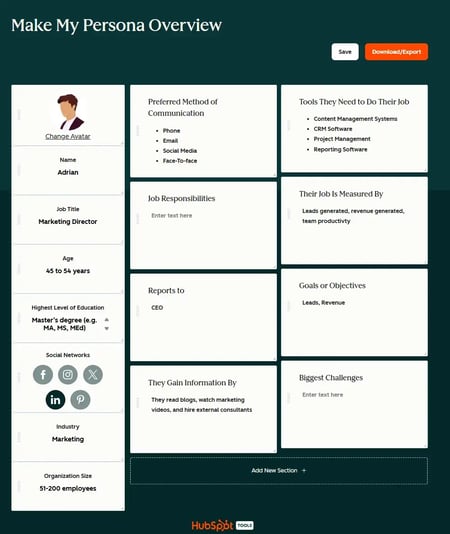
Pro tip: When planning AEO content, note the exact person you are responding to before writing the response. Unless Once you’ve created buyer personas, you’ll need them for every decision maker, especially if you’re in B2B.
HubSpots Make my persona helps marketing teams define clear buyer personas by mapping roles, goals, challenges and decision drivers into a single, consistent profile. Clear personas create a stronger match between entity and intent, making it easier to create audience-specific responses that AI systems can accurately extract and cite.
Once you have determined your target audience, you can serve them on your website.
2. Create targeted pages that speak to specific audiences and their challenges.
SEO landing pages are traditionally shaped by what Google appears to reward in search results. For example, if a search for “SEM marketing consultant for e-commerce” Because the company returns predominantly broad SEO service pages, teams often conclude that the safest place to target this term is on the broad service page rather than creating a dedicated landing page for the eCommerce audience.
Here are the SERPs that show fairly general search engine marketing (SEM) services.
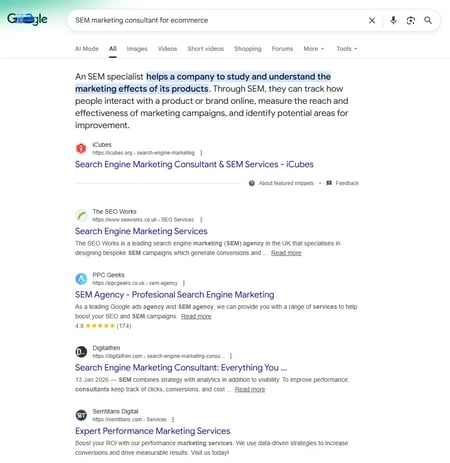
Although this approach to rankings can work, it is limiting. Wide pages leave little room to delve into nuances or fully explain a particular offering. In this case, a deeper look at SEM’s PPC page could dilute the relevance of an SEO-focused page, while at the same time keeping it at a high level risks undervaluing the entire service as a whole. The result is content that ranks but does not effectively address a specific audience.
This is where traditional SEO fails.
With SEO, searchers must open numerous links and search websites for case studies before they can be sure that the SEM services offered are suitable and that the company stands out in its industry.
AEO solves this problem by synthesizing information from all sources and providing a solid starting point for discovery and further research. AEO-driven search creates far more freedom and opportunity to serve narrow, clearly defined audiences with highly targeted content.
Here’s a screenshot from AIO that takes a searcher directly to their solution by mentioning brands:
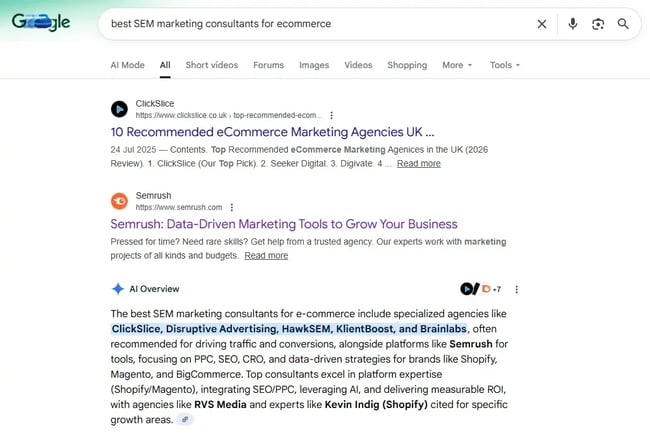
Detailed pages that address a specific role, problem, or use case make it easier for AI systems to find and cite a clear, relevant answer. A single paragraph can appear in an AI response even if the page itself would never land on page one in traditional search. That’s why smaller brands can now achieve top-of-funnel visibility with AI responses, even if their overall SEO performance isn’t particularly strong.
Pro tip: When a site tries to appeal to everyone, it doesn’t give a response engine anything specific to cite. The more precisely you define the target audience, their challenges and your solutions, the more likely your content is to be extracted and reused.
3. Format correctly to support AI
Even the most targeted pages can be missed by AI crawlers if the structure makes it difficult for AI systems to extract a clear answer.
Content formatting should use question-based subheadings, direct answer blocks, and semantic triples. I’ll keep this brief as I’ll discuss this in more detail later in the article.
4. Keep content available in HTML.
There are technical considerations that affect the success of an AI engine optimization strategy, and one of the most important is ensuring that content is available in HTML.
Google’s search crawlers can render JavaScript, meaning they are often able to discover text that isn’t present in raw HTML. Therefore, traditional SEO can sometimes rely on JavaScript to dynamically load or display content. Content does not have to be embedded in HTML for SEO. However, this approach still carries risks; Not all rendered content is indexed, especially if it is hidden behind tabs, accordions, or filters that require user interaction.
AI crawlers don’t behave like Googlebot. They rely solely on HTML. If important answers only appear after scripts have been run, there is a real risk that they will not be retrieved, extracted, or quoted at all.
The takeaway is easy: If content is critical for AI systems to understand or reference, it should be clearly present in the HTML and not rely on JavaScript to be displayed.
5. Don’t get too caught up in keywords and prompts.
An over-reliance on keywords has always failed to tell the whole story, but with AEO and prompt tracking in the mix, this is the case more than ever.
Keyword data can indicate Demand and timely tracking can help determine who has visibility where, but AI tools are changing their sources a lotbased on recent updates, individual search personalization, and of course the nuance of the prompts, it is impossible to track them.
Does it make sense to track keywords and prompts? Sure, but with reservations…
Pro tip: Don’t get so caught up in prompt tracking that it becomes your primary source of success, because AEO success isn’t just about whether a prompt triggers a mention. It’s about whether your content actually fulfills a specific need, answers the right question, and supports decision-making. The most reliable signal that your strategy is working is still a tangible impact on your website: engagement, conversions, and bottom-of-funnel results like revenue, not just isolated visibility metrics.
How to format AEO content for LLMs to extract and cite.
LLMs require content that is clearly structured and easy to extract. The following formatting principles are based on well-known SEO best practices, but apply them more consciously, allowing individual passages to stand on their own in AI-generated answers.
Write question-based subheadings with direct answers.
LLMs are optimized for answering questions, so your content should reflect this structure.
There is no strict format, but here is a guide to help you write succinctly:
- Write a 40-80 word response directly under each question. If you want, you can go into more detail after the first or second sentence.
- Stick to one idea per sentence, so it’s easy.
- Use a clear subject-predicate-object form Wording to reduce ambiguity. More tips on this later.
These formats aren’t exactly new and are probably already included in yours Guide to digital strategy, especially in your SEO blog.
When it comes to AEO strategy, it doesn’t hurt to think about this format again.
Tools like Breeze AI Suite Help marketers write content that ranks in AEO and SEO. Breeze AI helps writers research common buyer questions and plan extraction-friendly answers directly in their workflow. Combined with Content HubWriting and marketing teams are becoming an unstoppable force. Content Hub operationalizes templates, briefs, and reusable content patterns that support extractable responses at scale.
Combined with HubSpots Marketing HubMarkets can orchestrate cross-channel advertising and curation around responsive content.
Use semantic triples
Semantic triples are a writing and structuring technique that expresses meaning through explicit relationships: a subject, a predicate, and an object. This approach makes it easier for AI systems to understand not only the words on a page, but also how concepts relate to each other.
HubSpot does this particularly well. Instead of vaguely describing features, HubSpot explicitly states what its product is, what it offers, and how to use it.
For example, instead of a vague description like “HubSpot offers powerful tools to help businesses grow and improve their marketing efforts.” We use explicit, entity-driven descriptions like “HubSpot is a CRM platform that provides marketing automation, sales enablement, and customer service tools for B2B companies.”
Decomposed into a semantic triple:
- Theme: HubSpot
- Predicate: is a
- Object: CRM platform
In this structure:
- The Theme is a uniquely identifiable entity that AI systems can recognize and classify, such as a company, product, person, or concept.
- The predicate defines the relationship between the topic and the following information.
- The object provides the specific, factual information that defines or explains the topic.
This level of clarity helps AI systems understand not only keywords but also their meaning. Use them to find out who the expert is, what they are authoritative on, and how concepts relate to each other.
Pro tip: Semantic triples don’t have to take over your writing; Just consider them in your next piece. In my experience, I use semantic triples a lot more now than I used to, and I like them! It makes sense to me that semantic triples lead to unique content, and that must be helpful for AI.
Chunk content for AI and humans.
Chunking is the process of dividing content into small, self-contained sections that convey a single idea clearly and efficiently. This approach improves readability for humans and makes it easier for AI systems to identify, extract and reuse relevant information.
For AEO, chunking means using:
- Short sections
- Clear subheadings
- balls
- Code or callout blocks
Each key section should be able to stand on its own as a complete answer. If a paragraph only makes sense in the context of the entire page, it is harder for an AI model to confidently quote or summarize it.
Important NOTE: There are many Criticism of the division of content because it reads like “using paragraphs”. And while that’s part of it, content chunking isn’t just about implementing paragraphs. The concept of chunking is intended to help writers get the most important information out first. Instead of overloading objective facts with opinions or nuances, divide the content so that the facts come first, then your opinion. Don’t combine both.
How to build authority so answer search engines trust you.
Among SEO specialists, alongside Google’s Experience, Expertise, Authority, and Trust (EEAT), the importance of presenting authority has become increasingly important. The emphasis on authority signals appears to continue in the optimization of response engines.
The following principles will help ensure that your content remains authoritative (and extractable), regardless of the number of AI or AI content Google’s EEAT updates are happening.
-
1. Demonstrate expertise and author identity.
Presenting expertise starts with the content itself. Clear explanations, confident language and evidence of real-world experience signal credibility to readers, Google and AI systems.
This includes:
- Reference your own research results
- Citing reputable sources
- Demonstrate the depth of the topic rather than superficial comments
If your content doesn’t clearly reflect your expertise, no amount of technical optimization can compensate.
Important NOTE: Proving expertise is not just a substantive decision; it’s a technical thing.
In your website’s HTML, you can add or reinforce author bios, testimonials, and testimonials to help the AI understand your content and find more words to cite. You do this via the schema. JSON-LD schema improves AI content extraction and citation.
Schema resides in HTML and can display detailed information about a person (an author on your site or a team member), including their role, experience, areas of expertise, and publications. Since it’s in the HTML code, AI crawlers can read it and summarize it in the responses.
While schema (currently) for AI crawlers is just more words on a website, it’s a great tactic for SEO, so there’s every reason to use it.
Why I like Scheme: In some cases, adding or improving a schema can have noticeable effects within a few days. In my experience, shortly after implementation, rich snippets or knowledge panels can appear as a reminder that this work is paying off for SEO and benefiting the AEO strategy.
Interested in Schema? Read my article Schema markup for AEO: How to implement it to improve response engine visibility in 2026
2. Diversify citations on platforms preferred by AI engines.
Response engines are not based on a single source type; You can’t just optimize your website and expect that to be enough. When people search for AI, they look for third-party validation and branded content. For example, research shows that 32% of buyers Discover new B2B providers using generative AI. To discover vendors using AI, searches are likely to look for “the best (solution) for (very detailed problem).”
No marketer should expect branded content to be regularly cited in such searches. There has to be evidence, and AI tools are built on a mix of branded content, trusted publications, expert commentary, documentation and community-driven platforms.
Here is an example:
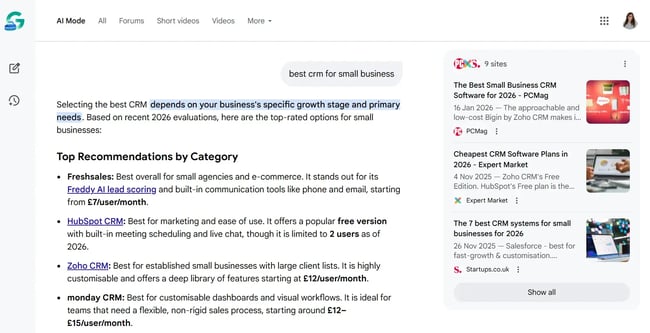
Searching the previous image shows three sources. These are lists from industry experts and not content from the recommended company’s website.
This means that establishing an AEO authority requires more than publishing on your own website; It requires high-quality mentions in the places AI engines already trust and cite.
A digital PR approach works best here.
Focus on:
- Bringing genuinely helpful, non-promotional insights to industry publicationsPodcasts, reports and expert panels.
- Prioritize clarity and usefulness via links or brand mentions.
- Ensure consistency You can influence the way other websites talk about you by providing brand guidelines.
If multiple credible sources consistently When you reference your expertise, AI systems are more likely to correctly cite your brand as part of an answer.
Once these mentions are in place, marketing teams can measure how their brand appears in AI-driven results. HubSpot’s AEO Search Grader measures brand visibility in AI response engines. The AI search tool makes it easier for marketers to understand where the brand appears, where it is missing, and how citation patterns change over time.
Read more about AI visibility: Quick guide to AEO with HubSpot.
3. Keep the facts current and consistent everywhere.
AEO specialists must work toward receiving consistent citations. To some extent, what generative AI tools produce is out of a brand’s control, but maintaining consistency across names, product descriptions, locations, and other attributes increases the likelihood that AI will cite accurate information about your brand.
This reflects the logic behind local SEO and name, address, and phone number (NAP) consistency. When AI systems pull information from multiple sources, even small discrepancies can result in outdated and incorrect answers coming to light.
That’s why it’s important to regularly update the top pages, profiles, and feeds that AI engines are most likely to revisit.
A particularly important example is pricing. AI tools display pricing information quickly and clearly, and accurate, accessible prices can actively influence purchasing decisions.
In his article AI tools are already changing B2B buying behaviorConstantine von Hoffman explains: “AI can dramatically shorten purchasing cycles for larger companies with complex, board-driven purchasing processes. Stakeholders can rely on AI-generated shortlists based on specific criteria, shifting the responsibility to vendors to provide explicit, searchable and accessible content – especially pricing – on their websites.”
In the same article, Hoffman interviews Chris Penn, co-founder and chief data scientist at TrustInsight.AI. Penn describes how he asked Gemini’s Deep Research to look for alternatives after its existing SaaS provider increased prices. Within minutes, the AI created a shortlist based on publicly available information and he switched providers without ever going through a traditional sales process.
The conclusion is clear: When facts such as prices, positioning or availability change, they need to be updated everywhere and quickly. In an AI-driven buying process, outdated or inconsistent information not only causes confusion; It can cost you the deal before your team even knows a decision is being made.
4. Publish first-hand insights that AI can’t find elsewhere
One of the strongest signals of authority you can send to response machines is originality. First-hand insights, proprietary data, internal benchmarks, unique frameworks or first-hand observations give AI systems concrete references that do not yet exist elsewhere on the web.
This type of content is harder to reproduce, easier to attribute, and more likely to be cited because it adds entirely new information to an answer. Even small original insights, when clearly explained and well-structured, can significantly increase the likelihood that your content will be surfaced and be trusted by AI-generated responses.
In theory, being the source of new information should increase your chances of being cited by AI tools.
How to measure the success of your AEO strategy.
Although there is a clear overlap between SEO and AEO strategy, measuring AEO requires going beyond traditional SEO metrics. Clicks are no longer an important metric; Marketers need to understand how AI-driven discoveries influence actual purchasing behavior.
Monitor citations and mentions across all engines.
Quotes and mentions are a useful signal that your AEO strategy is working, but they must be interpreted correctly.
The visibility of AI is volatile. Sources change depending on topicality, wording, personalization, and how a question is phrased. It is therefore normal for there to be changes from week to week.
For this reason, monitoring AEO performance requires a mix of regular manual reviews and targeted tracking. By manually reviewing how your brand appears on priority questions across various AI tools, you can assess accuracy, positioning, and context. Tracking over time allows you to identify patterns.
Pro tip: Xfunnel measures LLM visibility and AI-driven search performance, showing what content AI systems show up and how often. It is useful for identifying patterns, gaps and competitive movements, especially when combined with traffic and conversion data.
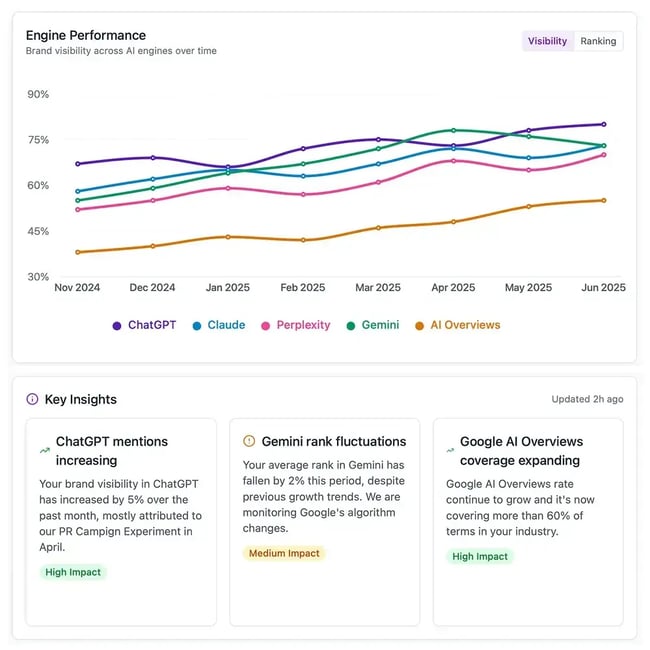
Traffic
AI-driven experiences can reduce overall clicks, but traffic still matters. AI tools Do Send recommendations and traffic remains a reliable indicator of discovery and relevance.
Unlike pure visibility metrics, traffic is tangible. By specifically looking at traffic from AI sources, you can better understand whether your content serves as a starting point for deeper research.
In my own reporting, I saw significant year-over-year growth from AI-driven traffic alone:
- There was a 40% increase in January 2025 compared to January 2024
- There was a 257% increase in January 2026 compared to January 2025
Pro tip: Don’t just look at the totals. review which pages Users land via AI recommendations. This insight shows you which topics, formats and questions actually generate citations and clicks.
Conversions
Conversions tell you whether AI-driven visibility is driving action. Track form submissions, demo requests, and content downloads related to AEO-optimized pages.
Supported conversions are particularly important. AEO often influences early-stage considerations rather than as a last-click channel, so its value may not be reflected in simplified attribution models. If AI presence results in more informed prospects entering your funnel, conversion trends will reflect this over time.
revenue
Sales can increase AEO’s tangible business value.
Close the loop on leads generated from AEO. You can track which source sent a lead, such as a referral from ChatGPT that filled out a contact form, and ask sales how the lead performed. When a sale converts the lead, AEO specialists can take some credit for it.
Over time, strong AEO performance should be associated with higher quality inbound leads, more informed buyers, and shorter sales cycles. When AI tools help prospects pre-qualify vendors before they even speak to sales, that efficiency shows up in the sales data.
In my own client marketing, I find that AEO leads convert 7.12% of their AI referral traffic compared to 1.37% of their traditional SEO traffic.
Connect visibility to pipeline in your CRM.
Smart CRM combines AEO transparency with pipeline and sales metrics
AEO only becomes strategically valuable when visibility is linked to business outcomes. By linking AI-driven discovery to on-site engagement, opportunities, and sales in your CRM, you can demonstrate how response engine visibility drives real pipeline impact.
Use HubSpot CRMSales and marketing teams can track how AI-driven traffic interacts with content, converts, and progresses through the funnel.
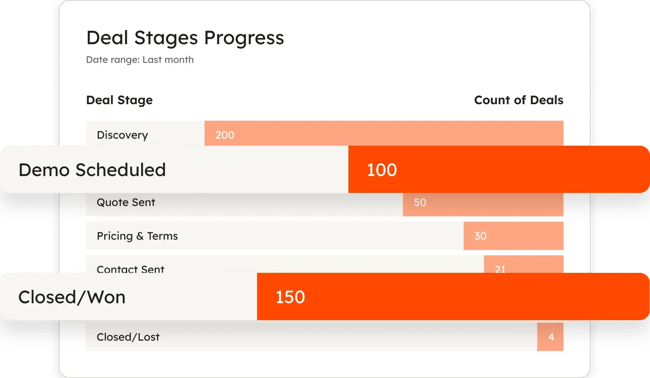
This makes AEO measurable in the same way as other growth channels – not as a vanity metric, but as a contribution to demand, pipeline and revenue.
Answer search engine optimization mistakes to avoid.
By avoiding the following mistakes, you can ensure your response engine optimization strategy strengthens visibility And supports real business results.
As you create your strategy, remember to avoid these mistakes:
- Treat AEO as a replacement for SEO rather than a layer built on strong SEO foundations
- Optimize for keywords or prompts instead of real questions, needs and decision-making context
- Publish authoritative content that is poorly structuredwhich makes it difficult for AI systems to extract and cite them
- Focus solely on visibility or mentions without tying AEO performance to engagement, pipeline or revenue
Frequently asked questions about the AEO strategy
Do I need llms.txt if I already have a sitemap?
A sitemap helps search engines discover pages, but llms.txt makes priority content available to AI models for discovery. It’s not a replacement for a sitemap – it’s an additional signal that helps guide AI models to your most important, responsive pages. It also provides more context about the page.
How do I follow Perplexity quotes or recommendations?
You can track citations in Perlexity using tools like Xfunnelthat measures LLM visibility and AI-driven search performance.
Track referrals in your analytics using source/media data. You can see exactly how much traffic was referred to your website from any AI tool.
What is the best way to balance human readability with AI extractability?
Write for humans first, but structure for AI. Use clear questions, direct answers, and short, self-contained paragraphs to make the content easy to read and extract without losing depth.
When should I use the Speakable schema versus the FAQ schema?
Use FAQ schema for pages that answer multiple individual questions in text-based formats. Use Speakable schema to mark short sections that are best suited for audio playback, allowing search engines and tools like Google Assistant to identify text-to-speech content and distribute it across voice-based channels.
How often should I update response blocks and schema?
Update the answer blocks and schema as facts change and review them at least quarterly. Regular updates help maintain accuracy and keep signals fresh for both search engines and AI systems.
The AEO strategy is key
Strong SEO fundamentals are still important, but the AEO strategy places emphasis on specific tactics. When you combine sophisticated audience understanding, responsive formatting, consistent entities, and measurable impact, you don’t just gain AI visibility – you gain trust at the very moment buyers make decisions.
In my experience in B2B environments, AEO increases traffic and generates high-intent leads for websites. Tools like AI search grader Make it easier to measure AEO by understanding where and how your brand appears in AI-powered search experiences – and where there is room for improvement. AEO works best when it is intentional, measurable and linked to revenue, not when it is done purely as an experiment.