
An AEO strategy for SaaS won’t stray too far from a good SEO strategy, but some tactics benefit AI search more than others and it’s helpful to know them. We all know that AI has changed the way brands gain visibility and that visibility does not equal clicks. But SaaS has disproportionately changed the way buyers discover and evaluate.
It’s no longer enough to rank well in search results; The product, brand competency and differentiation must be understood and accurately represented by AI-driven systems, especially during the buyer’s discovery and consideration phase.
In this guide, I share how SaaS teams can optimize for AEO. I’ve outlined why AEO strategy is important for SaaS, which strategies should be prioritized, how to track success, and what tools make AEO strategy easier.
Table of contents
Why AEO is important for SaaS companies.
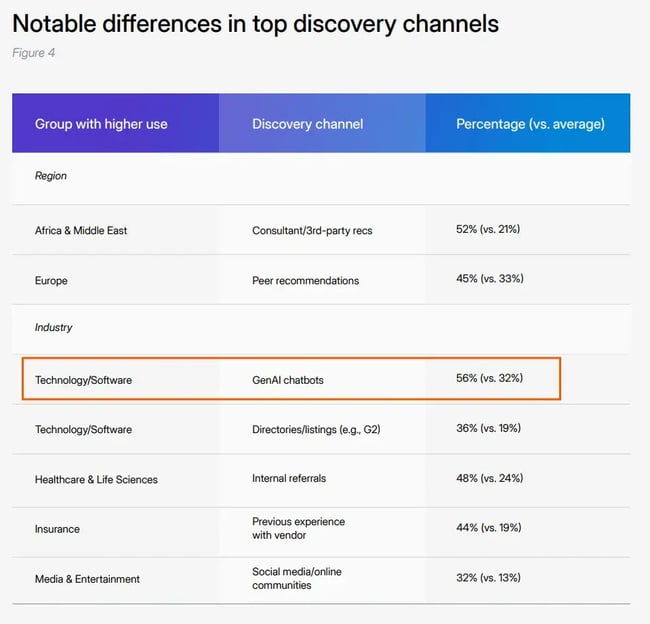
AI-driven response engines now play a central role in how SaaS buyers discover and evaluate software. responsive research, In the buyer’s mindshows that B2B buyers start researching vendors using generative AI chatbots 32% of the time, compared to 33% using traditional web search.
When SaaS is isolated, change is far more pronounced. For SaaS buyers specifically, 56% are now starting vendor research for generative AI tools.
SaaS brands are disproportionately at risk of missing opportunities if their brand doesn’t show up in AI searches.
Unlike traditional search results, response engines do not simply rank pages. They summarize the expertise of the website or knowledge base, compare options and provide recommendations directly to the searcher – all within the AI interface.
The consequence: If a brand is not mentioned in AI-driven search results, potential buyers overlook the brand as they create a shortlist of suppliers; Companies are out of the running at the earliest stage and don’t even make it to an evaluation or trial.
AEO strategy for SaaS companies.
The following strategies represent the areas that SaaS teams should strengthen for AEO. Each of these supports traditional search performance, but more importantly, they increase the likelihood that answer engines will show up, refer to, and trust in moments of high purchase intent.
1. Optimize for early visibility that factors into the rating.
To be visible in learning and exploration queries, SaaS teams must focus on how answer engines interpret and connect products to problems, use cases, and results.
On a practical level this means:
- Clear definition of the category and use cases This allows AI tools to match the product to the right problems and buyer needs.
- Publish explanatory content This answers the questions “what is,” “how does it work,” and “when should you use” in clear, unambiguous language
- Use consistent terminology and positioning across core pages, documentation and supporting content
- Structuring content for extraction with clear headings, short paragraphs and direct answers that can be summarized by AI systems (more on this below)
AI-driven response engines are best for buyers who learn, explore, and meaningfully consider options before beginning the formal evaluation.
If a brand isn’t visible at this point, it’s unlikely to make it onto a buyer’s shortlist.
McKinsey research shows that 70% of AI-powered search users still ask questions at the top of the funnel to learn more about a category, brand, product or service.
These early queries influence how AI search engines shape the market, which vendors they associate with specific use cases, and which products continue to show up as “relevant” throughout the SaaS customer lifecycle.
This is important for SaaS buyers because vendor lists are built early. According to research from Responsive, buyers typically start with a long list of potential solutions and around eight vendors before narrowing it down to three or four for deeper evaluation.
By optimizing early-stage AEO visibility, the product is clearly linked to the right problems, use cases, and outcomes in AI-generated answers. This early exposure increases the likelihood that a brand will be included in the evaluation phase where shortlists and testing decisions are made.
Why I like this tactic: It is important to consider early-stage visibility and understand its role in this Marketing funnel. Informational content used to drive hundreds or thousands of clicks to websites, but with AI overviews dominating the top of Google, many of these questions are answered directly in the SERP, often requiring no click at all.
When looking at SEO and click metrics, one could easily conclude that marketers should prioritize top-of-funnel efforts, but that’s not the case with SaaS AEO because AEO metrics tell a different story.
Measuring visibility, citations and inclusion in AI-generated answers tells a different story. Early-stage content becomes a critical input into how buyers discover, recognize and evolve brands throughout the buyer journey – from evaluation to trials to retention.
2. Optimize for questions in the assessment phase, not just problem awareness.
Once buyers understand a problem, the focus shifts from education to evaluation. At this stage, buyers compare options and check suitability.
SaaS teams must meet this need in a way that serves AEO search. Similar to informational searches, many review queries are answered within AI without the need to click on the brand’s website. Without visibility at this point, a product is unlikely to make it to a buyer’s shortlist.
To optimize for questions in the evaluation phase:
- Keep the website updated with information such as pricing, features and integrations.
- Have indexed and crawlable content across implementation efforts, pricing and knowledge bases to ensure the brand appears for any type of relevant use case or customer request.
- Create targeted landing pages that clearly communicate the product’s value proposition and the audiences it best serves.
Important NOTE: Questions in the evaluation phase that remain unanswered by a brand will be answered by someone else, and this content may not accurately reflect the positioning of the product. For example, if SaaS pricing remains hidden, AEO systems cannot rewrite accurate information and instead rely on every available source.
Why I like this tactic: Visibility in the evaluation phase is one of the few areas where brands can have a direct impact on whether a product is shortlisted.
3. Take PR, third-party validation, and credibility signals seriously.
AI-driven response engines place a heavy emphasis on third-party sources when evaluating which SaaS products to display, compare, and recommend. While first-party content helps determine relevance, credibility is often derived through independent validation.
Here’s how:
- Invest in consistent PR coverage above serious Industry publications.
- Actively manage review platforms (e.g. G2, Capterra, Gartner Peer Insights) with accurate positioning and current proof points.
- Safe partner mentions that reinforce a product’s use cases and integrations.
- Maintain consistency across third-party sources in naming, category definition and value proposition.
When multiple independent sources describe a SaaS product using similar terms, AI systems gain greater confidence in summarizing and positioning the brand. PR coverage, analyst insights, reviews and partner content help answer engines validate claims, resolve ambiguity and assess trustworthiness.
This is particularly important for comparison, best-for, and alternative questions, where answering engines are less likely to rely solely on first-party messages. SaaS brands with strong third-party presence are cited more frequently and included more consistently in AI-generated reviews.
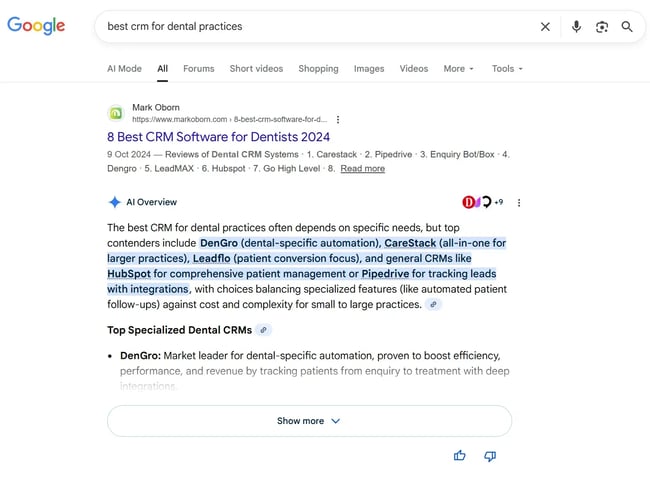
In fact, a brand can gain visibility in AIO without ranking well (or at all) in traditional Google search results.
Here’s an example search term: “Best CRM for dental practices.”

CareStack occupies a prominent position in AIO, but ranks second in traditional results.
Why I like this tactic: I keep seeing AI tools rely on third-party sources when shoppers compare options. It’s always been that way. “Best for” queries in traditional SEO have always been (mostly) reserved for third-party credibility, and that makes sense. Google wanted to prioritize unbiased sources.
4. Be hyper-targeted.
AEO rewards specificity. People are increasingly using AI tools to ask detailed, context-rich questions; Requests become less general and more situational. Instead of searching by broad categories, buyers are now asking for recommendations tailored to their industry, role, constraints or use case.
For a very specific request, broad SaaS content loses competitiveness because it doesn’t provide enough contextual signals.
Hyper-targeted content – focused on a defined audience, industry, role or scenario – is far more likely to be viewed, summarized and recommended when buyers ask niche or contextual questions.
Here’s how:
- Create industry or niche specific pages (e.g. “CRM for dental practices”, “ERP for construction companies”)
- Align the content with the buyer’s actual languageincluding how specific audiences describe their problems and workflows.
- Handle context-intensive queriesE.g., compliance requirements, integrations, or operational constraints specific to a segment.
- Avoid generic positioning for clear statements about who the product is designed for – and for whom it is not
- Increase cross-site targetingThird-party documentation, PR, and listings so AI systems see consistent signals.
Relevance is the main reason why niche queries even show smaller providers in AI overviews.
Back to CareStack: In the earlier “Best CRM for Dental Practices” example, CareStack appears prominently in AI-driven responses despite not ranking on page one in traditional search results. Because the product is clearly aimed at a specific target group, it fits the search query well, even without organic top rankings.
Why I like this tactic: Relevance and specificity are the most reliable ways to gain visibility in AI-driven search. For SaaS teams, hyper-targeting not only increases exposure, but also ensures clearer positioning and a much stronger path to conversion. When buyers repeatedly see that a product is designed specifically for their use case or industry, it reduces friction, increases trust, and makes the leap from discovery to testing far more likely.
5. Structure content so AI can extract, summarize and cite it
Content that is clearly structured and easy to interpret is more likely to be summarized.
Here’s how:
- Use explicit question-and-answer formatting For key questions buyers ask, use question-based headings followed by direct answers.
- Clearly define entitiesThis includes what the product is, who it is intended for and how it differs from alternatives.
- Keep explanations concise and directespecially for definitions, functions and use cases.
- Use consistent terminology across pages so as not to confuse AI systems
- Divide content into scannable sections with clear headings and logical hierarchy
- Avoid burying important information deep in long texts or overly narrative sections
When it is easier for AI systems to accurately summarize information, the brand is more likely to be cited in discovery and review requests, increasing visibility in moments that influence selection and testing.
Why I like this tactic: Well-structured content has always been important. It’s generally important; It’s certainly important for SEO, but a little more attention to providing clarity for AEO can’t hurt.
An example of additional efforts to create clarity is semantic triples, a tactic HubSpot uses. Authors use semantic triples to define relationships between subjects, objects and predicates. Example: “HubSpot’s AEO Grader is a tool that AEO specialists use to check brand sentiment in AI search tools.”
6. Implement a well-structured schema.
A schema is a standardized format for structured data added to the HTML of a web page. It helps search engines understand what a page represents by giving structure to the data. With AI systems, content is added or reinforced without overwhelming the front end and thus the reader.
Here’s how:
- Implement schema types that align with page intentE.g. FAQ, Product, Software Application, Review, Organization and Articles
- Make sure the schema reflects the visible content on the pageto avoid deviations or excessive markup
- Define entities consistentlyincluding product names, brands, authors and organizations
- Use schemas to clarify relationshipsB. who created content, what a product does and how it is rated
Schema has long supported traditional SEO, but its role in AI visibility is becoming clearer – especially for Google’s AI overviews.
Molly Nogami and Ben Tannenbaum evaluated the impact of strong, weak, and missing schema implementations on visibility. Their results showed that pages with a well-implemented schema consistently appeared in AI overviews and also performed best in traditional search results. Pages with poorly implemented schema – or no schema at all – were not appearing in AI overviews.
Why I like this tactic: I’ve loved implementing schemas for years. Sometimes brands can see the results of the scheme within days within search. For example, if a rating scheme is used for a SaaS product, star ratings will appear next to the organic listing. Thanks to Schema, I have secured knowledge panels for myself and my customers.
AEO for SaaS: Ways to track success.
Pursuing AEO success requires a mindset shift. Brands are no longer getting the clicks and impressions that came from SEO. Instead, the metrics must cover AI visibility, brand lift and, most importantly, sales.
Inclusion and visibility in AI responses
Before AI-powered discovery can impact reviews or sales, a brand must appear in the responses shoppers actually see. Inclusion and visibility into AI-generated results are fundamental indicators of whether an AEO strategy is working.
Unlike traditional rankings, AI visibility is about presence, positioning and context. Being quoted, summarized, or referenced in an answer is often more important than a page’s ranking in organic results.
To track this effectively:
- Monitor priority discovery and scoring queries via AI overviews and generative tools
- Record when the brand, product, or pages are cited or mentionedeven without a clickable link
- Track how AI describes the productincluding category placement, use cases and qualifiers
- Compare the visibility of different query typesB. Awareness, comparison and “best for” questions
- Look for consistency over timeinstead of one-off appearances
Important NOTE: I don’t think visibility alone is enough because it doesn’t always translate into sales. In addition to conversions and sales, visibility also needs to be tracked. I’ll address that next.
Test registrations are influenced by AI recommendations
Trial signups are the clearest signal that discovery has become intent. If AEO works for the company, it will appear here, as the source of the last click, but also as an influence that led buyers to start a trial once they experienced the product in AI-driven responses.
To understand how AEO contributes to testing volume, teams can:
Monitor referral traffic from AI tools
Identify sessions and test launches from sources such as ChatGPT, Perplexity, and Gemini. Teams can set up such tracking in GA4 using events. Capture conversions like a button click, trial request, or form submission from people who came to the site using AI.
Form submissions are automatically captured in GA4 but must be activated first. To enable form filling:
Visit GA4 > Click Admin (the gear at the bottom left) > Data Streams > Click your website.
This should open “Web Stream Details” and “Advanced Metering” as shown in the screenshot below. Turn on any measurements you want to start tracking.
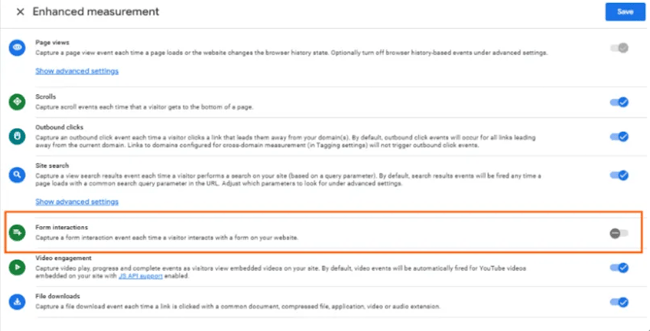
Once this is done, these events will appear in the event report.
Pro tip: Once set up, teams can create real-time dashboards in Google Looker Studio to monitor success with a filtered view that includes only AEO traffic.
Use assisted conversion reports
AI-powered discovery rarely results in immediate conversion. In most SaaS journeys, buyers encounter a product early on in an AI-generated response. They then do more research elsewhere and only convert later via branded search, direct traffic or another channel. For this reason, AI should be viewed as a support rather than a source of the last click.
Instead of expecting AI traffic to convert in isolation, track how AI-driven sessions contribute to conversions over time using multi-touch attribution and audience analytics.
In GA4, the easiest way to do this is to use the Segment Overlap report. This allows teams to compare users who arrived through an AI source with users who ultimately converted, showing how often the two groups overlap.
To apply this in practice:
- Create a segment for AI-driven sessionsusing source or media filters that capture traffic from tools like ChatGPT, Perplexity, and Gemini
- Create a second segment for convertersfor example, users who have signed up for a trial or submitted a form
- Use the segment overlap view to identify users who first arrived via AI but later converted via another channel
This approach helps bring to light AEO’s true contribution. While AI isn’t the final touchpoint, crossover analysis shows whether AI-driven discovery is attracting qualified users who later convert – often through more traditional channels.
Increasing brand demand
When a brand appears in an AI-generated response, prospects may return later by searching for the brand directly, navigating to the website, or searching for product-specific terms once interest has been piqued.
Since AI tools often answer early questions without a click, brand demand becomes the measure of influence. It shows that a brand has been recognized, remembered and carried over to the next phase of the buying journey.
To effectively track brand demand growth:
- Monitor branded search growth in Google Search Console and GA4.
- Monitor product-specific inquiry volumesuch as feature names, integrations, or “{product} pricing” searches.
For SaaS teams, increasing brand demand helps close the attribution gap created by AI search.
Pro tip: In theory, the brand will appear in every brand search. Look for searches that include the brand name and competitors and see if there is anything there that can inspire content, such as “the differences between,” “alternatives,” or content about how the brand handles certain features compared to competitors.
Conversion rate from trial to paid version for AI-influenced users
Test volume doesn’t tell the whole story. Sales and monthly or annual recurring revenue are most important in SaaS. The real measure of AEO’s effectiveness is whether AI-driven users convert into paying customers.
To measure this effectively:
- Segment users who have interacted with AI-driven touchpointseven if AI was not the final source of conversion. Teams may need to manage this internally by surveying customers during their session Onboarding whether they have interacted with AI during their buyer journey.
- Track conversion rates from trials to paid products for this group and compare it to organic search, paid media and outbound studies
- Analyze time to conversionnot just the conversion rate, to take longer review cycles into account.
- Link conversions to salesincluding deal size and expansion potential.
Customer lifetime value for AI-influenced users
For SaaS companies, the long-term value of a customer is important. Tracking customer lifetime value (CLV) for AI-influenced users can help determine whether AEO is attracting more suitable customers, not just more trials.
To measure this effectively:
- Take advantage of segmented customers from above.
- Track retention and churn rates for AI-influenced cohorts compared to other acquisition channels.
- Compare expansion metricssuch as upgrades, add-ons or seat extensions.
- Measure sales over timenot just the initial contract value.
Best AEO tools for SaaS marketing teams
Xfunnel
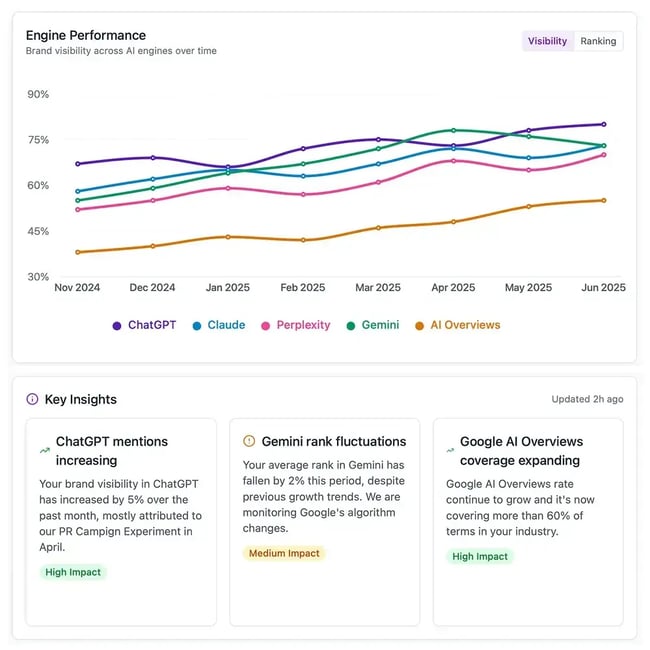
XFunnel is a platform for measuring AI search visibility and performance in large language models and AI-driven answer engines. It tracks how often a brand, product or piece of content appears, is cited or referenced in AI environments, including tools like ChatGPT, Google AI Overviews/AI Mode, Gemini, Perplexity, Claude and others.
Xfunnel provides AEO specialists with insights into sentiment, citation context, share of voice and competitive positioning to help teams understand where they are visible and where gaps remain.
Why I like it: XFunnel measure is specifically designed to measure the visibility of AI answers. It helps SaaS marketing teams understand where they show up in AI-generated results, how they are described, who sees them, and where visibility can be improved.
AEO grader
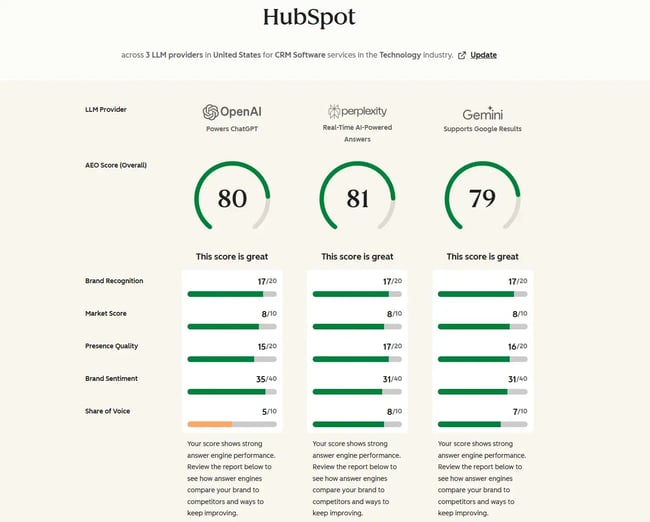
HubSpot’s AEO Grader assesses visibility, sentiment, and consistency in AI-generated responses to highlight gaps that could limit discovery or misrepresent positioning. AEO Grader examines how AI systems interpret a brand: what it is associated with, how it is described, and whether the content is structured clearly enough to be extracted and quoted.
AEO grader:
- Assesses brand visibility across AI search tools and LLMs
- Highlights sentiment and positioning issues in AI-generated responses
- Indicates inconsistencies in message delivery or entity understanding
- Identifies opportunities to improve clarity, structure and extractability
Why I like it: AEO Grader is quick and easy to use. It is generally assumed that good content ranking and the right message on the website leads to AI results, but this is not always the case. The AEO Grader makes AI visibility tangible, giving SaaS teams a faster way to identify misalignments before they impact assessment, testing, or pipeline.
Semrush
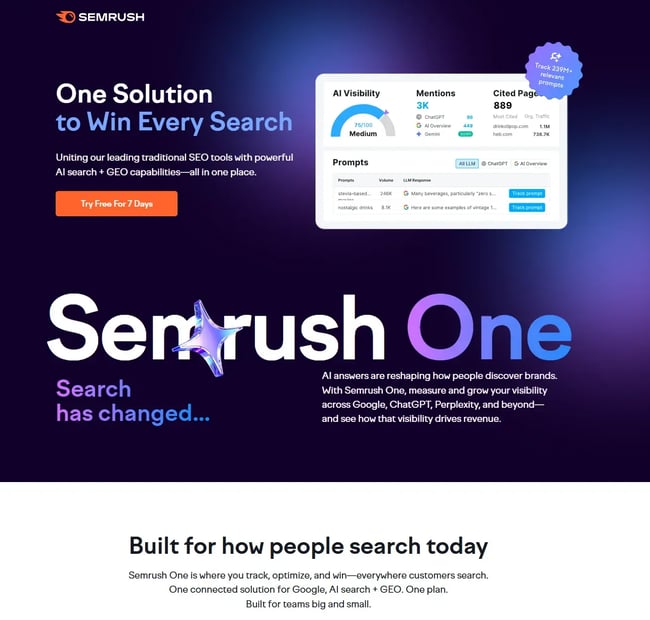
SEMrush One is an all-in-one SEO and AEO platform that supports keyword research, competitive analysis, website audits, SEO rank tracking, content optimization, AI visibility, rapid monitoring and more.
It is an expensive tool and starts at $199/month.
Why I like it: I’ve been using SEMrush for a long time and overall I really like the AEO prompt tracking and AEO improvement recommendations. I found that the tool’s recommendations were consistent with my own expectations.
Google Analytics 4
GA4 is the source of first-party truth. Although AI visibility is not directly measured, it shows what actually happens on a website after AI-driven recognition – test launches, form submissions, assisted conversions, and revenue events.
For SaaS teams, GA4 is best suited to understand how AI-influenced users behave, convert, and progress through the funnel compared to organic search, paid media, or outbound users.
Every business should use GA4, and it’s free!
Why I like it: GA4 ensures that AEO remains grounded in reality. It shows real business results like supported testing, brand demand, better qualified users, and stronger conversion paths. AEO specialists must link AEO efforts to real business outcomes.
Frequently asked questions about AEOf or SaaS.
How is AEO different from SEO for SaaS?
SEO focuses on blue link rankings, clicks and traffic. In modern search, SEO targets mid- to lower-funnel keywords. In contrast, AEO targets top-of-funnel keywords and displays them in AI channels where discovery, aggregation, and citation occurs in AI-generated answers.
Should we create separate comparison pages for competitors?
SaaS companies should consider creating separate competitor comparison pages. Dedicated comparison and alternatives pages provide AI systems with clear, extractable context for queries in the evaluation phase. Since AI often prioritizes third-party validation for queries like this, positively influencing third-party publications, where possible, increases visibility in the evaluation phase.
How can we allow AI bots without affecting website performance?
Unless a rule is added to prevent AI bots from crawling the website, they will be automatically allowed to crawl based on the rules set in the robots.txt file. It’s unclear how much AI agents pay attention to robots.txt, but some agents like it ChatGPT has suggested that they respect the ban Guidelines.
How do we connect AEO traffic to testing and the pipeline?
Treat AI as both a support channel and a source of last click. Leverage GA4-powered conversion reporting, segment overlap analysis, and signals such as brand demand and trial-to-paid conversion rates.
How often should we update pricing and integrations for AEO?
SaaS companies should update pricing and integrations as changes occur. Up-to-date, accurate pricing and integration data increases the likelihood that content is trustworthy and cited in the review.
First steps
AEO is already shaping the SaaS industry and the way buyers search, discover, evaluate and shortlist products. Today’s winning teams are those that adapt their SEO fundamentals for AI-driven discovery, double visibility in the evaluation phase, invest in third-party credibility, structure content for extraction, and measure success through testing, pipeline, and revenue.
If there’s one takeaway, it’s this: AEO only works if it is operational. This means visibility tools like