
AI search interfaces are changing the way content is displayed and cited. Pew Research Data from 2025 found that about one in five Google searches returned an AI-generated summary, with 88% of those summaries citing three or more sources. Bains Research 2025 found that about 80% of consumers rely on zero-click results for at least 40% of their searches.
Because answer engines compress results and bypass traditional links, visibility depends less on ranking position and more on whether content can be cleanly extracted and cited. FAQ sections created for Answer Engine Optimization (AEO) directly address this requirement. When FAQs are structured for extraction rather than navigation, they isolate individual questions, provide answer-first answers, and reinforce consistent terminology
This guide explains what FAQs for AEO are, why they are important, how to structure them for reliable extraction, and how to optimize them for measurable AI visibility.
Table of contents
What are FAQs for AEO?
AEO FAQs are structured question-and-answer sections designed to increase the visibility of results generated by AI, including Google AI overviews and conversational search tools. Unlike traditional FAQ pages that are primarily for navigation, FAQs for AEO are designed for retrieval. They are response-oriented, structured for extraction, entity-consistent, schema-driven, and tuned to natural language query behavior.
Search behavior underscores why this structure is important. At HubSpot AI trends 2025 for marketers According to the report, 31% of Gen Z respondents said they start searches in AI or chat-based tools instead of traditional search engines. FAQ sections reflect this conversation pattern by aligning with how prompts are phrased and resolved in AI environments.
Answer engine optimization focuses on making content quotable in AI-generated answers, not just ranking in search results. Instead of displaying a list of links, answer engines combine information from multiple sources into a single answer. If a passage cannot be extracted cleanly, it is less likely to be cited.
Modern AI SEO reflects this shift by prioritizing the way machines interpret and reuse information rather than ranking pages for isolated keywords. In this context, structure becomes a visibility lever.
AEO-ready content must be easy to access, summarize, attribute, and trust. FAQ sections support these conditions because they isolate the intent and resolve it directly. A clearly defined question ensures topicality. A concise, self-contained answer forms a reusable retrieval unit. Together they create structured passages that are useful for search engines to respond to.
HubSpot AEO supports continuous optimization by helping teams identify coverage gaps and refine FAQ structures in response to evolving AI search behavior.
Do FAQ sections improve AEO performance in LLMs?
FAQ sections improve AEO performance when implemented with structural discipline. They increase extractability, reduce ambiguity, and strengthen entity clarity. All of this influences whether a passage is selected and cited in AI-generated answers.
Large Language Models (LLMs) retrieve passages associated with defined entities and synthesize answers based on contextual alignment. When a section isolates a question and resolves it cleanly, the amount of interpretation required during synthesis is reduced.
In practice, response engines prioritize content that shows:
- Clear subject-verb-object relationships.
- Explicit entity definitions and consistent terminology.
- Completeness at the passage level without dependence on the surrounding text.
- Logical hierarchy through headings and formatting.
- Verifiable claims supported by structured markup.
These structural signals are consistent with patterns observed in AI-generated search, where long-tail, educational, and clearly organized content appear more frequently.
FAQ sections improve performance through three main mechanisms:
- Reduced ambiguity. When a question is explicitly written as a header, it defines the scope of the following passage. Clear scoping reduces topic drift and reduces the risk of recasts during synthesis.
- Improved summarization efficiency. Response engines prefer content where the resolution appears early and is structurally different from the surrounding text. Answer-first formatting increases passage completeness and reuse stability.
- Strengthened entity associations. Language models form associations between brands, categories and defined concepts. FAQ sections reinforce these associations by consistently linking entities to definitions and use cases.
For example, the following definition establishes clear semantic relationships:
“AEO is the process of optimizing content so that AI systems can extract, summarize, and cite it in response-driven search environments.”
- AEO → optimized → content
- AI systems → extract → content
- AI systems → summarize → content
- AI systems → quote → content
Repeating explicit entity relationships across multiple passages reduces ambiguity. FAQ sections formalize repetition within a single URL, increasing citation reliability when answer engines generate answers.
Tools like those from HubSpot AEO grader can be used to evaluate whether FAQ sections actually contribute to citation counts in AI-generated answers, rather than simply increasing the volume of content on the page.
Why FAQs are important for AEO
FAQs are important to AEO because they form structured retrieval units within a broader content system. Understanding how FAQs support AEO requires examining how answer engines isolate and reuse structured content. Defined question-answer pairs allow answer engines to isolate, score, and reuse specific passages without reinterpreting the surrounding content.
As generative search environments mature, visibility increasingly depends on how clearly information is organized, rather than how broadly targeted keywords are.
When it comes to answer-driven search, several measurable factors influence visibility:
- Target specific user micro-intents.
- Formatting that supports clean citation.
- Consistent entity definition and reinforcement.
- Completeness at the passage level.
- Share of Voice across all prompts.
FAQ sections reinforce each of these variables by increasing the number of quotable passages associated with a single topical URL.
Micro-intention alignment is important. A micro-intent is a narrowly defined query tied to a specific stage or operational concern within the buyer’s journey. When a page resolves multiple related micro-intents within a coherent structure, it increases the retrieval surface without fragmenting authority across separate URLs. This approach strengthens thematic depth while maintaining structural cohesion.
FAQ sections also influence AI search visibility. In generative environments, visibility can be assessed through brand mentions, citation frequency, sentiment framing, and share of voice across prompts. These indicators measure whether content is selected and referenced in responses, not just whether it ranks in traditional search results.
Teams can compare these signals using HubSpot’s AEO Graderwhat appears how often and where a brand appears across LLM-driven search experiences. Establishing a baseline will clarify whether the FAQ extension will improve citation presence or simply increase the number of pages.
Importantly, citation patterns do not always match traditional ranking positions. Latest BrightEdge AI overview research found that over 80% of AI-generated citations come from pages that fall outside traditional top ranking results. This divergence highlights the importance of structural clarity over positional dominance.
When FAQ content is organized into discrete, well-delineated answers that are linked to measurable visibility signals, it directly contributes to sustainable AEO performance. Its value lies not in its volume but in its controlled expansion of quotable passages anchored to a central theme. In practice, AEO FAQs improve visibility in answer engines and AI search by increasing the number of structured, quotable passages associated with a single topic.
How to structure FAQ pages so answer machines can read them Them
Response machines evaluate structure over prose. You look for defined question patterns, extractable answers and consistent hierarchies. This process helps them determine what a page covers and which passages they can reuse with minimal changes.
A disciplined FAQ system prevents structural deviations when scaling content. The following five steps establish repeatable standards that protect citation authority.
1. Choose one topic per FAQ page and define it clearly.
An FAQ page performs best when it is narrowly defined. When a single page attempts to cover unrelated product features, pricing policies, onboarding instructions, and compliance details, the topic boundary becomes weaker. Reduced thematic clarity reduces selection certainty.
A focused FAQ page should:
- Focus on one main topic (e.g. “AEO FAQs,” “AEO Reports,” or “AEO Tools”).
- Use an H1 that reflects the natural query formulation.
- Start with a short introduction that defines the topic in one to three sentences.
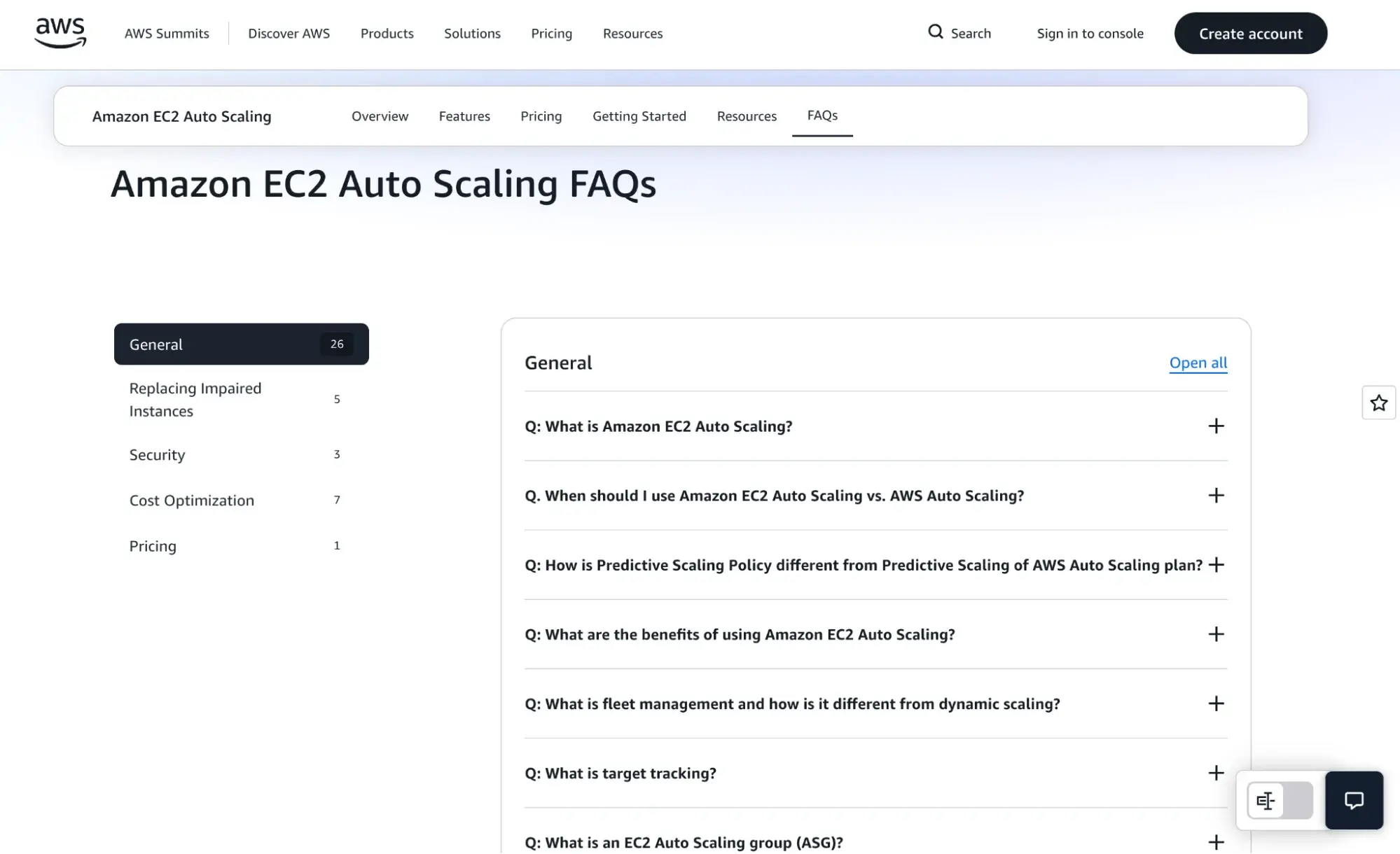
Avoid generic FAQ collections without a defined topic boundary or collection pages that mix unrelated categories. Clear topic ownership, as shown in this example from Amazon, increases retrieval accuracy and strengthens authority signals.
2. Use a consistent question and answer pattern for each entry.
Response machines prefer a predictable hierarchy. Each FAQ entry should follow a repeatable structural pattern so that question boundaries and answer boundaries remain clear.
Implementation standards include:
- Place each question in an H2 or H3 tag.
- Place the answer directly under the appropriate heading.
- Maintain consistent spacing and formatting across all entries.
- Avoid including independent media, calls-to-action (CTAs), or narrative sections between the question and the answer.
If FAQs are presented in accordions, ensure that the answer text is rendered in HTML when the page loads. Front-end decisions should not affect retrieval authority.
Structural consistency reduces interpretation effort and improves reliability at the passage level. HubSpot Content Hub enables scalable creation and management of AEO-friendly FAQ pages, helping teams maintain formatting consistency and reduce structural variation across large content libraries.
3. Write answer-first answers that stand on their own when quoted.
Answer engines often extract isolated snippets without surrounding context. Each FAQ answer must function independently. Direct, answer-oriented answers increase the likelihood of being cited by AI systems because they reduce the interpretation effort involved in extraction.
Open each answer with a direct solution to the question in approximately 40-60 words. The first one or two sentences should define, recommend, or solve without the need for prior explanation. Then add one to three supporting sentences that provide more operational clarity. When it comes to steps or criteria, add a short list of three to five items to maintain the searchable structure.
To achieve better results, teams should avoid:
- Introductory phrases that delay resolution.
- Marketing language that precedes the answer.
- Answers whose meaning depends on another section.
The completeness of the passage increases citation stability and reduces the risk of paraphrasing.
4. Adapt the question wording to the real query language.
FAQ headings should reflect how shoppers phrase questions in AI tools and search interfaces. Natural language alignment improves retrieval matching and reduces semantic discrepancies.
Effective question design includes:
- Complete question wording (e.g. “How often should AEO FAQs be updated?”).
- Comparison and Evaluation Prompts (“AEO vs. SEO,” “Best Tools,” “How to Measure Performance”).
- Terminology that reflects market language rather than internal vocabulary.
Avoid vague labels or fragmented headings. Clear query wording strengthens the match between buyer intent and page structure.
5. Do not add the FAQ schema until the content is structurally stable.
Schema markup strengthens structure; It doesn’t make up for weak formatting. Once the FAQ content is clearly organized and the answer comes first, the FAQPage schema makes it clear which text represents the question and which text represents the answer. The FAQPage schema identifies a list of question-answer pairs for answer engines and helps systems clearly distinguish between prompts and their corresponding answers.
Implementation standards include:
- Only mark FAQs that are visible to users on the page.
- Make sure the schema text exactly matches the wording on the page.
- Avoid adding structured data that introduces content that users won’t see.
- Update the schema when FAQ content changes.
Schema acts as a structural verification layer. When implemented correctly, it formalizes the relationship between question and answer and reduces ambiguity in machine interpretation.
FAQ optimization tips for AEO
Optimizing the AEO AI FAQ page focuses on refining structure, aligning intent, and improving extractability after basic formatting is done. Eligibility is determined by structuring an FAQ page. Optimization determines visibility in the competition. Once structural clarity is established, refinement should focus on intent alignment, extractability, entity precision, authority reinforcement, and measurement.
Align FAQ questions with commercial intent.
Many FAQ sections focus only on definition questions. Definitions support awareness, but rarely influence evaluation or visibility in the purchase phase. Optimization requires expanding coverage to decision-oriented micro-intentions.
Important FAQ questions often revolve around the following:
- Product comparisons.
- Pricing considerations.
- Requirements for implementation.
- Use case qualification.
- Industry-specific restrictions.
Examples of this are:
- “How is AEO different from traditional SEO?”
- “Which tools support Answer Engine Optimization?”
- “How much does it cost to implement AI SEO?”
Questions about costs and implementation reflect behavior in the evaluation phase. Their inclusion increases the likelihood that FAQ content will appear in commercially relevant prompts. For example, often cost considerations Designing research patterns for AI introduction. Coverage at this stage improves the alignment between visibility and pipeline impact.
Optimize extractability across platforms.
Response engines prioritize passage completeness and synthesis efficiency. Extractability depends on how easily an answer can be cited without structural reconstruction.
Optimization standards include:
- If possible, limit each answer to 150-200 words.
- Use short paragraphs and structured lists for multi-part explanations.
- Remove unnecessary qualifiers that cause ambiguity.
- Place the direct resolution in the first 40-60 words.
Content that can be reused with minimal rewriting is more likely to be cited. This principle underlies generative engine optimization frameworks, which emphasize clarity and structural coherence as citation drivers.
Dedicated platforms like HubSpot’s AEO tool are intended to help structure and evaluate content for extraction, especially as FAQ libraries scale.
At the operational level, implementing these standards requires a disciplined structure and assignment of questions. Tools like those from HubSpot Breeze Suite can speed up research and design structured, extraction-ready sketches. Editorial review remains essential. Acceleration improves efficiency while structure determines eligibility. Internal links from FAQ answers help users and answer engines discover deeper content without disrupting the primary answer structure.
Reinforce the clarity of the entity in each answer.
Entity consistency strengthens model trust. When terminology shifts unnecessarily, it weakens semantic reinforcement.
LLMs link entities across dimensions, such as:
- Brand and product names.
- Category definitions.
- Use cases.
- Industry contexts.
If an FAQ refers to a product, consistently use its legal name. When an FAQ defines a category, rephrase the core term rather than replacing it with stylistic synonyms. Clear entity framing supports association stability, especially when explaining related concepts such as AI agent types or related classifications.
Optimization at this level is not stylistic. It ensures a structural strengthening of knowledge relationships. Consistent terminology supports entity recognition and EEAT signals, reinforcing the way models connect brands, categories, and concepts over time.
Include freshness and source signals.
In addition to clarity, response machines also evaluate credibility. Content that appears outdated or without attribution poses risks during synthesis.
Strengthen authority signals by:
- Display a visible “Last Updated” or “Last Reviewed” date.
- Citing primary sources when referencing statistics, regulations, or formal definitions.
- Including a car racing entry or a thematic review.
- Direct indication of the year when referring to time-critical data.
Temporal specificity reduces ambiguity. Attribution reduces the risk of paraphrasing. Both improve the appearance of AI responses.
Combine FAQ optimization with visibility measurement.
Optimization without measurement limits strategic value. FAQ sections should support broader AI visibility goals, including mentions, citation frequency, sentiment framing, and share of voice across prompts.
Operational measurement may include:
- Monitoring which FAQs are cited in AI-generated answers.
- Track the frequency of brand mentions in priority searches.
- Identify current gaps where competitors are popping up more frequently.
Benchmarking citation performance across AI platforms requires dedicated visibility tracking tools. HubSpots AEO grader offers a practical way to evaluate LLM search results and determine which FAQ topics lead to measurable citation gains.
Because citation visibility does not exist in isolation, marketing teams should evaluate AI performance alongside traditional search performance. Tools in HubSpot Marketing Hub can complement FAQ optimization by combining structured content visibility with more comprehensive SEO reporting and cross-channel performance analysis.
FAQ optimization becomes sustainable when done within a monitored system and not as a one-off formatting exercise.
Frequently asked questions about FAQs for AEO
How many questions should an AEO FAQ page contain?
An AEO FAQ page should contain enough questions to comprehensively cover a clearly defined topic. As a practical guide, most well-structured FAQ pages contain between 8 and 20 entries, with the right number depending on the complexity of the topic rather than a fixed goal.
Effective FAQ pages address the entire decision arc on a topic, including definition, implementation, measurement, comparison, and common objections. Adding repetitive or loosely related questions weakens topic clarity and reduces recall accuracy. Each entry should introduce a clear micro-intent that expands coverage without diluting thematic focus.
Do I need a separate FAQ page or can I embed FAQs on important pages?
Both standalone FAQ pages and embedded FAQs support AEO, but fulfill different structural roles. A standalone FAQ page consolidates topical authority, while embedded FAQs increase passage-level visibility tied to specific commercial pages.
Standalone FAQ pages are useful for managing a category-level query such as “FAQs for AEO”. Embedded FAQs on product or pillar pages reinforce prompts and implementation questions in the evaluation phase. The strongest approach often combines both models while avoiding unnecessary duplication across URLs.
Can I use multiple schema types on an FAQ page?
Yes. A page can use the FAQPage schema along with other structured data types such as organization, product, or article schema, provided each markup type accurately reflects the visible content.
The key requirement is consistency. Structured data must exactly match the wording on the page and the FAQPage schema should only highlight question-answer pairs that users can see. A misaligned schema introduces ambiguity and weakens the machine’s trust signals.
How often should I update my AEO FAQs?
AEO FAQs should be reviewed and updated at least quarterly when significant changes in positioning, data or buyer behavior occur. Regular reviews ensure answers remain quotable and contextually correct.
If an FAQ contains statistics or time-sensitive claims, include the year directly in the sentence to avoid ambiguity. Refreshing content provides clarity and strengthens entity stability as AI systems integrate additional sources.
Will it hurt AEO if the same FAQs are duplicated across multiple pages?
Duplicating identical FAQ content across multiple URLs can dilute topic authority and lead to confusion about page citation preferences. Response engines prefer pages with clear subject ownership.
If a question needs to appear in more than one place, tailor the answer to the context of that particular page. Contextual differentiation maintains semantic clarity while strengthening expertise within different content clusters.
Designing FAQs for sustainable AI visibility
FAQs about AEO are structural assets. They improve citation authority by isolating intent, clarifying intent, and reinforcing consistent terminology across related questions. When FAQ sections align with buyer stage prompts and follow “answer first” formatting, they expand coverage without fragmenting authority.
A thoughtful introduction of AI remains essential. Expanding FAQ libraries or generating large amounts of AI-powered pages alone does not improve the probability of selection. Response machines respond to clarity, specificity and coherence. Sustainable AEO performance comes from making conscious decisions about what you publish and how you structure it.
If the content is truly useful and structurally accurate, citation becomes a byproduct of quality.