
According to major AI predictions for 2026, marketing is facing the year of biggest change in decades. Currently, marketers are struggling with fragmented customer journeys, declining attention spans, rising acquisition costs and failed campaigns. The use of AI in marketing will redefine the way brands engage with consumers by leveraging real-time data processing and predictive analytics.
According to the HubSpot 2026 State of Marketing ReportCurrently, over 64% of companies are using AI. With the rise of AI-driven content, AI agents, hyper-personalized campaigns, and more, the growth of AI in marketing is expected to increase dramatically in the next year. Marketers must evolve to take on more strategic and analytical roles while delegating routine tasks to AI tools.
This article covers the top AI predictions for 2026 and the AI marketing predictions for beyond 2026. For teams that want to stay at the forefront and implement AI, the HubSpot AI Agent Playbook offers step-by-step frameworks for automating marketing workflows and deploying AI agents across campaigns.
Table of contents
|
Current AI capabilities |
Future AI capabilities |
|
Basic AI Summaries |
AI-powered conversational responses |
|
Marketing content design |
Run entire campaigns and agent-to-agent interactions |
|
Ability to create a single text/image/video based on a user prompt |
Multimodal content repurposes a single asset |
|
Basic customer segmentation |
Advanced individualistic personalization |
|
Allows recurring tasks |
Replace repetitive tasks with predictable workflows |
|
There is a lack of data protection |
Prioritizes data protection by prioritizing first-party and zero-party data |
AI marketing predictions for 2026
2026 is a pivotal year for AI in marketing. AI is expected to not only streamline routine tasks but also drive strategic decision-making in marketing. This is about translating insights into action faster than ever before, while raising important questions about data protection, ethical use and the balance between human creativity and machine intelligence.
Spread of AI-driven search engines
One of the key AI predictions for 2026 is that traditional SEO will be replaced by Search Everywhere Optimization (SEvO), Generative Engine Optimization (GEO), and Answer Engine Optimization.
Search behavior is shifting from looking for links to looking for answers. Consumers no longer rely solely on Google to make their decisions. Instead, users actively search AI search engines and ask Perplexity, Claude, Gemini or ChatGPT for direct answers.
This fragmentation means brands need to be discoverable wherever audiences search: not just in traditional search engines like Google, but also in AI-generated summaries and conversational interfaces.
As a result, brand mentions in trusted sources such as reviews, forums, podcasts and social media now carry more weight than traditional backlinks. AI systems highlight brands based on “AI authority,” i.e. how often and credibly a brand is mentioned, making reputation and content quality critical to visibility.
In short, one of the AI marketing predictions for 2026 is that a brand’s SEO strategy will need to evolve into AEO. When content is not structured for LLMs and people, brands lose their voice in the conversation. Businesses and enterprises need to start speaking the language of AI models and human users simultaneously if they want to be called a “source of truth.”
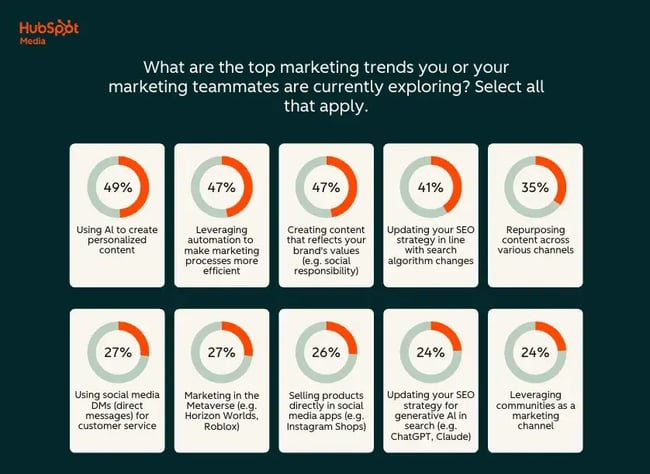
According to the HubSpot 2026 State of Marketing Report, 40.6% of marketers are currently updating their SEO strategy for AI-powered search engines. Another 48.57% of marketers occasionally use AI to create personalized content.
Marketing in 2026 requires optimization for:
- Voice search
- Image and visual search
- Conversation requests
AI models that drive discovery will go far beyond keyword-based SEO to include multimodal content relevance across all channels.
My strategy for AI search
I like how product search and discoverability evolves over time while the fundamentals stay the same. Ultimately, users want to find answers in the easiest and fastest way possible. AI-powered search engines will deliver this in 2026, while AI tools will help brands optimize for the age of AI search.
I often use HubSpot’s Breeze AI content generator to create content for brands as it helps me optimize for AEO. I can use HubSpot’s AI to write pieces that structure my posts for LLM readability and for humans at the same time.
The HubSpot Breeze AI suite helps companies optimize for AI search engines to accelerate business growth and increase team productivity. Breeze can also help segment customers for campaigns, Personalize contentand help clean data to save teams time.
Rise of AI agents in marketing
One of the key AI predictions for 2026 is that AI agents, autonomous systems that think, act and optimize on their own, will become mainstream in marketing workflows. Here’s how:
- AI agents manage entire campaigns end-to-end
- AI agents can help marketers optimize bidding, audience targeting, and creative in real-time
- Agentic AI will allow people to focus on strategy instead of manual tasks
AI agents are transforming from assistants to autonomous decision makers. By the end of 2026, agent-based AI systems will be able to plan, execute and optimize entire marketing campaigns without constant human input. These agents will operate across platforms, managing budgets, testing creatives and refining strategies in real time.
Consumers are also using personal AI agents to research and purchase products. With 24% of AI users Since marketers are already using AI shopping assistants, they need to optimize them not only for human audiences, but also for “agent-to-agent” interactions. Optimizing agent-to-agent interactions means ensuring product data is structured, accessible via APIs, and interpretable by AI systems.
The future of commerce and advertising is agent-mediated. One of the future predictions of artificial intelligence is that AI agents will negotiate media purchases directly with each other, bypassing human intermediaries. Agent-to-agent trading enables faster, more scalable transactions and supports new ad formats that don’t fit into legacy programmatic pipelines.
Similarly, consumers use AI agents to compare products, check inventory, and make purchases, often without visiting a brand’s website. Protocols like Agentic Commerce Protocol (ACP) and Model Context Protocol (MCP) enable brands to embed interactive, transactional experiences directly into AI chat interfaces.
In 2025, AI was primarily used for content creation. In 2026, AI will be used to run entire campaigns. While one AI agent waits for a command, another agent works toward a predefined goal, doing the busy work of acquisition and qualification in the background.
According to HubSpot’s State of Marketing 2026 report, 19.20% of marketers are already using AI agents to automate end-to-end marketing initiatives. These numbers are expected to increase in the coming months.
How I use AI agents
I use AI agents to automate workflows, giving me more time to focus on brand strategy. For example, I can assign a target to a HubSpot Breeze agent and have them research, qualify, and onboard leads in the background. The sales team can then start closing deals based on the AI-generated leads.
The HubSpot AI Agents Playbook explains how people can use AI agents and prepare for the future. The HubSpot AI Agent Playbook allows marketers to determine exactly where and how to implement agents into workflows.
As a starting point, I recommend using HubSpot’s built-in AI agents.
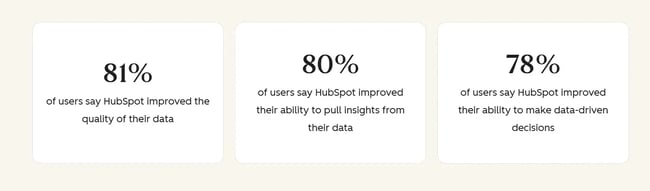
The HubSpot Breeze AI agents Help marketing teams discover, adapt, and deploy AI agents to automate business processes. Likewise those HubSpot Breeze data agent helps scale data operations with an AI agent that researches and analyzes customer data to deliver immediate results.
Pro tip: If a workflow requires strict logic (if criterion X is met, Y should follow), it is best to delegate the work to an AI agent. See this HubSpot AI Agents Playbook to learn how to use AI agents and prepare for future-proof work.
AI content is becoming mainstream
One of the key AI predictions for 2026 is that generative AI will no longer be just a content creation tool, but will become a creative co-pilot. Marketers will use AI tools to produce multimodal content (text, images, audio, video) at scale, enabling rapid localization and personalization.
However, as AI-generated “slop” floods the internet, authenticity and human creativity become differentiators. Brands balance AI efficiency with employee- and creator-led storytelling to maintain emotional resonance and trust.
As mentioned earlier, almost half of the marketers surveyed in the HubSpot report have used AI to create personalized content. Additionally, 35.08% of marketers are repurposing content across channels.
In 2026, AI will not only produce content but also drive “living campaigns” that self-adjust messages, formats, visuals and tones based on performance signals across platforms. Traditional static ads will largely give way to dynamically evolving creative assets that adapt to each audience segment.
Brands are likely to use AI-generated images, videos and text as standard practice rather than as experiments. Therefore, marketers will leverage AI tools to create thousands of creative variations for A/B testing, with human marketers focusing more on strategy and creative direction than execution.
Users now desire fluid formats and expect to consume ideas in the format that suits their moment. So, AI future predictions for 2026 include the rise of AI tools that can generate multimodal content by converting a single asset into audio, image, and text formats.
How I see AI content
I think the most successful brands in 2026 will look at a blog post as just raw material and use AI to turn that post into a podcast, slide deck, or social carousel. This ensures that marketers reach every segment of the audience on launch day.
For example, I often use the HubSpot Breeze AI Content Generator to create AI content and convert a single asset into blogs and social media posts.
The HubSpot Breeze AI content generator can generate AI content that helps teams save time. Breeze can also help segment customers for campaigns, Personalize contentand help clean data to save teams time.
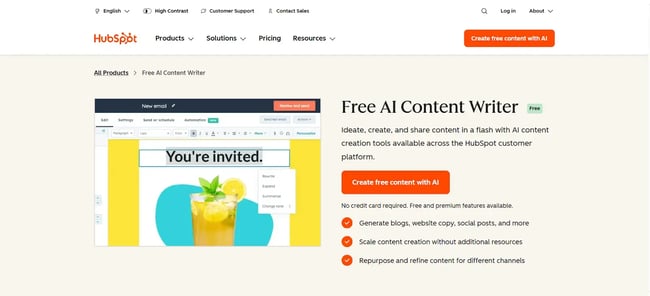
Pro tip: Stop publishing content in a single format. The right AI tools can help marketers quickly ideate, create and share content across different platforms.
Hyper-personalization and predictive analytics
One of the key AI predictions for 2026 is AI-driven personalization, which goes beyond user segmentation and enables cross-channel customization in real time. Using behavioral signals, context and intent, AI tools tailor content, product offerings and journeys for each user by dynamically tailoring emails, ads and website experiences.
Predictive analytics enables predictive marketing, where brands present offers before customers consciously realize they want them. Tools like Google Analytics 4 AI Insights predict customer churn, purchase probability, and next best actions, allowing marketers to be proactive.
According to HubSpot’s State of Marketing 2026 report, 32.96% of marketers are currently heavily using AI for data analysis and automated reporting. Another 33.24% use AI extensively for market research and competitor analysis.
The future of AI is marketers providing one-to-one personalization to drive higher engagement and conversion rates. Marketing will eventually move beyond basic segmentation to truly customized experiences.
AI will enable brands to create unique content, product recommendations and messaging for each customer in real-time, analyzing behavior patterns, purchase history and contextual signals to deliver exactly what resonates with each person.
How I see hyper-personalization
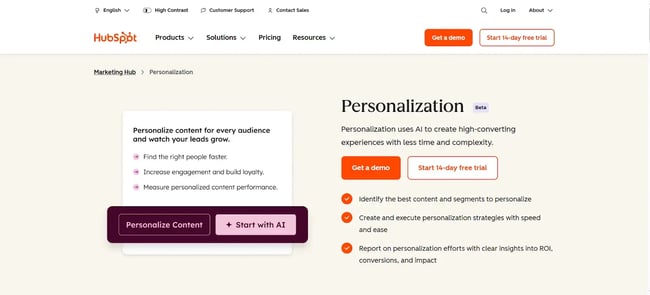
In a world flooded with AI-generated content, the only way to cut through the noise is with data an LLM doesn’t have: the real-time context of customers. The solution is predictive personalization. That’s why I use HubSpot Breeze to unify customer data to predict what a customer needs next. I move from general messaging to timely, high-quality interactions.
The HubSpot Breeze AI suite unifies marketing, sales and customer data to accelerate business growth, increase sales and improve customer service. The HubSpot Breeze data agent assists with data operations by researching and answering individual questions using CRM data.
Marketers can also refer to the HubSpot AI Agents Playbook to understand how AI agents work and use them for predictive data analysis.
The future of marketing teams and roles
One of the key AI predictions for 2026 is that AI will change roles in marketing. Routine tasks are automated so marketers can focus on strategy, creativity and ethical oversight. Some of the new roles emerging are:
- AI Marketing Specialist: Manages AI tools for personalization and analytics.
- Prompt engineer: Creates inputs to generate high-quality AI outputs.
- Automation manager: Integrates AI workflows across platforms.
- Data Storyteller: Translates AI insights into business narratives.
- Micro-content creators: Produces authentic, human-edited content to counteract AI weakness.
Leadership must promote AI literacy and human-in-the-loop processes to ensure that AI enhances, not replaces, human judgment.
The 30% rule dictates that AI must automate one-third of routine workloads. Adopting AI frees up 30% of the marketing team’s time to invest in impactful creativity.
AI marketing predictions for 2026 also include new roles such as Vibe Marketing, a concept inspired by the “Vibe Coding” trend. Marketers don’t have to be a technical CRM expert to work in marketing; You just need to know the broader strategy.
This shift eliminates the tool fatigue that plagues growing teams. Vibe marketers provide the vibe (the strategy and goal), and AI takes care of the execution. This allows junior marketers to run leadership-level campaigns as long as their strategy is sound.
According to HubSpot’s State of Marketing 2026 report, 32.82% of respondents said AI tools save marketing teams 10-14 hours per week. At the same time, 41.81% of marketers said that AI moderately increased productivity.
AI is going nowhere. Marketers need to educate themselves and learn the tools to secure their positions and find AI-safe jobs.
How I see the future of marketing roles
I think AI will replace repetitive tasks while retaining those that require human creativity and innovation, returning marketing to its creative roots. The barrier to entry no longer exists “Knowledge of the software” But “Know the customer.”
I would also recommend the HubSpot 2025 AI Agents Playbook to marketers. Ultimately, further training and learning AI is the only way to secure jobs in the long term.
The HubSpot 2025 AI Agents Playbook helps marketers learn insider strategies and helps companies gain an edge in marketing, sales and operations.
Pro tip: Instead of traditional business school degrees, what matters is how well a marketer can execute a strategy. Even young marketers can run a campaign if they know how to use AI tools effectively. Learn quickly on the go.
Data protection-oriented data strategies
Privacy-focused data operations for AI systems are one of the key AI predictions for 2026.
As third-party cookies are phased out and global privacy regulations tighten, first-party and zero-party data are now essential. Brands are moving to consent-based data models and capturing customer preferences directly through surveys, loyalty programs and preference centers.
AI helps extract value from limited data by using intent-based signals and contextual targeting, reducing reliance on personal identifiers. Responsible use of AI not only ensures compliance, but also creates trust and transforms data strategy into a competitive advantage.
With the increasing adoption of AI, ethical issues such as data protection, avoidance of bias, transparent decision-making and responsible use are moving from optional to strategic imperatives. Brands that lead with trustworthy and explainable AI will gain a competitive advantage.
According to HubSpot’s State of Marketing survey, 40.13% of marketers are concerned about privacy and security. In fact, it is the biggest obstacle stopping companies from using AI in marketing.
How I see data strategies that put privacy first
Privacy is a fundamental aspect of human life. Therefore, it is natural for the majority of marketers to be concerned about privacy issues.
However, I hope that in 2026, with the right regulations and better data practices across AI companies, more companies and marketers will be confident in using AI.
AI tools with built-in data protection are preferred over those that are not as transparent. For example this HubSpot Breeze AI suite delivers secure and trustworthy AI solutions with robust data protection measures built into the system.
Pro tip: Always read the privacy policy of AI tools to understand what type of personal data they collect and process. Review the permissions granted to AI tools and revoke them if they violate privacy policies.
How marketers should prepare for AI predictions for 2026
The window of opportunity for marketers to stay ahead of the next wave of AI is closing quickly. Here’s what marketers need to do now to survive the future of AI:
- Start experimenting with AI agents today. Don’t wait for the “perfect” tool. Start testing current AI models to understand their capabilities and limitations before more powerful systems become widely available.
- Create workflows that require AI automation. Start designing processes where AI takes over routine tasks like email responses, content creation, and data analysis. Focus your energy on strategy and creative direction rather than execution.
- Develop AI orchestration skills. The future marketing professional will be more of a director who coordinates multiple AI tools than someone who handles manual tasks. Learn to engineer quickly and manage AI systems effectively.
- Build custom solutions instead of buying SaaS. Many marketing tools can now be created in minutes using AI. Marketers can use OpenAI, Claude, Gemini, and HubSpot to create complex projects that previously would have required entire teams.
- Think like a small, strong team. AI will enable small, focused groups to create projects that previously required hundreds of people. Position the marketing team to take advantage.
AI predictions beyond 2026
Predictions for AI marketing in 2030 would be smart, ethical, immersive and human-centric brands, powered by AI but guided by empathy.
By 2050, in the age of AGI, marketing will no longer be about selling products but about creating intelligent relationships between people and the systems that serve them.
What marketing looks like in 2030
Marketing in 2030 will function through predictive AI systems that anticipate customer needs before consumers express their intent, replacing reactive campaigns with adaptive, deeply human experiences in real time. All marketing campaigns are powered by AI but guided by empathy.
Marketing becomes predictive, not reactive
By 2030, marketing will not wait for customers to act.
- AI models will anticipate needs before an intention is expressed
- Campaigns are triggered based on life moments, context and behavior patterns
- Funnels will be dynamic and non-linear and will update in real time per person
Hyper-personalization at the identity level
Segmentation will be obsolete.
- One-to-one marketing at scale is becoming the norm
- Content, pricing, UX, and even brand tone adapt to each user
- AI-generated content is subject to strict branding and ethics levels
The rise of the zero-party data and trust economy
With stricter privacy laws and cookie-free ecosystems:
- Customers pass on their data voluntarily and receive added value in return
- Brands compete on transparency, not tracking sophistication
- Trust becomes a measurable KPI
AI co-marketers are becoming the norm
Marketers won’t be using “tools” – they’ll be working with AI partners.
AI will:
- Design campaigns
- Try thousands of creative variations instantly
- Predict ROI before launch
- Optimize messaging during the conversation
The human will focus on:
- strategy
- ethics
- creativity
- Cultural relevance
Content develops into experiences
Static content is hidden. Immersive content dominates.
- Interactive video, AR demos, virtual showrooms
- Conversational content about AI agents
- Personalized brand worlds instead of landing pages
Vision 2050: Marketing in the Age of AGI
By 2050, marketing will no longer be a function defined by tools, channels or even data. In the age of artificial general intelligence (AGI), one of AI’s predictions is that marketing itself will become a coevolutionary system – one in which human values, machine intelligence and consumer intentions adapt to each other continuously and in real time.
From optimization to understanding
Today, marketing is obsessed with optimization: click-through rates, conversion funnels, attribution models. AGI changes the game by shifting the focus from what works to why it works.
AGI systems will:
- Understand human psychology on an individual and collective level
- Model emotions, motivations, cultural context and ethics
- Identify needs before consumers can articulate them
The end of campaigns, the rise of vibrant brands
In the AGI era, campaigns will seem archaic. Instead:
- Brands will operate as constantly evolving entities
- Messages, images and values adapt immediately to social, cultural and economic changes
- The brand identity will be fluid yet consistent and guided by an AGI “brand consciousness”.
Marketers as philosophers, curators and governors
AGI will fully automate execution, but not responsibility. The most valuable skill will not be rapid writing or analysis; it will be a judgment.
Human marketers will evolve to:
- Philosophers who define goals, values and boundaries
- Curators guide creativity, culture and narrative
- Governors oversee the ethical use of intelligence information
The Ultimate Shift: From the Attention Economy to the Meaning Economy
The attention economy will collapse under AGI overabundance. What it replaces is the economy of meaning, in which:
- Brands compete on their contribution, not their visibility
- Success is measured by the long-term impact on human well-being
- Marketing is designed to reduce friction in life, not to artificially create desire
Frequently asked questions about AI predictions
What is the best AI predictor?
The performance of the AI predictor depends on the specific use case and data requirements. HubSpot Breeze AI Suite is one of the best AI predictors that offers built-in predictive capabilities for marketing attribution, lead scoring, and sales forecasting. HubSpot Breeze analyzes historical customer data to create actionable predictions that inform campaign strategy and resource allocation.
What are the future predictions of AI?
Future AI predictions include the rise of AI search engines, AI agents in marketing, AI-generated content, hyper-personalization, changes in job profiles, and privacy-first protocols. By 2030, marketing will become more predictive, AI co-marketers will become commonplace, and content will evolve into immersive human experiences.
What is the 30% rule for AI?
The 30% rule for AI means that it should handle 30% of the workflow, including repetitive, data-intensive tasks. Humans can focus on the remaining 70% of work, which requires critical thinking, creativity and ethical judgment. AI therefore serves as a supporting tool for employees and does not replace their jobs.
Which jobs will be lost by 2030?
Professions such as telemarketers, accounting clerks, compensation and benefits managers, receptionists, couriers, proofreaders, computer support specialists, market research analysts, advertising salespeople and retail salespeople could be eliminated and replaced by AI by 2030. However, strategic marketing roles that focus on creativity, ethics and culture will continue to be essential.
AI in 2026: The Conclusion
AI in 2026 will be defined not by a single “ChatGPT moment,” but by the quiet, powerful transformation of how work is done more efficiently. Companies that integrate AI into their core operations will increasingly see an increasing impact.
While there will continue to be breakthroughs in modeling capabilities, the real success stories will come from how marketers integrate AI into everyday workflows.