
In November 2025, Yoast announced a collaboration with NLWeb, an open web protocol developed by Microsoft that aims to simplify the creation of conversational interfaces for the web.
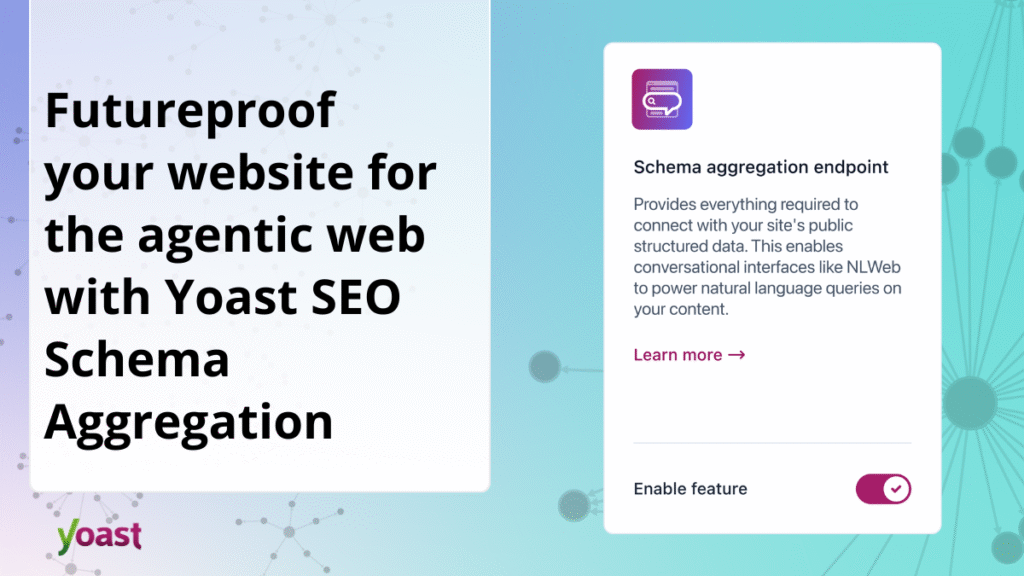
Today we are proud to present the first major result of this work: Yoast SEO Schema Aggregation. This is a Opt-in function This brings together your website’s structured data more clearly and consistently. By opting in, you can help search engines and intelligent agents better understand and use your content.
If you’d like to see what schema types are available for your WordPress setup, check out our schema overview to see what’s included in the different product plans.
Closing the gap: from discovery to conversation
Yoast has always helped to present WordPress websites fairly and responsibly on the open web.
2019: Yoast introduced the first schema diagram and API of its kind, helping search engines better understand your content as they moved beyond keywords and evolved into discovery engines.
Today: We’re taking the next step. As the agent web becomes more and more important, we help move your WordPress site from being discovered to being understood and engaged with through conversation.
Starting today, the new schema aggregation feature is available in Yoast SEO. It establishes a standardized connection between your website’s structured data and the systems that enable AI-driven discovery and interaction. These include large language models, agents and conversational assistants like Copilot. It helps ensure that your published content can be properly understood by the AI. This is important as AI becomes part of the way people find and use information online.
The NLWeb + Yoast integration was developed in collaboration with the NLWeb team, including RV Guha, co-founder of Schema.org. Together, we extend the open web standards you already rely on so your WordPress site can safely participate in the emerging agent web in a responsible and future-ready way.
Benefits of the schema aggregation feature
Questions about AI often come down to one thing: who can access your data? When developing this function, data protection was taken into account right from the start.
- Complete: All indexable content included
- Clean: No duplicate entities, no navigation chaos
- Tied together: Relationships between entities are preserved (author → article)
- Compliant: Respects existing privacy settings
- Fast: Less than 100ms cached responses, pagination for large websites
For developers and technical users who want more control, we have developer documentation on schema markup. It explains how to review and extend your schema diagram. This gives you maximum personalization while maintaining standardization at scale.
“You can’t stop the AI wave, but you can guide it. Our integration with NLWeb puts you back in control. It allows you to efficiently manage server load and ensures that when AIs access your content, they receive the comprehensive semantic understanding needed to display it correctly.” Alain Schlesser – Principal Architect, Yoast.
What’s new
Next time you log in and open Yoast SEO (updated to 27.1), you will see a short guide. It introduces the new schema aggregation feature. It also shows how to activate it with a simple switch.
We’ve added a new endpoint to Yoast SEO (free), making the schema aggregation feature available to all customers who want to enable it. The endpoint exposes your site’s fully structured data graph in a proposed new standard called Schemamap.
This means that an AI system no longer has to crawl hundreds of pages one at a time (or however many pages you have on your site), but can now retrieve your site’s schema, including articles, authors, products, and organizational data, in one optimized request.
Before and after: from pages to a connected site
Below is an example of the structured data that Yoast already outputs on a single page. This page-level schema helps search engines understand what that particular page is about, including content type, author, and relationships.
When schema aggregation is enabled, Yoast provides a site-level view. Instead of looking at pages in isolation, the structured data of your entire website is connected. It is consolidated into a single output called a schema map. The sight can be quite overwhelming. It makes it easier for AI systems to understand your content. You can see how your articles, authors, products, and organization relate to each other on the site.
Nothing about your existing schema changes. The same data is reused and simply organized to reflect how your website works as a whole. Here is an example schema map from dailyimtravelling.com, displayed using the Yoast SEO Schema Visualizer.
How it works: Standardized, connected and deduplicated
The Schema Aggregation feature doesn’t just pass data; it organizes it for AI consumption:
- Eliminates data chaos: It brings together duplicate author, product, or article mentions into a scalable, connected dataset.
- Integrates automatically: If you use one of our Schema API partners, e.g The events calendar or WP Recipe MakerThese schema types are automatically included in the diagram.
Developers can also explore our Schema Integrations page to see how Schema API partners connect to and extend the Yoast SEO Schema Framework (the graphic).
Collaborative innovation
When working at scale across millions of websites, careful testing is essential to ensure a safe and reliable launch. This feature was designed specifically for government and advanced users and tested in controlled environments.
We worked closely with Sydeour innovation partner to test the new function in a variety of real customer scenarios. The approach for this release was tested in controlled environments to confirm scalability and consistent output quality prior to deployment.
Syde’s feedback was instrumental in refining the schema aggregation logic. We look forward to continuing this partnership and working together to help customers remain visible and accurately represented as they advance AI-driven systems.
Be visible, understood and represented
The rules of discovery are changing, but your website doesn’t have to be left behind. With NLWeb and Yoast, your website stays at the center of the conversation.
Are you ready to see it in action? Upgrade to the latest version of Yoast SEO today and enable the NLWeb integration in your Yoast SEO settings. For more information about enabling schema aggregation, see this help article.
