
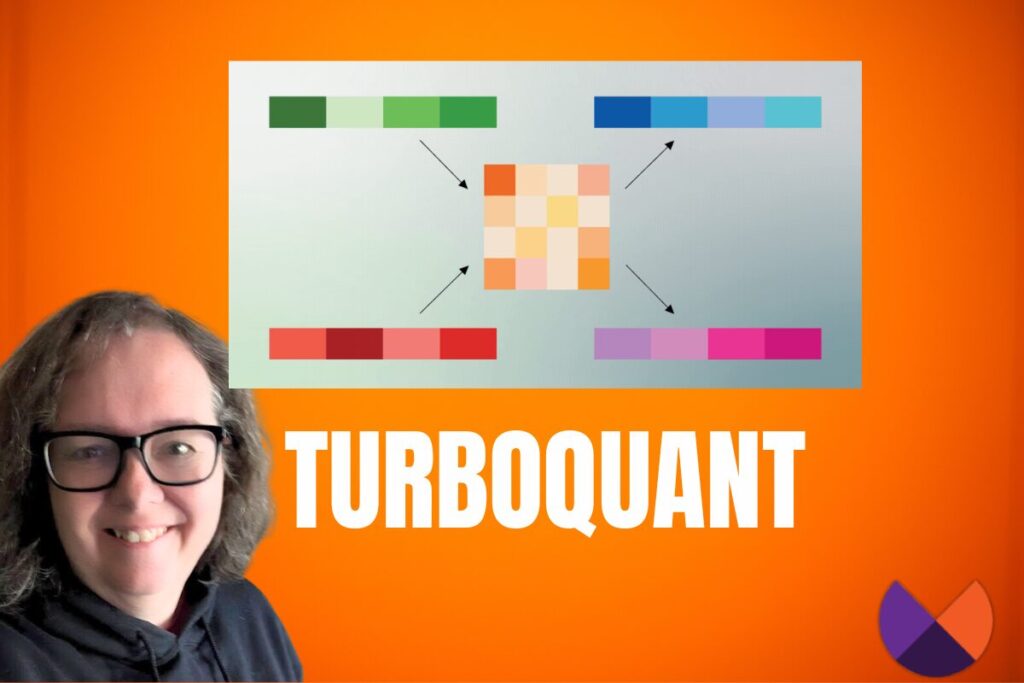
Google has published a blog post about a new breakthrough in vector search technology called TurboQuant. The potential impact of this technology on search is staggering!
TurboQuant is a suite of advanced algorithms that dramatically reduce AI processing size and memory requirements. Their blog post states: “This has potentially profound implications…”especially in the areas of search and AI.”
Let’s talk about how TurboQuant works, and then I’ll think about how this opens the door to more AI overviews, more personalized AI, instant indexing, a vastly improved ability to present searchers with content that meets their needs, and massive advances in AI usage in both agents and the physical world.
This is how TurboQuant works
TurboQuant is a technique that significantly speeds up the process of creating vector databases. The summary of the TurboQuant paper tells us that this method not only outperforms existing methods for vector search, but also reduces the time needed to build an index for vector search to “virtually zero”.
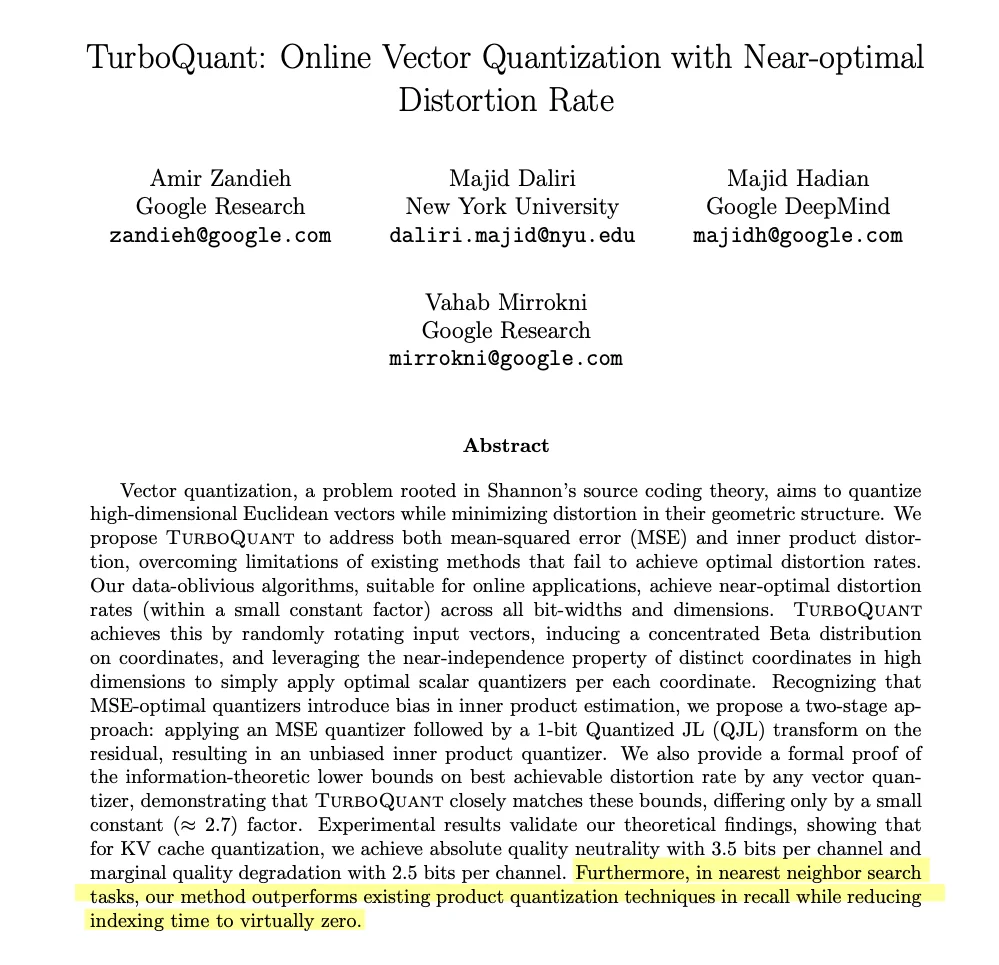
To understand how this works, we first need to understand vector embeddings, vector search, and then vector quantization.
Vector embeddings
If you are new to vectors and vector search, I highly recommend this program Video by Linus Lee. He explains how text embeds work.
Essentially, vector embedding is a way to convert text (or images or videos) into a series of numbers. The numbers encode the semantic meaning and relationship of words or concepts. It really is that amazing. If you have time, I would highly encourage you to do so Read Google’s 2013 Word2Vec article Or better yet, paste the URL into the Gemini app, select Guided Learning from the tools menu, and ask Gemini to walk you through. It blew my mind to learn how math can be done with vector embeddings. Since words are mapped into vector space based on their context, you can actually do math on them.
In the paper, Google says that if you take the vector for king, subtract the vector for man, and then add the vector for woman, you end up with almost exactly the vector for queen.

Wow.
Vector search
Now that we know that words and concepts can be mapped as mathematical coordinates, vector search is simply the process of finding which points are closest to each other. Let’s say I’m searching for the query “how to grow super hot peppers in a backyard” in a vector space. A conventional search engine looks for texts that contain exactly these words. In vector search, this query would be embedded in a vector space. Content in this space that is semantically similar to the query and the concepts embedded within it will appear nearby in vector space.
I demonstrated this below in a two-dimensional space, but in reality that space would have far more dimensions than our brains can comprehend.

Vector quantization
Vector search is incredibly powerful, but it comes with a catch. Vector search in a space with multiple dimensions consumes a lot of memory. Memory is the bottleneck for Search for the nearest neighbor used by the parts of Google Search that use vector search. This is where vector quantization comes into play. Essentially, vector quantization is a mathematical technique used to reduce the size of these huge data points. It compresses the vectors, similar to a highly efficient ZIP file.
However, the problem with vector quantization is that compressing the data leads to a degradation in the quality of the results. Additionally, vector quantization adds an extra bit or two to each block of data, increasing the memory load required for the calculations – defeating the purpose of compressing the data!
How TurboQuant solves the storage problem
TurboQuant takes a large vector of data and compresses it by rotating the vector to simplify its geometry. This step makes it easier to assign the values into smaller, discrete sets of symbols or numbers to each part of the vector individually. It is similar to JPEG compression and allows the system to capture the main concepts of the original vector, but requires much less memory.
However, the problem with this type of compression is that it can lead to hidden errors. The TurboQuant system uses something called QJL to mathematically check for errors in the tiny errors left behind, using just one bit of memory. The result is that the new vector is a fraction of its original size but retains the same precision, allowing the AI to process information much faster.
I pasted Google’s TurboQuant paper and announcement into NotebookLM and asked them to simplify the explanation for myself:
“To understand how Google’s TurboQuant solves this storage bottleneck, imagine trying to fit thousands of oddly shaped objects—like jagged lamps and rigid chairs—into a moving truck. Traditional compression simply compresses the objects to fit, corrupting them and, in the case of data, leading to poor search results.”
TurboQuant does something completely different. Instead of destroying the data, these massive, unwieldy vectors are mathematically twisted and reshaped into identical, perfectly smooth cubes so they can be easily packed. To repair minor scratches caused by this reshaping, a metaphorical piece of “magic tape” – a single bit of data – is applied, restoring the item to its perfect, original condition.”
This is still a bit confusing. If you want to go deeper here, I had NotebookLM created a video to explain it further:
You don’t need to understand the exact processes used for TurboQuant, but rather know that it makes it possible to compose a space embedded in vectors and perform a vector search very quickly and on large amounts of data.
What does TurboQuant mean for search?
What we have learned so far is that vector search is slow and inaccurate in large data sets, but TurboQuant makes it faster and more accurate. The TurboQuant article states that the technique reduces the time to index data in a vector space to “virtually zero.”
When I read this, I thought of Google Engineer Pandu Nayak’s statement on RankBrain in the recent trial between DOJ and Google.
(Fun fact: When RankBrain was introduced, Danny Sullivan, writer for Search Engine Landsaid Google told him it was connected to Word2Vec – the system for embedding words as vectors. Here is the Google blog post from 2013 Learn the meaning of words with Word2Vec.)
In the test, Nayak said that traditional search systems were first used to rank results and then RankBrain was used to re-rank the top 20 to 30 results. They only ran it through the top 20-30 results because that process was expensive to carry out.

I think TurboQuant is changing that! If TurboQuant reduces indexing time to virtually zero and dramatically reduces the memory required to store large vector databases, the historical cost of performing a vector search on more than 20 or 30 documents will disappear completely.
TurboQuant enables Google to perform large-scale semantic search.
All or some of the following events may occur:
Truly helpful and interesting content that meets the user’s specific needs and intent is easier to display
Google uses AI to understand what a searcher really wants to achieve, and then in turn uses AI to predict what will be helpful to them. TurboQuant should make this second step much faster and allow more choices to be included in the vector space from which the AI draws its recommendations.
I know what you’re thinking. If AI overviews answer the question, why should I create content for it? This is actually the topic of a separate article, but to summarize my thoughts: I believe that creating some types of content is no longer useful, especially when that content’s main strength is organizing the world’s information. If you can create content that people actually want to engage with via an AI response, then you have gold on your hands. It’s doable! I mean, you’re reading this article right now, right?
We may see more AI overviews
I know this won’t be a popular thing for many. From a user perspective, however, AI overviews are becoming increasingly helpful. TurboQuant should allow Google to collect the information that might be helpful in answering a user’s question, even a complicated one, and then immediately create an AI-generated answer.
Personalized search becomes even more powerful
Google introduced Personal intelligence and this week the time has come available for many other countries.
TurboQuant should make it even easier for Google to become a highly personalized, real-time AI assistant, as it can create searchable vector spaces loaded with your personal history. (I remember DeepMind CEO Demis Hassabis’ post explaining Google plans to develop a universal AI assistant.)
The capabilities of agent systems will improve dramatically
Agents are severely limited by their context windows and the speed at which they retrieve information. With TurboQuant, an AI agent has limitless, perfectly retrievable long-term memory. It will be able to instantly search every interaction, document, email and preference you have shared with it in milliseconds. And it will be able to communicate massive amounts of information with other agents. The implications are too diverse to comprehend!
Visual search (coming soon to glasses) will be even more helpful
The large amount of visual data you see through AI glasses or Gemini Live can be converted into vector space. Also this week Search Live has expanded worldwide.
Your glasses become a powerful visual reminder for you. Hey Gemini…where did I leave my keys?
Other technologies based on collecting real-world data (such as Waymo and other self-driving cars) are becoming smarter and faster.
Robots are becoming much more powerful
Now if you put a robot in my living room and asked it to clean up, it would be overwhelmed by an overwhelming number of objects and would try to understand their semantic context and what to do with each of them. I expect that TurboQuant will make robots much smarter and more powerful. (Did you know that? Google DeepMind recently partnered with Boston Dynamics?) I think that progress in robotics will accelerate dramatically thanks to TurboQuant.
What do we as SEOs do with this information?
We discussed TurboQuant in my community, The search bar and one of the members asked how this changes our work as SEOS. I think that for those of us who focus on thoroughly understanding and fulfilling user intent over tricks or technical improvements, not much changes.
Some companies have greater incentive to create in-depth, genuinely helpful content. For others, however, especially those whose business model is to curate the world’s information, TurboQuant will likely cause you to lose more traffic as AI Overviews will satisfy searchers who landed on their site earlier.
You may find this twin gem helpful. I have added several documents, including the one you are currently reading, to the knowledge base. It brainstorms with you and helps you figure out whether your current business model is likely to be affected by AI changing our world. It will also help you dream about what you can do to be successful.
Marie’s Gem: Brainstorming Your Future as the Web Becomes an Agent
I expect we will see another core update soon. Well, Google released the March 2026 core update before I could publish this article!
It wouldn’t surprise me if TurboQuant was introduced into the ranking systems.
Last year I speculated that Google’s vector search breakthrough MUVERA was behind the changes we saw in the June 2025 core update. Some people said, “But Marie, you can’t publish a breakthrough and then implement it into core ranking algorithms within a week.” What they missed was that Google’s announcement came from MUVERA a whole year after they published the original research. It turns out the same is true for TurboQuant. They published the blog post announcement in March 2026, but the Original paper was released in April 2025. They’ve had plenty of time to improve their AI-driven ranking systems.
When TurboQuant is part of the March 2026 core update, we will see Google have more ability to perform semantic search across hundreds of possible results and provide searchers with accurate and helpful information almost immediately. If this is true, there will be even less reliance on traditional SEO factors such as links and SEO-focused copy.
Demis Hassabis has predicted that AGI (artificial general intelligence that can do everything cognitive a human can) will be achieved within the next 5 to 10 years. When asked this question, he almost always says that we need a few more breakthroughs in AI to get there. I believe TurboQuant is one of them!
TurboQuant makes it much easier, cheaper and faster for Google to perform the intensive calculations required by AI. Amazingly, this was predicted by Larry Page many years ago.
If you liked this, you’ll love my newsletter:
Or, Join us in the search bar for the latest news on search and AI.
In case you missed it, I recently published an article about how the web becomes an agent. I would highly recommend you to read this next so that you can learn more about WebMCP, Agent2Agent communication, Universal Commerce Protocol, and other AI-related changes that every marketer needs to know.
Mary