

Maybe you opened ChatGPT a few times, got subpar results, and then moved on. Maybe you’ve taken an AI training course or two and thought, “Cool, but how does this actually apply to my job?” Or maybe you’ve bookmarked a dozen AI tools recommended to you on LinkedIn and haven’t tried a single one of them yet.
You’re not alone. This gap in between knowing AI and use AI is where many of us are right now. And it doesn’t help that everyone tells you to use it.
I know because that’s pretty much my job: I lead a team of writers for the HubSpot blog and a big part of my job is equipping them with AI. Not in the abstract, inspirational keynote sense, but in the here is how you can do your actual work better Sense.
I’ve learned that the problem is almost never motivation. People want to learn. It’s that information about AI is everywhere, but real support – what actually changes the way you work – is surprisingly rare.
That’s what this post is about. In this guide, I share a practical framework for integrating AI into your work in a way that advances your skills, influence, and career.
Table of contents
Why AI support will help your career
Let’s start with some honesty. “AI helps your job” is an almost insignificant statement in 2026. We know it can make us more productive, so what now?
Here’s a better insight: There is a widening gap between people who use AI and people who use it well. The advantage lies with the people who have gone further, who have integrated AI into their routines, who use it to do significantly better work, and who can demonstrate that impact.
Let’s take a closer look at why this is:
Promotions come from performance, not effort.
“I put in a lot of effort so I should be rewarded” is a much harder argument to make these days. That’s because AI-enabled professionals tend to achieve greater performance and impact than those who don’t. By AI-ready, I mean someone who regularly uses AI in their daily work to increase their output and impact.
In 2026 Many industries have now moved into an “operational age” of AI. The experimentation phase (ad hoc prompt, one-time tool use) is largely completed. The expectation now is integrated, sustainable use.
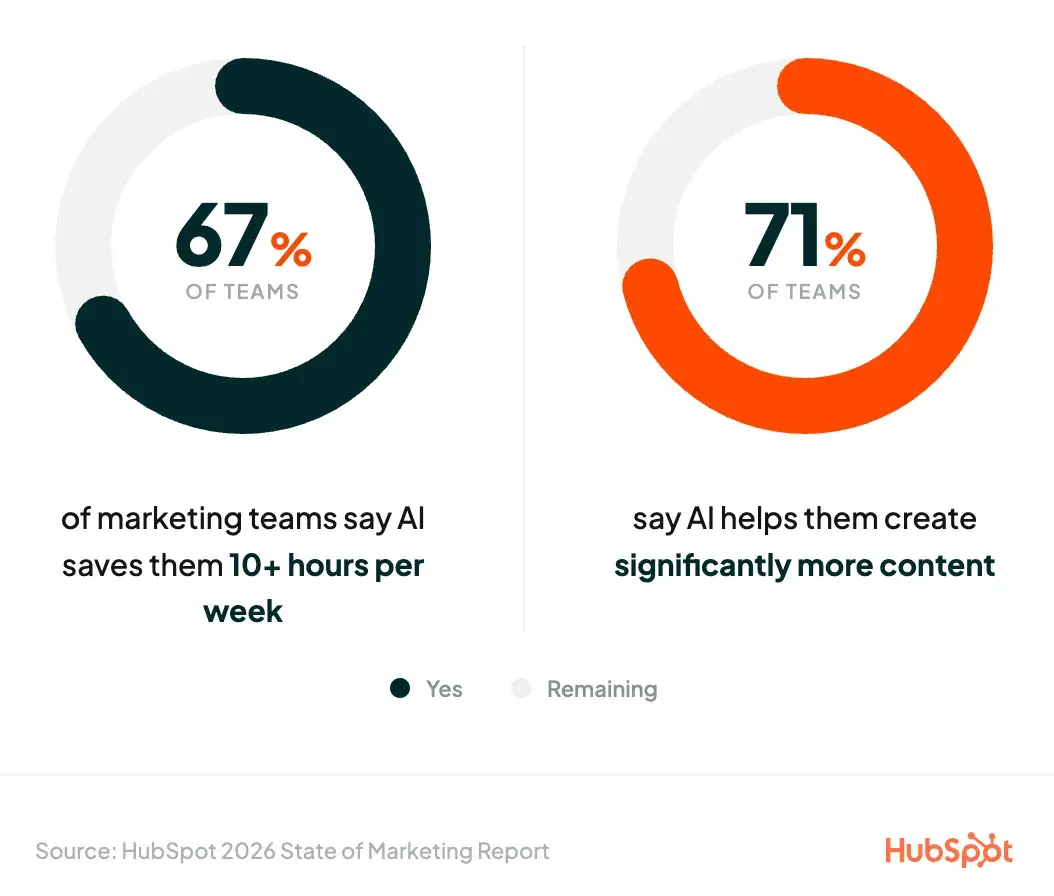
Take content marketing as an example: Small, strategic teams can use AI as a force multiplier, offloading the routine aspects of production so human editors can focus on narrative flow, brand voice, and accuracy. Accordingly HubSpot’s 2026 State of Marketing Report67% of marketing teams say AI saves them 10 or more hours per week, and 71% say AI helps them create significantly more content.
Because AI can handle much of a role’s day-to-day tasks, it frees up time for higher-level tasks: strategic thinking, creative problem solving, cross-functional leadership, and long-term planning. Performing basic tasks loses value. And if that doesn’t make you suffer from bottlenecks, managers will give you more challenging and visible tasks.
The use of AI is becoming the new basis.
A generation ago, using Excel was a unique selling point. Then it became the floor. The same shift is happening in AI, which means the window for progress is closing.
Currently, AI capabilities are still impressive. If you tell your manager that you used AI to cut a process in half or created a prompt that saves your team three hours a week, it will stand out (more on that later).
However, what gets you the approval of your manager today will sound like “I created a new macro in Excel” in a year or two. Useful but not remarkable.
When AI skills become a prerequisite, the advantage will be to the people who got into it early and built on it while everyone else was still figuring out where to start. You could even argue that it’s the baseline: HubSpot research found this 83% of marketers say they are expected to produce more than ever before because of the AI.
And most importantly for your career: AI will not replace you. But someone who uses it better might. Not a hypothetical robot or a faceless wave of automation. Someone in your industry, at your level, who decided to take this seriously before you.
Managers notice who is using AI (and who is not).
Gallup data from 2026 shows this 69% of executives and 55% of managers use AI at least a few times a year, compared to just 40% of ICs. Your manager probably uses AI more than you do, so he has a pretty good sense of what’s possible and whether you can keep up.
I’m not saying your boss is keeping secret who Claude asks the most. But if two people on the same team deliver similar work and one of them consistently does it faster and more thoroughly because they have integrated AI into their process, that will be noted. It influences who gets the next challenging assignment, who is included in strategy discussions, and who gets promoted.
Why is AI so difficult to adopt?
There’s a reason so many people get stuck between “I know I should use AI more” and actually implementing it. In fact, there are several well-documented reasons:
The gap between knowledge and action
We’ve all wanted to learn or try something new, only to find that months or years have passed without us actually doing anything about it. Just ask my bass guitar, which is collecting dust in my bedroom.
Researchers Jeffrey Pfeffer and Robert Sutton referred to this phenomenon as “Gap between knowledge and action“. Basically, knowing what to do and actually do it are almost entirely separate problems.
When applying the knowledge-action gap to AI, the research agrees: BCG has found that despite widespread AI implementation 74% of companies have not yet demonstrated concrete business benefits from using AI. It also found that 70% of the challenges companies face when implementing AI are due to people and process issues, compared to just 30% for technology issues and 10% for AI algorithms.
Part of the reason for the delay is simply practical. You already have a task to do. Your calendar is full, your to-do list is long, and the abstract goal of “figuring out how to use AI better” is competing with everything else on your mind.
When I asked Timothy Biondollo, prompt engineer and AI specialist at HubSpot Media, why so many people waver between awareness and acceptance, he didn’t sugarcoat it:
“Awareness is passive, and acceptance requires changing the way you actually work, not just adding a new tab to your browser. The gap is that most people still go about their day task by task, sequentially, and do the work themselves. Empowered people have made a completely different shift. They spend their time gathering context, writing instructions, and then executing ten parallel workflows in the background while focusing on strategy and quality. That’s no small adjustment. That’s a completely different one Operating model. Nobody tells you that’s the case.” The transition actually looks like that, so people try AI a few times, don’t feel the change and assume it’s not for them or that the AI isn’t smart enough to make it happen.”
Learning AI in addition to performing your existing tasks is a real challenge. Your brain has a ceiling for processing new information, and when that is exceeded (which it almost certainly has been, given the pace of AI in recent years), adoption drops sharply, even when motivation is high.
Too many options, not enough clarity
Let’s assume you take the time. What now?
There are thousands of AI tools on the market. The landscape changes monthly. New models and features are rolling out, and your LinkedIn feed is full of people telling you about the one tool that changed their life. You don’t know where to start, so you don’t start at all.
Even if you’ve never heard of it Paradox of choiceYou’ve probably already experienced it. The more options we have, the less we want to choose. So we freeze, or we make a worse decision than if we had fewer options.
This is exactly what is happening to anyone trying to build an AI habit. What is the chance that the tool you chose is actually the right one? Intimidating is an understatement.
The productivity trap
There’s also a cruel irony here that I don’t think gets mentioned as often as it should: if you don’t use AI consciously, it will create more work than it reduces.
Imagine a scenario where you want to use AI to summarize a data set as a memo. You export the sheet, put it in ChatGPT and great, within 30 seconds a memo comes back. But now you review the output, notice inaccuracies, ask again because something isn’t right, check claims you’re unsure about, and reformat the whole thing to get the tone right. When you’re done, AI no longer feels like an enabler; it feels like a bottleneck.
This is a big reason why AI adoption is stalling. People try it, get a general answer, and think is that it? They come to the conclusion that the continued effort is not worth it and return to the old way. But the problem is the approach, not the tool. If you use AI well, you need to know where you’re really saving time and where you’re just shifting work away. This distinction takes practice and is what separates someone who is AI aware from someone who is AI capable.
What does AI activation look like?
We know why enabling and adopting AI is important. In making the leap from knowledge to practice, so many of us fail, and it’s not because we don’t try.
Next, I’ll outline the strategies that worked for my content team and me. These are practical, step-by-step steps that put AI fear into action.
Recognize that you are not behind (yet).
Searching for “latest AI technology” is a good way to immediately close your laptop and say goodbye for the day.
There’s a pressure in AI that comes from the constant stream of influencers, product announcements, think pieces, and even colleagues telling you how they’re getting on.
But this noise is mainly to get your attention and market you. It’s one of the oldest tricks in the book: You go back. You can’t fall back. Subscribe to my newsletter so you don’t fall behind. This message appeals to our primal desire to be in the in-group. It’s basically caveman logic.
Some reality for you: According to Gallup 49% of U.S. workers say they never use AI in their roleand only 26% use it a few times a week or more. Let that sink in. In the country where most large AI companies are based, only about a quarter of workers frequently use AI.
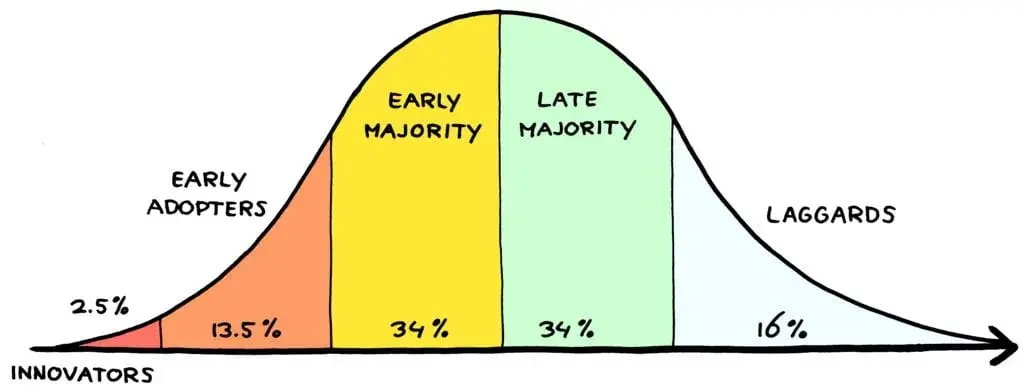
I would like to introduce another concept to put things in perspective: the diffusion of innovation theory. The Diffusion of Innovation theory was first shared by E. M. Rodgers in 1962 (and is still relevant today). She divided the entire target group of a technology into five groups: innovators, early adopters, early majority, late majority and laggards.
These groups adopt each new technology in this order. Adoption starts with the innovators (think tech enthusiasts, influencers, people first in line for the latest phone) and ends with the laggards (those still using landlines). As you can see from the chart below, most people fall somewhere in the middle:
So where are we on this timeline with generative AI?
It’s a subjective assessment, but given the data we have so far, I’d bet we’ve just reached the early majority. In other words, while AI as a concept has been in the public eye for some time, AI literacy is just beginning to reach the mainstream. All the people you hear raving about AI and its possibilities are the first 15%, the innovators and early adopters. And they are much louder than the others.
What does this mean for you? If you’re new to using AI, you’re still in a good place. But don’t hesitate either, because the early majority is your last chance to move forward.
That’s not to say that being a beginner at anything is easy – especially not. But a lot of that discomfort comes from believing everyone is ahead of you. That is not the case yet.
Start small.
Like any skill, AI competency is a muscle that is built over time through repeated use. You won’t get stronger by reading about weightlifting. At some point you have to reach for the dumbbells.
That doesn’t mean you have to hire an agent to summarize all your emails, clean up your spreadsheets, manage your schedule, and do your taxes the first time. Be a beginner, look for small successes, and just like training, you will see the benefits faster than you think.
The first thing I ever did with AI was to use it to help me suggest rewordings to my internal Slack messages when I felt my tone was off. Basic things, but I immediately realized that this was more efficient than thinking about the perfect way to phrase something. I have seen the benefit with relatively small investments.
Over time, I got used to using Claude to help me code internal tools for my team, create memos from datasets, and plan my weekly tasks. It’s hard for me to find something that I don’t use AI for in my everyday life.
Applying AI solutions to your own problems and seeing the real-world benefits is a powerful motivator. You use it on something concrete and it just clicks. You’ll think, “Oh, I can use it for this…what else can it do?” Your curiosity becomes the engine that builds the habit.
Additionally, integrating AI into your existing work (rather than as a separate experiment or activity) removes the hurdle of trying it once, getting dubious results, and reverting to the way you already work. They see the benefits firsthand and are therefore more likely to overcome the initial friction. The benefits of AI outweigh the temporary inconveniences.
Amy Rigby, author of the HubSpot blog, has mastered this firsthand: “The hardest thing about incorporating AI into workflows is also the hardest thing about any attempt to increase efficiency: It will be completely inefficient at first. You will stumble over how it works, experiment and fail because it is all new to you…You have to persevere past the learning curve to unlock that value. It’s a great feeling once you get it done have.”
Learn how to prompt.
AI Prompt is the most useful skill you can learn when starting out. A good prompt is the difference between a generic answer and one that actually helps.
When I asked Meg Prater, Head of Content Strategy & Operations at HubSpot Media, why there is a gap between AI awareness and actual adoption, she said, “You’re not using the right prompts. Once you learn how to prompt better, your results make it impossible not to use AI to improve your work and free up more time for the work that matters.”
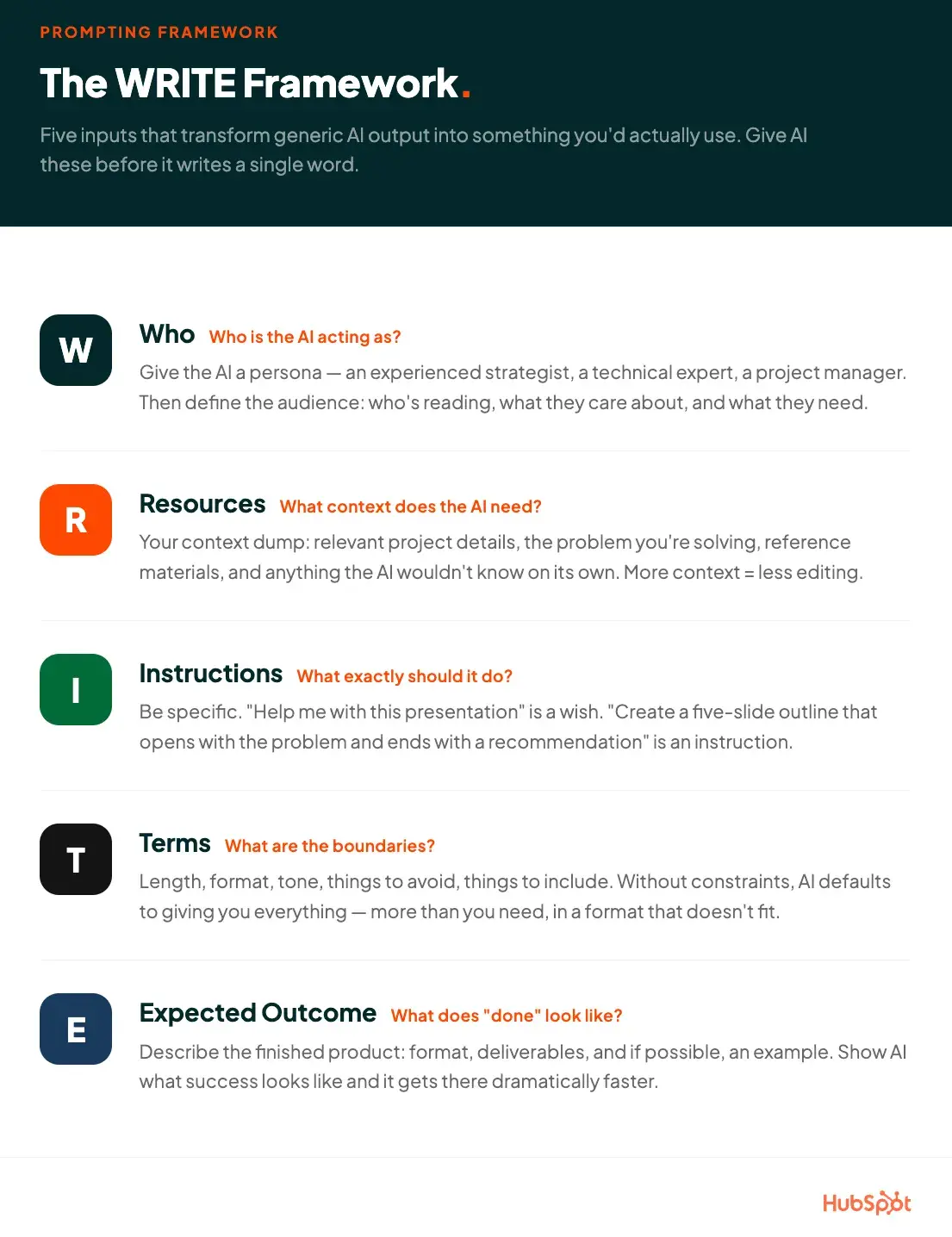
It’s okay to experiment with different prompts at first, but eventually you’ll want a framework for better-led conversations. I encourage writers on my team to use the WRITE framework – it provides the AI with five key pieces of information for the query:
- WHO: Who does the AI act as? Give the AI a persona, such as an experienced strategist, a technical expert, a project manager, etc.
- Resources: What background does the AI need to do this correctly? This is your context dump: relevant details about the project, the problem you’re solving, reference materials, and anything else the AI wouldn’t know on its own.
- Instructions: What exactly is the AI supposed to do? Be specific.
- Conditions: What rules, limits or boundaries apply? For example, length, format, tone, things to avoid and things to include.
- Expected result: Describe the finished product as specifically as possible: the format, the deliverables and, if possible, an example.
Here is an example of a WRITE prompt:
W: You are a small business marketing consultant specializing in DTC product launches. My target audience is women ages 25-40 who purchase handmade candles as gifts and for self-care, primarily through my Etsy shop and Instagram.
R: I’m launching a summer candle collection in June. My budget to start is around $500. My best sales channel is Instagram and I have around 3,000 followers. My last collection sold out in two weeks, mostly via Instagram Stories and email.
I: Create a four-week launch plan for me that includes teaser content, launch day strategy, and post-launch follow-up. Specify what you want to publish, when you want to publish it, and provide an email for each stage.
T: Keep the plan realistic for a one-man operation. No paid ads. Only organically and via email. The tone should be warm and personal, not corporate.
E: A weekly calendar that I can follow with specific content ideas for each day, three short email drafts, and a launch day checklist.
Run this command prompt next to a non-framework command prompt and you will see the difference. If you are actually a candle maker, you will smell it too.
Create a timeline for AI goals.
Once you’ve tinkered around a bit and have a feel for where AI can help you, the next step is to keep the momentum going.
Easier said than done. Remember the gap between knowledge and action? Research shows that strong goal intention alone is not enough.
But, People who create plans that detail how they will work toward a goal are more likely to actually follow through. The thought “I want to use AI better” is less effective than “Every Tuesday morning I spend 20 minutes applying AI to a task on my plate.”
Here’s why I recommend the following: Plan a weekly schedule for AI victories. These are tasks that you can reasonably complete in a week. It doesn’t have to be big jumps. Instead, think of them as incremental progress toward a larger goal, small enough to actually achieve but significant enough to move the needle.
A structured schedule does two things. First, it turns the intention into a habit and provides the scaffolding so you can get back to it every time without a heroic act of willpower. Second, it distills the endless possibilities of AI into practical steps tailored specifically to your work. It’s an antidote to options paralysis.
Let’s say you want to use AI to improve the efficiency and follow-up of your meetings. This is what a schedule might look like in practice:
Main goal: Use AI to reduce the time spent on status updates and meeting preparations next month.
- Week 1: Select your most recurring meeting. Use AI to create an agenda template from your notes.
- Week 2: After the meeting, use AI to draft the follow-up summary. Check if this took less time than usual.
- Week 3: Create a prompt for weekly status updates using bullet points you already keep.
- Week 4: Combine all three into a simple, repeatable workflow. Do it in multiple meetings over a week.
- Week 5: Check your system. What works? What isn’t it? What’s next? Set goals for the following month.
Nothing here is a jump. Each week builds on the last and by the fifth week you have a documented system.
You can track your progress however it works for you: a note-taking app like Notion, a task management tool like Asana, a running document, or sticky notes if that’s how you work. Consistency is more important than format.
And (you may have already predicted it): AI can even help you create the schedule yourself. Explain your role and responsibilities to them and ask them to help you brainstorm where you could realistically use AI in your workflow. Set a main SMART goal to work towards over the next four to six weeks, then use AI to design the sub-steps to achieve that goal.
Make your progress visible.
If your company is AI-focused, your manager probably wants to know what you’re up to. How visible your AI progress is to them is as important to your career as the work itself.
This is especially true if your performance is focused on AI adoption. When you regularly share with your manager how you’re using AI and update them on new use cases or efficiencies, you’re signaling that you’re forward-thinking. This could look like a Slack message, an item in your weekly update, or a mention in your one-on-one conversations. Even small successes give the impression that you are indispensable.
However, visibility is easier said than done: Once you get into the weeds with AI, it’s easy to get so caught up that you forget to share your progress. Sometimes I get so invested in a project that I forget to let my boss know how my use of AI has actually improved my performance.
One solution: Set up a recurring calendar reminder for a Manager AI update. Then copy your rollout plan (or whatever you use to track your AI progress), paste it into the AI tool of your choice and ask for a summary of your weekly progress. Bam, something you can share with your boss with almost no extra work.
This is why using a task management tool like Asana to track your work can be helpful. You can export your completed tasks to a spreadsheet, pass them to an AI tool, and ask it to retrieve recent achievements. Progress tracking is built in and is much easier than keeping a separate Google Spreadsheet that you have to update every time you do something.
I also encourage you to link your use of AI to how it advances your work. Tell a story: How you got better at it and how it made your work better and how that impacted the team’s KPIs. Ultimately, it’s about advancing your career.
Another note: Visibility among like-minded people is also important. Managers are important, but so is being the person your teammates turn to when they have a question about AI. This informal expert status increases the pressure on your own development.
Timothy had some helpful insights here: “The trick is to share the how, not the wow. Not ‘Look what I built,’ but ‘Here’s how I built it, maybe this will help you.” Once it becomes useful to someone else in the room, it stops being a show-off and becomes a way to unlock abilities for the entire team.”
Keep an information loop going.
You do the work, you show the work, now make sure you stay sharp. My final advice is to continue your education and stay up to date with progress as you put your knowledge into practice.
As Meg puts it, “Someone who is AI-ready is someone who is AI-curious. You should experiment with it, practice with it, and try new tools/builds. It’s not enough to run the same three prompts (although that’s a good start). Being AI-ready today means using and evolving those tools and models as they’re released.”
The key is to maintain an information loop that is loose enough so that you don’t become overwhelmed. You want a flow that is comprehensive enough to keep you current, but not so much that you want to crawl into a hole.
Limit yourself to four or five AI information channels at the same time. This could be a newsletter or blog, a YouTube channel, an internal community, a mentor, a podcast, a LinkedIn account, or even an AI counterpart, someone in a similar role who is also experimenting.
And to make this all sustainable: every time you add a new channel, think about deleting one.
My channels at the moment are:
- Simple.ai: a newsletter that presents AI news and updates in a down-to-earth and down-to-earth manner. If you want a newsletter about AI without being overwhelming, then this is for you.
- Ben’s bites: a Substack that’s a little more ambitious in scope but still digestible.
- An internal AI Slack channel we have at HubSpot to share AI progress relevant to marketing.
- An AI mentor.
- My team, with whom I regularly discuss on our blog how best to use AI.
And that’s just for now. This may change in the future as my comfort level and responsibilities change.
How teams can move from AI experimentation to implementation
Everything above is about empowering yourself. And with ICs, you can stop here. However, when you’re leading a team, moving from “We’re trying this out” to “This is part of how we work today” is a different challenge.
Promoting acceptance in a team is not a given. You can’t present information to someone and expect them to immediately apply it. Not everyone will be as willing to learn or as comfortable as you. This is not a blow to them; People have different relationships with new technologies, and you may have a number of early adopters, early/late majority, and perhaps even innovators or laggards on your side.
People generally trust other people when they are getting used to something new. I bet that’s one of the reasons you sought advice from a blog post I wrote, a certified real personinstead of just asking ChatGPT or Claude. There’s something about hearing, “This worked for me” from another human that no chatbot can fully replicate.
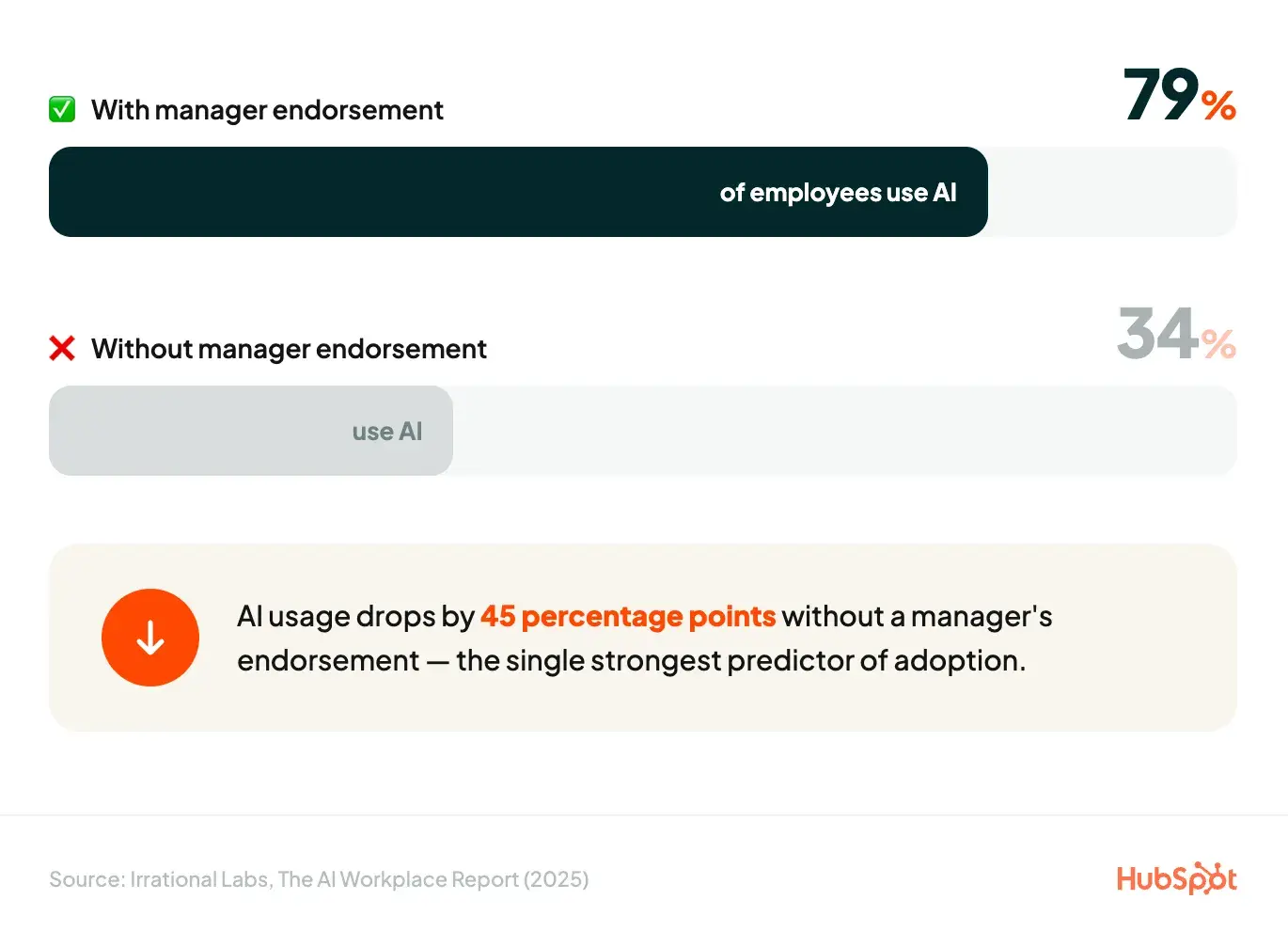
According to Irrational Labs, leadership support is also one of the strongest predictors of whether someone will use AI at work. Without supervisor approval, employee AI usage drops from 79% to 34%.
So meet your team where they are. Ask them how they use AI. Not in a micromanaging, “show me your inspiring story” kind of way, but from a place of genuine curiosity. What is holding them back? Based on what you find, suggest some of the strategies I’ve shared here.
Through one-on-one conversations with my team, I learned more than any help article or training deck could have taught me. Everyone’s AI enablement journey is their own, and the best thing you can do as a manager is to encourage them while giving them space to explore.
Where Futurepedia fits into AI enablement
This entire post has been about one idea: knowing about AI is not the same as being empowered by it. And the biggest obstacles aren’t problems you can solve by reading another article or bookmarking another tool.
That’s why HubSpot acquired Futurepedia.
Futurepedia is the world’s largest independent AI education and discovery platform. It operates the first AI tool directory – Thousands of curated tools in every category imaginable – alongside a growing educational platform Over 25 courses and more than 1,000 lessons The focus is on real-world AI capabilities for business and productivity.
Across Futurepedia, its YouTube channels, and its newsletter, it has become the standard destination for professionals who want to actually learn how to use AI, not just hear about it.
HubSpot helps millions of businesses grow better. Futurepedia helps professionals find and master the AI tools that improve their work. Now they’re the same team, which means more resources, greater reach, and the same obsession with making AI useful for real people.
The professionals who will win in the next five years are not the ones who know the most about AI. They are the ones who have actually learned to deal with it. If this post has given you the framework, Futurepedia offers you the starting point.