
You ask ChatGPT to do something and suddenly your brand name appears in the response. Sounds like a win, right? But before you share the screenshot with your team, you need to ask yourself an important question: is your brand being quoted or mentioned?
As AI search and LLM-driven discovery continue to grow, understanding the difference between AI brand mentions and AI citations will become increasingly important for SEO and brand visibility. In this article, we explain what AI trademark mentions are, how they work, and how they differ from citations.
Since we know you’re excited to celebrate your AI visibility victory, let’s get started.
Key insights
- AI brand mentions occur when an AI tool references your brand in answers while citations back up the information with sources
- Understanding the difference between mentions and citations is crucial for SEO and brand visibility
- To improve AI mentions, create clear, structured, and extractable content that directly answers user queries
- Brands need to build authority through trusted mentions across platforms to improve visibility and adoption through AI systems
- Both mentions and citations are crucial; Mentions help the AI recognize your relevance, while citations build your credibility
What is AI Brand Mention?
An AI brand mention occurs when an AI tool references your brand name in a generated answer, recommendation, comparison, or summary. The brand mentions can be either linked (also called explicit mention) or unlinked (also called implicit mention).
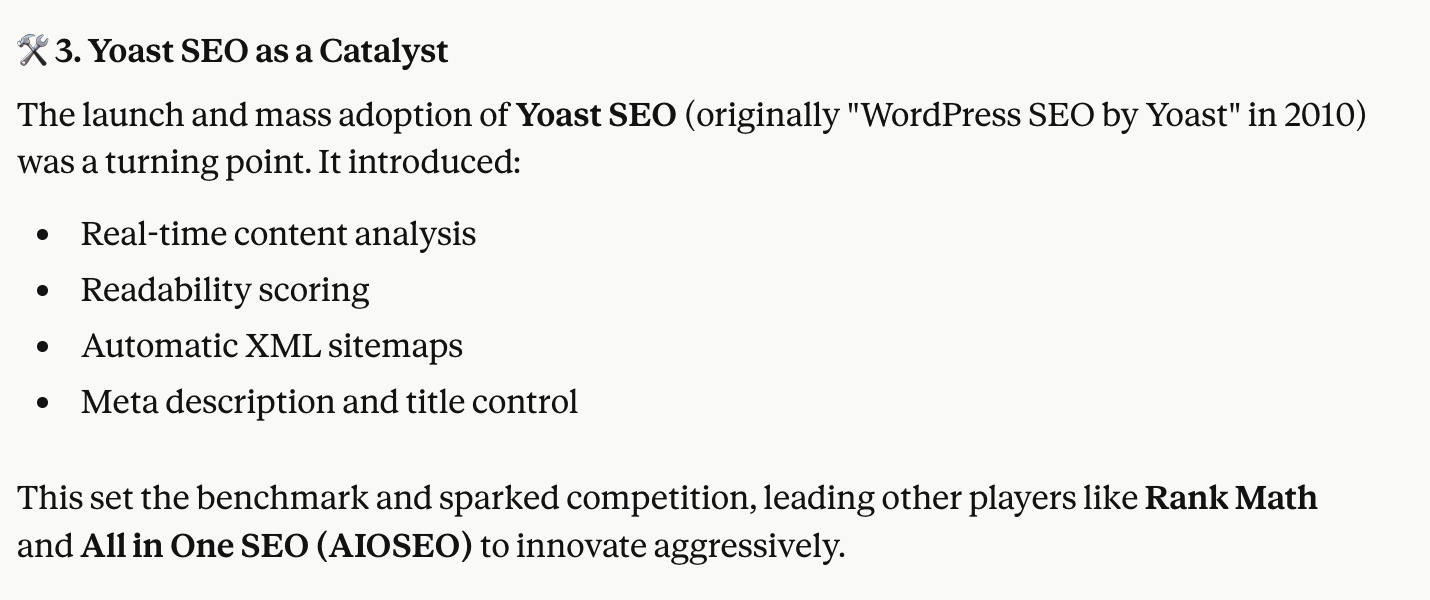
Here is an example of ChatGPT’s answer to the question “What are some of the best WordPress SEO plugins?”
AI can mention brands in different conversation contexts depending on the user’s request and intent. Here are some of the most common ways AI-generated responses include brand mentions:
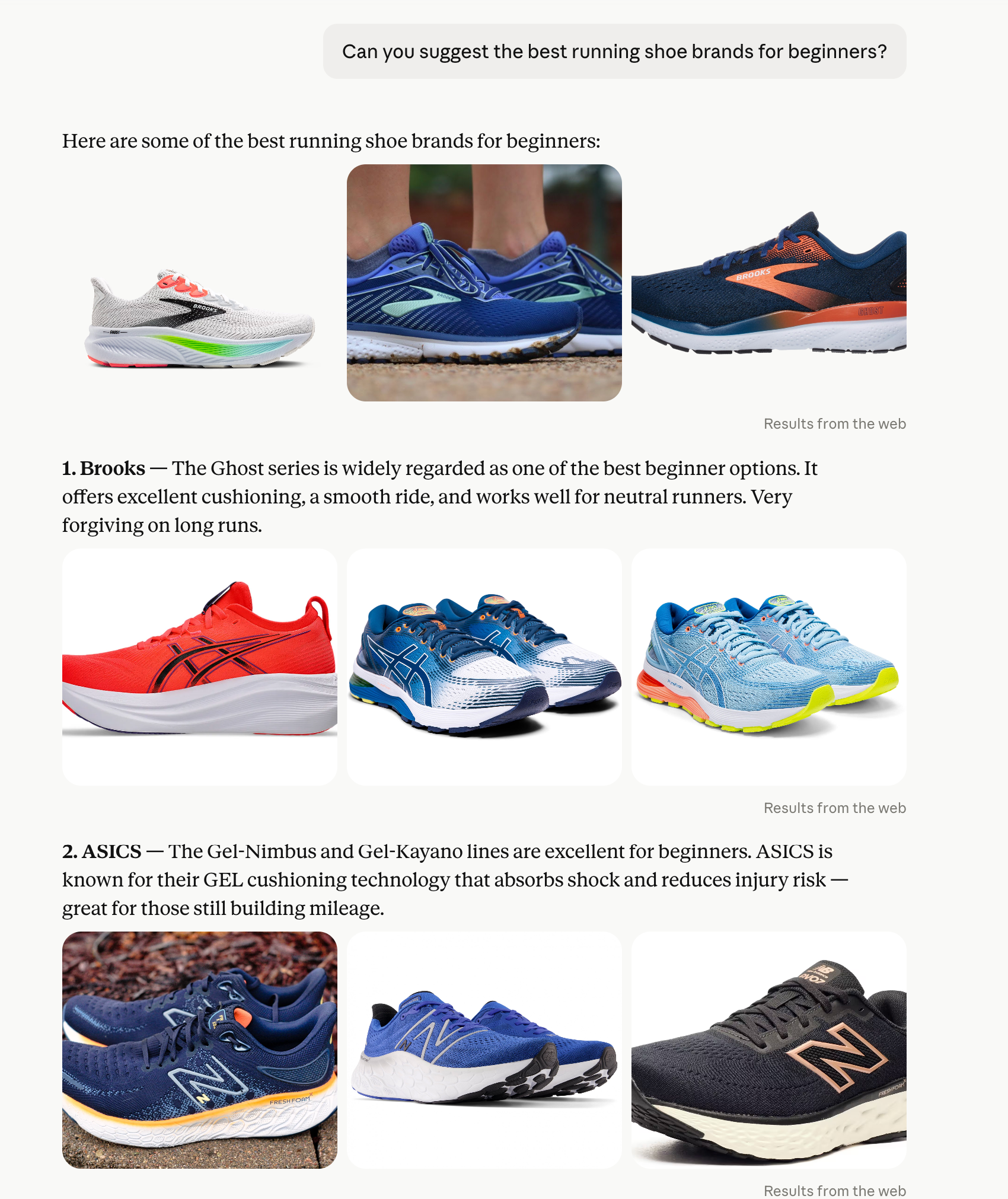
Direct recommendations
This happens when AI directly suggests a brand, product or service as a possible solution to the user’s query. For example, these mentions typically appear in recommendation-style prompts where users are actively searching for options or tools.
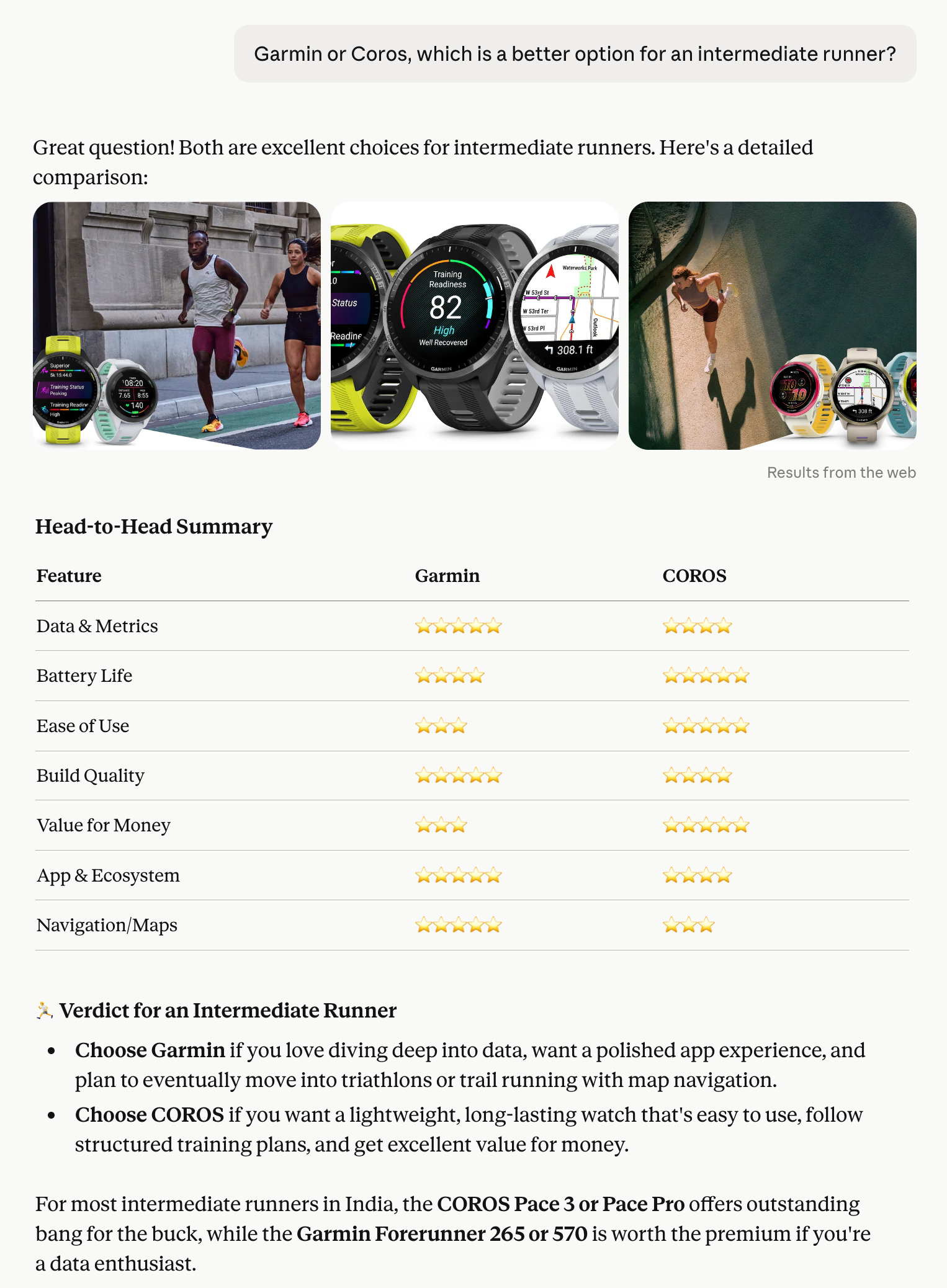
Comparisons
AI may mention brands when comparing products, services, features, prices, or use cases. In such cases, the brand becomes part of a broader assessment or decision-making discussion.
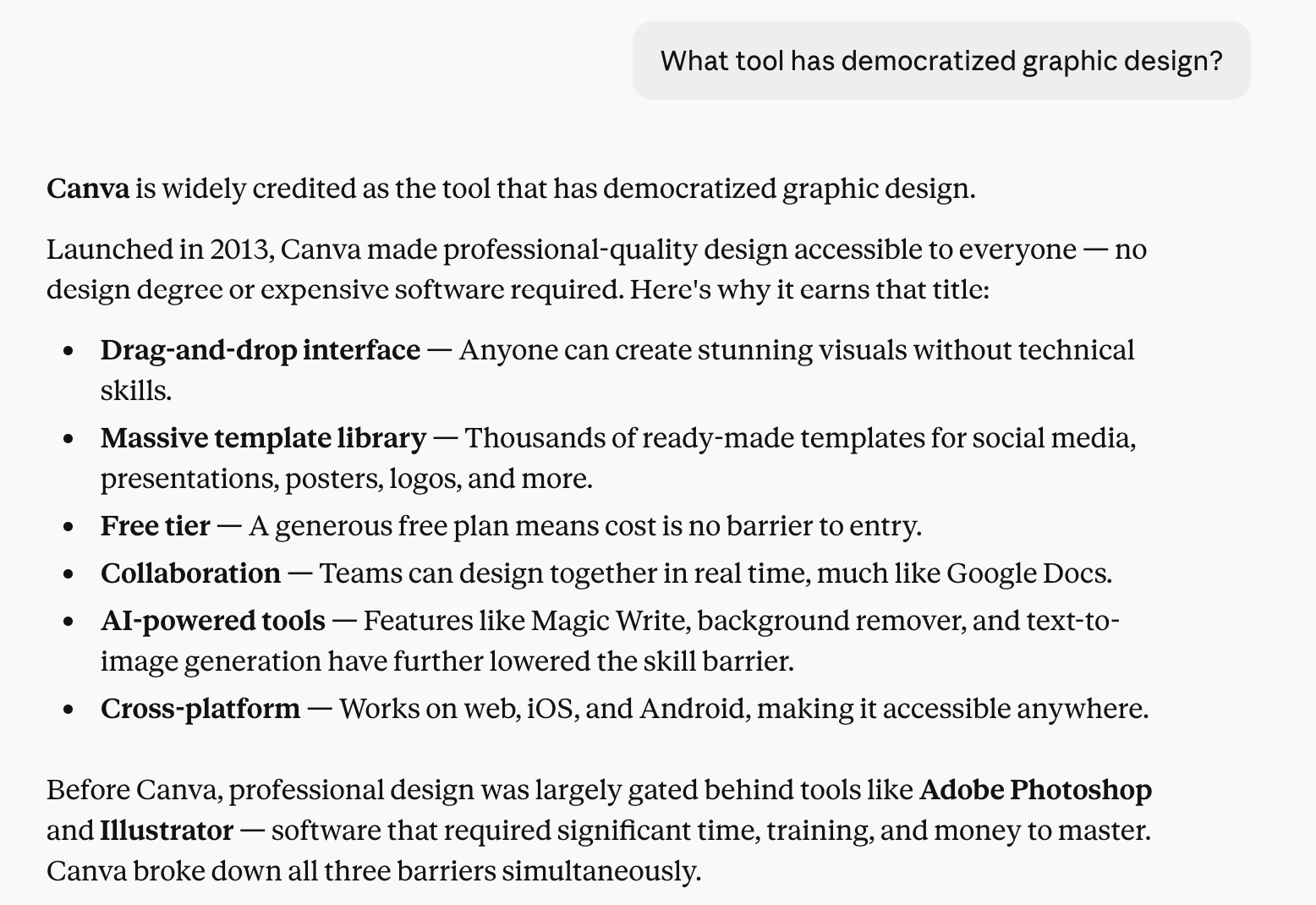
Examples within the answers
Sometimes AI uses brands as examples to explain concepts, trends, workflows, or industry practices. These mentions help provide context and make the explanation more understandable for users.
Contextual references
Of course, brands can also appear in broader discussions about a topic or industry. These mentions are less about advertising and more about establishing thematic relevance within the conversation.
How do LLMs decide what to mention?
Large language models do not “choose” brands the way a human would. They generate answers based on patterns, probabilities and signals they have learned over time. When a brand appears in an AI response, it’s usually because several underlying factors align.
Must Read: Go beyond CTR with 6 AI-powered SEO discoverability metrics
The following characterizes these mentions:
1. Training data patterns
LLMs learn from huge data sets that show how often certain brands appear next to certain topics.
When people repeatedly discuss a brand in the context of a specific use case, the model develops a strong association. Over time, this increases the likelihood that the brand will appear in responses to similar queries.
But it’s not just the frequency. Context is just as important.
- What topics is the brand associated with?
- What problems does it seem to solve?
- What other terms pop up around it?
Brands that appear in multiple contexts build deeper and more flexible associations. Those with limited or inconsistent mentions have difficulty surfacing.
2. Retrieval Augmented Generation (RAG)
Many modern AI systems augment their training data using Retrieval-Augmented Generation (RAG). Things are becoming more dynamic here and many brands are either gaining visibility or disappearing completely.
Basically, the following changes:
- Without RAGthe model only responds with what it learned during training
- With RAGThe system first retrieves relevant information from external or live sources and then passes both the user query and the retrieved content to the model
The model then combines this new information with its existing knowledge to generate a more accurate and timely answer.
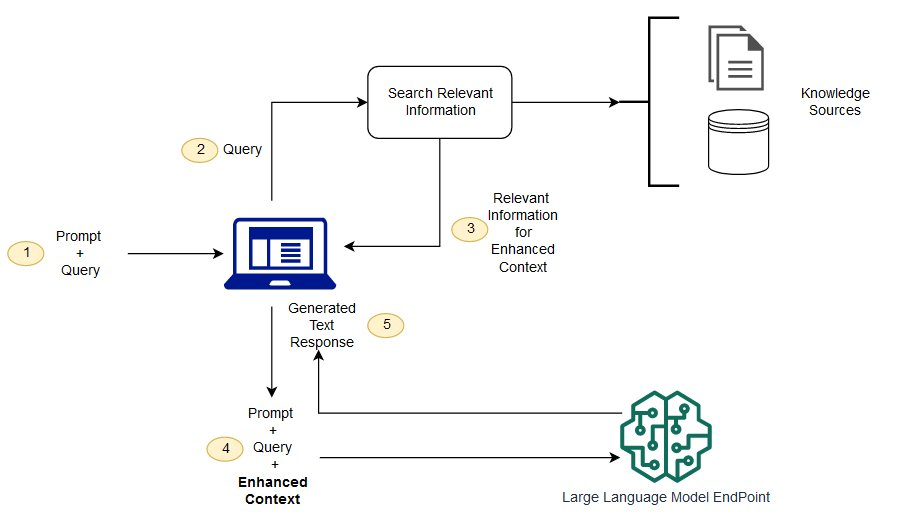
When a user makes a request, the retrieval system acts as a gatekeeper. It searches indexed sources such as web pages, documentation, articles and forums to find content that best matches the search query.
3. Context and semantic understanding
LLMs do not rely on exact keyword matches. They interpret intent. When someone asks a question, the model maps them to broader concepts and then highlights brands that match those meanings.
For example, a query about “remote team tools” might connect to:
- Cooperation
- Asynchronous work
- Team communication
- Workflow management
With LLMs, brands are more likely to emerge that consistently associate with these ideas, even if users don’t use the exact phrase. This is where entity clarity becomes crucial. If your brand is described differently in different sources, the model will have difficulty understanding what you actually do.
Overall, it’s not just what you say that matters, but also how your content relates to related topics. Therefore, linking your brand to relevant concepts, use cases, and terminology helps AI systems understand when your brand is relevant. This is where it helps to semantically link entities to your content so that these relationships are clearer and easier for models to capture.
4. Authority and cross-source validation
LLMs do not rely on a single source. They validate information by comparing patterns from multiple sources and weighing the trustworthiness of those sources. If a claim appears consistent across many independent platforms, the model is safer to include it. If it only appears in a few places, trust decreases.
AI systems combine semantic understanding with retrieval signals to assess which sources to trust. These typically include:
- Source credibility: Well-known publications, academic content, government sites and recognized organizations are prioritized
- Citation pattern: Sources frequently referenced by others are considered more authoritative
- Novelty: More up-to-date information is often given higher weight, especially on rapidly changing topics
- Transparency: Content with clear authorship, dates and references is considered more reliable
Authority in AI is about being consistently referenced in credible, independent sources. This is why PR, earned media, and third-party mentions play a larger role in AI visibility than traditional SEO.
5. Relevance to the query
Above all else, the model evaluates fit. Even high authority or frequently mentioned brands will not appear if they do not clearly match the user’s intent, e.g. B. the use case, the target group or the problem to be solved.
Simply put, if your brand isn’t a compelling answer to the query, it won’t be included.
When a brand appears in responses, AI models can include the following nuances:
- Beginners vs. advanced
- Budget vs. Premium Solutions
- Niche vs. general use cases
Modern AI systems have shifted from traditional keyword matching to query understanding. They use Natural Language Processing (NLP) to understand the “why” behind text strings. If you explain it technically, Gen AI converts text queries (prompts) into vectors that allow it to find semantic similarities and return relevant answers.
6. Mood and Human Feedback (RLHF)
LLMs do not rely solely on training data or web sources. They are continually improved through human feedback, a process known as Reinforcement learning from human feedback (RLHF).
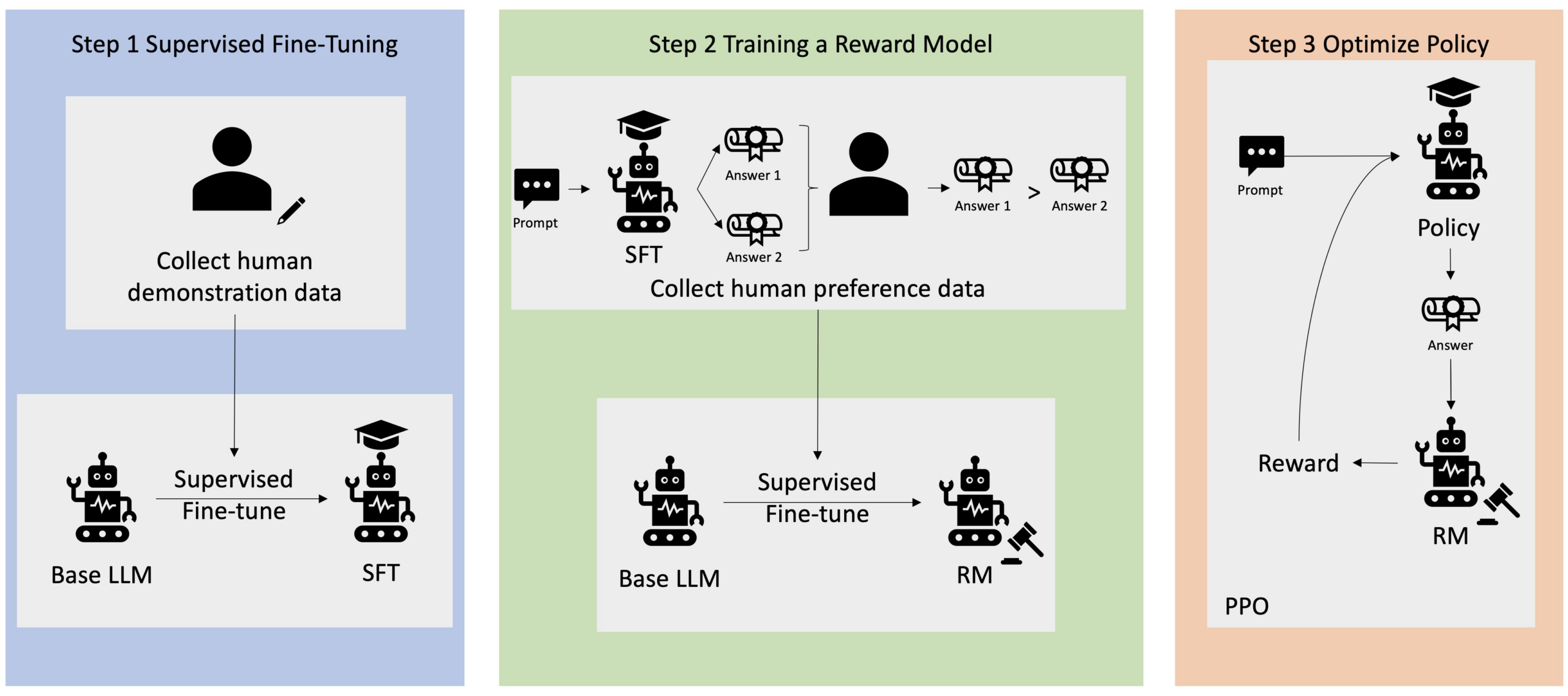
In this process, human raters review the model answers and base them on whether the answers:
- Helpful
- Exactly
- secure
- Trustworthy
How does this affect brand mentions? If a brand is consistently associated with negative sentiment, the model may learn to avoid or prioritize it. On the other hand, brands that appear in neutral or positive contexts across sources are more likely to be taken into account.
In this way, RLHF acts as a layer that refines raw data signals and better aligns brand mentions with quality, trust and user expectations.
Tips to get more mentions
Mentioning your brand in AI responses is not an entirely new discipline. It overlaps a lot with what many today call LLM SEO. If you’ve already worked on visibility, authority, and content quality, you’re on the right track.
Here are some practical ways to improve your chances of being mentioned:
Create content that is easy for AI systems to understand and reuse. This means clear definitions, structured explanations and direct answers instead of long, vague introductions.
For example, a well-structured guide that clearly defines “What is customer data management” with concise sections is far more likely to be picked up than a generic blog post that hides the answer halfway.
Answer evaluative questions
AI assistants often answer questions like “Best tools for X” or “Which platform should I choose?” When your content directly addresses these comparisons, you increase your chances of being included.
Like a comparison site, for example Yoast vs Rank Math, that explains when your product is better than alternatives and gives the model clear context to recommend you.
Strengthen authority signals
Mentions in trusted, independent sources significantly improve your visibility. This includes being featured in industry publications, contributing expert insights, or receiving mentions in reviews and comparisons.
For example, a brand that is mentioned in multiple reputable blogs and reports is more likely to be featured than a brand that only publishes content on its own website.
Keep the cornerstone pages current
Freshness plays a key role, especially when it comes to topics that are evolving quickly. Regularly updating the content of your most important pages signals that your information is reliable and up-to-date. For example, a “best tools” page that is updated with current data every few months is more likely to be viewed than a page that hasn’t been touched in years.
Expand entity clarity
Your brand should be described consistently across your website and external platforms. This helps AI systems clearly understand what you do and when you need to be mentioned. For example, if your product is always positioned as “project management software for remote teams,” this repeated clarity strengthens your association with that use case.
AI brand mentions vs. AI citations
Before I share the comparison, I would like to give you a quick overview of quotes. AI citations are references that incorporate AI systems and search engines to support the answers they generate.
Citations typically point to a specific source, such as a website, report, or article, and identify the source of the information. In many cases, an answer can contain a brand mention and a quote at the same time.
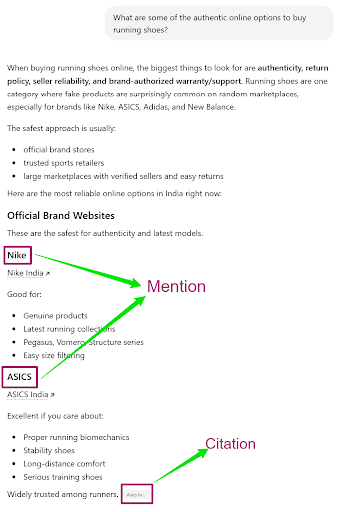
Next, let’s see how they differ.
| aspect | Mention of the AI brand | AI quote |
| definition | Your brand name appears in the AI-generated response | AI associates information with your content, often with a link or reference |
| format | Of course mentioned in the text, no link required | URL, footnote or inline reference |
| What it signals | Brand awareness and category relevance | Authority, credibility and trustworthiness |
| Effects | Builds mindshare and keeps you top of mind | Serves as proof of expertise and can increase traffic |
| Traffic potential | Indirectly, through increased brand recall | Directly, through clickable or attributed sources |
| frequency | Common in most AI responses | Less common and more competitive |
| Where it appears | In most LLMs, even without live web access | More common in systems with on-demand or web access |
| How to optimize | PR, earned media, third party mentions, community exposure | Create cite-worthy content, structured data, and original research |
| Example | “X is a popular CRM software” | “According to The Yoast Perspective 2026 report…” |
Some takeaways
- Mentions get you into the conversation. Quotes make you the source.
- Mentions familiarize the AI with your brand. Quotes make the AI willing to vouch for it.
In short, the most effective strategy is to optimize for both.
Are quotes still important?
Yes, quotes are still important, but they are no longer a standalone strategy.
AI systems still use quotes as supporting signals to validate information, confirm credibility, and discover trustworthy sources. When multiple reputable websites link to the same brand or source, it increases trust and helps AI systems verify the reliability of the information.
While both mentions and citations are important, mentions currently carry more weight for relevance and AI visibility. Citations still help build authority and trust, but mentions give AI systems broader contextual signals about where a brand fits, how often it appears in conversations, and why it is important within a topic.
How do you achieve both citations and mentions?
Brands that regularly appear in relevant conversations while publishing credible content are more likely to receive both mentions and citations. Here are some simple strategies you can follow:
Create noteworthy content
The easiest way to get both mentions and citations is to post content that people naturally want to relate to. This includes thought leadership, original research, unique insights, industry commentary and practical resources that deliver real value. When your content adds something new to the conversation, it becomes easier for journalists, creators, communities, and AI systems to pick it up.
Focus on contextual brand mentions
AI systems pay attention to how and where your brand is being talked about. Mentions in community discussions, industry blogs, PR coverage, podcasts, forums, and trend-based conversations help reinforce your relevance within a topic. The goal is not just visibility, but also to regularly appear in meaningful, context-rich discussions.
Build credibility for quotes
If you want more citations, credibility is crucial. AI systems are more likely to point to content that demonstrates strong expertise and trustworthiness. This is where principles like EEAT (Experience, Expertise, Authority and Trustworthiness) become important.
AI Brand Mentions vs. Citations: FAQs
While mentions help AI systems recognize your brand and associate it with specific topics, citations build trust and authority by validating your content as a reliable source.
The reality is that both work together. Brands that regularly appear in relevant conversations while publishing credible, high-quality content are far more likely to strengthen their AI visibility over time.
Here are some frequently asked questions about AI brand mentions and citations:
Not quite. Backlinks are traditional SEO links that point from one website to another, primarily to help search engines understand authority and ranking signals. AI citations, on the other hand, are references that AI systems use to support or validate the answers they generate. While citations can contain links, their primary purpose is to provide attribution and trustworthiness, not to pass on ranking values. For a deeper understanding, read AI Citations vs. Backlinks.
Not always. A brand can be mentioned in an AI response without being directly credited as a source. This typically happens because AI systems often recognize brands based on repeated contextual mentions online, even if they don’t use that brand’s content as the primary supporting source for the response.
Mentions and citations support various aspects of AI visibility. Mentions help AI systems understand where your brand fits into a topic, while citations build authority and trust.
Manually tracking AI visibility across platforms can quickly become difficult. Tools like Yoast SEO AI+ help brands monitor how they appear in AI-driven search experiences. With AI Brand Insights, you can track mentions, citations, and overall brand presence across all AI platforms to better understand where your visibility is increasing and where there are opportunities to improve your AI brand visibility using Yoast AI Brand Insights.
