
Generative AI is changing the way people discover brands, products and information. As it disrupts the buyer journey, new metrics, particularly GEO KPIs, are needed that accurately reflect the performance of these AI engines.
With Google AI overviews appearing in over 20% of searchesMarketing leaders are now being asked new questions by executives: Do we show up in AI answers? Will we be quoted? Or do AI engines recommend our competitors?

As search behavior changes, traditional SEO KPIs alone can no longer explain visibility or downstream revenue impact.
This guide breaks down the GEO KPIs that really matter, how to measure GEO success, and how to link AI visibility to business results using tools marketing teams already trust, including HubSpot AEO.
Why GEO KPIs matter now
As generative AI becomes a primary decision-making layer in the buyer journey, generative search engine optimization (GEO) KPIs will become key performance indicators. Accordingly OpenAINearly half of all ChatGPT usage falls into the “Questions” category, where users rely on AI for advice, reviews, and guidance rather than simple task execution.
For many users – 61% Of these, these “requests” are product recommendations. This means that brand preference is influenced by AI-generated responses, often before a potential customer visits a website.
Traditional marketing KPIs don’t capture this level of visibility. Without understanding where and how often a brand appears in AI responses, it can be difficult to develop a strategy to regain or maintain that influence.
In my experience, maintaining transparency within AI response engines is fragile without a conscious GEO strategy. After a targeted content refresh on my own website, I saw my content appear ahead of mainstream industry publishers in the form of AI-generated answers 96 hours – without a corresponding jump in traditional search rankings.
If I had only tracked SEO metrics, I would have completely missed this change. GEO KPIs exist to pinpoint these changes before they result in loss of authority or, worse, impact on downstream revenue.
KPIs to track for generative engine optimization
The following metrics reflect real-world AI search behavior and provide teams a clearer and more honest way to evaluate how their brands appear in AI-generated answers. Key metrics for measuring GEO success include AI citation frequency, reply inclusion rate, entity authority signals, AI referral traffic, AI share of voice, and AI-driven leads.
To understand which GEO KPIs and metrics actually hold up, I spoke to Kristina FrunzeFounder of WebView SEOin a recorded interview for the Found in AI Podcast.
1. AI citation frequency
AI citation frequency tracks how often a brand is mentioned directly in AI-generated answers in large language models (LLMs). Direct brand mentions are the most reliable signal that an AI engine recognizes and remembers a brand.
What the experts say: Frunze told me: “For AI citations, direct brand mentions are the best way to track them at the moment. The tools are evolving and are not 100% accurate, but we can rely on that for now.”
Here’s how I use the metric: I use citation count as a basic trust signal. If a brand is not mentioned at all, the amount of traffic or conversion optimization does not matter. But because I have a sense of where a brand should appear, I can track changes over time.
For a brand that already appears in AI responses, I track changes in citations after content updates to see if AI engines recognize the brand as a legitimate source or cite it more frequently.
How to track: Monitor direct mentions of a brand in AI-generated responses with tools like HubSpot AEOXFunnel, Addlly AI or Superlines. Track changes over time for content updates to see if AI models are increasingly recognizing and citing the brand.
Pro tip: Use HubSpot SEO marketing software for aligning cited pages according to topic clusters and internal linking. A strong thematic structure increases the likelihood that AI systems will consistently associate your brand with specific topics.
2. AI response inclusion rate
AI response inclusion rate measures how often a brand appears somewhere in an AI-generated response, even if no direct quote or link is provided. This generative engine optimization metric captures presence and relevance, not just attribution.
What the experts say: Frunze explained: “If you only look at your AI quotes, you miss the bigger picture.” She explained that metrics like AI response inclusion rate help brands understand “what their competitors are doing and how they compare to them in LLM search.”
Here’s how I use the metric: I use inclusion rate to assess whether AI models consider a brand as part of the conversation. Inclusion without citation often indicates early authority, which may later be reflected in citations as the clarity of the content improves.
How to track: Capture all instances where the brand appears in AI responses, whether cited or not, with cross-platform monitoring tools. Compare inclusion trends over time and across competitors to understand early-stage visibility and relevance.
Pro tip: HubSpot AEOThe brand visibility dashboard tracks how often your brand appears in AI-generated responses, including instances where the brand is present but not directly cited. Track inclusion trends along with assisted conversions in HubSpot analysis to understand how early-stage AI presence influences downstream pipeline activity.
3. Entity authority signals
Entity authority signals measure how consistently AI engines associate a brand with specific topics, attributes, and use cases. These associations are reflected in the underlying knowledge graphs and are reinforced by:
- Structured data
- Third Party Mentions
- Consistent brand positioning across the web
What the experts say: “With AI SEO, links don’t matter as long as your brand is actually mentioned in communities, third-party sites and directories,” Frunze said. “It’s very important that your brand is talked about, and talked about properly.”
Here’s how I use the metric: I view an entity’s authority as an external layer of credibility. When I conduct AI visibility checks, I pay attention to where a brand is mentioned, whether the information is accurate, and whether the AI-generated descriptions are consistent with the company’s positioning.
This means I spend a lot of time measuring social KPIs and monitoring how users discuss a brand. One-off mentions on platforms like Reddit and Quora can appear in AI-generated answers, but it’s important to understand where these comments come from and how they impact the perception of a brand.
How to track: Verify structured data, third-party mentions, and consistent brand positioning across web sources using social listening and entity tracking tools. Measure how often AI connects the brand to specific topics, attributes and use cases.
Pro tip: Use HubSpots Social inbox to monitor – and link to – brand mentions, conversations and sentiment across social platforms in one place HubSpot AEOSentiment analysis allows you to see how these external signals influence the way AI engines actually describe your brand. Keeping a close eye on where and how a brand is being talked about helps reinforce consistent entity signals across the web.
4. AI referral traffic
AI recommendation traffic tracks sessions originating from AI platforms and feeds recommendation data to analytics and CRM systems. While this metric is under-reported, it provides leading insights into the impact of AI visibility on website engagement.
What the experts say: Frunze told me: “AI traffic is the easiest to track because it feels familiar, but there is a lot of uncertainty because not all elements meet the right parameters. You don’t always get a complete picture.”
Here’s how I use the metric: Direct referral traffic from AI platforms is relatively easy to identify when it is clearly labeled as coming from tools like ChatGPT or Perplexity. However, in practice, not all AI-driven sessions provide clean recommendation data.
For this reason, I view AI referral traffic as a supporting signal rather than a standalone success metric. I look at it alongside assisted conversions and branded search lift to understand its true impact rather than expecting clean last-click attribution.
How to track: Use CRM and analytics platforms (e.g. HubSpot, GA4) to identify sessions originating from AI tools like ChatGPT or Perplexity. Since not all AI traffic shares proper recommendation data, consider this as a leading metric alongside assisted conversions and branded search lifts.
Pro tip: Create custom source groupings in HubSpot reporting to isolate known AI referrers and assess their influence across the funnel. Combine this with HubSpot AEO’s prompt tracking to understand which prompts lead to citations. This gives teams a leading indicator of where AI referral traffic is likely to come from before it shows up in the analysis.
5. AI Share of Voice (AI SoV)
AI Share of Voice measures how often a brand performs on a defined set of prompts compared to competitors. Marketing teams typically pursue this in two ways:
- Entity-based share of voice. Measures whether a brand even appears in an AI-generated answer.
- Quote-based share of voice. Tracks how often a brand is explicitly cited or referenced.
Taken together, these views show which brands the AI engines trust and rely on to generate a response.
What the experts say: “AI Share-of-Voice shows how often you show up in prompts compared to your competitors,” Frunze explained. “It helps put things in perspective.”
Here’s how I use the metric: This is the first GEO KPI I look at when diagnosing AI visibility. When competitors dominate AI responses to high-intent prompts, it usually indicates that the brand I’m working with has positioning or authority gaps.
How to track: Compare a brand’s presence with competitors across a defined set of AI prompts using tools like XFunnel or Superlines. Track both entity-based and citation-based performances to understand AI’s relative trust and authority.
Pro tip: Use XFunnel to measure AI visibility and share of voice in LLMs. Combine this data with KPI dashboards to contextualize AI presence alongside pipeline and revenue metrics.
6. AI-driven leads
AI-driven leads measure conversions influenced by AI detection, especially for bottom-of-funnel queries like competitive comparisons, alternatives, and integrations. This metric is most valuable for understanding what AI visibility looks like in the pipeline, as these interactions typically come from buyers who are close to making a purchase decision.
What the experts say: Frunze mentioned, “The content that drives AI leads the most is the bottom-of-funnel content. These leads tend to come from people who are already exploring options and are already past the awareness stage.”
Here’s how I use the metric: I use AI-driven leads to understand whether GEO work is contributing to sales, not just visibility. I review form filling and store creation, as well as high-intent pages like comparisons, alternatives, and integrations.
In these forms I look for explicit references to ChatGPT, Perplexity or Gemini. Sometimes I ask customers where they first heard about the brand.
How to track: Connect AI recommendation data with lead tracking in CRM to quantify conversions resulting from AI interactions. Use UTM parameters or platform-specific identifiers to measure downstream impact on pipeline and revenue.
Pro tip: Track AI-driven form fills and deal creation in HubSpot CRM to understand how generative search contributes to pipeline, even when attribution is not linear. Use HubSpot AEO’s recommendations feature to prioritize which visibility gaps to close first. Each recommendation includes a full content description linked to the bottom-of-funnel prompts most likely to result in AI-referred leads.
Quick overview: SEO KPIs vs. GEO KPIs
Best tools for monitoring GEO KPIs across all AI platforms
1. HubSpot AEO
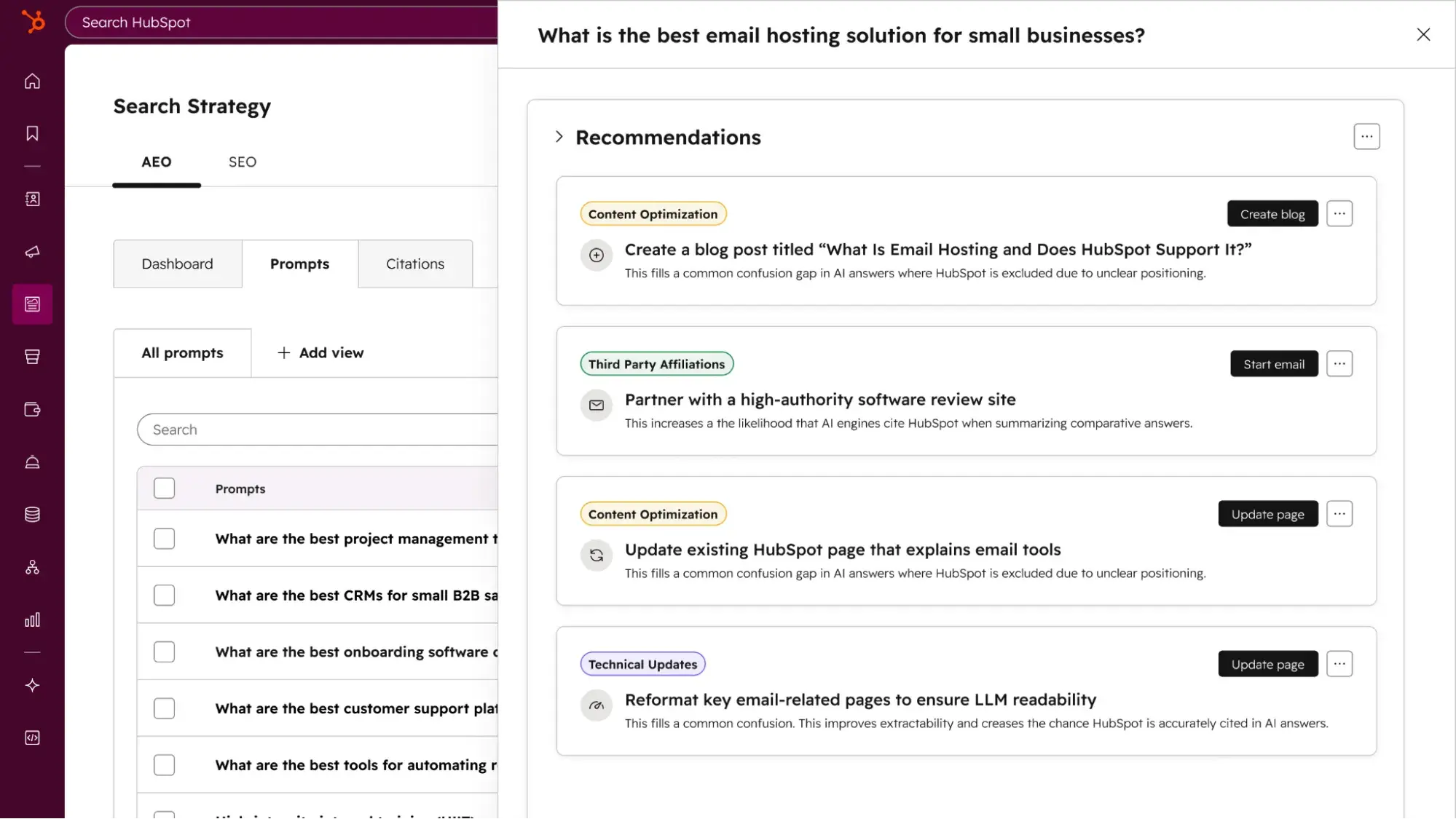
HubSpot AEO Tracks and improves how a brand appears in major response engines including ChatGPT, Perplexity and Gemini. HubSpot AEO directly measures key GEO KPIs, from citation frequency and AI share of voice to prompt-level awareness and sentiment.
Unlike tools that focus on a single metric or require merging data from multiple sources, HubSpot AEO centralizes GEO measurement into a single dashboard. This makes it possible to track performance consistently over time and link visibility shifts directly to content and strategy changes.
Key Features:
- Brand visibility dashboard. Tracks the response inclusion rate across all response engines, showing how often the brand appears in AI-generated responses for priority prompts and how this value changes over time
- Competitor analysis. Enables AI measurement of voice share and shows relative presence compared to competitors in the same prompt set, allowing teams to see where they are gaining or losing ground
- Prompt follow-up and suggestions. Monitors answer meaning and positioning at the prompt level, including which prompts cite the brand, which cite competitors instead, and where the brand is completely absent.
- Quote analysis. Shows which domains, content types, and source channels AI engines use to answer questions in the category
- Sentiment analysis. Measures how positively or negatively the brand is described in AI-generated responses on a scale of -100% to +100%, giving teams an early signal of entity authority issues and visibility gaps
- Recommendations. Converts visibility and citation data into a prioritized action plan, with full content descriptions for each recommendation so teams know exactly what to create or change to drive GEO KPIs
Best for:
- Marketing teams that need a single dashboard to track GEO KPIs consistently over time
- Brands looking to connect AI visibility to pipeline and revenue results without having to manage multiple tools
- Teams report AI performance to leadership, which requires clear, comparable data across response engines
Prices: Available in Marketing Hub Pro and Enterprise or as a dedicated tool for $50/month without a HubSpot subscription.
What I like: Most GEO KPI tracking requires a combination of manual testing, spreadsheet tracking, and separate tools. HubSpot AEO brings core metrics together in one place so teams can monitor performance consistently, rather than episodically. The centralized dashboard makes it significantly easier to view directional movements over time and link AI visibility to pipeline results.
2. XFunnel

XFunnel measures how brands appear in AI-generated responses from large language models by analyzing AI share of voice, quotes and entity mentions. Instead of relying on traffic as a proxy, this shows how AI engines actually show up and describe brands in response to real user input. XFunnel helps teams answer questions that traditional analytics can’t, such as:
- Which brands are mentioned most often for high-intent prompts?
- Are we included at all or consistently excluded?
- When we appear, are we quoted, summarized or just listed?
Most GEO KPIs require direct observation of AI responses. Xfunnel does this on a large scale. It gives marketing teams the opportunity to go beyond anecdotal testing and understand competitive positioning within AI search in a repeatable, measurable way.
Best for:
- Marketing teams track AI share of voice and competitive visibility.
- Brands operating in crowded categories where being “on the list” matters.
- Executives who need to explain AI performance without relying on traffic alone.
Prices: Pricing varies based on usage, request volume and report depth.
What I like: XFunnel focuses on response-level visibility and not just referral traffic. This is consistent with how generative search works today: influencing often occurs without a click.
I also like that it separates entity-based visibility from citation-based visibility, which maps directly to the GEO KPIs that teams need to report on.
Seeing how often competitors show up – and in what context – makes it easier to prioritize content updates and close authority gaps.
3. HubSpot’s AEO Grader
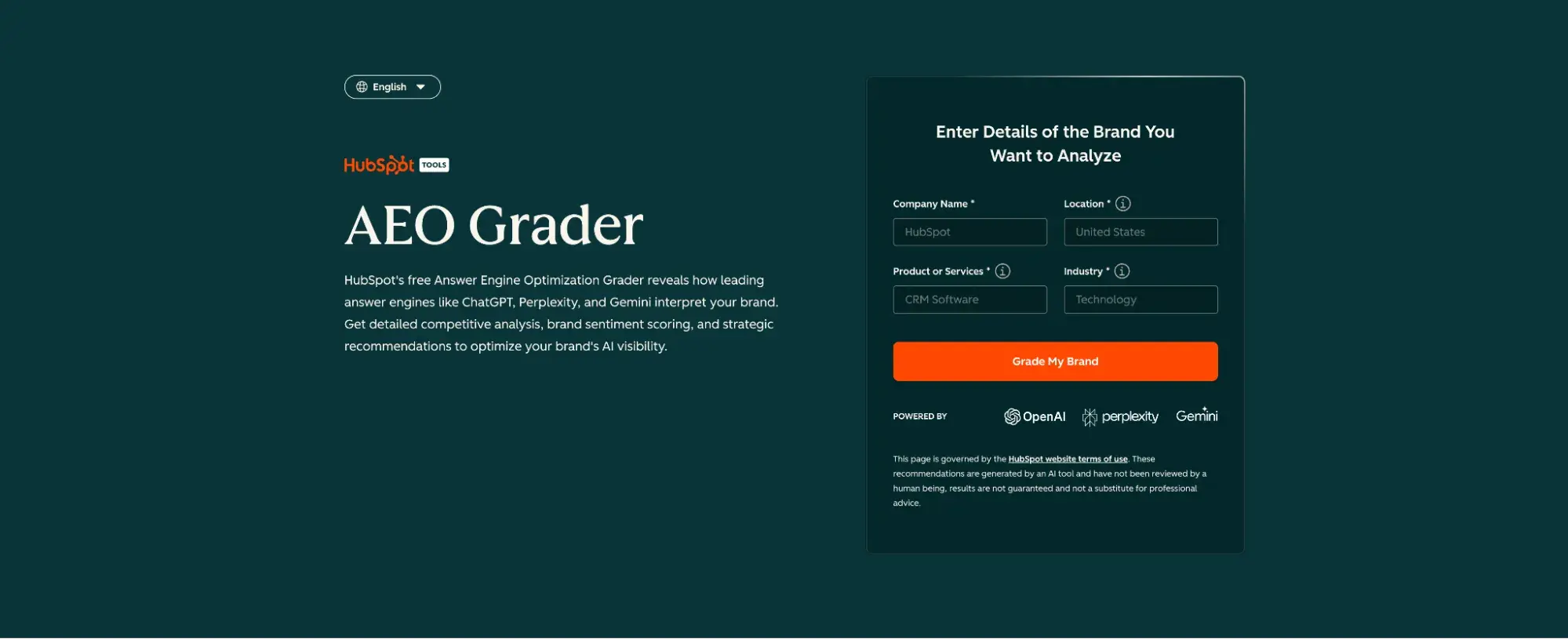
AEO from HubSpot Graders is a free tool that evaluates how well a website is structured for AI and response engines. It focuses on fundamental elements – such as schema implementation, page structure, and content clarity – that influence how AI systems interpret and surface information.
The AEO Grader helps uncover structural gaps that directly impact GEO KPIs. For teams just starting out, it provides a quick way to identify technical and structural roadblocks before investing in deeper optimization work.
Best for:
- Teams assess AI readiness without committing to new tools.
- Marketers check whether the schema and structure are implemented correctly.
- Organizations seeking to identify technical and structural barriers before investing in deeper AEO optimization work.
4. HubSpot’s SEO marketing software
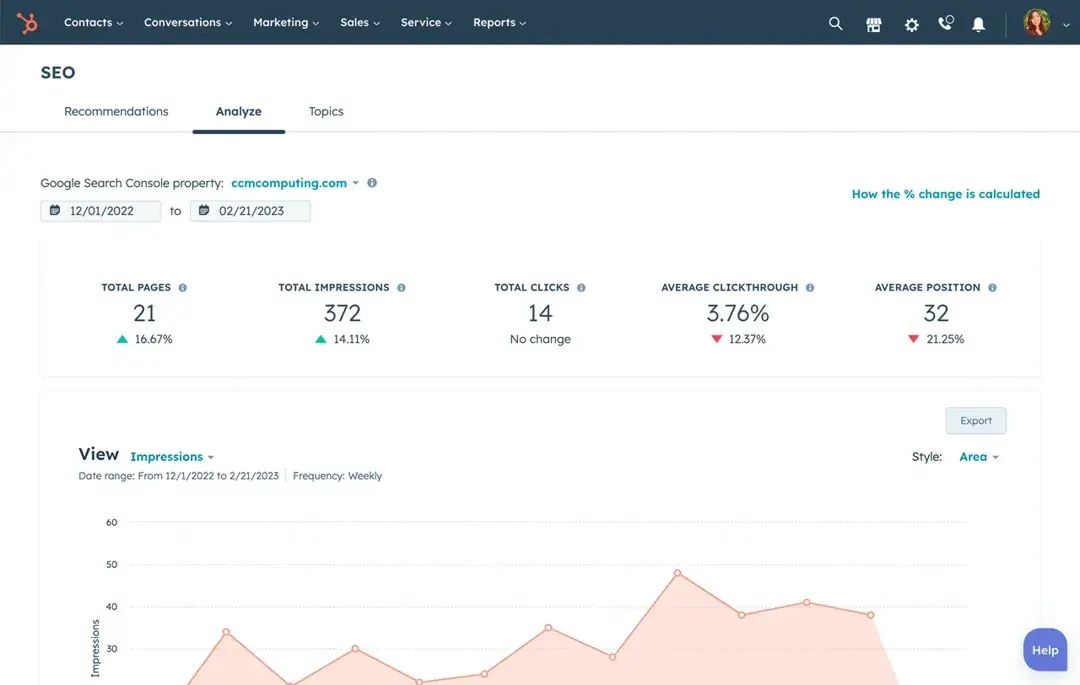
HubSpot’s SEO marketing software helps teams plan and measure content performance through topic clustering, on-page recommendations, and integrated performance reporting.
While designed for traditional search, these same signals are important for AI engines. Topic clusters strengthen entity authority by clarifying what a brand is about and which pages should be treated as primary sources, while on-page recommendations support clear structure and semantic direction.
Best for:
- Teams that want SEO and GEO measurements on one platform.
- Marketing leaders who need to link content performance to pipeline and revenue.
- Organizations that standardize content structure and topical authority across teams.
What I like: I like that HubSpot’s SEO marketing software doesn’t live in a vacuum. Instead of pulling SEO data from one tool, AI visibility from another, and revenue data from a third, HubSpot enables teams to connect content performance with pipeline results in a single system.
I also find that topic clustering is particularly useful for GEO because it forces teams to explicitly address core topics, which AI engines reward when deciding which sources to trust.
5. HubSpot’s Content Hub
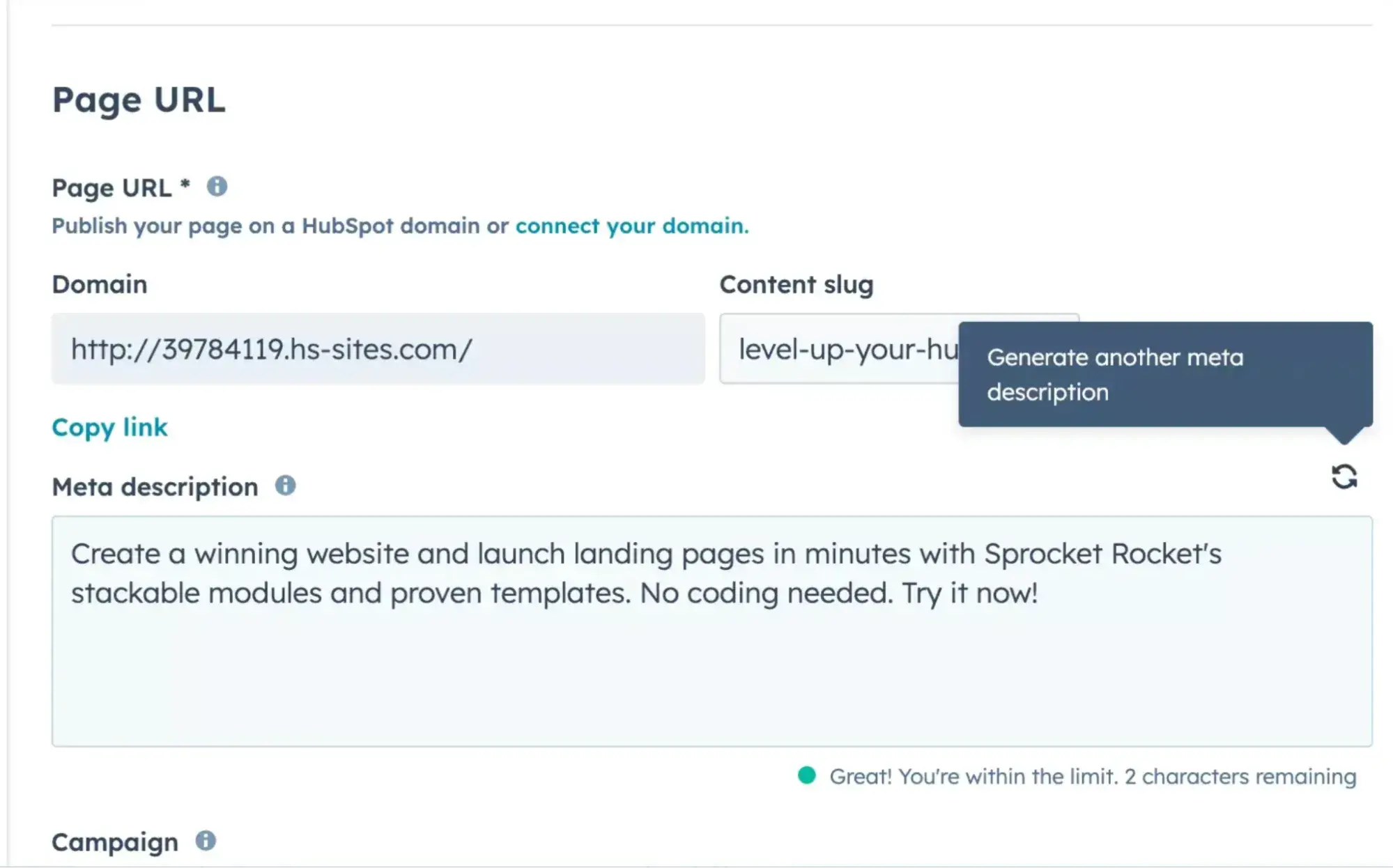
HubSpot’s Content Hub is a CMS that helps teams create, manage and optimize content with built-in SEO guidance and support for structured, schema-ready publishing. It allows marketers to standardize the way content is written, organized, and maintained across the site.
For GEO, structure is as important as substance because AI engines rely on clearly organized content to understand what a page is about and when it should be reused in an answer.
Content Hub supports this by promoting a clean page structure. Teams can implement the schema and structured data that help AI engines interpret important information more accurately.
What I like: Content Hub makes it easier to implement effective content writing habits at scale. Instead of relying on individual authors to memorize schema rules or formatting best practices, the CMS itself encourages teams toward consistency.
Best for:
- Teams publish content to both humans and AI systems.
- Organizations standardize content structure across multiple contributors.
- Marketers who want schema-ready content without custom development work.
6. Addlly AI
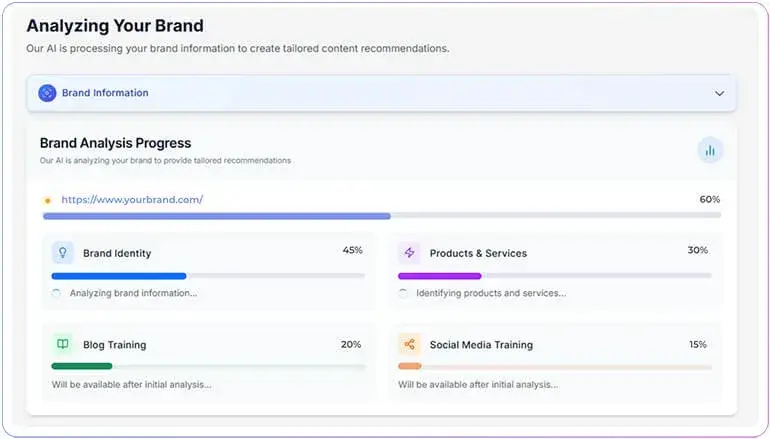
Addlly AI is a platform that connects GEO exam with AI-driven optimization to show how brands appear in AI-generated responses across multiple major language models. It tracks quotes, mentions, and AI share of voice, giving teams a clear overview of where their content is being shown or ignored by generative engines.
Addlly AI GEO agent goes beyond reporting by helping teams take action: identifying visibility gaps, generating AI-optimized content, and structuring information to increase the likelihood of being cited by AI. Teams can see not only whether they appear, but also how they appear across different AI platforms – summarized, cited, or listed.
Best for:
- Marketing teams that want end-to-end AI visibility tracking and optimization.
- Brands operating in competitive categories where being cited or summarized matters.
- Teams looking to go beyond traffic-based metrics to understand real AI-driven influence.
Prices: Flexible based on depth of review, prompt volume, and use of AI content generation.
What I like: Addlly integrates diagnostics and execution so teams not only get a snapshot of visibility, but also the tools to improve it. It also separates entity mentions from quotes, which fits perfectly with the GEO KPIs that teams need to measure. Seeing where competitors are emerging and in what context makes prioritizing content updates much more strategic.
7. Superlines
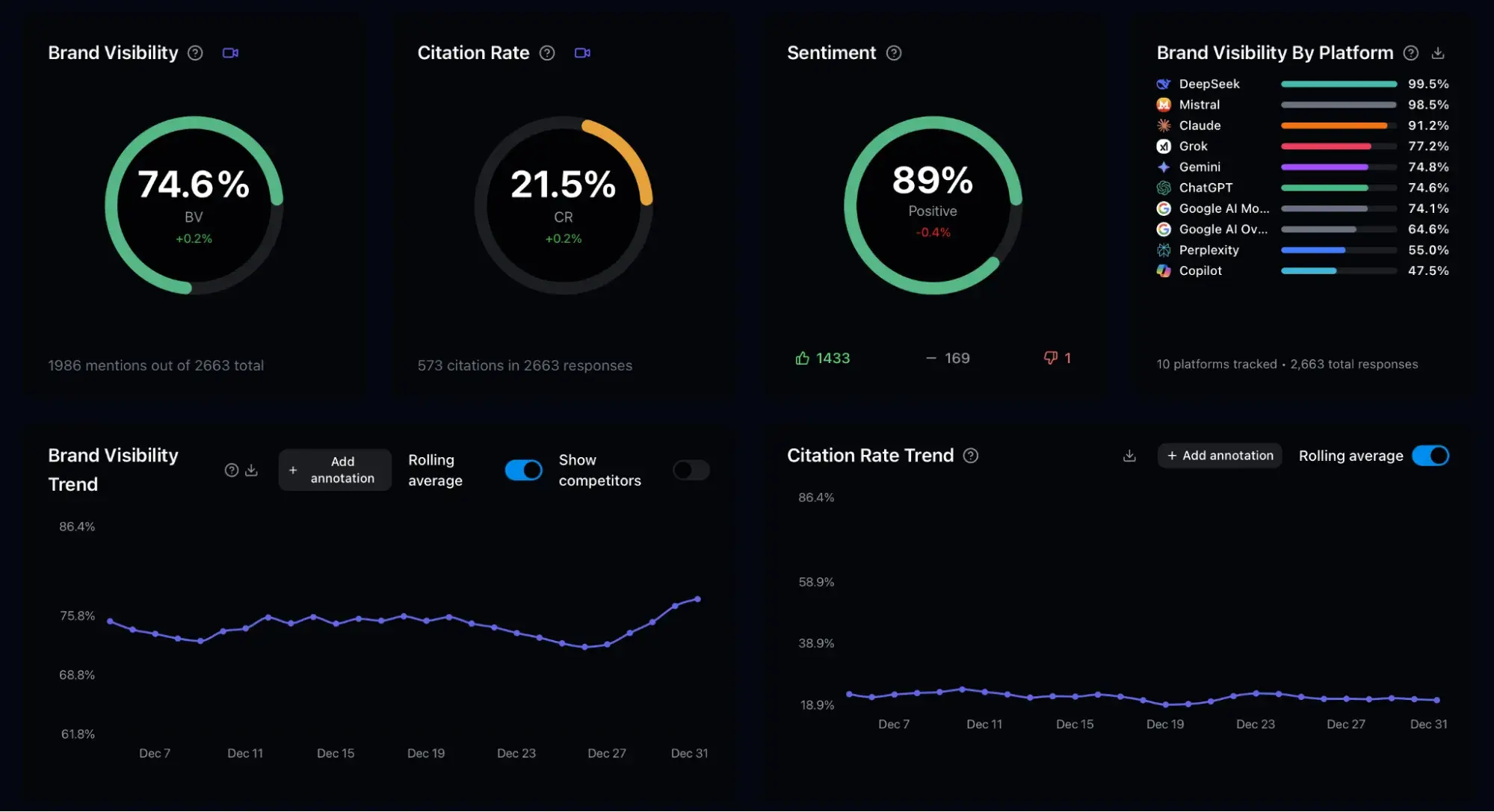
Superlines is an AI search intelligence platform that measures how brands appear in generative AI responses on platforms such as ChatGPT, Perplexity, Gemini, Claude and others. The focus is on response-level visibility, tracking brand mentions, quotes, sentiment and competitor share of voice in real-world, user-focused AI output.
Instead of relying on search traffic or generic rankings, Superlines allows teams to directly observe AI responses, showing exactly where and how a brand is included or excluded. This allows for comparison with competitors, identification of gaps in content authority, and strategic prioritization of updates.
Best for:
- Marketing teams track AI share of voice and visibility across multiple platforms.
- Brands in highly competitive categories where response level involvement matters.
- Teams that need a measurable way to show AI influence without relying on clicks.
Prices: Based on platform coverage, reporting frequency and team size.
What I like: Superlines values real, user-centric AI visibility rather than indirect metrics. It captures cross-platform AI output at scale and provides teams with repeatable insights for competitive positioning. The combination of citation and context tracking leads directly to GEO KPIs that are important for reporting.
Common GEO measurement challenges and how to solve them
When teams adopt generative engine optimization, they often encounter measurement challenges not present with traditional search engine optimization. Many of these issues arise from the way AI platforms surface answers, limit attribution, and distribute influence across channels.
Below are the most common challenges in GEO measurements, followed by practical ways to address them based on real-world experience.
1. Limited AI recommendation data
The challenge: Many AI platforms suppress or delay recommendation data, making it difficult to attribute website sessions or conversions to a specific AI source in analytics and CRM systems.
My experience: In analytics dashboards, I’ve repeatedly seen what appear to be “ghost” recommendations – sessions that lead to signups, form fills, or offers, but are not tied to a clear referral engine. The commitment is real, but the attribution is incomplete.
How to solve it: The goal is to understand influence, not just clicks. Instead of relying solely on recommendation data, look for additional signals. This includes:
- Check form responses for mentions of ChatGPT, Perplexity, or Gemini.
- Ask prospects directly how they first heard about the brand.
- Monitor citations or mentions in places that don’t show up neatly in the analysis.
2. KPI overload
The challenge: GEO introduces a wide range of potential metrics, and tracking too many metrics at once can result in KPI reporting noise that obscures meaningful insights.
My experience: I’ve seen teams struggle to monitor all possible GEO KPIs simultaneously. Reporting becomes harder to explain and optimization efforts lose focus.
How to solve it: I recommend choosing one or two KPIs that the team can actively influence in the short term. The other key figures can fall by the wayside. I’ve found that building a deep understanding of a small set of signals yields far more progress than superficially tracking dozens of indicators.
3. Tool fragmentation
The challenge: GEO data is often scattered across SEO platforms, AI visibility tools, analytics software and CRM systems, making it difficult to get a cohesive view of performance.
My experience: I’ve seen teams invest in GEO tools that don’t provide actionable insights. Not every platform that claims to measure AI visibility is worth the investment.
How to solve it: The most effective approach is to combine response-level visibility tools with centralized reporting. Xfunnel is useful here because it focuses on how brands appear in AI-generated responses rather than relying on traffic proxies. Combining these insights with HubSpot’s reporting reduces fragmentation and increases trust in the data.
4. Managerial skepticism
The challenge: Leadership teams may question GEO metrics because they lack well-known benchmarks and long-established reporting standards.
My experience: As a fractional content strategist working with C-level executives, I’ve encountered skepticism about whether GEO is worth the effort. Some executives rely heavily on the idea that “good SEO is good GEO,” and many executives are reluctant to adapt existing processes.
How to solve it: Competitive framing helps. Tracking AI share of voice over a short period of time and comparing it to the competition quickly shows where influence is gained or lost within the AI-generated responses. Once executives recognize this gap, the value of GEO metrics becomes much easier to justify.
5. Measure influence without clicks
The challenge: AI-generated responses do not always result in immediate website visits, making traditional traffic-based performance indicators incomplete.
My experience: I’ve seen GEO improvements appear long before there is a noticeable increase in sessions or before traditional rankings catch up. When teams rely solely on clicks, they risk missing early indicators of impact.
How to solve it: Look beyond last-click attribution and monitor branded search lift, assisted conversions, and downstream deal creation over time. GEO influence often occurs later in the funnel, not always at the moment of discovery.
Frequently asked questions about GEO KPIs
How often should you report GEO KPIs to executives?
Monthly reporting is best for GEO KPIs because it allows teams to identify directional trends without overreacting to short-term volatility in AI-generated responses. AI visibility can fluctuate from week to week as models are updated, prompts change, or competitors release new content. Therefore, a monthly rhythm helps to smooth out disturbances and bring meaningful movements to the surface.
During quarterly reviews, GEO KPIs should be linked to pipeline, revenue, and competitive position. Looking at GEO performance alongside existing company valuations allows you to incorporate it into the growth discussion rather than treating it as a standalone experiment.
What is the easiest way to flag AI referral traffic in analytics and CRM?
The simplest approach is to start with custom source groupings within HubSpot that capture well-known AI referrers like ChatGPT, Perplexity, and Gemini. Although not all AI platforms share clean recommendation data, grouping the visible data creates a baseline signal.
From there, campaign parameters and CRM fields can help fill in gaps. For example, include a short “How did you hear about us?” added. From the field to high-intent forms, AI detections often occur even when the analysis does not. Over time, these signals combine to create a clearer picture of AI influence across the funnel.
How do you prioritize content updates to improve GEO KPIs?
The most impactful updates typically start with prompt-level visibility, not page-level performance. Prioritize content tied to prompts where competitors are already appearing in AI-generated responses, especially comparison, alternative, or review queries.
From there, look for gaps such as unclear positioning, outdated language, weak structure, or lack of context that would help an AI engine understand why the brand belongs in the response. Updating these pages with more differentiation and better structure tends to produce GEO gains faster than publishing entirely new content from scratch.
When should you consider new GEO KPIs or optimize existing ones?
New GEO KPIs should only be introduced when existing metrics no longer explain what is happening. If current KPIs still help answer questions about visibility, competition, and revenue impact, adding more metrics typically leads to confusion rather than clarity.
New KPIs should serve strategy and not expand dashboards.
Turn GEO KPIs into a competitive advantage
Generative engine optimization KPIs give marketing teams insight into a part of the buyer’s journey that traditional analytics can’t fully explain. By tracking citations, entity authority, instant inclusion, and AI-driven influence, teams gain a clearer picture of how their brand is performing in modern search experiences.
From what I understand, the teams that win with GEO measurement are the ones that integrate AI visibility into existing systems rather than treating it as a side experiment. Tools like HubSpot AEO enable this integration without adding unnecessary complexity.
As AI-powered detection becomes standard, GEO KPIs are no longer optional. You’ll show how confident marketing leaders explain performance, defend strategy, and demonstrate impact even when the click doesn’t happen.
Editor’s Note: This post was originally published in January 2025 and has been updated for completeness.