

There’s a lot going on today while searching. Google is still the leader, but competition and development from AI alternatives has left many marketers wondering how to optimize for ChatGPT.
When someone opens ChatGPT and asks a question, they don’t get ten blue links. You will receive a synthesized, coherent answer that comes from sources that the AI has found authoritative, structured and trustworthy. At the risk of sounding dramatic, if your content doesn’t belong to these sources, you don’t exist for that user.
ChatGPT is now processing over 2 billion requests dailyand while AI search currently accounts for less than 1% of referral traffic, that share is doubling month over month. The brands that build AI visibility infrastructure today will dominate brand discovery tomorrow.
This guide provides content marketers, SEO managers, and businesses in general with a comprehensive, source-driven playbook for optimizing content for ChatGPT and other AI search engines.
Table of contents
TL;DR: Summary
Optimizing content for ChatGPT requires the following: clear structure, authority signals, and extractable answers. For example, answer-first writing improves the extractability of content for AI systems. The content should include:
- Question-based headings that match natural language search behavior.
- FAQ page schema that maps specific questions to specific answers.
- Article schema containing author, heading, published date, modified date, info and quotes.
- Sanitize HTML so AI systems can accurately analyze page content.
HubSpot’s free AEO grader can assess your current AI visibility and identify areas for growth.
What has changed (and what is generative optimization?)
For three decades, SEO was the name of the game: ranking high on Google, getting clicks, and increasing traffic. This model still works, but it now comes with fundamentally different tools and consumer behavior.
Nowadays, SEO still determines traditional rankings, but Bain & Company found that 80% of consumers rely on zero-click results for at least 40% of searches. In other words, clicks have dropped dramatically thanks to zero-click features like AI overviews, featured snippets, and searches in tools like ChatGPT and Perplexity.
Read: ChatGPT search engines: what they do and how to optimize your site for them
Generative AI does not return a link list like SERP; It summarizes an answer and selects sources based on credibility, clarity and extractability. Pew Research Center found that only 8% of users who saw an AI overview clicked on a traditional result, compared to 15% who clicked without one. Given these statistics, marketers are turning to generative optimization to stay visible.
What is generative optimization?
Generative Engine Optimization (GEO) is just another word for Answer Engine Optimization (AEO). GEO emerged as a term to emphasize focus on new technologies like ChatGPT, Perplexity and Google AI Overviews, but the goals are generally the same: to get cited. That said, here at HubSpot we name it all AEO.
Read: Response engine optimization (AEO) best practices cannot be ignored by marketing teams
SEO vs. AEO vs. GEO vs. LLM optimization
While AEO covers all of these strategies, we want to clarify the differences between each strategy to avoid any confusion. The commonality of these strategies is that discovery favors structured, authoritative, and extractable content.
- Search Engine Optimization (SEO): SEO works to improve rankings in traditional search results through keywords, backlinks, and technical signals like site speed and metadata.
- Response Engine Optimization (AEO): AEO is about improving how often and how accurately your business appears in AI-generated responses on platforms like ChatGPT, Gemini, Perplexity, and AI Search (e.g., AI Digests, Recommended Snippets).
- Generative engine optimization (GEO): This term specifically refers to optimization for new AI like ChatGPT and its counterparts.
- LLM optimization (LLMO): This is a broader term for influencing the way large language models represent your brand in their training data and retrieval behavior.
HubSpots free AEO grader measures how AI currently characterizes your brand and can help you understand how to improve your visibility. Try it!
How do ChatGPT and other AI systems select sources?
Ok, here’s the plot twist you probably didn’t expect: ChatGPT uses Bing by default. Yes, Microsoft Bing. However, there are some limitations and not every AI system works the same way. Let’s look back for a moment.
ChatGPT vs. Perplexity vs. Google AI Overviews
Each AI engine draws on different source pools and applies different trust criteria, leading to different results. For example, only 11% of domains are cited by both ChatGPT and Perplexity. This means that optimizing according to a platform’s criteria may not be enough to achieve your goals.
Marketers need to understand the nuances of each platform in order to deliver what they want and maintain visibility there, just as they would with different social media platforms.
Sources: Profound (680 million citations, August 2024-June 2025); seer interactive; BrightEdge (2025); thedigitalbloom.com
ChatGPT’s source selection logic depends on whether browsing or live search is enabled (and perhaps even the user account level). Without browsing, ChatGPT relies on parametric memory or the information it was trained on (e.g. publicly available sources on the Internet, third-party partnerships, etc.). User Provided Data) to answer a user’s query. Think of it like answering a friend’s spontaneous question.
With browsing enabled, ChatGPT queries Bing, selects 310 different sources, and compiles an answer that it believes most accurately answers the user’s original question. Once candidate pages are retrieved, the AI evaluates them for parsability, directness, and semantic clarity.
Ok, but why Bing? Since forming a partnership in 2023ChatGPT used Bing as its default search tool, and Bing and the Edge browser used ChatGPT as their AI. This is a bit surprising given Google’s dominance in search, but it’s true.
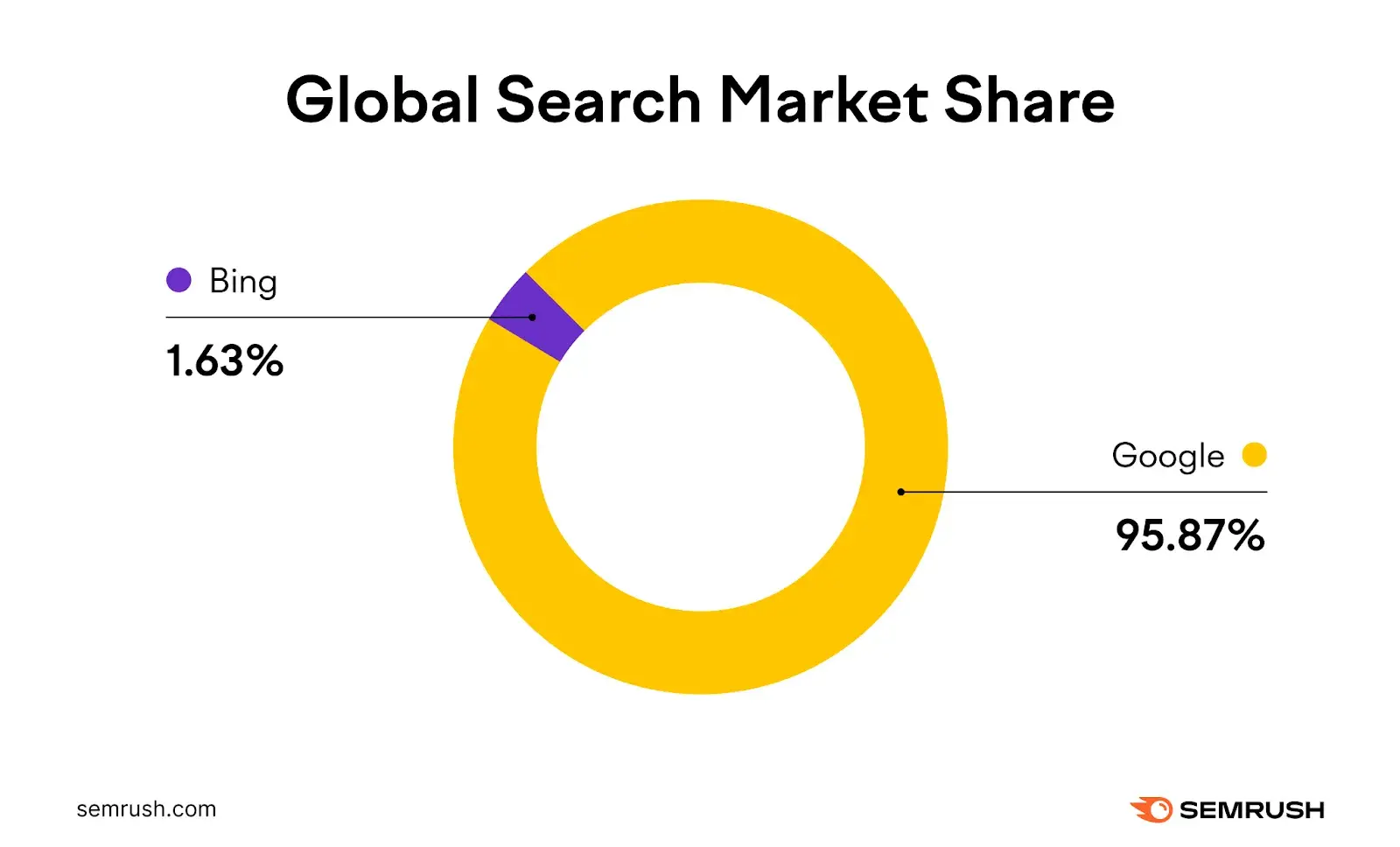
But that doesn’t mean ChatGPT completely ignores Google. Many experiments by Backlinko, Semrushand other well-known search experts suggest that Google results be integrated with the results of paid ChatGPT users. OpenAI has yet to confirm.
Current studies found that 87% of ChatGPT citations match the top 10 organic results from Bing, while only 56% match the top 10 organic results from Google. This gap is important to keep in mind as marketers try to gain traction with ChatGPT.
How to Optimize for ChatGPT: Quick Tips
Although search engine quality criteria are generally very similar, here are some quick tips based on them Bing’s webmaster documentation. I’ve also included some related Google-preferred features to help teams write for AI search.
1. Lead with an answer-first structure.
Bing recommends “bringing important information to light early,” and Zyppy analyzed thousands of ChatGPT citations and found this to be the case The first 30% of a page generates 44.2% of all LLM citations. The middle 30% to 70% of the content contributes 31.1%, and the final section accounts for 24.7%. So address your target requests early.
Pro tip: Use your queries as headers (h2s and h3s). Then follow the header query with a concise 40 to 60 word answer. This makes it easier for AI systems to crawl your content and find the answers you need.
2. Make content public and easy to crawl.
Content hidden behind modal pop-ups, login gates, or heavy scripts is difficult for AI to read. However, use JavaScript sparingly and optimize images and videos with descriptive file names, alternative text, captions, and overall context.
3. Keep your URLs, links and sitemap clean.
Bing emphasizes what I call URL hygiene. What does that mean exactly?
- Use IndexNow URL submission, XML sitemaps, and robots.txt correctly
- Use short, keyword-focused URLs whenever possible
- Make sure you have crawlable internal links
- Keep your sitemap current and accurate
- Delete old URLs
- Be diligent about URL redirects
- Notify Bing (and Google) of URL changes
4. Structure your content clearly and intuitively.
Using a clear structure helps improve understanding for both readers and search engines. In this sense:
- Follow HTML best practices (metadata, header hierarchy, list code).
- Use schemas and structured data when appropriate. Schema and inline quotes are about 40% higher on ChatGPT Source selection than on pages without these elements. AEO structured content with the FAQ schema receives three times as many ChatGPT citations as plain prose.
- Use columns and clusters to make authority more easily evident.
5. Use a natural tone.
Write content for people, not robots. Content that contains repetition, unnatural wording, or excessive loading of irrelevant keywords can reduce AI visibility or even lead to removal. AI views these behaviors as attempts to manipulate ranking and citation systems, not true value.
AI Boost Marketing Research supports this, noting that keyword stuffing performs 10% worse than content that uses keywords more sparingly.
6. Maintain external credibility.
AI pays attention to a brand’s online reputation to establish its credibility. This means maintaining an accurate reputation and presence on review sites, social media profiles, media outlets, industry organizations and more.
Let’s explain some of these tips in more detail.
How to optimize content for ChatGPT with the Answer-First structure
The most actionable (and data-backed) advice for getting AI citations is structural: AI systems extract answers at the paragraph level, and that includes ChatGPT.
A paragraph that makes a clear point in the first sentence, is supported with data, and is written in simple declarative language is significantly more quotable than paragraphs that lead to a conclusion, are backed up with qualifications, or cover multiple unrelated ideas.
ChatGPT hasn’t publicly disclosed why this might be, but in my decade of content experience there are probably two reasons.
First, the information the AI is looking for is easily accessible (the AI doesn’t want to waste time searching through content for answers). Second, the claims are viewed as trustworthy and reliable because they are backed by data.
Consider how you search for information. When you search for a question and get a clear, specific answer from a source you trust, you will accept it and move on. ChatGPT does the same unless challenged.
What questions should your H2s and H3s answer?
Each H2 and H3 should be a question that your target reader could type verbatim into ChatGPT. This approach is sometimes also called Question-driven heading architectureserves two functions. It takes its cue from the way users naturally query AI systems (in complete questions, not keyword fragments), and creates a structural map that AI query systems can follow to link questions with their corresponding answers. Here are some example headers:
- Weak headline: “Email Marketing Best Practices”
- Strong headline: “Which email tactics will deliver the highest open rates in 2025?”
Before you finalize a header, ask yourself these three questions:
- Would a user enter this exact phrase as a query in ChatGPT? There is currently no way to see which searches are most popular on ChatGPT, but talking to your sales and customer service teams and targeting popular keywords on SEMrush and Ahrefs is a good place to start.
- Does the section directly under this heading answer the question directly in the first 40 to 60 words?
- Does the heading contain a specific noun or concept that signals topical relevance (not a generic label like “Best Practices”)?
From here, include definitive factual statements in your answers. At HubSpot we call them semantic triples.
How to write semantic triples
Semantic triples in AEO are elevable factual statements that an AI model can extract, quote verbatim, and include in a generated response without requiring the surrounding context to make sense.
The characteristics of a semantic triple include:
- Begins with the subject and the predicate, not with a clause (“Email marketing delivers an ROI of $36 per $1 spent” not “When done right, email marketing can…”)
- Contains a specific assertion, not a compound assertion
- Contains a number, named entity, or verifiable attribute
- Quote the source inline or directly below
- Don’t use hedge words: Avoid, some might suggest
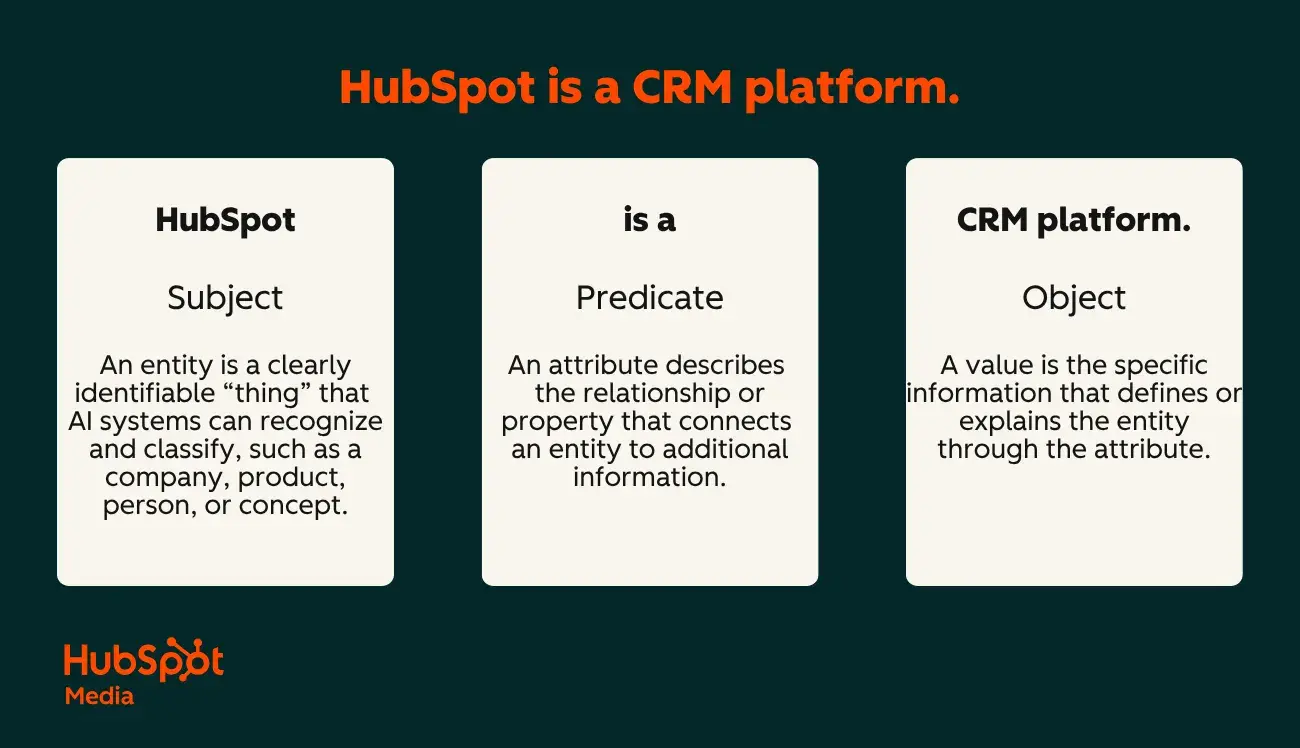
All of this supports the belief that AI models prefer definitive language. Research on ChatGPT citation patterns confirms that content that matches the user’s query intent precisely, rather than just close to keywords, is cited more frequently. Precision begets confidence, and confidence begets authority.
How to optimize content for ChatGPT with schema and clean HTML
Structured data is, and is also referred to as, the way you submit content to AI systems in a machine-readable format one of the most effective techniques to improve visibility in AI-generated answers.
Use schema markup for FAQs, guides, and articles
Prioritize these three schema types for AI visibility:
- FAQPage schema: Maps individual question strings to their answer strings. AI retrieval systems can extract these directly. Implement it on every page with a question and answer section.
- HowTo scheme: Structures step-by-step process content with named steps, estimated time, and required tools. Ideal for tutorial and guide content.
- Item scheme: The basis for all editorial content. The article schema must contain the properties “Headline”, “Author” (with “sameAs” links), “datePublished”, “dateModified”, “about” and “citation”. The missing dateModified is one of the most common AI visibility gaps on otherwise strong sites.
JSON-LD Article Schema Pattern (Add-in
or before):
{ “@context”: “https://schema.org”, “@type”: “Article”, “headline”: “How to Optimize for ChatGPT”, “author”: { “@type”: “Person”, “name”: “Your Name”, “sameAs”: (“https://linkedin.com/in/yourprofile”) }, “datePublished”: “2025-01-01”, “dateModified”: “2025-04-01”, “about”: {“@type”: “Thing”, “name”: “ChatGPToptimization”}, “citation”: “https://arxiv.org/abs/2311.09735”}
Validate the schema before publishing with Google’s rich results test And Schema.org validator. A broken schema is worse than no schema because it signals technical unreliability to crawlers.
Add clean HTML, semantic headings and accessible media
ChatGPT’s browser mode evaluates HTML readability before deciding whether to extract content from a page. This means that pages with semantic heading hierarchy (H1 → H2 → H3), visible text (not CSS hidden) and content loaded without JavaScript are processed more reliably. Here are some HTML technical best practices you can use for better AI visibility:
- Maintain an H1 per page that corresponds to the primary query the page targets
- Use H2s and H3s in logical hierarchy. Don’t skip heading levels just for aesthetic reasons.
- Render core content in static HTML rather than JavaScript as this makes crawling difficult.
- Make sure OAI-SearchBot is not blocked in robots.txt (separate from GPTBot, which governs training data).
- Include descriptive alt text with the focus keyword if relevant to images.
- Implement a clean URL structure (“/chatgpt-optimization/”, not “/?p=2847&cat=seo”).
How to optimize content for ChatGPT with credibility and external validation
AI systems evaluate authority through Entity resolution. They reference third-party websites and schema markup to determine whether a source is a verified, trustworthy entity. It’s like word of mouth, but for search.
Inconsistent naming or missing credentials don’t just reduce trust. They break the entity recognition chain that AI systems use to decide whether a source is citable. Here are some tips to strengthen and simplify this process.
- Author entity consistency. Use the same author name and credentials on your website, LinkedIn, all publications, etc person Scheme with even Links to verified profiles.
- Visibility of credentials. Include a byline on each page. Link to a full author bio with verifiable experience. For topics related to YMYL (finance, health, law), provide professional qualifications.
- Invest in and highlight external earned media. 82 percent of all AI citations come from earned media. Every press placement and guest article becomes a potential AI citation source.
- Knowledge Graph Signals. Brands with Wikipedia entries or Google Knowledge Panel entries have significantly higher AI citation rates. Wikidata contributions and consistent structured data help AI systems recognize your brand as a verified entity.
- Third party validation. G2 reviews, industry database entries, and community mentions on Reddit or LinkedIn form the cross-platform confirmation that AI systems treat as trust signals. Only 14% of the most frequently cited sources are shared via ChatGPT, Perplexity and Google AI – platform-specific off-site presence is important.
Overall, pay attention to your author’s biography, credentials, and institutional affiliations in LinkedIn profiles, Wikipedia entries, publication histories, and even review sites.
How to optimize content for ChatGPT with topic clusters and internal links
AI systems do not evaluate pages in isolation; They assess your topic authority by scanning how comprehensively your domain covers a topic.
Think about it. If you’re truly an expert on a topic, don’t just scratch the surface. To be seen as a thought leader, you need to go in-depth – discussing advanced nuances and sharing lived experiences.
Topic clusters (a pillar page that covers a broad concept and is linked to multiple subtopic spoke pages) help create the organization on your site that gives AI systems deep, consistent knowledge and helps you get cited. Create topic clusters with these parts intact:
- Hub or pillar side. Your definitive guide to the core topic (e.g. “What is email marketing?”). This page should be comprehensive, answer-first, and link to all major Spoke pages.
- Spoken or supporting pages. Cover specific subtopics in depth (e.g. “How to Improve Email Open Rates,” “Key Email Marketing Metrics”). Each spoke is connected to the hub and neighboring spokes.
- Anchor text consistency. Use the same technical terms when linking internally. Inconsistent anchor text dilutes the entity association that AI systems build around your domain.
- Trustworthy page linking. Pages with many external references (such as “Info”, “Press”, “Methodology”) should point to core content. This also adds credibility and what we used to call “link juice.”
Internal linking also directly supports AI extractability. When a spoke page is cited in an AI response and links to your pillar page, users and crawlers can easily find the most descriptive version of your content.
HubSpots Content Hub Enables you to easily create and manage a pillar and cluster architecture at scale, with tools to track internal link coverage, content performance across subject areas, and templates.
How to measure AI search visibility
Unlike traditional SEO, there is no simple or native analytics dashboard for AI search citations. Measurement requires a combination of proxy signals, purpose-built AI visibility tools, and manual query testing.
However, the brands that build an AI search measurement infrastructure now will have increasingly greater data advantages as the channel matures. Here are the AI search metrics teams should track.
AI referral traffic
Mark ChatGPT (chat.openai.com), Perplexity (perplexity.ai), and other AI platforms as tracked referral sources in GA4. Monitor session volume, bounce rate, and conversion rate separately from organic search traffic to understand behavioral differences.
Bing Organic Performance
Because ChatGPT Search uses Bing as its seed index, Bing rankings are a leading indicator of ChatGPT citation authority. Track Bing keyword rankings alongside Google rankings on your SEO platform.
Branded search volume
AI citation research identifies brand search volume as the strongest predictor of LLM citations (correlation 0.334). outweigh the effect of traditional backlinks. Rising brand search volume signals growing AI recognition.
AI Share of Voice
Run monthly target queries in ChatGPT, Perplexity, and Google AI Overviews. Note which brands appear and how often. HubSpot AEO Continuously tracks share of voice across major response engines and shows how your relative presence changes over time as you implement changes. For a quarterly snapshot, HubSpot’s free AEO grader Provides a quick baseline comparison between your brand and your competitors.
Schema coverage
Track which key pages have validated FAQ pages, articles, and HowTo schemas implemented. Missing or incorrect schemas on high-traffic pages are a common and fixable visibility gap.
Reporting cadence: Review AI visibility quarterly
Perform this audit every 90 days to keep up with AI platform changes:
- Step 1: Run HubSpot AEO grader for your brand and the top 3 competitors. The document rating changes in all five dimensions.
- Step 2: Manually test your top 20 target queries in ChatGPT, Perplexity, and Google AI Overviews. Record which sources are cited in each search query and whether your domain appears.
- Step 3: Check schema implementation on your top 50 pages by traffic. Use Google’s Rich Results Test to identify broken or missing schemas.
- Step 4: Check AI referral traffic in GA4. Compare month-to-month and year-to-year trends. Correlate traffic changes with content updates, schema additions, or media wins earned.
- Step 5: Check OAI SearchBot access in robots.txt and ensure that high priority pages are not accidentally blocked from AI crawler access.
HubSpots AEO grader is the free basis for this audit. It simultaneously cross-validates brand characterization in GPT-5.2, Perplexity and Gemini and produces a composite score of 100, a narrative summary, a source quality assessment and an exportable report.
Run it on your own brand and competitors to identify positioning gaps.
For deeper insights at the content level HubSpot AEO Tracks brand visibility, citation frequency, and share of voice in ChatGPT, Perplexity, and Gemini. The tool also includes a prioritized recommendation feature that tells teams exactly what they need to build or optimize to improve their AI visibility over time.
Editorial checklist and before and after example
Use this checklist before publishing or updating a page that targets AI visibility. It integrates content structure, schema, and authority signals into a single preflight workflow.
Before and After Example: Same topic rewritten for AI extractability.
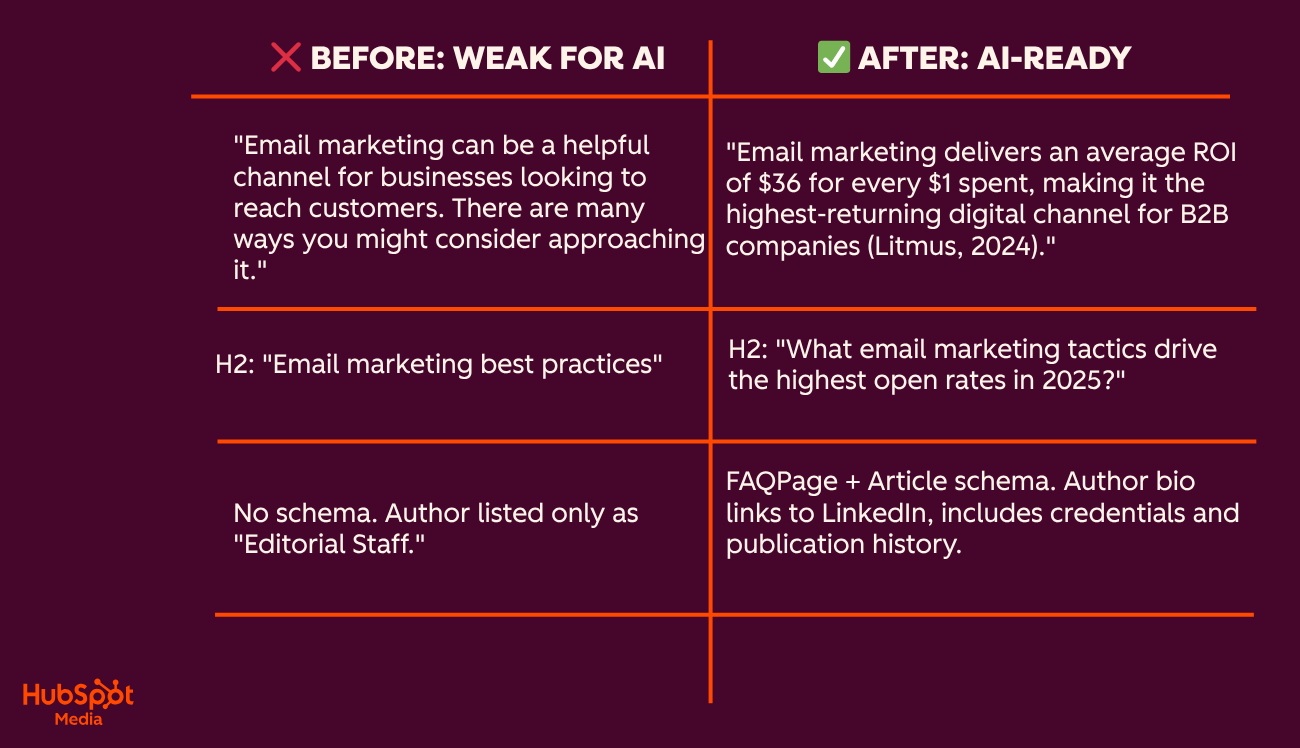
The revised version provides a lifting semantic triple in the first line, cites a primary source, and uses a questioned heading. The original version requires context, backs up its claim, and doesn’t give AI systems anything concrete to extract or associate.
Common mistakes to avoid when optimizing ChatGPT
Vague claims without data
Weak or hedged phrasing (such as “could,” “could,” “some experts suggest”) signal low trust in AI systems and make claims irrevocable. Any AI search intent claim should be supported by a dated, linkable primary source. Vague content that avoids concrete answers is consistently ignored by AI answer machinesregardless of domain authority.
Broken or missing schema
Invalid JSON-LD produces errors that indicate technical unreliability. Missing dateModified fields cause pages to appear outdated even if the content is current. Always validate the schema with Google’s rich results test before publishing and again after any site migrations or CMS updates.
Content hidden from AI crawlers
Content in accordions, tabs, JavaScript components, or behind login gates cannot be read by AI crawlers, including OAI-SearchBot. If important information only appears after a user interaction, it is unlikely to be extracted. Core answers should be in static HTML in the body of the page.
Inconsistent terminology on all pages
AI systems build entity associations from repeated, consistent signals. Referring to the same concept by different names on different pages (e.g., “Email Drop Sequence,” “Automated Email Flow,” “Nurture Series”) fragments current authority. Establish a canonical term for each concept and use it consistently throughout your content, internal links, and schema.
Blocking OAI-SearchBot in robots.txt
GPTBot (used for training data) and OAI-SearchBot (used for real-time ChatGPT search citations) are different crawlers. Blocking GPTBot for privacy reasons does not prevent citations in ChatGPT search, but blocking OAI-SearchBot does. Check your robots.txt explicitly and intentionally.
Optimization for Google AI overviews only
Given Google’s dominant market share, it’s tempting to optimize exclusively for Google AI Overviews, but only 14% of the most frequently cited sources are shared on all three major AI platforms. ChatGPT, Perplexity and Google each use different source pools. A complete AI visibility strategy requires platform-specific monitoring and optimization.
Frequently asked questions about optimizing content for ChatGPT
Do I need to recreate old content to make it ChatGPT friendly?
Not necessarily. Start by checking your highest traffic pages for things that have the most impact on extractability:
- Structure of the first paragraph with the answer
- Question-based headings
- Schema implementation
- Author entity visibility
Many pages only need targeted optimization, not a complete rewrite. Prioritize pages where AI query intent matches your existing content. Definition pages, comparison guides, and how-to articles are high ROI starting points.
Which schema types should I start with first?
Start with FAQ page and article schema. The FAQPage schema has the most direct impact on extractability because it explicitly maps question strings to answer strings, which is exactly what AI retrieval systems look for. The article schema creates the author entity signals that affect EEAT visibility. As a third priority, add the HowTo schema to all step-by-step guide content.
How often should I update high-quality pages to ensure AI visibility?
Freshness is a powerful signal, especially for Perplexity, which indexes in real time, and for ChatGPT queries, which are tied to a specific year. However, plan to update at least every 90 days for pages that target competitive or rapidly changing topics.
Update the Date changed Each time you update content, add the field in the article schema, make the last reviewed date visible on the page, and add new data or examples to signal true freshness rather than cosmetic re-dating.
How can I prove the ROI of AI search optimization?
Create a three-level measurement stack:
- AI Share of Voice. Use HubSpot AEO to continuously track share of voice, citation frequency and brand visibility. For a quarterly benchmark comparison between your brand and your competitors, HubSpot is free AEO grader provides a quick starting point.
- AI referral traffic. Designate AI platforms as tracked referral sources in GA4 and compare conversion rates to organic search benchmarks.
- Branded search volume. Increasing brand search correlates with LLM recognition and is the strongest predictor of citation frequency.
AI search currently acts as a research channel and not a conversion channel BrightEdge data. For now, consider AI visibility as a top-of-funnel KPI for brand awareness rather than a direct revenue driver.
What is the easiest way to keep my team consistent?
Adopt a common one Content Terminology Glossary and an editorial checklist (like the one in this article) that each author completes before publication. Establish a canonical term for each key product, concept, and category your brand covers. Enforce this throughout page text, headings, internal links, and schema.
First steps
HubSpot’s Content Hub supports content workflow management that makes these standards enforceable at scale, from design to SEO review to publishing. Combine it with quarterly AEO Grader audits so the entire team can see the upstream impact of their content decisions on AI visibility.