
It seems like every brand is scrambling to get a piece of the pie in this new world of response engine optimization (AEO). But what if you could stay ahead of the competition by knowing the best on-page content formats for AI, backed by research? To find out, I looked at the results of the new HubSpot State of AEO 2026 report and Wix Studio’s AI Search Lab research on the most cited content types.
In this article, I’ll describe which formats get the most citations at ChatGPT, Gemini, AI Overviews, and Perplexity, why LLMs prefer them, and how you can apply them to both new and existing pages on your website. You’ll also find format-by-format templates, a five-step review for older content, an AI visibility measurement framework, and a governance model to keep cited pages up to date.
Table of contents
TL;DR The best on-page content formats for AEO
The best on-page content formats for AI across the board are Listicles, articles, product pages and category pageswhile Comparison content outperforms ChatGPT Specifically, with a 95% citation rate – the highest of any format on any engine. These conclusions come from two independent data sets for 2026 – HubSpot’s AEO booth 2026 And Wix Studio’s AI search lab – which analyzed over a million AI quotes.
Content type is one of the three levels that influence citations. Cited Pages combine the format with a title pattern that matches the intent (“What is X,” “X vs. Y,” “How to do
What are the best on-page content formats for AEO?
Listicles, articles, product pages and category pages are the four most frequently cited content types overall and Comparison content ChatGPT wins with the highest single citation rate in both datasets. This is the image for two independent data sets: HubSpot’s AEO booth 2026which analyzed thousands of quote topics between December 2025 and March 2026, and Wix Studio’s AI search labwhich indexed over a million quotes from 75,000 AI answers.
A note on scope: This article covers on-page content formats – the pages you publish on your own domain. Third-party discussion content (Reddit, G2, LinkedIn, Quora) falls outside this range, but it’s worth noting that discussions account for 17.35% of Perplexity citations in the Wix dataset, more than double the cross-engine average. If perplexity is important to your buyers, an off-site discussion strategy is a parallel effort to the on-page work in this article.
A note on taxonomy: Both studies treat “blog posts/articles” and “listicles” as separate categories, even if the listicle is on a blog. So, in this article, “article” and “blog post” refer to long-form informative content (the “What is X” or explainer kind), and “listicle” is treated as its own format.
Content type is just one of three on-page levels that correlate with high AI citations:
- Content type: What the page basically is (listicle, article, product page, category page, comparison, guide)
- Title pattern: How the title is phrased (“What is (X),” “Guide,” “X vs. Y,” “Best (X)”)
- Structural elements: What is included on the page (FAQ sections, schema markup, statistics, last updated date, author bios, outbound links)
For the remainder of this article, I will use “format” as the umbrella term under which all three fall.
Types of content most frequently cited by AI engines
Both HubSpot and Wix datasets match the same top three formats for cross-search sure bets: listicles, articles, and product pages. Specifically, Wix found that category pages were the fourth most cited, and HubSpot found that comparison pages were specifically favored by ChatGPT. Here’s the engine-by-engine breakdown from the state of AEO:
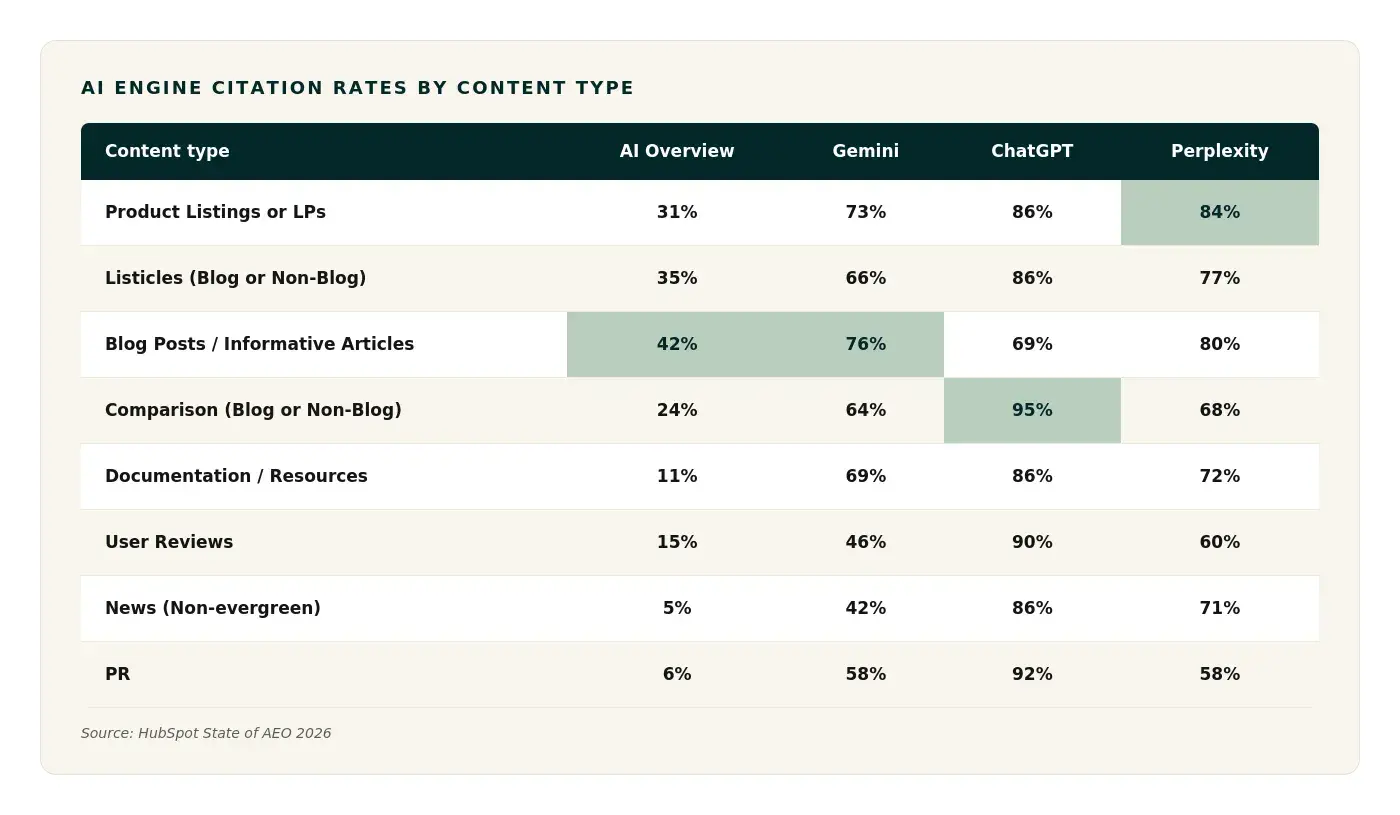
Status of AEO 2026 measured Citation rates – the proportion of queries where the response engine cited at least one page of that content type – across eight content categories. The leaders per engine:
- Google AI overviews: Blog posts (42% citation rate)
- Gemini: Blog posts (76%)
- ChatGPT: Comparison content (95%, just ahead of PR with 92%)
- confusion: Product lists and landing pages (84%)
Caveat emptor at ChatGPT: Every content type measured on this answer engine scored 69% or higher, with most falling between 86% and 95%. ChatGPT is comparatively format independent. In AI overviews, the type of content plays a larger role, as rates vary widely, ranging from 5% (news) to 42% (blog posts).
State of AEO’s three key claims are based on three levels of evidence in the report:
- Average citation rates. Across the four search engines measured (AI Overviews, Gemini, ChatGPT, Perplexity), only three content types achieve an average citation rate of 65%: product lists or landing pages (68.5%), blog posts (66.75%) and listicles (66%). Comparison content comes in fourth at 62.75%, while documentation, PR, user reviews and news average below 60%.
- Brand level endorsement. Each of the top-cited B2B brands in the report has its most-cited page type within the Blog/Product/Listicle group. State of AEO reports a similar pattern in B2C, where blogs and product pages dominate among the top performers. Microsoft’s “What is a CRM?” The blog post was outstanding and NerdWallet’s top performer was a product page/listicle.
- The express recommendation. The report’s “Next Steps” note states: “Product pages, blogs and listicles are the most cited in answer search engines, so make sure your pages are optimized and up to date.”
Wix Studio’s AI search labcreated with Peec AI, looked at the same question from the opposite angle: Proportion of citations across all engines, not for individual engines. Your top three:
- Listicles (21.9% of all citations)
- Articles (16.7%)
- Product pages (13.7%)
These three formats received more than half of all citations tracked by Wix.
The practical souvenir: Listicles, articles, and product pages are the safest cross-engine bets. Comparison content earns its place by winning ChatGPT outright, and How-tos earn its place by leading title patterning in AI Mode and Perplexity and over-indexing in informational queries in Wix’s data. Layer engine-specific optimizations beyond: comparison framework for ChatGPT, depth of information for AIO and Gemini, and step-by-step structure for AI mode.
Title patterns that are cited
In the State of AEO dataset, the title pattern is the most important citation factor when writing meta titles. The following was found:
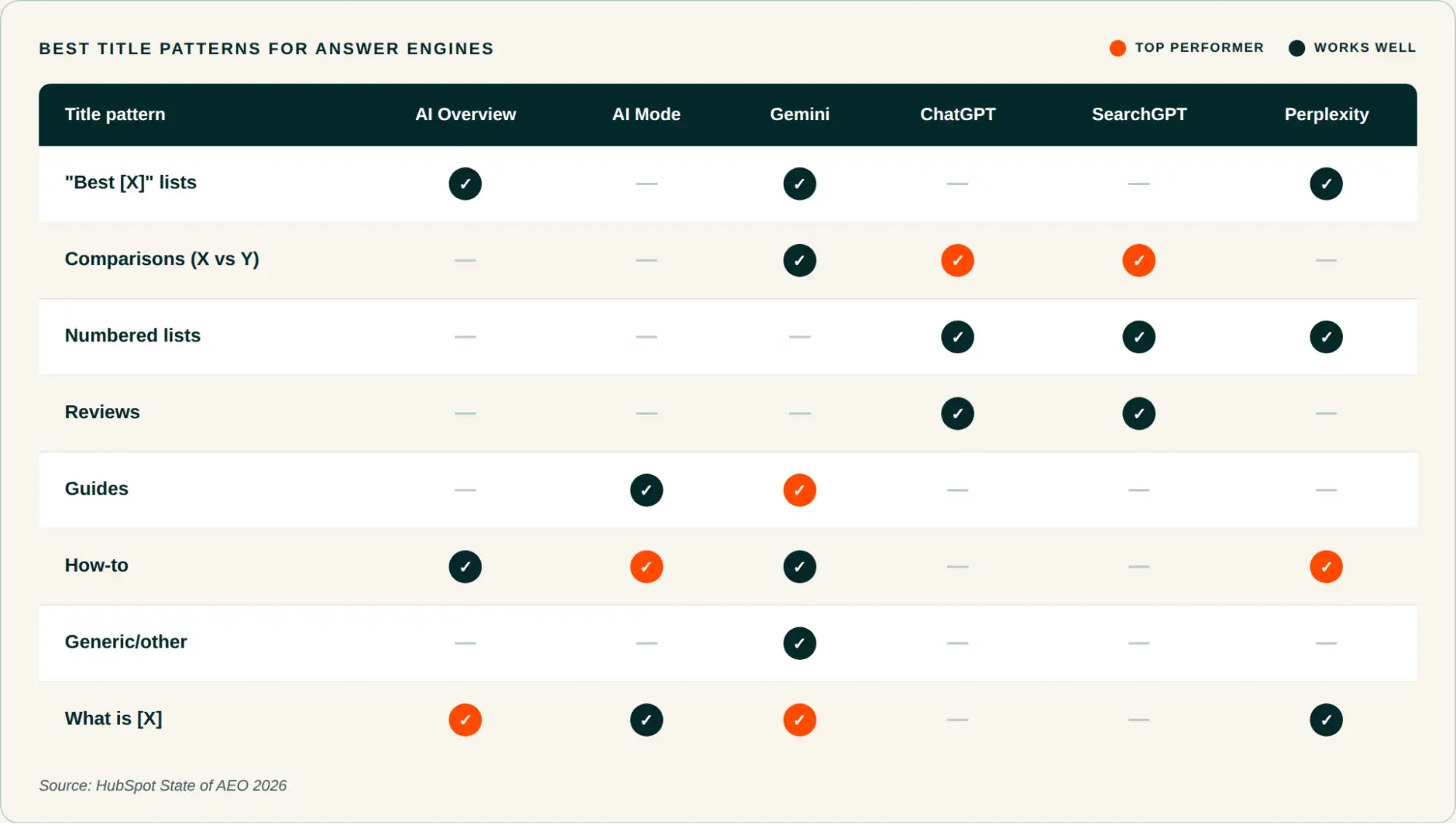
- “What is (X)?” tops both Google AI Overviews and Gemini.
- “X vs. Y” comparison Titles surpass both ChatGPT and SearchGPT.
- “Directions” tops both Google AI mode and helplessness.
According to State of AEO, including the year in the title and H1 correlates with higher citations in AI reviews. My advice would be to only get involved if you actually update the post every year. A title that still reads “2024” in 2026 could hurt your case.
Structural elements that correlate with more citations for each content type
According to HubSpot’s AEO status 2026:
- FAQ sections correlate with more citations in AI reviews; Combining with the scheme extends the correlation to Gemini, Google AI Mode and Perplexity. Descriptive H2 wording (“Frequently Asked Questions About Content Hub Pricing”) paired with questions as H3s beats a mere “FAQ” heading.
- Statistics and data generally correlate with citations, most strongly for AI Overviews and ChatGPT.
- Outbound links, author bios, and visible “last updated” dates. All correlate with higher citations, with last updated date being a stronger predictor than original publication date.
- Course depth (H3s and H4s) and more headings correlate with more citations, peaking on pages with seven to fifteen H2s.
Pro tip: HubSpot AEO Tracks how your brand appears on ChatGPT, Gemini, and Perplexity, shows what types of content are cited in your category, and recommends where to invest next.
TL;DR – Which combination to use depending on buyer intent
As the Wix Studio study notes, “User intent is the strongest predictor of what types of content will be cited.” A comparison summarizes differences. A best-of list evaluates the options. A step-by-step guide walks the reader through a procedure. An FAQ is equivalent to a natural language question. Check out the table below for suggestions on how to match user intent to content format.
|
Buyer’s intention |
Content type |
Title pattern |
Structural must-haves |
Engines where you are most likely to win |
|
Informative (“What is X?”) |
Article/blog post |
“What is (X)?” |
FAQ section + schema markup, statistics, author bio |
AI overviews, Gemini |
|
Comparative (“X vs. Y”) |
Comparison article |
“X vs. Y” |
Side by side table, statistics, last updated date |
ChatGPT, SearchGPT |
|
Commercially (“Best X”, “X-Tools”) |
Listicle |
“Best (X)” or numbered list |
Numbered H2s/H3s, date of last update, FAQ section |
AI Overviews, Gemini, Perplexity, ChatGPT |
|
Procedural engineering (“How do you do X”) |
Step-by-step instructions |
“Like (X)” |
Numbered steps + HowTo scheme, screenshots |
Google AI mode, perplexity |
|
Transactional/Navigational (ready to purchase) |
Product list, landing page or category page |
Product or feature name |
Item list or product schema, specifications in tables |
Perplexity and all navigation query engines |
Why the best AI on-page content formats work for LLMs
The best content formats for AI search optimization have three things in common: they are predictably extracted, they match patterns that LLMs already produce, and they display citation signals to indicate that it is a trustworthy source.
Predictable extraction
LLMs don’t read pages like people do. She Process tokenized chunks and weight information uneven. Stanford Research have documented a U-shaped accuracy curve in which LLM performance decreases when relevant information is placed in the middle of long input contexts rather than at the beginning or end. Consistent headings, short paragraphs, and leading answers move important content to the positions that models actually use. A separate one 2026 GEO-SFE preprint found that lists, tables, and similar structured formats had 43% better LLM extraction accuracy than similar prose formats.
Citation signals
Schema markup (e.g. FAQPage, HowTo, ItemList, Article, etc.) tells crawlers what type of page they are on before parsing a word. Visible last update dates and author biographies signal topicality and authority. Strong claims with named themes and verifiable facts give models a language they can use directly. The same GEO-SFE preprint found that structural changes alone across six generative engines resulted in an average citation increase of 17.3% without changing the actual meaning of the content. None of these signals replace good content, but they do make good content more trustworthy and easier to associate.
How to structure pages using the best on-page content formats for AI
Some structural elements are specific to certain formats. For example, numbered steps belong in instructions, while side-by-side product tables belong on comparison sites. However, the following structural elements apply to almost every page, regardless of content type. They create a basic structure that makes it easier for response engines to understand, extract, and summarize each format.
The universal structural elements:
- H1 Match the intent title pattern (as per the table above)
- Introduction TL;DR that provides the direct answer in the first paragraph or a standalone summary field
- H2/H3 hierarchy with a new heading every 150-200 words so that each section reads as a stand-alone section
- tables for all facts that can be compared side by side (specifications, prices, study results, etc.)
- A descriptive FAQ section below (e.g. “Frequently asked questions about (topic)”) in H2 format, questions in H3 format
- Takeaway section at the end of long H2s, so that models that extract from the end of a block find a clean summary
Structured data for AI
Match each schema type to the appropriate page: Article for editorial contributions, HowTo for procedural guidelines, FAQ page for question and answer sections, Item list for listicles and ranking summaries. Include an author and organization chart on each page so it’s clear who wrote it and the brand behind it.
A note about schema markup: It is being discussed in the AEO area. I can’t guarantee that implementing it will magically increase your AI citation rates, but I can say it’s good hygiene. Adding schema markup is an SEO best practice. Since answer engines use search indexes (e.g. from Google and Bing) to generate answers, this can indirectly influence how the AI interprets your content.
Internal links and topic clusters
A single page is a candidate for citation; A topic cluster creates multiple connected entry points into the same topic. Create a pillar page that broadly defines the topic, link subtopic pages to it, and link related cluster pages that share concepts, entities, or follow-up questions. Googles own leadership treats internal links as a signal to both users and crawlers navigating between pages on a website AI optimization guide confirms that generative AI functions in search are based on the same index – and the same ranking and quality systems – as traditional results.
In AEO terms, this means that a well-connected cluster can make your site easier to crawl, easier to understand, and more likely to appear in the fan-out queries that answer engines use to compile answers. It doesn’t guarantee citations, but it does provide response systems with more relevant, linked pages to choose from.
Templates for the best on-page content formats for AI
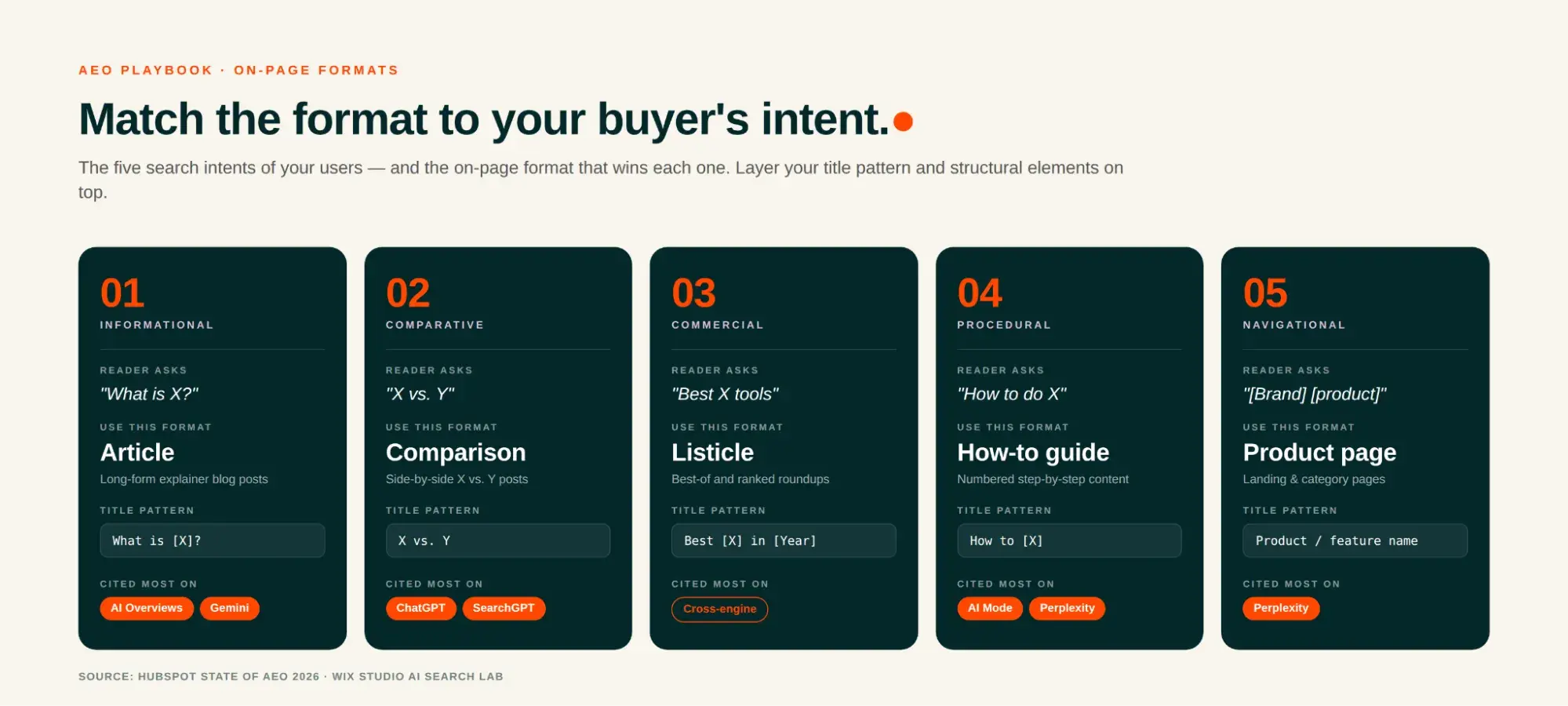
Five page types generate the majority of AI citations across all answer engines. Each is associated with a different intent, takes a different form, and rewards different structural choices in addition to the universal structural elements from the previous section. The following templates assume you already understand the basics – H1 matches intent, introduction TL;DR, H2/H3 hierarchy every 150-200 words, descriptive FAQ section, last updated date – and focus only on what’s distinctive about each format.
Note: The five formats come from the State of AEO and Wix data. The structural decisions within each template are part measured (stats, schema, FAQ, title patterns) and part principles-driven – they come from research and my own AEO work, but not from studies that isolate these precise decisions.
Long articles and explanatory blog posts
Best for: Information queries (“What is X”, “Why does X happen”, “How does X work” as a concept)
Blog posts and informative articles drive citations in AI Overviews (42% citation rate) and Gemini (76%) pro State of AEOand account for 45.48% of citations to requests for information in Analysis of Wix Studio – more than any other format with this intention. They are the safest cross-engine bet when the searcher wants to understand a concept, not buy something.
Template:
- Title: “What is (X)?” or “What is (X) and why is it important?”
- Definition line: a one- to two-sentence direct answer to the title question in the first paragraph, before any context, story, or framing
- Defined entity block at the top, indicating the adjacent terms on which the topic depends (for “What is AEO” these are answer machines, quotes and share of voice)
- Original statistics or first-party data in the article
- Scheme: Article
Listicles and best-of articles
Best for: Commercial searches (“Best (X)”, “Top (N) (X), “(X) tools”)
Listicles are the most cited content type in Wix Studio’s cross-engine data, accounting for 21.9% of all citations and 40.86% of commercial search citations. In State of AEO, listicle title patterns (“Best (X),” numbered lists) work for AI Overviews, Gemini, Perplexity, ChatGPT, and SearchGPT.
Template:
- Title: “Best (X) in (year)” or “(N) best (X) for (audience)” – both numerically and best-run titles perform; The year indicator correlates with citation increase when updated annually
- Selection criteria The intro explicitly states: what made the list, what didn’t, who you wrote it for
- Each item as its own H2 or H3 with the brand name in the heading (“2. SEMrush AI Visibility Toolkit”), no generic position headings (“2. Our Second Choice”)
- Description per item Shows the three or four facts that buyers compare: price, key feature, best value
- Comparison table Consolidate these facts in each article, at the top or bottom of the post
- Scheme: Item listindicating the name and position of each element
Brand name H2s make it clear what entity each section is about, while vague headings like “Our Second Choice” require LLMs to rely on the surrounding text to identify the brand being discussed.
Comparison posts (X vs. Y)
Best for: Comparative commercial search queries (“(Brand A) vs. (Brand B),” “Is (X) better than (Y)?”)
Comparison content has the highest citation rate of all formats State of AEO at 95% in ChatGPT and is the top title pattern for both ChatGPT and SearchGPT.
Template:
- Title: “(Brand A) vs. (Brand B)” or “(Brand A) vs. (Brand B): Which is better for (use case)?”
- Verdict at a glance in the first two sentences: Who wins for what? Not buried under a 300 word intro.
- comparison table, with the same attributes for both products in clearly labeled columns (pricing, key features, integrations, target users, reviews)
- One H2 per comparison criterion (not one H2 per product) so that each section answers directly: “Which one is better at (criterion)?”
- Mini verdict at the end of every second half of the year Indication of which product wins this criterion and why
- A final section “Which one should you choose?” Assign use cases to a selection, not just summarize them
- Scheme: Article; There is no native comparison scheme.
Product and landing pages
Best for: Navigational and transactional queries where the searcher already knows the brand or product (“(Brand)(Product Name)”, “(Brand)(Feature Name)”)
In Perplexity, product listings and landing pages achieve a citation rate of 84% per year State of AEO – the highest of all formats on this engine. Analysis of Wix Studio ranks product pages in 13.7% of all AI citations across all search engines, with the share concentrated where the buyer is closest to making a decision – 24.88% of transactional citations and 21.95% of navigational citations. On these pages, readers don’t learn more about a category; Here the searcher already knows the product and wants the specifications or confirmation of a function.
Template:
- Title: Product or feature name as primary anchor (“HubSpot AEO”, “Marketing Hub Email Automation”)
- Product summary in one sentence in the first paragraph (what product it is, who it is intended for, what category it belongs to)
- Specification table Lists key features, integrations, supported platforms and plan availability
- FAQ section Answering the actual questions entered into answer machines about a known product (“Is (product) integrable with (tool)?” “Is (feature) available in the (stage) plan?”
- Scheme: product
Category pages
Best for: Navigational and commercial-exploratory searches where the searcher wants to browse options in a category and not read editorial comments about them (“(Category) Tools”, “(Category) Software”, “(Category) in (Location)”)
Wix Studio treats category pages as a different content type than product pages, accounting for 11.3% of all AI citations. They deserve their place in the intent split: 18.31% of navigational citations, 14.97% of transactional citations, and 12.42% of commercial search queries. They are even more visible in e-commerce (15.96%) and home repair (14.95%) than the cross-industry average. State of AEO does not break down category pages separately from product lists and landing pages, so the segmentation here only occurs at Wix.
Template:
- Title: The category name itself (“Email Marketing Software”, “BI Consultant in Boston”) – no individual product brand in the title
- One paragraph scope statement Top: What the category covers, who it is intended for, and how the elements on the page have been grouped or filtered
- Article list of products in the category, each linked, with a one-line description that states the primary use case of the product
- Snapshot table Compare one or two attributes for each item (a starting price, a category defining feature, or a “best for” use case)
- Scheme: Item list or Collection pageindicating the name and position of each element
How to optimize existing pages with the best on-page content formats for AI
Start optimizing content for AEO on pages that are already generating organic traffic. Structural updates alone can increase the SEO value you’ve built. The following review initially targets the changes with the highest leverage.
The 5-step quick audit
- Select candidate sites. Capture your 25-50 organic pages with the most impressions and then prioritize the ones whose target queries you want to attract in ChatGPT, Gemini, or Perplexity. Run these queries again across the engines and note which pages are cited and which are not.
- Standardize heading hierarchy. Add an H2 approximately every 150-200 words and rewrite vague headings into descriptive, entity-anchored headings. For example, “Frequently asked questions about (topic)” instead of “FAQ”, “Step 3: Add JSON-LD markup” instead of “Markup setup”.
- Insert a TL;DR. Place the direct answer to the page’s main question in the first few sentences or in a special summary box before any progression or framing.
- Convert large facts into tables and FAQs. Specifications, prices, study results, and side-by-side comparisons in tables can be more easily extracted by AI than if they were buried in paragraphs. Move recurring reader questions to a descriptive FAQ section at the bottom of the page.
- Apply the scheme that corresponds to the format. If this applies to your content, use “Article”, “HowTo”, “FAQPage” or “ItemList” as well as “Author” and “Organization”.
Make content more “piecemeal”.
Long paragraphs are the best candidates for AEO optimization. When creating content for generative AI to extract from, restructure walls of text in the following ways:
- Break paragraphs longer than 100 words into shorter paragraphs or bulleted lists. Make sure each important paragraph can stand on its own. In other words, if just that one paragraph were extracted from the page, would it contain a valuable answer? Would it make sense?
- Introduce each paragraph with a subject-verb-object statement and then support it.
- Replace pronoun openers (“It also helps with…”) with named entity openers (“Schema markup also helps with…”) to eliminate confusion about what the pronoun refers to.
- Pull buried statistics and definitions into your own sentences.
- Add a section summary at the end of long H2s to give readers and answer search engines a clear summary of the section’s main point.
Mass updates and governance
Manually updating pages becomes tedious and difficult to track. HubSpot Content Hub provides teams with a CMS to update and republish content at scale, with built-in SEO recommendations that flag issues on the page as you work through the checklist. Be sure to check out our guide to using AI in your SEO workflow.
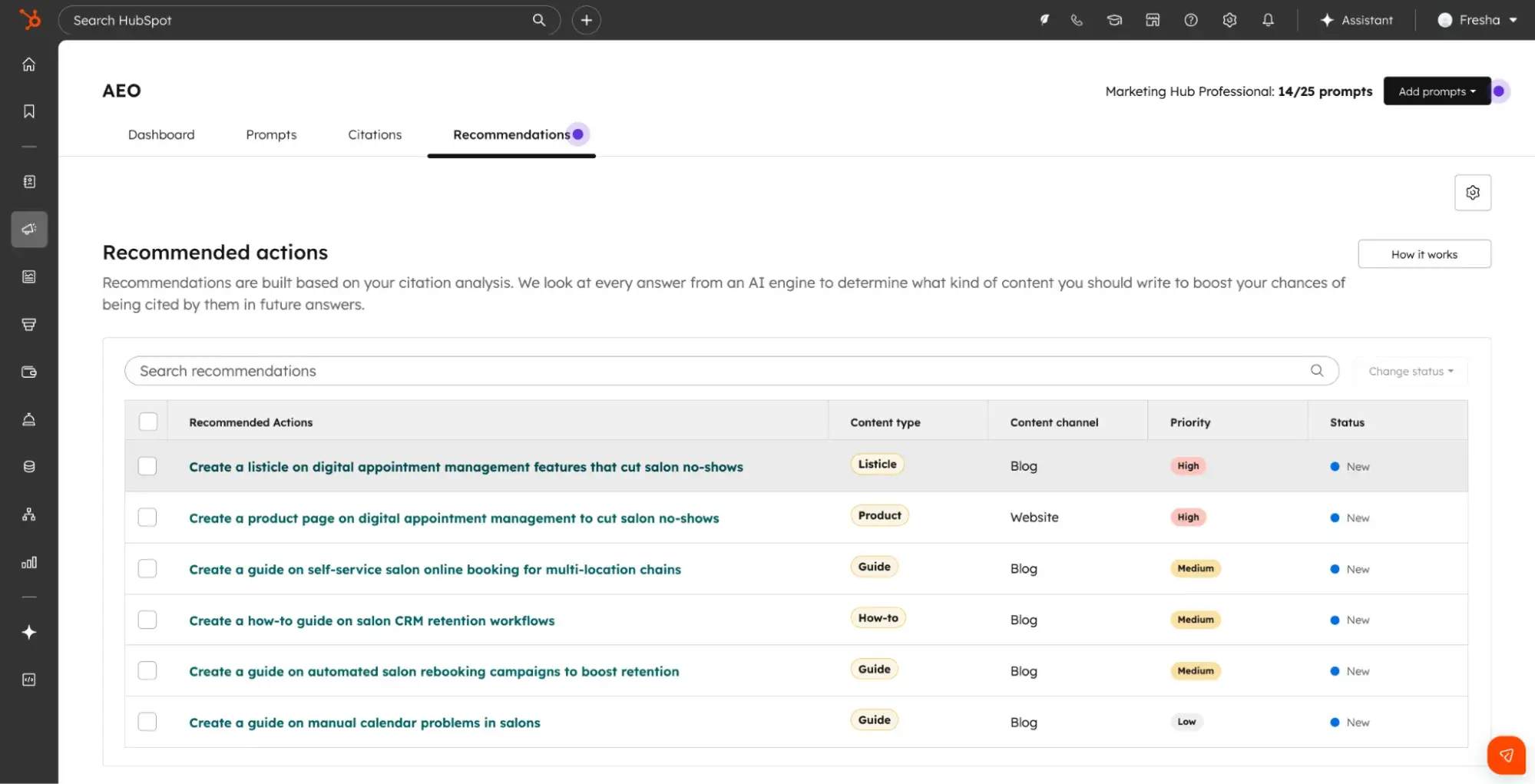
The answer machine specific recommendations come from HubSpot AEOwhat surfaces need to be repaired; You can troubleshoot the issue in the Content Hub.
How to measure the results of the best on-page content formats for AI
Content format changes only matter if you can prove they moved the metric. AEO-savvy marketers measure AI visibility alongside page-level performance and pull regular reports to track the progress of both.
AI visibility tracking
Three metrics form the basis of ChatGPT, Gemini, and Perplexity for a tracked set of prompts:
- Brand visibility: The percentage of prompts where your brand appears in the AI’s response
- share of the vote: Your brand mentions divided by the total number of brand mentions for you and your competitors
- Own quotes: When your website is cited in an AI response
If you do this manually, you will need to do a before-and-after comparison for each upgraded page by sending prompts through each engine before and after the update. But HubSpot AEO automates prompt tracking and provides brand visibility scores, share-of-voice scores, and citation information.
Pro tip: AEO grader is a free tool that gives marketers an assessed overview of how response engines represent their brand today. HubSpot AEO automates the tracking of prompts across response engines and compares competitive share for those prompts. Here’s how marketers can improve their brand’s AI visibility.
Page-level performance mapping
Visibility doesn’t always lead to sales. Therefore, map each optimized page to its conversion role – demo signups, content downloads, trial launches – and track engagement and conversion delta after the update. Referrer data from ChatGPT, Gemini, and Perplexity is incomplete or missing in many analytics tools, meaning AI-powered sessions often end up in “direct” traffic. Branded search volume and direct traffic shifts are useful proxy signals when referrer data is insufficient.
Report cadence
Set a monthly baseline and a more in-depth review quarterly. Re-run your tracked prompts across all engines at least once a month and log changes from the baseline. Check quarterly which pages have gained or lost citation shares and decide what to update next. HubSpot AEO sends you weekly score tracking and trend notifications, saving you time and quickly assessing results.
How to manage and update pages built with the best AI on-page content formats
Governance ensures that every page remains current and citable long after the initial review. Here’s a framework to help you ensure your content stays fresh to your audience, search engines, and response engines.
Governance model
Assign an owner per content cluster. The owner runs the cluster’s scan cadence and handles any updates triggered between scans. Notable common update triggers:
- A decline in citation share on a cluster page (captured during the monthly visibility recheck from the previous section)
- A major model release from OpenAI, Google, Anthropic or Perplexity
- Price, feature or product name changes on a referenced product page
- A new competitor or company appears in the answers in your category
The internal QA checklist a cluster owner can complete before re-publishing:
Update tactics
Update the parts of the page that contain the most direct citation signals.
- Update outdated statistics in tables and comparison sections to current numbers. A good rule of thumb is that if the document is more than two years old, use more recent research whenever possible.
- Add or rewrite FAQs to better reflect the questions customers might ask an answer machine. Marketers who use AEO in Marketing Hub Pro or Enterprise can receive timely recommendations based on their business context in HubSpot Smart CRM.
- Update screenshots and steps in the instructional content when the product interface changes.
- Update case study results with the latest measurable results.
- Check author bios, credentials, and outbound links to demonstrate ongoing EEAT.
Audience targeting and tools
The prompts you pursue should reflect the concerns of your potential buyers. AEO in Marketing Hub Pro+ uses yours Smart CRM Data to make quick suggestions so what you monitor stays rooted in your business context (rather than being reinvented from scratch). Combine this with AI content optimization tools to make changes to your content that can help increase AI citations.
Frequently asked questions about on-page formats for AI
Do I need a schema to rank in AI results?
No. Schema is not required for AI citations, but the State of AEO 2026 dataset flagged it as a structural element worth implementing, particularly schema markup paired with a properly formatted FAQ section, which increased citation rates in Gemini, Google AI Mode, and Perplexity. Treat the schema as a way to tell crawlers what page it is, not as a citation cheat code. Only use Articles, HowTo, FAQPage or ItemList where they accurately reflect the content. Marking elements that are not present on the page is a violation Google’s Structured Data Guidelines.
How often should I update AI-optimized content?
There is no magic number for how often AI-optimized content is updated, but there are some events that should trigger an update. Retest a page’s target prompts whenever you notice a drop in citations, a competitor entering an answer, or a larger model release OpenAI, Anthropocene, Googleor confusion. Conduct monthly re-audits of the visibility of your captured prompts and quarterly audits of pages that have lost ground. HubSpot AEO automates prompt-level tracking and highlights trend shifts so you can act quickly.
Can I block AI crawlers while maintaining search visibility?
Yes, major AI companies separate training crawlers from search crawlers, and the instructions are in robots.txt. Block GPTBot to prevent OpenAI from using your content for training, while still allowing OAI-SearchBot to allow ChatGPT live web search citations. block Google Extended to opt out of Gemini training while still being able to crawl Googlebot – which is used for Google search. Check each company’s bot documentation to confirm what each user agent actually does before adding them to your robots.txt.
Which format should I start with first?
Start with the format that matches the predominant intent behind your buyers’ searches. If most of your high-value searches are informational (“what is X,” “how does X work”), articles are your best entry point; They lead citations in AI Overviews and Gemini according to HubSpot’s State of AEO 2026. If they are comparative (“X vs. Y”), prioritize comparison posts that get the highest citation rate in ChatGPT. When buyers come from commercial search queries (“Best X”, “Top NX”), listicles cover the greatest cross-engine reach. From there, review the pages that are already ranking for those intents and optimize them first. Building on existing organic equity is the fastest route to citation profits.