
There is no denying that search behavior has changed. As more and more queries are answered directly by AI Overviews, ChatGPT, and Perplexity, the changes in search redesign are forcing marketers to rethink ranking and, just as importantly, learn how to write for AI search and not just a list of blue links.
The urgency is already evident in the numbers: loud HubSpot’s 2026 State of AEO Report, 58% of marketers say their company optimizes content for response engines. Answer Engine Optimization (AEO) has evolved from a fringe experiment to a mainstream priority.
But it is important to know and know AEO what actually needs to be done are two different things. The good news? The content that is most frequently cited has some recognizable characteristics that depend primarily on structure.
In this post, I’ll break down the content formats that work best in AI search, from question-based headlines and direct response summaries to structured data and deliberate website structure designed for maximum impact.
Table of contents
Why content structure increases citation rates in reply engines
Search is shifting from a list of links to a single, synthesized answer.
Instead of returning a list of links, Google’s AI Overviews, ChatGPT and Perplexity now provide:
- Read a page
- Highlight the passage that best answers a question
- Quote the source inline
These days, visibility is no longer about ranking in the top 10 blue links. These days, it’s all about whether a reply engine can extract a clean, self-contained passage from your page and associate it with your brand.
That is, the page structure is The Mechanism that makes this extraction possible.
Here is a detailed breakdown of the reasons:
- Response engines clearly prioritize content. Well-formed headings, short declarative passages, and explicit question-answer pairs give parsers clear boundaries to follow.
- The cleaner these boundaries are, the higher the probability of citation. Poorly structured pages force the engine to guess and ambiguous passages are rarely cited.
- The conclusion for AEO: The same structural themes that make a page easier to parse correlate with higher citation frequency.
Structural themes that correlate with quotations
Clear structure and direct answers appear in all quoted content. You should think of them as the core of AEO.
This is what they look like in practice:
- Question-based headings improve answer extraction and topic clarity. A heading worded as the question it answers tells the engine exactly which passage is assigned to which question.
- AI summaries extract concise passages that answer a specific question. Start each section with the answer in the first sentence or two, then add support—a pattern often referred to as AI passage extraction.
- Q&A blocks support quote-friendly answer formatting. Explicit question-answer pairs are among the easiest structures for engines to quote verbatim.
- Keep paragraphs short. Dense blocks with multiple claims obscure the extractable answer.
In the next section, you’ll learn how to put these patterns into action.
Schema and Entities: The Machine Readable Layer
Schema and entity consistency directly closes the gap in weak schemas and internal links.
This machine-readable layer tells search engines what a page is and who is behind it. To help you better understand how each schema type works, here is an overview of the most important schema types:
- The article schema describes the primary page content. It highlights the headline, author, and publication date to help search engines identify the main content.
- The FAQPage schema markup structures question-and-answer content. This allows search engines to read each question and answer pair directly and quote it verbatim.
- The organizational schema identifies the brand behind the content. It ensures that the quote cites the correct source.
- Person-entity markup connects content to a named expert. It provides the author with credibility signals that search engines weigh before assigning an answer.
- Consistent entities align brand, product, and author relationships across your site. This strengthens attribution over time.
How to measure schema and entities
Optimization for AI-generated answers only counts if it is measurable.
To measure your progress, track the following three signals:
- Quotes: How often do answer engines cite your pages and for which search queries?
- Mention quality: Whether the brand is named, linked and displayed correctly.
- Supported conversions: Sessions that start with a response engine quote and convert later.
Now that I’ve covered the three most important KPIs, let’s discuss how we can respond to them.
How answer machines analyze and cite content
Response machines don’t so much rate pages as read them. Before a quote appears in an AI summary or Perplexity response, the engine does the following:
- Retrieves candidate pages
- Divide them into individual passages
- Selects the one that most directly answers the query
Understand that it is the parse-then-cite pipeline that separates content that gets cited from content that gets skipped. Additionally, understanding AEO, which I will explain shortly, will give you a framework for receiving these quotes repeatedly.
What is AEO?
AEO (response engine optimization) is the practice of structuring content so that response engines can extract, understand, and cite it.
- SEO optimized for a ranked link; AEO optimizes inclusion. With AEO, your content is included in the generated response itself.
- The reward is brand visibility. When a search engine cites your page, your brand will appear in the response, often as a named source link.
- Consistency confirms brand, product and relevant author information. This is how a search engine decides that your page is a credible source worth citing.
How a response machine analyzes a page
Engines divide a page into blocks and evaluate each one based on the query. Knowing how this works is the first step to optimizing content for response engines.
- Retrieval: The engine fetches candidate pages from its index or a live search.
- Passage extraction: It isolates the snippet that answers the question.
- Selection: AI engines prefer clean, self-contained answers
What makes a passage quotable
This is the core of structuring content for Google’s AIOs and, more importantly, the foundation for broader visibility of the AI overview.
As a content writer at HubSpot who creates long-form blogs that regularly rank in AI search, here’s what I do to make my content quotable for answer engines:
- Include question-based headings. This improves answer extraction and topic clarity by indicating which passage belongs to each query.
- Implement direct response passages first. This gives the engine a liftable snippet, the essence of writing for AI extraction.
- Use FAQPage schema markup structures for question-and-answer content. This makes question and answer pairs machine-readable.
Topic 1: Question-based headings and direct answer summaries
Let’s talk about question-based headings and direct response summaries.
These types of headlines and direct response summaries are two of the highest leveraged structural actions in AEO. As stated by AirOps in their State of AI Search 2026 ReportSequential heading structures increase citation likelihood by 2.8x.
In short, AEO rewards passages that an engine can elevate and map, and that’s exactly what these two formats do. You assign a passage to a request and send the engine a ready-to-use response.
Below I have described in more detail how each function works.
Question-driven headings
A question-based headline accurately reflects the query a reader or search engine would enter.
- Question-based headings improve answer extraction and topic clarity. The heading tells the engine what question the passage below answers.
- They also anchor the section to a single intent rather than a vague theme. This focus makes it easier for an engine to match the passage to a specific query.
- In practice, this is the way content is structured for AIOs. Phrase the headline as a question and then answer it immediately.
Direct Answer Summaries (TL;DR)
In a direct response summary, the answer is stated in one or two sentences before each context.
- TL;DR summaries help answer engines accurately summarize sections by giving the parser a canned, self-contained answer.
- Provide the answer and then add support. This answer-first pattern is the essence of AI passage optimization.
- Brevity is important. Keep the text to around 40 words so that it fits neatly into a featured snippet or AI answer box.
How to format Q&A blocks for maximum citation potential
Q&A blocks combine an explicit question with a concise answer, making it one of the most quotable structures on a page.
To maximize citation potential, be sure to format them as follows:
- Write the question as a real request. Use natural formulations; a person would search, not a clever label.
- Answer in the first sentence. Provide the full answer in advance. After that, add nuances.
- Keep each answer self-contained. It should make sense to be lifted off the page.
- Limit each answer to two to four sentences. Long answers dilute the passable passage.
- Add FAQPage schema. Mark the pairs so they are machine readable.
- Assign ownership. Authors design the couples; Web teams maintain the schema. Clear roles ensure consistent formatting across the site.
This is also a practical core for maximizing content for response engines and a cornerstone of AI overview optimization.
Next, let’s look at an example that demonstrates the difference in practice.
Weak vs. AEO capable example
- headline – Weak: “Headline strategy.” AEO capable: “What makes a headline quotable for AI answer machines?”
- Summary – Weak: “In this section, we will examine various considerations that may influence the results.” AEO capable: “TL;DR: Question-based headings and answer-first summaries are the structural patterns that correlate most strongly with AI citations.”
- Q&A block — Weak: The answer is buried in the middle of the paragraph. AEO ready: “Q: How long should a direct answer be? “A: One to two sentences that precede any supporting detail so that an engine can lift it cleanly.”
Together, these patterns reflect best practices for AIO visibility: ask the question, answer it first, and make the answer easy to extract and attribute.
Topic 2: Semantic Schema and Entity Modeling
Schema and entity modeling are the machine-readable layer of AEO. They provide answer machines with explicit facts about what a page is, who wrote it, and the brand behind it, closing the vulnerability gap that prevents otherwise strong content from being cited.
Clear prose tells a person what you mean; The schema tells a machine the same thing in a format it can respond to.
However, AEO depends on both, as an engine can only attribute a quote if it can confidently identify the source.
The schema types that describe your content
Structured data characterizes the parts of a page so that an engine does not have to infer it. The four that are most important for citations:
- The article schema describes the primary page content – Headline, author and publication date.
- The FAQPage schema markup structures question-and-answer content so that engines can read each Q&A pair directly.
- An organizational schema identifies the brand behind the content, Make sure to cite the correct source when quoting.
- The person schema associates content with a named expert. Providing authors with credibility signals.
Overall, this structured data is part of the approach to structuring content for Google’s AIOs feature and, most importantly, a core component of broader AIO visibility.
Pro tip: Use HubSpot’s AEO Grader to compare how answer machines represent your brand today. It provides a scored snapshot that flags weak or missing entity signals before they lead you to quotes. Then use HubSpot AEO to track how your brand appears in answer search engines over time.
How to model entities that recognize and cite response machines
Entity modeling means defining the people, brands, and products on your website as consistent, connected things rather than random words on a page. And with a conscious entity model, not only is entity consistency strengthened, but also brand, product, and author relationships, helping search engines build trust in your source over time.
Check out this easy-to-understand, practical sequence to model entities that recognize and quote response machines:
- Step 1: Define your core units. List your brand, products, and lead authors as separate entities.
- Step 2: Use one canonical name per entity. Reference every element consistently on every page. Variants weaken detection.
- Step 3: Connect entities to a schema. Link Person to Organization and Article to both so that the relationships are explicit.
- Step 4: Add SameAs references. Point entities to authoritative profiles (LinkedIn, Wikidata, Crunchbase) to make them unique.
- Step 5: Reinforce with internal links. Link related entities across pages to signal topic and brand relationships, directly closing the internal linking gap.
- Step 6: Assign ownership. SEO strategists define the entity model; Web teams implement schema; Content marketers ensure that names remain consistent in the text.
This order simplifies passage optimization for AEO: Structure the answer, then label who said it and what it’s about.
Weak vs. AEO Ready Example (Entity Driven)
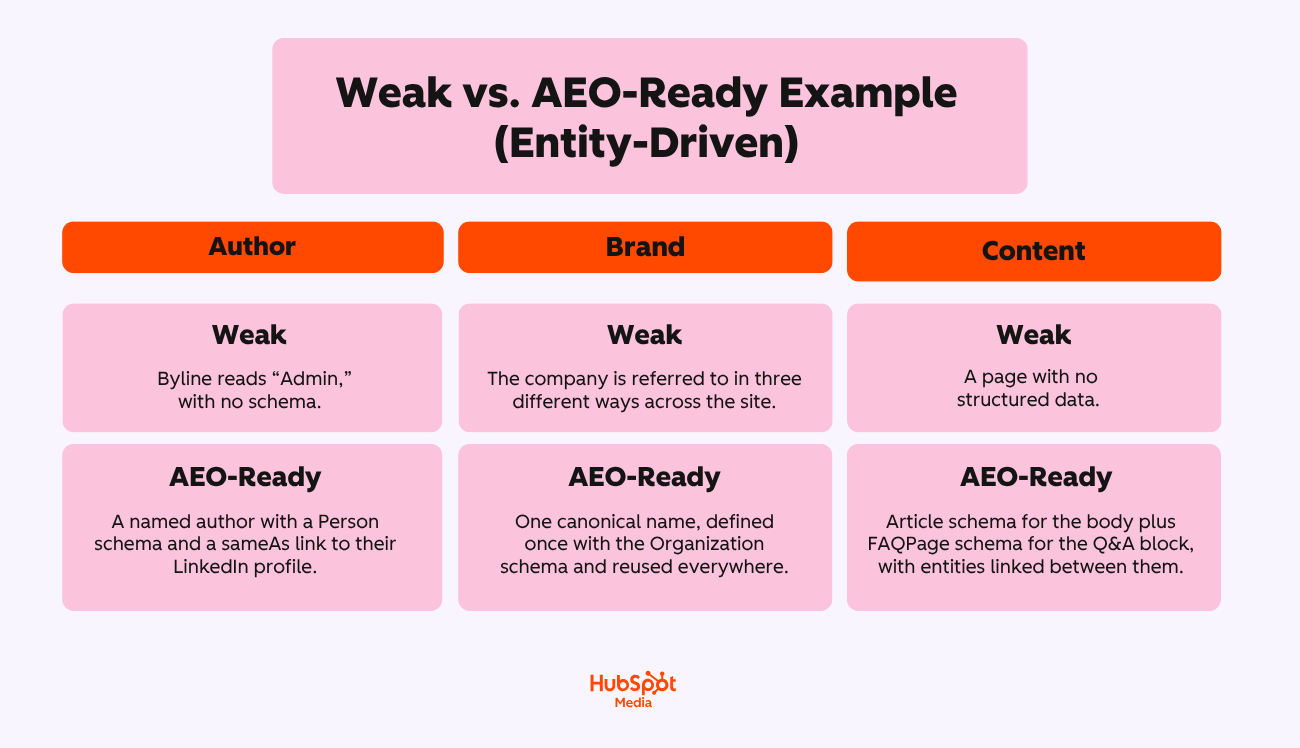
Here is a comparison between weak and strong entity modeling methods for AEO at the author, brand, and content levels:
- author – Weak: The byline says “Admin” without any schema. AEO ready: a named author with a person schema and a even Link to their LinkedIn profile.
- brand — Weak: The company is mentioned in three different ways on the website. AEO-enabled: a canonical name that is defined once with the organizational schema and reused everywhere.
- Contents — Weak: a page without structured data. AEO-ready: Article schema for the body plus FAQPage schema for the Q&A block, with entities linked between them.
When done well, this is the difference between content that an engine merely reads and content that it can confidently cite, and it reflects content optimization best practices for Google’s AIOs: Make it clear what, who, and what brand.
Topic 3: Significant signals and trust markers
Here’s the tricky part of AEO: answer engines weigh trust before quoting.
Two sites can answer a question equally well, but the engine prefers the source it can verify. These signals of trustworthiness are called authority signals.
Basically, they are how you gain that trust and they directly impact the quality of the mention.
Authoritative brand, leadership and product profiles
A profile is a stable, well-described entity that an engine can recognize and trust. Strong profiles make it clear who and what they represent.
- Brand: A complete, unified company profile.
- Managing Director: A named leader with a real biography, not an anonymous byline.
- Product: Clearly named products with consistent descriptions across pages so a search engine understands what you offer.
This profile level is a handy way to get the most out of response engines: give them verifiable entities, not vague mentions.
Distribution across trusted ecosystems
When distributed, your content and entities appear beyond your own website, and response engines consider verification from reputable sources as a trust signal.
- Clearly defined entities re-establish brand, product, and author relationships wherever you publish. Each performance strengthens the other.
- Prioritize the already trusted ecosystem engines. These ecosystems include established publications, business directories, Wikidata, LinkedIn and credible review sites.
- Make sure names, bios and links are the same everywhere. Mismatches dilute recognition. Consistency is what ensures that each appearance enhances the other.
- This confirmation is part of what works in the AI Overview content. Answer engines prefer sources that have been verified by multiple trusted sources.
Video transcripts, timestamps and VideoObject
Unfortunately, it’s difficult for engines to parse videos unless you make them text-readable.
Luckily there is Are Especially supplements that do just that; they are as follows:
- Transcripts: A full transcript converts spoken content into text that can be extracted. AIOs extract concise passages that answer a specific question, and a transcript gives them passages to lift. It is an AI-enabled passage structure that is only applied to videos.
- Timestamp: Chapter timestamps assign specific answers to specific moments, helping structure content for Google’s AIOs feature when it comes to videos.
- VideoObject schema: This markup describes a video’s title, description, and key moments, allowing search engines to index and cite it. It is a building block for AEO at the level of AI overview in the multimedia area.
Weak vs. AEO-ready example (for authority signals and trust markers)
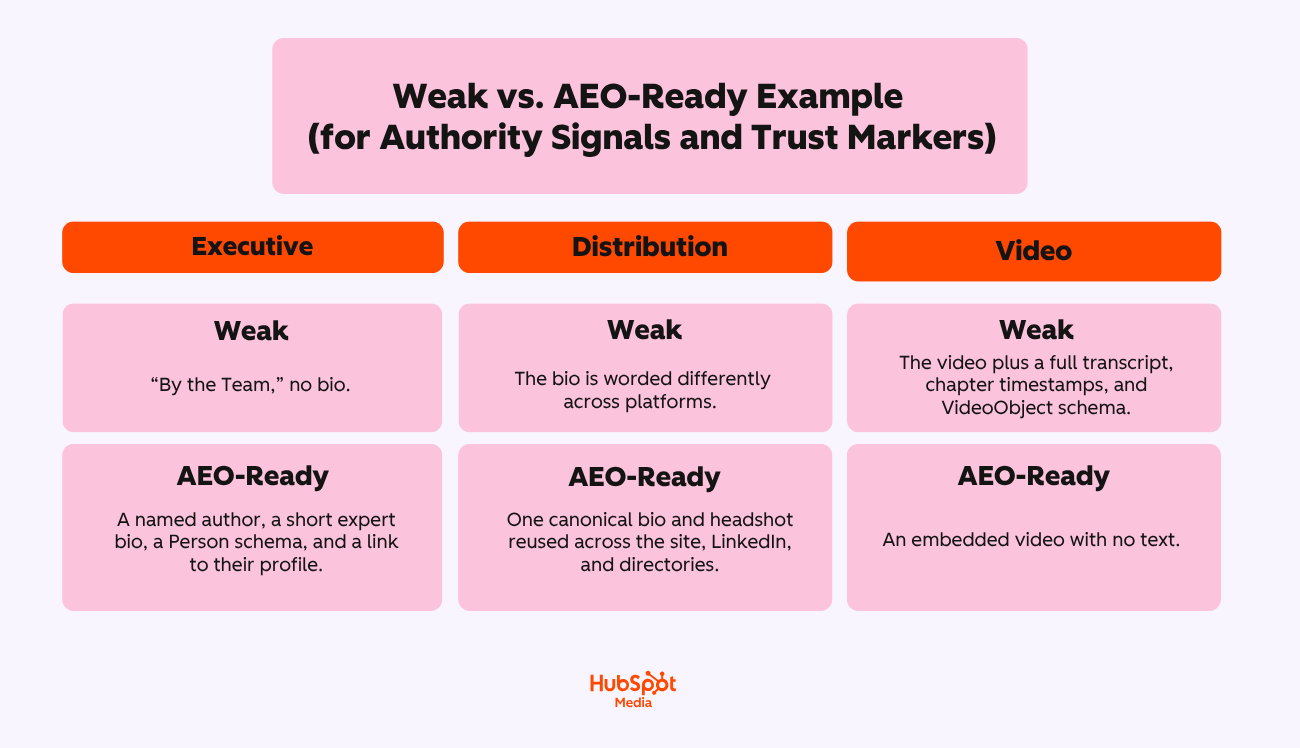
- executive – Weak: “From the team”, no biography. AEO ready: a named author, a short expert bio, a persona and a link to their profile.
- distribution — Weak: The biography is worded differently on the different platforms. AEO-ready: a canonical bio and headshot are reused on the website, LinkedIn and in directories.
- video – Weak: an embedded video without text. AEO ready: the video plus a full transcript, chapter timestamps, and VideoObject schema.
If implemented consistently, these trust indicators are a measurable lever for AEO. They turn “a page that answers the question” into “the source that an engine is willing to name.”
Topic 4: Strategic internal link architecture
Internal linking is the expression of site-level structure and one of the weak points that silently limits citations. Therefore, treating internal links as architecture is one of them preferably Ways to optimize content for AIOs.
Strong internal linking helps search engines crawl, group, and trust related content. Simply put, weak or random linking will result in your best answers being lost and difficult to assign to a topic.
Hub and spoke structure, glossary pages and sibling links
A hub-and-spoke model organizes a topic into a single authoritative page that links to targeted supporting pages.
- Hub (column): A broad site that covers the topic at a high level.
- Spokes: Focused pages, each answering a narrower question and linking to the hub.
- Glossary pages: Short, explanatory pages that explain important terms and link to related articles.
- Sibling links: Links between related spokes so engines see the entire cluster rather than isolated pages.
This architecture largely reflects how content is structured for Google’s site-level AI Overview feature.
Clear anchor text and early link placement
Anchor text and placement tell search engines what a link means and how important it is.
- Use descriptive anchor text. Descriptive anchors do to links what question-based headings do to sections: they improve the way AIOs extract information, and clear anchors extend that clarity to the relationships between pages.
- Avoid vague anchors. “Click here” and “continue reading” do not have a current signal.
- Place important links early. Links at the top of a page are seen before an engine truncates the read and tend to carry more weight.
Done well, this is a practical guide to optimizing content for response engines.
Internal link to topic clusters
A topic cluster is a group of interconnected pages that together comprehensively cover a topic.
- Clearly defined units establish brand, product and author relationships, and a well-connected cluster does the same for topics – each internal link tells an engine that these pages belong together.
- Large, interconnected clusters signal current authority, which is associated with higher citation frequency.
- Clusters also direct engines to the passages worth citing, complementing passage optimization.
- For governance, assign each cluster an owner who will keep links updated as pages are added or removed.
Weak vs. AEO-ready example (internal link architecture driven)
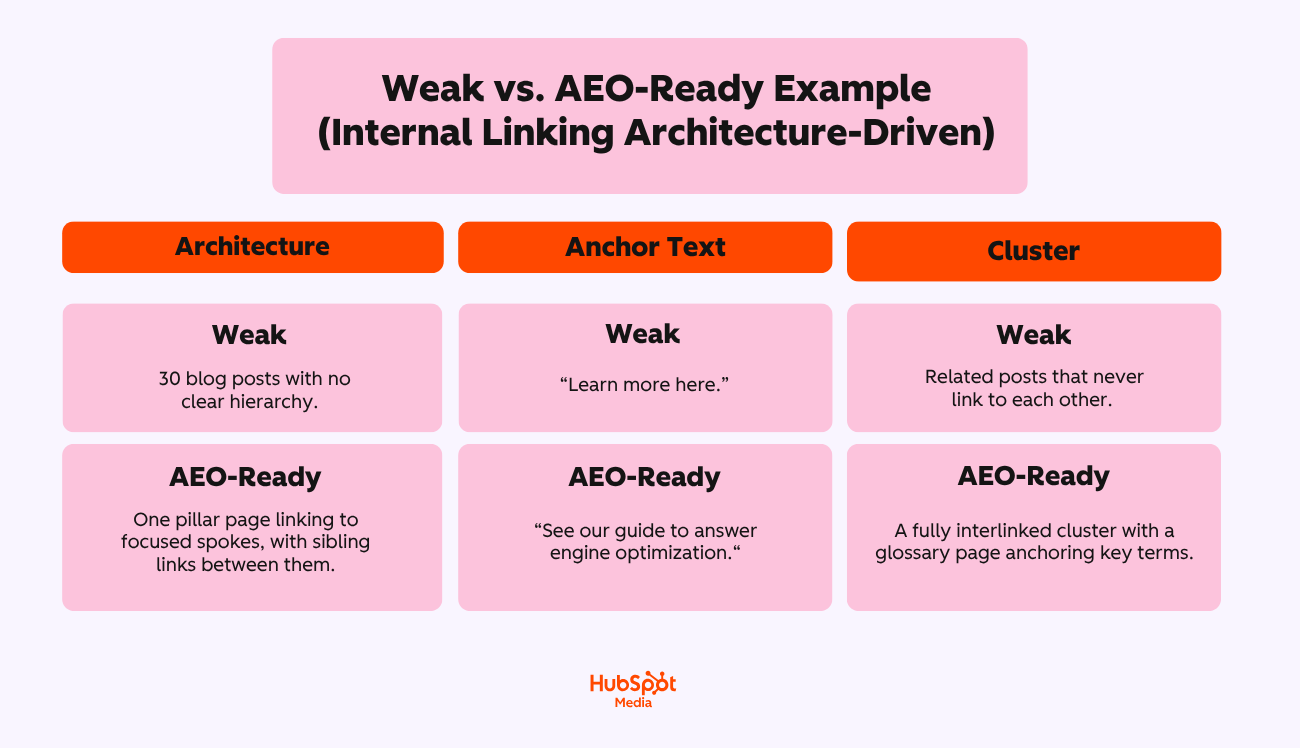
- architecture — Weak: 30 blog posts without a clear hierarchy. AEO Ready: A pillar page with links to focused spokes and sibling links between them.
- Anchor text — Weak: “Learn more here.” AEO capable: “Check out our search engine optimization answer guide.”
- Clusters — Weak: related posts that are never linked to each other. AEO-ready: a fully connected cluster with a glossary page anchoring key terms.
When used correctly, internal linking is a measurable lever for AEO and a foundation for sustained AI overview performance.
Topic 5: Passage-level optimization for extraction
Extractable passage writing is the practice of writing each passage so that it can be extracted and quoted individually, without the surrounding page.
A passage is a self-contained section (e.g. a paragraph, a list, a table row, a definition). The goal is for each individual element to make sense outside of context.
This passage-first mindset is at the core of AEO at the content level.
Stand-alone paragraphs that answer a question
Each paragraph should answer exactly one question and stand on its own.
A stand-alone answer paragraph provides the answer clearly and without dependence on the paragraph before it.
Open with the answer and then add support. Also avoid pronouns that refer to a previous text (e.g. “this”, “that approach”). (They interrupt the passage when it is picked up. One question per paragraph is the focus of optimizing content for answer machines.)
Lists, tables and definition fields
Structured formats are among the most snippet-friendly elements on a page.
Below are the types of extractable formats you should include to be successful at AEO:
- TL;DR summaries help answer engines accurately summarize sections.
- Tables and definition fields act as pre-built summaries that an engine as a whole can create.
- Lists fit steps, rankings, and option sets.
- Tables are useful for comparisons and specifications where rows and columns can be clearly assigned to the answer.
- Definition boxes provide a one-line, quotable answer to the question “What is X?” Queries.
- Effective use of these formats is part of structuring content for AIO functionality.
Concise, extractable sentences
Sentence length and clarity determine how cleanly an engine can quote you.
- Put key facts first; Trim qualifiers that dilute the claim.
- One idea per sentence makes each one individually quotable.
- Concise sentences are a quiet but reliable lever for improving the visibility of your AI search.
Weak vs. AEO capable example
- Paragraph – Weak: “As we mentioned above, there are multiple factors, and they interact in ways that are worth exploring.” AEO capable: “A removable passage answers a question completely in two to three sentences.”
- format — Weak: a comparison buried in prose. AEO-ready: a two-column table comparing options side by side.
- Sentence — Weak: a sentence with 40 words and three subordinate clauses. AEO-ready: a 12-word sentence stating a fact.
When your content is optimized passage by passage, search engines get clean units to cite.
How to align structural themes with Google’s quality guidelines
Structural optimization is only cited if the underlying content is truly helpful. Google rewards human-centered content, and AEOs that game the system while ignoring quality tend to backfire.
My advice? Balance both: use structure to highlight good content and never to obscure weak content.
The structural themes that best fit quotations (e.g. clear headings, direct answers, schemas) increase quality. They don’t replace it.
Knowing how to structure content for Google’s AIOs feature is only important if the substance holds up. This is the line between long-lasting AEO tactics and short-lived tricks.
Accuracy, quality, relevance and user context
Google evaluates content based on a few key dimensions. Treat them as prerequisites for any AEO work, rather than boxes to be checked after the fact.
- Accuracy: The facts are accurate, current and sourced.
- Quality: The content is original, sufficiently in-depth and genuinely useful – not sparse or duplicative.
- Relevance: The page matches the intent of the search query, not just its keywords.
- User context: The answer fits the seeker’s situation – his level, his location and his goal.
Pro tip: Before optimizing the structure of a page, ask: “Would this answer satisfy the searcher even if no AI summarized it?” If not, repair the fabric first.
Disclosure when automation helps
Google considers AI-powered content acceptable if it is helpful and not created primarily to manipulate rankings. Transparency about how content is created protects reader trust.
- Identify the human author and editor responsible for the content.
- Ensure meaningful human review when designing or supporting automation.
- The person schema links content to an actual person so that attribution is clear and machine-readable and not just a byline.
Pro tip: For AI-powered drafts, add an editor’s note, e.g “Reviewed and fact-checked by (Name), (Title).” It signals responsibility towards readers and search engines alike.
Do/Don’t guidelines for helpful content
Clear guidelines ensure that a team’s performance remains consistent. The governance gap that many content organizations struggle with.
Do:
- Lead with an accurate, direct answer.
- Cite primary sources for data and claims.
- Attribute each page to a real, named author.
- Have a human review AI-powered output before publishing.
Not:
- Publish unedited automated text.
- Create statistics, offers or expertise.
- Creating keyword stuff or pages that only exist for search engines.
- Treat structure as a substitute for substance.
Consistent entity signals that unify brand, product, and expert POVs, as well as honest attribution across pages, are part of how Google interprets trustworthiness. AI passage optimization must also first serve the reader.
When you apply it this way, your structural work strengthens Google’s commitment to quality rather than fighting it. The foundation of best practices for presentation in AI overviews.
Pro tip: Turn this into a one-page checklist in your CMS. Integrating the guardrails into the publishing workflow allows you to adapt content for response engines without sacrificing quality.
How to measure citation performance and structural impact
In my opinion that is hardest Part of AEO is proving it works. Most teams can publish structured content, but can’t yet answer a simple question: Did the structure actually receive more citations?
Fortunately, measurement closes this gap. By measuring you confirm that the preference is paying off on your pages.
Structural impact essentially means that a specific change will be linked to a specific citation result. Without measurement, AEO remains a guess.
This makes your approach to structuring content for AIOs repeatable and data-driven.
The three KPIs that matter
Track these three KPIs together; Everyone answers a different question.
- Citation frequency: How often do reply machines cite your pages? Measures raw visibility.
- Mention quality: Whether the quote names your brand, refers to you and accurately represents you. A frequent but inaccurate mention can do more harm than good.
- Supported conversions: Sessions that start with a response engine quote and convert later. Connects AEO to sales, not just reach.
KPI framework at a glance
The measurement loop: diagnose, test, measure, iterate
Treat the structure as a series of testable hypotheses rather than a one-time solution.
- Diagnose. Establish a baseline; run HubSpot’s AEO Grader to see how reply engines represent your brand and which pages are already being cited.
- Test a structural change. Change one variable at a time.
- Measure. Compare citation frequency, mention quality, and assisted conversions before and after the change.
- Iterate. Maintain what moves the KPIs; Roll out the successful pattern on similar pages.
This loop is the practical core of content optimization for response engines, and applies equally to optimizing passages for citations: change the passage, then measure whether it gets addressed more often.
How to operationalize commonly cited content topics
Successful structural themes only become stronger when they are systematized. Operationalizing AEO means turning one-time successes into a repeatable workflow so that every page is delivered with the same quotable structure, regardless of who writes it.
Answer machines prefer content with a clear structure and direct answers. Consistency is what ensures this structure appears on every page, not just your best ones.
To implement consistency well across content teams, break it down into two systems: 1) who does what (roles) and 2) how it’s reused (templates).
Role-based checklist
Assign each part of the AEO process to a unique owner so nothing falls through.
- Strategist: Defines the target queries, maps the topic clusters, and sets the structural standard that each page must meet (e.g., coding how to structure content for Google’s AIOs feature in a repeatable specification).
- Writer: Writes question-based headings, leads with direct answers, and designs the TL;DR and Q&A blocks.
- SEO: Checks keyword and entity coverage, internal links, and headline match to real search queries.
- Developer: Implements and tests the schema (article, FAQ page, person, organization) and keeps the markup valid.
- PM: Executes the workflow (i.e., schedules audits, tracks KPIs, and keeps the loop moving so continuous improvements occur).
Templates in the Content Hub
Reusable templates transform structural topics into standard topics, taking the guesswork out of authors.
I suggest creating them once (possibly with Content Hubbut use the tool you like best) and apply them to each relevant page:
- Q&A template: A repeatable question and answer block.
- TL;DR template: There is a brief summary at the top of each section. (For this type of summary, a template enforces the habit of giving the answer first.)
- Schema template: Pre-built structured data blocks. The article schema clarifies the primary page content; Submitting templates ensures that the scheme is never skipped in a timely manner.
Pro tip: You can use this to speed up the design Breeze AI by generating Q&A and TL;DR blocks from your template in the first pass and then having a human review them as required by quality guidelines. In this way, optimizing passages for response machines becomes the default rather than a special effort.
Frequently asked questions (FAQs) about structuring content for Answer Engine citations
Do I need a new AI overview page or can I optimize existing content?
You almost can always optimize existing content; A new page is rarely required.
Here’s why:
- AIOs extract concise passages that answer a specific question. So the unit quoted is the passage and not the page. Therefore, AI-enabled passage structure is the fastest way: improve passages on pages you already rank for.
- Restructure existing posts with question-oriented headings, a TL;DR, and question-and-answer blocks. This is a lot of how content is structured for Google’s AIOs, which is applied to pages you already own.
Which schema types help the most with B2B content citations?
In B2B, prioritize the schema that creates credibility and structure.
- An organizational schema recognizes the brand behind the content, This is important when buyers and motors are considering a provider.
- Person-structured data links content with a named expert, Strengthening the expertise that B2B audiences expect.
- FAQPage schema markup structures question and answer content, suitable for Comparison and guidance questions that are common in B2B research.
Overall, these strengthen AEO by making your authority and structure clear.
How often should I update content to maintain citation rates?
Update on a schedule based on how quickly the topic changes, rather than a fixed calendar.
- Fast-moving topics (tools, prices, regulations): Review quarterly.
- Stable topics (definitions, frameworks): Check every 6 to 12 months.
When you update, update the facts, reconfirm the direct response, and update your structured data so that the modified date update signals freshness. Consistent refreshing is part of sustainable AIO optimization; Outdated answers lose citations to newer sources.
Can I limit LLMs and still do the traditional search?
Yes, but understand the trade-off.
Blocking AI crawlers (via robots.txt or specific user agents) can keep content off some answer engines while still ranking in traditional search indexes. But the same structure that brings in AI citations (i.e. clear answers, schema, searchable passages) Also Helps with traditional rankings, so limiting LLMs loses citation benefits without improving SEO.
The more common approach is to remain open to search engines and compete in structure. Knowing how to optimize content for response engines is rarely at odds with ranking well in traditional search.
Set your robots and crawler rules intentionally instead of blocking them by default.
What is the best way to adapt the response engine structure to our CRM funnel?
Map content structure to funnel intent and then connect it to your CRM for measurement.
- Question-oriented headings increase the likelihood that answers will be extracted. Frame each page around the question a buyer is asking Funnel stage (i.e. awareness, consideration or decision).
- Lead the content of each stage with a direct answer. Then lead to the next step with internal links and clear CTAs.
- Include tracking-assisted conversions. These are query sessions that start with a response engine quote and are later converted in your CRM.
This connects citations to the pipeline and reflects best practices for optimizing content for Google’s AI Overviews. So, do content structuring to increase sales, not just reach.
Winning in the age of AI search doesn’t have to be daunting.
I know the transition to AEO can be overwhelming, but mastering it requires one learnable discipline: structure.
LLMs prioritize content that is clear and direct, and any format that merits citations is just another expression of that one principle. You don’t have to reinvent your content; You need to ensure that the best answers are easy to find, highlight, and attribute. This is the entire AEO practice.
The work is also more manageable than it looks because it is systematic rather than magical. If you want my advice, I suggest:
- Start by establishing structure on the pages you already rank for.
- A schema and consistent attribution are then added.
- Finally, we measure what moves citations, mention quality and assisted conversions.
Additionally, consistent units link brand, product, and author relationships, amplifying the benefits as your team applies the same templates and role-based checklists on every page. When AEO is viewed as a repeatable workflow rather than a guessing game, it becomes a lasting advantage rather than a scramble.
The quickest way to start is to look at where you are right now.
Are you ready to transform the structure of your content into quotes? Start with HubSpot AEO Today.