
According to McKinsey 50% of consumers now use AI-powered search and more than 70% rely on it to ask questions and gather information. This shift in search behavior means SEO leaders must evolve. Modern workflows need to incorporate Answer Engine Optimization (AEO) strategies so that brands not only rank on page one of Google, but also gain visibility in AI-generated answers on platforms like Google AI Overviews, ChatGPT, and Perplexity.
This means marketing leaders need to know what’s going on with their brand in AI search. How do AI tools reference it, cite it, and in relation to which search queries do brands appear?
Enter Profound and Peec AI. These AI visibility tools are designed to help marketing teams monitor, measure, and improve their search generative experiences (SGE) content while tracking how AI response engines represent their brand.
As AEO becomes a strategic priority, marketers are evaluating Profound AI vs. Peec AI for AEO and looking for a clear comparison between the two. This guide explains what each platform offers, how they differ, and which solution will best support a team’s strategy.
Table of contents
Why marketers should consider Profound and Peec for AEO
As AI-powered answer engines transform the way people find information, marketers need new ways to measure and influence brand visibility beyond traditional search. Platforms like Peec AI And Deep AI Sit at the center of this shift. Both are designed for Answer Engine Optimization (AEO), helping teams understand how their brand appears in AI-generated answers in tools like ChatGPT, Claude, and Perplexity.
At a high level, they solve similar problems—tracking AI mentions, citations, and visibility—but differ in depth, complexity, and intended use cases.
- Peec AI The focus is on clarity and accessibility. It offers straightforward visibility tracking, sentiment analysis, and competitive benchmarking. It’s well suited for teams that want quick insights without the hassle of implementation. The downside is that it may lack some of the deeper integrations and advanced workflow features that larger companies need.
- Deep AIIn contrast, it is designed for scalability and feasibility. It combines visibility tracking with deeper analytics, integrations, and optimization workflows. With Profound, enterprise teams can directly link AI presence to content strategy and business outcomes. However, this additional power can come with greater complexity and a steeper learning curve.
Marketers should consider tools like Peec AI or Profound AI as AI response engines increasingly shape what customers see and trust, and these platforms reveal whether – and how – a brand appears in those responses. Both platforms help marketers understand and optimize how their brand appears in AI answers, an increasingly important part of modern search visibility as AI answers replace traditional blue links.
Peec AI
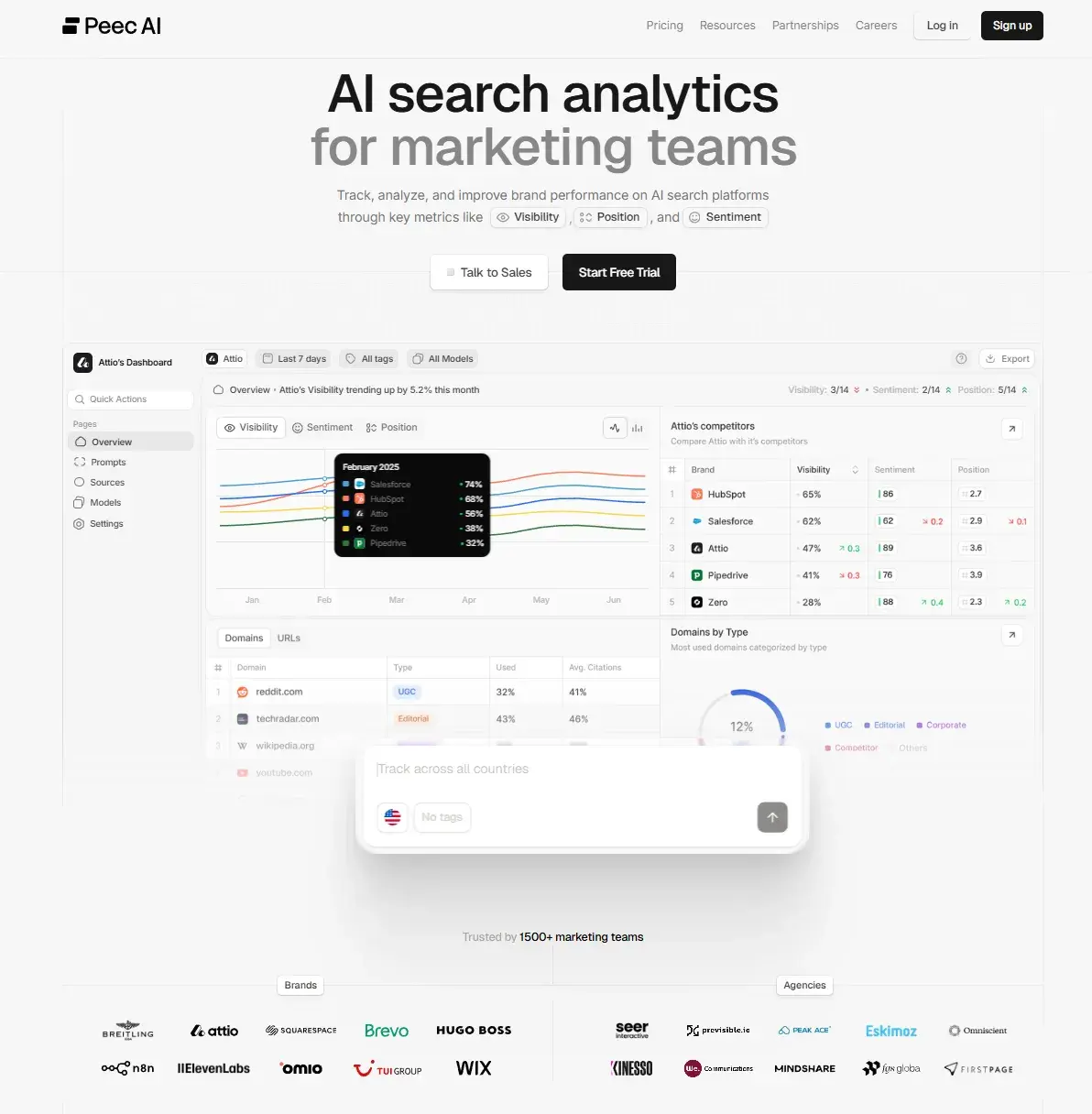
Peec AI is an AI visibility and search analytics platform that helps teams quickly understand how their brand appears in AI response engines. It tracks key AEO metrics such as:
- Brand mentions and quotes.
- Sentiment in AI-generated answers.
- Competitive transparency across models and regions.
Peec is characterized by its simplicity and speed. The platform provides clear, digestible data that makes it easy to assess performance and identify gaps without the need for extensive setup or technical integration. This makes it ideal for:
- Marketing teams new to AEO.
- Companies value fast reporting and competitive insights.
- Teams that want transparency without complex workflows.
The downside is that Peec focuses more on measurement than activation. While it helps marketers and SEO professionals understand how their brand is presented, it offers less integrated tools to translate those insights into action across content and workflows.
Profound
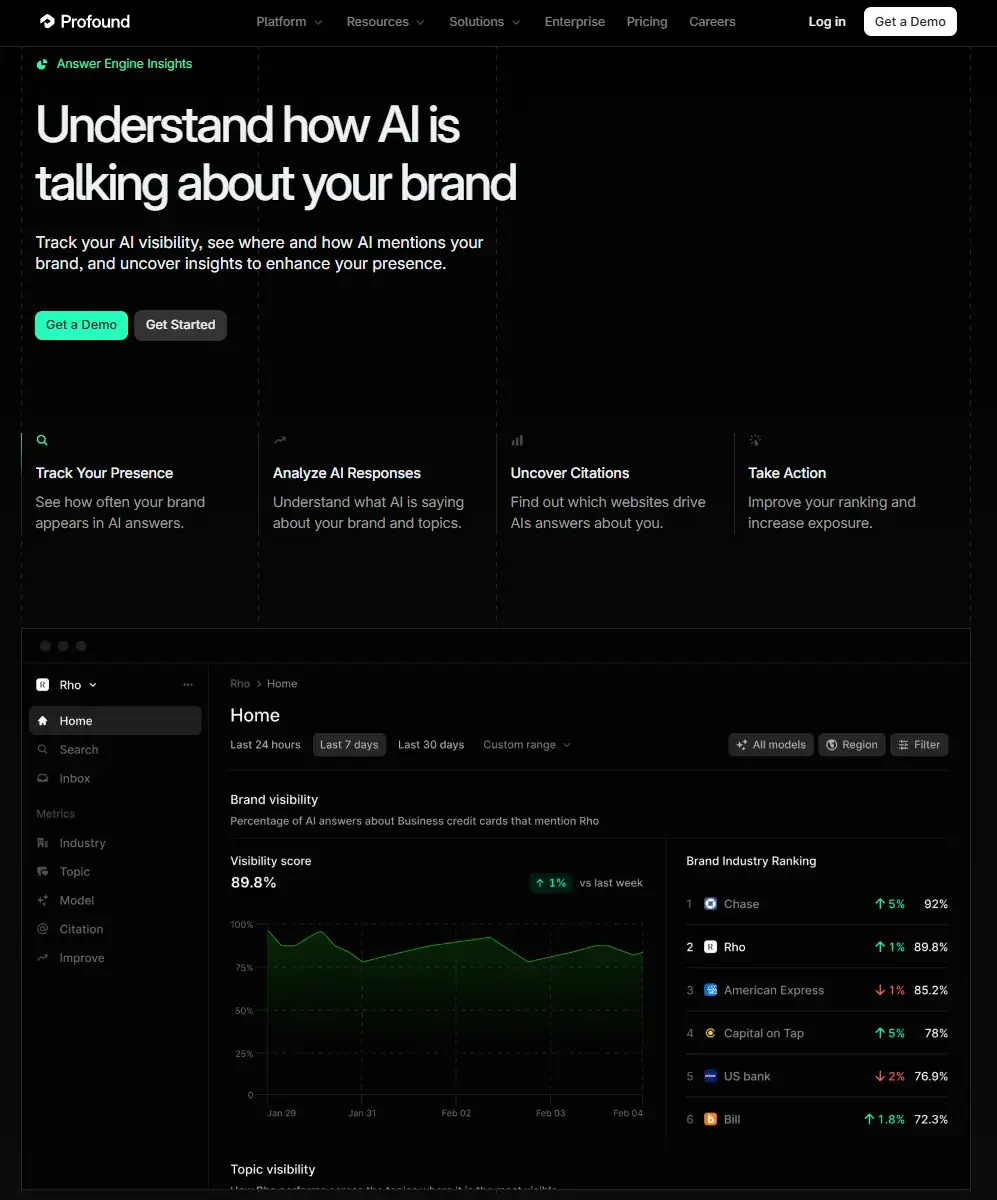
Deep AI is an enterprise-class AEO platform designed to measure AI visibility and help teams actively improve it. Profound’s greatest strength is its feasibility at scale. Like Peec, it tracks mentions, citations, and presence across AI systems. But the tool goes even further:
- In-depth analysis and trend analysis.
- Integrations with content and workflow tools.
- Features that link insights directly to optimization efforts.
Profound is designed for companies looking to operationalize AEO and connect AI visibility data to content strategy, SEO workflows, and business outcomes. This makes it ideal for:
- Corporate marketing and SEO teams.
- Organizations with existing content and data infrastructure.
- Teams looking to move from insights to execution.
The trade-off is complexity. Compared to Peec, Profound may require more onboarding and ongoing management to fully realize its value.
Did you know that HubSpot AEO grader offers a free snapshot of a brand’s AI visibility? The AEO Grader is a handy tool for benchmarking how response engines represent your brand. This is what the snapshot looks like:
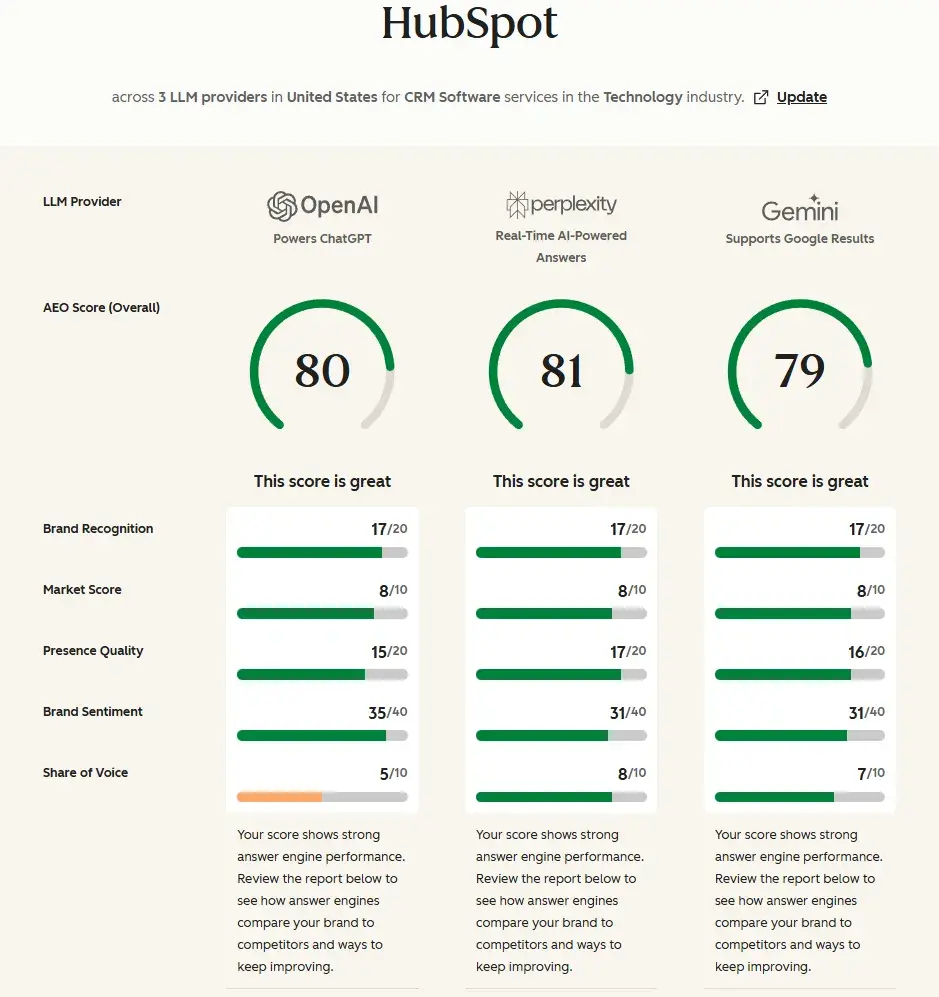
Marketers can access the full analysis by filling out a short form that breaks down a brand’s performance across key dimensions, including sentiment, share of voice and competitive positioning. The report also contains specific recommendations for improvement. Here is the market competition report:
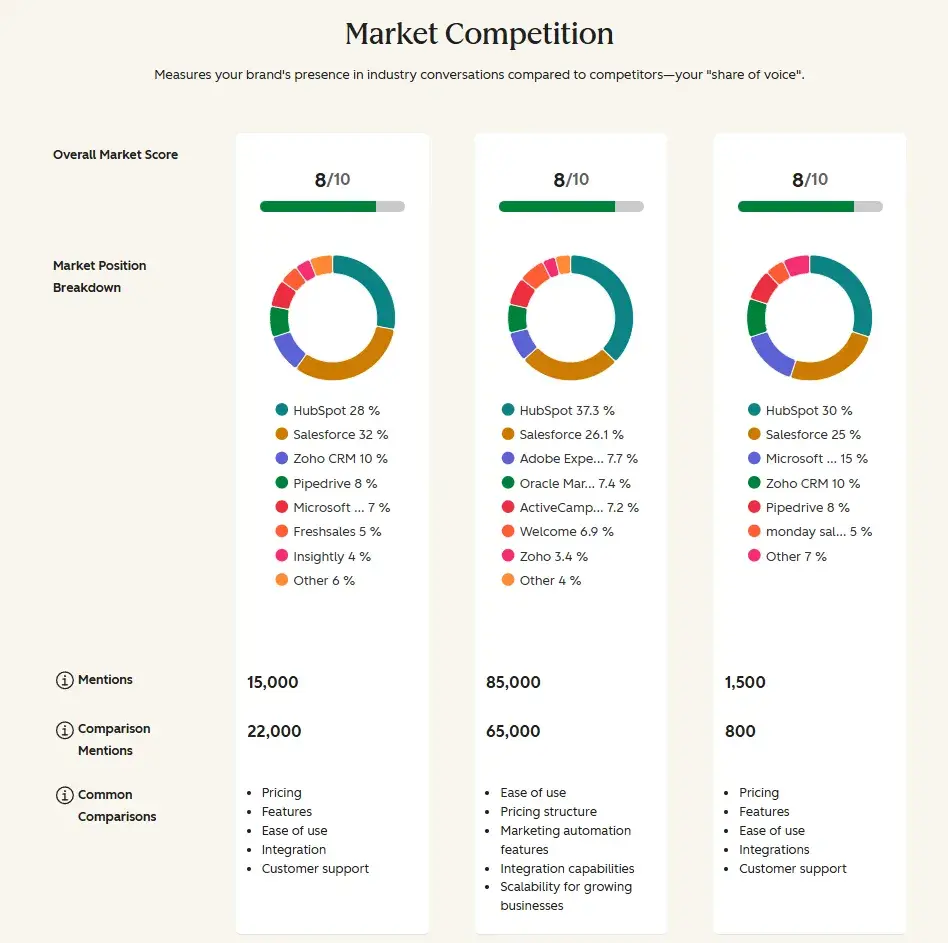
And better? HubSpot’s AEO Grader recommends what marketers can do to improve AI visibility:
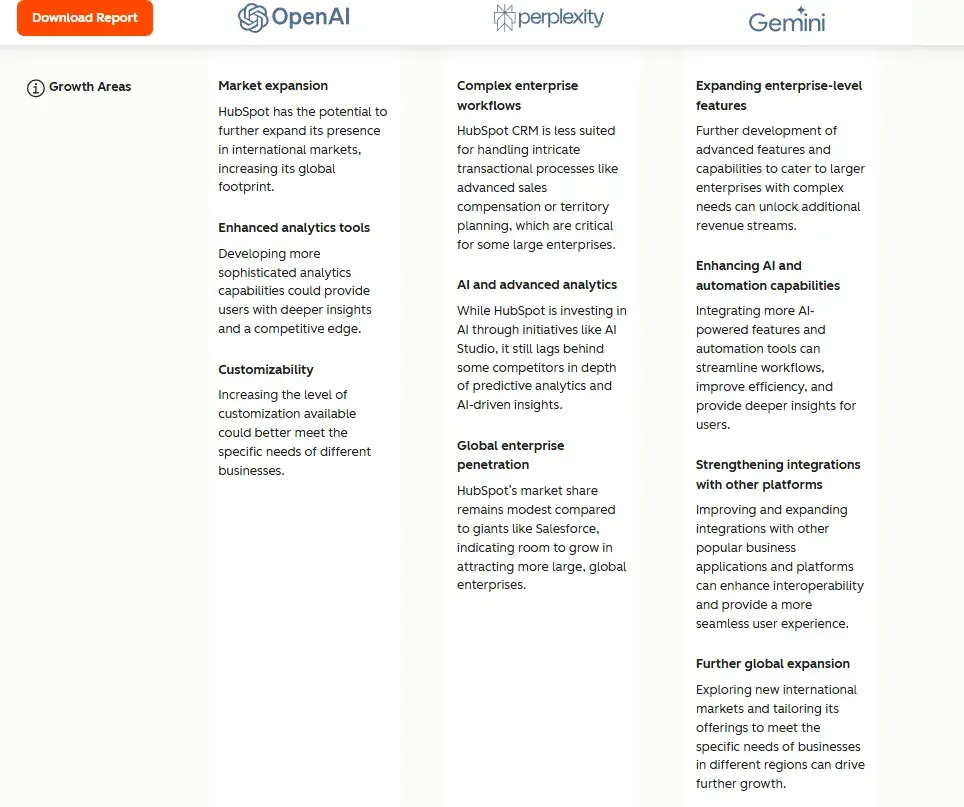
The AI search tool also offers:
- Brand awareness Metrics including the importance of your brand in AI-generated responses and how AI characterizes you compared to competitors.
- Presence quality Assessment, including source quality analysis, showing what influences AI’s understanding of your brand.
- Narrative themes are associated with your brand, these are the recurring stories and attributes that answer search engines repeatedly associate with your company.
- Sentiment analysis Show how positively ChatGPT, Perplexity and Gemini characterize your brand.
Has this free AEO tool piqued your interest? Read the full AEO marketing guide here.
Profound vs. Peec AI for AEO: Comparison at a glance
Profound vs. Peec in comparison
Supported AI engines and platform coverage
For marketers investing in AEO, coverage is important, especially as more AI search tools come to market. When a tool only tracks one or two AI engines, marketers are operating with partial transparency. In modern search, shoppers switch between Google AI Overviews, ChatGPT, Perplexity, and other response engines, so a team’s monitoring platform needs to reflect this search experience.
How Peec AI handles platform coverage
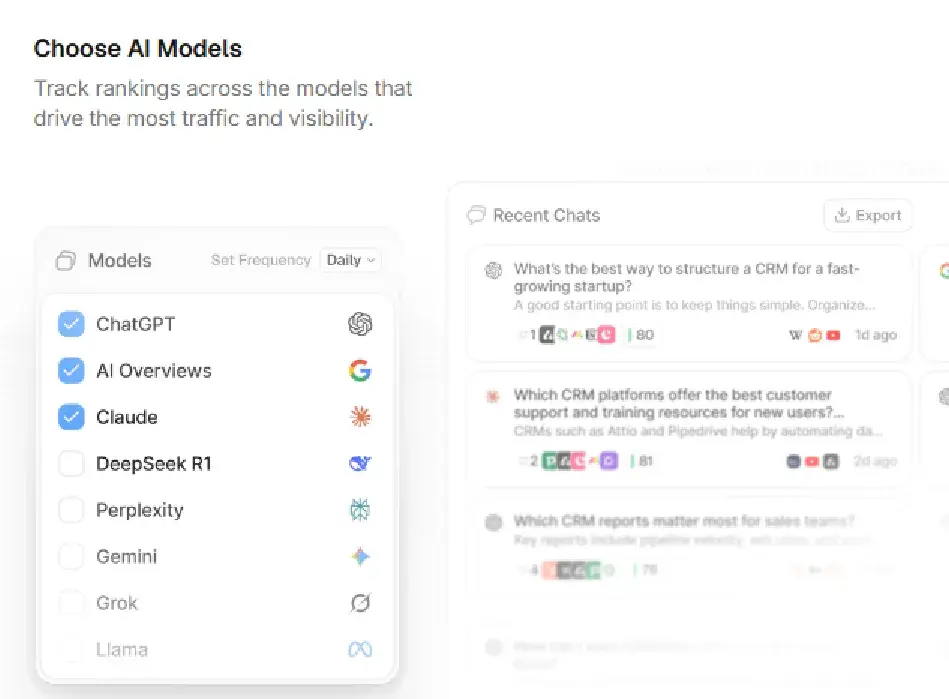
Peec AI supports Google AI Overviews and other major response engines, but the Starter, Advanced, and Pro plans allow teams to select just three engines to track or pay an additional fee to add more. At the enterprise level, teams can track an unlimited number of models, including Grok, Claude, and GPT 5 Search.
Its coverage is designed to monitor key generative platforms that influence buyer research and help marketers track mentions, citations, and competitive presence across multiple search engines without excessive configuration complexity.
How Profound handles platform coverage
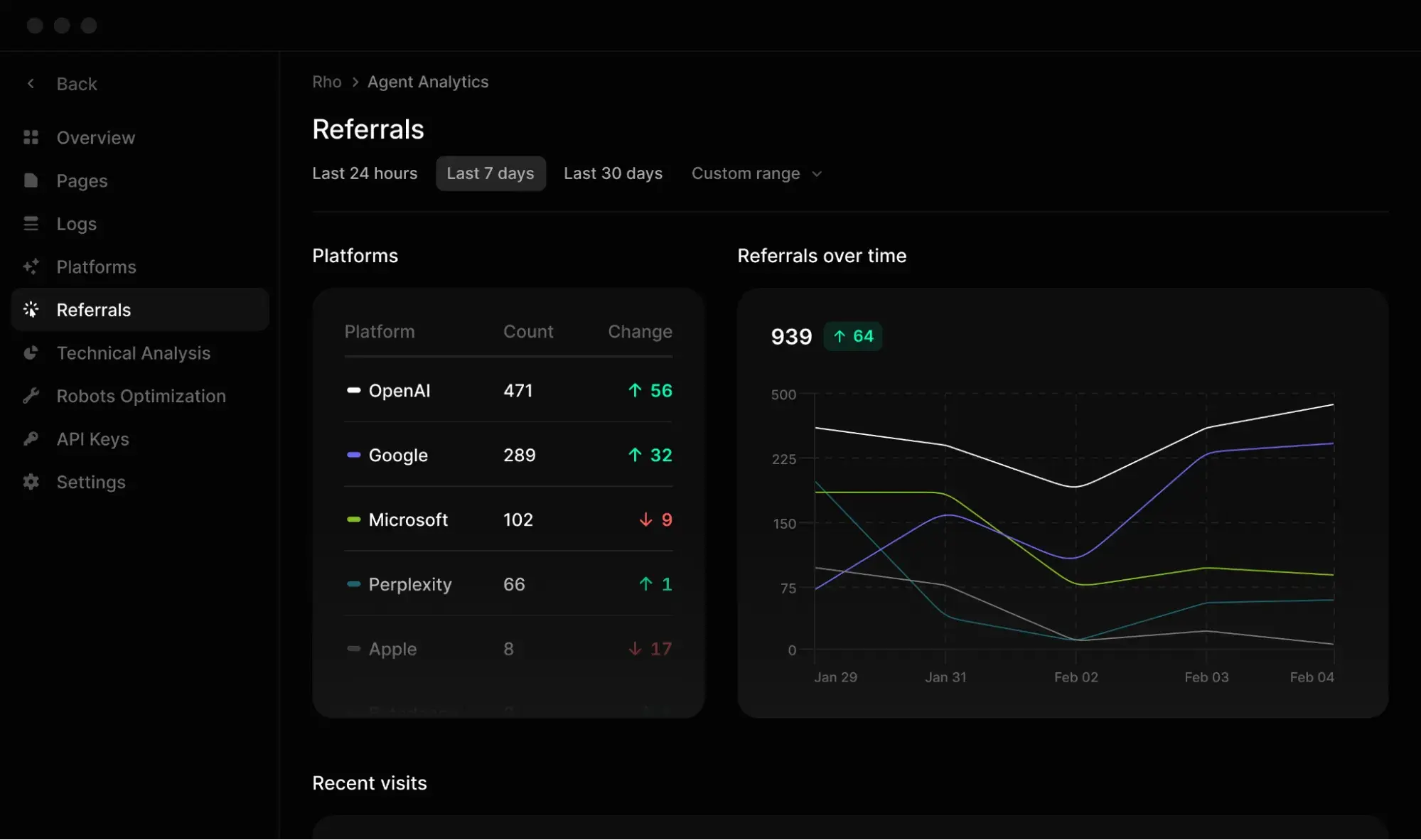
Profound uses front-end capture for AI response tracking. However, the Starter plan only includes ChatGPT. To access tracking for the other models, teams must upgrade to either the Growth plan (ChatGPT, Perplexity, and AI Overviews) or the Enterprise plan (these three models plus Gemini, Copilot, Meta AI, Grok, DeepSeat, Claude, and AI Mode).
Who wins?
- Profound victories when teams want the widest possible engine coverage and future-proof monitoring across multiple AI systems.
- Peec wins If teams want basic tracking first, then the ability to pay for more analytics across different tools.
Reporting depth and competitive intelligence
For marketing and SEO leaders, tracking AI visibility is only valuable if the data leads to action. Reporting depth determines whether a team can just see mentions or truly understand positioning, competitive gaps, and ways to influence AI-generated narratives.
How Peec AI handles reporting and competitive intelligence
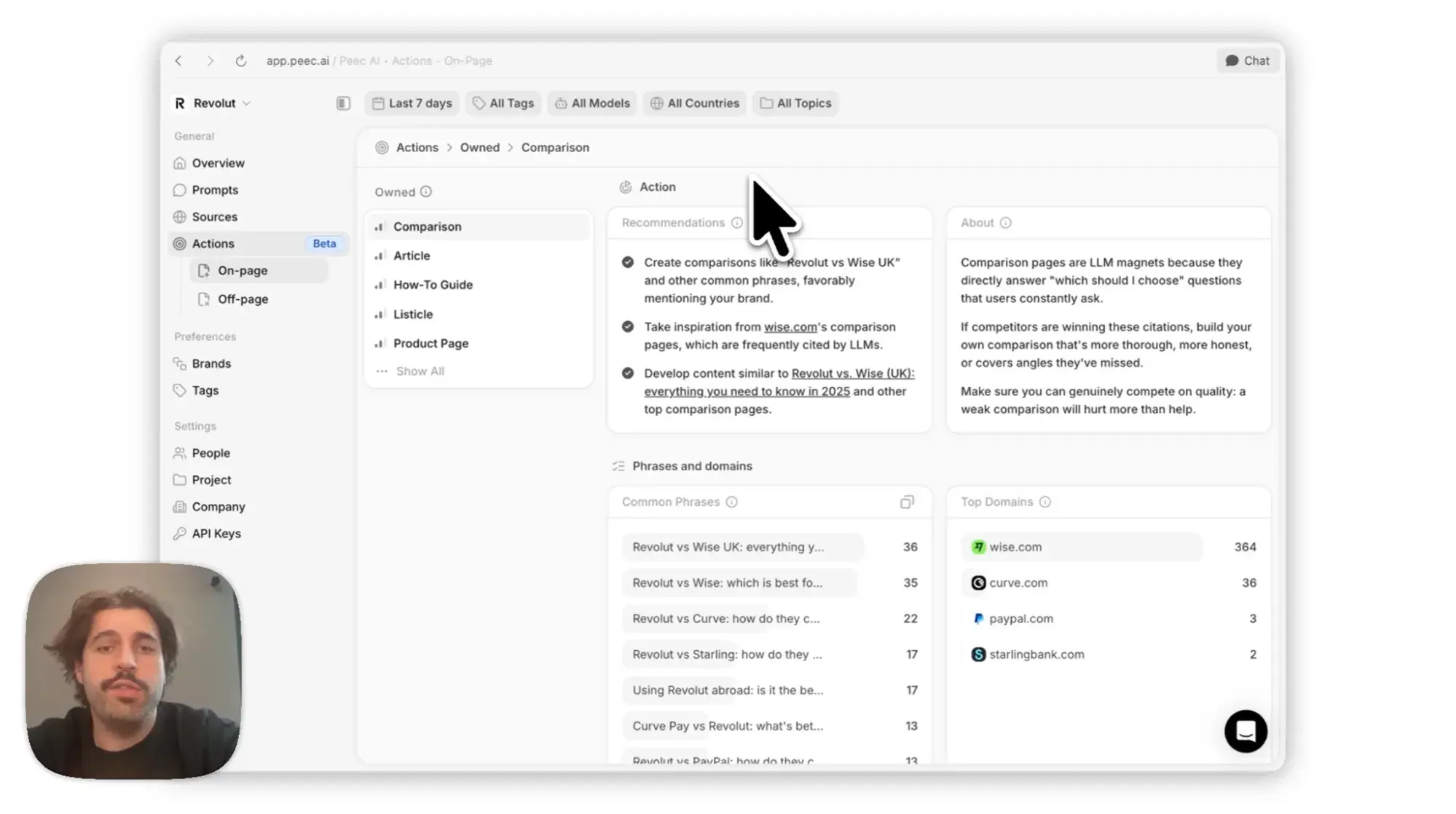
Peec AI goes beyond visibility reporting with a built-in “Act on Insights” feature that turns AEO data into concrete next steps for marketers. Instead of simply showing whether a brand appears in AI-generated responses, Peec shows actionable recommendations, such as building a presence on cited review platforms or participating in relevant community discussions. This helps teams prioritize authority building opportunities based on what actually drives AI citations.
How Profound handles reporting and competitive intelligence
Profound relies on deeper analysis and contextual tracking. Profound leverages front-end ingestion for AI response tracking, allowing teams to monitor how responses appear in live environments and evaluate how responses are structured, cited, and positioned.
This approach can provide more detailed insights into competitive dynamics, e.g. E.g. which brands are mentioned first and how prompts influence results. For teams running advanced AEO programs, this level of detail supports more conscious optimization and content strategy decisions.
Who wins?
- Profound victories for teams that need more comprehensive investigative reporting and advanced competitive intelligence.
- Peec AI wins for teams that value clean dashboards, quick interpretation, and streamlined visibility reporting.
Integrations and workflow connectivity
AEO cannot live in a silo to drive measurable growth. Marketing leaders need AI visibility data that connects to their CRM, content workflows, and sales analytics. Without integration, AEO becomes another disjointed metric and measuring its impact is inefficient.
How Peec AI handles integrations and workflow connectivity
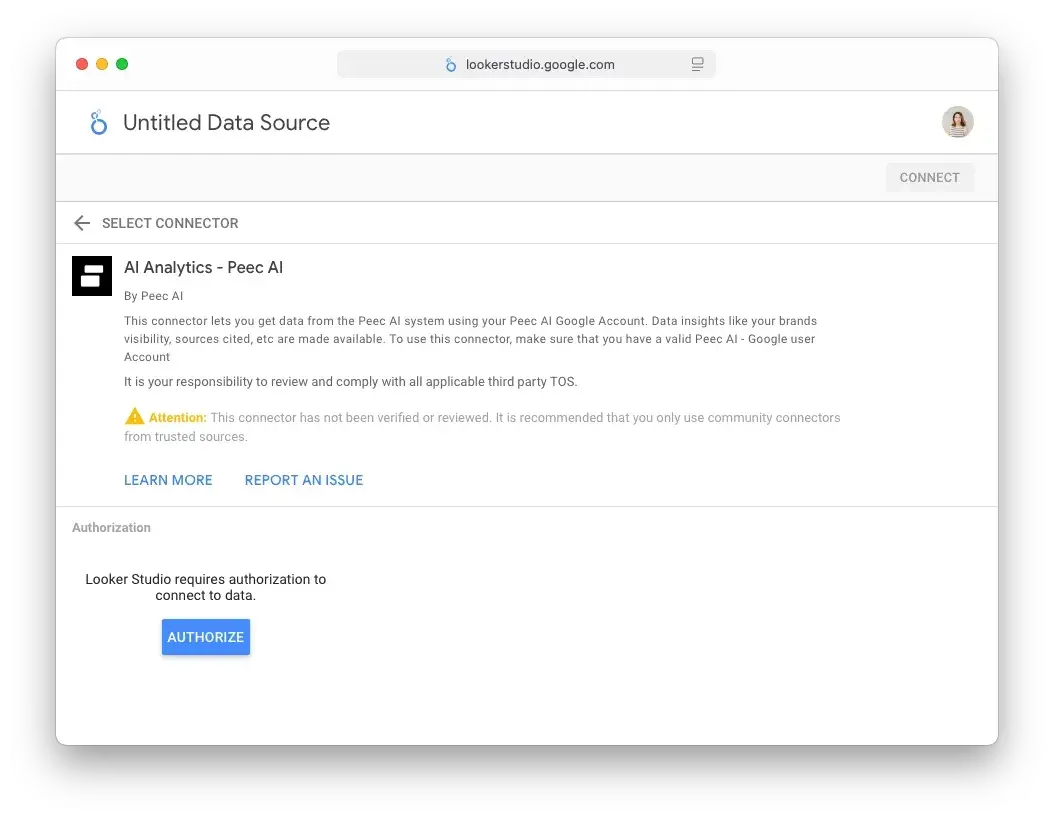
Peec AI offers flexible data export and integration options. It currently offers a Looker Studio integration for exporting and visualizing visibility data in customizable dashboards. This allows teams to centralize key AEO metrics, along with SEO and other performance data, in a familiar reporting environment. A data API and CSV exports are also available for teams that need to integrate visibility data into existing workflows.
For marketers focused on simple dashboards and visibility reports, the Looker Studio integration makes it easy to visualize AEO trends among other metrics. However, outside of Looker Studio and API access, Peec’s scope of integration remains limited. If a team’s workflow requires deeper connectivity to enterprise systems – such as CRM, content hubs, or analytics platforms – Peec’s current integrations may seem lightweight.
How Profound handles integrations and workflow connectivity
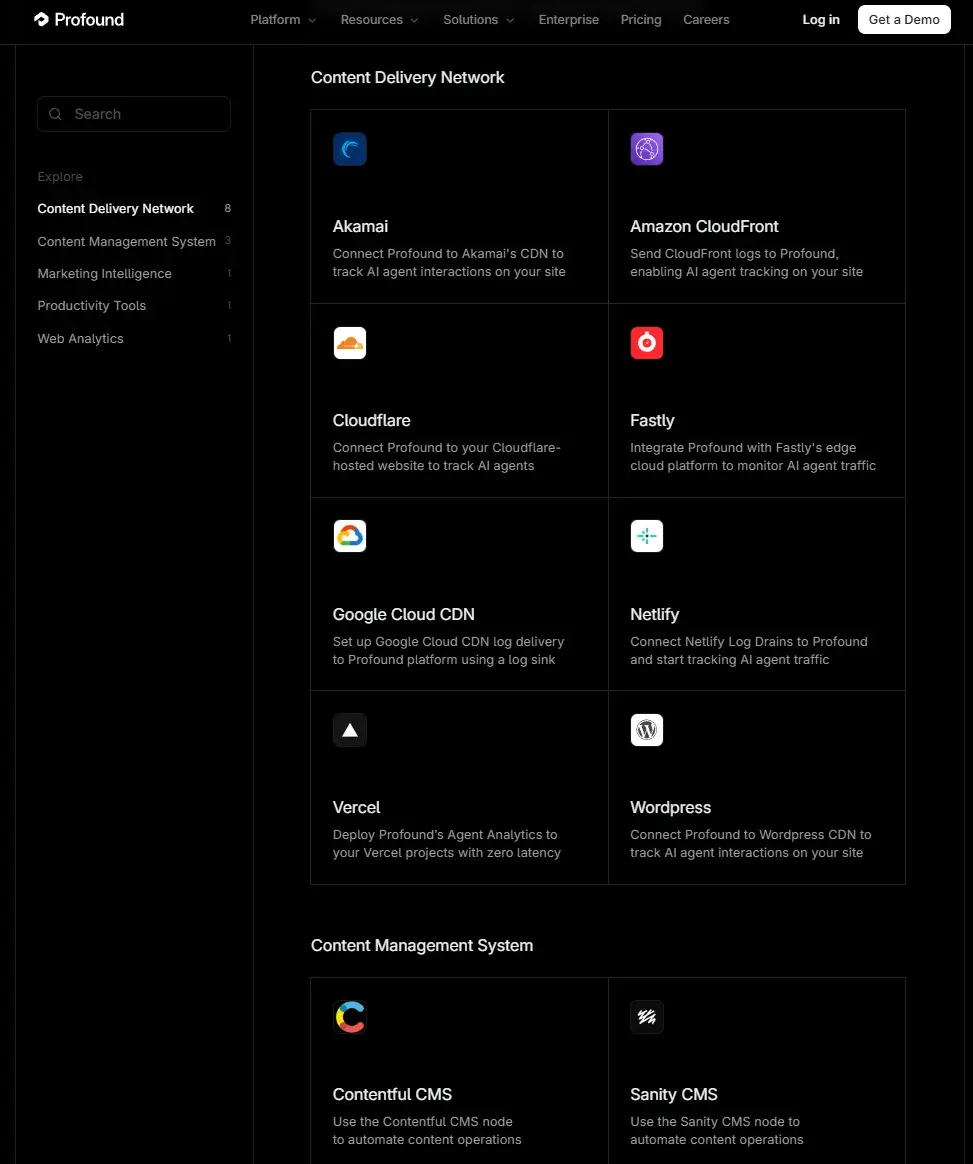
Profound offers a broad ecosystem of integrations designed to embed AEO insights into content and marketing workflows. Beyond dashboard exports, Profound Agents connect natively to content management systems (WordPress, Sanity, Contentful, and Webflow), productivity and collaboration tools (Slack, Gamma), and Google Search Console. Teams can act on AEO data without leaving the platforms they already use.
This allows teams to bring AI visibility signals into:
- Content planning, optimization and CMS publishing workflows.
- BI dashboards and executive reporting via custom dashboards and data exports.
- Cross-channel collaboration and editorial review via Slack notifications.
- Analyzing search performance by combining Profound data with Google Search Console.
Who wins?
Profound Clearly a leader in integrations and workflow connectivity.
- Profound victories for companies that require comprehensive connectivity between CRM, content operations, analytics and enterprise systems.
- Peec AI remains useful For teams that require basic dashboard reporting through Looker Studio, but may require manual work to operationalize insights beyond visualization.
Pricing structure, onboarding and scalability
The cost of AI can be an immediate and non-negotiable barrier when choosing between Profound and Peec AI for GEO. Profound may outperform some companies out of the box because it is expensive, especially when planning to scale to large packages.
How Peec AI handles pricing, onboarding and scalability
Peec AI is known for competitive pricing and fast onboarding, making it attractive to startups, mid-sized teams, and agencies that want rapid deployment. Low barriers to entry allow marketing teams to quickly start tracking AI visibility. Peec offers an extensive knowledge base with videos for every task marketers need to complete to get set up.
Peec is particularly attractive for organizations that want to experiment with AEO and scale incrementally. Agencies that manage multiple clients may also value a simpler onboarding process that allows for faster adoption across all accounts.
Prices
Teams can test Peec for free for seven days, after which there are paid packages available:
- Starter: $95/month
- Per: $245/month
- Progressive: $495/month
- Company: custom
How Profound handles pricing, onboarding and scalability
Profound is more focused on corporate organizations. Profound offers enterprise-class security and compliance features that can be critical for large brands operating in regulated industries or global markets.
Profound’s pricing and onboarding model is typically aligned with enterprise procurement processes, including structured implementation, stakeholder alignment, and governance considerations. While this may require a longer ramp-up period, it supports larger organizations that require data control, auditability, and scalable delivery across global teams.
Prices
With Profound, teams jump straight into paid packages. In my experience there is no free trial, but CTAs suggest you can try it for free. Paid packages start at:
- Starter: $82.50/month
- Growth: $332.50/month
- Company: custom
Note: Profound’s starter package only includes ChatGPT.
Who wins?
- Peec AI wins for cost efficiency and quick time to market.
- Profound victories for enterprise security, governance and large-scale deployment.
Which should you choose AEO, Profound or Peec?
The right choice between Profound vs. Peec AI for AEO depends less on siled functions and more on team structure, growth stage and operational maturity. AEO tools alone do not create growth. They reinforce the systems that are already in place. Here’s how to think about it scenario-by-scenario.
Consider HubSpot AEO as an alternative to Profound vs. Peec AI for AEO.
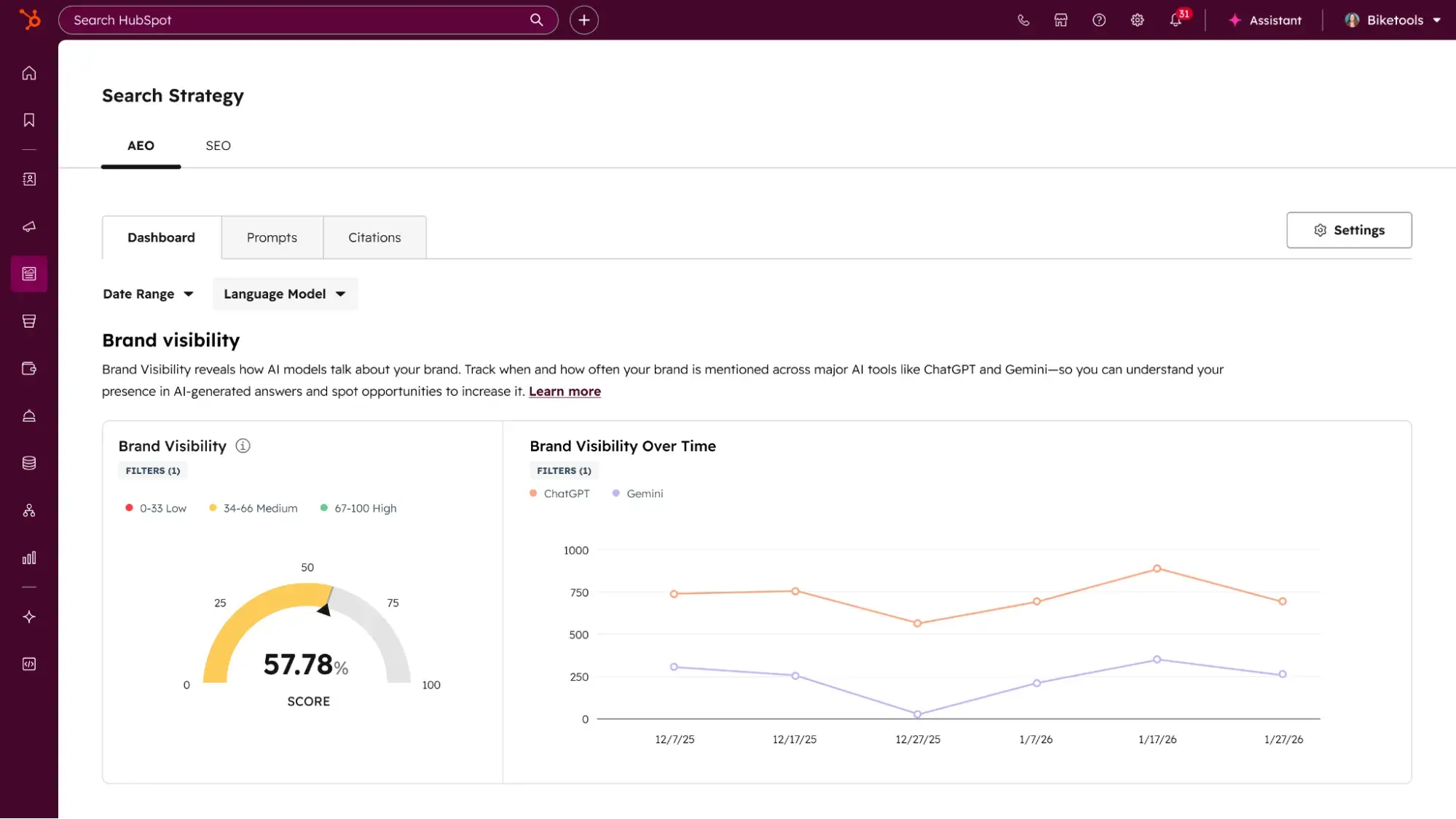
HubSpot was recently launched HubSpot AEOits response to in-depth AEO analysis and ongoing AI visibility strategy. This GEO tool includes:
- Prompt follow-up that suggests and monitors the prompts real buyers ask in ChatGPT, Gemini, and Perplexity—filtered by buyer journey stage, product relevance, and topic—so teams know exactly which queries are important to their brand.
- Competitive intelligence It tracks brand mentions, share of voice, and sentiment across top response engines, helping teams compare performance with competitors and identify patterns that influence AI recommendations.
- Quote analysis Learn which domains, content types, and specific URLs drive AI mentions for your brand and your competitors.
- Prioritized recommendations Translate visibility insights into actionable next steps, each with a content description explaining what prompts they triggered, which content types dominate citations, and which URLs are most frequently cited.
- Coverage of the buyer’s trip It filters prompt tracking by funnel phase, ensuring transparency across the entire AI-driven purchasing process.
With HubSpot AEO, marketing teams can track their brand’s performance across response engines over time, with visibility scores continually updated as AI platforms evolve.
HubSpot AEO is available as a standalone tool for $50 per month or in Marketing Hub Pro and Enterprise. Recommendations connect directly to HubSpot’s content and social tools, allowing teams to act on AEO insights without leaving the platform if they’re already using HubSpot.
Frequently asked questions about Profound vs. Peec AI for AEO
What is the main difference between Profound and Peec AI for response engine optimization?
Profound emphasizes comprehensive analytics, broad engine coverage, and enterprise integration. It’s a good fit for teams that want deep insight into how AI response engines interpret and display content. Peec AI focuses on easy visibility tracking and actionable recommendations, allowing teams to quickly understand where their brand is appearing and what strategic actions to take next.
Which AI engines and platforms do Profound and Peec AI monitor?
Peec AI supports seven different platforms, although teams can only choose three to monitor unless they add additional engines. Teams using Peec AI Enterprise can monitor an unlimited number of engines including ChatGPT, Perplexity, Claude, Google AI Mode, AI Overviews, Gemini, Copilot and Grok.
Profound offers broad coverage across all platforms, although the Starter plan only includes ChatGPT coverage. The upgrade gives teams access to key and new engines like Perplexity, Claude, Google AI Mode, Gemini, Copilot, Grok, and more.
Does Profound or Peec AI offer better enterprise-level features and compliance?
Profound is generally more suitable for enterprise-grade use and has features designed for security, governance, and large-scale deployments. Companies that operate in regulated industries or have strict data policies typically prefer compliance and integration capabilities. Peec AI remains valuable for teams that prioritize rapid adoption and clear insights, but may require additional controls or manual processes for enterprise governance needs.
Is Profound or Peec AI better for agencies managing multiple clients?
Peec AI’s pricing and ease of integration make it attractive for agencies that need to quickly roll out AEO tracking to a portfolio of clients. Its actionable reporting and visibility dashboards help agencies demonstrate their impact without steep learning curves. Profound can also serve agencies, particularly those supporting enterprise clients or complex global strategies, but its depth and governance capabilities may be a better fit for larger, more structured agency engagements.
The right AEO platform for sustainable growth
Teams benefit most from Peec AI or Profound AI at different stages of their AEO maturity and operational complexity. Peec AI is ideal when the goal is to quickly understand AI visibility, compare competitors, and generate clear, actionable insights without heavy implementation – making it a good solution for teams early in their AEO journey or who value speed and simplicity.
Deep AI, on the other hand, offers the most value when AEO becomes a key growth lever and requires deeper analytics and integration into content, CRM and reporting workflows. For companies looking to implement AEO at scale and link AI visibility directly to business outcomes, Profound provides the infrastructure to move from insight to sustainable implementation.
Before committing to a platform, teams should compare where they are today. HubSpot’s AEO Grader allows you to analyze your brand’s AI visibility for free – no credit card required. It provides visibility snapshots, competitive insights, sentiment analysis, and actionable recommendations to help you understand how AI response engines currently represent your brand. Whether you choose Profound, Peec AI, or another solution, starting with objective performance data will give you clarity.