
As you walk down a suburban street, you may come across a sign. It’s probably messy because of poor formatting and inconsistent font size. Here’s one I saw in Houston.
One line caught my eye. It is said: “Window cleaning in progress.” I love this board because it shows something that most marketers forget. K&C Window Cleaning does not try to convince you with flashy slogans or intrusive claims. They are much more subtle, and that makes them more subtly effective.

While advertising is about influence, no one wants to be sold to. Instead, this sign uses psychology to get people thinking, “Other people are using the service, so maybe it’s time to clean my windows.” The idea seems organic and nothing seems forced.
Table of contents
We follow the actions of others
In 2008, legendary researcher Robert Cialdini carried out an infamous plan study. The three researchers conducted tests in a mid-range hotel in the southwestern United States for 80 days and conducted tests in 190 rooms. Their goal was to encourage visitors to reuse their towels. In the room, they tested various signs with over 1,058 guests.
First, they tested a standard environmental message that read, “Help protect the environment.” Guests said this message was the most convincing to them. But researchers also tested a message that read, “Most guests reuse their towels.” The results were surprising. 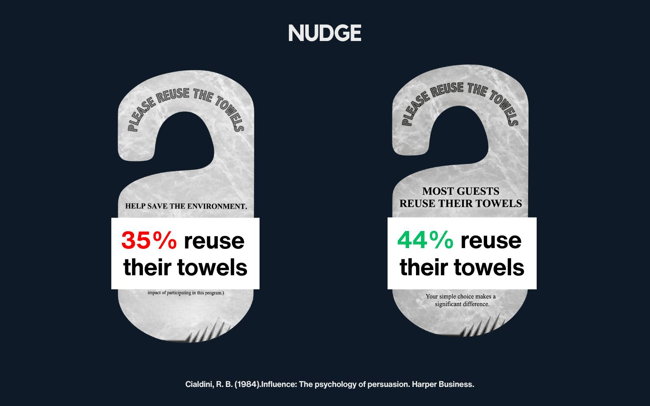
The environmental case encouraged 35% reuse, but indicating that the majority of guests reused their towels increased reuse to 44%. But then they added a third message: “Most guests in this room reuse their towels.”
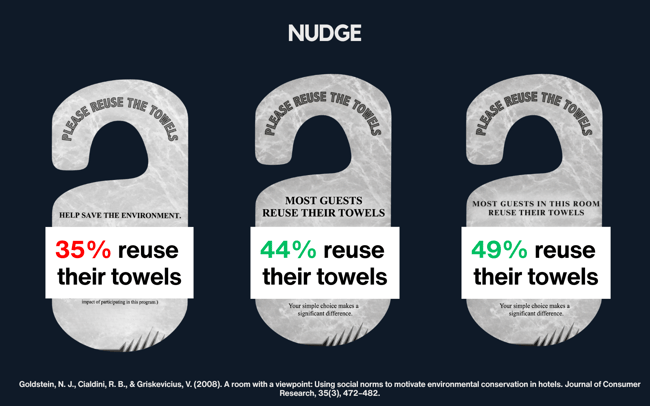
This had an even greater impact. Meanwhile, nearly 50% of guests reused old towels, compared to 35% in the control group. The insight is simple: we follow the actions of others.
So if a neighbor pays for window cleaning, we think about doing the same. But marketers forget one important element: consumers don’t like to feel forced.
We don’t like feeling forced
Messages like “We are the most popular” and “We are number one” work, but they are not perfect. Nicolas Gueguen in 2000 showed that people are more likely to act when they feel autonomous and not forced.
The study tried to convince French commuters to leave a few coins for a bus ticket. The researchers tried two messages that produced surprisingly different results:
- “I’m sorry, would you have some coins for the bus ride please?“ 10% agree
- “I’m sorry, would you please have some coins for me so I can ride the bus? But you are free to accept or decline.” 47.5% agree
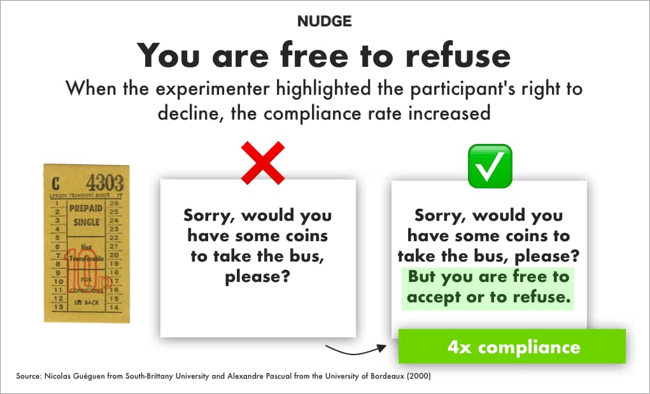
This method, called the “but you are free to decline” technique, has been proven effective in many different areas, both online and offline. A 2013 A meta-analysis found that the effect worked in 42 different areas.
This brings us back to the sign of K&C Window Cleaning. Take all of this advice to heart. It shows the actions of others but doesn’t force the reader into a corner.
- It doesn’t say, “We are the most popular window cleaners in Houston.”
- It says: “Window cleaning in progress.”
And many other companies are doing the same. They don’t say they’re popular; they prove it.
My favorite example comes from Sam Tatam’s wonderful book: Evolutionary ideas. At his favorite cafe in Sydney, Australia, the owners don’t say, “We’re popular.” Instead, they show it by sticking their customers’ loyalty cards on the wall.
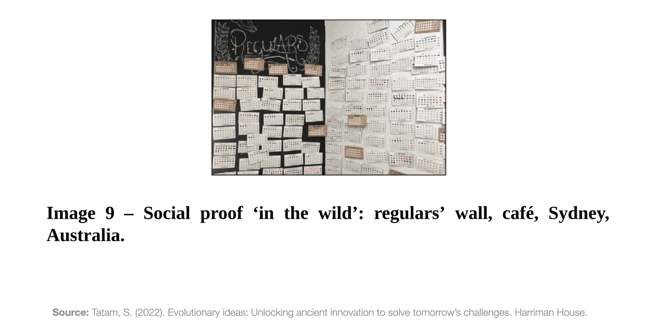
Don’t say it. Show it. This will make your message far more effective.
Make decisions that feel natural
If you believe in your offering, you want to brand it as the best, brightest, and most popular. Resist the urge. The best marketers let customers make their own decisions by demonstrating value. The most compelling thing you can do is to make your client feel like the idea was theirs all along and supported by colleagues who have also benefited from it.