
SEO expands in 2026, does not change. Traditional search is still important, but SEO now includes AI-driven discovery, social platforms and chatbots. The principles are the same, such as clarity, structure, authority and relevance, but the platforms are multiplying. We surveyed 59 SEOs to find out how they’re dealing with these changes.
Some have less than a year of experience. Others have been working in the field for over a decade. Their answers show an industry that is figuring things out. Some are ahead of the curve, but most are still catching up.
The best SEOs don’t just respond to AI. They use it to strengthen what already works: technical foundations, quality content and real authority. Others argue about whether SEO should even keep its name.
Here’s what stood out and where Yoast fits into the conversation about what SEO means in 2026.
The full results, with additional questions and deeper insights from Yoast’s top SEOs, Carolyn Shelby and Alex Moss, are available in a downloadable PDF. Sign up below!
Download the PDF report now
Enter your email address below. We will send you a download link to the full Yoast Perspective PDF report. Check your inbox as it will arrive in just a few minutes.
Privacy Policy
1. SEO is not dying, it is evolving
51% of respondents believe SEO is “evolving.” 33% say it is “thriving.” Only 10% think it is “declining.”
This is an interesting divide, but it is not random. In the results, those with more than 10 years of experience say SEO is successful while newbies say it is not. It could be that experts know the landscape better and see change as a constant.
Alex Moss’s opinion: “SEO has always adapted to changes in the SERP, and now it is adapting again. The traditional SERP is gone, but SEO is not.”
Carolyn Shelby’s opinion: “SEO is evolving, but not because its foundations are broken. The interfaces between users and information are changing. Search is no longer limited to ten blue links, but the need for structured, relevant and trustworthy content has not diminished.”
The Yoast perspective: We believe that SEO is no good, but changes are happening. Traditional search from Google and Bing still drives traffic, but AI-driven discovery through LLM-powered assistants is shaping perception and discovery. That’s why the best SEOs don’t choose sides in this battle; They master both directions.
2. Keep the search engine optimization name
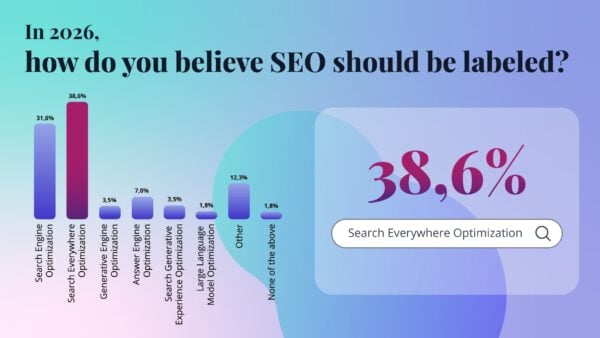
39% believe SEO should be renamed “Search Everywhere Optimization.” Only 32% want to keep “search engine optimization”.
Strong support for rebranding SEO, and even among veterans, 41% are in favor Search Everywhere optimization. Of course, that doesn’t mean we should do that.
Alex Moss’s opinion: “The term ‘SEO’ is here to stay. The role will expand to include AI and other disciplines, but the name doesn’t have to change.”
Carolyn Shelby’s opinion: “The term ‘SEO’ still has shared meaning, credibility and market recognition. There is no clear evidence that renaming the discipline itself is necessary or beneficial. Responses advocating ‘Search Everywhere Optimization’ reflect where SEO results are now emerging, rather than a fundamentally different practice.”
The Yoast perspective: At Yoast, we don’t believe the term SEO is wrong. Yes, there are a lot of changes, especially in search, with AI overviews, chatbots and social media platforms, but what about the core work of search engine optimization? You need to continue to focus on technical fundamentals, content quality, brand building and authority.
“Search Everywhere Optimization” may describe where SEO happens, but it doesn’t change what SEO is. The name “SEO” still works, but we just need to explain how it applies to AI and social platforms.
3. Good SEO is LLM optimization
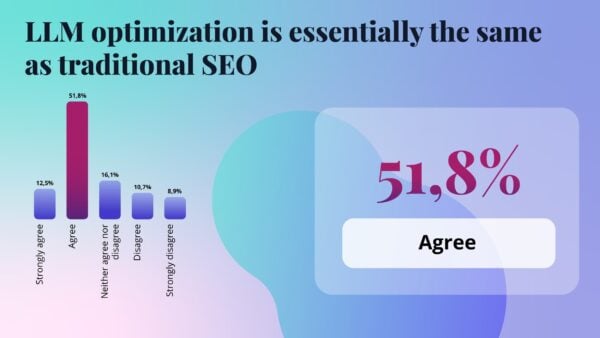
64% agree that LLM optimization is essentially the same as traditional SEO. 59% are not even actively optimizing for LLMs.
You could call it laziness, but you could also call it efficiency. Often it comes down to the same thing.
There are also 9% who strongly disagree with this statement. These respondents say that LLMs prioritize synthesis over rankings, so it makes more sense for them to focus on structured data and brand mentions. Of course they’re not wrong, but they don’t contradict what others have said. LLMs do not require new tactics; They just reward the same SEO principles more rigorously.
Alex Moss’s opinion: “If you’re doing good SEO, you’re already optimizing well for LLMs. The tactics don’t change – just the audience.”
Carolyn Shelby’s opinion: “The same practices that make content discoverable and trustworthy for search engines also make it usable for LLMs. The confusion arises when people treat LLMs as an entirely separate system. In reality, LLM visibility rewards clarity, relevance and authority – all long-standing SEO principles.”
LLM optimization is not a standalone discipline as it is SEO for AI. The same principles apply: clarity, structure and authority. The difference? AI systems are less forgiving of mediocre content, so the bar for quality is raised.
4. Rankings still matter, but not like they used to
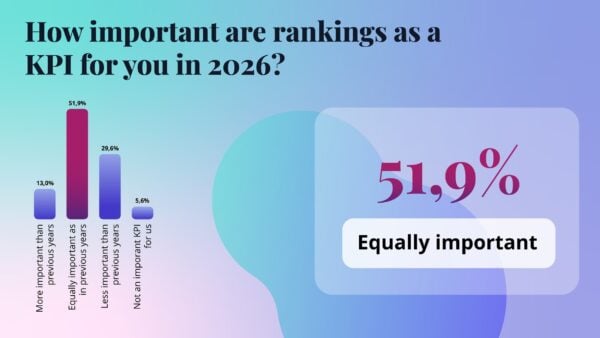
52% say rankings are “just as important” as before. 30% say they are “less important.”
This is a sensible change. Google’s AI overviews and other zero-click results mean that visibility does not equal traffic. For AI systems, rankings are still a signal of authority.
Alex Moss’s opinion: “Traditional rankings are still important because agents still scour the Internet to absorb information. If you’re not visible there, an agent is less likely to identify you and include you in their responses.”
Carolyn Shelby’s opinion: “Rankings are still important, but they are no longer the end goal. They are an indicator of visibility, not a guarantee of impact.”
The Yoast perspective: We need to stop focusing on first place and start pursuing visibility and presence. See if you are quoted in AI-driven responses and try to get mentioned in industry discussions. AI visibility and citations are the new rankings.
5. Organic traffic is still king, but for how long?
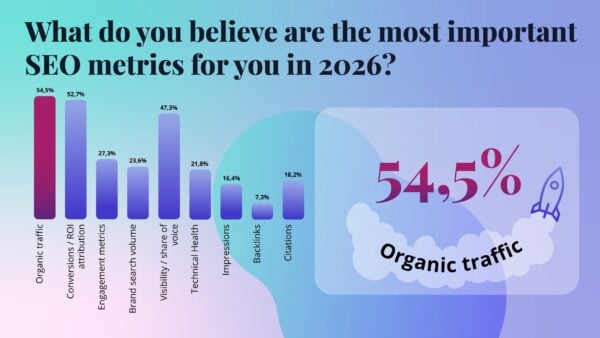
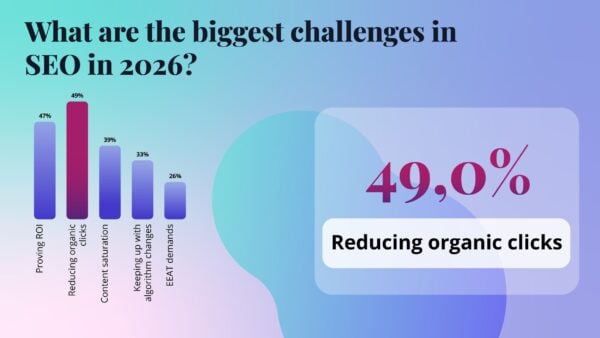
55% say “organic traffic” is their most important metric. Still, 49% cite “reducing organic clicks” as their biggest challenge.
We see this as the great paradox of 2026. Traffic is declining, but the value of that traffic could be increasing. You may get less traffic, but the clicks that actually happen have better intent.
Carolyn Shelby’s opinion: “As AI reduces the need for some visits, success looks like getting them properly represented, not just visited. Visibility in AI overviews doesn’t always result in clicks, but it creates legitimacy. Inclusion signals that you are a credible source, even if users don’t click.”
Our advice:
- Work on AI visibility as it is the new SEO metric. Just as rankings show your visibility in traditional search, citations in AI overviews show your authority in AI-driven discovery. Track it along with rankings and traffic
- Keep an eye on your brand’s search volume to find out if people are searching for you by name
- Monitor citations to see if others are linking to your content online
6. Content saturation is a major threat
39% say “competing with AI-generated content” is their biggest challenge. Only 4% cite a “talent gap.”
We know that AI can write bad content. But it’s more challenging when AI writes good enough content at scale. This floods the network with noise, making penetration more difficult.
Alex Moss’s opinion: “AI-generated content is artificial. People connect with stories, not regurgitated lists.”
Carolyn Shelby’s opinion: “AI doesn’t change what good content is, it just raises the bar. Mediocrity doesn’t just get worse, it disappears.”
Our advice:
- Focus on building your EEAT because AI cannot fake real-world expertise and authority
- Prioritize quality over quantity because a single great piece of content can outperform ten average pieces of content
- Use AI, but be careful and always use it as a tool, not a replacement
7. Most SEOs ignore a fast-growing search channel
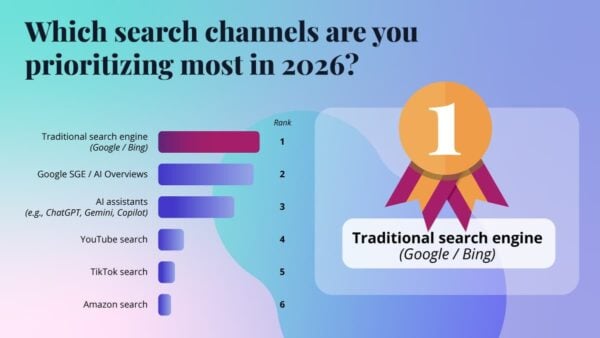
Traditional search (Google/Bing) is still #1. But TikTok search is at #5, lower than Amazon.
For many, this could be a blind spot. Younger generations are using TikTok and other video platforms for entertainment, recommendations, tutorials and even B2B advice.
Alex Moss’s opinion: “Social platforms influence how LLMs perceive freshness and authority. Ignoring them means missing signals that AI systems value.”
Carolyn Shelby’s opinion: “You don’t have to rank on TikTok, but you do have to be discoverable there. LLMs scan social platforms for real signals.”
The Yoast perspective: SEO now also includes social platforms like TikTok. You don’t have to rank there, but you do need to be discoverable, as LLMs look to these platforms for fresh, authoritative content. A great video channel can strengthen your authority in AI responses.
Our advice:
- Leverage content for video platforms like TikTok and YouTube
- Check brand mentions on these platforms
- Improve your video SEO in general
What Yoast experts really think
The data shows trends, but the real wisdom comes from Yoast’s SEO leads, Carolyn Shelby and Alex Moss. Here’s a sneak peek at the insights they share across the various debates:
On the topic of “Search Everywhere Optimization”:
Alex: “The term ‘SEO’ is here to stay. The role will expand, but the name doesn’t have to change.”
Carolyn: “Rebranding risks fragmenting understanding. ‘SEO’ is already well established outside the industry.”
On the future of SEO metrics:
Alex: “As you move from visibility to selection, visits no longer have the same value as they once did. Business objective should be the most important metric.”
Carolyn: “Visibility in AI overviews doesn’t always result in clicks, but it does create legitimacy. Inclusion signals that you are a credible source.”
Regarding rankings vs. influence:
Alex: “Rankings are still important because agents search the Internet to absorb information.”
Carolyn: “Rankings are an indicator of visibility, not a guarantee of impact. Focus on presence.”
On the role of SEOs in 2026:
Alex: “100% all three: marketers, brand builders and SEO specialists. Brand and marketing are intertwined as our role expands with SEO.”
Carolyn: “A mixed mindset is essential. SEO cannot work in isolation from brand, product or communication.”
Would you like to read the whole story?
These insights are just a small taste for you. You can find much more in the full Yoast SEO report:
- Includes complete answers to all 25 questions
- In-depth commentary from Yoast SEO experts Carolyn Shelby and Alex Moss
- Find out which metrics really matter in 2026
- Why backlinks are losing ground to citations
Sign up and download instantly!
