
AI search behavior may cause your traffic to drop, but it will also send you higher quality leads. For marketers, this second part is a huge win. According to HubSpot, AI search was the top predictor of purchase intent for CRM software buyers Status of AEO 2026 Report. And there are other insights from the report that every go-to-market team needs to know.
In this article, I share the latest insights into AI search behavior, its impact on brand recognition, an answer engine optimization (AEO) strategy you can implement today, and more.
Table of contents
What is AI search behavior and why should marketers care?
AI search behavior refers to the actions people take when searching for answers using artificial intelligence, be it asking ChatGPT or consulting Google AI Overviews.
In the past, traditional search consisted of a user typing keywords into a search engine like Google, getting a list of blue links, and clicking on them to find their answer. But Search behavior is changing. Today, users are increasingly turning to AI when making conversational queries (usually a few sentences long) and reading AI-generated summaries that instantly fulfill their search. AI search behavior differs from traditional search behavior in that it becomes a multi-round question and answer session – an entire conversation in a chat, not just a click on a single web page.
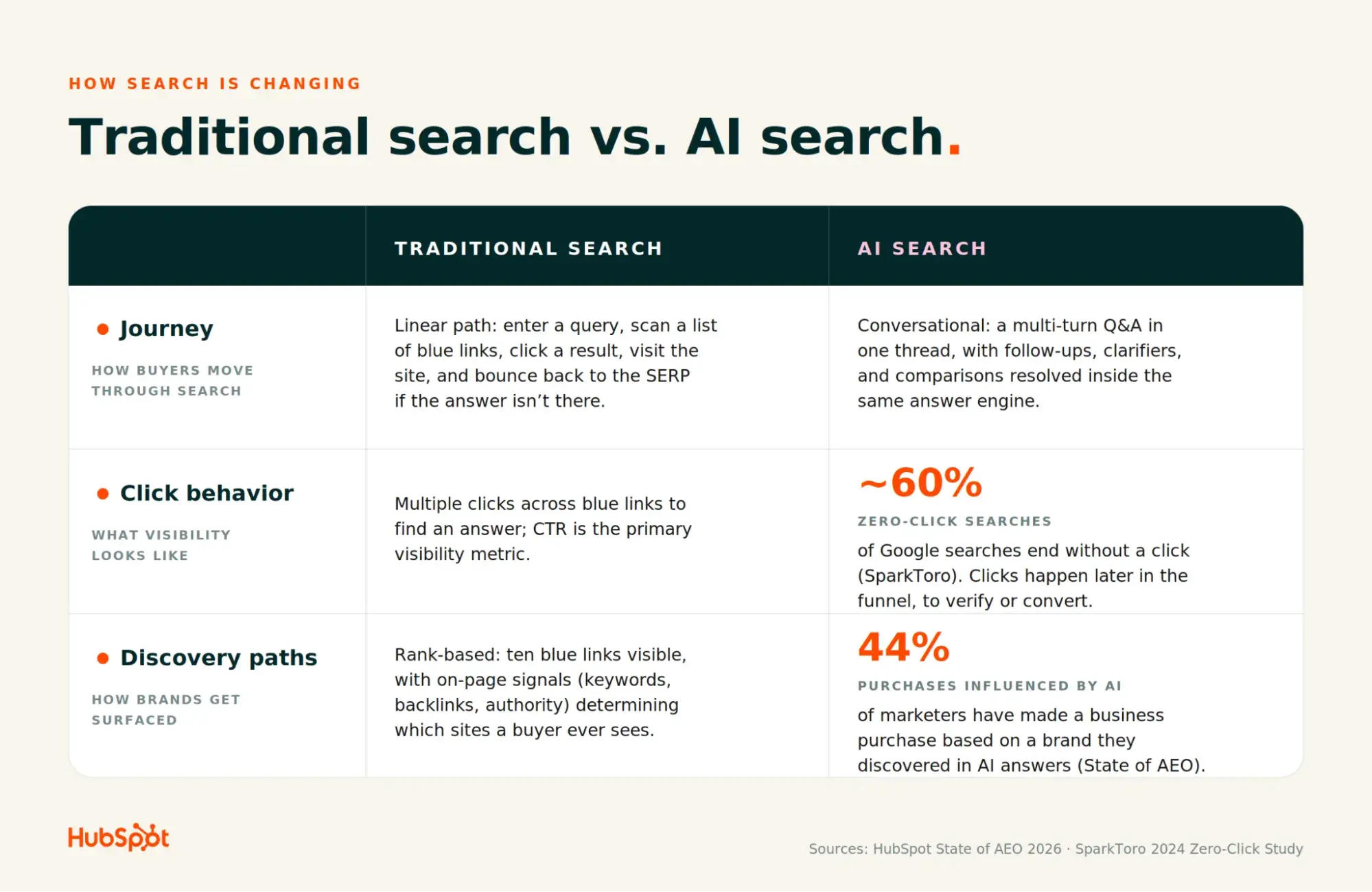
Marketers should care about AI search behavior as it accounts for a growing portion of search. SEO still determines which pages rank in the underlying search index, but Answer Engine Optimization (AEO) determines which sources AI tools cite when writing summaries. Both have to be optimized in parallel and AEO has an increasing influence on whether buyers even see your website listed.
How AI search behavior creates new high-intent discovery paths
Yes, AI search behavior reduces organic traffic, but the good news is that the traffic that comes from AI has higher intent. HubSpot saw 3x better lead conversion from AI sources compared to other channels in 2025. Referral traffic from tools like ChatGPT and Gemini has also tripled, according to data Search engine land.
AI-driven traffic converts better because summary-first experiences answer the simple questions in the answer engine itself. A reader asks, “What is AEO?” no need to click on a single result; They get a definition, sometimes a list of providers, and move on. But a reader who clicks after reading an AI answer to their question “How can a five-person B2B marketing team implement AEO on their blog” has usually moved beyond that superficial level. They’ve validated their issue, seen who was cited, and want to review, compare, or convert.
This change in funnel shape changes the way you measure success. Clicks become a smaller, later signal in a journey that now takes place partly within the response machine. The metrics that capture the rest look different: How often does your brand appear in the summary, which competitors appear alongside you, and which prompts drive the highest intent traffic to your site?
The impact of AI search on brand recognition
AI search behavior has also changed brand discovery. The old canvas was predictable: ten blue links, a few ads at the top, maybe a featured snippet. Being ranked #1 for a category term before AI launches will ensure your brand is reliably presented to shoppers. But AI response engines, chat assistants, and copilots have replaced that canvas, and most of the visible page space now goes to the AI-generated response itself, rather than the links below.
Just look at my recent Google search for “WordPress plugin for Google Analytics.” The AI overview takes up most of the screen above the fold. Even though the site ranks #1 for GA Google Analytics, it ranks ahead of Site Kit in the AI overview – and which page do you think I’m more likely to click on?
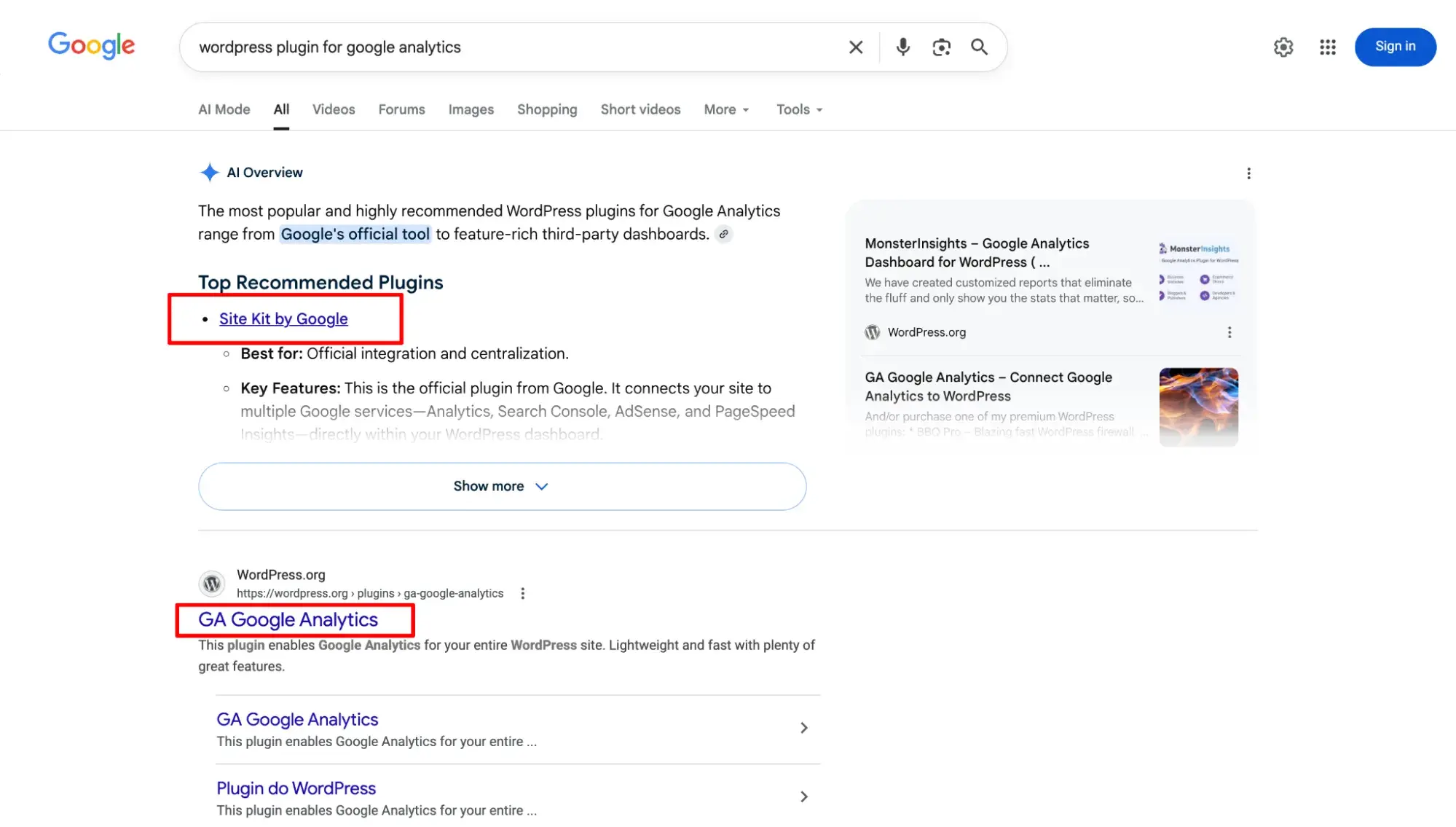
Brands that were previously ranked No. 1 for a category term compete for a smaller share of viewable space, and the AI overview decides itself which sources to cite. According to this, around 60% of Google search queries now end without a click SparkToro. In my opinion, this number will likely continue to rise as more and more queries trigger AI-generated responses.
Brand searches have held up. Buyers who already know your name will still enter it and land on your website. Category term recognition is the area where AI search has been hit the hardest: according to Google, Google provides AI overviews for non-branded searches 1.9 times more often than for branded searches Ahrefs. A query like “What is the best software for video editing?” no longer just provides a list of blue links for evaluation. It returns one or two AI-recommended brands in a highly personalized output, sometimes with a comparison table, and the shopper often responds to that response.
HubSpots Status of AEO 2026 found that 42% of CRM software buyers used AI search to evaluate vendors. Across all assessment activities tracked in the report, AI search was ranked as the strongest predictor of CRM buyer purchase intent. If a response engine names your competitor in this recommendation, the deal is often decided before your sales team knows the buyer exists.
Entity clarity, topic authority and reputation signals now determine which brands appear on search engines. Everyone plays a specific role:
- Clarity of entity determines whether a response engine recognizes your brand as a unique, well-defined option. Without it, it could be difficult for answer search engines to match your brand to the right category, use case, or comparison set.
- Current authority reflects the depth and consistency of coverage across a category. It influences which category questions, comparisons, and use cases your brand can be cited for.
- Reputation signalsOther sources, such as third-party mentions, reviews, comparison sites, news coverage, and Reddit threads, show answer search engines that you are a trustworthy person.
In the old model, signals like links, keywords, and authority gained Blue Link visibility, and reputation grew from there over time. These signals are still important, but with AI search, they are evaluated by a response engine before a prospect ever reaches your website. By the time someone clicks through, they’ve typically weighed multiple options within an AI response – hopefully you too.
How to plan content around AI search behavior
Content planning for AI search behavior starts with prompts instead of keywords, which requires a different approach Content marketing strategy. A buyer using AI rarely asks an isolated question. You start with a question, then ask a follow-up question, then a clarification question, and then a comparison question. To get citations throughout the multi-turn exchange, your content needs to anticipate order and be more comprehensive.
Brainstorm the questions your buyers ask AI.
Question mapping starts with a starting query and tracks subsequent queries. Choose one question to ask your category at the top of the funnel (“What is AEO?”) and then write down the next five questions a buyer would logically ask (“How is AEO different from SEO?” “Do I need an AEO tool?” “What AEO tools do marketers actually use?” “How much does AEO software cost?” “What is the ROI of AEO?”). Your content as a whole must respond to this order.
HubSpot’s topic cluster model organizes the question set into a pillar page and supporting cluster pages: a pillar for the general starting question, cluster pages for each follow-up. This structure gives answer engines a clear entity to cite for the big query and a clear trail of supporting pages for the long-tail follow-ups.
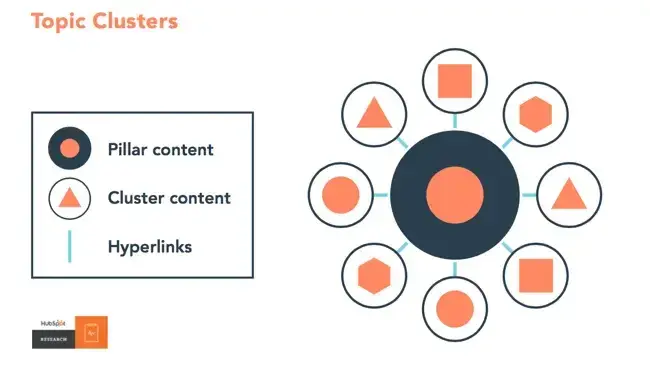
Source: Matt Barby
HubSpot’s Content Hub helps marketing teams organize topic clusters and manage pillar pages directly in their CMS.
Pro tip: Run your initial question yourself through ChatGPT and Perplexity, then track which sources they cite for each follow-up. These are the brands you compete with in the reply engine, and the citation patterns give you insight into what type of content is being mentioned at each step.
Restructure existing content into extractable answers.
A content check shows which pages are already cited and which need to be revised. Rerun the target queries of your top 20 or so landing pages via ChatGPT, Gemini, and Perplexity. Cited pages work. Those who are absent are candidates for restructuring.
Here are some strategies you can apply to your existing content to make it more AEO friendly:
- Ask the answer in advance. The “Lost in the Middle” Stanford Research maps a U-shaped extraction curve: response engines pull most reliably at the opening and closing of a passage, not in the middle. If the direct answer to the target question contains four paragraphs, cut the context setting before it and move the answer to the first sentence of the lead.
- Write self-contained paragraphs. Answer machines retrieve passages, not pages, so each paragraph must make sense as a stand-alone section. Pronoun-led openings (“Therefore…”) or paragraphs that intertwine two ideas end up as broken context when recalled. Rephrase each text so that it begins with its own named topic and covers an idea. As an AEO/SEO expert and founder of iPullRank Mike King sums it up“A passage that focuses on one idea will, in almost every measurable case, be recalled better than a passage that attempts to cover three.”
- Make content manageable with tables and bullet points. Comma-separated lists embedded in prose (“Benefits include speed, accuracy, and cost”) should be bulleted lists. Embedded numerical comparisons should be tables. In Yu et al Preprint March 2026Lists and tables had 43% better extraction accuracy across six engines than the prose versions they replaced.
Learn more about writing for AI search.
Why AI-driven search engines track and how to get started
By tracking AI search metrics, declining traffic becomes a visibility gain that you can show as a leader. The same metrics tell you which momentum your brand is losing, which competitors are gaining, and which content you need to fix first.
AI search visibility can be broken down into three signals worth tracking:
- Quotes Show whether an answer engine has linked to your page as a cited source.
- Brand mentions appear when an answer mentions your brand, even without a link.
- share of the vote measures how often your brand appears compared to competitors when shoppers ask questions about the category.
But traditional analytics tools like Google Analytics weren’t designed to count brand mentions or share of voice. To do this, you can look into AI response engines manually or use a dedicated tool such as: B. get HubSpot AEO to automate AI visibility tracking.
How to check the visibility of your AI search
A basic check begins by running your 10 highest priority prompts across ChatGPT, Gemini, and Perplexity (make sure you’re logged out or using a temporary chat in each case). Track which sources are being cited, whether your brand is appearing, and which competitors are leading on your top topic clusters, brand queries, and category-level questions. Use this baseline to identify gaps between you and your competitors and create a roadmap to optimize content for better AI visibility.
How to track AI search visibility over time
AEO grader is a free tool that gives you a quick overview of where your brand stands on ChatGPT, Perplexity and Gemini, including a share of voice score.
HubSpot AEO monitors your brand visibility across response engines over time, analyzes how competitors appear in your tracked prompts, and prioritizes recommendations to increase your citation rate. Once your baseline is established, it is the continuous tracking level.
How AI model updates impact search optimization
Similar to how Google’s algorithm changes, AI models are updated frequently, and each update changes the way the model weights certain things, resulting in different response patterns and source selections.
For example, when OpenAI introduced GPT-5 in August 2025, the update represented a significant improvement in how ChatGPT answered health-related questions. As OpenAI wrote in its Announcement of GPT-5in terms of health: “The model now also provides more precise and reliable answers, adapting to the user’s context, knowledge level and geography, enabling safer and more helpful answers in a variety of scenarios.”
To keep up with the changes and ensure your content continues to be optimized for the latest models, you can follow release notes at OpenAI, Anthropocene, GoogleAnd confusion.
I also recommend a consistent review cadence:
- Monthly: Re-run your core prompt set for ChatGPT, Gemini and Perplexity. Compare the number of citations and brand mentions to your baseline. Highlight any prompt where your presence noticeably shifted in one direction or the other.
- Quarterly: Check the pages whose citation share has been lost. Verify that the content format, schema, or entity definitions still match the current structuring of responses on each platform.
- Important model announcements: Perform an immediate retest for your five highest priority prompts. OpenAI, Google, and Perplexity all release release notes – a public model update is a signal to consider before you see the impact in your tracking data.
Pro tip: HubSpot AEO Tracks brand visibility across response engines over time, making monitoring AEO efforts significantly less burdensome.
Between review cycles, here are the four content-side items most worth maintaining:
- Entities: Make sure your brand, product names, and key people are consistently defined on your website, about page, and third-party profiles like LinkedIn, Crunchbase, and G2. Inconsistent naming can confuse a response engine.
- Scheme: Make sure relevant schema markups such as articles, FAQ page, and organization are present and usable without errors Google’s rich results test And The Schema.org validator.
- Internal links: Check that pillar pages and cluster pages are still pointing to each other and that no links have been broken due to URL changes or content migrations.
- Answer summaries: Reread the body paragraph of each high priority page. AI models can more reliably extract the beginning and end of a long context the “Lost in the Middle” researchso that a lead that no longer opens with a direct response to the page’s target query represents a quick solution.
What AI search behavior means for sales and service
How AI search behavior is changing sales conversations
AI search behavior compresses the sales cycle before reps ever pick up the phone. Prospects now arrive on initial calls having already read AI summaries comparing your category, competitors and pricing.
For AI-informed buyers, timing and messaging must evolve. General discovery questions like “What is your current stack?” or “What are your pain points?” often fall flat with a prospect who has already discussed these details with a chatbot. Sales reps who delve into the specific competitors and trade-offs that AI has identified for each buyer category can skip the superficial questions that end up being redundant.
But sales reps need tools to understand what AI says about their brand. AEO in the Marketing Hub brings to light prompts and quotes that shape these conversations and makes these signals visible to sales and marketing teams.
How AI search behavior changes service content
Service content is great source material for response engines. Knowledge base articles and Help Center documentation feed the same response engines that buyers use during evaluation. A well-structured support article on “How do I export X from your tool?” is exactly the type of extractable content models in question format that are most popular to cite. Service teams that optimize their documents for clarity also optimize AI visibility by extension.
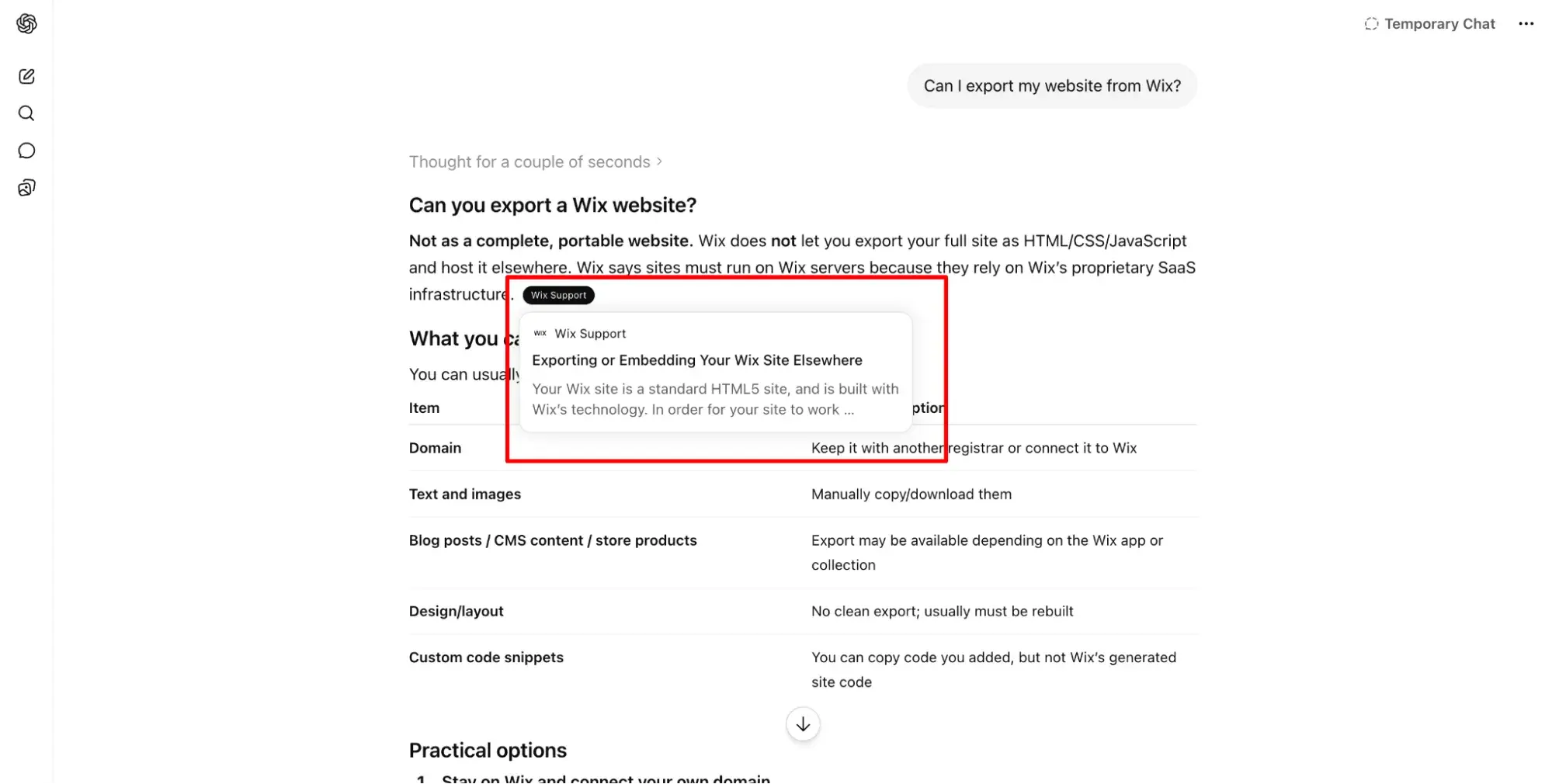
Here’s a real-life example: I asked ChatGPT, “Can I export my website from Wix?” (a frequently asked buyer review question), and the answer cites an article in the Wix Help Center.
How sales and service teams inform AEO content
Feedback loops between sales, service and marketing transform buyer language into source content for the response engine. Sales and service teams hear the real questions buyers and customers are asking before those questions show up in keyword tools. A shared document, Slack channel, or quarterly review forwards this language to the people creating content for AI search.
An AEO playbook you can execute today
This AEO playbook covers four phases of adapting to AI search behavior: mapping buyer questions, creating extractable answers, applying technical signals, and iterating on tracked data.
Step 1: Discover the questions your customers ask AI.
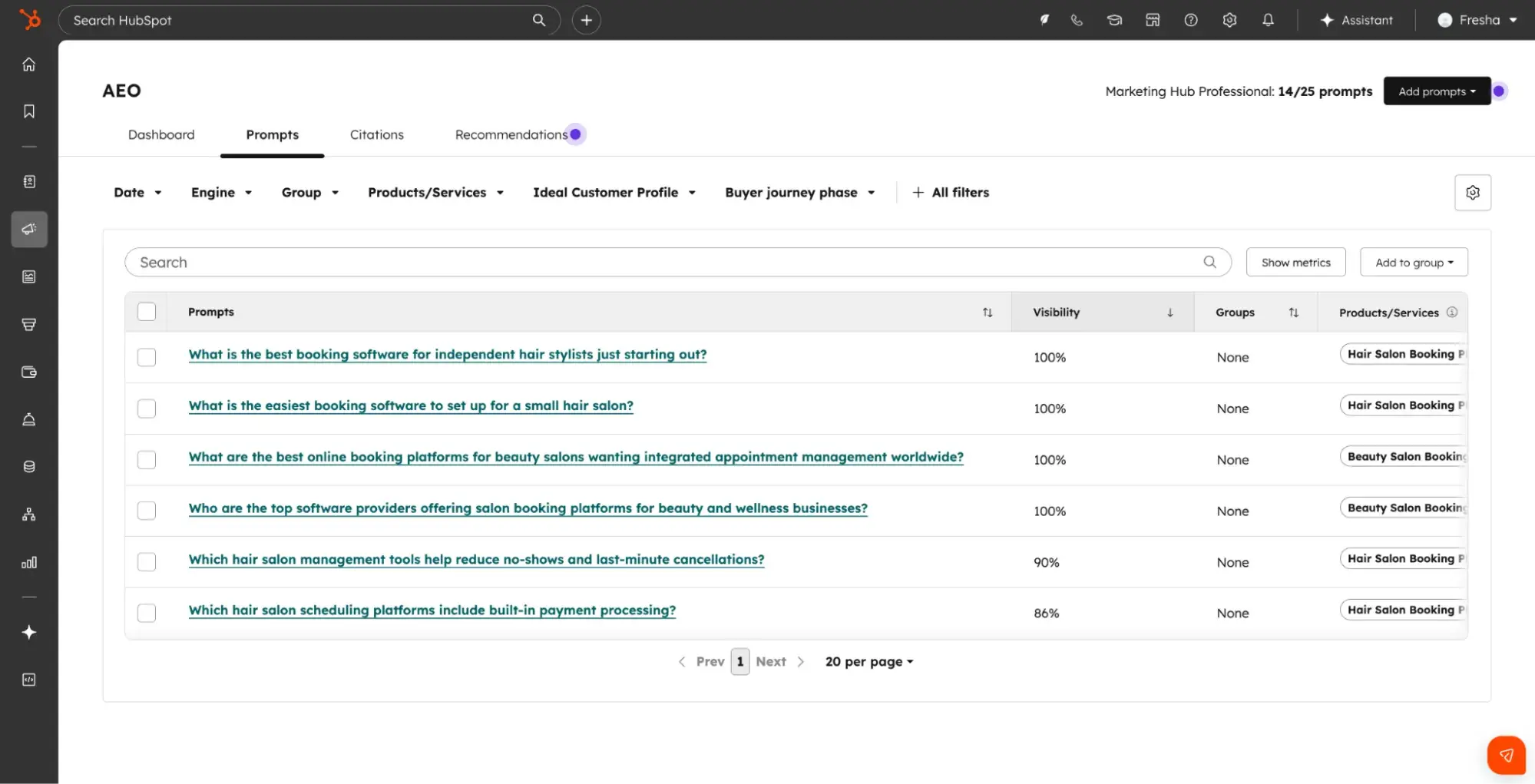
Recognizing the demands AI prospects have about your brand is at the core of the rest of this playbook. You can ask questions by prompting response engines with your category’s seed queries, noting the follow-up queries the AI generates in response, and asking your sales team what they actually hear during calls.
Marketers serious about optimizing AI search behavior will benefit from using a dedicated AEO tool for quick detection and tracking. Subscribers to Marketing Hub Professional or Enterprise plans have an advantage because they have access to it AEOthat can suggest prompts based on the business context within the CRM.
Step 2: Create extractive responses and entities.
Now take the questions you identified in step one and create new content (or optimize existing content) to answer them. Structure each page to answer the main question in the introduction, then reinforce the brand unity behind it. AI response engines prefer content that solves the query immediately and clearly identifies the source as Preprint March 2026 by Junwei Yu et al. showed that structural changes—heading hierarchy, paragraph splitting, and visual highlighting—can increase citation rates by double digits in the six engines they tested.
- Opener with direct answer Answer the target question in the first sentence of each paragraph. Anything else is a preamble that pushes the answer deeper than it needs to be.
- Formats for questions and answers, definitions and decision-making aids Cleanly map the answer forms to the answer forms that answer machines reuse when writing summaries.
- Brand entity consistency Across your domain, your LinkedIn company page, your Crunchbase profile, and your rating lists (G2, Capterra), you will be recognized by answer engines when writing answers.
Step 3: Apply schema markup and internal links.
Schema markup and internal linking provide response engines with structural clues that help them interpret pages and rank source quality.
HubSpot’s AEO booth 2026 found that pages with FAQ sections are more likely to be cited in AI overviews and that FAQ sections paired with schema markup correlate with higher citation rates in Gemini, Google AI Mode, and Perplexity. The combination that performed best in the data set: a descriptive H2 such as “Frequently asked questions about (topic),” with each question below it formatted as an H3. General “FAQ” headings produced weaker results.
The heading structure carries its own citation signal in the same data set. Keyword-rich H1s correlate with more citations. Including the year in H1 and meta titles helps, and more headings overall – especially H3 and H4 headings – lead to higher citation rates. The sweet spot is sites with 7 to 15 H2s.
Adding schema to optimize web pages is a controversial topic in AEO. “It’s not a bad idea, but it won’t move things that much,” says the AEO strategist Kaleigh Moorewho prefers to focus on off-site signals on platforms like LinkedIn and YouTube. “Third-party sources like this that really go into depth are really great for getting citations,” she adds.
Elie BerrebyHead of SEO and AI search Adoramatakes a different view of schema markup. “I would 100% recommend using it,” he told me, “but not the way most people use structured data – in an intelligent way, connecting the different entities together.” The value of schema, in Berreby’s view, is to create the knowledge graphs that help answer machines map entity relationships. Even if the schema is inserted via JavaScript (which many AI crawlers cannot render), Googlebot can still process it, which has downstream implications. “If you have well-structured data and this leads to a more comprehensive search result, it now feeds the AI scraper, which then feeds the AI-generated answer,” explains Berreby. “It’s an indirect mechanism.”
My opinion: Implement a schema, but don’t expect it to be the only lever that gets you citations. The data on the status of the AEO 2026 is correlative and the increase in citations is only reliably displayed in combination with a well-structured FAQ section.
Finally, don’t forget about internal links. They reinforce topic authority and pass ranking signals between related pages.
Step 4: Publish, monitor and iterate.
After publishing content, make changes based on the data. Keep a spreadsheet or create a dashboard to track quote shifts, missed prompts, and competitor wins and review them weekly to monthly. You should log the following:
- Basic snapshots Capture where your brand stands at the time of publication. Without it, a later movement cannot be interpreted.
- Loss logs Understand which prompts your brand no longer appears in and which competitor has replaced you, and uncover the patterns worth fixing first.
- Win logs Track which new prompts your brand appeared in after the changes and help you reverse engineer what worked.
AEO grader generates the base snapshot in a few minutes; HubSpot AEO handles ongoing tracking, competitive monitoring, and prompt-level reporting, allowing you to iterate without manual prompting.
Frequently asked questions about AI search behavior
How do I measure AI visibility without relying on clicks?
AI visibility measurement tracks two metrics invisible to GA4 and Search Console: brand mentions (answers that name your brand without a link) and share of voice (how often your brand appears in category questions compared to competitors). You can manually enter your highest priority prompts into ChatGPT, Gemini, and Perplexity at a fixed cadence and log which sources are cited. But HubSpot AEO Automatically tracks prompts and monitors changes in these signals over time.
How often should we update AI-optimized content?
If you notice a sharp decline in citations in your AEO software, update the top performing pages. Otherwise, AI-optimized content requires monthly visibility retesting, quarterly content retesting, and immediate retesting after each major model release. Models are updated so frequently that it can have a significant impact on your most important content (OpenAI, Anthropic, Google, and Perplexity all release release notes worth watching).
How can we increase our chances of getting cited by LLMs?
Citation likelihood in the LLM increases through four content disciplines: answer-first writing, analyzable structure, entity consistency, and topic authority. The Yu et al. The study found that structural rewrites alone – without changing the meaning of the content – increased citation rates by an average of 17.3% across six engines
Here are four changes worth making to your content to increase LLM citations:
- Content where the answer is first It begins with the direct answer to the query in the first paragraph and then supports it with clear definitions, original data, expert quotes, examples and current sources. Stanford Research shows that language models are most attracted to the beginning of a passage, which is why a buried answer may not merit a citation.
- Parsable structure uses descriptive H2s and H3s, concise summaries, comparison tables, and FAQ-style sections where appropriate, paired with valid article, organizational, product, or FAQ page schemas. Structured formats such as lists and tables outperformed prose in terms of extraction accuracy in Yu et al. by 43%. Cross-engine testing.
- Entity consistency means ensuring that the same brand, product, author and leadership names are used on your and other websites. This may include your About page, author bios, LinkedIn, Crunchbase, G2, and other trusted third-party profiles.
- Current authority is built on internally linked content clusters and an update cadence that updates high-priority pages when facts, products, prices, rankings or model behavior change.
Do we need to change link building for response engines?
No, you don’t need to change response engine link building, but you do need to understand why it’s still important to AEO. Backlinks help with SEO, and since response engines use search indexes, they are important for AEO too. However, what is different about AEO is this not linked Brand mentions influence AI responses: YouTube videos, Reddit threads, comparison summaries, and third-party reviews. Therefore, diversifying the formats and platforms on which reply engines cite is actually more important than just looking for link numbers.
How can teams best align with these changes?
Sales, service, and marketing teams can adapt to changes in AI search behavior by creating a common dashboard and feedback loop. Sales reps hear the AI-powered objections that shape early conversations and service teams see which questions land in chat first – both signals belong in the marketing content team’s roadmap. HubSpot AEO Displays citation and competition data in one workspace, making it easier to link AI search signals to the questions sales and service heard this month.